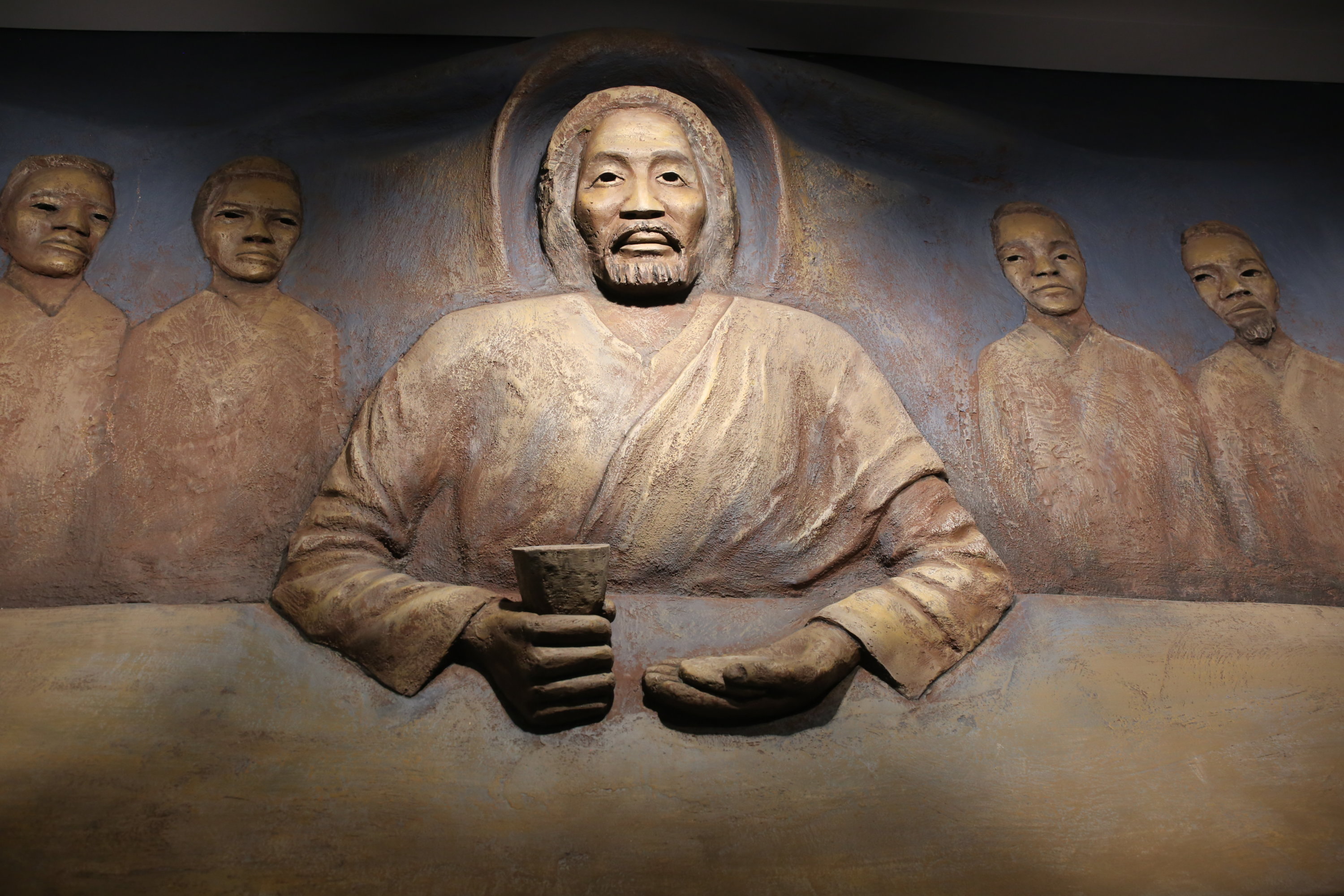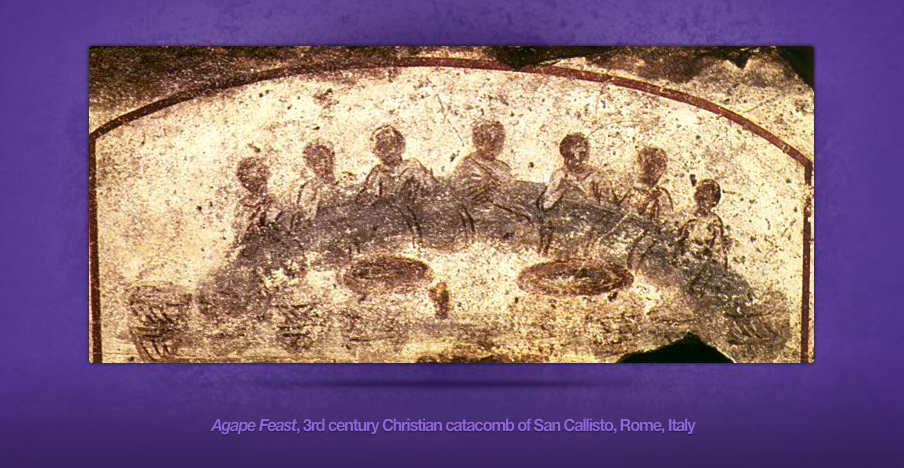
Restoring the Vanishing Anaphora

During the week, I often sample the previous Sunday’s streamed services from different UCC congregations. It’s mostly because I like sermons, and I want to be edified. I’ve never heard one that didn’t give me something to take seriously. Thank you, preachers.

Every now and then I’ll catch a video from a Communion Sunday. Most are UCC Communion services from New England congregations, but I skip around the country, too; and in roughly 2/3 of the services I’ve seen, I have been surprised by the fact that the Communion liturgy includes no anaphora, or “great thanksgiving.” 

Which I find curious, and a little disturbing, since the original name of Communion is eucharistia, and you know what that means. 

The “no thanks” services I’ve been watching all begin more or less the same way: First, there’s an inclusive (and often effusive) invitation explaining who’s welcome at the Table, why we should all feel free to come, whose Table it is and isn’t, and the like. 

Sometimes that welcome is preceded by a confession, and sometimes (very few instances) it’s followed by a brief prayer of thanks for the gift of having been invited to the Table. 

But most of the liturgies I observed move directly from the inclusive welcome to the narrative of the Last Supper; that is, to the so-called “words of institution.” 

The words of institution are sometimes followed by a prayer asking the Holy Spirit to bless the gifts and the people, although in most of the services I witnessed, this ancient (and I think, crucial) invocation, or epiclesis, is also omitted. 

Then there’s another welcome, this time to come and receive the elements, which also includes a recitation of safety features (grape juice, gluten-free bread) and reception logistics. 

Finally, after everyone has received, the liturgy concludes with a brief unison prayer of thanks for having shared the gift of Communion.

If that’s your liturgy, more or less, I’d urge you to consider the following:

At the Last Supper, Jesus gave thanks, and chances are good that the thanks he and his friends offered was a recitation of “the mighty deeds of God,” in good Jewish fashion. “You brought us out of Egypt, you led us through the wilderness, etc.” 

If we believe that Communion carries, or ought to carry, the deep resonances of a meal with Jesus, then the liturgy of Communion ought to include a great thanksgiving. But not simply or solely because he did it, since we’re not obliged to replicate to a T everything he did that night. (As I have written elsewhere, not every Eucharist must refer to the Last Supper.)

No, we ought to give thanks– i. e. restore the anaphora to the eucharistic liturgy– because what Jesus did in giving thanks that night was just. Eucharistic thanksgiving is an ethical act. Not to give thanks at the Table weakens the ethical wallop of the sacrament. 

Why?

Communion is not a holy private act set apart from the world. It’s an enactment of God’s new reality in the world. Each element of the liturgy is public witness. For example:

Gathering, or assembling at the Table, witnesses to the communion/unity that God intends for creation and is a counter to the scattering and dividing the powers of this world thrive on. 

Remembering is the way the church makes visible what the Regime erases, the real presence of the Victim, and with him every victim of the world’s powers with whom he is absolutely identified (Matt 25). We refuse to forget.

Blessing bread and grape witnesses to the holiness of the earth’s gifts and the dignity of the labor that elaborates them for human use.

Feeding each other offers a witness to God’s intention that everyone should eat, and a counter-witness to the Empire’s lie that for some to have more than they need, others must has less–or nothing at all.

The anaphora, the prayer of thanks and praise that traditionally precedes the words of institution and is inclusive of them, is also a witness: it makes an emphatic claim about the true source of life and all good, and therefore also about human solidarity and mutual dependence. 

As such, the prayer of great thanksgiving is a rotund rebuke of the atomizing lie the Regime thrives on– that you don’t owe anyone anything, you are your own source, self-made, self-contained, self-reliant. 

This authoritarian credo is individualistic, distancing, divisive, and designed to gin up anxiety and hostility towards any neighbor who, for the sake of the common good, might lay claim to what you alone earned and what belongs therefore only to you to dispose of as you choose. 

This false narrative about the absolute autonomous character of human beings shapes a personal and public ethos in which any acknowledgment of dependence or indebtedness is a character flaw, even a failure of citizenship. Like empathy, being thankful is regarded as a weakness and an embarrassment in public discourse and social life. 

Unless, of course, the Regime wants something, which, being insatiable, it always does. Then gratitude becomes useful as a transactional instrument, a pressure tactic, and a threat, as when Trump and Vance bludgeoned Zelensky in the Oval Office because he wasn’t sufficiently grateful for American lip service to the defense of Ukraine. 

In authoritarian regimes, the only permissible expression of gratitude is gushing thanks and praise for the unmatched excellence and beaming benevolence of the Dear Leader, the source of all good. (Think fawning cabinet meetings.) 

The purpose and effect of this kind of gratitude is to cement unequal relationships. The debtor is always in debt. It’s enslavement, a control mechanism, the price you pay for breathing. The eucharistic anaphora offers a counter-credo, enacting a different world in which human beings give thanks together. 

Eucharistic gratitude opens a space for relationships of mutual grace and generosity where one day I may be in your debt, another day you may be in mine, we’re all always in God’s, God exacts nothing in return for divine benevolence, and there’s never a score to settle between us. 

Communion’s thanksgiving materializes this new world at our Tables by naming the source of all good and proclaiming the holy character of our indebtedness to God’s love and interdependence with one another; and it does so communally, publicly, persistently, routinely, perseveringly — and defiantly. 

And that’s why I think the anaphora is critical and indispensable to the Communion liturgy, maybe its most important feature. 

In traditional prayer book liturgies, the anaphora begins with this dialogue, familiar to many of us:

The Lord be with you.

And also with you.

Lift up your hearts.

We lift them up to the Lord.

Let us give thanks to the Lord our God.

It is right to give God thanks and praise.

This dialogue introduces a prayer that enumerates our motives for thanks, a catalog of God’s saving deeds throughout history that we speak back to God. And it frames our gratitude explicitly in justice terms: “It is truly right and just to thank you, God of all creation…” 

Why is it just?

Because thanksgiving tells the truth: We’re not self-made, not self-sufficient, not independent of others. We receive and rely on benefits we didn’t generate or earn. When we give thanks, we recognize our finitude, our dependency, our creaturehood, our indebtedness.

Thus, thanksgiving is also an exercise in vulnerability. The thankful Body of Christ at the Table is a Body pierced with holy trembling in the face of life’s fragile beauty. To be grateful is to be in awe of our breath and driven to our knees before the One who grants it. Only creatures do this. Masters of the Universe do not. You never find a tyrant on his knees. 

When the Empire claims to be the source of all good (“I alone can fix it”), the eucharistic anaphora rebukes it with a robust statement creed as ancient as the Sh’ma, “There is one God only, from whom all blessings flow. Let us count the ways…” 

When the Regime exalts mastery and self-sufficiency, the Great Thanksgiving testifies to and enacts human creaturehood, with its life-giving patterns of dependence and interdependence.  

When the powers tell a story of invincibility, of making everything great again, Eucharistic thanksgiving remembers and tells the story of life hanging by a thread, perpetually in doubt except for the unmerited grace and mighty saving deeds of a loving God, with whom we are in covenant. 

As we remember and give thanks at the Table with Jesus, we become a Body that enacts this “real” reality — gracious, interdependent, creaturely, and irreducibly social. And so it is truly right and just to give God thanks and praise.

Now, this eucharistic anaphora is not simply a laundry list of all the things we’re generally grateful to God for. As I said, it’s a catalog of “God’s mighty deeds,” a particular and identity-conferring story that the whole community (i. e., the entire communion of saints) recites to God in the direct address of prayer. 

The traditional anaphora pages through the chapters of faith’s revolutionary story, and the community that has been the object of God’s vast and generous affection declares: “It is truly right and just to give you thanks and praise, for you created us, you redeemed us, you led and upheld us, fed and watered us, deposed oppressors for us, sent prophets and dreamers to us, and in the fullness of time sent a savior to heal and redeem us…”

This Great Thanksgiving is corporate, it rises from communal memory, and it is part and parcel of the church’s stubborn refusal to forget in the face of the erasure tactics of the Regime. 

By remembering God’s mighty deeds so that we can thank and praise God’s glory rightly, we raise something to visibility that the Regime wants disappeared: namely, all the times and ways that God has worked and still works to liberate and love the people, especially the poor, oppressed, and slaughtered, in the midst of a world that seeks glory in vastly different kinds of deeds: brutal subjugation of the other, acquisition of obscene wealth, relentless waging of war, raw exercise of power, and an offhand, almost whimsical exercise of cruelty. 

In giving thanks to God, we serve notice to the Regime that we will not enable it with any of the deadly forms of misplaced gratitude it requires in order to rampage on. We declare that the God who did great things long ago can and will do them again –and is doing them even now — casting the mighty from their thrones, raising the lowly, defending the vulnerable, dignifying the poor. The eucharistic anaphora is a public exercise of defiant trust in God’s present compassionate sovereignty and defiant confidence in God’s inbreaking future.

Eucharistic thanksgiving is also a counter-liturgy to modern western culture’s dissatisfaction machine: My life isn’t complete until I have… you name it. 

This sense that turns things we want into things we need into things we deserve into things I must protect–against you — generates distrust, broken relationships, ruthless competition, war, hunger, poverty, gross economic inequality, and the degradation of the natural world. A staggering amount of injustice arises from this place of perpetual dissatisfaction. In contrast, Communion’s prayer of thanksgiving affirms a fundamental satisfaction that there is enough, and enough for all. 

Even as we affirm this truth, however, we know that millions u[on millions of our neighbors remain in real want, and so our enacting of our fundamental satisfaction with God becomes also a confession. In turn, our sincere and truthful confession becomes a decision for our neighbors. Thanksgiving is thus the engine of community. It creates social solidarity. And it frees the imagination to consider new political, economic, and social possibilities on every scale, intimate to global. 

In the current political situation, the authoritarians have been especially successful at manufacturing and manipulating a particular form of dissatisfaction — grievance. Take, for example, the myth of our nation’s glory days now usurped by foreign invaders and domestic enemies of the people: “What’s ours is being taken from us–privilege, dominance, whiteness, jobs manhood, womanhood, religion, country. It’s unjust and evil. It’s our duty to hate it, mobilize, arm ourselves, wrest back from ‘them’ what belongs exclusively to us.” 

Eucharistic thanksgiving is a radical rejoinder to grievance, real or imagined; but it doesn’t waste time arguing on grievance’s affronted terms about whether any particular complaint is justified. It simply gives thanks; it simply embodies and enacts a gracious reality; and thus it emphatically denies the very premise of grievance itself. The public witness of Eucharistic thanksgiving resets the old transactional equation in new terms of gracious, awestruck satisfaction.

Now, if all this is true, why would a progressive Communion liturgy deliberately downplay, lessen, or cut the anaphora?  It can’t be because our communities are ungrateful. Of course we’re not. It may more likely be because we’ve just never given it much thought. I also suspect that it may be to save time. No one wants the kids to get antsy or the grownups to start fidgeting with their phones. So, we look for ways to cut to the chase. The chase we usually cut to is the institution narrative. 

We go directly there because many of us regard the words of institution as the heart of the Eucharist, the thing that makes it what it is, it’s what we came for. Those words are so ingrained in us as something essential that we think Communion isn’t valid unless we say them.

I don’t believe that’s the case. I believe we can even dispense with them from time to time. But this isn’t the place to argue that position. For now, I want only to put the words of institution, if we use them, in their proper place, which is not as a stand-alone special moment that “as long as we have them, we have Communion,” but as an integral part of the Great Thanksgiving. 

The so-called words of institution enshrine a tradition of what Jesus said and did at the Last Supper. But we were never meant to “pronounce them over the elements” as if by doing so something happens, a “something” that stands alone and apart from the rest of the Communion liturgy, or that constitutes the Communion liturgy itself.

The words of institution are part of a longer narrative, a culmination in the catalog of all the saving deeds we remember and give thanks to God for at the Table. Among all those gifts, we remember the self-gift of Jesus on that night with special thanks. The words we say about “that night” belong within, not apart from, the longer narrative of gratitude we recite in the direct address of prayer to God. 

And in traditional liturgies that’s where you’ll find them, embedded in the Great Thanksgiving that goes something like this:

“It is right and just to give you thanks, O God, for you did this for us, and you gave that to us, and this, and that, and so we praise you–holy, holy, holy, Lord God of power and might, hosanna in the highest–AND we thank you because in the fullness of time you sent Jesus, who on the night he was betrayed took bread…. Therefore, we ask you to bless and sanctify these gifts… “

If the narrative of that last night is not addressed to God as a prayer of thanks, if we separate it out from the larger narrative of God’s mighty deeds, if we regard the words as lending special sacredness or validity to our sharing at the table, or if, as seems to be happening more frequently, we reduce the entire Communion liturgy to those “special” words (with their accompanying dramatic actions of breaking and pouring–don’t get me started), they inevitably become exactly what Protestants claim they’re not: a holy, immutable, untouchable sacred formula, even a kind of incantation, hot to the touch words you must carefully recite, words you expect will make something (what?) happen

(Dearly beloved, don’t go there: for this we fought a Reformation…)

So —

If your Eucharistic liturgy doesn’t feature a robust thanksgiving prayer preceding and incorporating the so-called words of institution, add it for justice’s sake. It doesn’t have to be long and involved. it just needs to give God communal thanks and thereby bear witness to the truth. 

If your liturgy has only passing words of thanks, or if they are offered only for being welcomed to the Table (necessary but not sufficient), beef them up. Thanksgiving is why we’re at the Table. Our public testimony should not be, “Oh by the way, thanks.”   

And if your service does include a robust anaphora, check to see if the institution narrative reads like a prayer of thanks or if it’s still treated like a set apart formula, a special sacred moment. Revise accordingly.

There’s a lot at stake. We need our Eucharists to be authentically eucharistic if they are to do the justice Communion intends to do.

Let us give thanks to the Lord our God.

It is right and justr to give God thanks and praise!

Yes, it is.

A Hymn to Christ in A Time of Trial 

We Will Be Brave

LM

Tunes: AGINCOURT HYMN (“O Love How Deep…”)

Alternate Tunes: ST LUKE, DISTRESS, BRYNTEG


1.
We will be brave for you were brave. 

We’ll risk it all because of you. 

And when they threaten cross and grave?

You went there first, and we will, too.

2.
We will be strong for you were strong.

We’ll disobey because of you.

And when they say, “Just go along”? 

You stood your ground, and we will, too.

3.
We will be bold for you were bold.

We’ll tell the truth because of you.

And when they try to still our souls?

The stones will shout, and we will, too.

4.
We will endure for you endured. 

We’ll carry on because of you.

And when they think our end is sure?  

You rose from death, and we will, too. 

5.
No one alone can ever be

enduring, strong, courageous, true.

But grant us, Christ, your company,

and we shall overcome like you. 

Say Mass

Akili Ron Anderson


“When in doubt, say Mass.”  So said a wry old Catholic priest to me many years ago at a hastily arranged Eucharist after some national horror I can’t even recall.

He was referring to the Catholic tendency to slap a Mass on every occasion. If something noteworthy happened, joyous or devastating, local or global, Mass was the way you marked it. The Eucharistic liturgy was the vessel that held what needed holding, the grounding and clarifying act by which the community steadied and oriented itself.

“When in doubt…” It was a cheeky quip, but the priest who said it wasn’t being entirely facetious. If nothing else, a reflexive recourse to the liturgy is a way of persisting, the kind of repetitive showing up that’s easily dismissed as rote, but is rather (potentially, anyway) a training in perseverance. And God knows that showing up, persevering, is no mean thing in the face of evil’s demonstrated determination not to go away easily or any time soon. “Saying Mass” at every turn was a way of declaring “We’re not going away either.”

But even more, “Saying Mass” was testimony. Every time the church sat down at the Table, it engaged in a public counter-liturgy (in William Kavanaugh’s words) to all the liturgies of doubt, anger, upheaval, fear, cruelty, violence, and injustice celebrated daily by the world’s powers.

As such, “saying Mass” when in doubt, or in any other human circumstance, was not merely a way to strengthen, ground, steady, and orient the community; it was justice-doing itself. Taken together, the various movements of the Communion liturgy are a defiant refusal to accept the world’s claim to be “real” and an assertion that the real “real world” shows up, a real presence, in all the just things we say and do at the Table:

We gather, we don’t divide.

We welcome and bless, we don’t condemn, exclude, or curse.

We attend to a true Word, not a false narrative.

We give thanks, we don’t claim and assert self-authorship.

We share equally in the earth’s gifts of food, we don’t grasp and hoard.

We honor bodies and recognize their labor, we don’t exploit.

We distribute food to all, we don’t withhold it from some.

We welcome a real presence, not create a real absence.

We do not erase and falsify, we remember, we remember. We refuse to forget.

In Anglican theologian Kenneth Leech’s words, the Communion liturgy is “the weekly meeting of rebels against a Mammon-worshiping world order…, a freak event in a world where bread and wine are hoarded, not offered; concentrated, not divided; unequally distributed, not commonly shared.”” And we could add:

Because Communion is freely available to all, and all are fed according to their need, Communion enacts a counter-politics to the politics that says hunger is necessary. It’s an economic confrontation with the entrenched assumption that for some to have, others must not.

Because Communion is sheer gift, it enacts a non-shaming reality in a world where the powers decide who is worthy to eat.

Because Communion makes one Body, we are each other’s flesh. Communion enacts a new social space wherein bodies are sacred, of infinite worth, not dispensable on a whim.  

And in our current context of reprisal and revenge, of getting even as a way of life and as a way of governing, Communion enacts mercy, for the Body it makes is the body of the Victim who returned to those who disappeared him without a word of retribution on his lips. And with him, every disappeared victim, all the marginalized, poor, and oppressed, also materialize, for he is eternally and absolutely identified with them: “Whatever you do to the least, you do to me.” And we see them.

We shouldn’t politicize the sacraments. But the Eucharist is already politics just by being bread. And just by refusing to forget. And just by materializing disappeared victims. And just by being open to all. And just by hallowing created things. And just by being a feast of persevering and resilient joy. And just by being a communion, a new and just human polity, a new social order that denies the very premises on which the old order runs.

And because it recognizes no legitimacy whatsoever in that system, the Communion liturgy is provocative and dangerous. If, as Paul contends in 1 Corinthians, Communion wrongly practiced can make you sick, rightly practiced it can get you killed. (Ask Oscar Romero about that.)

In the progressive circles I run in, we don’t have much of a liturgical reflex. Only rarely do pastors and people go first to the Table and then to the march or set a table in the streets “in the sight of our foes…”

Only rarely is the Eucharist taught and celebrated in our congregations as the church’s most fundamental and effective source of transformation for communal witness and justice-doing.

Much less have we cultivated in the faithful a strong sensibility that it is through this ritual activity that the world we are fighting for “out there” materializes every time we gather “in here,” and we can touch and taste it and lend ourselves to its transforming grace.

And it can transform us. By faithful Eucharistic engagement over time, we can become one Communionized Body, enacting in the world the justice we embody at the Table.

We should “say Mass” more often. Yes?

——-

For Holy Communion as Testimony, Justice-Witness

When We Assemble

LM

Words: Mary Luti

Tunes: ACH BLEIB BEI UNS (Lord Jesus Christ, with Us Abide), HERR JESU CHRIST DICH ZU UNS WEND (Lord Jesus Christ, Be Present Now)

*
When we assemble, we say no

to pow’rs that scatter and divide.

To gather is the way we show

that none of us belongs outside.

*

When we say thank you, we say no

to pow’rs that tell us we’re our own.

Our grateful praise is how we show

we owe our lives to God alone.

*

When we remember, we say no

to pow’rs that lie to leave no trace.

Refusing to forget, we show

their victims cannot be erased.

*

When we are sharing, we say no

to pow’rs that take and hoard and keep. 

To feed each other is to show

that everyone deserves to eat.

*

When we assemble, break the bread,

remember bravely, share, and bless,

we say the nos that Jesus said;

and then to Love we say our yes.

——-

For more on Communion and Justice, see UCC Stillspeaking Writers Group, “Do This: Communion for Just and Courageous Living,” available from the Pilgrim Press.

O Who Are We?

The Divine became human so that human beings might become divine.” — Athanasius the Great

“Thus God has given us precious and very great promises, so that through them you may become partakers of the divine nature.”–  2 Peter 1:4

For Christmas

Tune: CANDLER (YE BANKES AND BRAES)

1

O who are we to hear the song,

the dazzling news awaited long,

that in a little town forlorn

eternal Mercy has been born?

O who are we? Your flesh and bone!

We’re siblings, Child, your very own.

We’re one with you in breath and birth,

the life of God upon the earth.

2

O who are we to hurry there,

to meet the Hope that mends despair, 

entrusting to your gleaming star 

our wildest dreams and all we are?

O who are we? Your flesh and bone!

We’re siblings, Child, your very own.

We’re one with you in breath and birth,

the life of God upon the earth.

3

O who are we to bend and gaze,

and lose ourselves in thanks and praise

that trampled hearts now have a chance

to sing again, to laugh and dance?

O who are we? Your flesh and bone!

We’re siblings, Child, your very own.

We’re one with you in breath and birth,

the life of God upon the earth.

4

O who are we to have a part

in God’s own life, in God’s own heart,

and know that when God looks at you,

forevermore God sees us, too?

O who are we? Your flesh and bone!

We’re siblings, Child, your very own.

We’re one with you in breath and birth,

the life of God upon the earth.

Good Joseph Makes a Cradle

7.6.7.6.D

Tunes: MERLE’S TUNE, MERIONYDD, SALLEY GARDENS

Good Joseph makes a cradle, 

young Mary plots the way, 

while patiently the donkey

is nibbling on the hay.

Good Joseph prays for safety, 

young Mary loads their things,

while messengers in heaven

are warming up their wings.

*

Good Joseph sweeps a corner,

young Mary tamps the earth,

while up from town the midwife

is hast’ning to the birth.

Good Joseph holds the lantern, 

young Mary labors strong,

while far off sheep and shepherds 

begin to hear a song.

*

Good Joseph rocks the baby,

young Mary starts to sing, 

while cats draped in the rafters 

are watching everything. 

Good Joseph greets the neighbors,

young Mary shows her son,

while women with their baskets

start feeding everyone.

*

The lords of earth are lording,

the tyrants wield their power; 

the rich and sleek are preening, 

the haughty have their hour,

while always and forever,

around, below, above,

our God is busy finding 

the little things to love.

This Dreaming Child

8.8.8.8.

Tune: DE TAR (Calvin Hampton),* BOURBON, DISTRESS

__

This dreaming Child sleeps unaware,

still unacquainted with despair;

he nothing knows of desperate prayer

unheard in heaven, no one there.

__

When he awakes and as he grows, 

he’ll learn what all the sad world knows:

while kings are lording here below,

injustice rules the poor and low.

__

But now he sleeps beneath the wings

of Love alone that healing brings,

and dreams a world of wondrous things

like justice, and the end of kings. 

__

So dim the stars’ celestial gleam;

no angel song disturb the scene,

let earth be hushed, still and serene, 

and let him sleep, O let him dream. 

______

*See The New Century Hymnal 587 “Through All the World A Hungry Christ”

Also: https://www.youtube.com/watch?v=MgkqeUJpLTE

A PENTECOST COMMUNAL READING

BASED ON ACTS 2:1-21

This communal reading replaces the formal reading of Acts on Pentecost Sunday.

Directions:

  • Assign parts.
  • If read in the sanctuary, position various readers around the chancel and in the pews.
  • If read virtually, double check to be sure all readers are unmuted before beginning.
  • No extensive rehearsal required, although readers should review their parts ahead of time. All readers should be ready to jump in when indicated. No long lags between parts!
  • Hard copies of the reading for the congregation (or a projected copy if your congregation uses a large screen) should omit all stage directions except for those that pertain directly to the congregation. 
  • If read virtually, screen-share the congregations’ copy.
  • Everybody should totally ham it up.
  • Maybe a little intro music first… and then begin.

The Reading

Luke: Friends, I know a great story about God. Want to hear it?

Congregation: Yes, tell us! We’re all ears!

Luke: OK. Here goes… Once upon a time, after Jesus returned to heaven, people from all over the world were in Jerusalem to celebrate a big holiday. But Jesus’ friends were in a house praying.

Choir: Praying? For what?

Luke: For the promise of Jesus to come true.

Choir: Promise? What promise?

Luke: That the Holy Spirit would come and be their helper.

Child: Why did they need help?

Luke: Because Jesus told them to go to the ends of the earth and tell people to trust God, to welcome strangers, and to love their enemies.

Child: Oh, I get it! But that’s not an easy thing to do…

Luke: Right! The disciples needed all the help they could get! Anyway, they were praying away, when suddenly… the house began rocking!

Choir(Making noise like strong winds): Woooo! Woooo! Woooo!

AND

Congregation: (Making rumbling sounds, stamping feet, slapping thighs) Rumble, rumble, rumble…

AND

Musician(On the organ or other instrument, plays spooky music underneath the woo-wooing and the rumbling)

Luke: And after that, fire came down and settled on their heads!

CongregationTheir heads were on fire?!

Luke: Well, not exactly. Sort of. You had to be there. And then

Congregation: There’s more?

Luke: Yes! Listen! Then, all Jesus’ friends started talking in other languages!

Choir: Like this? (In different languages, and all at once: Alleluia! Praise God! Thank you, God! God is good!)

Luke: Just like that! People in the streets heard them and hurried to the house. They were amazed! They said,

Congregation: “But they’re all Galileans! How come we understand them?” 

Choir: “We are from Parthia, Media and Elam, Mesopotamia, Judea, Cappadocia, Pontus, Asia, Phrygia, Pamphylia, Egypt, Crete, Arabia and Libya.”

Child: And I’m from San Diego! (or whatever town the child is from

Luke: It was an amazing scene! But some onlookers made fun of the apostles.

Bystander: You know what I think? You’ve all been drinking instead of praying!

Luke: But Peter, who was the leader, stood up and said,

Peter:  No, no, no! We’re completely sober! It’s nine in the morning, for goodness’ sake! No, what you ‘re seeing is what God promised through the prophet Joel a long time ago!

Musician(Plays something pompous and prophet-y sounding here to introduce Joel)

Joel(Clears throat and begins, loudly)…

In the last days, God says, 

I will pour my Spirit out upon all flesh. 

Your sons and daughters shall prophesy, 

the young shall see visions, 

the old shall dream dreams. 

And everyone who calls on the name of God will be saved!

Luke: And that’s the story of Pentecost! THE END!

Child: Hey! Wait a second! I wanna know what happened next! Did the friends of Jesus stop being afraid?

Luke: Well… you’re all friends of Jesus, aren’t you?

Everyone: Yes, we are!

Luke: Well, that’s a question you have to answer!

Choir: A question we have to answer? Um….We’re going to need some help with that! 

Luke: Then maybe we should pray! 

Everyone: Yes, maybe we should! “Come, Holy Spirit, come! Come, Holy Spirit, come! Come, Holy Spirit, come! Come, Holy Spirit, come!”

ChoirWind sounds… AND CongregationRumbles…. AND MusicianSpooky music….  Sound effects die down… a brief silence follows. Then, on to whatever is next in the order of service.

In Waters

Hymn for the baptism or baptismal renewal/new-naming of trans persons 

8.8.8.8.

DISTRESS (William Walker, Southern Harmony)


If you’ve been shamed and cast aside,

if you’ve been suffering to stay true,

in waters deeper than your pain

enfolding Mercy waits for you.

If you’ve been wounded and reviled,

if you know beauty lies within, 

in waters strong as any death

the sweetest Life waits to begin.

If you believed you’d never hear

your worth and miracle proclaimed,

in waters newer than the dawn

Love waits to speak your truest name.

.

If God made everything and loves 

the lovely flesh that Jesus knew,

in waters wide as God’s own heart

the loveliness God loves is you. 

Reflection and Hymn: Leftovers

For when the time comes to eat, each of you goes ahead with your own supper, and one goes hungry and another becomes drunk.”–1 Corinthians 11:21 (NRSV)

“And all ate and were filled; and they took up what was left over of the broken pieces, twelve baskets full.”Matthew 14:20 (NRSV)

Years ago, a faithful member of my congregation sidled up to me after Communion and cracked, “The service was great, but the portions were small.” I laughed. And then I didn’t. 

So, let me ask, what’s up with equal-sized portions, little cubes of pre-cut bread, precisely measured thimblefuls of juice in identical, tiny cups? What’s up with strict Communion parity, exactly this much and no more for everyone, precisely the same? 

You’d think we were on a group trip being served a set menu at a tourist trap instead of enjoying a homemade meal at the family table where you can eat as much as you want, according to your hunger, according to your delight.

St. Paul says that at the Lord’s Supper table no one should drink too much and get drunk, or eat too little and go hungry. But that doesn’t mean that everyone should be served exactly the same minimally calculated, pre-measured portions, which always tend to be small. 

Now, to be sure, Jesus can convey his loving presence with us by any means at all, including one-inch square white bread cubes. His life will surely come to us even in shot glasses. And sometimes, like during a pandemic, we have no choice but to package him up in mass-produced, pre-proportioned containers, like a holy Keurig cup. It’s the necessary, safe, and prudent thing to do. 

But when we have a choice?

When we have a choice, it might help to remember that Communion is a sign. Among other things, it discloses God’s generosity. It’s embodies God’s unrestrained impulse to feed, to feed abundantly and well, and to feed everyone without discrimination, holding nothing back. It enacts a divine justice that is not minimal, but maximal. With God, it’s not just enough for all, it’s always more. 

If tiny elements are any indication of what we think justice is, the one who collected twelve baskets of leftovers after the crowds ate as much as they wanted might beg to differ. 

Communities that get this will make sure there’s bread that looks and tastes like bread and flowing juice for all. There will be leftovers. They’ll gladly pass them around, too. Seconds and thirds for anyone who’s still hungry.

And we are always hungry. Everyone, so very hungry. Communities that get this will also give bread, wine, justice, and themselves away in the world, in very generous portions, with great service, and even greater joy.

_______

O Christ of Boundless Treasures

7.6.7.6.D

Words: Mary Luti

Tunes: WEST MAIN, ANDÚJAR, WEDLOCK (American/Lovelace) 


O Christ of boundless treasures

in prodigal display,

all reckless like a spendthrift,

you give yourself away.

Yet we who claim to follow 

prefer our portions small;

our timid calculation:

one little size for all.


No miracle of feeding

we offer crowds bereft;

no baskets for collecting,

no loaves or fishes left.

Withholding all your plenty,

we measure to each one

too little for the justice

that’s begging to be done.


O Christ, in wasteful mercy,

come kindly and impart

in overflowing measure 

the fullness of your heart;

then show us how to squander

the bread and wine of love,

dissatisfied forever 

with barely just enough.

___________

For ANDÚJAR, see https://hymnary.org/tune/andujar_hurd

For WEDLOCK (American), see https://hymnary.org/tune/wedlock_american

For WEST MAIN, see https://hymnary.org/tune/west_main