Real things
Over the millennia, Catholics and Protestants alike have supernaturalized, intellectualized, pietized, sentimentalized, privatized, and moralized Communion into an untouchable sacred thing, even a “prize for the perfect,” to use the late Pope Francis’ scathing term. As someone once wrote: “We are become like people who know everything about bread except that it’s meant to be eaten.”
But Communion is a meal. Whatever else it is — and it is many things–, if it isn’t a meal, it’s not Communion. Even if it’s a “token” meal, not a full-on banquet, as it is for most of us, the meal is meant to be at least recognizable as food.
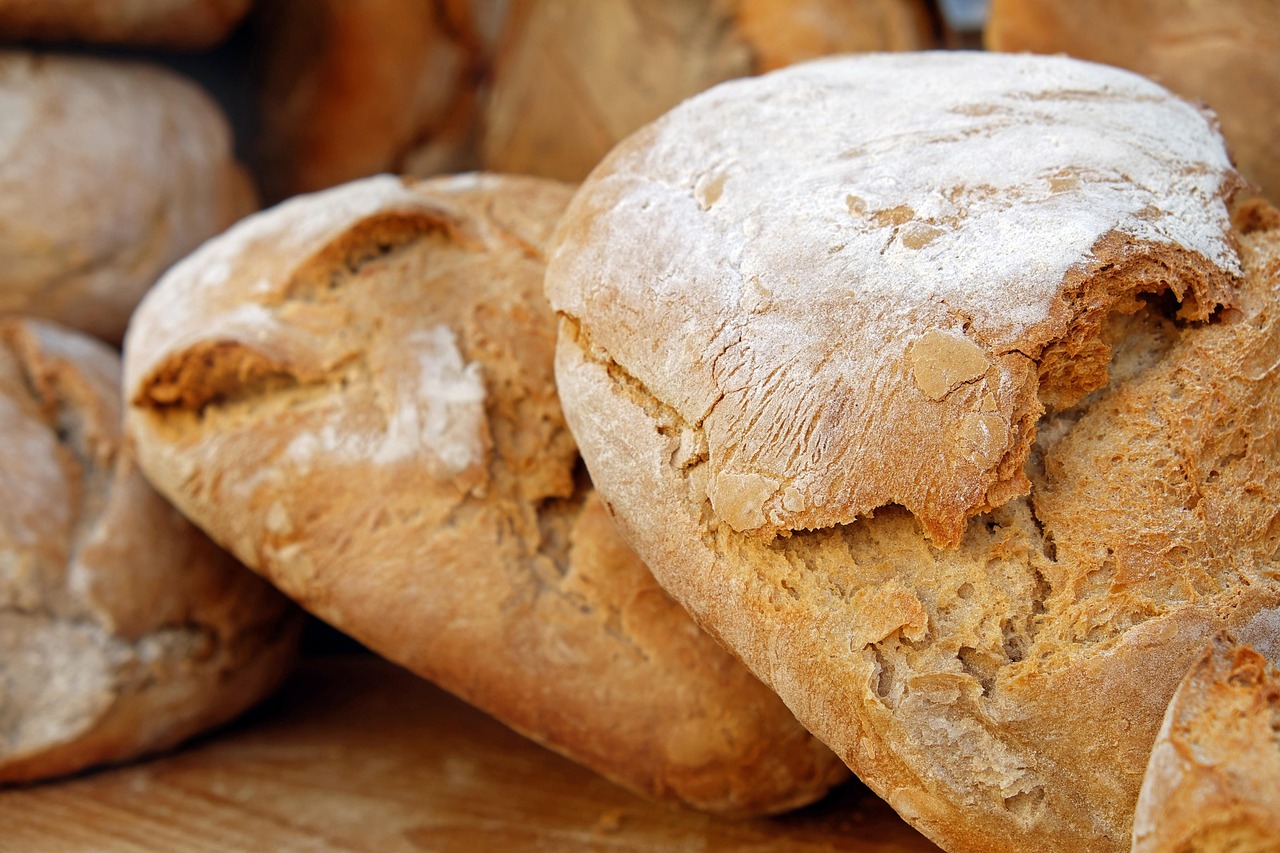
Before we get to any talk of symbolism, representation, signification or what it “reminds us” of, our eating together is eating. The bread we consume is bread. The wine and juice we drink are wine and juice. The table at which we gather is a table. And the people around it are people. Real things. And real things are radical things. As Jesuit peacemaker and poet, Dan Berrigan, noted in a letter, years ago:
“When I hear bread breaking…, it seems as though God never meant us to do anything else. So beautiful a sound, the crust breaks up like manna and falls all over everything, and then we eat; bread gets inside humans. It turns into what theologians call “formal glory of God.” But don’t let that worry you. Sometime in your life, hope you might see one starved man, the look on his face when the bread finally arrives. Hope you might have baked it or bought it – or even kneaded it yourself. For that look on his face, for your hands meeting his across a piece of bread, you might be willing to lose a lot, or suffer a lot – or die a little, even.”
The poor man might not have much to say about the symbolic meanings of bread, but he can tell you exactly how it looks, feels, and tastes.
Jesus said we don’t live by bread alone. But not for that can we live without it. His own meal practice makes it hard to imagine that he would have asked us to remember him with a meal that consisted only of pale allusions to actual food and drink.
Communion is food for the body’s life, the life we breathe and bleed, as much as it is nourishment for the spirit. Bread is bread, wine is wine. Real food and real drink. Or it ought to be.
Real and ritualized
Now, to insist that the Communion meal is a meal, the real thing, is not to say that there’s no deeper meaning, no symbolic character, no spiritual power in it, and that it shouldn’t be ritualized. In late antiquity, social eating of every kind was ordered in symbolic and meaningful patterns. The Christian Eucharist was no exception.
Early Christian Eucharistic meal practices were diverse in form and content across far-flung communities in strikingly different cultural contexts, and in them all, the Eucharist was always a ritualized meal. It was never like a spontaneous picnic or casual potluck or a clean-out-the-refrigerator night, “whatever you have on hand.” Even the meals that the gospels show Jesus eating in people’s homes unfolded according to established patterns, the pouring of libations, blessings, dedications, prayers, a ritual order.
So, when I emphasize Communion as a real meal, I’m not suggesting that its mealness is incompatible with its being also a ritual. I’m suggesting instead that the ritual elements of the sacrament–words, gestures, objects, elements, choreography– should never be such that they obscure the fact that we’re engaging in a bodily, earthy, and human act, even if it is also an act that has profound spiritual significance and is carried out in specific ritual patterns.
A delight, an indictment, a confession, and a turning
Why is the mealness of the meal important? Because if we experience Communion as a sacrament of real food, real eating, real physical feeding, real satisfaction of creaturely needs, a truly human sharing in mutuality and conviviality, we will also experience it at the same time as the sacrament of real hunger, real deprivation, real human atomization, and endemic institutionalized food injustice.
If Communion’s host is a God who provides food; if the sacrament in any way materializes among us the Jesus fed the physical hunger of multitudes; if the ritual makes grateful use of the fruits of creation and dignifies the human labor it takes to put food on the Table; if Communion is real food, a meal, then we’re meant to enjoy it with delighted thanks.
And if Communion is real food, when we consume it together, it’s also necessarily an indictment and a confession. It rebukes and shatters us and turns us around, because its mealness confronts us with the fact that we’re actually eating. We have food. And we’re eating it in full view of (while participating in) a world deliberately structured so that for some to eat more than they need, others must eat much less, even nothing at all.
The Eucharistic meal has a shadow side, and we can’t see or acknowledge it, much less address it, if we keep spiritualizing it into personal intimacy and inner feelings. We more clearly discern its justice dimensions when we take the “mealness of the meal” seriously. And that means, among other things, taking bread and wine seriously, as what they are, not solely what they may represent.
Fruit of the earth and the work of our hands
Restoring the mealness of the meal entails not only honoring the goodness of the elements as gifts of the natural world, thus implicating us by our grateful reception of them in the earth’s care and defense; it also entails recognizing the ethics of the meal’s human production.
A few years ago, I wrote a brief devotion in which I make this point about the real labor it takes to land the elements on our Tables. The scripture is from James:
“Behold, the wages you withheld from the workers who harvested your fields are crying aloud, and the cries of the harvesters have reached the ears of the Lord of hosts.”
Basil Hume, former archbishop of Westminster, once declared, “No work, no Communion.” He didn’t mean you have to earn the bread and wine we bless. He meant there’s no bread or wine to bless unless someone labors to make it.
Communion begins long before church begins, in the daily work of human beings as workers plant, harvest, mill, bake, pluck, press, ferment, refine, and bottle.
Communion is a divine gift, but human work is the medium through which it arrives on our tables to be shared in love.
Like all human labor, the work that makes Communion is holy work, and whenever we gather for Communion, we should gratefully acknowledge its dignity. But we should examine our consciences, too. For to receive the gift of someone else’s labor is a confession as much as a celebration.
By regularly consuming the labor that makes Communion, we’re meant to become the kind of people who don’t just spout pieties about the dignity of labor, but who can also face the fact that holy human work is often unsafe and rarely justly compensated—and that we’re all implicated in this injustice. The kind of people who know that the bread and juice on our table, like so many products we routinely consume, are often the products of human suffering.
And the human suffering that give us food for the Table is also the earth’s suffering—pollution, deforestation, ecological imbalances, unchecked free markets that destroy the health of people and planet for the sake of profit.
All this is in the bread and cup: the sweating, suffering, suffocating bodies and blood of human beings, and the damaged exhaustion of the plentiful world we were given to tend.
At Communion we routinely pray that the bread and wine will become for us the food and drink of abundant life. Let’s pray, too, that by eating and drinking, we’ll also become something—a communionized Body that lives to do justice, ensuring an equal and generous share of the world’s food for all, respecting those who labor; and caring for Earth, our common home.
Enacting the meal’s mealness
Even when we acknowledge Communion’s mealness, we’re often at a loss about how to enact and embody it in our liturgies of Communion. Our instinct is to talk about it, to explain and exhort. But the Table really isn’t theplace for studying and debating the environment’s destruction, the causes and mechanisms of hunger, of the unequal distribution of food, and unjust labor practices everywhere.
The remedy for our denial is not to make Communion an occasion of sociological self-flagellation. The Table wasn’t made to bear up under that kind of moralizing. We don’t need any more guilt trips in church than we’ve already got. Communion packs an ethical wallop, but it’s a ritual, not a screed-y stump speech. So, “no” to wordy exhortations and explaining the Eucharistic symbols to death. The Table is for truth-telling, not moralizing.
The good news is that we don’t have to burden the liturgy with all kinds of facts and figures and examples and moral exhortations. Simply taking steps to restore the mealness of the meal will go a long way on its own. The “realer” we are with real things, the more Communion can tell the truth just by being itself. Good ritual cuts us to the quick even if it never speaks a word. And good ritual starts with real things.
If we keep it real– mindfully gather, serve each other recognizably real food in thanks and joy, discern a real Presence in our sharing among real people in real convivial mutuality– we might also come to experience by contrast the depths of the real hunger that haunts human eating and daily labor.
If we keep our eating real, we might find intertwined in it both our sacred solidarity and our sinful complicity. And at an honest Table, we may safely confess it.
If we keep the meal real, it may give us real hope, real vision, and real commitment in the presence of a real and hungry Christ.
Restoring the mealness of the meal will entail practical and logistical questions whose solutions will depend a lot on the culture and context of each congregation. Each community will need to contemplate what this restoration might look like for them.
Maybe it will be a reevaluation of the skittish habits we got into during the Covid epidemic that left some congregations with only ghostly, sanitized, and individualized traces of the real food they used to serve.
Maybe it will be the institution of a “dinner church” practice once a month.
Maybe it will be a Communion table set as if for an actual meal–no metal tray contraptions, no big bronzed cross taking up space, no odd white coverings over the bread and wine/juice suggesting that there’s something on this table too sacred to see or touch before the ministers begin the sacred ceremony. (Some congregations set the table at the offertory, with a real dinner service from people’s homes.)
Maybe you’ll find a new way to feed each other, not always receiving from an appointed minister, but face to face with one another, person to person, while singing creates a festive mood?
Maybe you’ll be more intentional and creative about ways to link your Communion service visually and actively with a feeding ministry of the congregation, or some other ministry to which you contribute?
Maybe you’ll design a more robust offertory ritual in which, along with monetary offerings, the elements and other food from the people are brought to the table with songs of thanks, and are set apart with a blessing prayer that acknowledges the gift of food and the labor that produced it, acknowledging also the suffering of the earth and of workers.
Maybe you’ll want to engender a new appreciation for the act of distribution–some simple, direct, non-ponderous ways of serving that makes clear that it’s a holy thing to distribute food. One pastor (who was reading through the UCC resource, Do This) calls the deacons/servers forward with this invitation:
“In soup kitchens and food banks,
at the family table and at the Communion table,
what a holy thing it is to distribute food, O God!
Bless all those who give your hungry people daily bread.
Deacons, come now, prepare to serve…”
Maybe it will be a reexamination of practices you may have that overlay (mostly invented) “meanings” on every liturgical action (you know, like holding the bread till all have received, then consuming it together on signal in order to symbolize X; and drinking the little cup separately to symbolize Y…). Maybe you’ll try instead to let the acts of distributing, sharing, and eating speak for themselves, as the real, everyday things they are?
Like most things human, this business about the meal’s mealness is complicated. The challenge for us who shape Communion liturgies and for us who participate in them is to find and use language, gestures, and objects that are adequate to this complexity; words, gestures, and objects that neither overwhelm the Table with sheer fullness and contentment nor overwhelm it with abject pain and guilt; that neither alleviate us with false assurances nor flagellate us into paralyzed helplessness. We need instead liturgies that help us eat in joy the bread of tears and eat in tears the bread of joy.
Does it matter what we eat?
One of the questions that often arises when I’m speaking about the mealness of the meal concerns the elements: Does it matter what we eat?
I think it does. Normally. Which means I think bread and wine/grape juice should be our default choices. Which means I think there are also circumstances (limited and conditional) in which other choices can and even should be made. But this nuanced position will take me a while to explain. Which I will attempt in the next essay I post. Stay tuned.
—
NOTE: In these essays about justice and Communion, I rely upon and have been influenced by many scholars, especially the work of William C. Cavanaugh, Andrew McGowan, and Christopher Grundy.
 Sicut Locutus Est