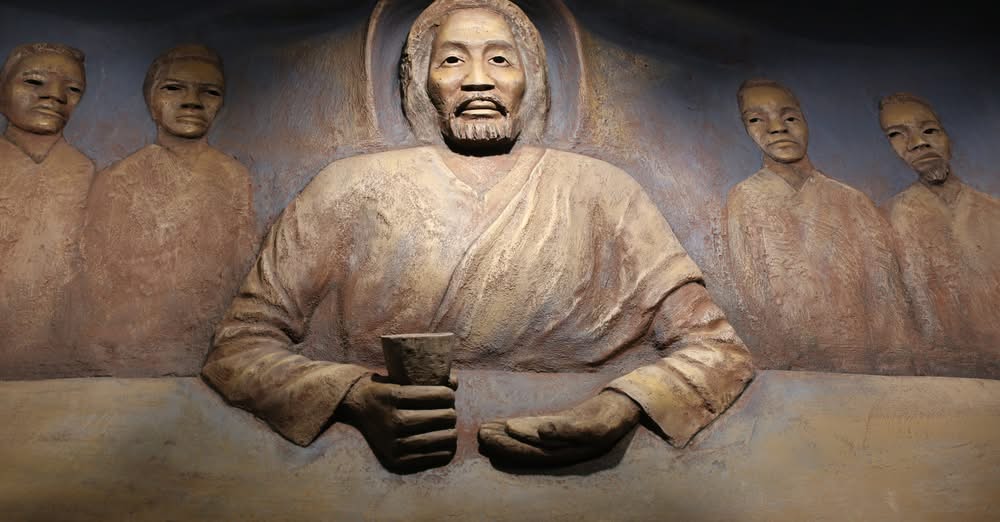
Akili Ron Anderson
A Christian activist friend of mine found out I was going to be giving a series of talks to clergy about holy Communion. She told me she thought it was a frivolous thing to do as the world burns.
She likes Communion, but thinks of it as a spiritual breather between bouts with fire-breathing dragons, a consoling and inspiring ritual. It’s gas in the tank, a helper, like the women’s auxiliary to the real work of justice witness in the world.
Why spend so much precious time talking about it? When the world’s burning, time spent doing something that’s not dousing the flames is time wasted.
I have a different view of Communion: I believe that the Eucharist is the “real” work, that justice-doing is intrinsic to the sacrament, that Communion is Christian witness in the world. It’s indispensable, not a booster or an add-on.
Why? Because the Eucharistic liturgy–its signs, gestures, actions, words — materializes a new reality in the world, an alternative social presence that challenges all oppressive regimes that claim the right to define reality and shape every social space in their own image and likeness.
The Eucharistic liturgy, and our participation in it, exposes the falsity at the heart of that enterprise and makes visible the fully divine and fully human enterprise Jesus named the kingdom of God.
For example, unlike the regime we are currently living under, the new realm Communion materializes does not require victims, nor their erasure from common memory. It remembers them, brings them from oblivion to presence, and refuses to forget.
Oppressive regimes depend on erasure. They ban books, words, ideas; they decree the non-existence of certain identities; they remove museum exhibits, and scrub information from government websites. And they impose themselves by means of a purposefully constructed narrative, a story about reality that’s romantic and heroic, self-congratulatory and aggrandizing, pious and innocent, and above all, simple and uncomplicated. This narrative replaces confusion with clarity, locates blame and approval, and confers identity and belonging.
It’s also false. The reality it describes is un-real. The polity it supports is brutal. The culture it fosters is cruel. But as long as no one remembers any other story, the regime is secure. Which is why repressive regimes strike fast to erase it.
If indeed we ever do overcome some day, it will be in large measure because someone dared to remember. “The struggle of humanity against power,” novelist Milan Kundera wrote, “is the struggle of memory against forgetting.”
The Eucharist is the church’s quintessential practice of remembering. Even if you think of it in its root meaning, thanksgiving, it’s still remembering, because remembering is the wellspring of thanks. It’s how we know what to be thankful for: “You brought us out of Egypt. You fed us in the wilderness. You did not abandon us when we sinned. You sent us dreamers and prophets…”
At the Table, the church remembers with thanks God’s saving deeds. And chief among them is Jesus — teacher, storyteller, healer, breaker of chains. And he is the Regime’s slaughtered Victim, the innocent one whom the powers disappeared.
The stunning claim the Church makes is that he lives. And in the communal act of remembering him we call Communion, he rises again to visibility in the world. He is a “real presence.”
But that’s not all. Along with him, all the victims of Empire also rise. Everyone rendered unreal and invisible by the Regime’s calculated forgetting is made real and visible when the church gathers to remember Jesus, because he is absolutely identified with them.
As long as the church remembers, their real absence becomes a real presence. Communion is the counter-liturgy to the liturgy of erasure.
A few years ago, I wrote a short piece about Communion called “Refusing to Forget.” You may have seen it in the Daily Devotional:
When Christians talk about Communion, we say it’s a remembrance of Jesus, a memorial. Which is true, but also potentially misleading, as if what we’re doing at the table is reminiscing, like you would maybe at a wake.
But in the gospel’s original Greek, the word for remembrance is stronger, edgier, more demanding—anamnesis—literally, “against amnesia.” It turns out that remembering Jesus in Communion is oppositional, like standing up to something, an adversary. Remembering at the table is not reminiscence, it’s resistance. It’s refusing to forget.
There are forces around us and within us that want us to forget what they’ve been up to for eons, wreaking havoc, taking up all the breathing room, squeezing the life out of everything for ego, profit, supremacy, and power. Killing for sport.
They’re still at it, night and day, trying to fog over all traces of Jesus’ love revolution in the world and in our hearts. They hope we’ll lose his trail, his story’s thread. They hope we’ll forget we ever knew him.
For if we forget, we’ll be putty in their hands. If we forget, they can tell us anything they want, and we won’t know they’re lying. In the vacuum of forgetting, injustice has it easy, violence rules the day.
Communion is dangerous memory, it’s our uprising. At the table we take a stand. We remember him. We remember each other. We remember everyone and everything hate wants to erase. And we refuse to forget.
This devotion elicited more responses than anything I’d ever written for the DD. Its main idea seemed new to many readers. But it’s not new. The early church teachers we call the “Fathers” routinely taught that the Lord’s Supper is a witness against all who disappear the vulnerable by their disdain and indifference. Communion was incompatible with these ruptures of human solidarity.
They took their cue from Paul’s eucharistic teachings in 1 Corinthians. They were writing later and in different contexts, but their concern about what was at stake in Communion was the same.
Examine yourselves (Paul writes) and only then eat the bread and drink the cup. For all who eat and drink without discerning the body, eat and drink judgment against themselves. For this reason, many of you are ill, and some have died. (1 Cor 11: 27-30)
Paul is talking about the individualistic way some Christians are eating the communal meal. He says it’s making them sick. This isn’t hyperbole or metaphor for him. Paul believed that Communion creates an absolute solidarity with Christ and among believers.
Communion makes a Body and incorporates everyone who partakes into it equally. For him, this is a real incorporation, not a poetic, sentimental, psychological, metaphorical, or merely spiritual one. When the community eats the Lord’s supper, Paul says we cease to be atomized individuals. We become one living reality in and with Christ.
In one of his sermons, Augustine is emphatic about this absolute identification of the sacramental Body and the Church. He writes:
If you want to understand the body of Christ, listen to the Apostle telling the faithful, “Now you are the body of Christ and all members of it” (I Cor. 12:27). So if it’s you that are the body of Christ and its members, it’s the mystery meaning you that has been placed on the Lord’s table; what you receive is the mystery that means you. It is to what you are that you reply with the Great Amen and by so replying express your assent.
In another sermon he puts it this way:
You are on the Table and you are in the Chalice, you along with us are this. We are this together. We are eating and drinking this together because we are living this together… Since what is made here is one reality, you too must be one by loving one another, by keeping one faith, one hope, one indivisible love.
“We are living this together…” The Eucharist is not an act of individual piety: it’s a true social solidarity. As such, Augustine writes elsewhere, it is life itself. If you don’t discern the social solidarity that Communion makes, if you divide the Body’s “indivisible love” by ignoring and effectively disappearing the poor and vulnerable, your body may suffer, not just your soul.
When the privileged members of the Corinthian church arrive for the Lord’s Supper and don’t wait for the poorer members, and in their absence consume all the best food, Paul says they aren’t eating the Lord’s supper at all. They’re eating their own– Joe’s supper, Linda’s supper, Betty’s, Fred’s. They’re privatizing the Eucharist, erasing the poor, and traumatizing the Body.
For Paul, this isn’t just a moral failure, it’s an ontological failure, a refusal to be who we are, the Body who is Christ. He’s echoing Matthew 25, where doing justice to the vulnerable is doing justice to Christ himself and withholding it from them is withholding it from Christ himself.
In the mid-2nd century, the apologist Justin Martyr confronted pagan charges that Christian Eucharists were actually “Thyestean banquets.” This slander refers to the myth of Atreus, whose brother Thyestes seduced Atreus’ wife. Atreus punishes Thyestes by slaughtering his small children and serving them to him at a banquet.
Christians were routinely accused of cannibalism, but when he defends the Eucharist, Justin isn’t concerned mainly with cannibalism. What he emphasizes is the way power erases the powerless, such as when Atreus treats his brother’s vulnerable children as totally dispensable: he doesn’t see them. They’re unreal to him, so he can do with them whatever he wants.
Justin distinguishes Communion from a world where power and status define reality, and the poor and vulnerable are literally devoured. The Eucharist is a different kind of banquet at which the vulnerable are not instrumentalized, consumed, and disappeared, but are real, valued, and seen.
At the Table, every victim lives and becomes present to the eyes of faith because the Eucharistic assembly remembers, and in remembering, it materializes the One who is absolutely identified with them.
Justin notes the practical dimensions of this identification. In his churches, immediately following the Eucharist, “the wealthy come to the aid of the poor.” The deacons take up a collection for the use of the presider, who’s charged with the care of orphans and widows, the sick, the imprisoned, resident foreigners, and “all those in need.”
In the 4th century, John Chrysostom vexed Constantinople’s Christian elites with uncompromising preaching about their erasure of the poor through the persistent neglect of their needs. In a homily on 1 Corinthians, he reminds them that eating together at the Table across socio-economic lines is a post-Pentecostal gift. The Corinthians refuse this gift when they divisively ignore the church’s weaker members. Since the meal belongs to Christ, every Christian should have equal access to it. Which is why the rich sin mortally against the Body when they eat separately and don’t share with those who have less.
Christ,” Chrysostom says, “counted all worthy of the same Table even though that Table far exceeds your dignity and the dignity of us all; but you still consider the poor unworthy and rob them of temporal things… Christ gave equally to all, saying, ‘Take, eat,’ but you do not give so much as the common bread equally. Yet it was broken for all alike and became the Body equally for all. If you come to this sacrifice of thanksgiving, you are to do nothing unworthy of it. Do not dishonor your siblings; do not neglect them in their hunger; do not injure the Church.
“Do not injure the Church.” There it is again: when you neglect and disappear the poor from your attention and concern, you traumatize the Body that Communion makes.
Chrysostom was talking about the elites’ behavior towards fellow Christians in the church, but he charged them with neglect of the vulnerable outside the community as well. Their failure to see and serve them also demonstrates that they don’t take the Eucharist seriously: “You have tasted the blood of the Lord,” he wrote, “yet you do not recognize your sibling.… God freed you from your sins and invited you here, but you have not become more merciful.”
In his Homilies on Matthew, he sums it up:
“Do you wish to honor the body of Christ? Do you ignore him when he is naked? Do you pay homage to him in church clad in silk, only then to neglect him outside where he suffers, cold and naked? The one who said, “This is my body,” is the same one who said: ‘You saw me hungry and gave me no food.’ What good is a Eucharistic table loaded with chalices if Christ is dying of hunger?”
Chrysostom affirms that the Body the Eucharist makes is the same body suffering on the street. Devotion to Christ in his Eucharistic presence is devotion to his real, concrete poverty, the poverty of the flesh of suffering siblings that he shares. Chrysostom even says that we’ve disqualified ourselves from the Eucharist if we aren’t acting justly towards each other’s bodies.
All this is to say that the act of defiant communal remembering we call Communion is at the heart of the church’s long determined effort to keep victims visible, oppose and subvert the powers, deny the legitimacy of the prevailing social structures, and enact a new social solidarity in the world over against all solidarities of power, wealth, individualism, violence, and erasure.
As such, Communion may be the most powerful source of justice witness among all the church’s means of grace. And maybe its most neglected.
We rarely think or speak of social justice in Eucharistic terms. Like my activist friend, many of us regard Communion as something set-apart, an in-house spiritual activity that gives us access to Christ’s love in a special way, makes us feel close to him and one another, and in so doing, strengthens us for engagement with the “real world.” We don’t usually think of the Eucharist itself as the real “real world.”
But the Table is the real “real world.” God’s reality is embodied and enacted in all the radically counter-cultural actions of the Communion liturgy —
gathering, not dividing;
blessing, not cursing;
giving thanks, not asserting self-authorship;
sharing equally in the earth’s gifts, not hoarding;
honoring human labor, not exploiting it;
extending peace, not doing violence;
distributing food, not withholding;
remembering, and refusing to forget.
What we do at the Table is the radically real new world of God. But when we’re talking about Communion, we progressives tend to attenuate that radicality. We talk about metaphors, symbols, and representation, distancing ourselves from the depths of participation and identity that Communion offers us.
One of the most common expressions I hear when people speak about Communion is that it reminds us. Communion reminds us of Christ’s love. It reminds us that God turns no one away. It reminds us that we’re all one in Christ. Communion is a reminder that a generous God feeds us all.
I’ve read zillions of UCC ordination papers. Nearly all refer to Communion in this way. The ritual reminds me. It helps me think about spiritual things, much the same way that a candle reminds me there’s hope in the night, or a photo on my desk reminds me how much I love my kids.
Those papers also often describe Communion, and Baptism for that matter, as helping us feel things. “Baptism,” one candidate wrote, “is a community sacrament. The church welcomes the baptized person as a new member and makes promises to support them. Baptism reminds us that we’re in this together. Communion is an individual sacrament. It’s a time for each of us to think about our relationship with Jesus and feel his presence in our hearts. It’s also a time for us to feel closer to one another. Communion reminds us that Jesus went the extra mile for each of us, for me. It reminds us we should do that for each other, too.”
It appears that Communion is primarily a prompt for pious thought, devotional considerations, spiritual feelings. Moral obligation, too: We’re reminded that Jesus went the extra mile for us so we should do that for others. And so, having been reminded, we leave the private set-apartness of the Table and cross back over to the public realm, to the real world, and do what Communion reminds us we should be doing.
This way of framing Communion isn’t helpful at any time, but especially so in our current situation. Why? Because it’s not really remembering Jesus. It’s not the radical anamnesis that raises victims to visibility and refuses to forget. It’s not biblical remembering that collapses time, creates common memory, and shapes a common identity.
It’s not the remembering a kid named Markie Shapiro did one day (true story) in geography class. During a lesson on the way culture is created, his teacher asked his roomful of 7th graders to share the earliest memory they could recall. The kids said things like, I remember my dog, my mom, my blue plushie. But Markie, the only Jewish kid in the room, said, “I remember Abraham.”
From this we learn that little Markie doesn’t just belong to a people, he is a people: he remembers with one communal memory, shared, participatory, immediate, a memory that constitutes identity. This is the way the church remembers on Good Friday, when it asks, “Were you there when they crucified my Lord?” And we say yes, I was there, because there is here, and then is now, and so today I tremble, tremble, tremble. It’s the kind of remembering we do when we sing, “Christ is born today” on Christmas, and when the great hymn of the Easter Vigil deliriously insists, “This is the day…. This is the day… This is the day…” Immediate, participatory.
Communion as “reminder” maintains a distance. That happened then, and we can bring it to mind over the centuries that separate us from it, but what we remember still remains back there. Which is why so much of our remembering is closer to nostalgia, momentarily affecting, but ultimately superficial, sentimental, and ephemeral.
William C. Cavanaugh has noted that Communion as “reminder” also Gnosticizes the sacrament. Its value and benefit lies in knowing and feeling certain things. We discover its meanings if we have the right interior dispositions. The irony is that you don’t really need the sacrament to be reminded of things. We may experience the things it reminds us of in sharp relief at the Table, but we can be reminded of them elsewhere, too, by many other means.
The same is true, he says, if you regard Communion solely as something that shapes your personal inner life, your character and affections, your motivations and the way you act in the world. Now, Communion is certainly formative. All liturgy is. But if we instrumentalize Communion as primarily an opportunity for spiritual formation, it becomes one among many tools for personal growth. I can leave it behind once I’ve taken in what it offers, or even not do it at all, since my inner life can also be shaped in other contexts by other means. Communion is not necessary for “becoming a better person.”
The crucial thing about Communion is not so much what it means, Cavanaugh insists, but what it makes. Paul and the patristic theologians have already told us what that is: Communion makes a Body, Christ’s Body, the church — a Body, in Augustine’s words, that is us.
Not a private, sacred entity apart from the world, but a new social solidarity in the world.
Not solely a personal intimacy, but a public Body that presents a new reality in the world, a Body that enacts the realm of God, a Body that does in the world what’s done at the Table.
Not ancillary to the work of justice, but itself a justice-doer, a resister, a persistent counter to the unreal “real world” of the powers of erasure, violence, submission, and fear.
Communion is an act whereby the church refuses to grant legitimacy to anything else that claims to represent reality, whether it’s obeying in advance or shopping till you drop.
As I said, this isn’t the way we usually think about Communion. Neither did Brazilian liberation theologian, Leonardo Boff, until he “got it” like an arrow to the heart one day after Mass.
A woman approached him to confess that she’d received Communion from his hand unworthily that morning, because she hadn’t been to confession first, which was the rule back then. She told him she was truly sorry. “But I hadn’t eaten anything for days,” she explained, “and when I came in, you were handing out the wafers. So I ate one, because it’s bread.”
Because it’s bread. At that moment, Boff understood that when even one Christian has to eat a Communion wafer to keep from starving while other Christians eat excessively, it calls into question everything about the church.
For him, the existence of that woman’s hunger wasn’t just a moral and social problem; it was a sacramental problem. It signaled that for too many of us Communion has become a privately consoling ritual, “reminding” us of Jesus in a morally inspiring, yet sentimental, individualized, and ultimately evanescent way, making little substantive difference in the world.
What’s on offer at the Table is not only meanings, feelings, inspiration, and a sense of moral obligation. It’s full-on transformation, a gathering up and remaking of atomized individuals into a new kind of social body, a communionized Body, the Body of Christ. And this Body has a real life in the world, a life that necessarily includes justice-making.
In the context of erasure, the Body Communion makes refuses to forget.
In the context of hunger, it’s concerned for feeding.
In the context all the -isms, it’s determined to dignify, reconcile, and make whole.
Because it’s freely available to all, and all are fed according to their need, Communion’s Body becomes the counter-politics to the politics that says hunger is necessary, and an economic confrontation with the entrenched assumption that for some to have, others must not.
Because it’s sheer gift, Communion enacts a non-shaming reality in a world where the powers decide who is worthy to eat.
Because in the one Body we are each other’s flesh, Communion makes a new social space wherein all bodies count, all suffer the pain and joy of one, all convey to each other mutual care, mutual love, mutual defense, and infinite worth.
Because it partakes of the generous fruits of the good earth, the Communionized Body lives in the world in profound gratitude for creation, in responsible use of its richness, and in active defense of its integrity.
Because the elements that nourish it are the work of human hands, the Body lives in solidarity with workers such that anything that demeans them or their labor is of ultimate concern.
And in our current context of reprisal and revenge, of getting even as a way of life and as a way of governing, Communion makes a Body that’s animated by mercy, for the Body it makes is the victim who returned to those who disappeared him without a word of retribution on his lips. Only a question: Do you love me? Only an offer: Feed my sheep.
Yes, the Eucharist has meanings. Yes, it teaches lessons. Yes, it inspires personal devotion. Yes, it affects and shapes our individual inner lives. And yes, it entails ethical obligations. But most of all Communion makes a Body. And this Communionized Body, the Body that is us, lives and acts in the world as a Real Presence.
And a political actor. As Boff discovered in the encounter with the woman who ate a wafer to live, “the Eucharist is already politics just by being bread.”
And, we could add, just by refusing to forget. (Remember me.) And just by being open to all. (Taske, eat, all of you.) Just by hallowing created things like bread and wine. Just by giving thanks (He took bread and blessed it.) Just by being a feast of persevering and resilient joy. (Until he comes again!) Just by being a communion, and just by unveiling a just human polity, a new social order that denies the very premises on which the old order runs; and, because it lends no legitimacy whatsoever to that system, just by being a provocative and extremely dangerous ritual. If, as Paul contends, Communion wrongly practiced can make you sick, rightly practiced it can get you killed. (Ask Oscar Romero about that.)
Anglican theologian Kenneth Leech once described the Communion liturgy as “the weekly meeting of rebels against a Mammon-worshiping world order.” The sacrament, he said, “is a freak event in a world where… bread and wine are hoarded, not offered; concentrated, not divided; unequally distributed, not commonly shared.”
At the Table all this is reversed as we enact God’s new reality, the real real world, together. We become a Body that doesn’t have to be persuaded that it should do justice; justice is our second nature reflex.
Again, as Cavanaugh writes, If we centered Communion more purposefully in our congregational practice; if we communed at the Table with the living Christ more regularly and more hungrily; if we more daringly welcomed the Spirit’s agency by which our Eucharistic participation makes of us a communionized Body, maybe we wouldn’t have to convince ourselves with repeated moral exhortations to remember victims, honor bodies, feed the poor, and defend the vulnerable.
Maybe we wouldn’t have to guilt each other into challenging, dismantling, and replacing the structures that now demand an endless supply of victims.
Maybe we wouldn’t have to contend with the strong resistance to siding with the oppressed that we often experience within our own congregations.
Maybe, by our rising from and returning to the just Table, a just life in the world would be simply what we do.
And if justice-doing were to come more naturally to us as the ordinary reflex of Christ’s Body, if we were to lend ourselves to Communion’s full-on transformation so that it might be so, maybe there’d be far fewer siblings disappeared into the regime’s oblivion of forgetting, and far fewer standing at the church door aching to eat a wafer in order to live. There might instead be “a table set in the sight of all our foes…”
—
NOTE: In these essays about justice and Communion, I rely upon and have been influenced by many scholars, especially the work of William C. Cavanaugh, Andrew McGowan, and Christopher Grundy.
 Sicut Locutus Est