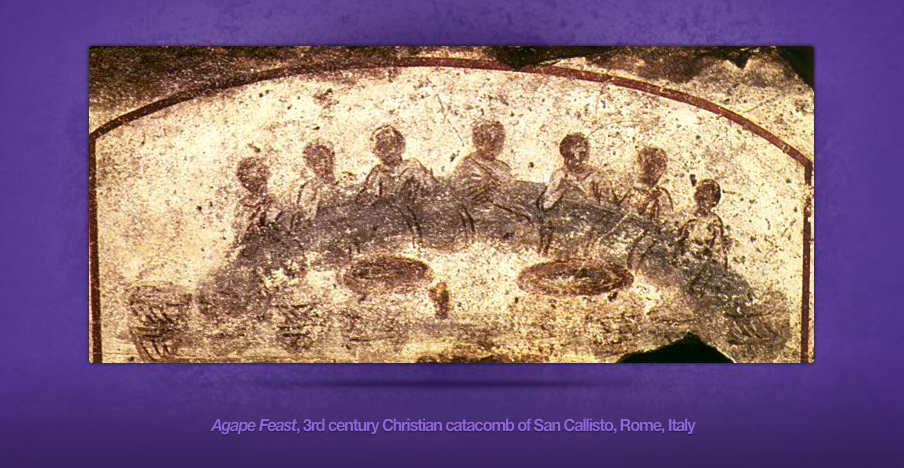
I’m often asked whether there’s ever a good reason for barring someone from Communion. This question usually arises when a Catholic bishop threatens to excommunicate a politician because of their abortion views.
The question is a trap, and I try never to answer it. When I do, my response never satisfies anyone, because it’s complicated. And few people like complexity.
Still, let me try. And start with something we often say when we’re inviting people to the Table:
“Jesus knew that there were betrayers, deniers, and deserters at the table with him that night. He fed them anyway. If he fed them, he’ll feed us, too.”
Now, by this we mean to encourage people who think their moral lives may disqualify them. In fact, I recently heard a pastor passionately assure his people that there’s absolutely nothing they could ever do that could keep them from the Table. Nothing, nothing, nothing!
And I found myself thinking, almost against my will, nothing? Nothing at all?
You may infer from my astonishment that I think there may indeed be something. And you may be thinking, but doesn’t Paul say that nothing can separate us from the love of God in Christ Jesus? “Neither death nor life, neither angels nor demons, present nor future, not height nor depth, nor anything in all creation…”
But despite his reassuring words, Paul and the entire early church believed that really big sins like murder, apostasy, and fornication could indeed separate us from God’s love, or at least from the fellowship of the church, which was to be cut off from the Body of Christ. so more or less the same thing. (Today Paul might put child trafficking and the proud espousal of White supremacy in the same category of sins that are truly “mortal,” i. e., deadly.)
In the early church there was no coming back from such deadly depravity. Later, the bishops would create a path for the restoration of notorious sinners –a system of penance and absolution– but in the first generations, the only recourse was to “ex-communion” such faithless folk.
Grievous sins were thought to deal such a severe blow to the one Body of Christ that to continue eating together the meal that makes that Body one felt like blasphemy. To enact a ritual of unity while the body is falling apart made a mockery of the sacrament.
Paul was confident in the strength of Christ’s love, yet he still thought it was possible to eat and drink so unworthily that you’d cut yourself off from the Body; which is why he begged the Corinthians to examine themselves before approaching so that they might rightly discern the Body and not injure or break it apart.
I have a relative who’s a devout Roman Catholic. The Eucharist is the center of her life. At one point a few years ago, I was at a Catholic wedding with her, and a few months later at a funeral, and I noticed that she didn’t receive Communion either time, which I found remarkable given her devotion.
Less than a year later, her husband began divorce proceedings. It turns out she’d been carrying on a 4-year affair, and after her shocked husband refused her request that they open their marriage to include her boyfriend, it was clear that they couldn’t go on.
Now, sorry to say that my kneejerk reaction was uber-judgmental. Such hypocrisy, such deceit: a devout RC carrying committing adultery and for so long and then having the you-know-whats to ask for an open marriage!
But after reflection I realized that she was at least honest about one thing: according to her eucharistic theology, she needed to absent herself from the Table. Her unfaithfulness and deceit by themselves might not have been bad enough to disqualify her, but her unwillingness to repent and amend her conduct, her decision to keep doing the profoundly damaging thing she was doing even when she knew it was wrong, certainly did. She believed that her unrepentance did grievous harm in and to the Body, and she knew she shouldn’t partake until she could actually stop doing that harm, which she wasn’t yet ready to do.
I wonder what she would’ve made of a hearty progressive Protestant invitation to the Table that cheerfully assured her that none of that mattered, that her sin was not an impediment to her coming to the Table. Would she have felt relief and joy, and received Communion as a “converting ordinance”, a consolation and a token of healing, a help for her weakness? Or would she have thought her moral condition wasn’t being taken seriously, and that what she was being offered was cheap grace? I don’t know, but I think that’s one important question to ponder in any discernment about inclusion and exclusion.
That there were sinners with Jesus at the Table is attested to in scripture. We progressives see in their presence, and in Jesus’ decision to feed them too, only an assurance of grace. But to leave it at that could run the risk of whitewashing that truly unsettling scene. Look at it again:
The gospels also reveal that Jesus was in soul turmoil at the table that night. He sensed that his friends would fail him utterly and he repeatedly disrupted the evening’s intimate fellowship to indict them: “You will all become deserters.” “One of you will betray me.” “Before morning, you will deny me.”
When he said those things, I’m pretty sure it wasn’t to reassure them that even though they were crapioca disciples, it was OK. I think he was truly calling them out, naming their sin publicly, and doing so so that there might be truth at the Table. He’d eagerly desired to eat the feast with them, and he would, but he wasn’t about to eat it in denial.
When we reassure each other that nothing we’ve ever done or ever could do is a barrier to our participation because Jesus ate with betrayers and deniers, we’re telling a potentially healing truth. But there’s more to the story. Our presumptive language papers over some very real and sorry things we rarely call out at the feast.
I think about this especially when it comes to the look of many of our eucharistic gatherings. UCC congregations are overwhelmingly White. This isn’t an accident. It’s a result of ongoing personal choice and historic entrenched systemic arrangements. Yet in our White-dominant churches, Communion liturgies tend to speak only glowingly of the unity of the Body, even as our racial demographics dismember it. Racism eats with us every time we share Christ’s bread. And only a fraction of our congregations ever asks seriously that most destabilizing question, “Is it I, Lord?”
Racism isn’t the only instance of turmoil rumbling underneath our sweeping assertions about unity and confident welcomes to all and sundry. And to be fair, we’re not wholly oblivious to the ways our smooth talk about inclusivity, wholeness, equality, and unity in Christ is actually a long-haul ethical work in progress.
We know that the Body Communion makes is beautiful and holy and real, and that it’s yet to be fully realized: it’s a Body that has not yet come, as Paul put it, to full stature. We know that our claims are often more aspirational than accomplished. But if our rituals of welcome to the table never evince this more complex awareness, we could easily forget what we know and celebrate in denial.
Instead of remembering Jesus only in ways that reassure us and give us peace, we need to create ways of remembering him that call us out, unmask the denial in our mantras of inclusion, and give us courage and grace to address the trauma in Christ’s Body with truthful transparency. Acknowledging the shadows at our Table may be more just, or at least more honest, than a simple uncomplicated “Y’all come because Jesus is cool with us, no matter what.” He is. And he kinda isn’t.
Under what conditions, in what circumstances might it be necessary and legitimate to bar someone from the Table? Maybe there are none, as we confidently proclaim. Maybe there are a rare few. I can’t say for sure. But some historical perspective could give us clues.
Many of you are familiar with Albert Raboteau’s study, Slave Religion, which documents the 19th century practice of Communion in the South wherein enslaved people drank Christ’s gift from the cups of their slavers. Raboteau cites the story of William Humbert, a fugitive in South Carolina, who describes how enslaved people came from vast distances to gather for Sunday worship under the auspices of the White slaver church. One commentator on Humbert’s story summarizes the scene like this: “There the sermon droned on with the same moralism week after week: God demanded obedience to masters; thou shall not steal. White deacons distributed Communion to those gathered. Then it was time for the long journey back to the scattered plantations. After sharing the Eucharist, the same White deacons met the enslaved workers on the roads, and if it seemed they were tarrying and wouldn’t arrive back at their plantations within the time allotted by their passports, White deacon slave patrols would flog them. They did so within two hours of administering the sacrament to them.”
“I thought,” Humbert wrote, “that a man who would administer the sacrament to a brother church member and then flog him before he got home ought not to live.” Or maybe at least he ought not be welcomed back to the Table.
Picture White deacons with a cup in one hand and a whip in the other the next time you read Paul: “Whoever, therefore, eats the bread or drinks the cup of the Lord in an unworthy manner will be answerable for the body and blood of the Lord” (1 Cor. 11:27).
So, what do we do when we’ve come apart like this?
Some Christians think one answer could be excommunication. Withhold Communion from sinners whose transgressions are mortal, like slavers, child traffickers, people who unrepentantly abuse their partners, war criminals, and maybe Christians in charge of ICE. Catholics would add abortion providers. The list could be endless if we really got into it. Which, of course, is precisely the problem with this position: which sins make the list, who decides, and where does it end?
Others say we ought not do Communion at all in view of just how broken the Body actually is. This was the posture of one John Lankford, the White minister of the Baptist church in Black Creek, Virginia, a congregation that included enslaved people, White slavers, and White people who were not slavers.
Raboteau recounts that in December of 1825, Lankford announced to his congregation that “in justice to his conscience” he could no longer offer Baptism or Communion “owing to his opposition on the subject of Negro Slavery, a part of the church being Slave holders.”
White members of the church were outraged. For seven years Lankford had offered Communion to all the members of the church. What changed? Slavery was a matter of individual conscience. Were not all welcome at the table, both slave and free?
Throughout their report condemning Lankford, the White church leaders insisted that that the unity demanded by the gospel outweighed their minister’s conscience. Whatever happened in the cotton fields and plantation houses had nothing to do with the Body and Blood of Jesus shared in the plate and cup of the church. Lankford was excommunicated for his attempt to “split the Church.”
What led him to “discern the body,” in Paul’s crucial phrase? We aren’t told. But at some point, he came to believe that the brokenness in a church of slave and free was total. As a commentator notes, “the sacrament had failed, not because of any inherent flaw but because people hid their sin behind the veneer of unity.”
Hiding behind the veneer of unity is something we can easily relate to. We do it, too. To maintain the peace of the church and speak the truth in love is supposed to be possible. Ministers vow to do that at their ordinations. And we want to, at least theoretically. But in practice, it’s endlessly fraught. Sometimes what we think maintains the church’s peace actually allows sin to fester and creates underground division in the church, gnawing away at the Body from within. To separate someone and apparently disrupt the church’s unity could be exactly what’s needed to maintain and protect the church’s peace, preventing further injury to the Body.
It should go without saying that excommunication, if it happens at all, must be a last resort. In our congregations, when we’re angry or hurt because of some transgression, a betrayal of trust, or some other persistent bad or harmful behavior, to go immediately to excluding the offenders, or to absenting ourselves from Communion because the offender will be there, breaking the bonds of the Bdy with their presence, may feel emotionally true to the level of damage that has been or is being done; and it could indeed be the right thing to do.
But not the first thing to do. In an ideal world, exclusion ought to be the nuclear option. Understand me, I know the world isn’t ideal. And I’m not making light of the seriousness of significant moral disruptions in the Body, nor of the pain they generate, and I’ll have more to say about this in a moment. My point now is only that separating ourselves or others from the Table is such an alienating and maybe even irreparable action that if at all possible, we shouldn’t go there until or unless we’ve made sincere use of the church’s many other means and practices that invite repentance, accountability, evidence of a changed life, and finally pardon and restoration.
The faith community has many ways of attending to its own brokenness and to its members who cause harm. We’re built for this. No one is automatically expendable; we want harm to lead to repentance and repair, not shunning and exclusion.
When a community is in agony from church members hurting one another—when a woman in the church suffers abuse at the hands of her partner, when someone is harmed by a fellow church member’s racism or sexism or transphobia, when leaders betray the trust of their people, or when the people mistreat their leaders, or when members of the church are complicit in perpetrating public injustice and violence (think ICE), we’re called first to stop, examine, name the damage, and offer life-giving pathways for repair. The last thing the church desires is to add damage to damage.
But when that harm is grievous, and especially when there are clear danger signs that the offender will likely never acknowledge their harm, much less amend their behaviors, we may indeed need to let them go the way they’ve chosen to go. We may need to affirm, but not with a punitive spirit, that they have separated themselves, and regretfully close the little gate in our otherwise unfenced Tables behind them, even as we ceaseless hope for their return. And if they won’t go, if they insist on sham unity at the expense of the Body’s health, we may have to absent ourselves.
I think the church needs to accept that there could be times when fencing the Table is the right thing to do, times when we have to make a painful judgment when all else has failed. Sacraments can go wrong. And they go wrong because they exist for and within communities of people. And people? We break things. Sometimes we break one another. We’re no different from the Christians at Corinth and the church of Black Creek. Our duty and struggle as an aware, self-confessed flawed community is to discern with the Spirt ways to square two seemingly unreconcilable truths:
1. The Table is sheer grace and must be open to all. It is, at least potentially, a “converting ordinance” that not only shows forth the unity of the Body but can also over time and by faith and love heal that Body when it has been hurt;
2. Soul damage is real, and we have experience of the painful spiritual disorientation and dislocation that occurs when we look around the Table and see, for example, the man who raped you (which happened not long ago in a church that must remain nameless), or the woman who betrayed you with a 4-year affair, or the co-workers who slandered you to your boss and got you fired, or the ICE agent who’s just come from cuffing the Latino kid who’s been your beloved neighbor since he was born.
So, bottom line:
Not only is it not unheard of to separate someone or separate ourselves until restoration has occurred, it could sometimes be required, necessary, loving and more fully reflective of the Body’s honest condition. BUT… It’s the church’s job to try to live in such a way that it never becomes necessary to make that discernment at all.
—
NOTE: In these essays about justice and Communion, I rely upon and have been influenced by many scholars, especially the work of William C. Cavanaugh, Andrew McGowan, and Christopher Grundy.
 Sicut Locutus Est
This is a brilliant essay, Mary, and so on point in a culture that increasingly demonizes other people. I’m grateful and in awe.
Thanks, Eric.