Author Archives: sicutlocutusest

Contemplating Jesus’ Baptism: An Opinionated Opinion

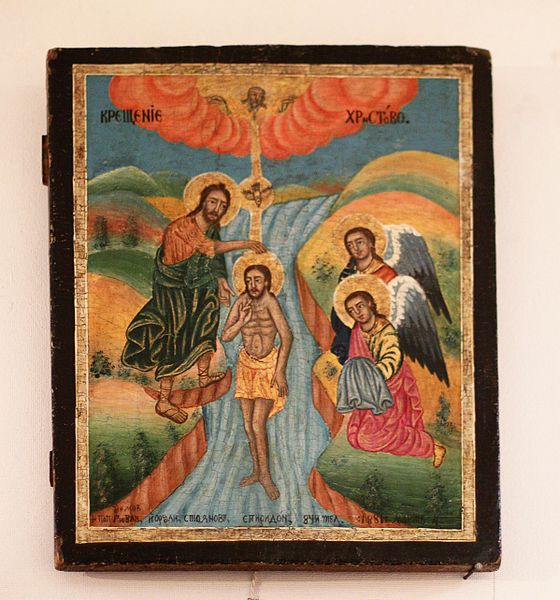
560px-Haskovo_Historic_Museum_2011_PD_247

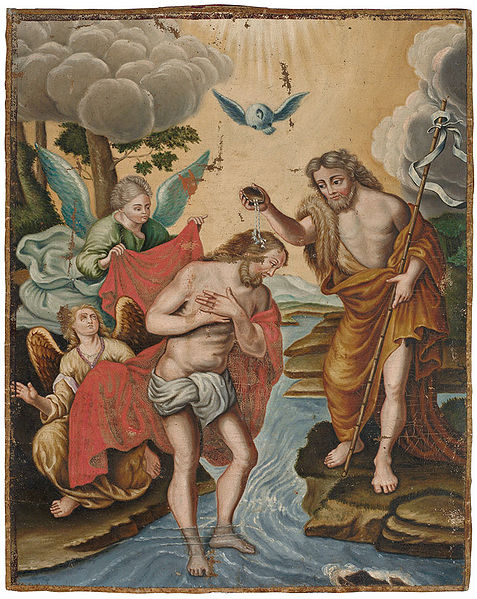
–Haskovo Historic Museum, Haskovo, Bulgaria

On Baptism of Jesus Sunday, one of the most important commemorations of the season of unveiling we call Epiphany, we are often quick to turn the ancient Christian memory about Jesus at the Jordan into an intra-psychic contemplation of ourselves.

Rather than focus our religious imagination on the revelation about Jesus as God’s child and chosen one for the work of redemption, and on what sort of redeemer he is, we move immediately from Jesus’ experience to our own. We make Baptism of Jesus Sunday all about our own baptisms and our own naming as ‘beloved’ by God.

Now, this is true and well done insofar as we believe that in our own baptisms God accepts and adopts us in Christ. We are indeed God’s beloved, God is indeed pleased with us, and we can indeed move confidently into our own ministries, and towards our own suffering and deaths, secure in this necessary knowledge.

It is also true and well done insofar as this powerful and transforming message of our belovedness is desperately needed by so many in our pews (including by us who preach this message). We whose lives are often overwhelmed with experiences of inadequacy, isolation, rejection, and shame; or for whom God has always loomed too large as judge and antagonist need this message. It must be preached repeatedly and perseveringly, yes, even on Baptism of Christ Sunday.

But the fact remains that Jesus’ baptismal experience is his own, not ours, and it is unique: we are not the messiah, no matter how often we may mistake ourselves for him; and it is not through us, except by the divine grace of incorporation in him and the extension of his ministry to us, that healing comes to the world. The voice at the Jordan was for him, not us; it addresses him and his identity, character, and mission, not us and ours; and it effectively grounds his loving, sacrificial ministry in ways only he could know and with graces only he could draw upon.

No matter how much we may wish to appropriate Christ’s baptism, we have to acknowledge some difference and allow some distance between him and us so that we can contemplate with awe, as the ancient festival intended, the mystery concealed and revealed in this striking event.

Our tendency is to assume that everything in scripture has an obvious, immediate, and necessary application to our own experience and our own needs. And we are, in my opinion, also far too quick to assign ethical imperatives to everything the gospels say about Jesus. It makes us nervous simply to let a story hang out there for our contemplation without moralizing it. Our protestant tendency is always to skip sustained contemplation of Jesus and sprint to the question of us.

I think the immediate focus on ourselves misses the point sometimes. It’s useful, to be sure; but it isn’t all there is. I wonder whether we would discover something even more ‘useful’ by means of a more imaginative and more lingering gaze at Jesus himself in these stories. What would we see that we haven’t seen before because we took our eyes off him to talk about what we need, who we are, what we are required to do and become?

What is hidden here that steady contemplation might unveil? What if we permit the stories to be truly the stories of Jesus first, focusing our attention on him as the only protagonist worth thinking about — the one in whom we too are learning, by patient contemplation and wide open hearts, to be well pleased?

Four Sermons on Baptism: 4. Have You Been Saved?

690px-Noahs_Ark

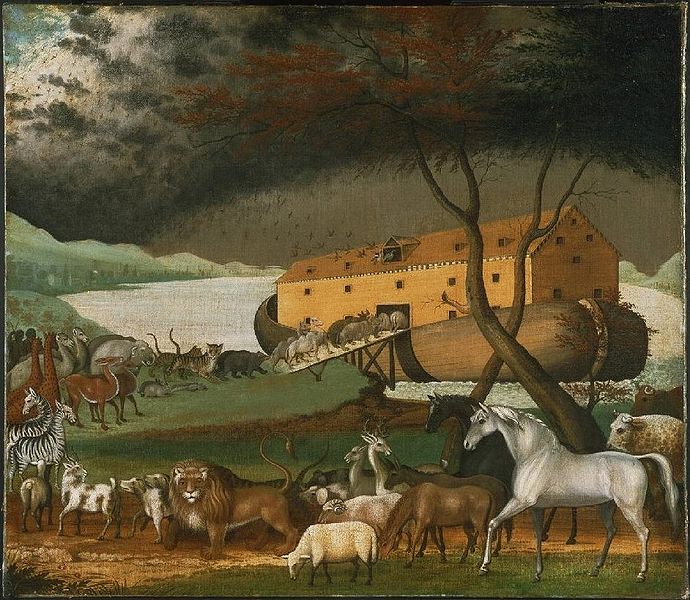
–Edward Hicks, Noah’s Ark

Luke 15:1-7

Baptism of Bryn M.

 One of the most ancient words in the Christian vocabulary is the word “salvation.” It shows up in practically all our hymns and prayers. We think we know what it means, sort of, but a lot of us would be hard-pressed to define it. It is like beige. Or wallpaper. It’s a background word. We hardly notice it.

There are other Christians, however, for whom “salvation” is not a wallpaper word. It is a foreground word, a word always on their minds. Given half a chance, these brothers and sisters will confront you with “salvation” whenever they can. And wherever they can—say, on the bridge over the Mass Pike as you’re heading to Fenway Park for a ballgame.  They accost you, wearing sandwich boards that are painted with flames (signifying hell, where they believe we all deserve to be). A picture of Jesus on the cross is superimposed over the flames (signifying the way to avoid hell. The only way). As they hand you a tract, they ask, “”If you died tonight, would you wake up in heaven or in hell?” And then, “Have you accepted Jesus as your personal Lord and Savior?”

They believe that “saving” you is the most loving thing they can do. After all, if there is a God, and if God means business, and if God’s business involves assigning eternal reward and punishment, and if there is a divinely-appointed way to avoid the punishment and get the reward—namely, affirming with your lips that Jesus is your personal Lord and Savior—then it really would be in your best interest to listen to them and do what they say.

Hardly anyone does. Especially outside Fenway Park. There’s no hope that they are going to have much success with Sox fans anyway. Most of us have already sold our souls to the devil.

Have you been saved?

The typical theologically-liberal reply to that question is not yes or no, but “it all depends.” It all depends on what you mean by ‘saved’—saved from what? Surely not from damnation. Not too many of us believe in damnation. It flies in the face of our conviction that God is all-forgiving and utterly gracious. We say things like, “Well, maybe hell exists, but that doesn’t mean anyone’s in it.” When pressed, we include even Hitler and Pol Pot in God’s mercy, and if God can redeem those monsters, God will certainly redeem us, who are much smaller potatoes.

If “getting saved” basically means “going to heaven,” then, with hell out of the picture and no purgatory to worry about (Protestants don’t hold to a doctrine of purgatory), all we mainline Christians have to do to “get saved” is to die. Which takes no special talent. Sooner or later we all die. Our somewhat wan theology about all this salvation business is neatly summed up by 19th century German poet Heinrich Heine who once wrote, “I love to sin. God loves to forgive. Really, the world is admirably arranged!”

But surely salvation is about more than where you end up when you die. Our parable today is all about salvation, but it has nothing to say about what happens after death. That’s not to say that nothing happens; it’s only to say that Jesus is not preoccupied with that in this story. He just wants to find that one lost lamb.

When we tie our notion of salvation too narrowly to the matter of our fate after death, we always end up also narrowing the grand complexity and thickness of Christian life and faith. That one might be saved simply by affirming that Jesus is Lord is a case in point. The odd case of limbo is another. Recently it was reported that the Catholic Church is going to abolish limbo. For the clueless, I’ll explain.

Traditional Catholics believe that everyone inherits the “original” sin of Adam and Eve and that we are therefore born into the world in a condition of radical separation from God. Only baptism can take that sin away and restore the human friendship with God. If you die unbaptized, you can’t go to heaven.

Where does an unbaptized soul go? If it’s not its fault that is has not been baptized—say, in the case of a newborn— it goes to a “place” or state of being in hell called “limbo.” There the soul is “punished” by being deprived forever of the vision of God, which is the greatest joy of the saved. But it is mercifully spared the eternal torment of those who are in hell through their own damned fault. In limbo, there is no active suffering, only the deprivation of God’s presence. If a soul is in limbo, it is simply, well, in limbo. Avoiding limbo is the reason that Catholics tend to baptize their babies as soon after birth as possible.

The idea of limbo was meant originally to be a consolation in the face of a very strict doctrine of original sin and a very narrow idea of salvation-as-fate-after-death. At least an unbaptized child is spared the pains of hell. But this teaching about limbo was in fact a source of terrible anxiety for parents. And when a child did die before being baptized, it caused them unspeakable agony. On top of the grief of losing a child, grieving parents had no hope of ever being reunited with her.

The current Pope Benedict is on record as saying that the doctrine of limbo is not “pastorally useful” any more. Many Catholics doubt it ever was. They can’t wait to see it go the way of fish on Fridays.

Now, I know that this internal Catholic discussion about original sin, baptism, salvation, and our fate after death has little to do with us as Protestants of the more open, y’all come, God is merciful to everyone variety. We have a very different view of original sin and a very different view of baptism. We are in no rush to baptize babies! We do not worry about their eternal fate if, God forbid, they should die without the sacrament. Washing away the stain of original sin is not the first (or the second or the last) thing on our minds when we baptize.

And yet when you look closely at our baptism service, you can find traces in it of a concern about sin and salvation. There is language that alludes to cleansing and rebirth. We make promises renouncing evil and turning towards the things that make for eternal life. We mention forgiveness.

Why do we keep that kind of talk? Isn’t baptism more about welcoming people into the Christian family? Isn’t it the moment when we hear God say to us, “You are my beloved”?

We keep traces of the language of sin and forgiveness because the family of faith into which baptism ushers us is not just any old company of people. The church of Jesus Christ has a specific character. More than anything else it is a company of the pardoned, a congregation of the redeemed, a new kind of family characterized by a life-long and life-giving dependence on forgiveness—God’s and each other’s.

In our UCC tradition, baptism does indeed speak primarily of our unconditional acceptance by God as God’s beloved children. But the amazing and precious thing about this gift of acceptance and adoption is that God bestows it on us “just as we are, without one plea.” God gives it to human beings who may come into the world free of sin, innocent, fresh and clean, but who never stay that way. And don’t you think God knows that we won’t stay that way? And yet, knowing what God knows, God embraces us anyway. Baptism’s waters plunge us into an ocean of forgiveness in which we will need to be swimming all the days of our lives.

You do not have to believe in original sin transmitted almost genetically from generation to generation in order to be persuaded that sooner or later actual sin plays a disruptive role in every human life and in every human society. No one and no society escapes its ravages—the revolting headlines of the last week’s carnage in Iraq are proof enough of that.

You do not have to believe that we come into the world already infected by sin to acknowledge that it isn’t all that long afterwards that each of us fall sin-sick in our own way, secret or public, great or small.

You do not have to believe that at our birth original sin radically separates us from God in order to take seriously the common human experience of estrangement, alienation, and loneliness that are like a persistent undertow, dragging our longing to be whole out into a vast sad sea, and against which we feel helpless to resist.

I don’t believe that the simple affirmation that Jesus is my Lord and Savior guarantees me a place in heaven if I should die in the night. In the same way, I don’t believe that left unwashed, the stain of some inherited original sin will damn me to hell at worst, or at best perpetually suspend me in a limbo of futility between my worst fears and my best hopes.

What I do believe is that I need and desire mercy. I need assurance of mercy. Assurance that my own real and deliberate sins will not cause me—now or in the end—to be forgotten or lost. Assurance that I will not—now or in the end—have nowhere to call home.  Assurance that I will not ever—now or in the end—vanish like a dream from the heart of God.

So far, Bryn, our newest little sister in the faith, has not hated anyone, started a fight or a war, or decided that she’s more righteous than the rest of us and started treating us that way. She is the very picture of God’s pleasure, holy and innocent. It’s hard to imagine her sinning when you look at her now, but even her besotted parents know that it won’t be long before she’ll be needing mercy just like the rest of us.

And so today we have done the best thing we could do for her. We did for her what loving hands once did for us. And loving hands before them did for them. We presented her to God, who is the mercy we crave. And by water and the spirit God made her part of this great, wide and embracing family of Jesus where it is always and everywhere simply a given that our need for daily saving will always be met by his endless need to save.

We have made a preemptive strike on Bryn’s life, moving it out of the lost column into the found. And by the vows we made to her today, we have become for her, with Christ, the shepherd who will track her down when later on she gets lost for real—as often as that happens, and as long as it takes to find her.

Every time we do this, we glimpse the meaning of Christian fellowship, and the nature of the Church. Every time we do this, we exercise the debt of love we owe each other because God first loved us. Every time we do this, we create and re-create the blessed tie that binds. Every time we do this, a window opens on the character of God, and what we see in that window overcomes us with a joy no circumstance can alter. Every time we do this, the ancient hope for a new world and a new way of living in it together materializes among us.

If salvation is anything, this is it.

If it is to be found anywhere, it is here.
Four Sermons on Baptism: 3. Joseph’s Tears

Bourgeois_Joseph_recognized_by_his_brothers

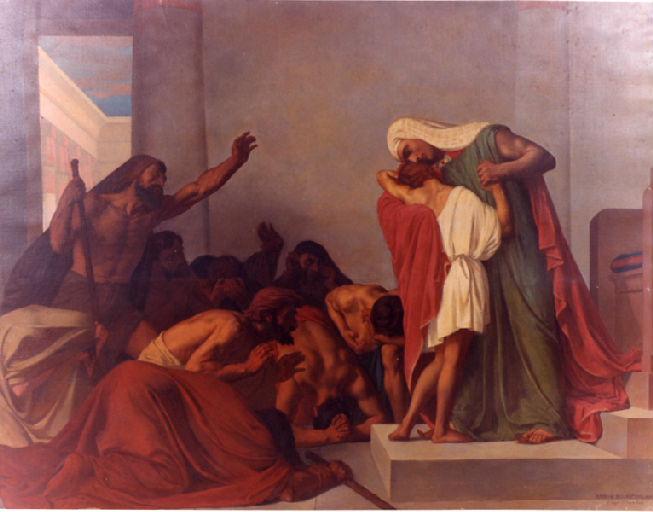
–Joseph Recognized by His Brothers, Leon Pierre Urbain Bourgeoise, 1863

Baptism of Oliver Magnus L.

Genesis 45:1-15; Luke 6: 27-38

If you don’t know the story of Joseph, you owe it to yourself to read it from start to finish. It has everything: jealousy, violence, sex, power, money, suspense, God — and a happy ending.  It begins in chapter 37 of Genesis when Joseph is 17 and a shepherd in the land of Canaan. It ends in chapter 50 (the end of the whole book) when Joseph dies in the land of Goshen at 110. In between, Joseph is transformed from a spoiled little Hebrew kid into a shrewd Egyptian potentate, and his pack of jealous brothers into men of honor.

The plot of this convoluted story has a large historical purpose: it is meant to explain the manner in which the Israelites whom Moses led out of Egypt got down to Egypt in the first place. But it has a theological purpose too: it is meant to demonstrate the character of Joseph’s God. This God has a plan, and everything that happens to Joseph happens for a reason.

God’s reasons become clear only in hindsight, of course; but to Joseph, the divine method in the madness makes even attempted fratricide meaningful. Joseph says to his brothers, after finally revealing his identity, “Don’t be distressed or angry with yourselves about what you did to me: it was not you who sent me here, but God, in order to preserve life” [45:5].

Now, the providential worldview that makes such a crime meaningful does not remove the need to resolve the nasty old family secret. The business of forgiveness is still pending, and it won’t be simple. Joseph will subject his brothers to a series of tests, some bizarre, before he finally reveals himself and absolves them.

But absolve them he does — through his tears. In the short passage we read this morning, Joseph weeps only once, but if you read the story from its beginning 3 chapters earlier, you’ll see that this encounter-reunion narrative is drenched in Joseph’s tears.

The first time Joseph weeps is after he has terrified his brothers by accusing them of espionage. When the brothers realize that they are in deep trouble with this powerful and enigmatic man, they can only think that their crime has returned to haunt them: “We’re about to pay the price for what we did to our brother,” they all agree. “Joseph pleaded with us, but we turned our backs. Now we will surely answer for his blood…” [42:21-22]. And Joseph, who has pretended he can’t understand their language, is overcome — he hurries from the room to weep.

Why these tears? Well, why not? Here he discovers that his brothers have come to comprehend the gravity of what they did. So it all comes back to him — the horror of being snatched and stripped and thrown into a well in the middle of nowhere, left for dead by your kin. When he hears them recall the crime, he also discovers that for all these years in a foreign land, he has not been altogether lost; he has been remembered by these brothers of his — their guilt has kept him near, and so has their grief, a grief not unlike his own.

Does he see a glimmer of possibility for a new relationship, one woven of regret and empathy for their mutual emptiness, their mutual sorrow? Does he weep, then, also in joy, because he knows now what he will do with his power over them — that he will use it to be kind to them, and that soon he will effect a reunion with his father and his mother’s only other son, the youngest of the brood, Benjamin?

Joseph’s tears fall again when, much later, the brothers return for another sojourn in Egypt, still unaware of who “the man” who so dominates their lives now really is. This time, they bring Benjamin. And again, tears force Joseph out of the room: “Then he looked up and saw his brother Benjamin, his mother’s son… He hurried out, for he was overcome with affection, and was about to weep. So he went into a private room and cried. When he composed himself and washed his face, he came out…” [43:29-31].

Joseph then plants evidence of theft on Benjamin, and when Benjamin is caught, Joseph decrees that he must remain behind as a slave while the rest of the brothers return to Canaan. This is the greatest test — whether they will abandon Benjamin just as they abandoned Joseph once upon a time. They do not. One of the brothers offers himself in Benjamin’s stead. His father’s grief would undo him, he says, if he were to go home to report yet another lost son.

Joseph is overwhelmed by the pain of his own absence and the genuineness of his brothers’ loyalty. He bursts out weeping, and this time there is no hiding his tears. His passionate weeping, the scripture says, echoes through the palace — an eruption of pain and possibility so intense that it compels him at last to drop the game and reveal himself: “I am Joseph, your brother, whom you sold into Egypt…” [45:1-2].

Now you might conclude that Joseph was a sentimental fool prone to exaggerated displays of emotion. And maybe he was — no one else but Joseph weeps in this story, and he’s not done weeping yet. When his father Jacob finally comes down from Canaan, Joseph “weep[s] on his neck” a good long while too.

But I think Joseph’s tears are more than sentiment. I think he knows that the sin of human enmity is something that can only be grieved, and never quite fully repaired. He knows that human estrangement is something to be borne, and never quite completely fixed. I think he knows, in the words of another preacher, that with those who hate us and with those whom we despise, with those who have harmed us and those whom we have harmed, we share a single damaged heart, and for this common wound he also weeps. I think he knows that the great tragedy of the refusal to forgive is that at a certain point in that stubborn sustenance of estrangement, all you succeed in doing is erasing yourself from your own on-going history; and because the absence of anyone from a rich human life is unutterably sad — a waste — it is worth weeping over.

I think he knows that you can’t retrieve, relive or reconstruct the past, and you certainly can’t forgive on command. You can only hope, by the grace of God, to test and probe and dare the present to see if you can get a little closer each day to the empathy and regret that make reconciliation and new relationships thinkable — a bit closer to the experience, the knowledge that we are in truth each other’s Josephs, that all our enemies (and those who scare us) are kin in disguise.

So in that hope he also weeps — the hope for joy in solidarity, in eventual reunion, in a holy communion. He knows it is possible: after all: his brothers tried to kill him once upon a time, but now they refuse to sacrifice Benjamin. He knows it is possible, after all: for now somehow he who was their victim is now holding them in his arms.

Today we baptized Oliver Magnus. What did we do for him? We passed him through water into a Company of Forgiveness. We wet him down with tears — God’s ancient tears, the same ones Joseph shed over his brothers, the same tears Jesus wept over us — and ushered him into a Way of Reconciliation.

Now, we know he didn’t need those tears of mercy today, didn’t need to be wept over. So far he hasn’t hated anyone, started a fight or a war, or decided he’s more righteous than the rest of us and treated us that way. He doesn’t have any siblings he can throw into a dry cistern (although there is a pesky cat in the apartment…).

But even if it’s hard to imagine him sinning today, he will need these tears some day, for sure. We all sin, there’s no reason to think he won’t end up sinning too.

So what we did for him today was to give him the best defense and the best offense we have found. Led by the Spirit, the church has for centuries collected the copious tears of God’s grieving over our alienation and aimlessness; God’s tears of regret for our foolishness and anger, our need to kill (in one form or another) to protect our own lives and the life of our tribe; God’s tears of hope for our turnaround, and God’s tears of joy at our homecoming — the tears that bathe our wounds and water our growth and enliven our pleasure and refresh our loves; the tears we too learn to shed for others, whether they belong to our tribe or sojourn in foreign places. We collected tears in this cistern (which can never dry up) and plunged this baby boy down in it, bathed him deep.

He is drenched now, and sealed: no matter what he ends up doing, where he wanders or is carried off to, God’s tears can find him, reach him, wet him down again and again. God will never lose him or let him lose himself. He is entrusted to us, too, who are likewise bathed and sealed and are wept over daily. We are each other’s kin now, now and always, God hanging on our necks and weeping tears of love, pure love, always love, nothing but love for us all.

God bless you, Oliver Magnus. We are Joseph, your siblings. Don’t be afraid. All will always be forgiven: Welcome home.

Four Sermons on Baptism: 2. Keep to the Trail of Water

Image

–Photo: National Park Service

Exodus 15:22-27; John 2:1-11

Baptism of Aiden D.

Have you heard about extremophiles? I don’t mean people who hang-glide over belching volcanoes or snowboard down Mt.Everest blindfolded. Those risk-taking, rock-climbing, canyon-jumping, rapids-rushing, bull-running, totally insane folks can’t hold a candle to the critters I’m talking about.

Extremophiles, I read in yesterday’s Boston Globe, are microorganisms that thrive in the most unforgiving conditions imaginable. Some of these remarkable beings live miles below the earth’s surface. Others survive in temperatures reaching 250 degrees. Some breathe iron, some consume hydrogen, some eat rocks. The ones that live under the ocean floor have respiration rates 100,000times slower than organisms nearer the surface. As Beth Daley, the science reporter, put it, they lead “a mellow life” for millions of years – scientists call them “Zen microbes.”

How cool is that?

It turns out that life is far more pervasive, varied and enduring than we ever suspected. And so simple! While we complicated human creatures are madly trying to lengthen our lifespans and improve our looks with no carbs and comb-overs, these strange invisibilities are eating granite and living practically forever. Even as we reach for our cell phones, breathing hard and on the run, there are bugs out there sitting calmly in lotus positions, simply being bugs – they have no mortgages, no soccer practice, no sibling rivalries, no crummy co-workers to moan about, no nuthin’…

Of course they have no brains, either – no self-awareness, no emotions, no music, no aspirations, no ice cream. There’s not a Rembrandt or Ted Williams among them. And that’s one reason that, as cool as it is to contemplate the sheer tenacity of these little lives, and as humbling as it is to know that when our high-achieving species disappears from the planet, extremophiles will still be doing their no-thing thing in unseen places, I’m glad I’m me, and not one of them.

And yet…  Aren’t there times when our human environment seems every bit as extreme as theirs? Times when we discover that we are all extremophiles (well, not philes exactly, since we don’t usually love our hardships)?

Sooner or later most of us find ourselves in unforgiving conditions, at the far limits of livability, eating grief instead of bread, breathing pain instead of air; colonizing a subsurface world of depression and shame, or sojourning in the bewildering landscape of a bad diagnosis, an unfair dismissal, a financial disaster or some other almost casual calamity.

We cling to life in the hot core of anger or on the frozen crust of indifference, subsisting for what seems like an eternity on only the tiniest of kindnesses and paper-thin hopes. And somehow we hang on, scratching out a living in extremis, expanding the definition of the spiritual habitable zone.

How do we do it? Some people think it’s by force of will. Others think it’s by dumb luck, or good genes. More and more people swear by pharmaceuticals. But if you ask me, I’d say it’s water. We would never make it for a minute without water.

The Globe report agrees with me. It noted that one of the reasons scientists are so excited about the discovery of extremophiles is that in the search for life elsewhere in our universe, the amazing microorganisms we are finding here may be the clue to what to look for there. And in that search for life, scientists have one cardinal rule: Keep to the trail of water. “Studying life in extreme environments,” one said, “reinforces our focus on water. One thing all these life forms need at some time in their life cycle… is water.”

And let all the thirsty Israelites of today’s first reading say, “Amen!”

They have come out of Egypt thinking that unbearable misery is behind them, a painful memory. But now they are three days into the even more miserable wilderness of Shur with no water in sight, except for the polluted stuff they find at Marah. Worse than no water at all is lots of water you can’t drink; and so, wanting to live and not to die, the people cry out to Moses to do something. Moses cries out to God to do something. And God? God answers Moses by giving him… a piece of wood.

Wood?

Moses picks it up and tosses it into the water. Now, notice that God does not tell Moses to do that. He does it on his own. I read one preacher who wondered if, when he saw that piece of wood, Moses thought, “Great! A piece of wood. This is so not a good answer to our prayer!”, and threw that stick into the bitter water in disgust – or in utter despair.

But Moses’ God is the same God who makes it possible for some little bug somewhere under the earth in Peru to do rather well by eating rocks and breathing iron, so there’s no reason that a piece of wood can’t quench the thirst of God’s people, ailing in the wilderness of Shur.

And sure enough, it does. As soon as it hits those acrid waters, they turn sweet. The people drink and live. They live to thrive, for soon afterwards they arrive at the oasis of Elim, with its twelve springs and seventy palms. And there they camp, the Bible says, “close to water.”

If you are looking for a life that persists in extreme conditions, for a life that thrives when by logic it should shrivel up and die, keep to the trail of water.

And if you want a life that is more than life, more than merely coping with adversity, more than occasionally rearranging the furniture, more than the illusion of balance; a life rescued from the undertow of regret, fear, guilt or the dullness brought on by a lack of depth and challenge or by casual sin; if you want your life of obligation (and resentment) transformed into a life of delight and inexplicable, indestructible joy, take the same advice – keep to the trail of water.

Follow that trail to a village wedding where the wine has run out, or to some other human circumstance in which even the best intentions and the hardest work have not been enough to make us completely happy. Follow it to an ordinary disappointment or embarrassment that rubs your nose in your everyday limitations, brings you face to face with your lack of foresight and wisdom, your inability to control circumstances, your lack of imagination, your tendency to give only a small fraction of who you are and what you have to the great feast of life, and then to complain that you have been shortchanged, that there is not enough.

The trail of water – follow it to six stone ceremonial washing jars, holding twenty or thirty gallons each. Follow it to Jesus, who said that he has living water for everyone, and who out of compassion for our ineptitude is always changing the water of obligation and self-preoccupation and low expectations into a kind of extravagant and useless delight, a new and better wine. Always transforming the bitterness of the cross into the sweetness of resurrection. Always taking ordinary life and creating from it a miraculous adventure.

How do we thrive in impossible climates?  Human will?  I admire it. Dumb luck? I am always amazed (and amused) by it. Good genes? I wish I had ‘em. Drugs? They can help. But I believe, and I know, that we would never make it for a minute in the challenging conditions of this life without the daily water of God, without the Christ of transformation – without their extremophile grace.

Call it mercy, forgiveness, acceptance, welcome. Call it the power of the Holy Spirit, divine adoption, vision, vocation, hope. Or call it the central symbolic expression of Christian faith – call it baptism – that washing, drowning, refreshing, soaking, birthing, forgiving, restoring, including, welcoming water that makes extremophiles of us all, able and even willing to live and thrive in any circumstance or condition, including the forbidding habitats we are, by our sin, forever creating for ourselves.

In a few minutes, God is going to make an extremophile out of Aidan. We will pour over him the water that signifies the grace that will help him thrive in all climates and conditions – including the harsh geology of his own sins and weaknesses (which, of course, he does not have very many of right now, but will surely start acquiring as soon as he is old enough to make a mess of things other than the purely biological ones he now makes several times a day).

We don’t know what life holds for him – bringing a child into the world is one of the greatest acts of faith anyone can make – but by baptizing him we believe we will have done the best we can for him from the start. We will have given him water, the secret of an existence more astounding than iron-eating microbes and Zen bugs breathing slow. We will have welcomed him to the trail of water, where Life is always seeking other life, to know, to love, to thrive and to rejoice.

Now, how cool is that?

Four Sermons on Baptism: 1. Water World

http-inlinethumb21.webshots.com-22484-2592936640102347975S600x600Q85

Isaiah 41:17-20; John 4:1-15

Baptism of Anne Elizabeth B.

He gets really tired, our Jesus, and worn out from traveling. So he takes a load off his feet at the highest, hottest hour of the day at a well in a Samaritan town where the neighbors are unlikely to be friendly. But it can’t be helped, because he has this great thirst. And because he has no bucket, and the well is deep, he’s going to have to ask somebody for help, the first person who comes along, who is likely to be a woman, and if she happens to be hard-nosed about Jewish-Samaritan relations, she might just cut him dead if he speaks to her, and if she does, he won’t get his drink of water. And water is what he wants.

When she comes, Jesus asks her for a drink. She gives him a little lip about not having a bucket, but he isn’t put off; before long they’re talking theology. First they talk about water, although at the start she thinks he’s talking about the water from Jacob’s well. But eventually the conversation gets around to establishing that the water she needs and the water he wants to give her are different. Then they move to the subject of life—just a short step away from the topic of water, since water and life are twins. But it’s not life in the abstract he is interested in; he wants to talk about her life, including her five husbands, and “everything she’s ever done.”

She drinks his “living water.” How quickly it revives her; how unencumbered she becomes! She drops everything and plunges into town to tell everybody about Jesus, and about a soul-thirst she didn’t even know she had, about the thirst Jesus first awakens in her, and then slakes. It turns out that she is the one who had no bucket, standing at the deepest of deep wells. It turns out that Jesus is the one who hospitably dips into unseen depths to refresh her. You could even say that he baptizes her, immerses and drenches her from the inside out; and from that day on, she who lived in a hot, dry world begins living also in a world of water, amid secret pools of refreshment, intimate cascades of acceptance and favor, and subterranean streams of joy.

She enters a water world: we have come to call it the church, the great reservoir of life. Since time immemorial rejuvenating waters have been collecting in its cisterns: the waters that buoyed up Jesus in Mary’s womb, they’re in there. The water by which John the Baptist cleansed Jesus, it’s in there, too. That water that by wedding’s end became good wine, it’s all there.

The church’s well holds the angry sea that Christ rebuked to save his friends, the waters he made as firm as a road so that he could reach them in their swamped boat; the tears he cried over the city he loved, and over Lazarus, his friend; the water from the basin he dragged from foot to foot at his last supper; the water that flowed from his side when the soldiers pierced him; the waters of ecstasy and revelation at Pentecost when the Holy Spirit, poured out from above, became living water within us.

The church is a great reservoir of all the waters that heal and challenge, cleanse and refresh, delight and save and serve and compel. And when by God’s mercy we are invited into the church, we who live in such hot, dry places get drenched with them. Safely submerged, we learn to swim in a brand new world, wet and wondrous; we learn to go deep and drink to our heart’s content.

Today we baptize Anne Elizabeth, child of God. We bring her not into the world (her parents managed that just fine), nor into communion with God (God knew and loved her from her mother’s womb), but into Christ’s body, into the church, into this world of water. By water we quench a thirst she is too small even to know she has—a thirst for becoming completely who she is, a thirst for fellowship with God’s people, for belonging to a household of faith and service, a thirst for home and the eternal vision of God.

Her baptism is pure gift to her: before she is able to fend for herself, to understand anything, to name anything or even to ask for anything, Christ drenches her with welcome and acceptance, makes her an indispensable member of his body, and reserves for her a unique place at our table of memory, justice and love.

Her baptism is pure gift to her: it is a lifetime pass to our village well, a right to draw from the church’s reservoir that never dries up or runs out and at which she will always find Jesus waiting for her, ready to help her, to talk with her about her life, to help her uncover who she really is, what she most truly desires. She will always find him at the center of town, at this well; and in life-long conversation with him she will drink in the kind of unencumbering good news she can’t produce for herself or get from anybody else.

And if the rest of us water babies do our part, the part we promise in our vows to God, as she grows up among us, she’ll never dry out, because we will daily be soaking her in the gifts of God with which the church is waterlogged—worship, sacraments, prayer, singing, fellowship, encouragement, teaching, counsel, correction, stewardship, healing.

If the rest of us water babies do our part, she too will someday go squishing about to tell others what it’s like to live in a water world, about the One who lives at the source, the One who can awaken their thirst too, and then quench it, the One who will hospitably draw out for them the same unending joy she knows.

Anne Elizabeth, child of God, baptized today. You came here with no bucket of your own to draw water from this pool, and Jesus was here waiting for you. He has now given you everything you’ll ever need to be safe and sound  — he has given you to us and us to you; he has made you a water baby and introduced you into a water world.

And something else too, something that we all too soon forget; but as you grow up here, we want you to remind us of it. Here it is: today we baptized you also into a mission and ministry. “What is it?” you will ask someday.  I’ll tell you now, and if we keep the promises we made to you today, we’ll be telling each other again and again for years to come.

Remember the drink that Jesus asked for? In all the commotion, it isn’t clear if he ever got it. We need to find out. Our mission and ministry is to ask and keep asking if Jesus ever got his drink of water, to ask and keep asking whether he is still thirsty, and to be on the lookout for him in all the village squares where he is dying for refreshment, in all the places where in so many guises he sits down to rest (including pews like these). Our ministry is to see him and give him that drink, to make sure someone passes by to refresh him. It isn’t much, but it’s all he’s ever asked for, all he’s ever wanted, all he wants from us today.

If you see him in the heat of the day or in the cool of the evening and give him a drink, if together we help each other do this day by day, on the Great Day when God calls us home, you and I and everybody here who loves you, along with all the saints who, waterlogged with the works of love, squish their way before Christ’s seat at God’s right hand, will hear Christ say:

“Well done, good and faithful church; well done, good and faithful Elizabeth Anne. Now enter my Father’s joy, prepared for you from the foundation of the world, for I gave you living water, and you gave it back to me. When I was thirsty, you gave me a drink.”

Baptism

477px-Kirchenfahne_18_Jh_Taufe_und_Jakobus_1_Taufe_Christi

They paint you standing in the river, or kneeling,

never more than waist deep, head inclined,

hands folded in prayer or fluttering at your breast

like a demure virgin answering an angel, ecce ancilla,

while John pours dainty trickles from a shell over your hair.

They are all like this, annunciations not baths,

not baptisms, nothing like the drowning dream

you gasp through at night: dead weight in water,

you kick and claw but go nowhere, air gushes out

in a geyser of bubbles, and the last thing you see is your own

dear face upturned, lolling half sorrowful, half serene

just beneath the surface, the panic over, given in.

In Season and Out

epiphany

By the time you read this, Advent will be a memory—although we never really leave Advent, do we? We are always longing for love to materialize, always waiting for promises to come true, always scanning the signs of the times, always living under the judgment of a God who prefers mercy to sacrifice, always creating highways in the human wilderness to announce the good news about God’s unshakeable commitment to the earth and all who dwell upon it. Advent may be over, but Advent never leaves us. Desire for joy and justice is the permanent subtext of our lives.

Christmas will have come and gone too—although we never really leave Christmas, do we? We are always adoring on bended knee at cradles occupied by unfathomable babies, always surrounded by glory-singing angels, always offering ourselves and all we have in praise, always finding God most tenacious and tender among the suffering, the homeless and the poor, always subverting the violent power of kings with humility, with the insistence of stars, with the simple truth. Christmas may be over, but Christmas never leaves us. Human life is forever divinized. God forever wears a human face.

By the time you read this, it will be (almost) Epiphany—the season when eyes of faith flood with the most wonderful light, and the beauty of the One who lives and breathes in Jesus’ ministry is irresistible. All season long, the veil lifts and God is known in the wonders Jesus does, the words he speaks, and the kinds of people he calls to his side to share his company and his daily work.

You too, come and see, Jesus says. Come, see for yourselves. And if we go, and if we see, and if by his grace we stay, we will never leave Epiphany, nor Epiphany us.

Come and see, he says. And if we do, we will become like him, all light from light.

According to Matthew

Epiphany-Josephat-Rest-Gentile_da_Fabriano_030-e1356892384419

–Joseph Sleeping, Gentile da Fabriano

According to Matthew, angels do not sleep: in the small hours they intervene, scattering the sleep of others.

They harry exhausted fathers and tip off shrewd men who hail from far away.

According to Matthew, the world is a place where good people’s dreams bulge with warnings, and hope is barely one hard breathing step ahead of tyrants bent on harm.

According to Matthew, there is an inexhaustible supply  of tyrants.

Angels have to work overtime; even then children die.

Only one escapes this time.

He will grow to be the sort of man who accepts angelic ministrations in wilderness and garden, but no more intervention.

Even forewarned, he will not flee; not even put up a fight.

“Leaking Light” — Epiphany

adoration_of_the_magi_giotto

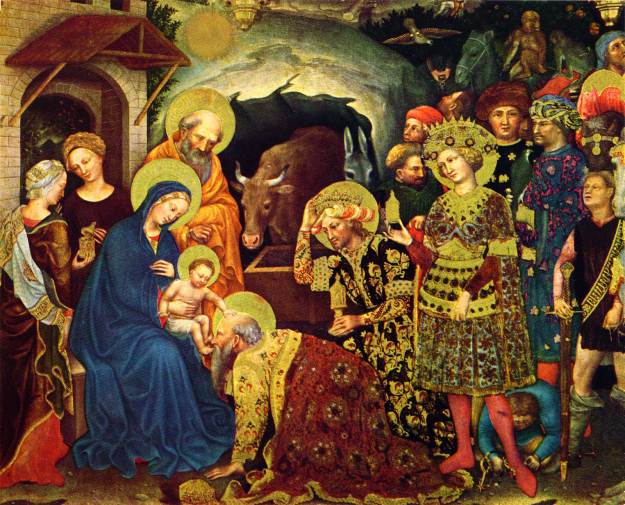
–Adoration of the Magi, Gentile da Fabriano, 1423

Our planet has come full circle, and things should feel new; yet for many people, the calendar is cleared only for business as usual, and the soul’s season, like the weather outside here in the northern hemisphere, is winter. But the church has entered a different season. We call it Epiphany, from a Greek word meaning to point out in a striking way, to reveal.

Epiphany is a season of signs. It starts with a Star in the East and ends with fire on a mountain. A season of voices, it starts with directions in a dream and ends with acknowledgment from a cloud. A season of unveiling, it starts with a glimpse of a baby’s skin and ends with a display of gleaming garments. A season of worship, it starts with the homage of kings and ends with the prostration of disciples.

How generous and wise the liturgy is to gives us this string of bright, hot God-sightings in a cold, dark time. It is the church’s way of showing us that our world only appears solid, still, dark, and cold, but is in fact ardent, vivid, and porous. As Barbara Brown Taylor says so eloquently, Epiphany reminds us that we live in a world that is leaking light, and that this long stretch of predictability we call our daily life is really a wondrous game of hide-and-seek with the divine.

Starfire, dream-clouds, baby’s flesh, garments of light, kings on their knees and disciples on their faces—in Epiphany we learn, again, to see, to listen, to worship, and to be called; for discipleship (we know, but too soon forget in our drive to be useful and productive) is as much about being spoken to as it is about speaking, as much about adoring as serving, as much about perceiving as doing, as much about being found as searching. Discipleship is born in awe, it arises from encounter, it is a consequence of worship.

Our planet has come full circle; but for us this does not mean just another round in an endless, futile turning of things. In this new year, we are not so much going around again as we are spiraling down and in, deeper and deeper. Spiraling down and in on a mystery. A mystery that calls to us to duck under the surface, to come and see, to taste and hear, to feel and know, to adore, and thus to follow.

Naming Jesus

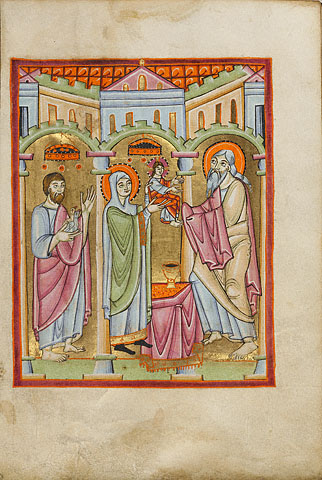
Luke 2:15-21  After eight days had passed, it was time to circumcise the child; and he was called Jesus, the name given by the angel before he was conceived in the womb.

 00348701

Image: Unknown , Ottonian, Regensburg, c. 1030 – 1040

It used to be that when I’d find out that a couple was expecting or preparing to adopt an infant, I’d inquire right away about whether they’d decided on a name. But experience has taught me that it’s a very bad question to ask, especially if you also feel it’s your duty to offer a few suggestions! Parents are generally pretty particular and protective about choosing names. It is often a cause of friction between them, and if the relatives are butting in too, everybody is on edge. It’s not for nothing that many of our given names have little family stories attached to them.

When I was leading small discussion groups, I’d sometimes break the ice with a question about the participants’ names. Why were you named Elizabeth or Paul or Malcolm or Linda? Were you named for a hero or saint, a grandparent, a movie star? Was ‘Tiffany’ or ‘Grant’ a hot name the year you were born? Is your name brand new, invented out of wonderful sounds, like Keeshawn or Tawanda or Juwan? Or is it traditional, biblical, like Ruth or Rachael or Adam?

I, for example, was supposed to be named Janice, after my mother’s mother, Janetta. But the labor was long and my head and shoulders were big, and the pain was great, and my mother — who up till that moment had not been particularly devoted to the Mother of Jesus — was heard to scream, loud enough for everyone in heaven to hear: “Get me out of this and I’ll name her Mary!”

Names matter to us. We try to remember names and get them right. We’re embarrassed when we forget somebody’s name. It bothers us when somebody gets ours wrong, adds an ‘e’ on Ann if there isn’t one, or forgets to add one if there is. We don’t treat our names lightly.

Names have a way of saying: Attention! Human being here. To deny people their personhood, we take their names away. When people are sent to prison, they gets a number; when Jews were sent to camps, they became numbers; when Africans were enslaved, their African names were erased and they were given different ones, left nameless, or called ‘Tom’ or ‘boy.’ To sing, then, as they did, “Hush, hush, somebody’s calling my name…” was a defiant assertion of human dignity. Jesus knew their names.

If our names don’t feel right, we change them. You know, one minute he was ‘Prince,’ and the next he was ‘The Artist Formerly Known as Prince,’ and then he was a graphic logo. We snicker, but we also understand. In some irreplaceable way, our names do more than identify us: they create us. And the simple utterance of a given name often generates the most intimate intimacies. Recall the scene in the Gospel of John when one of the women who went to anoint the entombed Jesus met a man she thought was the caretaker. She demanded to know where Jesus’ body was. He said, ‘Mary.” And she knew him.

Names elicit real presences. If you doubt the power of a name to evoke a person, go to the Viet Nam Memorial. Watch people trace with their fingers the names cut into the wall as if they were making out the features of a well-loved face in a dark room.

Names, the scriptures tell us, are also important to God. Practically any place you open the Bible, you’ll find God preoccupied with names, naming people, changing their names, explaining their names. This God won’t assign you a number. In fact, God is said to know us before we are even conceived, and that means by name. God, we are told, has inscribed all our names on the palm of the divine hand. In scripture, being called by name is a rich gift—it carries with it implications of belonging and safety and redemption and covenant love and mission and accountability.

It shouldn’t surprise us, then, that God had a name picked out for Mary and Joseph’s child. When he announced the birth, Gabriel also announced the name, and thus the couple was spared all the intra-family hazards of having to choose one. They never fought over which grandfather to honor, or whether to name him Joseph, Jr., or whether to saddle him with a hip name or an old fashioned one. And when eight days had passed, and the time came for him to be circumcised, they gave him, Luke’s gospel says, the name commanded by the angel before he was conceived in the womb– Jesus, that is, ‘God saves.

Naming their child was an act of obedience, one of a series of obedient responses that marked the odd experience of these parents. This obedience is the only reason Luke mentions the naming ceremony in his gospel (it only merits half a line, after all): he wants to show that neither this child nor the child’s parents are independent agents. They operate faithfully in response to the divine plan for reconciliation. Mary and Joseph name the child Jesus because even though it’s plain that neither of them understands fully what is happening, they believe God has spoken, and that’s enough for them. From the beginning, then, the child whose name means ‘God saves’ is a son of obedience as well as a son of God.

And that never changes. This association of salvation and obedience permeates Jesus’ life. It is a major concern of the evangelists too. You can invoke Jesus’ name again and again, one says, but unless you are also obediently carrying out God’s will, it will do you no good. You can be his mother, the first to call him by name, says another, but unless you are hearing and obeying God’s word of mercy, blood connections and old family stories won’t do you any good either. Even the demons know Jesus’ name, we read, and they easily invoke it; but they are still demons.

Each of us has a different name. But we have a name in common too. We who follow Jesus bear his name together. It is the name God likes to call us, even if it is also the one we find hardest to call ourselves, since we are usually better at knowing ourselves deficient and a cause of God’s disappointment than we are at knowing ourselves holy and a source of God’s delight. And yet by grace the name of Jesus is indeed our best and truest name, the name that delivers us into God’s intimacy. If we hush, hush, we will always hear the Spirit calling it, reminding us of the dignity we possess even when we ignore or squander it. Bearing this name of Jesus self-consciously, purposefully, responsively, will make us children of obedience like he was, so that we will not be children of God in name only.

The name of Jesus belongs first to the baptized, but it is not an exclusive name; it also fits every person who obediently seeks the mystery of God and the community of justice and wholeness that is the will of God. Anyone who has ever participated in depth in inter-faith dialogue or in cross-cultural movements for liberation knows well how much the name of Jesus is revered and ‘adopted’ by people whose religious lives unfold in other traditions, sometimes more so than within the Christian family itself.

The name of Jesus is a precious name. Many a soul has gone trustingly to an awful martyrdom or to a kinder, everyday death with this name on its lips. Many a struggling heart has found that name sweet in times of illness and strong in times of fear. Many courageous, persevering men and women have invoked its righteous beauty in the face of injustice and oppression. We pray privately and communally in that name, assured by scripture that God responds as faithfully to it as Jesus did to God. We sing stirring hymns in church about the glorious name of Jesus, and about how every knee must bend to it.

But we are generally timid about naming Jesus explicitly outside the small circle of our faith communities, and sometimes even inside them. Some of us hesitate to name him to others (and to each other) because we think we don’t believe enough, or believe correctly, or believe at all. Some think it is hypocritical to speak of him if one’s actions do not match in every particular one’s rhetoric. Some of us fear ‘imposing’ his name on others, as if merely speaking of Jesus were coercive or imperialistic. Or we worry that if we invite people to glimpse this cornerstone of our hope, to grasp the reason for our commitment to the world, they will hear in our naming of Jesus only the narrow-mindedness of the ultra-conservative right or the fanaticism of the fundamentalist.

Of course, we can’t help but be acutely aware that in the name of Jesus every imaginable human horror has been and is still being devised and perpetrated. We know all too well what happens when naming Jesus is divorced from obedience to the God whose ways are not our ways. But the solution is not to keep still about him and about the way we know and experience him. If we are silent about Jesus, withholding from the world the reasons for the way we think and live, we concede the field to the demons who happily speak his name in the world, but only in order to lie about him.

In the silence deepened by our reluctance, God only knows what those demons might say—that Jesus prefers white, well-to-do people? That he stands against the violence of the Palestinians, but not that of the Israelis, or vice-versa? That he is satisfied when the state punishes killing with more killing? That he shows his wrath at Western homosexuality by striking millions of heterosexual Africans with AIDS? That he thinks the answer to gun violence is more guns? If we fail to name him as we have come to know him, at the sound of his name named by such demonic voices, knees will bend all right, but it will surely be in loathing, or in ridicule, or in dread.

But what if we were in the world naming him differently? What if we were less timid and more aware of the difference naming him as we know him could make?  What if we encouraged each other to name him, telling stories of how we got this name, telling the world why we think it is a lovely one, why he is ‘God saves,’ and not ‘God condemns,’ why he is worthy of our allegiance. Maybe the more we name him, the more his obedience will live in us, the more his life will be reproduced in us, and the more his compassion will go out from us to the world God loved.