Author Archives: sicutlocutusest

Supplication

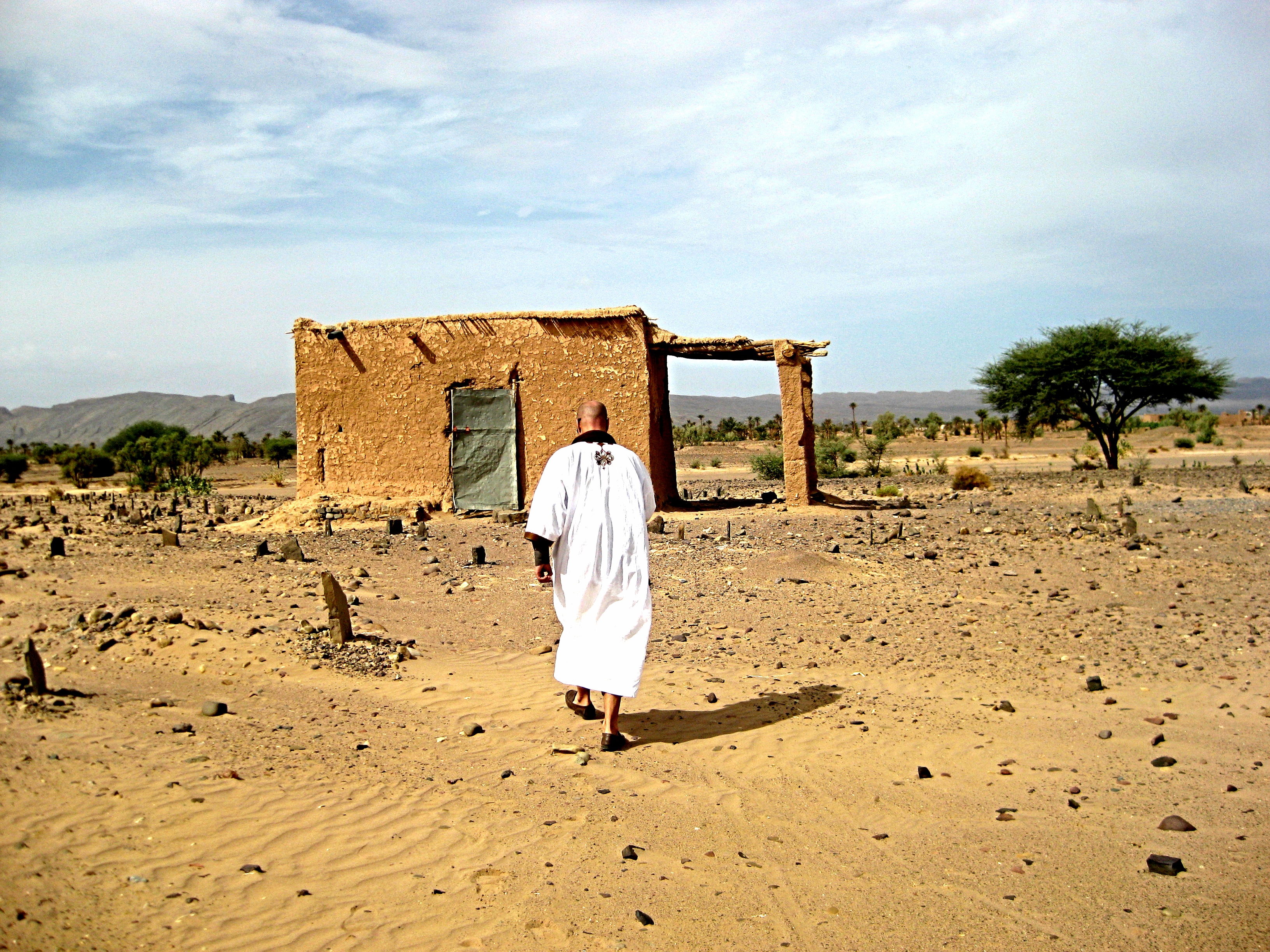
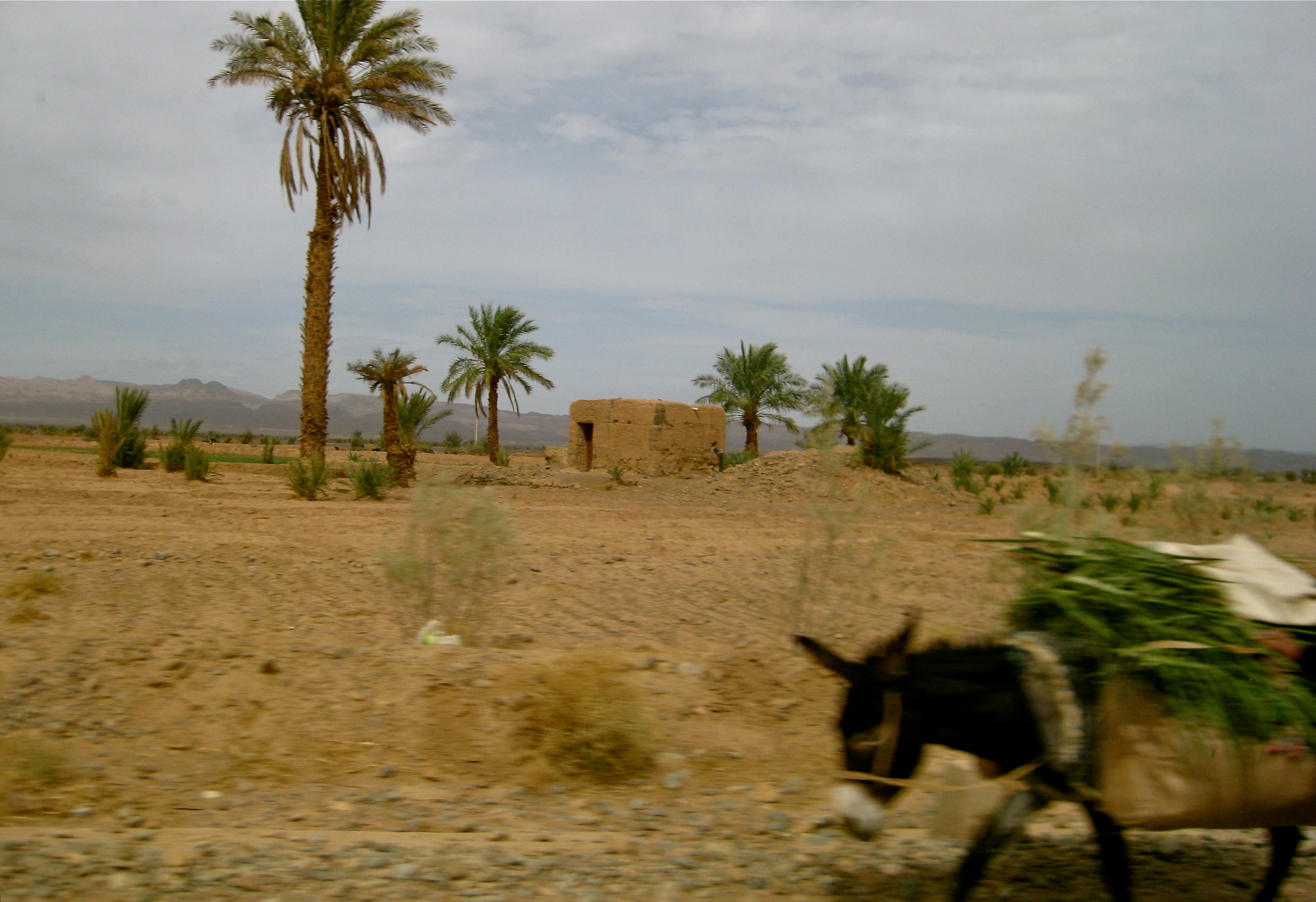
After a couple of days in a desert encampment, we packed up the 4x4s and headed for the town of Tinghir. The dusty, bone-jarring track out of the Sahara took us past a couple of nondescript villages, each with no more than half a dozen dwellings, a date palm or two, and an overloaded mule. When we came to a third such village, we barely gave it a glance; but as we were passing by, waving to some children who’d run out to gawk at us, the drivers pulled over. Our guide indicated that this was a stop, and so we tumbled out to look around.

What we saw was about a half acre of hard sand dotted with thousands of stones that appeared randomly strewn. We’d come upon a cemetery; the stones that seemed haphazard were markers on burial sites. Perpendicular stones signified males, horizontal stones, females. You could tell adults from children by the length of the mounds of hard sand heaped over the grave.

There were little bowls of pebbles on many of the graves. We speculated grandly about their meaning until our guide came up, shrugged, and explained that the pebbles were just to keep the bowls—receptacles for flowers and other memorial gifts—from blowing away in sandstorms.

Only three among all the graves bore the name of the person whose remains lay under the mounds. The rest were unmarked, similar in every respect. Identification of the dead, our guide reminded us, is forbidden among traditional believers for whom the democracy of death is a truth that needs teaching as often and by as many methods as possible—especially in places like this, where life’s cruel inequalities are crushingly apparent, and death is the only thing you can’t buy off with money.

The insistent anonymity of these graves rattled several people in our group. The prospect of being stripped of singularity after spending a lifetime trying so hard to achieve it was befuddling. Besides, most of us were bearing up fairly well in the face of life’s inequalities and felt no need to pull back the curtain on the fiction of our distinctiveness. It was all too candid and bleak. Several people were not sorry when the guide moved us along.

He pointed to a low adobe structure at the edge of the cemetery. Another shrine to another local saint. “Let’s go see it,” he said. We’d seen many shrines by this time, which explained the soft groans and slumped shoulders that greeted his suggestion. Like all tour groups everywhere, however, we trudged dutifully behind him.

The saint was buried inside the unadorned hut. Worse than unadorned, it seemed neglected, dark and close and (of course) full of cats. There was no light inside except for the brightness at the open door, which we had tugged halfway off its hinges when we came in. This seemed an unlikely place for veneration. One of us wondered aloud, “Does anyone even come here anymore?” As if on cue, three teenage boys materialized in the doorway.

They had seen us meandering around the cemetery, and watched as we entered the shrine. Now like gushy representatives of the Chamber of Commerce, they wanted to tell us all about it. “The saint answers many kinds of prayers,” they explained, “but specializes in women who cannot conceive. They come in all the time. They sit here all day. They eat and pray. They ask for children, and the saint hears them.”

“Do you mean they get pregnant and have babies after they pray here?” This from the one declared atheist in our group. “Do you believe that? That the saint works miracles?” The boys did not seem to understand the question. Neither did our guide. They said again, “They come, they pray, the saint hears them.”

By this time, our eyes had grown accustomed to the dark. We could now see the walls. They were patched and sooty and covered with graffiti. The guide said these were requests for help, reports of success, thanks for favors, but among the more devout scrawls we were sure there were also a few that told the world “Mustafa was here” and “Ali loves Faiza.” The more the guide denied it, the more convinced we became.

And then we saw the hands, dozens and dozens of small palm prints in bright henna stamped on the walls like Paleolithic cave drawings. These were women’s hands, supplicating, declaring presence and need, tattoos of trouble, imprints of hope.

The boys didn’t know how long they had been there, whether they were fresh or ancient, but said they did not remember a time without them.

Yes, I thought, that’s because there never has been a time without them. Here in this shrine or anywhere else.

And just like the graves outside, and like the human need they conveyed, the small red hands were  anonymous, almost interchangeable, absolutely democratic in desire.

Muhammed’s Cats

We were barely off the airplane in Casablanca when we noticed the cats. You couldn’t not notice the cats. They were everywhere, all the time, street cats with the hungry look of street cats, brazen and intrusive in tourist venues, city shops, and roadside cafes. But cute, always cute, especially the little ones; so cute that even the inevitable germophobe in the group risked the assault of unspeakable miseries to pet them.

In European cities like Rome, feral cats don’t often win local hearts, but the cats we saw in Morocco seemed not unwelcome. Tourists weren’t the only ones making mewing noises to signal the imminent drop of scraps from restaurant tables. Shallow bowls of water were set out everywhere too, even in the middle of what seemed like nowhere.

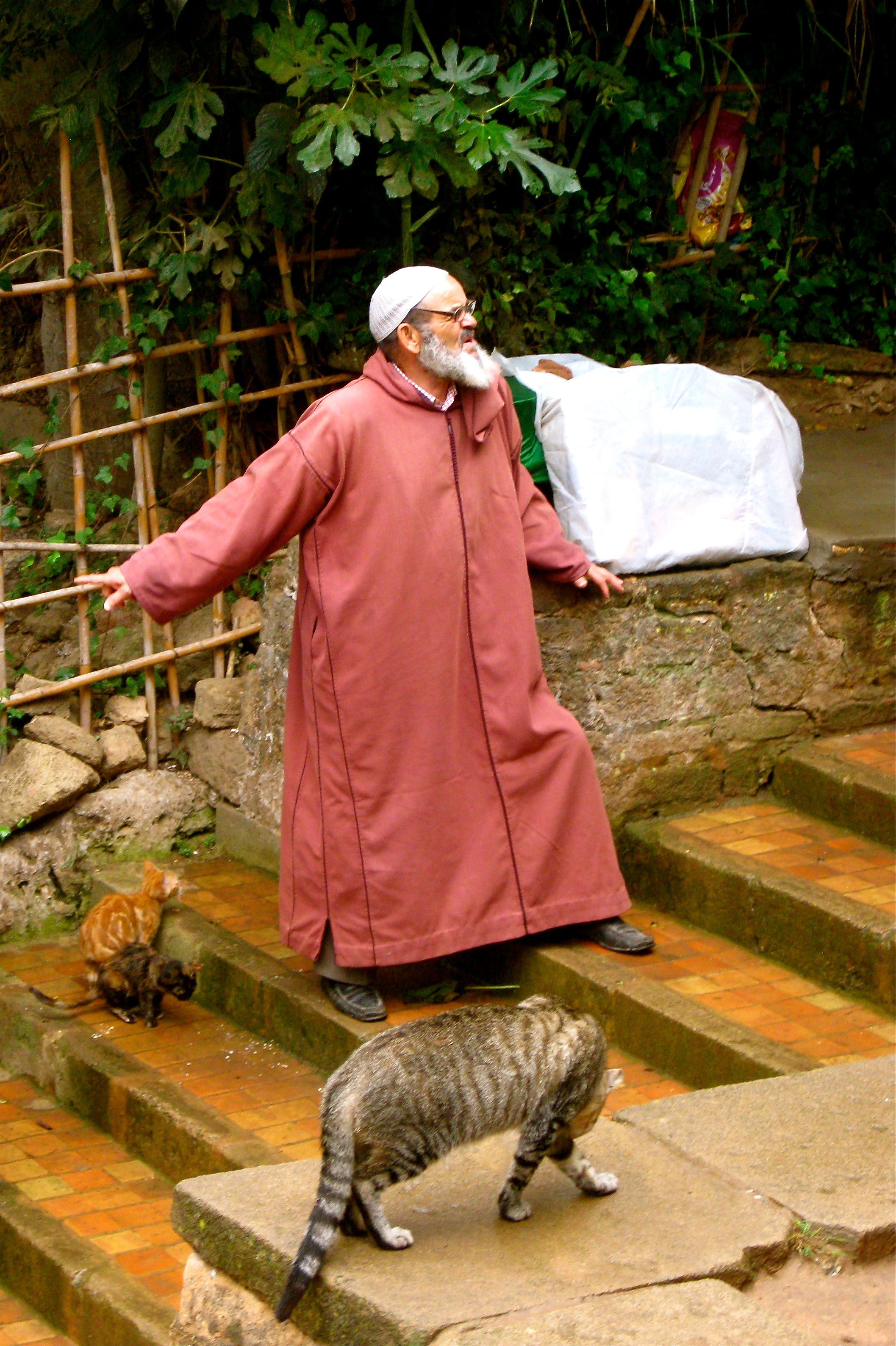
On a showery day in Rabat, we came across an old man inside the 14th century Chellah Necropolis. He was the unofficial guardian of a shrine inside the grounds. Devout Sunni Moroccans routinely deposit their raw needs at the feet of long-dead holy ones at such shrines, in hope of answered prayer, much like the Berber “pagans” and Christians in North Africa did before Islam arrived. Don’t ask me now which saint was venerated in that small dark room, there were so many shrines along the way, some imposing and ornate, but most as forlorn as the people who trudge to them. And they are filled with cats. The shrine in the Necropolis had its ample share, and the guardian fed and watered them every day, asking alms from visitors to offset the cost of his mercy.

He’d been there too many years to count, he told us, and so had most of the cats. They were his preoccupation. When a man in our group asked the obvious “Why?”, the guardian told us one of those short, slight stories that explain everything to those whose hearts want to know.

“Once upon a time, the Prophet awoke at the sound of the call to prayer and went to put on his best robe in order to pray. But he discovered that a cat, whose name was Muezza, was sound asleep on the sleeve. Rather than wake her, he got a pair of scissors and cut off the sleeve, leaving her there undisturbed.”

I liked that story very much, but it was another legend we heard in another town that captured my heart. Forgive me, Muhammed, but I think I fell for it so hard because it sounded a lot like a story Jesus would tell; and as much as I respect you, I am a hopeless sucker for him. Anyway, my Christian chauvinism aside, here it is:

“A woman with a bad reputation was returning from a night of debauchery when she saw a cat in the road. The wretched thing was starving, very close to death. The wicked woman ran into her house and filled one of her jeweled slippers with water, returned to the street, and set the slipper down before him. The cat drank and lived. Many years later, a holy man of that same town died and entered Paradise. There he saw the woman and was astonished. He asked the Prophet how it was she had found mercy. The prophet said, ‘Because she showed mercy, even to a cat.’”

Under my breath, I said (for my own instruction), “Go and do likewise.”

Come and Have Breakfast

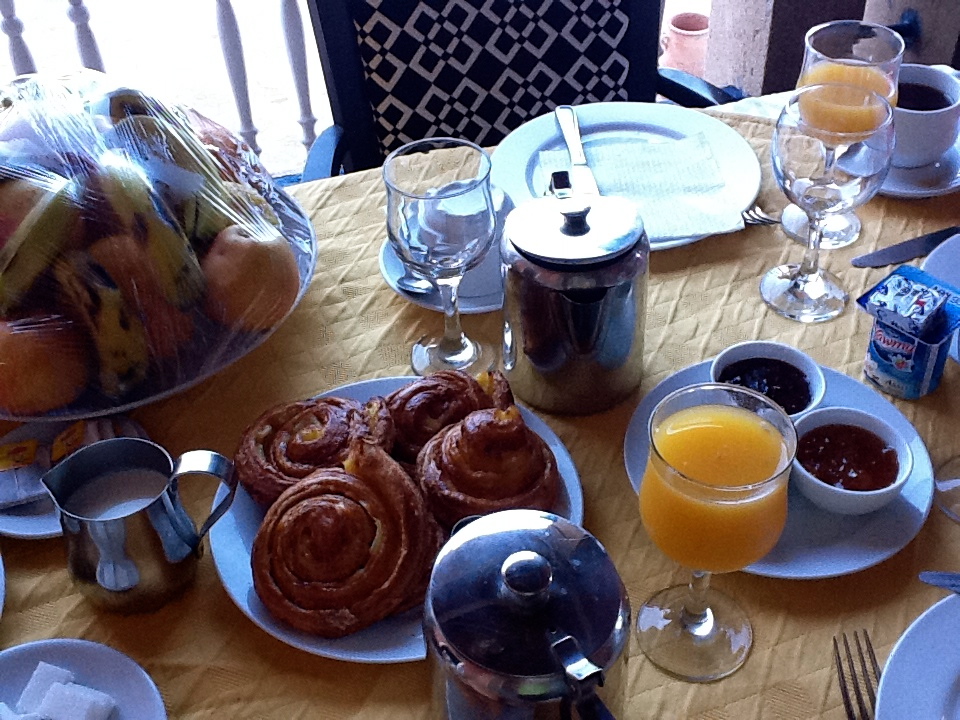
The first morning of our stay in Essaouira, our breakfast waiter met us at the dining room door to steer us to the table reserved for our small group of travelers. To our surprise, he did not seat us in the dining room. He led us instead to a table he had set for us, and for us alone, on an outdoor terrace overlooking the ocean.

You could tell he was pleased with himself: the smile that spread over his face when he saw our delight was positively beatific. “This will be your table every day,” he announced. “My name is Aziz.”

Aziz spoke Arabic, Berber and French, Morocco’s three official languages; he also spoke some German, pretty good Spanish, and passable English. In all these languages he was unfailingly exotic, old fashioned, over the top. He executed the most amazing flourishes and deep bows as he set down plate after plate of breakfast breads and pastries, huge bowls of fruit, hot coffee and milk, and fresh squeezed juice. Voilà. Voilà. Voilà.

He also made sure he learned our names so that he could greet us personally as we came to breakfast and inquire solicitously about our sleep and our health. Aziz was a quick study, and before we knew it, he had associated songs with some of our names, literary snatches with others, movie references to the rest. Even the bleary-eyed “I am not a morning person” member of our group was completely charmed by him when he broke into song or recited some corny verse tailored to her alone.

The cynic in me was tempted to think of Aziz as an astute showman who had figured out that Americans are suckers for this sort of local color and tip accordingly. And there was probably some of that in his behaviors. But I didn’t care. It’s not every day someone treats you like exalted royalty, let alone like a simple human being. It did wonders for me, who felt depleted and just this side of depressed at this point in the journey. I needed everything Aziz had to offer.

This was the morning dialogue he used with me:

“How are you today, Mary?”

“I’m fine, thank you, Aziz. How are you?”

“I am well if you are well, Mary. I am well if you are well.“

Of course I believed him.

When he flashed that smile, I had no doubt that his wellbeing hung on the thread of my own, his pleasure weighed in the balance with my delight. Of course he could not and would nor be happy if I were not, and so I resolved to be well for his sake. And for my own.

And of course on the last morning I slipped a very large bill into the pages of the memory book he begged us to sign with all his customary theatre and his brilliant, brilliant smile.


The Poor You Will Always Have With You [Matthew 26:11]


It wasn’t a very good lunch. The sweet, hard-working cook at our Sahara encampment had boxed it up for us to eat when we stopped for a break on the road through the High Atlas Mountains, but it didn’t represent his finest work. Inside each plastic bag was a slab of generic yellow cheese, 4 or 5 spicy green olives, an overcooked hardboiled egg (yes, you can overcook a hardboiled egg), two slices of pink mystery meat—the oddest and most forbidding cold-cuts I have ever seen— and one really beat up apple.

I ate mostly bread that afternoon. So did everyone else in the group. There was a lot of food left over.

By this point in our trip we’d been well schooled to throw nothing away. It was the custom to give leftovers to the poor, and we’d been doing that routinely in every city and town. We’d leave a restaurant or café with our remaining bread or meat or fruit wrapped up in napkins and hand it to the first person on the street who approached us begging. There were many such people, and no one ever refused our grease-stained packages.

But now we were deep in the High Atlas. We had gone for miles, hours, without seeing a soul. Most of us were so concentrated on the hairpin turns of the switchbacks we would probably not have noticed such a soul anyway, even if she had materialized atop the sheer cliffs or risen from the dry canyon floor below.

Our leftover lunches would be pretty disgusting by the time we reached a town. Not fit even for the poor, one person said. I recalled some of the beggars we’d seen, and doubted they would find even rancid food unfit. Nonetheless, the point was well taken—this stuff would probably go to waste on this part of the trip.

Someone else quipped that when Jesus said, “The poor you will always have with you,” he had not been on a bus in the middle of nowhere. General merriment ensued. I bit my tongue. The group had proven itself fairly impervious to nuance and complexity thus far, and there was not much hope things would change now.

A half hour later, when we had turned our minds to other things, our driver suddenly slowed the bus and pulled over. We didn’t know why. We looked out the windows, but saw only the same brown cliffs and hardscrabble valleys we’d been viewing for hours. But the driver waited. After about two minutes he said, “The lunches, the lunches.”

Our guide started collecting all the leftovers into one large bag. The driver opened the door and let him off. He ran down the road back in the direction we’d just come, jumped the low guardrail (which guarded nothing, really, just marked the edge of the narrow road) and started up a path into the hills; when out of nowhere—really, out of nowhere—a shepherd appeared. He strode nimbly down the hill and raised his arm in greeting, the only human being we’d seen for what seemed like a hundred miles.

There was an embrace and a kiss on both cheeks. When the food was proffered, the shepherd placed his right hand over his heart and patted it twice. The he took the bag, turned on his heel, and melted back into the rock, like a genie sucked back into his lantern. Our guide ran back to the bus and climbed on. The driver pulled back onto the road and smartly negotiated the next hairpin.

And I didn’t start breathing again until we came to the next pit stop, thirty kilometers down that winding road.


Almost Evening: Spirituality in the Face of Death [Luke 24: 13-35 ]

“Stay with us, because it is almost evening and the day is now nearly over.”

I ran into an old friend the other day. She’s a Baptist’s Baptist who hails from deep in the Bible Belt. Soul freedom personified, and a fierce free-churcher, she is not someone you’d expect to inhabit the same zip code as a Book of Common Prayer. But there it was… she had it in her hand.

I must have raised an eyebrow, because she immediately launched into an explanatory rant about how loopy worship services at her home church had become.

‘We never know what we’re going to get,’ she said. ‘Every week it’s amateur hour!’ A few Sundays before, it seems that instead of the sermon there was a fully-costumed skit announcing the Strawberry Fair. And just last week there was special music to honor the King…of Pop.  And every Sunday, she endures the vague churchy blather (her words, not mine!) of a pastor who can never quite pull off a single, simple, clear declarative sentence—subject, verb, object. ‘And,’ she said, ‘when that man prays, bless his heart’—if you’re from the South, that’s a phrase that makes it okay to say something bad about somebody—‘when he prays, bless his heart, you’d think it was the weather report on the morning news!’

“Dear God, we thank you for the blue sky and bright sun on this perfect spring day with temperatures hovering around 70 dry, breezy degrees. And for this high pressure area that’s going to ensure pleasant weather well into the week…“

So… she’s started going to an Episcopal church. Hence that BCP. She attends Morning Prayer, Eucharist, Evening Prayer—whatever’s on offer. With the ‘Piskies she gets a fixed liturgy, time-tested language, no guesswork. She can relax. “And,” she said, “it makes me cry.”

Now, I got the part about a fixed liturgy being a relief. But I wasn’t expecting her say, “It makes me cry.” And to mean ‘that’s a good thing.’ She’s not exactly sentimental.

So I echoed her, in my best imitation of a therapist, “It makes you cry….”

“Yes. Well, no,” she said. “not everything makes me cry. It’s mostly evening prayer that makes me cry. “

Evening prayer…”  I repeated.

“Yes. Well, no, not evening prayer as such.  One of the prayers in evening prayer, the collect, this one. It makes me cry.” And she opened the prayer book to read it to me. But I already knew which one it was going to be. Maybe you do too.

“Lord Jesus, stay with us, for evening is at hand and the day is past; be our companion in the way; kindle our hearts, and awaken hope, that we may know you as you are revealed in Scripture and the breaking of bread. Grant this for the sake of your love.  Amen.”

For years this prayer has been a devotional staple of mine for when I lay me down to sleep.  It makes me cry too… In part, I think, because my heart is easily smitten by a really great metaphor: Almost evening. Nightfall. The day passing away.

You know where this is going.

If you were to place this prayer on the lips of my 91-year-old father some Monday night, he wouldn’t be thinking, ‘Monday. Monday is almost over.’ He’d be thinking about how it’s all gone so fast. He’d make a stunning calculus of years behind and years ahead and wonder how it happened. He would say to himself, deep in that place in the soul where from time to time you dare to test out the truth, ‘It won’t be long. It’s almost evening. The day is far spent. Death is near.’

And, of course, he’s not the only one.

I occasionally spend time looking at photographs of myself as a child. Not so much because I’m vain, but because it’s bracing. It’s like the old monastic practice of keeping a skull in your cave. ‘Memento mori,’ says the wiry, sun-draped child sprawled like Huck Finn on a flat rock in the swift brook that empties into Stirrup Iron Pond on her grandfather’s farm.  She is so far away. She is impossible. I’m only 65, not 91, and yet I can’t reach her. I can’t really say in truth that I remember being her. She is a day drawing to a close. She is like an evening gone. She makes me cry.

Do you know what I mean?

Once upon a time, we had our whole lives ahead of us, and we imagined them a certain way as we hatched hopes and made plans for them. We cast ourselves as protagonists of beautiful unfolding stories: We’d have a loving, lasting marriage. We’d build a good career in a meaningful profession and stash enough money away for a comfortable retirement. And we would be fine people, people who do good and not harm. We’d eradicate world hunger by the time we were forty.

And then we wake up to find that we are forty and there is still world hunger, and that good intentions notwithstanding, we were more than occasionally mean or dishonest or selfish. Whatever we did or left undone, we managed to contribute our fair share of sin and stupidity to the vast reservoir of human pain and regret.

And then we wake up one day to find that we are fifty and our tattered marriage is no better now than it was when we were forty; or maybe we find that we don’t even have a marriage any more.

And then we turn around and we’re sixty, and we are have doubts about the meaning of our life’s work, and the money we thought we’d have is not as much as the money we actually have, and what we do have may not last until we die. And we are going to die. It wakes us up in the wee hours.

And I haven’t even mentioned what could happen at 70…

The day is far spent.  It is almost evening.
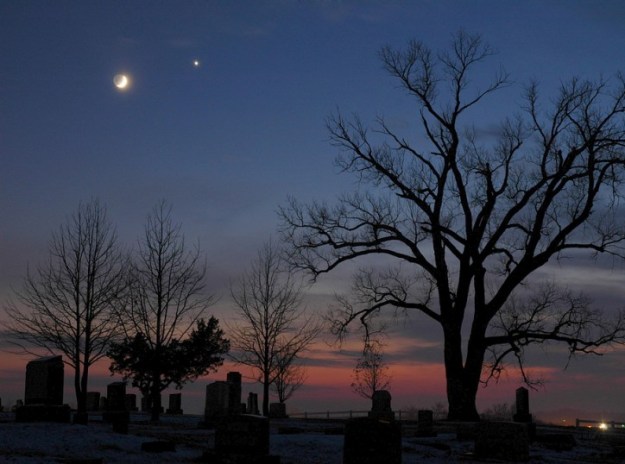
In the course of my teaching and preaching, I come across a lot of people who are really “into” spirituality. They also seem to know what it is, which I find fascinating, because I’ve been studying it for a good part of my life and I’m not sure I have any solid sense of it yet. But I have come to at least one conclusion about spirituality, not so much from study as from what happens in those wee hours when one is awakened by the sadness of things slipping away. I’ve learned it from the pathos that wells up and constricts your throat when you turn the soft black page of an old album and come face to face with a child who (they swear) is you, but you can’t exactly place her. I’ve learned it from the way tears come unbidden when at vespers we finally say out loud what we know is true, ‘It is almost night.’

I think if spirituality is about anything, it has ultimately to do with the immense grief that punctures the human heart, grief that stems from the knowledge that this one life is all we have, and that it is way too short, no matter when it ends, and that even if it is full of suffering, it is still too wonderful and precious to have to abandon, just like that, to the night that is fast approaching.

This grief is the subtext of every delight, the undertow of regret we feel even in the midst of ecstasy or quiet gratitude for the beauty and pleasure of this life, the smoldering rage we reflexively stoke up when we ponder the intractability of our fate, the fact that nothing can stay.

Spirituality must be about the kind of grief and fear that, left to its own devices, is capable of recasting our souls as one life-long, fatalistic shrug of the shoulders, rendering us indifferent to all kinds of intimate and global horror; or worse, making us cruel, able to take out our despair on the innocent.

If spirituality is about anything, I think it must have to do with this stunning human disappointment, the fact that we who love to live all die, that death is the one sure thing that is coming to us all.

The job of a devotional life, if I can put it that way, is to take us as we are—caught up in immense disappointment, traveling on a rough road to more of the same–and by grace, day by day, year after year, discipline us to know and embrace our heart’s anguish as the finite echo of another, infinite and encompassing reality: the fact that, although our deaths are sure, we were not made for death, but for a persevering love that cannot lose or leave us. When all is ended, love remains

The job of a spiritual practice is not to make us perfect people, holy people, or even better people, but simply to deposit us daily, routinely, in the way of this sustaining love; to accustom us to the familiar cadences of its voice, which we may not at first be able to place exactly, but which rings so true that it blazes; and to support these frail hearts as love makes mysterious, yet shining sense for us out of the grand story of the trustworthy ways of God; and shining, yet mysterious sense for us of our own stories in God.

And then, when we look up and register that it is almost evening, that the day is indeed ending and night is falling fast, we will know that our anxious prayer has already been answered, the prayer that goes, ‘Lord Jesus, stay with us.’ Our anxious prayer not to die, not to die forever, has already been answered and is never unanswered, no matter the strange disguise in which this answer may appear. Answered and never unanswered by the companionable One whose hands still bear the mark of nails and from whose open side we have all received grace after grace.

And after we have gone in with him and he has come in with us, after we have sat to eat with him, and after we have known him again and again together, there will be only one thing to do with the life he imparts: To get up and return to that rough and hopeless road to find some other pair, some other trudging hearts despondent over death, and say to them, “Love is living still!”

Angelology 101

Isaiah 6:1-8; Psalm 103:1-5; 20-22; Hebrews 1:1-9

Jim Janknegt

According to recent surveys of religious beliefs in America, 73% of us believe in angels. Many people also think that when we die, we go to heaven and become angels ourselves. TV shows and movies galore are based on this premise, and so was one of the ghastliest rock-‘n-roll songs ever written, “Teen Angel”—“That fateful night, the car was stalled upon the railroad tracks…” Google it if you are too young to remember.

But according to the Bible, it just isn’t so. Human beings and angels are and always will be two distinct species. As one theologian quipped a while back, you and I will never be angels. The good news is that we won’t ever be cockroaches either.

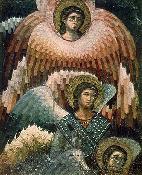
It’s very sweet that every Christmas since 1946 Jimmy Stewart has discovered anew that it’s a wonderful life as he is saved from despair by Clarence, an angel trainee trying to earn his wings. But it turns out that Clarence is wasting his efforts. Angels do not earn wings. With the famous exception of the six-winged seraphs we sing about in our hymns, angels in the Bible don’t have wings. (No one seems to have told this to artists down through the ages, however. There’s hardly a depiction of an angel anywhere that doesn’t include wings.)

Angels in scripture also have more important things to do than fish despondent Savings and Loans managers out of the drink. According to the Bible, it is not a major angelic function to snatch human beings’ personal chestnuts out of the fire. Neither do angels lurk about disguised as nice people who punctuate our anxious days with kindly coincidences. You are more likely to be slammed to the ground by an angel than sweetly touched by one. Just ask the biblical patriarch who once wrestled with one—you know, the guy with the limp.

Paul Guaguin

Angels in the Bible tend to be on the rather impressive side. The angel who left Jacob in need of a hip replacement could eat the cute cast of “Angels in the Outfield” for lunch. It’s not for nothing that in many instances the first thing angels say to people is, “Fear not!”

In the first lesson, Isaiah sees God surrounded by those six-winged seraphs. Their booming voices shake up the temple. Plaster is falling, smoke is rising, and the prophet is terrified. He immediately accepts two basic facts: God is holy, and he is not. He’s preparing to drop dead when one of the seraphim zooms toward him wielding tongs. The angel drops a red-hot coal on his mouth. Thus it is God distracts Isaiah from fruitlessly contemplating his own unworthiness and frees him up to hear and accept God’s call.

Angels are intelligent, spiritual entities who exist to do God’s bidding. Because that bidding often entails delivering messages to mortals, occasionally angels take human form, as three of them did when Abraham “welcomed angels without knowing it” under the oaks of Mamre.

Marc Chagal

But angels are normally invisible, part of the world beyond the thin veil that we refer to when we say, “I believe in God…maker of heaven and earth, and of all things seen and unseen.”

Although people pray to angels in some parts of the Christian family (all Roman Catholics have “guardian angels” assigned to them), the biblical record does not show us any angels interceding for us with God, or otherwise facilitating our salvation. They are creatures, not demi-gods, mini-gods, or intermediaries between us and God.

This is the point that the author of the Letter to the Hebrews is trying to make in the second lesson. He is addressing first-century Christians who seem to have been infected with angelmania, much like people in America at the end of the 20th century when Raphael’s two pudgy-armed cherubs were merchandised to death. The author of Hebrews is trying to persuade his community that angels cannot hold a candle to Christ, in whose name alone that they can confidently expect grace and favor from God. “To which angel,” he asks dismissively, “did God ever say, ‘You are my son?’”

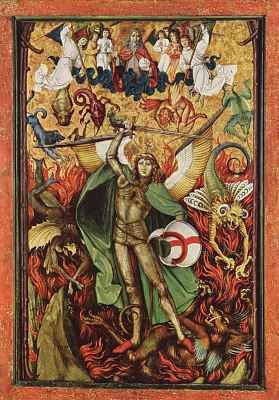
Like human beings, angels have free will, and that means that they can choose, and that means that at some point they could have chosen wrong. There is, for example, Christian midrash about a big angelic revolt against God after they had all gotten wind of the divine plan for a future Incarnation. Some of the purest ones flew into high dudgeon about the insult to God’s dignity such a plan entailed—they were hell-bent on saving God from God’s own folly. They were literally hell-bent when Michael, a loyal archangel, conquered their leader (another archangel named Lucifer), put down the revolt, and bounced him and all his minions out of paradise and down into hell, created especially for the occasion. From that time on, they have been called “devils.” So, the next time you bend over a baby carriage and coo, “What an angel!”, remember to specify what kind of angel you mean. You wouldn’t want to imply that the munchkin in the carriage is the spawn of Satan.

God’s angels are a lot like us—busy, busy, busy. They commute long distances to work. They multi-task. They ascend and descend Jacob’s ladder (which is one reason we know they don’t all have wings. Why climb if you can fly?).  They travel at the head of the Israelite column across the wilderness. They announce a couple of unplanned pregnancies to a couple of startled women. They guard the ark of the covenant and they stand with flaming swords at the locked gates of Paradise. They rejoice over the repentance of a single sinner. They minister to Jesus in the desert and in the Garden, and they announce his resurrection to the women at the tomb. And that’s just the short list of what angels get up to in the Bible.

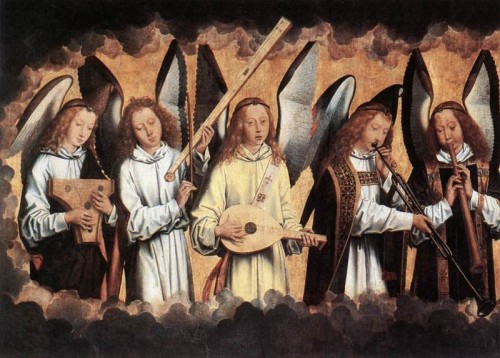
There are also countless ranks of stay-at-home angels who surround God’s throne night and day, behold God’s face, and incessantly cry out, “Holy!” and “Glory!” Apparently they do not get tired of doing this sort of thing. It turns out that angels are primarily worshippers. They are praise for God’s glory. Contrary to our assumptions about this angelic worship, however, the Bible never actually says that they sing. It does say that they play musical instruments—the psalms speak effusively of a veritable heavenly orchestra.

Too numerous to count, angels are a sabaoth, a host, and when push comes to shove—and the Bible says it surely will—they are an army. In the lurid Book of Revelation we are presented again with the angels’ general, Michael, the great Warrior Prince of Heaven. It is he, we are told, who will lead the angelic troops in the final apocalyptic struggle between God’s forces and Lucifer, the great star-sweeping Dragon. It will not surprise you to learn, therefore, that Michael is the patron saint of paratroopers. (He is also, inexplicably, the patron saint of green grocers.)

So, do you believe in angels?

Jews seem to have a happy tolerance for differences of opinion about just about everything, and so naturally they also disagree about whether belief in angels is a necessary element of Judaism. Observant Muslims, on the other hand, hold to a strict belief in angels as a basic tenet of faith. They especially honor Gabriel, who taught the 114 surahs of the Holy Qur’an to Muhammed (pbuh)—and yes, that’s the same Gabriel who told Mary to expect the baby Jesus and gave Daniel the gift of pre-Jungian dream interpretation.

Concerning belief in angels, Christians divide into the same camps we divide into about belief in a lot of other things. Christians to the ‘right’ tend to think that because angels are part of the biblical worldview, they absolutely must be part of ours too. Christians to the ‘left’ are more likely to think of belief in angels on a par with Elvis sightings and UFOs. Christians in the ‘middle’ usually can take ‘em or leave ‘em. They don’t think much about angels, except maybe at Christmas, or if they have some sort of odd experience that defies rational explanation, and the metaphor of ‘angel encounter’ seems as good a metaphor for what happened as any.

As for me, I know that belief in angels will not put me right with God or save my soul. But just because something isn’t necessary for salvation, or even for faithful discipleship, doesn’t mean it can’t do me some good. And one good thing that the Christian tradition about angels does for me is enliven my imagination.

Imagine with me, then.

Picture psychedelic seraphim, eyes plastered all over their strange forms, wings flapping madly. Imagine disruptive intrusions into a person’s life or a nation’s destiny.  Imagine bizarre and even painful angelic ministrations. All these things the angels do as God’s servants. And in their activity we glimpse something of God’s character. God is more than we want and nothing we expect. God is for us, but not like us. Much of what we think we know for sure about the divine turns out to be as elusive as Isaiah’s smoky vision in the wee hours. This is not comfortable news, but it is good news. It saves us from pride and certainty, and from the violence that is often the fruit of pride and certainty.

The angels conform to God’s purposes. They are created and exist solely to do God’s will. Their brilliance, strength, and ferocity are all ordered toward that one end. They are what it might feel and look like to love and serve the Lord with all our heart, mind, soul, and strength, as scripture commands. Their service is free and complete and confident; it is service with authority. Jesus taught us to pray, ‘Thy will be done on earth as it is in heaven.”  Who does God’s will in heaven? The angels do. Their responsiveness might be a model for our own.

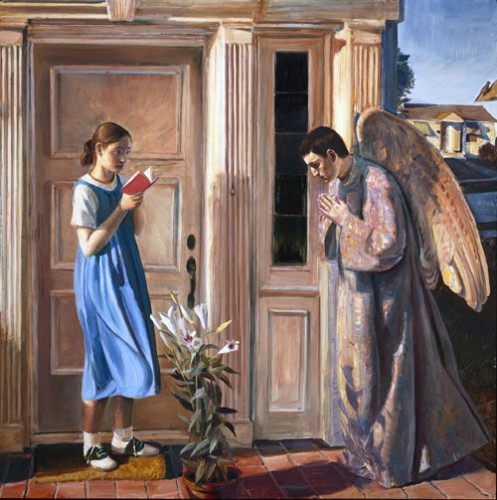
Angels are God’s messengers. The Greek word angelos means ‘messenger.’ It’s the same Greek word from which the word for ‘gospel’, or good news, derives—evangelion. Angels are announcers, word-bringers, heralds of glad tidings, and therefore life-changers by proxy. Imagine! What it is that we have been baptized into if not a herald’s role? We are not and never will be angels, but perhaps in the course of responding to our own callings, we can still make people jump, surprise them in their sleep or on the road with the announcement of God’s merciful purposes, God’s pleasure and God’s peace.

John Collier, Annunciation

The vocation of the angel army to defend God’s realm against evil confronts us with a question of great seriousness. Imagining that apocalyptic struggle, I imagine as well the earthly, human project of moral and spiritual growth. Do I expect it to unfold serenely? Will I not encounter enemies—the shallow world, the narrow mind, the fear-filled heart? Will they let me pass on towards my hopes for maturity and wisdom in peace, or will there be a fight? And what about the moral and spiritual well-being of others? Could the angels’ example of fighting hard for God’s interests prompt us to help someone in big personal trouble actually change the sad or self-destructive direction of his or her moral life? In addition to battling for societal and institutional justice, shouldn’t we be actively engaged in bringing sanity and strength to each other’s inner lives as well?

It is the nature of angels to worship night and day, crying out, “Glory!” and “Holy!” Every time we gather for worship, might we imagine that we are not doing it alone? Imagine that every sanctuary, when we gather as God’s people, is a thin place where earth and heaven meet, filling with the smoke of the angelic presence and the energy of their adoration? Imagine ourselves joined to their praise, engaged in the captivating duty of adoration? If you can imagine it, you may also feel a certain fright. Your heart may sink at the realization that you are so small, and a sinner. The One we worship is holy. But perhaps you can also imagine a fierce and determined seraph coming right at you with tongs, ready to burn off your protestations of unworthiness, and jolt you into a new freedom by which you will have courage to answer ‘yes’ when you are called.

Angels may or may not exist. But we do, and because we are people of story who live by beauty and imagination, we have done ourselves no harm—and we may have done ourselves some good—by thinking about them for a while. If you’re in a mood to do so, honor them too.

Their liturgical commemoration is October 2, the Feast of the Holy Angels.

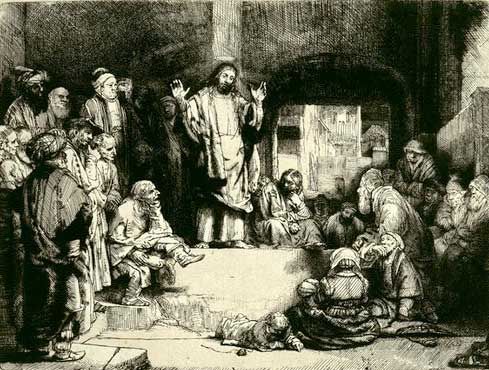
When The Teacher Comes Telling A Story

When the Teacher comes telling a story

and the story he’s telling is life,

it will pour down like rain,

it will spring up like grain.

Alleluia, sing glory, Amen!

When the Teacher comes telling a story

and the story he’s telling is light,

it will break clouds apart,

it will show you your heart.

Alleluia, sing glory, Amen!


When the Teacher comes telling a story

and the story he’s telling is hope

it will feed you like bread,

it will raise up the dead.

Alleluia, sing glory, Amen!

When the Teacher comes telling a story

and the story he’s telling is love,

it will heal like a song,

it will say you belong.

Alleluia, sing glory, Amen!

Sequela Christi: Francis and the Leper

Francis is easy to diminish: he’s a bird-preaching saint, a wolf-taming saint, a saint in your backyard propped up in a bathtub shrine, Francis on the half-shell. He is the peace saint, the ecology saint, the troubadour, the juggler, the Brother Sun, Sister moon, Donavan-Zeffirelli romantic, twirling ‘round and ‘round in a golden plain turning blood red with wild poppies as the sun heats up in May. He’s a lovely man.

Yes, he was.

And he was fierce and terrible in his loveliness, a medieval madman who wanted to be poor, poor as the wretched refuse that crowded every European town in the 13th century and filled the nostrils with the stench of that poverty. He wanted to share their lives. For him there was no middle way. It was who Christ was, it was where he would find him.

It is said that Francis, at the end of his life, got his desire to be literally like Christ. After he had been engaged in an intense period of prayer, people reported seeing wounds in his hands and his feet. It is also said that every day after that until he begged to be laid naked on the cold stone floor of his cell to finish dying, he suffered the pain Jesus knew on the cross.

I don’t know about that, and neither does anyone but Francis and God. Here’s what I do know. The fullness of Francis’ transformation into the Jesus he loved so much did not happen on Mount Alvernia when the mark of nails was seared into his flesh. If it happened at any one moment, it was  two decades earlier. He had gone to Rome to find faith and forgiveness at all its shrines. He had found none. In fact the only place where anything like insight had come to him was when on impulse he paid a poor man to change clothes with him, and spent the day in the streets of the city begging with the beggars.

It was not a serious moment. Play, really. But it shifted something.

On his way home, on the outskirts of town, Jesus was waiting for him in the road. And Francis, who somehow knew he was coming, got off his horse and went to him. Here is the story:

Excerpted from Salvation: Scenes from the Life of St. Francis, by Valerie Martin,

The leper stands in the middle of the road, perfectly still. One hand rests on the bell cord around his neck, the other hangs limply at his side. He is dressed in a filthy garment, patched together from bits of sacking and undyed wool, which hangs loosely upon his emaciated body. He regards Francesco and the horse steadily, his head slightly turned and his chin lifted, the better to see them, for his disease has eaten away half his of face and he has only one eye.

Francesco does not speak, he cannot move. They face each other on the road, and the sun pours down over them, so that there are no shadows anywhere, nothing to soften or dim the reality of this encounter and nowhere to hide from the necessity of playing it out. The leper’s eye drills into Francesco; he can feel it penetrating into his brain. From childhood he has had a horror of lepers, and he has always avoided the  lazaretto at the foot of Mount Subasio, where they sometimes congregate in the road, ringing their bells and calling out for alms. The stench rising from their rotting flesh, their phlegmy, guttural voices, pursue him in dreams, from which he wakes sweating and shouting for help.

But this is no dream, and there is no point in shouting now, for no one will hear. He glances back down the road and into the neat ranks of olive trees. The world is uncommonly still.

He could ride on. There is no reason to stop. As he passes, he can throw down his last coin to the leper. His horse lifts one hoof and paws the dirt. It is time to go on, to go home. As Francesco drops his hand to the reins, his eyes fall upon his own expensive, well-fitting glove, and it dawns on him that this leper is not wearing gloves, which is odd; he and his kind are required to wear them when they leave their hospitals, just as they are required to wear and ring their bells to warn the unwary traveler of their approach. Again Francesco looks down upon the solitary figure of the leper, who has not moved a muscle. His hand is still wrapped around the cord of the bell, his head arrested at an angle. He is like a weatherbeaten statue, and Francesco has the sense the he has been standing there, in his path, forever.
Something has been coming toward him, or he has been coming to something; he has known this for some time, and he has bent his energy in the direction of finding out what it might be. This was the reason for his pilgrimage to Roma. At the shrines he recited the requisite prayers, gazed upon relics, bones, bits of hair and cloth, vials of blood and tears, proffered the proper offerings, but he did not feel the burden of his sins lifted, and this spiritual restlessness drove him on. Only when he was with the beggars beneath the portico at the basilica did he feel some respite from this condition of urgent expectancy.

He is in the grip of it again as he swings one leg over the saddle and drops to the ground beside his horse. The stillness of the world makes every sound acute: the clicking of the bridle chain as he leads the animal to a green patch nearby, the sound of grass tearing, and then the big jaws grinding as the horse chews the first clump. Francesco runs his hands through his hair, bats the dust from the front of his surcoat, and turns to face the man, who is there, waiting for him.

The leper watches him with interest. His blasted face is bathed in sunlight; the black hole that was his eye has a steely sheen, and a few moist drops on his lips glitter like precious stones. He moves at last, releasing his bell cord and extending his hand slowly, palm up, before him.

This supplicating gesture releases Francesco, for it dictates the countergesture, which he realizes he longs to make. Without hesitation, he strides across the distance separating him from his obligation, smiling all the while as if stepping out to greet an old and dear friend. He opens his purse, extracts the thin piece of silver inside it, and closes it up again. He is closer now than he has ever been to one of those unfortunate beings, and the old familiar reaction of disgust and nausea rises up, nearly choking him, but he battles it down. He can hear the rasp of the leper’s diseased, difficult breath, rattling and wet.

The war between Francesco’s will and his reluctance overmasters him; he misses a step, recovers, then drops to one knee before the outstretched hand, which is hardly recognizable as a hand but is rather a lumpish, misshapen thing, the fingers so swollen and calloused that they are hardly differentiated, the flesh as hard as an animal’s rough paw. Carefully, Francesco places his coin in the open palm, where it glitters, hot and white.

For a moment he tries to form some simple speech, some pleasantry that will restore him to the ordinary world, but even as he struggles, he understands that this world is gone from him now, that there is no turning back; it was only so much smoke, blinding and confusing him, but he has come through it somehow, he has found the source of it, and now, at last, he is standing in the fire. Tenderly he takes the leper’s hand, tenderly he brings it to his lips. At once his mouth is flooded with an unearthly sweetness, which pours over his tongue, sweet and hot, burning his throat and bringing sudden tears to his eyes. These tears moisten the corrupted hand he presses to his mouth. His ears are filled with the sound of wind, and he can feel the wind chilling his face, a cold, harsh wind blowing toward him from the future, blowing away everything that has come before this moment, which he has longed for and dreaded, as if he thought he might not live through it. He reaches up, clinging to the leper’s tunic, for the wind is so strong, so cold, he fears he cannot stand against it. Behind him, the horse lifts his head from his grazing and lets out a long, impatient whinny, but Francesco does not hear him. He is there in the road, rising to his feet, and the leper assists him, holding him by the shoulders. Then the two men clutch each other, their faces pressed close together, their arms entwined. The sun beats down, the air is hot and still, yet they appear to be caught in a whirlwind. Their clothes whip about, their hair stands on end; they hold on to each other for dear life.

Making Joy: Francis Preaches to the Birds

In a collection of 14th c. legends about Francis, I Fioretti, each vignette is a clear echo of Francis’ spirit and personality, but these “little flowers” are hardly the stuff of cold hard fact. And that’s just right. For there’s nothing like a story to tell us the truth.

Several of the fioretti involve animals. And miracles. Although not miracles so much as signs, like Jesus’ miracles were. Signs of the intentions of God to work life in the midst of death, draw joy from the wells of pain, make rich the poor, and refresh all creatures with freedom. Signs of a new heaven and a new earth, the Garden that was, and is, and is coming.

In these stories when Francis speaks and acts, it is as if we are deposited in that Garden: humans and beasts are at ease with one another, the cosmos is attentive to God, and all created things are responsive to their charge to be creatures, and simply by being creatures to glorify God.

When Francis and natural things are engaged in creature-to-creature delight, we who hear of it through stories like these are ushered into the time beyond time, as a newer hymn says, in which “praise is the healing, praise the glory, praise the final mystery.”

And in this praising lies the simplicity and freedom of what some have called original blessing. The simplicity and freedom, the lightness that lifts the wings of birds and the hearts even of the poor.

When Francis strides into a field—ragged, penniless, a man transported with joy that he is in infinite debt—and preaches that blessing to the birds, morning breaks like the first morning, blackbird speaks like the first bird.

Here’s the story:

Francis Preaches to the Birds

A short time after his conversion, Francis was uncertain about what he should do—whether to go apart from the world and devote himself only to prayer, or go into the world and preach the Gospel. And so he called Brother Masseo and said to him: “Go to Sister Clare, and ask her to pray that I may see clearly whether it is God’s will that I should preach. Then go to Brother Silvester, and ask him the same favor.” Brother Masseo did as St Francis said.

After a while, Brother Masseo returned to Francis. Francis received him with love, washed his feet, and served him at dinner. Then he called Brother Masseo into the forest. He knelt down before him, and said: “What answer do you bring me? What does my Lord want me to do?”

Brother Masseo answered: “The Lord has revealed to Brother Silvester and Sister Clare that you should preach; for you have not been called to help yourself alone, but also to help others.”

Then, filled with joy, Francis got up, and said, “Let us go in the name of God!” He took Brother Masseo and Brother Agnolo and set out, but he did not choose the road: he let himself be guided by God’s Spirit.

Along their way, Francis saw a great multitude of birds on some trees, and he was very taken with them. He said to his companions, “Wait for me here. I am going to preach to my little sisters the birds.”  He set off into the field. There he began to preach to the birds on the ground, and all those on the trees also flocked to him. They listened attentively to Francis, and did not fly away until he had given them his blessing.

Here is what Francis said to the birds:

“My little sisters the birds, you owe everything to your Creator. Therefore you should sing God’s praise always and everywhere, because God has given you freedom to fly; and although you neither spin nor sew, you have been given beautiful clothing. God sent two of your species into the Ark with Noah so that you might not be lost to the world; and God feeds you, though you neither sow nor reap. God has given you fountains and rivers to quench your thirst, mountains and valleys in which to take refuge, and trees in which to build your nests. Your Creator loves you very much. So, my little sisters, do not ever be ungrateful, but praise. Praise God.”

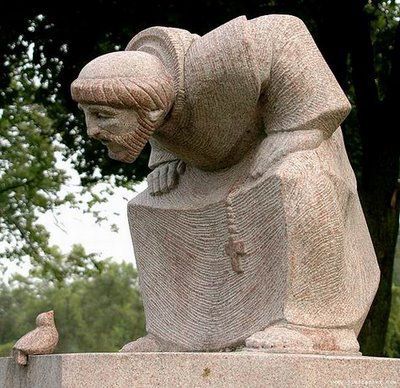
[“God’s Fool,” by Frank C Gaylord, of Barrem VT. Found in SS Peter and Paul Cemetery in Naperville, Illinois.] 

Then the birds began to open their beaks, stretch their necks, spread their wings, and bow their heads, showing their joy by their movements and their songs. Francis rejoiced with them, giving thanks to the Creator. Then he made the sign of the cross, and let them fly away.

All the birds rose into the air, singing. They divided themselves into four companies. One flew towards the east, another towards the west, one towards the south, and one towards the north; each company singing most wonderfully as it flew, encumbered by nothing; signifying that Francis and his brothers, and Clare and her sisters, like little birds, should possess nothing in this world, but should cast all the care of their lives on the goodness and providence of God.


Making Peace: Francis and the Wolf of Gubbio


Francis’ world was all about war.

The war between his father, a wealthy middle class cloth merchant climbing the social ladder, and Francis, with his natural impulse to generosity, giving away his father’s things to beggars on the street.

Constant war among the hilltown communes.

Struggles between the pope and the emperor.  Conquest, invasion, pogroms.

And a church split into heretical movements, the most persistent  of which denied the true humanity, the real human flesh, of the Savior.

Francis had gone to war before his conversion. He was not a good soldier. He was afraid, he was horrified, he got sick. After his conversion, he was determined to make peace. To reconcile enemies. To befriend everyone.

This was not, however, a mere psychological reaction against violence. Because by now he had read the gospels. And he had heard a voice tell him to mend the church. He thought it meant a chapel that had fallen into disrepair, and so he became a builder. But the charge went deeper: to mend the riven church, and to extend the mercy of mending  to the whole world.

That’s why he gathered a company around him. That’s why he sent them to preach compassion. That’s why he is the patron saint of stowaways, having hidden on a boat going East where he hoped to convert the sultan and end the bloody horror of the Crusades. He did not succeed, but it is said that the sultan thought he was a lovely man, and made sure he got home safely.

He was not naïve. He knew what he was up against.  But he believed in Jesus. And so he kept at it, even when in the last years of his short and painful life, his own brother Franciscans went to war with him about the most important thing of all—the vow to be poor, to own nothing, and thus to be free of the vested interests that come with possessions so that one could be an unencumbered maker of peace among all who called each other enemies.

It’s a battle Francis lost to semantics—the new rule was that the brothers would not own things, but they could make use of things. Before Francis was cold in his grave they began to build the great stone basilica where today his body lies.

“Make me an instrument of your peace,” Franciscans pray in his spirit.

“O send us an instrument of your peace,” prayed the good folk of Gubbio. And they really needed one.They had a wolf. Or better said, the wolf had them.

Along came Francis, filled with compassion for the terror of the people, and, please note, filled with compassion for the hunger of the wolf.

Here’s the story:

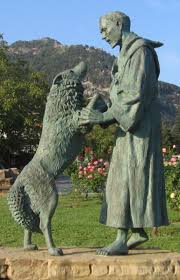
Francis and the Wolf of Gubbio

From I Fioretti [The Little Flowers of Saint Francis]

While Francis was living in Gubbio, a large wolf appeared in the neighborhood, terrible and fierce. He preyed on livestock, and he ate people too.  And because he often lurked near town, everyone went about armed, as if going to battle. But all defense was useless. Anyone whom the wolf surprised alone was devoured. Because they were so afraid, the people did not dare venture outside the city walls.

Seeing this, Francis was moved with compassion. He decided to go and meet the wolf, although everyone begged him not to. Putting his confidence in God, he started out of the city, taking some of the brothers with him. But they held back at the gate, and so Francis went alone towards the place where the wolf was known to lurk, while people watched from a distance.

The wolf saw him coming, and he charged Francis with his jaws wide open. Francis cried out: “Come to me, brother wolf. But I command you, in the name of Christ, not to harm me nor anybody else.”

Immediately, the terrible wolf stopped in his tracks and closed his jaws. He approached Francis quietly, and curled up at his feet, meek as a lamb.

Then Francis said to him: “Brother wolf, you have done much harm in this land, destroying and killing the creatures of God. You have destroyed livestock and people. You deserve to be hanged like a murderer. Everyone cries out against you, the dogs pursue you, all the inhabitants of this city are your enemies. But there can be peace, O brother wolf, if you stop harming them, and if they forgive you all you sins.”

The wolf listened to Francis. Then he bowed his head, and by that sign agreed.

Then Francis said: “Because you are willing to make peace, I promise you that you shall be fed every day by the inhabitants of this land as long as you live among them; you shall no longer suffer hunger, because I know it is hunger that makes you do so much evil. But if I can get the people to agree, you must promise for your part never again to attack any animal or human being. Do you promise?”

Then the wolf, bowing his head, consented.

“Brother wolf” Francis said, “Can I trust your promise?” And he extended his hand. The wolf lifted his right paw and placed it in Francis’ hand, giving him his pledge.  Then Francis said: “Brother wolf, follow me now, without hesitation or doubting, that we may go together to ratify this peace which we have made in the name of God.”

And the wolf walked along by his side as meekly as a lamb.

All the inhabitants of Gubbio, men and women, small and great, young and old, flocked to the market-place to see Francis and the wolf. Francis said: “Listen, my sisters and brothers: this wolf has promised to make peace with you. Now you must promise to give him each day his necessary food; and if you consent, I promise in his name that he will most faithfully observe the agreement.”

Then they all promised to feed the wolf to the end of his days.

Then Francis, addressing the wolf, said again: “And you, brother Wolf, do you promise to keep the compact, and never again to offend man or beast, or any other creature?”

The wolf knelt down, bowed his head, lifted his paw, he placed it in Francis’ hand .

Then all the people lifted their voices to heaven, praising and blessing God.

The wolf lived two more years in Gubbio. Every day he went from door to door without harming anyone, and all the people received him courteously, feeding him with pleasure, and no dog barked at him.

When the wolf died of old age, the people mourned his loss; for when they saw him going about so gently amongst them all, he reminded them of Francis.