Author Archives: sicutlocutusest

Yes and Amen


Spirit of comfort and demand, of callings and questions, stirring, coaxing, leading:

Spell out in us today the strong little word that makes the difference. Give us your yes, and make it our own.

And if the yes you give us cools or fades from sight, find it with your all-seeing light in the recesses of our hearts, warm it up by your ardent breath, and put it back on our lips where it belongs.

Even as we kick and scream, doubt and wonder, ponder, brood and bargain, make us say it, live it, become it.

Crown us with it, and impel us to offer it and share it, rejoicing in the full life you are making for all by the liberating power of one small word. In other words, Amen.

Stay in the Boat

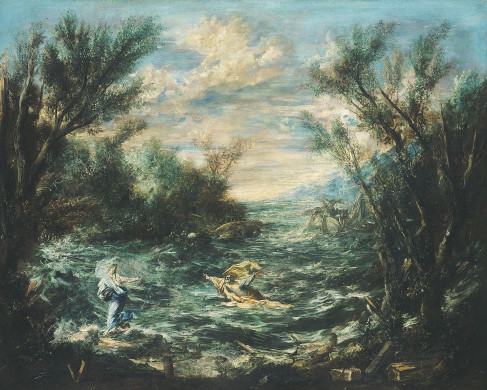
Matthew 14:22-33 After Jesus has fed thousands of hungry people with five loaves and two fish, he sends the people home. It’s late, but he wants to pray, so he tells the disciples to take the boat back across the lake. He’ll meet them later. Now, if someone says, “You go ahead in the boat, I’ll meet you later,” you think, okay, he’s going to go on foot around the lake, or maybe take another boat across. You don’t think he’ll walk to you on water. So when the disciples see someone walking on the water, when they all stand up in the boat and lean way out to get a good look, they’re not thinking, “Oh, that’s Jesus.” They’re thinking, ”Oh, Jesus, that’s a ghost.” And so you can also imagine how relieved they are when that familiar voice calls out and says something they’ve heard before: “Don’t be afraid. It’s me.” I imagine they are so relieved they sit right back down in the boat. They sit right back down and they grin at each other with those goofy grins you can’t help grinning when things that should have turned out really really bad turn out really really good. Jesus said he’d meet them. They assumed he meant on dry land. But it’s out here, in the wind and waves, in the wee hours, just when they’re most exhausted and aren’t making any headway at all. “Don’t be afraid. It’s me,” he says. And at that, everybody sits down and waits for him to get there and climb in. Everybody, that is, but Peter. We know what he does. He challenges Jesus, and Jesus challenges him back. We know that he sinks, and that he cries out, “Lord, save me!” We know that Jesus grabs him in the nick of time, and that Jesus asks him,  “Why did you doubt?” Now, when we hear that bit about doubting, we think Jesus is scolding Peter for noticing the waves and the wind. And it’s true. He notices, he wavers, he sinks. But it’s doubt that gets him onto the water in the first place. His doubt begins before he even leaves the boat. All the other disciples take Jesus as his word. It’s him. There’s nothing to fear. That’s why they sit back down. They believe it’s him. He’s coming. That’s all they need to know. But Peter says, “If it is you…” If you are who you say you are. You’ll have to prove it to me. Do a trick, a miracle, something cool and spectacular.  Like, tell me to walk to you on the water. Where have we heard this before? “If you are the Son of God, turn these stones into bread, or better yet, jump off the temple pinnacle and see if the angels will catch you.” That’s Satan tempting Jesus in the wilderness. “If you are the Son of God, let’s see you come down off that cross and save yourself.” That’s the mockers tempting Jesus as he was dying. “If it’s really you, show me the nail marks your hands.” That’s Thomas tempting Jesus after the resurrection. The minute Peter says, “If it’s you, command that I walk to you on water,” he joins the company of the tempters, and that’s not good. Jesus calls him “little faith” not so much because he gets scared and starts to sink, but because he didn’t sit down when the others did, he couldn’t wait like they waited, he wouldn’t stay in the boat. Now, I know we often hear this story differently. We make fun of Peter for sinking, but we admire his courage and impetuosity. We think it took guts and faith to get out of the boat. We like people who strike out on their own and take risks. If you’re going to do something bold for God, you can’t just sit there. You have to do something. Faith climbs over the side, faith walks out to Jesus. Yes, you’ll have doubts. Yes sometimes you’ll go under. That’s okay. Jesus will give you a hand. So get out of the boat. Just do it. That’s the way we often read this story. Like a Nike ad. But the early Christians who handed this story down to us saw it differently. For them, the best thing you can do is trust Jesus’ promise that he is either already always with us or that he is always on his way to us. Trust that it’s him when he says so. Trust him enough not to tempt him, not to try to be him, not to walk on water, but to leave that to him and stay in the boat. Why in the boat? Because he’s getting in it, and you want to be with him. And because that’s where your sisters and brothers are, and you want to be with them too. Because life is treacherous and hard and it’s easy to get picked off by its cares if you go it alone. Because evil is real and you’re easy prey if you think you can confront it alone or depend on your own virtue to avoid it. Because human sin and woundedness require compassion and healing and forgiveness, but we are unlikely to grant ourselves such gifts, such is the depth of our confusion and shame. Because we do not save ourselves and we cannot be saved alone. If there is any safety to be had in this life, it does not come through self-sufficiency, but by discovering the companionship of God, and by sailing through thick and thin with other companion disciples. If we find healing in this life, it won’t be because we went it alone, but because by God’s grace we found good company, and by that same grace we bound ourselves to Christ and to others in affection and accountability. If there is hope for us, it lies in telling each other stories and singing each other songs, and eating from each others’ hands, and showing each other our dreams and visions, and reminding each other where we’d be if there were no boat, no companions, and no fearless Christ with us, but only rising water, only howling wind. If we live to see the dawn it will be because through every adversity we have sailed together.

Today our story tells us to take Jesus at his word. To wait for him to arrive. To watch how he comes to us no matter how high the waves. He’s on his way, here even now, with us till the end of the age. Our story says, don’t be afraid, just sit tight, glad of the good company that gives meaning and hope to life’s sailing. Be a steadfast companion. Stay in the boat.

****

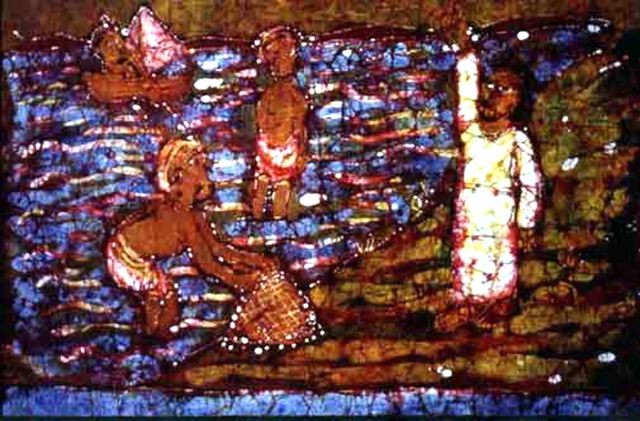
Credit: Deacon Matthew Garrett of http://www.holy-icons.com for the icon image of the Mystical Church, above.
l

Sitting under Trees, Resting under Vines: A Reflection for Peace Day

Micah 4:1-4; John 15:1-8; Revelation 21-22

Seven years ago, the Israeli Defense Ministry began investigating the theft of Palestinian olive trees. Black market trade in the trees was growing as Israeli government contractors confiscated and cleared Palestinian land in order to build an 80-mile-long barrier to stop suicide bombers from infiltrating into Israel. It appears that the government contractors were uprooting the trees and selling them to wealthy Israelis and to local town councils for their gardens and parks.

Olive trees are extremely hardy. They can weather great shocks — uprooting, transplanting, sometimes even frost, fire and, of course, flood.  When the waters of the Great Flood receded, the Book of Genesis says, it was from a hardy, surviving olive tree that the dove from the ark plucked a silver branch to carry back to Noah as a sign that the land was dry and salvation was near. Some gnarled old olive trees in the Garden of Gethsemene are said to date from the time of Jesus, although that is certainly not true. But there are olive trees there that are among the oldest in the world. And that may be why the olive branch is a symbol of peace — olive trees grow and mature very slowly, they abide, they endure, they outlast just about everything. And they are beautiful.

News of the illegal sale of Palestinian olive trees leaked out after a contractor offered two reporters 100 large trees for $250 each. The reporters also found one ancient tree on sale at a plant nursery for nearly $5,000. An official of the military command was implicated in that transaction. The Defense Ministry, which is in charge of building the security fence, stated that the Ministry pays contractors only to uproot and replant the trees; no one has permission to sell them. The contracts require that the trees be replanted in areas their owners suggest, away from the security zone; however, an Israeli human rights organization reported that these relocations were not taking place.

For the people who buy them, the trees have ornamental value. They have a different value for the people who owned them. They are the lifeblood of Palestinian agriculture, almost the only crop growing on the stony hills of the West Bank that does not need irrigation. The olives are precious. Many Palestinians are unemployed after all the years of violence; their staple diet is bread and olive oil.

According to some estimates, the wall will eventually take the land of 11,000 Palestinian farmers. One farmer complained that 44 of his 50 acres had been confiscated, and he had lost 2,700 fruit and olive trees. His village lost 7 wells, 15,000 olive trees and 50,000 citrus other fruit trees. The Palestinian Agriculture Ministry says that in the two years of fence-building to protect the settlers, over 200,000 olive trees have been destroyed.[1]

The contractors, the soldiers, the settlers, the corrupt officials — none of them, it seems, has read the Book of Deuteronomy. “Seek peace and pursue it,” the Torah teaches.  But even if you should fail, “Even if you are at war with a city . . . you shall not destroy its trees” (20: 19-20).

To sit unafraid under your own tree, to rest peacefully under your own vine — in this single striking image, the prophet Micah crystallizes God’s great vision of healing and wholeness for the creation. All the peoples of earth stream to God’s mountain where God presides. God judges them with divine insight. God instructs them with divine wisdom. Thus they stop learning war.

They dedicate themselves instead to the hot, hard and artful work of the blacksmith, pounding swords into plowshares and spears into pruning hooks. And then, when fear is gone, when nothing can harm them, when they too do no harm to anything on God’s holy mountain, they all sit beneath their own trees — their figs, their olives, their lemons — and rest under their vines. The fellowship, the well-being, the harmony, the presence of God is their shade. This, Micah implies, is God’s great shalom!

Do you sense what God’s shalom is like? It seems that many of us do, if polls are to be trusted. A poll I read a few weeks ago reported that of the huge number of Christians in this country who claim to be regular “churchgoers,” nearly 80% say we feel closest to God, most whole and most at peace with ourselves, our neighbors and the universe when we are out in nature, not in church.

And it doesn’t have to be Yosemite or Big Sur to awaken in us this intuition — memory? foretaste? — of God’s shalom.  An old Italian guy who lived a few blocks away from us in Somerville had a backyard that couldn’t have been more than 12′ x 14′, but he grew everything imaginable in there, including fruit trees. One was a weird-looking fig under which he abided amiably on Sunday morning and smoked cigarettes as the bells of St. Anne’s church summoned the rest of the neighborhood, including his wife, to mass.

Sometimes when you walked by his corner, only the wispy smoke told you he was there, sitting squarely on his old cane chair, because in the shade his face was the color of fig tree bark. He blended in. At times he seemed to be a plant himself, an old, thick, person-shaped vine with male pattern baldness. The bells would ring all morning — there were three masses — but still he abided, the garden his sanctuary, the fig tree heaven’s tent, and the lazy smoke his incense, rising to God.

You probably have your own version of shalom, maybe a special place that restores you. Your probably have glimpsed the truth and loveliness of creation’s web in some small way and have, as a result, your own story of what it’s like to stream towards God’s holy mountain. My father’s story might be about a hammock in the back yard, stretched between an aluminum pole he painted green and a maple tree that lightening struck years ago and split down the middle. Unable to bear the loss, he bolted it back together. Somehow, it survived, and he lazes about in its shade now and talks to the birds, mistaking himself for St Francis.

Mine is a cherry orchard in the Sabine Hills, north of Rome, a place I once lived and to which I’ll probably never return. On a long sloping hillside, the trees are pruned back to essentials in the early Spring, and all their skinny trunks are painted Smurf Blue. The cold mist that swirls and lifts as the sun comes up and the light changes makes them seem to move, to march in your direction — a squadron of aliens come in peace; a heavenly host.


But perhaps for you it isn’t so much a place or an experience by which God’s great shalom engulfs you. Maybe it’s simply an abiding awareness that this harmonious and satisfying presence is what is finally true about the world — as it was in the beginning in Eden, it is now and ever shall be, world without  end. Perhaps you are one of those people who carries around in your body a kind of solidarity with original solidarity, you are blessed with original blessing. Or perhaps you possess the mirror capacity to feel keenly the absence of wholeness, to feel grief well up in you over its betrayal by human self-centeredness and sin.

Last year a friend of mine was watching a news report about punishment meted out to the family of a young Palestinian who had been arrested for the shooting an off-duty Israeli policeman. She was silent as the camera showed the boy’s father turned away, his hands tearing at the hair on his head. She was silent as she watched the bulldozer smash through the walls of the family’s small house. She sat still when it rolled over the debris into the back garden and tore up an olive tree by its ancient roots. When the report ended, there was a commercial. It was about super-sizing your burger and fries. She burst into tears.

Maybe like my friend you are a witness to shalom by your sensitivity or your suffering — you have tears that testify to the reality of consolation, hunger that testifies to the reality of bread, anger that testifies to the reality of acceptance, wounds that testify to the reality of healing.

In the gospel of John, Jesus calls himself the vine and his disciples branches that will bear fruit, if they abide in the vine. The church has often read this metaphor of vine and branches as a reference to holy communion, and especially to the communion cup filled with the fruit of the vine. From ancient times, the cup has stood for the lifeblood of Jesus, blood that circulates vigorously, like the nourishing sap of a vine, through the many branches, making the lives of Teacher and disciples one deep life, lived together, fruitful and strong.

But this is not just a human in-group solidarity thing. When Jesus uses that metaphor to describe the source of a disciple’s fruitfulness — abiding like branches in a vine — we are imaginatively confronted not only with our solidarity with him and other humans, but also with the whole world of nature. To belong to God and to the one who took our flesh is to belong to the earth.

Every Christian ritual of inclusion and incorporation, of universality, affirmation and acceptance, requires us to touch the things of earth, or better said, to let the things of earth touch us. In baptism, we use water (in ancient times it would also have meant the use of oil and salt and beeswax). In our rituals of healing and forgiveness, we often use anointing oil. In the Eucharist, we bless the earth’s precious wheat and the wondrous grape. We light beeswax candles and set out bouquets – the flame and flower remind us that we are not alone, not apart from, not on some other plane, but are ourselves creatures, woven into and dependent upon nature’s wondrous web, inserted deep in the plan of God for the restoration of all things — shalom.

These natural elements remind us that we are not the only stewards on earth. The earth cares for us as much as we care for the earth.  It continually offers irreplaceable gifts to our bodies, minds and spirits, mediating God’s peace to us, in small and still imperfect measures, to be sure; but without these gifts, we might never see, taste, smell, hear and touch our God.

In the Book of Revelation, that wild series of visions that brings the Christian Bible to a close, the seer tells us that at the end of time when God’s shalom comes, it will be like a jeweled city with massive walls and gates and towers, with golden streets and many-roomed mansions. It will descend from heaven to earth and be our home. A city? Ah, read on! At the heart of the beautiful city there will be a tree — perhaps an olive? — nourished by a river gushing from the very heart of God.

That tree will produce diversity and healing. Like a kind of divine fruit-of the-month club, it will yield fruit of twelve different kinds. Not one kind for all, but many kinds for many people, something palatable for every taste. The leaves of the tree will be medicinal. They will heal the human heart, but they are meant mostly for “the healing of the nations,” for the good of the whole earth and all its peoples, believers and unbelievers alike, together. Under the canopy of that tree, all creatures may sit without being afraid. It is a tree everyone owns. Nothing and no one is fenced in or out; no one and nothing is cursed, untouchable, or unclean once touched by its shade.

It is hard to speak joyfully about such a tree today, to imagine its promised fruit, its healing leaves; for as we speak there are still guns in human gardens, we bulldoze the thousand-year olive, the wound of earth’s despoiling is opened again and again. If we sing of Easter joy, if we sing of new life, if we believe in the coming holy city with its sacred tree descending from above, if we have felt it, glimpsed it in places and moments of wholeness and peace — in the forest, in the yard out back, in sanctuary of this church, in the sleep of night, in the grief of loss and struggle, in the care we extend to one another; if we hail it at all, it is always with throats choked with tears.

We are called by the God who made us to be witness to God’s shalom without a shred of the kind of evidence the world loves to demand. But this is, of course, why faith, hope and love are required of us. It is also the very definition of our Christian calling to testify – to be so absurd, so brazen, so besotted as to announce to all (weeping, angry, suffering and lamenting all the while) that life is good, that God is even now content with us, that even now we walk in the beauty of the fig and the olive, safe on the dry land of peace; and that all will be well, all will be well, and all manner of thing will be well.


[1] From an account by journalist, Alan Philips, reporting from Jerusalem, 11-28-02.

Follow Me: An Invitation to Young Adults and Anyone Else Who Wants To Entertain It

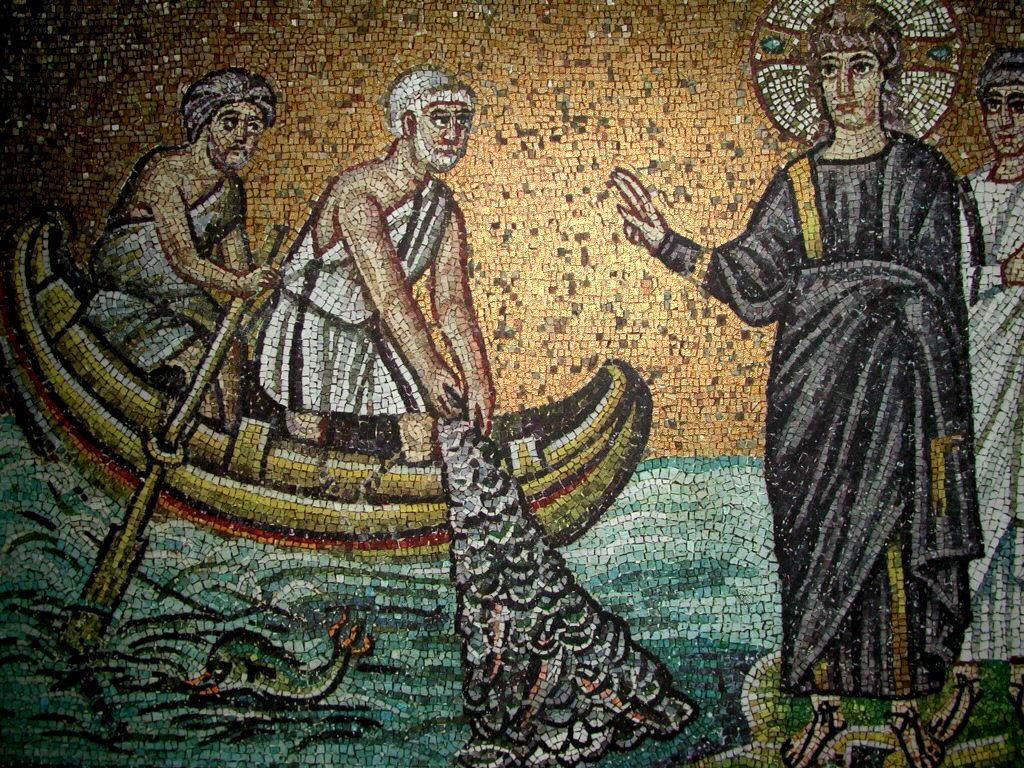
Christ Call His Disciples, Raj Solomon

Matthew 4:12-23

Is there anything better than the feeling you get at the start of something new, when a great idea strikes you, an ambitious project finally gets off the ground, a long-anticipated journey begins, or a promising relationship comes along? That sky-high, semi-nervous, tingly feeling that everything is possible—ain’t it grand?

It is, but when this kind of euphoria overtakes you, it can also scare you. So you try to shield yourself from disappointment with a reality-check. You sit yourself down and tell yourself it won’t last, something will eventually go wrong. But it’s useless. No matter how often you remind yourself, “What goes up must come down,” you still secretly think, you secretly believe, that this adventure will be the first one in human history not go the way of all flesh. This love affair will not crash and burn. This is the fever of infatuation. It can be awfully hard on the nerves, but it’s one of the greatest feelings in the world!

So here we have four young fishermen, two sets of brothers—Andrew, James, John and Simon—who leave their nets to follow Jesus. And I’m betting that they are feeling that feeling as they get up and go. From here on out, anything goes, the sky’s the limit, the world is their oyster.
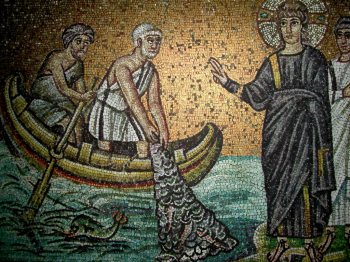
If we had a Wayback Machine, you and I could crash their 1st century party, throw a 21st century wet blanket over them, and reveal the sober ending of the script. “Boys,” we could warn them, “the ‘fishing for people’ thing that Jesus mentioned? It comes with a price. Did you know that Jesus came here to Capernaum because the baptizer got thrown in jail? No? Didn’t think so. Shades of things to come, fellas—days when you won’t feel what you’re feeling now, when you’ll grumble about him, second-guess him, and think seriously about peeling off from this now-merry little band and going home. Days when his charm wears off and his foolishness embarrasses you and his recklessness endangers you.

And there’ll be an awful day when you realize that you’re going down with him, and you’ll claim you don’t know him, that you’ve never had anything to do with him at all.”

We could tell them, but it wouldn’t matter to our four giddy fishermen right now. Not now, at the start of something big and grand and new. They would listen to us, sort of, then they would say, “Oh, sure. We know. He’s not guaranteeing a walk in the park. Got it. You want us to sign a release or something?” But they would not really register the caveat. They would brush by us with big goofy grins on their faces and hurry to catch up with Jesus.

Unconcerned about tomorrow, they’re feeling only the glory of today. We feel the exhilaration of their going, and we can’t help ourselves—we put aside what we know and cheer them on. We root for them even though the folly of their innocence is plain to us. We sense the risk, the daring, the unbridled hope in this great old story of call and response. We marvel at their beginners’ eagerness to throw themselves into the unknown, their precious idealistic willingness to follow a dream.

It’s all very energetic, isn’t it?  So energetic, upbeat, extroverted, enthusiastic, vigorous, and grand that it tires me out me just to talk about it.

Maybe it’s because I’m in my seventies that I think of this story as a young person’s story, a story for people with their whole lives ahead of them, for young adults searching for a way of life that is distinctive and worthwhile and who may still have that glorious, much-needed capacity to ignore the shadows ahead and throw caution to the wind.

Now, I know that’s wrong. This story isn’t just for young people. It’s also for people like me who are a little long in the tooth and crinkly around the edges. We are also capable of responding enthusiastically to the call of God. Not with youthful enthusiasm, perhaps, but with mature enthusiasm, with a deep and knowing eagerness.

We may not leap to our feet when Jesus calls, but we would if we could, and what our stiffer limbs balk at, our hearts can still embrace with nimbleness. We are age-appropriate disciples, offering ourselves to the adventure any way we can. We older generations have been following Jesus since we were young people. Now that we are not so young, we can—and do—persist in choosing him. This long habit of discipleship has made all the difference to us. When Jesus calls, we still find some way to go.

And he is still calling. He does not come preaching the way of our God just once. He calls us to the Christian journey all the time. Life is always changing, and the spirit is always inviting us deeper. Each new circumstance contains a new call. His invitation is never a one-off deal, never take it or leave it, once and for all. Jesus comes down to the lakeshore every day. So I know very well that the gospel’s invitation is to everyone, and in every moment. Whether we are young or old or in between, this energetic story of a new way of life is and can be anybody’s story, at any stage of life.

Nevertheless, as I was reflecting on this text anew, I felt it again—that sense that it is a young person’s story. And I felt an urge to say something about it directly to you who are a lot younger than I am. I want to tell you something that you may not hear elsewhere. I think it would be a shame not to share it with you precisely because you are unlikely to hear it elsewhere. I want to offer you the gift the church must never be reluctant to offer. I want to extend an invitation.

If you are looking for meaning in your life, or just needing to get a life, one that you can be proud of, you could do no better than to follow Jesus, to come and see where he is living and listen to what he is saying and participate in what he is doing; to take no heed for the morrow, as scripture says, and step into the adventure, no matter how many rumors you hear that things won’t always be rosy.

You will have to get past the Sunday school cardboard cutout Jesus, the unbelievable and even a little yucky holy perfect Jesus, the nasty judgmental Jesus, the “accept him into your heart as your personal savior” Jesus, or whatever Jesus it is that makes you hesitate. You will have to get past that Jesus in order to meet the Jesus who is incredibly new and very much alive, the one who will face you day in and day out (as a colleague of mine puts it) with a challenge to love like you have never loved before, and with a chance to be loved as you will never be loved by anyone else.

Thankfully it is not a Herculean task to find this real, living person. All you need to do is put yourself in his way, and he will come to meet you. Putting yourself in his way means shaping your days according to his earthy priorities. It means letting the practices that characterized his ministry give definition to your own life and your own activity in the world. It means mingling with people who know him and have shaped their lives in his pattern.

To get a life that is really worth something, you could do no better than to learn from him to be broadly and deeply hospitable as he was. To forgive, and to honor your body, the bodies of others, and the body of the broken world. To learn to say yes and mean yes, to say no and mean no, and in that way to get ready for the inevitable time when you will need to say a very costly yes to the good that conquers death, or a very costly no to the evil that deals in it. To participate in shaping new communities, beloved ones, especially the church, but also others, including households of every kind, communities in which people are accepted and valued because they are God’s creatures, not because they are rich or beautiful or productive or smart or compatible. To be a healer, pouring balm on every kind of woundedness, unrelenting compassion on unrelenting pain. To speak freely to others in your own words about what faith means to you, commending a life of faith to them with grateful joy, so that a world in shadows might brighten under the light of your testimony. To celebrate all life’s delights and to lament all its sorrows, singing your lives in the company of other singers, in the rhythms of worship and sacrament and silence, as well as in the solitary depths of your private communion with God. And some day to die well, in the love of family, friends and church, in certain hope of life that is resurrected and love that is indestructible and a God who is faithful and can never lose you.

If you are looking for a direction, for a teacher, a language, a tradition, a community, and a practice that will not merely enhance your life as you are living it now, will not merely help you cope, but will actually change you in ways that you cannot imagine now, I tell you from my heart, from 72 years of living in his company, that you could do no better than to apprentice yourself to Jesus in a community of apprentices, a community of disciples who will help you along the way, as you will surely help them.

I want to tell you now, from the experience of 72 years of living in his company, what many other faithful church-people of a certain age could also tell you—in words different from mine, and for that variety all the more compelling—that you could do no better than to become Christ’s friend, and in that friendship to discover as we have gratefully learned over many years that you can lean on him in trouble and grief, turn to him in exaltation and joy, learn from him all the time, entrust your life to him, be shaped by his words of challenge, and be loved by him with a passion so strong and enduring you will hardly know what to do with the lovely self he sees in you. You could do no better than to experience the joy of being freed in his name to love one another in the church, where I pray he will always be our center and our height, our depth and our whole, and to share that strong, healing and justice-making love with the hurting world.

I want to reassure you that knowing and following Jesus in such a company will not narrow your mind or make you judgmental or turn you into a mush-brained fool. It will not make you any stranger than your heart already longs to be, because God has given you a heart that is never going to be satisfied until it fixes on something true and selfless, and everything true and selfless will make you an alien in a world in which power, money, brute force and unvarnished self-interest are the norms of acceptance and success.

Following Jesus will not make you better than anyone else, so please don’t try to befriend him if you just want a leg-up on God’s favor and blessing, or if you just want to lord it over someone else. No, it will not make you better than anyone else, but it will make you happier than you ever thought you could be. To know and follow him will reveal your true heart to your own heart, in him you will come to know who you really are.

No matter how old or young you are, no matter whether you are newly arrived at the doorstep of faith or have been denizens of the household of God for longer than you care to say, I want to remind you, in the lovely words of another preacher, that “there was a time when we could not look at the face of God and live, but now we can look at the face of God in Jesus and live as we have never lived before.”

That is the invitation.

If you–if we– accept it, if we become (again and again) Jesus’ disciples, it won’t be a walk in the park. You know that. Nothing important ever is. So what? It’s Jesus calling. And if we all go to him, it will not be a solitary risk. We will be part of a company. We will always have each other, the church, so that in times of beauty and plenty, we will have each other’s grateful joy; and in times of challenge and pain, we will have each other’s courage; and in times of trouble, we will not hold back; and if we do fail, if we wander off, when we return we will always find acceptance, forgiveness, healing, and hope.

Can’t you feel it? Even a little? That feeling you get when something big is starting, when the world cracks open and the light comes through and the heart leaps up and a voice inside you says, “This is the real thing. Say yes. Say yes now”? The feeling you get when it dawns on you that everything can be new, that you can live an adventure, that you can be different, and that you can make a difference, and that the universe is on tiptoe just waiting to see what you will do…?

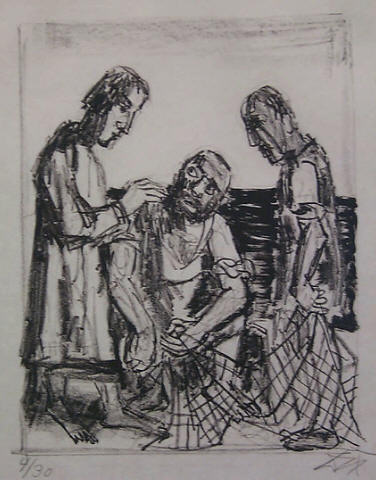
The Miraculous Catch, Eric de Saussure
When God’s Peace Descends Like Showers

Tune: HOLY MANNA

When God’s peace descends like showers, soaking into thirsty ground,

Then the Spirit stirs our gladness, and we dance to sweetest sound;

then the desert greens and blossoms, then we drink from new-made springs;

then our hearts believe the promise, and the hope inside us sings.

When God’s peace is kindly given heart to heart by word and sign,

then the Spirit takes our sorrow, turns its water into wine;

turns good wine to joy unending, crowning all our human days,

‘till we sing to God in heaven, lost in wonder, love and praise.

When the peace of God is flowing fathoms deep and oceans wide,

then the Spirit calls her children face to face and side by side;

then the key of love unlocks us, chains are broken, hatreds end,

then we walk in freedom’s garden, lamb and lion, foe and friend.

O May My Life Be Bread: A Morning Offering

O may the Sower’s seed

fall in a ready place:

the open heart your furrowed field,

a clearing tilled by grace.

O may the promised rain

find buried grain down deep

and raise up singing shoots of wheat

where hope was fast asleep.

O may good workers come

to gather in the gold

and set a table in the world

with joy a hundredfold.

O may my life be bread

love-kneaded and increased

to feed the guests dear Love invites

to revel at the  Feast.

Rain: A Prayer of Thanks

There is too much to be thankful for.

The goodness of so many years

should be clearer; each face and word,

each discovery and delight delineated,

so that all may be praised accordingly,

with emotions appropriate to each thing.

But this much accumulated grace

is indistinct, it can’t be sorted.

It is like trying to pinpoint precisely why

sharp air in autumn pleases me,

or why, in the wee hours, hard rain

on the roof brings me acquiescing

to the fact of death.

There is too much to be thankful for.

Therefore let this accusation,

that you are too much for me,

stand for now in the place of praise.

Which One of You, Having a Cow…? [Luke 14:5]

She got here the way

we all do, tripped up by fate,

or lured by the promise of more;

the same way we all do,

through a hole in a fence

she needed to squeeze through

because the grass was greener

on the other side;

or because so many grackles

suddenly rose in a loud

shudder of wings and caws

from that irresistible ditch.

She got here the way we all do,

tripped up, led on, curious,

ignorant of the laws of gravity,

or defiant of them and of all

the things our mothers told us.

At the brink, at the height

of freedom and enjoyment,

just this far from smelling

the clover, her knees buckled

and she fell in.

Now, like the pitiable rest of us

wedged between steep sides

looking up at sky, she is

terrified and breathing hard.

It’s not a day appointed for rescues,

but she got here the way we all do;

so you over there, retrieve the ladder,

and you, the harness and ropes.

And will someone please make

coffee?  We’re bound to be here all night.

Gardens and God: A Reflection on Practices

Genesis 1:9-13; Matthew 13: 1-9; 18-23

I am a city person, terminally urban. When we bought our last house, a handsome historic Greek Revival, it was in Somerville, the most densely-settled 4 square miles in Massachusetts. Unlike our former dwelling, however, this house had a small yard, and the previous owner had made the most of it. She’d created a beautiful blossoming border all around the big old house.

After we signed the papers and moved in, it took me a couple of months to understand that along with the house we’d also bought the garden. It took me another month to realize that somebody would have to take care of it! That turned out to be me.

Now, I’d never gardened before, but I came eventually to love weeding and watering, fertilizing, planting and planning. I appreciated even the yucky tasks — setting beer out for the slugs and picking off the crimson bugs that threatened the lilies.

Acquiring a love for something changes your outlook. You pay attention differently. Before I had the garden, I listened to weather reports to decide what to wear or to find out if the Sox would play. After I got started in the garden, what I wanted to know most was whether there’d be a long, soaking rain overnight, or whether I’d have to get up and lug the hose around. How long would the muggies last? Would there be a thunderstorm with damaging hail that could break the blue spikes at the back of the border?

Another thing the garden taught me was that you cannot accomplish everything all at once. I learned that it was bad for my back and bad for the garden to do too much, to spend hours on end fussing at it. But by tending only one part, doing only one chore carefully each day, the border of blossom around my house thrived, and I did too.

At first light and at last, I would sometimes go outside just to look at it, and people used to stop and look at it with me. And when they complimented me, I felt almost humiliated, struck in my soul by the disproportion between my efforts and the garden’s beauty. I’d think to myself, “Nothing I did made this happen.”

Thus I discovered anew the paradox everyone who deals in creativity and beauty knows well: if I hadn’t worked hard at my garden, it would have been a tangled mess. You know the old joke about the minister who stopped on his morning walk to admire a neighbor’s garden. The neighbor was weeding and watering, and the minister couldn’t resist a theological reflection: “Isn’t it wonderful,” he gushed, “what human beings and God can do together!” The sweaty man looked up and said, “Sure is, Reverend. You shoulda seen this garden when God was doing it alone!” Without me — no garden. But I had nothing at all to do with the beauty and pleasure it became for me and for others who saw it. The garden was in fact an extravagant gift.

Jesus says: A man went out to plant, scattering seed everywhere. Some never sprouted — the birds got to it first, or it landed on soil too rocky for roots. Some seed that did germinate got choked off by weeds, and some couldn’t get enough sun. But some fell on good earth: it got the right light and enough rain, and yielded thirty, sixty and a hundred-fold. Jesus explains: the seed is the word of God. Not everyone who hears it will take it in. But if we do, what can happen to us is beyond dreaming.

I used to hear this story as a summons to examine yourself, feel guilty and get busy. Am I the rocky soil? Do I choke off the voice of God in my life like thorns? Maybe I’d better pile on more compost, weed more diligently, shoo away cats, squish bugs and drown slugs with greater and grimmer determination. But too much of this sort of thing turns the parable into a spiritual work ethic — not Jesus’ point, I think.

As practically everyone knows by now, if you’ve ever sat through a sermon on this story, in the Palestine of Jesus farming could be a real hit or miss operation. You went out, tossed the seed indiscriminately, and hoped for the best. The best was about ten-fold. So when Jesus says that his fictional farmer might get a hundred percent yield, real farmers probably laughed in his face — it was beyond anyone’s experience.

Jesus was making an agricultural promise he couldn’t keep. But he was making a spiritual promise he had absolute confidence in: God wants to produce that kind of yield in our lives, in our human garden. This is a parable about a God who can and will make much more out of our efforts to be beautiful and fruitful than is proportionate. I know this now that I know a little about gardening.

God asks us only to come to terms with the fact that we bought the garden along with the house, and to cultivate what has already been planted in us. Just to tend a little to it, routinely — ruminating on the scriptures, worshiping with a community of faith, asking for what we need in daily prayer, giving thanks to God for all we have and for who we are, trying to bring the wisdom of Christ to our lives in small things and large, never getting out of daily touching distance of real human suffering, resolutely resisting the little evils that populate our day, putting ourselves in the way of beauty, meeting the lovely neighbor, welcoming the stranger and loving the enemy, letting ourselves fully enjoy the pleasure of the simplest things, and disciplining ourselves to believe that God is passionate about us and desires our good (for of all the tasks of the garden, this one is perversely the hardest of all).

After a while we’ll begin to feel a certain devotion to our tasks. We’ll begin to feel a need to be doing small things daily. And that in turn will become a blessed routine without which we will feel odd, at sea, a little off kilter.  And gradually, this simple daily discipline will become a deep passion. What was a chore will become a gift.

We will begin paying attention differently too, hearing differently and caring differently. Our interests and priorities will begin to shift. We may judge with more compassion and less narrow-mindedness. We may be less self-interested, more concerned for the good of people who are lacking and vulnerable. We may become less obsessed with our image or abilities, more settled and self-accepting, more open to others and less self-protective; more able to forgive and be forgiven, more able to relinquish our securities and our firmly-held but rarely thought-through opinions; more painfully aware of the pain of the world; more creative in making a difference even in the smallest of ways; more able to enjoy and more gratefully able to give and receive pleasure.

And after a few seasons of such patient daily tending, we will begin to experience that same paradox that people who deal in creativity and beauty know: the harvest we will have become is not of our own making. Rather, it will strike us as a great and extraordinary gift, full of mercy and mystery.

And when others start noticing our more centered lives; when people are attracted to God because of us; when someone inquires about our gardening secrets and growing tips, we will respond not in false modesty, but in all truth: we did not make ourselves loving and just; we did not by our own wisdom and skill help someone in our family change and live; it was not our effort that produced a reconciliation or a compromise in our circle of friends; it was not just our organizing skill that prompted the company to act more fairly or the politicians to work more diligently for the good of all. We will live gratefully in the great wonderment of the hundred-fold yield. All along it was God, we will say, all along it was the Spirit in us, just as Jesus promised.

And when we use the word “grace,” we will know whereof we speak: we will have become intimately persuaded that life is not about achievement, acquisition and productivity; not about earning God’s, our own, other people’s or some free-form cosmic approval; not a protracted struggle to get the love we never got and wish we had (and that would never be enough for us anyway), but about love already given and available in infinite supply, about gifts bestowed and received, mercy showered down and soaked up, and blessing all around. We may plant and weed and water, but God alone makes things mature, including us, including justice, including happiness, including desire.

God wants to give us this ridiculous, unbelievable yield. Maybe it’s hard to accept that we could be the object of this kind of generosity, hard to credit that God could be so besotted with us. But it’s the message of Christ, and we can at the very least try to live as if we know it to be true, in a daily discipline of refusing the internal voices that tell us it can’t be. If we get even that far — even if all we have is desire — God’s creative commitment to us will make us joyful, grateful cultivators of the gardens God gave us to tend: our souls and bodies, the family we live in, the town we are citizens of, the nation and world for which we bear responsibility, and the church wherein we learn about and celebrate the beauty of God’s work. And we will bear fruit, thirty, sixty, one hundred-fold.

You can trust God to produce this beauty, to produce it with or without you, whether you’re lugging a hose or taking a nap in the shade. You can trust that God will bless with extravagant yields your desire as well as your deeds, your deeds that flow from desire, and your sighs too deep for words.

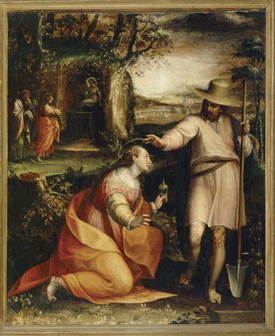
Christ the gardener greeting Mary: Lavinia Fontana, “Noli Me Tangere,” 1581

St. Peter’s Fish [Matthew 17:24-27]

I think he misses fishing. In a boat, he knew what he was doing. After the keel grated across sand and they were off, he was at home. Out on the water in the wee hours, there wasn’t much he needed to say to others who worked alongside. Casting nets under stars required stamina, not conversation.

Now he has to talk a lot more than he’s used to. He gets himself in trouble every time he opens his mouth. On land, forgive me, he is a fish out of water. This time it’s the tax. They asked him, and he answered hotly, without skipping a beat  —  the teacher pays his due. But he didn’t know if what he said was true.

Jesus is indulgent. As if he knows Peter will soon be telling a bigger lie by the light of courtyard fires. If he can forgive him that whopper (and he will), he can forgive this little fish story. Jesus will make good. He will pay the tax. For Peter. And to avoid offense. That’s why, having put his foot in his mouth, Peter is coming down here to discover what’s in mine.

Soon he’ll be dropping in a line, fishing again. And all I ask in return for this favor, Lord—for this neat trick we concocted to save his face—is that, after removing the coin, he might take the hook out too, and throw me back.