Author Archives: sicutlocutusest

The One Down God: Sermon for the Feast of the Baptism of Jesus

560px-Haskovo_Historic_Museum_2011_PD_247


TEXT: Matthew 13:13-17

Not every story about Jesus made it into the gospels. And not all the gospels tell the same stories. The angel Gabriel appears to Mary only in the gospel of Luke. Jesus turns water into wine only in John. And only Mark ends his account of the resurrection on a note of fear. Different communities prized different stories. So when a story shows up in all four gospels, you know it represents an early Christian memory that everybody thought was too important to leave on the cutting room floor. Jesus’ baptism is one of those stories.

We always read it at the start of the Epiphany season between Christmas and Lent. It’s a season of insight and revelation, when hidden things are made plain. All the gospel passages assigned to Epiphany’s Sundays shed a little light on the mystery of who Jesus is. As we watch him speak and act in these stories, our picture of him clarifies, and we catch glimpses in him of who God is and what God is up to in the world.

And sure enough, in Matthew’s version of the baptism story, we get a big revelation about who Jesus is. It comes right after Jesus wades out of the Jordan. The heavens open, the Spirit alights, and a voice declares, ‘This is my Son, the Beloved, in whom I delight.’

But we also learn a little more about who God is and what God wills. There’s no thunderclap, bright light, descending bird, or James Earl Jones voice accompanying this revelation, however. To see it, we have to go back to the flustered conversation John has with Jesus in the opening lines. Did you notice it?

Jesus presents himself for baptism, but John doesn’t seem pleased. He doesn’t say, “Good morning! No matter who you are or where you are on life’s journey, you are welcome here.” He says, “I know who you are. Please go away.” He tries to prevent Jesus from being baptized. “Me?” he says. “You want me to baptize you? You should be baptizing me!”

Why does John try to keep Jesus out of the Jordan?

The clue is in the kind of baptism John was offering. John was baptizing ‘for repentance.’ He believed the messiah had come. That’s why he’s preaching a message of urgent change. And, we read, crowds of people were coming to him, ready to repent of their sins, change their lives, and receive the appointed one.

They symbolized their willingness to change by immersing themselves in the river. They washed away their sins, they sloughed off their old lives, they left all that sorrow, hurt, and regret in the Jordan, and went away to live clean in the new age that was already dawning.

And now, here is that new age in person—Jesus of Nazareth, the messiah, the sinless one, God’s chosen person. But if that’s who he is, what’s he doing here lined up with sinners? Why is he asking for a washing? Isn’t he already clean? Besides (and here’s a second clue to the revelation), isn’t it humiliating for someone ‘high up’ like Jesus to be baptized by someone ‘down low’ like John?

John is the opening act, not the main event. The understudy, not the lead. The bridesmaid, not the bride. So how can an inferior baptize a superior? That’s not the way the world is arranged. You know that if you watch Downton Abbey.

‘Why you?’ John wants to know. ‘And why me?’

“Because,” Jesus answers, “in this way we do God’s will.” In this way everyone sees what God is up to. And what God is like. I go down in the river below you. You stand above me. You go one up. I go one down.

Ah! The revelation dawns. We know from the voice that speaks after the baptism that Jesus is God’s dear Son. But it’s when he submits to the baptism in the first place that we discover what kind of Son this Son of God is.

Who and what is the Son of God? He is one down, immersed in the river of human frailty and sin, turgid with tears and suffering, malice, carelessness, indifference, failure, and endless regret.

Why is God pleased with him? Because he gets into that water with us, side by side.

“Me, baptize you? God forbid,” says John. “You’re the messiah, the big shot of God. You should baptize me.”

“God forbid,” say all of us who spend most of our lives doing everything we know how to get ahead, climb the ladder, be somebody, go one up.

“God forbid,” say we all, who fear being one down like we fear quicksand and the dark.

“God forbid,” says everyone who expects their god to act like one and lord it over the cosmos.

“No,” Jesus says, “we’ll do things God’s way. I’ll go down. With you. Where you are. In the deep where all your hard stuff is swirling around. Where there’s the danger you could drown, danger you could get lost, danger you could succumb to your despair. That’s where I’ll go, a sibling in your own flesh. That’s where I’ll always be. That’s how you’ll know that God is not against you. That’s how you’ll know you’re not alone.”

And so, Matthew’s story says, John consented, and Jesus was baptized.

There’s another story in another gospel that sounds a lot like this one. We read it on Maundy Thursday. Jesus gets up from the table, pours water into a basin, and wraps a towel around his waist. Then, on his knees, he moves from one foot to the next, washing the dirt away.

He comes to Peter. Peter recoils. He tries to prevent Jesus from washing his feet. “Wash me? Not you! Get up! You’ll never wash my feet.”

Peter’s frantic with embarrassment. Jesus is the Teacher, the Lord. Peter is the follower, the idiot disciple. This isn’t proper. It should be the other way around. Peter watches Downton, too.

But Jesus says to him, “If I don’t wash you, you won’t have a place with me.” If you don’t let me serve you, you won’t know me, or God. If you insist on proprieties, you’ll miss the gospel. If I don’t kneel before you, you may never know the converting grace of love.

And so, the story says Peter consented and let Jesus wash him.

‘The King and I’ is an old, dated movie. I’m showing my age just by mentioning it. And you’re showing yours if you remember it. But there’s a scene in that movie in which Anna, the English governess of the Siamese king’s children, learns the protocol for being in the royal presence. No one’s head must ever be higher than the king’s. If he’s in the room and you’re taller than he is, you have to stoop or lower your head so that his remains higher.

The king enters the room. Anna lowers her head. Then playfully—but also to show that he can—he lowers his. She lowers hers again. He stoops down. She stoops even lower. Finally he drops to his knees, and she has to go flat out on the floor. The point is made.

But now imagine that scene the other way around. Imagine a completely new protocol—the king has to go one down. No one’s head can be lower than his. He’s the one who ends up prostrate before the governess.

This is Jesus.

And this is his God.

Over the centuries, a great many Christians have been embarrassed by this revelation, put off and dismayed by a God who stands in the sinners’ line, who bathes in our messes and kneels at our feet. We’re always trying to turn the one down God into a one up God, and when we do, we justify all sorts of pompous nonsense and bloody mayhem in the name of God’s one up-ness.

But sometimes, some blessed times, we’ve managed to love the one down God. We’ve let ourselves be drawn to the sweetness of Christ’s humility, swept up in his kindness, his refusal to lord it over us, his eyes that look up at us and not down.

The have-nots have never had much trouble loving him, but even some privileged and powerful people have fallen hard for his humble, hidden majesty. And when they have, they’ve found themselves in the Jordan, over their heads in human empathy and solidarity, immersed in a mystifying kind of joy.

I think of Francis of Assisi, the dissolute son of a wealthy merchant. He had an epiphany about the one down-ness of God while he was gazing at the figure of the abandoned Christ on the cross. It took Francis a long time—don’t believe all that medieval nonsense about instantaneous conversions—but eventually he fell in love with the poor and humble Christ. And out of that powerful attraction, he began giving away everything he had, and most of what his father had too.

This profligacy did not endear him to his proud and influential father, who was apoplectic at the sight of his privileged son one down among the leprous poor. But Francis was smitten by them. He ended up a beggar among the beggars, a disowned and displaced man. He waded into the Jordan with Jesus and never looked back.

Not everyone who’s attracted to the one down Jesus ends up disowned and begging like Francis. His is not the only way. Your heart can be broken open and your life re-humanized by the revelation of God’s humility in all sorts of ways. We each have to find our own path downward, as individual disciples and as a community of disciples. But one thing is true for everybody—if we feel even the slightest attraction to the one down God, sooner or later we’ll find ourselves in some discomfort, torn between the life we have now and the joy we sense is waiting for us under the river with him.

I once had a testy discussion with a woman new to our church about the foot-washing that was part of our Maundy Thursday service. She was aghast at the thought of it. “Why do you do such a weird, uncomfortable thing in this day and age?” she wanted to know. “We don’t wear sandals. Our feet don’t get dirty and need washing like they did in Jesus’ day.” Apparently she’d never distributed clean socks to homeless people. When she said ‘our feet’ she meant the clean healthy feet of people like her. “Furthermore,” she declared, “foot-washing is unhygienic, awkward, servile, and embarrassing.”

I said, “Your point?”

She said, ‘Well, all I know is you’re not touching my feet.’

But she surprised me. And maybe herself. She showed up, got her feet washed, and washed other people’s feet, too. Later, she confessed to a deacon that she’d wept when one of the oldest members of the congregation got down on his knees kind of creakily to dry her feet. She also confessed she’d gotten a pedicure earlier in the day. I guess foot-washing is more tolerable if your feet look good. I guess you can go one down as long as your feet are still one up.

But I’m not knocking her, believe me. It wasn’t a small thing for her to dip her beautifully lacquered toes into the Jordan with Jesus. Even a faint light in a great darkness is light. Even a slight unveiling can illumine the world, and maybe save it.

It was something big, her timid embrace of the distinguishing mark of a disciple: kneeling, one down. It was something, her beginner’s acceptance of the inescapable paradox of Christian faith: down is glory, lowliness is joy, embarrassment is glory. It was something, that start, that little falling in love, that little baptism, that epiphany.

And on this day of Jesus’ baptism, I wish something like that for us all.

In Common

copyofblknativity-12-m-1


“O come, Desire of nations, bind in one the hearts of humankind…” —O Come, O Come Emmanuel

On a visit to South India, the Archbishop of Canterbury was asked to bless the Hindu kitchen staff of a big hotel. The occasion was the annual mixing of the batter for their famous Christmas cake. So, as instructed, the Archbishop poured honey into an enormous trough of fruit, said prayers, shook hands, and walked out into the searing heat, with “Joy to the World” blaring over the loudspeakers.

Christmas, it turns out, is one of the West’s greatest exports. The story is known and loved even in places where other faiths predominate–Shanghai, Mumbai, Dar-es-Salaam.

And why not? It features a clutching newborn child, and not many people on earth can resist offering a pinky to the clutch of an infant.

It may be the thing we long for most—to let go of our aggression and fear and whatever else there is in us that keeps us tied to violence, and bend over a child in shared wonder and gratitude. Perhaps this common longing is what the old hymn means by ‘the desire of nations.’

You don’t have to be a Christian to be deeply gladdened by a story of open, defenseless love. Even when that story comes draped in gaudy tinsel and bows, it touches something basic, something commonly human.

And that should make us think twice, even in a season of fear and woe, about ever giving up on the heart’s capacity for goodness and faith, however deeply buried it may seem.

Prayer

“O come, Desire of nations, bind in one the hearts of humankind. Bid thou our sad divisions cease, and be thyself our Prince of Peace.”


Divinized

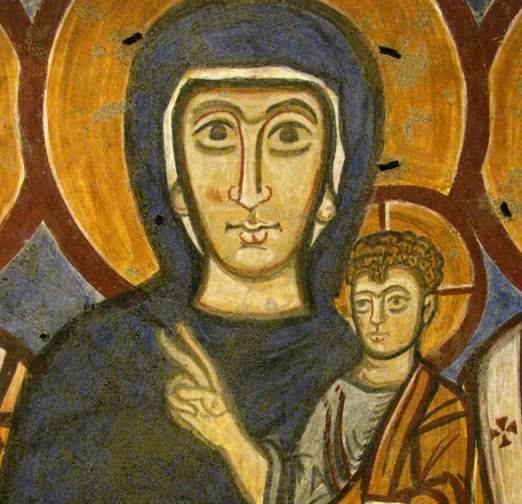
restauro-madonna-bizantina-san-gaudioso

“The One who makes rich is made poor, taking on the poverty of flesh, that I may gain the riches of divinity. The One who is full is made empty, devoid a while of glory, that I may share that glory fully. What is this wealth of goodness? What is this mystery that surrounds me?”—St. Gregory Nazianzen (329-391)

It’s an ancient theological question: Why did God become one of us?

Some Christians believe it was to fix a big problem—to pay the unpayable debt incurred by Adam’s sin. When he grows up, Jesus will bridge with his broken body the unbridgeable chasm our disobedience opened between us and God.

And if that’s what you believe about God’s purpose, you stand in a venerable stream of Christian tradition, and I won’t say you’re wrong.

I will say it’s not the only way to imagine why God took a body. There are other venerable traditions, and one of them says the Savior came to divinize us, to give us God’s own glory.

God emptied out to take humanity in. God stooped down to raise us up. God accepted limits to dissolve the limits that made it seem, tragically, as if God and humans are opposites. The mystery—the wonder—of the Incarnation is that we’re not.

In this way of imagining, what we wait for in Advent is not someone to fix us but someone to reveal us to ourselves. The gift on the horizon is not a grim course correction but a mirror, a gaze, a joyous shock of mutual recognition—there, the eternal resemblance, the beauty, the dignity, the shining, shining love.

Prayer

O to be the objects of so great an Affection! O this wealth of goodness! O this mystery that surrounds us!


Teresa of Jesus (1515-1582)

St.+Teresa+of+Avila+Portrait+cropped

The only portrait of Teresa from life, by Fray Juan de la Miseria. When Teresa saw the finished work, she is reported to have said, “God forgive you, Brother Juan, you have made me ugly and bleary-eyed.” The portrait is one of the many Teresian treasures housed in the convent of the Carmelite nuns in Seville, which Teresa founded in 1575.

THE LIFE of the Spanish Carmelite reformer, Teresa of Avila (1515-1582), was a complicated adventure in a complicated world.

At a time when practicing contemplation could get you either the garrote and the stake or a halo and a feast day, Teresa was a mystical sensation. She loved her God—and wrote about ‘Him’–with an erotic passion that sent chills down the spine of watchful churchmen who worried that affectivity in the spiritual life was at best a confusion, at worst heresy.

In a Spanish church serious about reforms but at dangerous odds about who should direct them and how far they should go, Teresa initiated one of her own, eventually splitting the  Carmelite Order.

In a male-dominated culture, she was a woman who read, a writer who meant to publish, and a theological gadfly.

In a society whose anxiety about reputation, bloodlines, and orthodoxy made moving targets out of personal safety, ecclesiastical standing, and social status, Teresa — born to a Jewish converso family — managed to neutralize and then overwhelm her detractors, ascending to the altars only 40 years after dying, a bona fide saint.

Even the most persevering readers with a passion for mysticism get lost in her vibrant, unruly prose—writings that are now regarded as some of the greatest in the canon of Golden Age literature. Making sense of her spiritual experiences — visions, voices, levitations and, yes, hot penetrations — is tougher still. It’s no wonder that some critics, for whom voices are a sign of mental illness and levitation a party game, call her the patron saint of religious pathology.

Teresa was, first and last, a soul in a progress towards God. And what a progress! That metaphor, a nod to the age of exploration in which Teresa lived, points to a life-long inner journey, as biographer Cathleen Medwick put it, “as full of wonder and terror as any ocean voyage through uncharted seas.” It took courage to navigate the soul. The dangers were real and many. Teresa’s battle to authenticate her religious experience with even the sympathetic and supportive men who guided her was ferocious. It left her physically ill and close to despair.

Life outside her “interior castle” was no easier. During the last twenty years of her life, in an era when only masochists traveled for pleasure, Teresa was constantly on the road founding and supervising reformed convents. The story of those foundations is a wild ride, a confusion of briefs, bulls, and competing obediences, a riot of real estate, fundraising, and ruthless intra-Carmelite politics.

Teresa gives us the story herself in her  writings, the Life and Foundations especially. The plot-twists and quirky characters in those relations make your head spin. Could there be a more sinister nemesis, for example, than the princess of Eboli– a breathtakingly self-absorbed woman with a black eye-patch and a refined taste for betrayal who, following a disastrous stint as a nun in a convent she’d forced the Saint to establish, sent Teresa’s top-secret autobiography to the inquisitors to avenge the convent’s collapse after an exasperated Teresa ordered the remaining nuns to desert it hastily, in the dead of night?

But the vivid personality of the evil princess cannot hold a candle to Teresa’s own — attractive, expansive, sociable, incisive, mordantly witty, shrewd and tenacious, possessed of a bottomless capacity for intimacy and an equally bottomless capacity for self-doubt and loneliness. She was a people-pleaser whose loyalties were often to a fault; and yet she could be breathtakingly brave when push came to shove towards a necessary confrontation. Her relationships with men were always more satisfying than her friendships with women; yet she complained that no one really understood her; and in truth, at some point or other, nearly all her closest allies disappointed or disparaged her.

Single-mindedly resolute (“I have,” she said, “a very determined determination”), she bent many to her will, even God. A workaholic, she was famously restless, and yet longed for nothing more than a little cell where she could tell her beads. Pragmatic and always ready to deal, she could be at times vain, coy, and Clintonesque, yet she always strove sincerely for simplicity and a transparent conscience, hammering away at the centrality of truth (for her, a synonym for humility) in the life of the soul.

If she despised anything on earth, it was pretension, especially the ruinous aspiration to status, pure bloodlines, and wealth–or at least the appearances of wealth– which had wounded her own family and created legions of  proud but destitute nobility, many hiding the tenths of fourths of  Jewish blood in their backgrounds with false genealogies and gaudy coats of arms. A close reading of her life and writings reveals a running protest against the moral captivity  of reputation, honor, and shame, as well as the wasteful sidelining of women in the church and the no-win situation of  ‘new Christians, among whom she found some of her best allies and friends. She hated what Spain had become in the post-expulsion era–a society organized for deceit.

She was unswerving in hope while enduring monstrous headaches, stomach disease, and crippling depression. She came across to all who knew and loved her as alternately domineering and compassionate, fragile and indestructible, admirable and  inimitable. In her day, many believed her to be a vile menace to the Church. Many others believed her to be its shining savior. To this day, she pleases no one who clings piously to the belief that saints are actually holy.

I  adore her.


Washing Socks

5160513351_8089e06577_z

At a church I used to serve, we distinguished clearly between Advent and Christmas. In Advent we sang Advent hymns. Pretty much only Advent hymns. Which means we didn’t start singing Christmas carols until everyone else was sick of them.

There’s a good liturgical and biblical rationale for delaying Christmas  carol gratification, although if you’re someone who never gets sick of singing carols, there’s not an argument in the world that will sway you.

But maybe this will—it’s just safer to wait.

If you sing carols too long, you might start paying attention to the words. If you do, you’ll have questions. Take those lyrics about “mild mother Mary.” How many mothers do you know who are mild, with screaming infants at the breast?

There are other dangers too, such as the invention of goofy lyrics. Sing carols enough and someone is bound to wreck them for you. Remember that old chestnut, “Good King Windshield Glass”? And surely you know “While shepherds washed their socks…”

While shepherds washed their socks by night, 

all seated round the tub, 

the Angel of the Lord came down

and gave them all a scrub.

We used to drive the nuns crazy with this one:

We three Kings of Orient are

puffing on a rubber cigar.

It was loaded. It exploded.

Bang!

We two Kings…

And so on. That’s the American version, by the way. In Liverpool they sing about underwear that sells for two pence a pair in Hamilton SquareSo fantastic! No elastic! Not very safe to wear. And not very safe to sing…

Yep, it’s just less risky to restrict carol-singing to the brief Christmas season. Unless, of course, you know that neither Advent nor Christmas is about being safe. Unless, of course, you know risk is what it’s all about—God taking a risk on the world, a risk on us. Leaving divine glory and heavenly peace aside to become one of us. A goofy, crazy, laughable plan if there ever was one.

No matter when you sing them, may the carols of Christmas give you joy, and maybe even a few laughs. Especially if you could really use one.

Prayer Grant us joy in your birth, O newborn Jesus. And not a little goofiness. We could use a laugh. Amen.

Story and Song: Reflection at Lessons and Carols

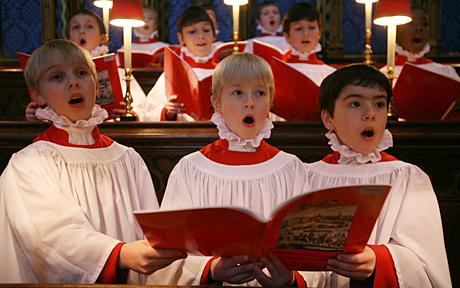
chorister_1735844c

The custom of holding Lessons and Carols on Christmas Eve originated at King’s College in Cambridge in the year the Great War ended. It was a rather fancy way to tell a simple story, high church and glorious. But whether you tell the story in a Gothic cathedral with priests in surplice and cassock, or in a village church with little kids in bathrobes and paper crowns, it’s the same story repeated, wondered at, puzzled over, relished, and entered into for 2,000 years. And whether it’s sung with sophistication by boy choristers in ruffles accompanied by a masterful organ, or with a willing simplicity by a few octogenarians at a church piano, it’s the same song, sung with astonishing trust in its ancient oddness and candid faith in its startling relevance.

It’s such a good story. And so we tell it and we sing it year after year until its truth dawns on us, its power changes us, its vision redirects us, and all its promises come true. No matter who you are or where you find yourself on life’s journey, the story and the song are for you.

If you’re a little restless in spirit, if every now and then you’re blindsided by a longing you can’t quite name, if you’ve ever felt far away from yourself, as if you’re missing some meaning you were made for, if you wish you could clear away what’s standing between you and the joy you know is in you—if that’s how it is with you, restless and distant from your own heart, the story and the song are yours. The story, about people in a kind of exile, yearning for a light, for someone to bring them home. The song, your own heart’s cry for a breakthrough, for joy at last—O Come, O come! Rejoice, rejoice! If this is the story you need to hear, listen. If this is the song you need to sing, sing it tonight with all your heart. [O Come, O Come, Emmanuel]

If you’re exhausted from the effort to climb to the top, if your heart’s a little soured from doing the things it takes to get there and to stay there, if you’re asking yourself what it’s costing you, whether you might be happier some other way—if that’s how it is with you, tired of climbing, wondering if down might be better than up, the story’s yours, and so is the song. The story, about a God who comes down, lays glory aside, abandons privilege to become small, and all for love. If this is the story you need to hear, listen. If this is the song you need to sing, sing it tonight with all your heart. [Born among Us in the Night]

If you’re feeling stymied as you survey an unjust world, if you’re angry and depressed about how seldom things change, if you’re tempted to throw in the towel—if that’s how it is with you, edging towards despair, the story’s for you, and the song. The story about the fear engulfing a proud tyrant’s city, while in a village just nine miles away—lightyears away—heavenly peace holds sway as an infant sleeps at his mother’s breast. The song, a vision, the powerful down from thrones, the poor up from the dust, justice no longer denied. If this is the story you need to hear, listen. If this is the song you need to sing, sing it tonight with all your heart. [My Heart Sings out with Joyful Praise]

If you’ve made a mess of something, maybe your life, if there are unkempt places in your heart you’d rather never come to light, if you know what you deserve and fear an accounting, if you think you’re not good enough for God to love you—if that’s how it is with you, hiding something, ashamed, the story is for you tonight, and the song. The story of a truce between earth and heaven, of pardon and peace and the erasure of shame, a story in which the feared judge turns out to be someone so like us, helpless and vulnerable, knowing our weakness well, from the inside out–a Child who pleads for us from a cradle. If this is the story you need to hear, listen. If this is the song you need to sing, sing it tonight with all your heart. [Hark, the Herald Angels Sing]

If you’re sad tonight, if you carry a heart pierced with the fresh pain of recent loss, or an old loss still sharp, if you’re acting brave but really want to curl up and cry—if this is how it is with you, grieving, bereft, the story’s for you, and the song. The story about a hard journey, following a star on sheer faith, keeping company with others in the long cold night as life and love are somehow born again. The song is sure: the Child feels for us, for all our sadness, and you are not alone. If this is the story you need to hear, listen. If this is the song you need to sing, sing it tonight with all your heart. [Once in Royal David’s City]

And if you’re joyous, at peace and full of hope, if you’re amazed by all the love you’ve received and all the love you’ve given in your life, if even your sacrifices are wellsprings of joy, if your thanks cannot be counted—if this is how it is with you, awestruck and grateful, the story is for you tonight, and the song. The story about love in the beginning, about love in the end, about light in shadows that shadows cannot overcome, about the unaccountable graciousness that makes you the apple of God’s eye. The song is glory in the highest, love’s come down to earth for us, and earth repeats the joy. If this is the story you need to hear, listen. If this is the song you need to sing, sing it tonight with all your heart. [Joy to the World, the Lord Is Come]

Dear friends in Christ, the church doesn’t offer certainty or safety. Faith won’t fix your problems or pay your debts. We have no armies, no power to force right where there is wrong. No doctrine or rule in our tradition can change a heart or mend it. We have nothing efficient to offer the world. But we have a story. We have a song. The story of fierce love, the song of tenacious hope, the surprise of God in flesh appearing. The Christmas story. And we tell it tonight to you, in this good company. In good company, we sing it with you tonight. With all who need to hear it, with all who need to sing it, we share it with love.  No matter who you are, no matter where you find yourself on life’s journey, it’s yours. A gift to you from God. May it save your life, heal your heart, soothe your pain, shield your gladness, awaken your desire, strengthen your hope, and give you joy that never ends. [On This Day Earth Shall Ring]

Treasure: Christmas Day

mary-and-jesus

“But Mary treasured all these things and pondered them in her heart.” – Luke 2:19

 The Savior is born!

A thousand angels broadcast the news. They fill the sky and sing. Shepherds praise the Lord. They scurry around, they come and go and tell. Christmas dawns bustling and loud. Everyone has something to say, noisy and glad.

Mary doesn’t say a thing. But the door of her heart stands dangerously open. It all comes in—gladness, hope, consequences. Inwardly, she turns the prism of each sight and sound, each extraordinary thing, every possible meaning. With each turning, new light, greater affection.

She is the still point in the resounding amazement.

Oh, the things she knows…

She is the field in which God buried a treasure. And some day, when we’re paying attention, we will stumble upon it. Some day our hearts will leap at its worth. Some day we will sell all we have for it.

Maybe today.

Prayer

On Christmas Day, Saving God, move us to loud rejoicing; but grant us also the stillness of Mary, her open door, the art of treasuring, and a glimpse of the things she knows. In the name of her newborn Child, we pray. Amen.

So Weird: Meditation for 4th Advent/Christmas Sunday

XIR361198

Luke 1:26-38; Luke 2:8-18

In our house, when I was growing up, the baby Jesus didn’t appear in the manger until after we got back from Midnight Mass on Christmas Eve. We were strict constructionists—no carols in Advent, and no baby in the cradle ‘till the night he was born.

But that was just about the only biblically correct thing about our crèche. Remember the part in the Bible where it says that a large fuzzy spider crawled along Joseph’s shoulder? No? Well, there was a large fuzzy spider in our manger scene anyway. And an angel in a tutu wearing big clown sneakers straddling the roofline of the barn. And a little model Ferrari parked next to the camels. And a purple wind-up Godzilla that spit electric sparks on the Virgin Mary’s head.

When you have little kids in the house and you’ve put the crèche on a low table, a purple Godzilla’s not the weirdest thing that’s likely to show up to adore the Child.

But then, all the characters in the Christmas story have a touch of weird about them. Take the angel Gabriel. He’s scary. Every time he appears in the Bible, he says, ‘Don’t be afraid!’ You don’t have to say “Don’t be afraid!” if nobody’s scared. Gabriel has to say it all the time. That’s because he scares people. You’d be scared too if a bright pulsating creature with ginormous wings dropped in on you out of the blue. Even if he were to appear as an ordinary person, which angels sometimes do, he’d still be a strange guy you don’t know—in your house.

Then there’s Mary. After Gabriel calms her down (‘Don’t be afraid, Mary!’), he tells her that God has decided she should have a miraculously conceived baby who will be the son of God and a king with an endless reign… and would that be okay with her? In one of the greatest understatements of the Bible, Mary is said to have been ‘perplexed’ by this. Perplexed? That’s what you are when you’re looking at an unusually high electric bill, not when you’re being informed of a virginal conception. Mary also ‘ponders.’ We’re told she meditates on everything that’s happening. While it’s happening. Giving birth in a livestock shed in the dead of winter, she’s pondering. Smelly animals nose around her newborn, she’s pondering. Angels play trumpets overhead, shepherds with garlic breath crowd her personal space, and she ‘ponders all these things in her heart.’ Mary ponders. You and I would be hysterical.

And Joseph. Silent Joseph. He says nothing at all from his first appearance in the biblical record until he disappears altogether, sometime after Jesus turns twelve. Not a syllable. He probably didn’t have time to talk. Angels were always interrupting his sleep. He kept having to load up the donkey at a moment’s notice. Off to Bethlehem. Off to Egypt. Back again. Without a GPS. Maybe he was just too worn out to say anything.

And the shepherds. You want them in your Christmas carols and on your greeting cards, but not in your house. They tramp in all that … manure. They tell off-color jokes. And they are known to have sticky fingers. Count the silver when they leave. You’ll be missing a few forks and the soup spoon.

No, Godzilla isn’t the oddest character in the crèche. They’re all a touch strange. But it’s probably a good thing for us that they are.

If Gabriel had been a pudgy-cheeked cherub who never made anybody nervous, we might not have known that it’s good for us to be scared by the Holy every now and then. To tremble before an awesome God. We sing about being scared— ‘Sometimes it causes me to tremble, tremble, tremble.’ ‘Let all mortal flesh keep silent, and with fear and trembling stand.’ But when was the last time you actually shook in God’s presence, or hid your face before God’s holiness, or begged God to go away and leave you alone, or stood mute before God’s power in the world, in someone else’s life, or in your own? The last time the world suddenly became a lot larger than you thought? Deeper and more mysterious than anybody thought? When your certainties vanished? When you fell to your knees?

And if Mary hadn’t done so much pondering, we might not have realized just how much there is to ponder in the way our lives unfold. How much mystery is tucked into life’s smallest details. How available God is to us in the facts on the ground, in the stuff of being human. If Mary doesn’t show us how to ponder everything that’s in a heart, we might never hold some seemingly insignificant experience up to the light, turn it ‘round and ‘round like a prism, and discover there, in every facet of mess and glory, the presence and activity of the living God.

And if Joseph hadn’t been so silent, so retiring, we might not have seen how silly it is always to want to have something clever or wise to say, to interject something about everything, to be the center of attention in every conversation. If he isn’t silent, we might not discover how liberating it is to have no need to comment, no compulsion to be heard, no urge to intrude upon a drama and steal a scene. We might miss a chance to notice how seldom we hold back and make room for someone else to be seen and heard, or how much we need to have someone make that space of dignity for us. If Joseph had been a chatterbox, his son Jesus might not have developed that beautiful capacity of his just to let things be. Jesus might not have disappeared to hilltops at night to be still and listen to God and catch the sounds of human suffering and hope rising from below. Maybe it was the example of Joseph’s silence that kept Jesus from being provoked when, bloody and accused, he stood before Pilate and the crowd. Maybe Joseph’s relinquishment of the need to be a Somebody enabled his Child to stand before the powers of the world and, in his infinite self-possession, vanquish them, without uttering a single self-defensive word.

And if it weren’t for the stinky, shifty shepherds, some people might think they have to spiff up to go to the manger and meet God. They might never go at all if they think it requires clean hands, trendy clothes, a spotless conscience. They might miss the chance to know the God who welcomes everybody who comes, even and especially the odd and undesirable. Welcomes everybody and everything who comes for whatever reason, even if it’s to try to steal the silver. Without shepherds who steal the silver we might never come to love this God who doesn’t seem to mind being taken advantage of. Who would hand over the whole treasure to us in a heartbeat. Who does hand it over to us in the life of a shivering Child. Who never demands a thing in return except that we hand ourselves over to each other in mercy, justice, and love.

In my family’s crèche there was a spider crawling on Joseph, a Ferrari parked next to the camels, an angel in sneakers perched on the roof, and a plastic Godzilla, purple and proud, spitting sparks on Mary’s head. It was a weird scene. But then, so is my life. And so is yours. And so is the world’s.

And, the Story goes, for some unfathomable reason—call it love—God can’t resist joining us in our weirdness. And so, the Story goes, the Word became flesh and lived among us. And because he became all that we are, weird and wonderful, nothing that we are is out of bounds at his cradle. Nothing and no one. Not you, not me, not purple plastic Godzilla.

Odd as that is. Strange as it seems.

‘Do This’ [Luke 22:7-23]

dark bread on white

The night of the last supper, all was not well among Jesus’ disciples. Everyone was on edge. They all saw the handwriting on the wall—soldiers and swords, crosses and nails. One of them had already sold Jesus to the authorities. And Peter was boasting he’d be brave and follow Jesus, even if it meant certain death. Every time he said it, eyes rolled. It was Peter, after all. But they were all off kilter, scared and queasy. None of them felt much like eating.

The Bible says Jesus was aware of their fear and confusion. He loved them. He knew their hearts were in the right place, but he also knew he’d end up alone. They were so frail.

As was he. He would have given anything to escape what was coming, and in prayer he begged God that it might pass him by. The Bible says fear ran down his face like drops of bloody sweat. He had seen crucifixions. He could imagine his.

The only difference between Jesus and his disciples was that when the time came, he didn’t run. But that doesn’t mean he welcomed his fate. He didn’t feel much like eating either.

But that’s what they did. On the night Jesus was betrayed, they shared a meal. They gathered at a table. Because that’s what they’d always done. A large part of their three years together was spent at tables.

In Jesus’ ministry, the table was where things got real—eating together, they began to understand that God’s love for them was full of mercy, no matter who they were or what they’d done. There they were, saint and sinner, rich and poor, all welcome to eat.

The table was where truth got told—Jesus would tell you stories about invited guests who were too important and preoccupied to come to a king’s banquet, so the riff-raff took their places, going into the kingdom ahead of the privileged and powerful. And so the last are first.

The table was where the vision of Jesus’ movement got spelled out in object lessons of service and humility. Jesus on his knees with a towel around his waist, dragging a bowl of water from foot to foot, washing his disciples clean. ‘Servants,’ he told them at that table, ‘are not greater than their master. What I have done for you, now do for each other.’

The table was where pardon was given—to a sinful woman who could not stop bathing Jesus’ feet with her tears, to an odious little tax collector who’d climbed down from a sycamore tree to welcome Jesus to a meal in his home.

At table with Jesus it somehow felt possible for hard things to get better, and lost things to be found. At table with him, you could imagine a time when you would be able to forgive just about anything.

And so that queasy night they ate with him. And while they were at table, he took bread, blessed it, broke it, and gave it to them, saying, ‘This is my body broken for you.’

The bread, his broken body. A sign of broken dreams, broken promises, broken hearts. A sign of mercy and presence to show us that in things that break, God is there.

‘Take, eat, all of you. Here is frailty made blessing,’ he said. ‘For you.’

And after the supper was over, he took a cup, blessed it, and gave it to them, saying, ‘Take, drink, all of you. This cup is a new covenant in my blood, poured out for you for the pardon of sins.’ Medicine for what ails you. And a covenant, a promise that we can begin again. And we will.

’Take, drink, all of you. Healing and the dawn of a new day,’ he said. ‘For you.’

And then he said to them, ‘Do this.’

Do this. To remember me.

Do this, and I am with you.

Do this when you’re broken. Do this when you sin. Do this when you get sinned against. Do this when you’re afraid. Do this when you just can’t believe the way hard things have dropped into your life uninvited. Do this when you disagree and fear you won’t find common cause or a clear way forward. Do this when you want good company, when you don’t want to be alone. Do this when you’re joyous and want to multiply your joys. Do this when you’re grateful and want to taste again the goodness of the Lord who’s been so good to you.

Do this. Come to the table. Sit down. Eat and drink.

And so on that awful night they did.

Now, if I were making this story up, I’d tell you that after eating with Jesus, all the disciples got up from the table, repentant, converted, faithful and brave. I’d tell you they were loyal, loving Jesus and each other with a love that could withstand anything. I’d report that they didn’t abandon him, but were with him to the end.

But ‘m not making this up.  And that meal didn’t make the weak strong, or cowards brave. It didn’t give Peter a personality transplant or any of them more wisdom than they had when they first sat down, which was pretty much zero. They shared with Jesus a meal of love and memory; a meal whose heavenly food and intimate company was all they should’ve needed to find a faith nothing could shake. But it wasn’t. They went out that night and failed him, and he went to his death alone.

After Jesus rose from the dead, they ate together again. At Emmaus he took bread, blessed and broke it and gave it to them, just as he did that last supper. And just as on that night, they were still who they were—betrayers, deniers, deserters, willing spirits with weak flesh.

In Galilee, he grilled fish and bread for them, and they ate breakfast in the cool dawn air by the lake. And just as on that last night, he fed Peter, who had sworn just two days before that he did not know and had never met his tender Lord. The table isn’t magic. But it is necessary. We have to eat. Jesus knows we always have to eat.

Jesus and his disciples ate together many times after his rising. And after he ascended to heaven, they keep on eating with him in the Spirit, in the church, in a holy communion.

For two thousand years Jesus has been eating and drinking with disciples like us whose hearts are in the right place but whose lives are still kind of a mess. Two thousand years of ‘doing this,’ and we’re still suffering the small cuts and deep gashes of our human frailty. It hurts. The damage is real. There’s no denying the pain or evading the consequences. And still he comes to us. Still he says, ‘Sit down. Eat and drink. You, just as you are. You, just as I find you. Come. Do this. Do it again.’

What matters to him, it seems, is what’s real. What matters is that we are who we are. That we don’t hide our wounds in the dark where no light can reach them for healing. What matters to him is not that we have the right answers or the right opinions, or even the best behaviors, but that we do this. That we come to the table, come together, come as we are, and do it again and again and again.

It might take us another two thousand years to fully grasp the table’s lessons, two thousand more to perceive the table’s truths, two thousand more to be transfixed by its mercy, transformed by its grace, caught up in its dynamics of self-gift and resurrecting love. But he is patient.

And in the end—who knows?—it may be that becoming perfect, or even becoming ‘better persons,’ isn’t the most important thing. Maybe just being together is. Maybe just eating and drinking is. Maybe just the fact that he is with us is enough. All he asks is that we don’t stay away because of our weaknesses, and that we don’t prevent others from coming because of theirs. ‘Do this,’ is all he says, ‘even when you don’t feel much like eating.’

Anchor your hearts here, he commands us. In bread and cup. At a table. And so we do. For as long as we meet here again and again, as long as we are together giving thanks for the amazing grace that so willingly embraces the poverty and beauty of our hearts, as long as we are sharing the meal of life, all will be well, even when it isn’t, he is so kind.

So come to the table today, lay it all out, everything you have—your emotions and questions, your strengths and weaknesses, your beauty and your struggle, your joy and praise and thanksgiving. Here with each other and with him, in the embrace of the Holy Spirit, you will taste and believe again, like never before, the trustworthy Word of the Lord—that as many times as we stumble, we’ll be helped up; as many times as we fail, we’ll learn and grow; whenever we sin, we’ll be pardoned; when we’re sinned against, we’ll find a way to offer pardon; when we’re full of joy, our joys will multiply. And when we die, we’ll rise.

Do this, our Brother said.

Sit down. Eat. Remember me.

Do this.

I am with you always.

Do this.

Again and again.

Until I come.

You Don’t Have to Be A Woman [Exodus 1:7-2:10]

synoptic_narrotive-14A360B4E0263FB41D5

Image: Pharoah’s Daughter Rescues Moses from the River–Synagogue Dura-Europos

Our story begins with a demographic problem in Egypt. The minorities are having too many babies. Something has to be done about them before they become a security problem. So the king gets Congress to take away their driver’s licenses, deprive them of health care, and make them clean office buildings for minimum wage with no benefits.

But you know how those people are. They’ll work three jobs if they have to. The Hebrew people survive and keep on breeding. So the king orders two of their midwives to smother male infants right after they’re delivered. They say, “Yes, Sir!” (he was the king, after all), but they know they’re not going to do it. And they don’t.

When Pharaoh finds out, he calls them on the carpet. They wiggle out of it by telling him with straight faces that Hebrew women are prodigious earth mothers who have fast deliveries, so the midwives never get there in time.

When the king realizes that they’ve been scamming him, he adopts a more straightforward strategy. He has his minions throw the boys into the Nile. As it turns out, this is a badly flawed approach to the problem. He makes two huge mistakes—he underestimates women, and he messes with a river.

You don’t mess with water. You don’t foul it with death. Water is life, it nourishes, cleanses and renews. It also kills, of course; but unlike kings, it never kills for ambition, security, or sport. If you defile a great body of water, it’s bound to come back to haunt you. Somewhere, somehow, you’ll pay a price. And when water turns on you, it won’t be impressed that you’re a king.

No, you don’t mess with water. And that’s just Pharaoh’s first mistake. He also underestimates women.

It seemed so self –evident: get rid of the males and there’ll be no one to father new baby Hebrews. No more babies, and it’s the end of the line. And while you’re waiting for the genocide to run its course, you’ll only have to deal with girls. And girls are not a threat. The thought of girls won’t prevent you from sleeping soundly behind your walls.

See what I mean? Pharaoh fails to take into account some important facts. Fact: girls grow up to be women. Fact: women tend to outlast you. Fact: at some point women will put their foot down. They will not join your procession to the grave.

Sick of being hemmed in and pushed around, repulsed by casual violence in the name of order, power, principle and pride, they will finally refuse to budge. “Not our babies!” they’ll say. “Not our people! Not our future!” If Pharaoh had half a brain, he’d leave the boys alone and go after the girls.

But he can’t imagine women thwarting his plan. He can’t imagine midwives inventing a way to bamboozle him. He can’t imagine that at least one mother of one Hebrew baby boy might rummage through her closet and come up with a basket, line it with pitch, test it on the water to see if it will hold him, then hide the basket in the reeds. It’s a measure of how little he knows about women that Pharaoh can’t imagine at least one mother giving that basket trick a try, one mother trying something, anything, to preserve her child.

No, he doesn’t know much about women. Or water, either. He doesn’t take into account that even clogged with blood, rivers still hold things up, still carry things along, even fragile things like a little ark, a bobbing basket with its tarred-over bottom and tucked-away child.

He doesn’t take into account that even sullied and sinned against, a river still attracts bathers. So he can’t imagine that a woman wading womb-deep in the current—his own daughter—will not be able to resist the whimper of even a foreign baby adrift. He can’t imagine that in the reeds on the bank, a guardian and a watcher will crouch, a big sister, Miriam: a quick thinker and a fast runner; a girl with patience and a plan and the nerve to see it through.

If Pharaoh were a man of imagination, if he were wiser about women and water, he might realize that, sooner or later, a floating Hebrew baby boy, snatched by women from the water, will grow up to be a Moses, and that such a Moses will make him let the people go.

He might see that one day this Moses will extend an arm, and there will be a wall of water on the left, another on the right, and a dry seabed in-between where an oppressed people will get to the bottom of things and find their way to freedom. He might see that sooner or later a terrible trap will spring, and that his mighty, mindless army will wash up lifeless on the shore.

But pharaohs don’t usually have much imagination. And so this king doesn’t know that women and water will have the last laugh and the last word, and that while he presides over a drowned army, that baby’s sister will improvise again, this time on her tambourine. Master only of broken chariots, on the far shore he will watch Miriam do her dance and sing her victory song: “Sing to God all the earth! Sing to God a fresh song. God does marvels for us! Horse and rider God throws into the sea!”

Poor Pharaoh. He should never have messed with the water and he should have got rid of the girls.

Well, that’s it—the story of a king disposed to violence to solve a dilemma. It’s what happened to him for ignoring the rules of water and for taking women for granted, not factoring them into his plan. It’s a story about Moses, too, of course, and about God who directed the whole drama from backstage.

But mostly it’s about what happened when an impromptu conspiracy of women decided that enough was enough. It’s about what happened when they decided that there’s never anything to be gained by standing around wringing your hands and cursing fate. It’s about the risks they took to assure a future, not just for a boy named Moses, but for a whole people; and, you could say, also for us. And it’s a good story for celebrating the gifts and courage of the Bible’s women, and of all women everywhere.

But you don’t have to be a woman to have this story be about you. This could be anybody’s story. It might be yours if you understand that Egypt is not some strange land far away, and that what goes on there has something to do with you. It’s yours if you know that Egypt is every place where tyrants large and small oppress human bodies and human spirits so that the powerful can hold onto what they’ve got, acquire even more, and sleep peacefully at night.

It’s your story if you decide that enough is enough and put your foot down, if you resolve to try something, anything, to save a life, and not just your own.

It’s your story if you’re clever enough, determined enough, cheeky enough, angry enough to devise delaying tactics against injustice; if you decide to join the small persistent band of God’s beloved who lie awake at night, thinking up ways to bamboozle the king.

It’s a story about you if against indifference and despair, you’ve chosen to be a launcher of life; if every day you float a frail hope for the future on the vast waters of the world’s pain; if you discipline yourself out of love to wait and watch and pray until, against the odds, all those small hopes in all those little baskets come back, grown strong to liberate and save. Because they will come back. They will.

You don’t have to be a woman for this story to be yours. It’s already yours if you’ve ever had some mindless army breathing down your neck—some sin against you, some sorrow out of control, some intimate danger in your hurt or hollow heart, and you thought that the only way out was to curl up and give in, neither asking nor expecting mercy. It’s your story if, against everything your frightened heart hoped for, the waters you were sure would drown you pulled back and let you through, and you found yourself finally at the bottom of things, on a seabed path to freedom.

It’s a story about you if you’re tempted to think that you can’t make it through another day, not one more step: I’m telling you, this story is about you, and for you it can end well. You can see the break of day from a safe and lovely shore. You will see that day, the day of God’s victory. And when you do, out of your mouth a fresh song will rise: ” God has done marvels for me: horse and chariot he tossed in the sea!”

No, you don’t have to be a woman to sing that song. You only have to believe that it’s wrong to foul life’s currents with death for the sake of something as insubstantial as undisturbed sleep behind a guarded wall.

You only have to believe that it’s unspeakably wasteful to stand by wringing your hands while a procession to the grave goes by, day after hopeless day.

You only have to decide that sticking your neck out to try something, anything, to halt that appalling parade won’t finally destroy you, even if you fail, even if you lose your life. You have only to understand that it is doing nothing that will destroy you. Doing nothing will destroy us all.

No, we don’t have to be women to sing that victory song; to have, like Miriam, the last laugh and the last word. But we do have to believe that no matter which Pharaoh’s army is arrayed against us, no matter the tyranny threatening our hearts—the big questions of justice and peace, the ordinary hardships of life, the misunderstanding or malice of others, the illness or grief we did not cause or want and cannot fix, or the self-defeating troubles of our own making—we are never adrift with no one watching.

Someone who once launched us like a faint dream on a great river is keeping track of us, the same Someone who will, like a woman, know how to seize just the right moment to reach for us, and save.