Category Archives: Lent and Holy Week

Prayer of Praise Lent III

smokva

O Gardener of Life,

your mercy is steadfast, sure.

With care you plant us.

You turn the earth around us

and water our roots with love.

Even when we bear no fruit,

year after struggling year,

you are patient.

Your hope for us leafs out and flowers.

From the sweet fruits of your labor

you make a feast—

a banquet for all the famished,

free and fine.

At the table we tell the story:

God alone is good!

Together we sing your praise:

Honor and glory, gladness and thanks,

now and forever. Amen.


What Stress I Am Under [Luke 12:49-56; Isaiah 55: 1-6]

pill_bottle_and_pills1

Does the title of this piece sound familiar? Have you said something like this in the last ten days? You can identify…yes?  Me too. None of us is a stranger to strains that put us on medication, drive us into therapy, or land us in the doghouse when our tempers fray and our coping mechanisms fail.

That we feel stressed from time to time is natural. It’s been shown that we need a certain level of stress in order to be creative, motivated, and responsive to others. So if a deadline or a creative challenge or a crying baby stresses you out, don’t worry, be happy. It’s good for you.

Ordinary stress, physiological or psychological, is not going to kill us. Stress itself is not remarkable. What’s remarkable is that so many of us are willing to tolerate higher and higher levels of it.

Of course, if your house gets blown apart by a hurricane, your kid gets arrested for shoplifting, or your doctor gives you bad news about your last mammogram, you don’t have a choice about how high your stress level goes. If you’re a Syrian refugee in a camp in Turkey, a soldier on patrol in Afghanistan, or the mother of a teenage boy in certain sections of a big city on a hot summer night, it’d be a miracle if your stress level were not off the charts.

But much of the stress that has us on the verge of stroke, acid reflux, and road rage is unconnected to such dire things. It has to do instead with our insertion in a world of dizzying choices, so many choices that we feel disempowered by them, frustrated and depressed by sheer variety. Or it’s connected to the images of success and the good life that bombard us daily. We are set up for stress by high expectations about relationships too—parenting, the kids’ SAT scores, whether our teeth are as white as God and Crest intended. Powerful economic and cultural interests are out to get us, and we seem to have fewer and fewer defenses against them, given the influence of the media, the mediocre state of our spiritual lives, and the erosion of the power of traditional communities of wisdom to anchor us.

We have become so inured to these manipulations that even the most sincere among us have a hard time getting a clear read on what our heart-of-hearts really desires. Even the most idealistic and committed among us are easy prey for corporate marketing departments who every day determine on their own what is good for our well-being. These interests have a story to tell about what it means to be a fulfilled and contented human being, a powerful and appealing story they tell artfully and well. And most of us believe it.

We Christians have a better story to tell about the source and meaning of a good and happy life, but it seems we believe it less and less, we rarely rely on it ourselves, and we are very reluctant to tell it to others. What an irony that we who have the ‘Greatest Story Ever Told’ have lost confidence in its power to ground and shape us, ceding the ground to Madison Avenue, where there is every confidence in formative myth-making!

Perhaps we have come to acquiesce in our own unhealth because we sense that to de-stress our lives by resting in faith in the arms of the old, old story of a trustworthy God will require changes too radical to contemplate. We may long to simplify our lives, to choose downward rather than upward mobility, to learn to pray and observe more faithfully the pleasures, rhythms, and rituals of a grounded life, but we are have a hard time taking the first step to make it come true.

The thought of what it will take to de-stress stresses us all the more. And so we accept the unacceptable, take the pills, pay our therapists, and settle for small oases—a day or two without Facebook, a week-end away without the phone.

It’s time to listen to Jesus.

In an unnerving story from Luke’s gospel, Jesus announces that he is anxious too—he feels stressed, under pressure to get on with a ministry that he describes as a work of provocation and controversy. His mission will strip him and his followers of the comforts of home and family, even cost them their lives. All the traditional loyalties will be on the table to be weighed against the graceful reality of the kingdom of God that Jesus announces and embodies.

He is aware of the adverse reaction he is stirring up; and so he chooses images of fire, which means judgment and cleansing, and images of discord and disruption. If the new relationships of the kingdom undermine the traditions and cause trouble, so be it. He speaks about the “baptism” he is chafing to immerse himself in. He is at a crossroads, a crisis is fast approaching, a juncture all his disciples also face, sooner or later.

For us who follow him, this crisis might be big, bold, obvious, and immediate, like a crucifixion. But it is more likely that it will be subtle and less dramatic, and that it will unfold over time—maybe a sense prompted by a passion for justice that you must change your profession and do a new thing; or an inner voice insisting that you finally break that debilitating habit that has kept your soul in thrall and prevented you from loving the way you were meant to love; or a growing inner attraction to God that finally leads you to a scary but joyful new capacity to give away who you are and what you have more generously.

It could be a single moment of insight, or a long season of life. Whatever it is, it is a crisis, a crossroads at which we will be asked to accept that we will never be happy unless we let our hearts be governed fully by something or someone for whom we are willing to make real sacrifices.

The crazy-making stress we accept every day is different from the sort of stress Jesus says he is under, but his and ours are connected by this notion of governance and sacrifice:

Jesus’ stress is what happens when you are impelled from within. It arises from his faithfulness to a grounding vocation that has shaped everything about him and governs him completely. It is the impatient energy, the eagerness of a person in love.

Our stress arises mostly from not surrendering to something that governs us in a truly grounding way, and to live a more spiritually aimless life that makes only momentary, fragmentary sense. We hedge our bets about anything that feels like a final claim on us, and squander all our energies perfecting our defenses.

Jesus’ stress stems from the urgency to know and do God’s will.

If we are under stress, it is often because we are so easily blown around by distractions and so passively governed by unexamined wants and needs that we can’t figure out our own will, let alone God’s.

It starts early, this heart-confusion of ours. John Ortberg, a well-known preacher and author in evangelical circles, tells a (now-famous and oft-reprinted) story about the search for grounded happiness in his own young family.

He has three little kids who regularly worship at the shrine of the Golden Arches. It’s the only place they’ll eat. And they always want the same thing. It’s just a couple of basic food items and a cheap little plastic prize, but in a moment of marketing genius the folks at McDonald’s gave it a great name—the Happy Meal. The Meal of Great Joy.  You aren’t buying McNuggets and a Hercules Ring, he says, you’re buying happiness.

Every now and then he tries to talk them out of it. He gives them a dollar to buy their own cheap little plastic toys, but they want a Happy Meal. They cry for a Happy Meal. A lot. He does not want to be the father who won’t buy his kids the Meal of Great Joy, so he buys them the Happy Meal, and it makes them happy—for about a minute.

You would think, Ortberg muses, that his kids would eventually catch on and say, “You know, I keep getting these Happy Meals and they don’t give me lasting happiness so I’m not going to buy them anymore. I’m not going to set myself up for the stress of disappointment.”

But it never happens. They keep buying Happy Meals and they keep not working. No young adult ever returns home to say to her parents, “Remember that Happy Meal you gave me? That’s where I found lasting contentment and lifelong joy. I knew that if I could just have that Happy Meal, I would be anchored for a lifetime. And I am. Thanks, folks.”

Contentment, meaning, purpose, fulfillment, a God-governed, centered and meaningful life—many of us still believe it’s just a Happy Meal away; only our Happy Meals, Ortberg notes, keep getting more expensive, more complicated, more dangerous, more self-defeating and more elusive. And our stress keeps rising, our frustrations become downright cosmic.

We dream of a mystery inheritance or a Powerball win that will be the escape hatch that permits us to live the simple life in Tuscany or raise llamas in Vermont, forgetting, as they say in AA, that wherever we go, we takes ourselves with us. The truth is that there is no such thing as a geographical cure for the stress that arises in us from spiritual aimlessness—unless, of course, you decide against Tuscany and go instead on the open road to Someplace New with Jesus.

The Happy Meal our hearts truly crave is the one set out in Isaiah 55, the great banquet of creation that God is always offering. It is the banquet at which the messiah breaks bread for free, pours abundant wine with joy, and gives us the whopping prize of acceptance, mercy, forgiveness, and the bonus of a world to serve, full of kin to care for.

And all these things are ours when, by grace and over time, our hearts come at last to rest, as Jesus did, under the merciful governance of the God whose only demand—and gift—is love.

What Grace Is Doing for Us All (Matthew 11:28)

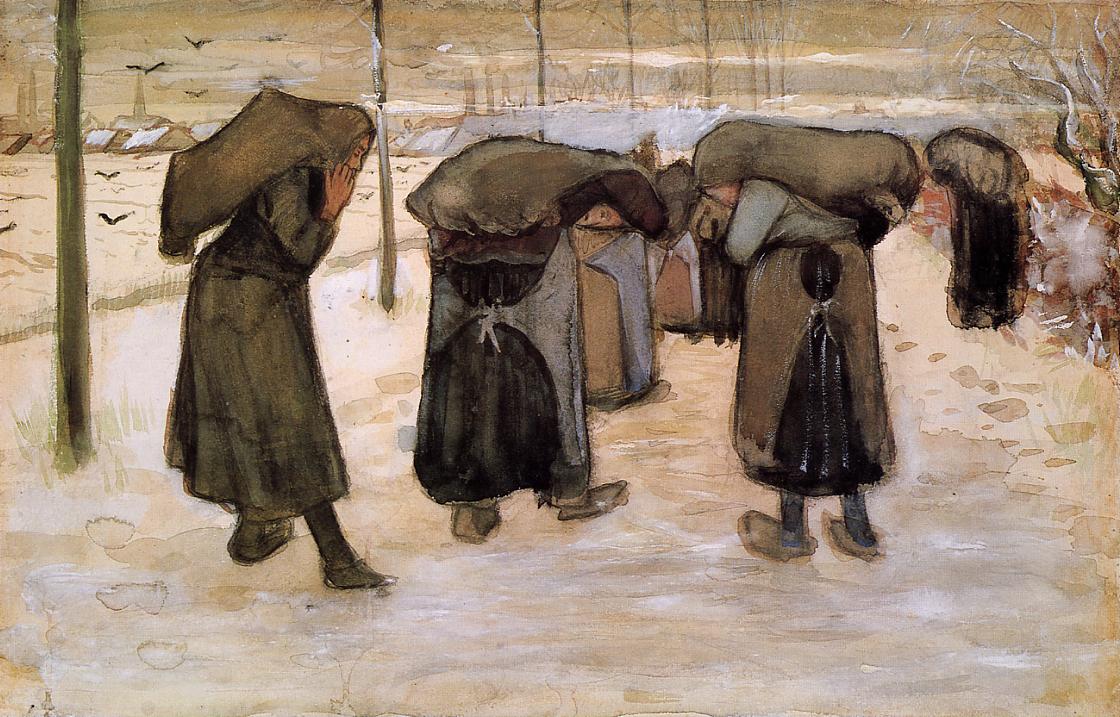
VincentVanGogh-Women-Miners-Carrying-Coal-1881-82

–Women Miners Carrying Coal, Vincent Van Gogh, 1881-82

Lent, we know, is a season of repentance. It is also therefore a season of mercy, for whenever we confess with the hope of conversion, whenever a desire to be free from a wounded or wounding life moves us to reach for help, pardon and healing are already ours.

As professor Greg Mobley writes, at the heart of Christian experience lies “the urgency of love in the present that overwhelms even the terrors of the past.” This urgency, he says, is what the slaver John Newton called “amazing grace,” and the torturer Saul of Tarsus called “the free gift of righteousness.”

In my lifetime, the urgency of love has lifted from my back more than one burden of shame and sorrow. If you have experienced the same relief even once in yours, you know what I mean when I say that I would wish this grace on my worst enemy (as well as, of course, upon my dearest friends).

I would like to suggest a simple Lenten exercise. On the Sundays of Lent when you come to worship, look around at the people with you there and try to grasp this reality – that sitting next to you, across from you, in front of you, are people carrying burdens which, if you knew all the facts and feelings of them, would rob you of breath. Then consider yourself, and your own.

During the silence at the time of confession, imagine Jesus removing one of your burdens. Tell God that you believe that you can be free.  Be grateful. Then imagine that you are helping people around you unload too, loosening knots, guiding bundles to the floor, moving them away with your foot.

Then, after the assurance of pardon, when the worship leader invites you to share a sign of Christ’s peace, step over all that useless cargo and greet your neighbors – light, relieved, and gratefully amazed at what they did for you, what you did for them, and what grace is doing for us all.

One Thing Necessary

i-BgWb6QN-L

–Photo from Keystone Pipeline Protest, REUTERS/Richard Clement

Remember the terrorism color code? It was invented in the previous administration to inform the public about the level of threat we faced at any given moment. When it got racheted up one ominous notch from yellow to orange, we’d be told, for example, that attacks on “soft targets” — malls, apartment buildings, hotels — were being planned somewhere by someone.

It was pretty scary stuff, but the officials who spoke at color code news conferences always said the same thing: “Don’t worry. Carry on your daily lives. We will protect you.” Okay, except that by definition soft targets are impossible to protect; and who wouldn’t worry at least a teeny bit about what a dirty bomb might do to Park Street Station at rush hour? I know I did then—and I still do.

But terrorism isn’t the only thing that worries me. The impending sequester worries me. Rising gas prices worry me. Gun violence worries me. Economic inequality worries me. Wall Street worries me. The breakdown of congressional compromise worries me. Racism and homophobia worry me. Drone strikes worry me. Increased settlements in the West Bank worry me. Global warming worries me. And that’s just for starters.

Most of all, I worry that things are implacably on track, and we are powerless to change them. Marches, protests, righteous legislative lobbying, letters to the White House all seem to go nowhere. I feel guilty that I’m not doing enough, which is true—I’m not. At the same time I think nothing I or others do, no matter how great or noisy, will ever really change things. I get angry and tired and cynical; and when this happens, it’s a sign that I am coming at the world, and at the work, all wrong.

I came across this paragraph in a piece by Kari Jo Verholst in Sojourner’s several years ago. It made me think deeply about what’s needed if Christians who care, who care deeply, are to avoid burnout, cop-out, or despair. I return to it every now and then when my mood turns especially sour. It helps me refocus on the only thing that should worry me—that my worrying will turn to idolatry, that I might sow a seed in the world unwatered by faith, that my care might yield nothing more than the same bitter fruit I decry.

Those of us who think of ourselves as social justice people often use activism as a shield against fear and loneliness. Leery of those who peddle spirituality as self-help and who ignore the ‘root causes’ of injustice and suffering, we can be fearful of admitting our own fatigue and dismay. [Herein] lies an idolatry… More often than not, we understand the gifts we have been given—the prophetic word, the cry of challenge to unjust systems—as something deposited in us, rather than something that flows through us. Thus we interpret our lives according to our faithfulness to this gift, rather than according to our relationship with the God who is the source of gifts and callings. This severance … either causes us to interpret ourselves as being of singular importance, which renders us easily threatened, or it increases our already deep sense that we are always failing, no matter how hard we try. In either case, cut off from our life-source, the seed we sow in the world will be born of this fatigued arrogance, and we become just one more force out there imposing its vision on the world.

The season of Lent begins with a testing. Jesus in the wilderness is confronted by illusions that try to master him. The biggest illusion of all is that he will not need God, but that by his own power he can meet the challenge of engagement with the world. He shakes off that illusion and emerges from the wilderness fully alive, ready to testify, eager for mission, but with no guarantees about the success of his efforts to change the world.

All he knows is that he has chosen—over every other power, every other posture, every other solution—to entrust himself to the love of God and to bank on God’s faithfulness to the world into which he is being sent. It was enough for him. May it be so also for us.

At Least He Knows (Luke 4:1-13)

jesus_tempted–Jesus Tempted, Chris Cook

There were soldiers and tax collectors and beggars and even a few outstanding citizens standing around on Jordan’s bank that day when Jesus went into the river, when the voice from heaven came, when it dawned on Jesus who he was, when he felt just how loved he was, when he learned how infinitely delightful God found him, when God told him, You are my Son.

There was someone else there too, watching the moment unfold, listening to that voice, musing about whether this would be an opportune time, or whether to wait, to wait and see. When the Spirit led Jesus from the Jordan directly to the wilderness, the devil on the bank went right along with him into desolation.

He abided with him through the forty-day fast. Then, when Jesus was famished, he struck up a conversation with that Son.

At the Jordan, a voice from heaven spoke; in the desert, it is a voice from hell. But not the hell you imagine. Not flames and pitchforks, but the expanding torment of a pinprick of doubt.

You, God’s son? Well, if you are… if you are… if you are.

The temptations in this story are three: to be spectacularly useful (turn the stones to bread), powerful (serve me and I will give you everything) and immortal (throw yourself down). But there is only one temptation really, one embedded in these three: to wonder who you are. To entertain the question, Am I who God says I am?

What we need to take very seriously is that Jesus was really tempted to try the stone-into-bread trick. He thought for a moment and maybe more than a moment about taking that suicidal leap from the pinnacle. He wondered what it would be like to acquire all that delicious power and wealth, all that glory, through the agency of evil.

And that means that he also entertained the idea that the voice from heaven had been a chimera or a lie. It means that he wondered about what he had heard at the river and worried that even if it was true, maybe God’s delight in him wouldn’t be enough, maybe it wouldn’t last, maybe  it could be taken away, maybe it had to be earned and re-earned over a lifetime.

This was the temptation in the wilderness: to disbelieve that he was the apple of God’s eye. To fashion a life on some other grounds.

Too many of us know intimately what doubts like these can do to you. They torment you. Too many of us know what a life on other grounds feels like. It feels like hell.

Isn’t this the hardest thing? To embrace ourselves as chosen and cherished? To believe God when God says we are loved and disbelieve the devil’s lies when the devil says we are not—at least not loved like that? That God has duped us and will get us in the end? That our worthiness is no foregone conclusion? That we had better get busy and find some other identity, some other shape for our hearts, some other satisfaction for our hungers, some other way to make our mark?

Isn’t this the hell out of which the tempter rises to address us, the horrible striving place in our souls and psyches, even in our bodies, where no love is ever enough love for us because we are so unable to credit the First and Final Love?

And if I harbor doubts about me, there is little chance I will think of others as beloved of God. I will more likely see myself in competition with them for the scraps of the devil’s promises. I will not be alone in this, either. We will all kill each other over who will get to be most spectacular and useful and daring and powerful and, we think, therefore loved; and we will all try hard never to die. Hell, indeed.

Our inability or unwillingness to know ourselves beloved may be a psychological problem, a socially-conditioned problem, a family history problem; but it is also a temptation, maybe more than anything else, a temptation; a reasonable voice that says ‘If…” and offers to help us out of the wilderness of our longings by providing attractive substitutes for the ‘one thing necessary.’

Honest to God, there are times when, contemplating my own struggles to believe the river voice and not the desert voice, contemplating the painful lives of so many people I know who struggle with the very same thing, I seriously  wonder whether what we need in order to save our Christian lives may be fewer psychologists and more exorcists.

Jesus didn’t give in to the temptation of the devil, we know. The scripture tells us that he bested Satan at the game of dueling bible quotes, he trusted God, he emerged from his ordeal victorious over the devil and took up a powerful ministry of mercy that led to his death and to his vindicating resurrection.But it was never a given. It could have been otherwise.

Don’t be a docetist and think that Jesus serenely sailed over the temptations in a divinely easy way. Such a Jesus would be a bloodless, aloof God-in-a-man-suit performing an act for our benefit, giving us an heroic ethical example of righteous resistance, but nothing more. And if that’s the case, there’s no reason to follow him anywhere, let alone to stake our lives on him.

It wasn’t the case. Remember that in one of the gospel accounts, God even has to send angels to tend to him, he is so exhausted and beat up by what he’s been through. It was an ordeal, not an example.

And then there’s that sobering last line. The devil left him, it says, defeated for a while; he left him ‘until another time.’ Until an ‘opportune’ time—that is, any time he spotted a promising opening. Which means there may well have been some. Which means that the Tempter revisited Jesus when he was at a low ebb, and Jesus had to undergo the torment all over again.

I sometimes read the gospels and try to imagine just what those opportune times may have been. What was Jesus doing up on those mountains when he went off to pray alone? Was the triumphal entry into Jerusalem more tempting than we think?

Whatever they were, it’s never quite settled. Not for him, not for us.

I’m not sure what to make of this, other than to let it calm me down into a more humane acceptance of the chronic nature of this question of belovedness and the pain it causes. Other than to let it normalize a little the experience I and many others have of a two steps forward, one step back rhythm in the life-long journey of letting God speak to our hearts a word of tenderness we can finally believe. Other than to say—and I find this immensely helpful—‘At least he knows.’

At least he knows.

Order of Service for Ash Wednesday, including Holy Communion

ash-wednesday-usa

NOTE: This order of service is in a straightforward traditional form, nothing fancy or hip; so it will not appeal to everyone, nor be useful in congregations that prefer more laid back styles of worship–although I think its formality is not stuffy, only serious. Note also that this order of service includes communion, which is a fitting beginning to the season of Lent–food for the journey, companionship along the way, the centrality of Jesus, etc.There is, however, no sermon in this service. What ‘sermon’ there is is in the form of brief introductory reflections and commentary throughout the liturgy. I have preferred to let the rituals of Ashes and the Table take center stage instead of the sermon. The service may seem long and wordy at first glance, but without a sermon, it actually runs about 45-50 minutes, depending on how many people receive ashes and communion, how many ministers may be assisting, and how much time is given to the silences that give rhythm to the section, ‘readings and responses.’ Nearly all the ‘words’–intros, readings, communion liturgy, are also fairly brief, and will move smoothly if uninterrupted by unnecessary directions, such as “Now please stand and join me in singing hymn #235,” No verbal directions at all need to be given if everything is clearly marked, and if the worship leaders lead by confident example, gesturing with gentle movement for people to stand or sit if need be.

ashwednesday-4

Assembling for Worship

Prelude

*Greeting and Introduction

The peace of the Lord be with you always.

And on the whole world, peace!

Friends in Christ:

The holy season of Lent has begun, by God’s grace and mercy. And what a mercy it is to begin this season in this way, together. For now, more than ever, we need each other—each others’ faith, each others’ presence, each others’ compassion. Because Lent is a time of conversion; a time when, with the Spirit’s help, we open ourselves to change. We ask the Spirit to turn our lives around so that they are oriented towards God and towards the good of our neighbor. We contemplate the temptations and suffering of Jesus, and humble ourselves with him, as he travels the way of the cross, bearing in his own body the weight of human grief and need. On Ash Wednesday, the first day of Lent, we are asked to face without flinching the unyielding realities of human experience—

that we are creatures made from the stuff of earth, beautiful and good in God’s sight;

but that we are not God—we are mortals, and we shall one day die;

that none of us comes to the end of our lives without having contributed something regrettable, of our own making, to the great abyss of suffering;

and that no one comes to the end of life without having been wounded by the sin of another.

Sobered by these things, but not alone, we will make our way through this season with truth and gratitude, until the light of resurrection breaks. Let us begin the journey, then, with Jesus, with each other, and with the whole church everywhere.

*Hymn I want Jesus to walk with me

Readings and Responses

1. Ashes, a sign of creation

Now we acknowledge that we are creatures, wonderfully-made. In receiving ashes, we gratefully honor our earthy origins and our likeness to all other creatures; and we welcome God’s sovereignty over all that exits.

Reading Genesis 2:4b-9

Silence

*Response  From Psalm 8

O Lord, our God, how majestic is your name in all the earth!

When I look to the heavens, the work of your fingers,

the moon and the stars you established—

what are human beings that you are mindful of us?

mortals that you care for us?

Yet you have made us only a little less than divine

and crowned us with glory and honor.

O Lord, our God, how majestic is your name in all the earth!

2. Ashes, a sign of mortality 

Now we acknowledge that we are discontented creatures; we fall into to estrangement and alienation. We confess too that we are finite creatures, and we will one day die. In receiving ashes, we express our trust that in life and in death, by divine mercy, we shall always be safe in God.

Reading Genesis 3:8-13, 17-19

Silence

*Response Hymn By gracious powers

3. Ashes, a sign of repentance 

Now we acknowledge that we sin, and that we are much-sinned-against; we need forgiveness, healing, and reconciliation. In receiving ashes, we ask God to change our hearts, to make us and others whole, and to help us offer reconciliation in this world.

Reading Isaiah 58:1-12

Silence

*Response From Psalm 130

Out of the depths I cry to you, O Lord

Lord hear my voice!

Be attentive to my supplication!

If you should count our sins against us, Lord, who could stand?

But with you is forgiveness, so that you may be revered.

I wait for the Lord, my soul waits for God,

more than those who watch for the morning,

more than those who watch for the dawn.

Hope in the Lord forever,

for with God is steadfast love and power to save.

4. Ashes in the sign of the Cross

Now we acknowledge that Jesus freely chose a life of service that led him to lay down his life in love. In receiving ashes, we humbly follow his Way, and commit ourselves to love kindness, mercy and justice as he did, even if it means laying down our own lives.

Reading Matthew 16:21-26a

Silence

*Response Hymn What wondrous love is this?

The Ritual of Ashes

Blessing of the Ashes

Bless by your Holy Spirit, O God, these ashes, this dust of the earth. May all who receive them, and all who look upon them, be moved to repentance and renewal, for their own sakes and for the sake of the suffering world. May these ashes be no empty sign; but by your mercy, may all who bear them live what they signify—your steadfast love for our mortal flesh,  your power to save, and your boundless mercy. Praise to you, Holy One! In life and death we belong to you.

The Sign of Ashes

If you wish to receive ashes, please come forward. As ashes are placed on your forehead, a minister will address you with one of the following admonitions:

Remember, [name], that you were made from the earth in the image of God.

Remember, [name], that you are dust, and to dust you shall return.

[Name], repent and believe the Good News!

During the distribution of ashes, there may be a choir anthem (e. g., Senzeni Na?) or suitable Ash Wednesday/Lenten hymns of Taize chants may be sung.

Holy Communion

Hymn These I lay down, insert  [Chalice Hymnal]

Please remain seated for the hymn.

Invitation

L: Friends, we have acknowledged before God and in each others’ presence that we depend on God for our lives, that we are sorry for our sins, that we long to be reconciled in the peace of Christ, and that we are ready to turn around and walk in  a new way of love. Come now to the table of Jesus, where he presides, our gracious host. Come to the table of Jesus, where he calls us and where he waits for us, eager to heal us, to persuade us of his love, to welcome us with an unconditional welcome. Come to the table of Jesus, where he feeds his friends with wonderful gifts. Come to this table, from which we always arise with a blessing, no longer strangers, not even guests, but children all alike of our merciful God—children safe at home.

Thanksgiving and Praise

Holy God, we thank you for the gift of life, for time to turn around, and for your steadfast love. Most of all we thank you for Jesus, our teacher, savior and friend, who made his way through this life, delighting you and serving us. We rewarded his tenderness and truth with derision and a cruel death; and he loved us still: “Forgive them,” he said to you, “They do not know what they are doing.”

Words of Institution

And we remember that on the bleak night of betrayal, he gathered his friends. Even with his betrayer beside him, he was grateful to you for life and all the gifts of this earth. He blessed and broke the bread, and gave it to them, saying, ‘This is my body, broken for you. Eat it and remember me.’

And when supper was over,

he took a cup filled with wine, and blessed it.

He gave it to them saying,

‘Take this and drink it,

it is my life-blood poured out for you

so that sins may be forgiven.

And then he said, “When you do these things together, remember me.”

Prayer to the Holy Spirit

Come Holy Spirit, bless these gifts that earth has given and human hands have made.

By our eating and drinking,

fill us with the joy of Christ

and keep us persevering in his way,

honoring our bodies,

serving our neighbor, 

and praising your name.

The Lord’s Prayer

Sharing the Meal

Communion should be by intinction if possible. During the distribution of the elements, there may be a choir song, suitable congregational hymns or chants, or instrumental music only.

*Thanksgiving

Let us give thanks.

Thank you, God,

for life in the Spirit of Jesus,

for gladness in this bread and cup, 

for love that cannot die,

for peace the world cannot give, 

for joy in the company of friends,

for the splendors of creation,

and for the mission of justice you have made our own.

Give us the fruits of this holy communion:

oneness of heart, love for neighbors,

forgiveness of enemies,

the will to serve you every day,

and life that never ends.

In Christ’s name we pray. Amen.

*Hymn How firm a foundation

Blessing, Sending, and Peace

*Blessing (Cf. Isaiah 61:1-4)

The Spirit of the Lord is upon you,

because the Lord has anointed you;

God is sending you to bring good news to the oppressed,

to bind up the broken-hearted, to proclaim a season of God’s favor,

to comfort all who mourn—

to give them a garland instead of ashes,

gladness instead of sorrow,

a mantle of praise instead of a faint spirit.

And you will be called oaks of righteousness,

the plantings of the Lord to display God’s glory.

You shall build up the ancient devastation,

repair the ruined cities,

and heal the despair of many generations.

*Response

And I shall greatly rejoice in the Lord;

for God has clothed me in garments of salvation,

and covered me with a robe of righteousness!

As the earth brings forth its shoots,

so God will cause justice and praise

to spring up before all nations!

*Peace

Go in peace to love and serve the Lord!

Thanks be to God!

Now share with each other a sign of Christ’s peace!

The people share the peace and depart.

———

* All who are able may stand.

The people’s parts are in bold.

“Apparently You Couldn’t Be Bothered…” [Luke 4:1-13]

j-b-handelsman-i-asked-you-in-the-nicest-possible-way-to-make-me-a-better-person-but-new-yorker-cartoon–J. B. Handelsman, The New Yorker, September 14, 1998

One of my favorite New Yorker cartoons depicts a middle-aged man on his knees, praying at his bedside. Looking upward, he says to God, “I asked You, in the nicest possible way, to make me a better person, but apparently you couldn’t be bothered.”

That cartoon contains several sermons. There’s one in there about asking nicely, as if God were touchy about our tone, answering only prayers preceded by “please.”

There’s another one in there about blaming God for our imperfections, as if the fact that we are stubborn, greedy, irritable and dishonest were the result of divine dereliction of duty.

But the one that intrigues me most is the man’s prayer to become “a better person.”

I think the man on his knees is right about God’s attitude. God really can’t be bothered. No matter how nicely the man asks, or how often, it is unlikely that his prayer will get God’s attention because “becoming better persons” has so little to do with the divine project laid out in the Scriptures.

To be sure, the Bible contains plenty of commandments and rules that we are to live by. It has plenty of praise for the blameless and the upright, and plenty of condemnation for the wicked and the lawless; but the Bible is also persistent in acknowledging that no one, no matter how observant of God’s commandments, no matter how “good” a person he or she may become, can claim moral rectitude in God’s sight.

Even more, everywhere you look in Scripture a paradoxical undercutting of God’s own command to obey the commandments keeps cropping up. Some of the people who sin most often and most flagrantly in the Bible are people after God’s own heart whose sins seem only to bind them closer to God, even when God does not hesitate to punish them for what they’ve done.

The brazen sins of King David come immediately to mind, of course, but David is not alone. The Scriptures as a whole simply will not let us regard our lives or our God solely through the lens of morality. It seems that God has better things to do with us than to make us better, and much, much better things to do with us than to make us better according to our ideas of what it means to be “a better person.”

Personal makeovers used to be a hot thing on reality TV. These shows featured people who were massively unhappy with their bodies. They were whisked away from their family and friends for months on end and received tens of thousands of dollars’ worth of facelifts and nose jobs and tummy tucks and dental work. They returned home to a grand “reveal” and, they supposed, to the end of their problems, and a truly new life.

If it were up to the man in the cartoon, and if it were up to many of us, we would like God to be fully-employed in the business of personal moral makeovers. Somehow we have come to believe that the answer to our problems, to the human dilemma generally, and to the world’s sad mess, is for all of us to become “better persons.”

Because Lent is a time of repentance and conversion, we have been taught that it is also an opportune time to try to become a better person. Many people treat Lent as a time to re-make failed New Year’s resolutions to quit smoking, eat less, spend more time with the family, or take on some extra benevolence, some good deed. And if the turn of the calendar page to the Lenten season serves as a jump-start for self-improvement projects, so be it; but if the Scriptures are any indication, God will not be bothered to be of very much help to us in those projects as long as our sights remain so low and our expectations so small as to confine ourselves to becoming better persons.

What else is there, then? What is the larger horizon, the deeper quest? The thing that makes for sinning saints, for giants of God who were not always also giants of moral virtue? What other prayer can we make by our bedsides if not the prayer of the man in the cartoon “to become a better person?” And how might we spare ourselves perpetual disappointment in a God who can’t be bothered?

We could ask God, to paraphrase Eugene Peterson, to be made forever unwilling to be the subjects of our own little life projects, and to let ourselves instead be participants in who God is and what God is doing in us and in the world.

We could ask to be given the grace to step away from the center of our own self-preoccupied universes, even our religious and moral ones, and to be drawn instead into the mystery of divine action in, for, with, and through us.

800px-Temptations_of_Christ_(San_Marco)

–Temptations of Jesus, San Marco

We could ask to be led into a place empty of landmarks, a wilderness filled not only with wild beasts and wilder devils; a place not only of disorientation, temptation and moral danger; but also, as Scripture attests in many foundational stories, a place illumined by what Rowan Williams calls “a ray of darkness,” full of undreamed possibility. A place of the most profound re-making of a different kind, a time and a space for God to speak through uncluttered air not to our behaviors nor to our need for things to make moral sense, but simply to our hearts.

We could pray not to become better persons, but to live in Jesus and be assimilated to him:

He comes up out of the waters of the Jordan, having been baptized by John and confirmed in his identity by the voice from a cloud. Then the Spirit drives him in the wilderness for forty days, where he is tested by Satan to see what sort of “Son of God” we have here; and whether this Son of God will accept the vocation to be fully and dangerously transparent to the life of the God who loves him fiercely, whom he loves fiercely, and by whose moving Spirit he lives and acts for us and our salvation.

Out there, Jesus defeats the devil’s lie that he, and by extension any of us, can rightly seek a deeper, more meaningful, more successful and happier life – including a religious life – without being deeply immersed in the only true life there is, the life of God, a life that is mostly mystery.

Jesus’ victory over Satan in the wilderness was not a victory of moral virtue. To be sure, our traditions teach that Jesus was a sinless man, but it is not because he was sinless that he triumphed. He didn’t beat evil because he was good and getting better. Even though he is the protagonist, the story is not even about him—not Jesus as a tower or strength and the answer to every question, anyway.

It is rather about Jesus-in-God and God-in-Jesus. It is about the way Jesus has for forty days had his heart enraptured and refined so that it is fixed on God and God’s concerns in such a way that when the devil tempts, all Jesus can say in reply to every blandishment is “God” – we live by God’s word, we worship God alone, God is not to be tested.

The story is about God who is not responsible either for our sins or for our earnest acquisition of virtue, who is not in the business of moral makeovers or of things finally falling into place, but who is in the business of love and its cascades and cataclysms.

It is about God who does not want us so much to be better as to be lost – lost without a compass in the wilderness of God; lost, as the great hymn says, “in wonder, love, and praise,” disoriented to ourselves and reoriented to the One who is all in all.

Practicing in Lent

20EuroCents

In 2002, I was on vacation in Spain during the first week in which the peseta was retired and the Euro introduced as the official currency. ATM machines dispensed only Euros, taxi meters displayed fares in Euros, restaurant menus listed prices in Euros  – everyone was using Euros, but it was far too soon for anyone to be at ease with them.

I saw a woman who’d been walking briskly down the street suddenly stop short, take a handful of coins out of her purse, stare at them for a while, move them around on her palm, arrange them in different ways –by size or value – trying to get a literal feel for the new tender.

I saw grown men huddled over pocket calculators at kiosks and in bars talking themselves through simple transactions aloud, like children learning to count.

Whenever it was time to pay for something, the world slowed down, and everyone became a learner. What had been a reflex the week before, when pesetas were the common coin, had suddenly to be practiced as a deliberate act.

When people in the ancient world asked to be baptized into the church, they were not marched straight to the font. They first underwent a lengthy period of instruction and moral reorientation. The human life they thought they had mastered had to be re-learned in the light of the Gospel.

2EuroCentsLike people with a new currency, neophytes practiced  – they turned over coins of grace in their palms day after day, took time to count aloud each transaction of mercy, attended to the tasks of being a new kind of human with purpose, and approached the ordinary with discipline, with an intention of excellence.

Only thus, over time, did the disorienting shock of Gospel living became second-nature. Only thus did the faith they had received root deeply, and their witness flower in the world.

The season of Lent originated in these preparations for baptism, a ritual that signaled the end of one life and the start of another. For us, Lent is a holy opportunity to adopt and undergo a similar converting discipline, to learn anew what some of us thought we’d already mastered – a fully human life in Christ, facility with the new coinage of grace.

Perhaps this year, with the world as grimly attached to a currency of violence and exclusion as ever, we might use these forty days to practice some of the things required for a successful introduction of a new tender — slowing down, cultivating a learner’s pose, taking deliberate care with mundane transactions, paying attention to the sacred potential of the ordinary, maintaining an intention of excellence, practicing the faith.

1EuroThe example of the saints, living and dead, declares that if we practice gratefully over time, by God’s help we will eventually come to transact life with ease and poise, and with such graceful mastery that the dying world will know a resurrection and a life beyond its wildest dreams.

A Communion Liturgy for Lent

IMG_0785

*Invitation

Dear friends, we are going to Jerusalem with Jesus.

He is our pardon, our healing, and our peace!

We will suffer the trial with him, resisting evil.

With him, we will walk the path to life.

But come first to the table where there is food for the journey.

With hearts full of joy we come,

giving thanks to God, our maker,

and offering our praise!

*Praise

We are right to praise you, faithful God!

You answer sin with grace;

you guide our wayward steps toward home.

You are mending for the broken,

safety for the poor, belonging for the outcast,

strength for the weak, and pardon for the sinner.

You reveal your kindness in every sorrow,

your mercy even in death.

All your creatures see your works;

they sing your steadfast love.

We too declare your wonder and grace

as with angels and saints we sing:

*Holy, holy, holy…

Remembering and Giving Thanks

Now, O God, we remember Jesus.

Silence…

He fasted and prayed; he was tempted and tried.

He relied on you for everything.

He was obedient to you and scorned by the powers of this world.

He confounded the haughty and gave hope to the humble.

He was betrayed and deserted. He died between thieves and was buried in a borrowed grave.

You gave him new life. He lives even now, our healer and friend.

He loved us well, loved us to the end, and loves us still.

Even on the night of betrayal, he ate supper with his friends.

Words of Institution…

Prayer to the Holy Spirit

Holy Spirit, come! Make all things new.

Bless this bread which you have given

and human hands have made.

Let it become for us the bread of life.

Bless also this cup, fruit of the vine

and work of human hands.

Let it become for us the cup of salvation.

Bless us also who eat and drink,

that in this sharing we may know the living Christ

who is with us now, and to the end of the age.

Nourish us by these gifts to be willing servants of your world

until the new age [or, kingdom] comes, and every creature beholds it.

We pray in the name of Jesus, who taught us to say:

Our Father….

Breaking Bread

Sharing Bread and Cup…

*Thanksgiving

Let us give thanks!

Thank you, merciful God,

for gladness in this bread and cup,

for love that cannot die,

for peace the world cannot give,

for joy in the company of friends,

for the splendors of creation,

and for the mission of justice

you have made our own.

Give us the gifts of this holy communion —

oneness of heart, love for neighbors,

forgiveness of enemies,

the will to serve you every day,

and life that never ends.

In Jesus’ name we pray. Amen.

Prayer of Praise Lent I

The Third Temptation by William Blake

–The Third Temptation of Christ, William Blake

You call us to the desert to sojourn for a while

with wild creatures, to leave the land of markers;

but your eye does not close, you know where we are.

In restive night, you are near.

In dreams disturbed by demons, you are near.

In the heart’s decisive turning, through testing, you abide.

And when it is over (until another time), the angels come from you,

oil in their flasks, food in their baskets, bandages in hand.

Then let the fast begin, this journey alone and never alone.

Let it begin, this time of refusal, this time of embrace;

this winnowing of wheat, this clearing of the eye.

And all the while, let grateful praise arise

from breadstone and pinnacle, city and treasure,

companion beasts and ministering angels—

even from tempters who play their part.

Throughout these forty days, your praise be sung,

and in the endless age to come. Amen.