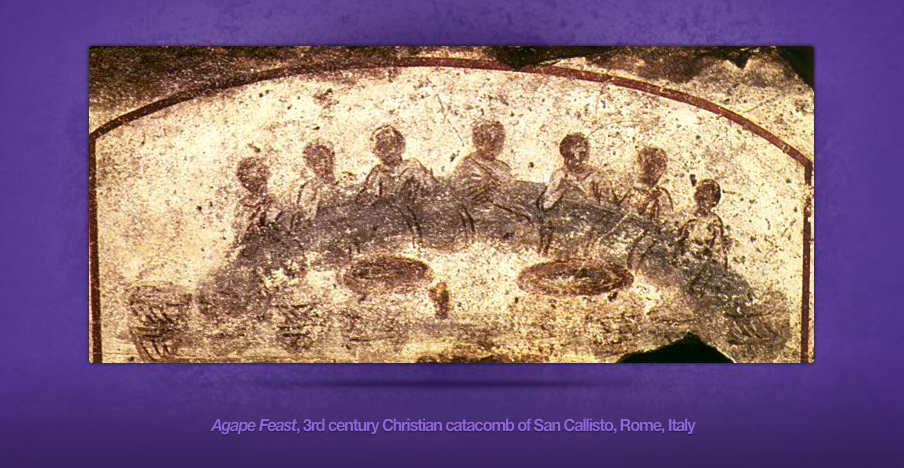
Category Archives: Liturgy

Telling the Truth at the Table: The Possibility of Exclusion


I’m often asked whether there’s ever a good reason for barring someone from Communion. This question usually arises when a Catholic bishop threatens to excommunicate a politician because of their abortion views. 

The question is a trap, and I try never to answer it. When I do, my response never satisfies anyone, because it’s complicated. And few people like complexity.

Still, let me try. And start with something we often say when we’re inviting people to the Table:  

“Jesus knew that there were betrayers, deniers, and deserters at the table with him that night. He fed them anyway. If he fed them, he’ll feed us, too.” 

Now, by this we mean to encourage people who think their moral lives may disqualify them. In fact, I recently heard a pastor passionately assure his people that there’s absolutely nothing they could ever do that could keep them from the Table. Nothing, nothing, nothing! 

And I found myself thinking, almost against my will, nothing? Nothing at all? 

You may infer from my astonishment that I think there may indeed be something. And you may be thinking, but doesn’t Paul say that nothing can separate us from the love of God in Christ Jesus? “Neither death nor life, neither angels nor demons, present nor future, not height nor depth, nor anything in all creation…” 

But despite his reassuring words, Paul and the entire early church believed that really big sins like murder, apostasy, and fornication could indeed separate us from God’s love, or at least from the fellowship of the church, which was to be cut off from the Body of Christ. so more or less the same thing. (Today Paul might put child trafficking and the proud espousal of White supremacy in the same category of sins that are truly “mortal,” i. e., deadly.)

In the early church there was no coming back from such deadly depravity. Later, the bishops would create a path for the restoration of notorious sinners –a system of penance and absolution– but in the first generations, the only recourse was to “ex-communion” such faithless folk.

Grievous sins were thought to deal such a severe blow to the one Body of Christ that to continue eating together the meal that makes that Body one felt like blasphemy. To enact a ritual of unity while the body is falling apart made a mockery of the sacrament.

Paul was confident in the strength of Christ’s love, yet he still thought it was possible to eat and drink so unworthily that you’d cut yourself off from the Body; which is why he begged the Corinthians to examine themselves before approaching so that they might rightly discern the Body and not injure or break it apart. 

I have a relative who’s a devout Roman Catholic. The Eucharist is the center of her life. At one point a few years ago, I was at a Catholic wedding with her, and a few months later at a funeral, and I noticed that she didn’t receive Communion either time, which I found remarkable given her devotion. 

Less than a year later, her husband began divorce proceedings. It turns out she’d been carrying on a 4-year affair, and after her shocked husband refused her request that they open their marriage to include her boyfriend, it was clear that they couldn’t go on. 

Now, sorry to say that my kneejerk reaction was uber-judgmental. Such hypocrisy, such deceit: a devout RC carrying committing adultery and for so long and then having the you-know-whats to ask for an open marriage! 

But after reflection I realized that she was at least honest about one thing: according to her eucharistic theology, she needed to absent herself from the Table. Her unfaithfulness and deceit by themselves might not have been bad enough to disqualify her, but her unwillingness to repent and amend her conduct, her decision to keep doing the profoundly damaging thing she was doing even when she knew it was wrong, certainly did. She believed that her unrepentance did grievous harm in and to the Body, and she knew she shouldn’t partake until she could actually stop doing that harm, which she wasn’t yet ready to do.


I wonder what she would’ve made of a hearty progressive Protestant invitation to the Table that cheerfully assured her that none of that mattered, that her sin was not an impediment to her coming to the Table. Would she have felt relief and joy, and received Communion as a “converting ordinance”, a consolation and a token of healing, a help for her weakness? Or would she have thought her moral condition wasn’t being taken seriously, and that what she was being offered was cheap grace? I don’t know, but I think that’s one important question to ponder in any discernment about inclusion and exclusion.


That there were sinners with Jesus at the Table is attested to in scripture. We progressives see in their presence, and in Jesus’ decision to feed them too, only an assurance of grace. But to leave it at that could run the risk of whitewashing that truly unsettling scene. Look at it again: 

The gospels also reveal that Jesus was in soul turmoil at the table that night. He sensed that his friends would fail him utterly and he repeatedly disrupted the evening’s intimate fellowship to indict them: “You will all become deserters.” “One of you will betray me.” “Before morning, you will deny me.” 

When he said those things, I’m pretty sure it wasn’t to reassure them that even though they were crapioca disciples, it was OK. I think he was truly calling them out, naming their sin publicly, and doing so so that there might be truth at the Table. He’d eagerly desired to eat the feast with them, and he would, but he wasn’t about to eat it in denial.

When we reassure each other that nothing we’ve ever done or ever could do is a barrier to our participation because Jesus ate with betrayers and deniers, we’re telling a potentially healing truth. But there’s more to the story. Our presumptive language papers over some very real and sorry things we rarely call out at the feast. 

I think about this especially when it comes to the look of many of our eucharistic gatherings. UCC congregations are overwhelmingly White. This isn’t an accident. It’s a result of ongoing personal choice and historic entrenched systemic arrangements. Yet in our White-dominant churches, Communion liturgies tend to speak only glowingly of the unity of the Body, even as our racial demographics dismember it. Racism eats with us every time we share Christ’s bread. And only a fraction of our congregations ever asks seriously that most destabilizing question, “Is it I, Lord?” 

Racism isn’t the only instance of turmoil rumbling underneath our sweeping assertions about unity and confident welcomes to all and sundry. And to be fair, we’re not wholly oblivious to the ways our smooth talk about inclusivity, wholeness, equality, and unity in Christ is actually a long-haul ethical work in progress. 

We know that the Body Communion makes is beautiful and holy and real, and that it’s yet to be fully realized: it’s a Body that has not yet come, as Paul put it, to full stature. We know that our claims are often more aspirational than accomplished. But if our rituals of welcome to the table never evince this more complex awareness, we could easily forget what we know and celebrate in denial. 

Instead of remembering Jesus only in ways that reassure us and give us peace, we need to create ways of remembering him that call us out, unmask the denial in our mantras of inclusion, and give us courage and grace to address the trauma in Christ’s Body with truthful transparency. Acknowledging the shadows at our Table may be more just, or at least more honest, than a simple uncomplicated “Y’all come because Jesus is cool with us, no matter what.” He is. And he kinda isn’t. 

Under what conditions, in what circumstances might it be necessary and legitimate to bar someone from the Table? Maybe there are none, as we confidently proclaim. Maybe there are a rare few. I can’t say for sure. But some historical perspective could give us clues.

Many of you are familiar with Albert Raboteau’s study, Slave Religion, which documents the 19th century practice of Communion in the South wherein enslaved people drank Christ’s gift from the cups of their slavers. Raboteau cites the story of William Humbert, a fugitive in South Carolina, who describes how enslaved people came from vast distances to gather for Sunday worship under the auspices of the White slaver church. One commentator on Humbert’s story summarizes the scene like this: “There the sermon droned on with the same moralism week after week: God demanded obedience to masters; thou shall not steal. White deacons distributed Communion to those gathered. Then it was time for the long journey back to the scattered plantations. After sharing the Eucharist, the same White deacons met the enslaved workers on the roads, and if it seemed they were tarrying and wouldn’t arrive back at their plantations within the time allotted by their passports, White deacon slave patrols would flog them. They did so within two hours of administering the sacrament to them.” 

“I thought,” Humbert wrote, “that a man who would administer the sacrament to a brother church member and then flog him before he got home ought not to live.” Or maybe at least he ought not be welcomed back to the Table. 

Picture White deacons with a cup in one hand and a whip in the other the next time you read Paul: “Whoever, therefore, eats the bread or drinks the cup of the Lord in an unworthy manner will be answerable for the body and blood of the Lord” (1 Cor. 11:27). 

So, what do we do when we’ve come apart like this? 

Some Christians think one answer could be excommunication. Withhold Communion from sinners whose transgressions are mortal, like slavers, child traffickers, people who unrepentantly abuse their partners, war criminals, and maybe Christians in charge of ICE. Catholics would add abortion providers. The list could be endless if we really got into it. Which, of course, is precisely the problem with this position: which sins make the list, who decides, and where does it end?

Others say we ought not do Communion at all in view of just how broken the Body actually is. This was the posture of one John Lankford, the White minister of the Baptist church in Black Creek, Virginia, a congregation that included enslaved people, White slavers, and White people who were not slavers. 

Raboteau recounts that in December of 1825, Lankford announced to his congregation that “in justice to his conscience” he could no longer offer Baptism or Communion “owing to his opposition on the subject of Negro Slavery, a part of the church being Slave holders.” 

White members of the church were outraged. For seven years Lankford had offered Communion to all the members of the church. What changed? Slavery was a matter of individual conscience. Were not all welcome at the table, both slave and free? 

Throughout their report condemning Lankford, the White church leaders insisted that that the unity demanded by the gospel outweighed their minister’s conscience. Whatever happened in the cotton fields and plantation houses had nothing to do with the Body and Blood of Jesus shared in the plate and cup of the church. Lankford was excommunicated for his attempt to “split the Church.” 

What led him to “discern the body,” in Paul’s crucial phrase? We aren’t told. But at some point, he came to believe that the brokenness in a church of slave and free was total. As a commentator notes, “the sacrament had failed, not because of any inherent flaw but because people hid their sin behind the veneer of unity.”

Hiding behind the veneer of unity is something we can easily relate to. We do it, too. To maintain the peace of the church and speak the truth in love is supposed to be possible. Ministers vow to do that at their ordinations. And we want to, at least theoretically. But in practice, it’s endlessly fraught. Sometimes what we think maintains the church’s peace actually allows sin to fester and creates underground division in the church, gnawing away at the Body from within. To separate someone and apparently disrupt the church’s unity could be exactly what’s needed to maintain and protect the church’s peace, preventing further injury to the Body.  

It should go without saying that excommunication, if it happens at all, must be a last resort. In our congregations, when we’re angry or hurt because of some transgression, a betrayal of trust, or some other persistent bad or harmful behavior, to go immediately to excluding the offenders, or to absenting ourselves from Communion because the offender will be there, breaking the bonds of the Bdy with their presence, may feel emotionally true to the level of damage that has been or is being done; and it could indeed be the right thing to do. 

But not the first thing to do. In an ideal world, exclusion ought to be the nuclear option. Understand me, I know the world isn’t ideal. And I’m not making light of the seriousness of significant moral disruptions in the Body, nor of the pain they generate, and I’ll have more to say about this in a moment. My point now is only that separating ourselves or others from the Table is such an alienating and maybe even irreparable action that if at all possible, we shouldn’t go there until or unless we’ve made sincere use of the church’s many other means and practices that invite repentance, accountability, evidence of a changed life, and finally pardon and restoration. 

The faith community has many ways of attending to its own brokenness and to its members who cause harm. We’re built for this. No one is automatically expendable; we want harm to lead to repentance and repair, not shunning and exclusion.

When a community is in agony from church members hurting one another—when a woman in the church suffers abuse at the hands of her partner, when someone is harmed by a fellow church member’s racism or sexism or transphobia, when leaders betray the trust of their people, or when the people mistreat their leaders, or when members of the church are complicit in perpetrating public injustice and violence (think ICE), we’re called first to stop, examine, name the damage, and offer life-giving pathways for repair. The last thing the church desires is to add damage to damage.

But when that harm is grievous, and especially when there are clear danger signs that the offender will likely never acknowledge their harm, much less amend their behaviors, we may indeed need to let them go the way they’ve chosen to go. We may need to affirm, but not with a punitive spirit, that they have separated themselves, and regretfully close the little gate in our otherwise unfenced Tables behind them, even as we ceaseless hope for their return. And if they won’t go, if they insist on sham unity at the expense of the Body’s health, we may have to absent ourselves. 

I think the church needs to accept that there could be times when fencing the Table is the right thing to do, times when we have to make a painful judgment when all else has failed. Sacraments can go wrong. And they go wrong because they exist for and within communities of people. And people? We break things. Sometimes we break one another. We’re no different from the Christians at Corinth and the church of Black Creek. Our duty and struggle as an aware, self-confessed flawed community is to discern with the Spirt ways to square two seemingly unreconcilable truths: 

1. The Table is sheer grace and must be open to all. It is, at least potentially, a “converting ordinance” that not only shows forth the unity of the Body but can also over time and by faith and love heal that Body when it has been hurt; 

2. Soul damage is real, and we have experience of the painful spiritual disorientation and dislocation that occurs when we look around the Table and see, for example, the man who raped you (which happened not long ago in a church that must remain nameless), or the woman who betrayed you with a 4-year affair, or the co-workers who slandered you to your boss and got you fired, or the ICE agent who’s just come from cuffing the Latino kid who’s been your beloved neighbor since he was born.

So, bottom line: 

Not only is it not unheard of to separate someone or separate ourselves until restoration has occurred, it could sometimes be required, necessary, loving and more fully reflective of the Body’s honest condition. BUT… It’s the church’s job to try to live in such a way that it never becomes necessary to make that discernment at all. 


NOTE: In these essays about justice and Communion, I rely upon and have been influenced by many scholars, especially the work of William C. Cavanaugh, Andrew McGowan, and Christopher Grundy.
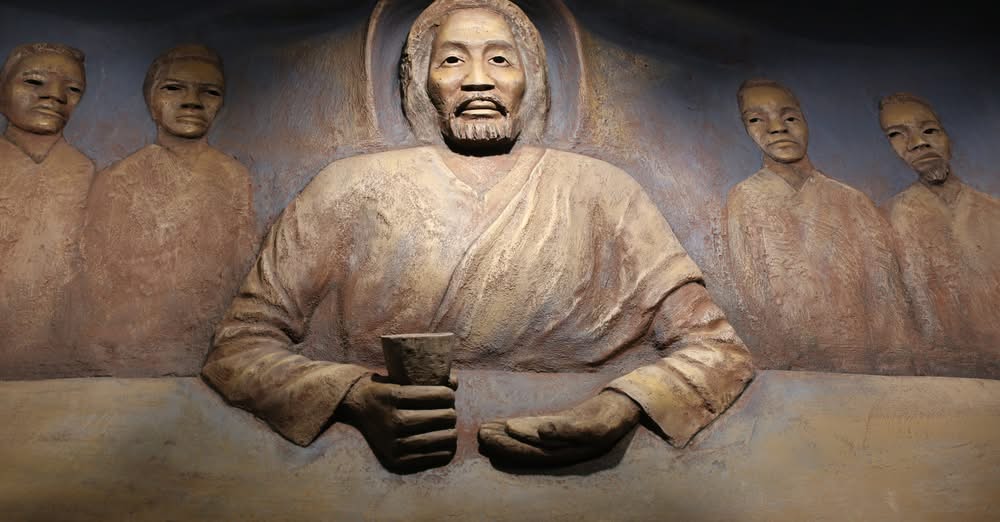
Eucharistic Remembering and the Witness of the Communionized Body

Akili Ron Anderson

A Christian activist friend of mine found out I was going to be giving a series of talks to clergy about holy Communion. She told me she thought it was a frivolous thing to do as the world burns.

She likes Communion, but thinks of it as a spiritual breather between bouts with fire-breathing dragons, a consoling and inspiring ritual. It’s gas in the tank, a helper, like the women’s auxiliary to the real work of justice witness in the world. 

Why spend so much precious time talking about it? When the world’s burning, time spent doing something that’s not dousing the flames is time wasted.

I have a different view of Communion: I believe that the Eucharist is the “real” work, that justice-doing is intrinsic to the sacrament, that Communion is Christian witness in the world. It’s indispensable, not a booster or an add-on. 

Why? Because the Eucharistic liturgy–its signs, gestures, actions, words — materializes a new reality in the world, an alternative social presence that challenges all oppressive regimes that claim the right to define reality and shape every social space in their own image and likeness. 

The Eucharistic liturgy, and our participation in it, exposes the falsity at the heart of that enterprise and makes visible the fully divine and fully human enterprise Jesus named the kingdom of God.  

For example, unlike the regime we are currently living under, the new realm Communion materializes does not require victims, nor their erasure from common memory. It remembers them, brings them from oblivion to presence, and refuses to forget. 

Oppressive regimes depend on erasure. They ban books, words, ideas; they decree the non-existence of certain identities; they remove museum exhibits, and scrub information from government websites. And they impose themselves by means of a purposefully constructed narrative, a story about reality that’s romantic and heroic, self-congratulatory and aggrandizing, pious and innocent, and above all, simple and uncomplicated. This narrative replaces confusion with clarity, locates blame and approval, and confers identity and belonging.

It’s also false. The reality it describes is un-real. The polity it supports is brutal. The culture it fosters is cruel. But as long as no one remembers any other story, the regime is secure. Which is why repressive regimes strike fast to erase it. 

If indeed we ever do overcome some day, it will be in large measure because someone dared to remember. “The struggle of humanity against power,” novelist Milan Kundera wrote, “is the struggle of memory against forgetting.” 

The Eucharist is the church’s quintessential practice of remembering. Even if you think of it in its root meaning, thanksgiving, it’s still remembering, because remembering is the wellspring of thanks. It’s how we know what to be thankful for: “You brought us out of Egypt. You fed us in the wilderness. You did not abandon us when we sinned. You sent us dreamers and prophets…” 

At the Table, the church remembers with thanks God’s saving deeds. And chief among them is Jesus — teacher, storyteller, healer, breaker of chains. And he is the Regime’s slaughtered Victim, the innocent one whom the powers disappeared. 

The stunning claim the Church makes is that he lives. And in the communal act of remembering him we call Communion, he rises again to visibility in the world. He is a “real presence.” 

But that’s not all. Along with him, all the victims of Empire also rise. Everyone rendered unreal and invisible by the Regime’s calculated forgetting is made real and visible when the church gathers to remember Jesus, because he is absolutely identified with them

As long as the church remembers, their real absence becomes a real presence. Communion is the counter-liturgy to the liturgy of erasure. 

A few years ago, I wrote a short piece about Communion called “Refusing to Forget.” You may have seen it in the Daily Devotional:

When Christians talk about Communion, we say it’s a remembrance of Jesus, a memorial. Which is true, but also potentially misleading, as if what we’re doing at the table is reminiscing, like you would maybe at a wake.

But in the gospel’s original Greek, the word for remembrance is stronger, edgier, more demanding—anamnesis—literally, “against amnesia.” It turns out that remembering Jesus in Communion is oppositional, like standing up to something, an adversary. Remembering at the table is not reminiscence, it’s resistance. It’s refusing to forget.

There are forces around us and within us that want us to forget what they’ve been up to for eons, wreaking havoc, taking up all the breathing room, squeezing the life out of everything for ego, profit, supremacy, and power. Killing for sport. 

They’re still at it, night and day, trying to fog over all traces of Jesus’ love revolution in the world and in our hearts. They hope we’ll lose his trail, his story’s thread. They hope we’ll forget we ever knew him. 

For if we forget, we’ll be putty in their hands. If we forget, they can tell us anything they want, and we won’t know they’re lying. In the vacuum of forgetting, injustice has it easy, violence rules the day. 

Communion is dangerous memory, it’s our uprising. At the table we take a stand. We remember him. We remember each other. We remember everyone and everything hate wants to erase. And we refuse to forget. 

This devotion elicited more responses than anything I’d ever written for the DD. Its main idea seemed new to many readers. But it’s not new. The early church teachers we call the “Fathers” routinely taught that the Lord’s Supper is a witness against all who disappear the vulnerable by their disdain and indifference. Communion was incompatible with these ruptures of human solidarity.

They took their cue from Paul’s eucharistic teachings in 1 Corinthians. They were writing later and in different contexts, but their concern about what was at stake in Communion was the same. 

Examine yourselves (Paul writes) and only then eat the bread and drink the cup. For all who eat and drink without discerning the body, eat and drink judgment against themselves. For this reason, many of you are ill, and some have died. (1 Cor 11: 27-30)

Paul is talking about the individualistic way some Christians are eating the communal meal. He says it’s making them sick. This isn’t hyperbole or metaphor for him. Paul believed that Communion creates an absolute solidarity with Christ and among believers. 

Communion makes a Body and incorporates everyone who partakes into it equally. For him, this is a real incorporation, not a poetic, sentimental, psychological, metaphorical, or merely spiritual one. When the community eats the Lord’s supper, Paul says we cease to be atomized individuals. We become one living reality in and with Christ. 

In one of his sermons, Augustine is emphatic about this absolute identification of the sacramental Body and the Church. He writes:  

If you want to understand the body of Christ, listen to the Apostle telling the faithful, “Now you are the body of Christ and all members of it” (I Cor. 12:27). So if it’s you that are the body of Christ and its members, it’s the mystery meaning you that has been placed on the Lord’s table; what you receive is the mystery that means you. It is to what you are that you reply with the Great Amen and by so replying express your assent.

In another sermon he puts it this way: 

You are on the Table and you are in the Chalice, you along with us are this. We are this together. We are eating and drinking this together because we are living this together… Since what is made here is one reality, you too must be one by loving one another, by keeping one faith, one hope, one indivisible love.

“We are living this together…”  The Eucharist is not an act of individual piety: it’s a true social solidarity. As such, Augustine writes elsewhere, it is life itself. If you don’t discern the social solidarity that Communion makes, if you divide the Body’s “indivisible love” by ignoring and effectively disappearing the poor and vulnerable, your body may suffer, not just your soul. 

When the privileged members of the Corinthian church arrive for the Lord’s Supper and don’t wait for the poorer members, and in their absence consume all the best food, Paul says they aren’t eating the Lord’s supper at all. They’re eating their own– Joe’s supper, Linda’s supper, Betty’s, Fred’s. They’re privatizing the Eucharist, erasing the poor, and traumatizing the Body. 

For Paul, this isn’t just a moral failure, it’s an ontological failure, a refusal to be who we are, the Body who is Christ. He’s echoing Matthew 25, where doing justice to the vulnerable is doing justice to Christ himself and withholding it from them is withholding it from Christ himself. 

In the mid-2nd century, the apologist Justin Martyr confronted pagan charges that Christian Eucharists were actually “Thyestean banquets.” This slander refers to the myth of Atreus, whose brother Thyestes seduced Atreus’ wife. Atreus punishes Thyestes by slaughtering his small children and serving them to him at a banquet. 

Christians were routinely accused of cannibalism, but when he defends the Eucharist, Justin isn’t concerned mainly with cannibalism. What he emphasizes is the way power erases the powerless, such as when Atreus treats his brother’s vulnerable children as totally dispensable: he doesn’t see them. They’re unreal to him, so he can do with them whatever he wants. 

Justin distinguishes Communion from a world where power and status define reality, and the poor and vulnerable are literally devoured. The Eucharist is a different kind of banquet at which the vulnerable are not instrumentalized, consumed, and disappeared, but are real, valued, and seen. 

At the Table, every victim lives and becomes present to the eyes of faith because the Eucharistic assembly remembers, and in remembering, it materializes the One who is absolutely identified with them.

Justin notes the practical dimensions of this identification. In his churches, immediately following the Eucharist, “the wealthy come to the aid of the poor.” The deacons take up a collection for the use of the presider, who’s charged with the care of orphans and widows, the sick, the imprisoned, resident foreigners, and “all those in need.” 

In the 4th century, John Chrysostom vexed Constantinople’s Christian elites with uncompromising preaching about their erasure of the poor through the persistent neglect of their needs. In a homily on 1 Corinthians, he reminds them that eating together at the Table across socio-economic lines is a post-Pentecostal gift. The Corinthians refuse this gift when they divisively ignore the church’s weaker members. Since the meal belongs to Christ, every Christian should have equal access to it. Which is why the rich sin mortally against the Body when they eat separately and don’t share with those who have less. 

Christ,” Chrysostom says, “counted all worthy of the same Table even though that Table far exceeds your dignity and the dignity of us all; but you still consider the poor unworthy and rob them of temporal things… Christ gave equally to all, saying, ‘Take, eat,’ but you do not give so much as the common bread equally. Yet it was broken for all alike and became the Body equally for all. If you come to this sacrifice of thanksgiving, you are to do nothing unworthy of it. Do not dishonor your siblings; do not neglect them in their hunger; do not injure the Church.

“Do not injure the Church.” There it is again: when you neglect and disappear the poor from your attention and concern, you traumatize the Body that Communion makes.

Chrysostom was talking about the elites’ behavior towards fellow Christians in the church, but he charged them with neglect of the vulnerable outside the community as well. Their failure to see and serve them also demonstrates that they don’t take the Eucharist seriously: “You have tasted the blood of the Lord,” he wrote, “yet you do not recognize your sibling.… God freed you from your sins and invited you here, but you have not become more merciful.”

In his Homilies on Matthew, he sums it up:

“Do you wish to honor the body of Christ? Do you ignore him when he is naked? Do you pay homage to him in church clad in silk, only then to neglect him outside where he suffers, cold and naked? The one who said, “This is my body,” is the same one who said: ‘You saw me hungry and gave me no food.’ What good is a Eucharistic table loaded with chalices if Christ is dying of hunger?”

Chrysostom affirms that the Body the Eucharist makes is the same body suffering on the street. Devotion to Christ in his Eucharistic presence is devotion to his real, concrete poverty, the poverty of the flesh of suffering siblings that he shares. Chrysostom even says that we’ve disqualified ourselves from the Eucharist if we aren’t acting justly towards each other’s bodies.

All this is to say that the act of defiant communal remembering we call Communion is at the heart of the church’s long determined effort to keep victims visible, oppose and subvert the powers, deny the legitimacy of the prevailing social structures, and enact a new social solidarity in the world over against all solidarities of power, wealth, individualism, violence, and erasure. 

As such, Communion may be the most powerful source of justice witness among all the church’s means of grace. And maybe its most neglected. 

We rarely think or speak of social justice in Eucharistic terms. Like my activist friend, many of us regard Communion as something set-apart, an in-house spiritual activity that gives us access to Christ’s love in a special way, makes us feel close to him and one another, and in so doing, strengthens us for engagement with the “real world.” We don’t usually think of the Eucharist itself as the real “real world.” 

But the Table is the real “real world.” God’s reality is embodied and enacted in all the radically counter-cultural actions of the Communion liturgy — 

gathering, not dividing; 

blessing, not cursing; 

giving thanks, not asserting self-authorship;

sharing equally in the earth’s gifts, not hoarding; 

honoring human labor, not exploiting it; 

extending peace, not doing violence; 

distributing food, not withholding;

remembering, and refusing to forget.

What we do at the Table is the radically real new world of God. But when we’re talking about Communion, we progressives tend to attenuate that radicality. We talk about metaphors, symbols, and representation, distancing ourselves from the depths of participation and identity that Communion offers us. 

One of the most common expressions I hear when people speak about Communion is that it reminds us. Communion reminds us of Christ’s love. It reminds us that God turns no one away. It reminds us that we’re all one in Christ. Communion is a reminder that a generous God feeds us all. 

I’ve read zillions of UCC ordination papers. Nearly all refer to Communion in this way. The ritual reminds me. It helps me think about spiritual things, much the same way that a candle reminds me there’s hope in the night, or a photo on my desk reminds me how much I love my kids. 

Those papers also often describe Communion, and Baptism for that matter, as helping us feel things. “Baptism,” one candidate wrote, “is a community sacrament. The church welcomes the baptized person as a new member and makes promises to support them. Baptism reminds us that we’re in this together. Communion is an individual sacrament. It’s a time for each of us to think about our relationship with Jesus and feel his presence in our hearts. It’s also a time for us to feel closer to one another. Communion reminds us that Jesus went the extra mile for each of us, for me. It reminds us we should do that for each other, too.”  

It appears that Communion is primarily a prompt for pious thought, devotional considerations, spiritual feelings. Moral obligation, too: We’re reminded that Jesus went the extra mile for us so we should do that for others. And so, having been reminded, we leave the private set-apartness of the Table and cross back over to the public realm, to the real world, and do what Communion reminds us we should be doing. 

This way of framing Communion isn’t helpful at any time, but especially so in our current situation. Why? Because it’s not really remembering Jesus. It’s not the radical anamnesis that raises victims to visibility and refuses to forget. It’s not biblical remembering that collapses time, creates common memory, and shapes a common identity. 

It’s not the remembering a kid named Markie Shapiro did one day (true story) in geography class. During a lesson on the way culture is created, his teacher asked his roomful of 7th graders to share the earliest memory they could recall. The kids said things like, I remember my dog, my mom, my blue plushie. But Markie, the only Jewish kid in the room, said, “I remember Abraham.”

From this we learn that little Markie doesn’t just belong to a people, he is a people: he remembers with one communal memory, shared, participatory, immediate, a memory that constitutes identity. This is the way the church remembers on Good Friday, when it asks, “Were you there when they crucified my Lord?” And we say yes, I was there, because there is here, and then is now, and so today I tremble, tremble, tremble. It’s the kind of remembering we do when we sing, “Christ is born today” on Christmas, and when the great hymn of the Easter Vigil deliriously insists, “This is the day…. This is the day… This is the day…” Immediate, participatory.

Communion as “reminder” maintains a distance. That happened then, and we can bring it to mind over the centuries that separate us from it, but what we remember still remains back there. Which is why so much of our remembering is closer to nostalgia, momentarily affecting, but ultimately superficial, sentimental, and ephemeral.

William C. Cavanaugh has noted that Communion as “reminder” also Gnosticizes the sacrament. Its value and benefit lies in knowing and feeling certain things. We discover its meanings if we have the right interior dispositions. The irony is that you don’t really need the sacrament to be reminded of things. We may experience the things it reminds us of in sharp relief at the Table, but we can be reminded of them elsewhere, too, by many other means. 

The same is true, he says, if you regard Communion solely as something that shapes your personal inner life, your character and affections, your motivations and the way you act in the world. Now, Communion is certainly formative. All liturgy is. But if we instrumentalize Communion as primarily an opportunity for spiritual formation, it becomes one among many tools for personal growth. I can leave it behind once I’ve taken in what it offers, or even not do it at all, since my inner life can also be shaped in other contexts by other means. Communion is not necessary for “becoming a better person.” 

The crucial thing about Communion is not so much what it means, Cavanaugh insists, but what it makes. Paul and the patristic theologians have already told us what that is: Communion makes a Body, Christ’s Body, the church — a Body, in Augustine’s words, that is us

Not a private, sacred entity apart from the world, but a new social solidarity in the world. 

Not solely a personal intimacy, but a public Body that presents a new reality in the world, a Body that enacts the realm of God, a Body that does in the world what’s done at the Table. 

Not ancillary to the work of justice, but itself a justice-doer, a resister, a persistent counter to the unreal “real world” of the powers of erasure, violence, submission, and fear. 

Communion is an act whereby the church refuses to grant legitimacy to anything else that claims to represent reality, whether it’s obeying in advance or shopping till you drop.

As I said, this isn’t the way we usually think about Communion. Neither did Brazilian liberation theologian, Leonardo Boff, until he “got it” like an arrow to the heart one day after Mass.

A woman approached him to confess that she’d received Communion from his hand unworthily that morning, because she hadn’t been to confession first, which was the rule back then. She told him she was truly sorry. “But I hadn’t eaten anything for days,” she explained, “and when I came in, you were handing out the wafers. So I ate one, because it’s bread.” 

Because it’s bread. At that moment, Boff understood that when even one Christian has to eat a Communion wafer to keep from starving while other Christians eat excessively, it calls into question everything about the church. 

For him, the existence of that woman’s hunger wasn’t just a moral and social problem; it was a sacramental problem. It signaled that for too many of us Communion has become a privately consoling ritual, “reminding” us of Jesus in a morally inspiring, yet sentimental, individualized, and ultimately evanescent way, making little substantive difference in the world. 

What’s on offer at the Table is not only meanings, feelings, inspiration, and a sense of moral obligation. It’s full-on transformation, a gathering up and remaking of atomized individuals into a new kind of social body, a communionized Body, the Body of Christ. And this Body has a real life in the world, a life that necessarily includes justice-making.

In the context of erasure, the Body Communion makes refuses to forget. 

In the context of hunger, it’s concerned for feeding.

In the context all the -isms, it’s determined to dignify, reconcile, and make whole.

Because it’s freely available to all, and all are fed according to their need, Communion’s Body becomes the counter-politics to the politics that says hunger is necessary, and an economic confrontation with the entrenched assumption that for some to have, others must not. 

Because it’s sheer gift, Communion enacts a non-shaming reality in a world where the powers decide who is worthy to eat. 

Because in the one Body we are each other’s flesh, Communion makes a new social space wherein all bodies count, all suffer the pain and joy of one, all convey to each other mutual care, mutual love, mutual defense, and infinite worth. 

Because it partakes of the generous fruits of the good earth, the Communionized Body lives in the world in profound gratitude for creation, in responsible use of its richness, and in active defense of its integrity. 

Because the elements that nourish it are the work of human hands, the Body lives in solidarity with workers such that anything that demeans them or their labor is of ultimate concern. 

And in our current context of reprisal and revenge, of getting even as a way of life and as a way of governing, Communion makes a Body that’s animated by mercy, for the Body it makes is the victim who returned to those who disappeared him without a word of retribution on his lips. Only a question: Do you love me? Only an offer: Feed my sheep.

Yes, the Eucharist has meanings. Yes, it teaches lessons. Yes, it inspires personal devotion. Yes, it affects and shapes our individual inner lives. And yes, it entails ethical obligations. But most of all Communion makes a Body. And this Communionized Body, the Body that is us, lives and acts in the world as a Real Presence.

And a political actor. As Boff discovered in the encounter with the woman who ate a wafer to live, “the Eucharist is already politics just by being bread.”

And, we could add, just by refusing to forget. (Remember me.) And just by being open to all. (Taske, eat, all of you.) Just by hallowing created things like bread and wine. Just by giving thanks (He took bread and blessed it.) Just by being a feast of persevering and resilient joy. (Until he comes again!)  Just by being a communion, and just by unveiling a just human polity, a new social order that denies the very premises on which the old order runs; and, because it lends no legitimacy whatsoever to that system, just by being a provocative and extremely dangerous ritual. If, as Paul contends, Communion wrongly practiced can make you sick, rightly practiced it can get you killed. (Ask Oscar Romero about that.)

Anglican theologian Kenneth Leech once described the Communion liturgy as “the weekly meeting of rebels against a Mammon-worshiping world order.” The sacrament, he said, “is a freak event in a world where… bread and wine are hoarded, not offered; concentrated, not divided; unequally distributed, not commonly shared.” 

At the Table all this is reversed as we enact God’s new reality, the real real world, together. We become a Body that doesn’t have to be persuaded that it should do justice; justice is our second nature reflex.

Again, as Cavanaugh writes, If we centered Communion more purposefully in our congregational practice; if we communed at the Table with the living Christ more regularly and more hungrily; if we more daringly welcomed the Spirit’s agency by which our Eucharistic participation makes of us a communionized Body, maybe we wouldn’t have to convince ourselves with repeated moral exhortations to remember victims, honor bodies, feed the poor, and defend the vulnerable. 

Maybe we wouldn’t have to guilt each other into challenging, dismantling, and replacing the structures that now demand an endless supply of victims.

Maybe we wouldn’t have to contend with the strong resistance to siding with the oppressed that we often experience within our own congregations. 

Maybe, by our rising from and returning to the just Table, a just life in the world would be simply what we do.

And if justice-doing were to come more naturally to us as the ordinary reflex of Christ’s Body, if we were to lend ourselves to Communion’s full-on transformation so that it might be so, maybe there’d be far fewer siblings disappeared into the regime’s oblivion of forgetting, and far fewer standing at the church door aching to eat a wafer in order to live. There might instead be “a table set in the sight of all our foes…”


NOTE: In these essays about justice and Communion, I rely upon and have been influenced by many scholars, especially the work of William C. Cavanaugh, Andrew McGowan, and Christopher Grundy.
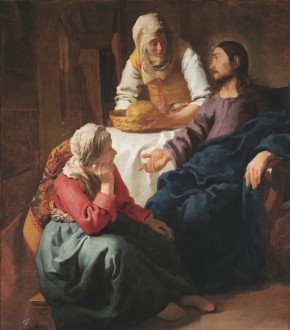
Restoring the Mealness of the Meal

Real things

Over the millennia, Catholics and Protestants alike have supernaturalized, intellectualized, pietized, sentimentalized, privatized, and moralized Communion into an untouchable sacred thing, even a “prize for the perfect,” to use the late Pope Francis’ scathing term. As someone once wrote: “We are become like people who know everything about bread except that it’s meant to be eaten.”

But Communion is a meal. Whatever else it is — and it is many things–, if it isn’t a meal, it’s not Communion. Even if it’s a “token” meal, not a full-on banquet, as it is for most of us, the meal is meant to be at least recognizable as food. 

Before we get to any talk of symbolism, representation, signification or what it “reminds us” of, our eating together is eating. The bread we consume is bread. The wine and juice we drink are wine and juice. The table at which we gather is a table. And the people around it are people. Real things. And real things are radical things. As Jesuit peacemaker and poet, Dan Berrigan, noted in a letter, years ago:

“When I hear bread breaking…, it seems as though God never meant us to do anything else. So beautiful a sound, the crust breaks up like manna and falls all over everything, and then we eat; bread gets inside humans. It turns into what theologians call “formal glory of God.” But don’t let that worry you. Sometime in your life, hope you might see one starved man, the look on his face when the bread finally arrives. Hope you might have baked it or bought it – or even kneaded it yourself. For that look on his face, for your hands meeting his across a piece of bread, you might be willing to lose a lot, or suffer a lot – or die a little, even.”

The poor man might not have much to say about the symbolic meanings of bread, but he can tell you exactly how it looks, feels, and tastes.

Jesus said we don’t live by bread alone. But not for that can we live without it. His own meal practice makes it hard to imagine that he would have asked us to remember him with a meal that consisted only of pale allusions to actual food and drink. 

Communion is food for the body’s life, the life we breathe and bleed, as much as it is nourishment for the spirit. Bread is bread, wine is wine. Real food and real drink. Or it ought to be.

Real and ritualized 

Now, to insist that the Communion meal is a meal, the real thing, is not to say that there’s no deeper meaning, no symbolic character, no spiritual power in it, and that it shouldn’t be ritualized. In late antiquity, social eating of every kind was ordered in symbolic and meaningful patterns. The Christian Eucharist was no exception.

Early Christian Eucharistic meal practices were diverse in form and content across far-flung communities in strikingly different cultural contexts, and in them all, the Eucharist was always a ritualized meal. It was never like a spontaneous picnic or casual potluck or a clean-out-the-refrigerator night, “whatever you have on hand.” Even the meals that the gospels show Jesus eating in people’s homes unfolded according to established patterns, the pouring of libations, blessings, dedications, prayers, a ritual order. 

So, when I emphasize Communion as a real meal, I’m not suggesting that its mealness is incompatible with its being also a ritual. I’m suggesting instead that the ritual elements of the sacrament–words, gestures, objects, elements, choreography– should never be such that they obscure the fact that we’re engaging in a bodily, earthy, and human act, even if it is also an act that has profound spiritual significance and is carried out in specific ritual patterns.

A delight, an indictment, a confession, and a turning

Why is the mealness of the meal important? Because if we experience Communion as a sacrament of real food, real eating, real physical feeding, real satisfaction of creaturely needs, a truly human sharing in mutuality and conviviality, we will also experience it at the same time as the sacrament of real hunger, real deprivation, real human atomization, and endemic institutionalized food injustice.


If Communion’s host is a God who provides food; if the sacrament in any way materializes among us the Jesus fed the physical hunger of multitudes; if the ritual makes grateful use of the fruits of creation and dignifies the human labor it takes to put food on the Table; if Communion is real food, a meal, then we’re meant to enjoy it with delighted thanks. 

And if Communion is real food, when we consume it together, it’s also necessarily an indictment and a confession. It rebukes and shatters us and turns us around, because its mealness confronts us with the fact that we’re actually eating. We have food. And we’re eating it in full view of (while participating in) a world deliberately structured so that for some to eat more than they need, others must eat much less, even nothing at all. 

The Eucharistic meal has a shadow side, and we can’t see or acknowledge it, much less address it, if we keep spiritualizing it into personal intimacy and inner feelings. We more clearly discern its justice dimensions when we take the “mealness of the meal” seriously. And that means, among other things, taking bread and wine seriously, as what they are, not solely what they may represent. 

Fruit of the earth and the work of our hands 

Restoring the mealness of the meal entails not only honoring the goodness of the elements as gifts of the natural world, thus implicating us by our grateful reception of them in the earth’s care and defense; it also entails recognizing the ethics of the meal’s human production.

A few years ago, I wrote a brief devotion in which I make this point about the real labor it takes to land the elements on our Tables. The scripture is from James:

“Behold, the wages you withheld from the workers who harvested your fields are crying aloud, and the cries of the harvesters have reached the ears of the Lord of hosts.”

Basil Hume, former archbishop of Westminster, once declared, “No work, no Communion.” He didn’t mean you have to earn the bread and wine we bless. He meant there’s no bread or wine to bless unless someone labors to make it. 

Communion begins long before church begins, in the daily work of human beings as workers plant, harvest, mill, bake, pluck, press, ferment, refine, and bottle. 

Communion is a divine gift, but human work is the medium through which it arrives on our tables to be shared in love. 

Like all human labor, the work that makes Communion is holy work, and whenever we gather for Communion, we should gratefully acknowledge its dignity. But we should examine our consciences, too. For to receive the gift of someone else’s labor is a confession as much as a celebration. 

By regularly consuming the labor that makes Communion, we’re meant to become the kind of people who don’t just spout pieties about the dignity of labor, but who can also face the fact that holy human work is often unsafe and rarely justly compensated—and that we’re all implicated in this injustice. The kind of people who know that the bread and juice on our table, like so many products we routinely consume, are often the products of human suffering.

And the human suffering that give us food for the Table is also the earth’s suffering—pollution, deforestation, ecological imbalances, unchecked free markets that destroy the health of people and planet for the sake of profit. 

All this is in the bread and cup: the sweating, suffering, suffocating bodies and blood of human beings, and the damaged exhaustion of the plentiful world we were given to tend.

At Communion we routinely pray that the bread and wine will become for us the food and drink of abundant life. Let’s pray, too, that by eating and drinking, we’ll also become something—a communionized Body that lives to do justice, ensuring an equal and generous share of the world’s food for all, respecting those who labor; and caring for Earth, our common home.

Enacting the meal’s mealness

Even when we acknowledge Communion’s mealness, we’re often at a loss about how to enact and embody it in our liturgies of Communion. Our instinct is to talk about it, to explain and exhort. But the Table really isn’t theplace for studying and debating the environment’s destruction, the causes and mechanisms of hunger, of the unequal distribution of food, and unjust labor practices everywhere. 

The remedy for our denial is not to make Communion an occasion of sociological self-flagellation. The Table wasn’t made to bear up under that kind of moralizing. We don’t need any more guilt trips in church than we’ve already got. Communion packs an ethical wallop, but it’s a ritual, not a screed-y stump speech. So, “no” to wordy exhortations and explaining the Eucharistic symbols to death. The Table is for truth-telling, not moralizing. 

The good news is that we don’t have to burden the liturgy with all kinds of facts and figures and examples and moral exhortations. Simply taking steps to restore the mealness of the meal will go a long way on its own. The “realer” we are with real things, the more Communion can tell the truth just by being itself. Good ritual cuts us to the quick even if it never speaks a word. And good ritual starts with real things. 

If we keep it real– mindfully gather, serve each other recognizably real food in thanks and joy, discern a real Presence in our sharing among real people in real convivial mutuality– we might also come to experience by contrast the depths of the real hunger that haunts human eating and daily labor. 

If we keep our eating real, we might find intertwined in it both our sacred solidarity and our sinful complicity. And at an honest Table, we may safely confess it. 

If we keep the meal real, it may give us real hope, real vision, and real commitment in the presence of a real and hungry Christ. 

Restoring the mealness of the meal will entail practical and logistical questions whose solutions will depend a lot on the culture and context of each congregation. Each community will need to contemplate what this restoration might look like for them. 

Maybe it will be a reevaluation of the skittish habits we got into during the Covid epidemic that left some congregations with only ghostly, sanitized, and individualized traces of the real food they used to serve. 

Maybe it will be the institution of a “dinner church” practice once a month.

Maybe it will be a Communion table set as if for an actual meal–no metal tray contraptions, no big bronzed cross taking up space, no odd white coverings over the bread and wine/juice suggesting that there’s something on this table too sacred to see or touch before the ministers begin the sacred ceremony. (Some congregations set the table at the offertory, with a real dinner service from people’s homes.)

Maybe you’ll find a new way to feed each other, not always receiving from an appointed minister, but face to face with one another, person to person, while singing creates a festive mood?

Maybe you’ll be more intentional and creative about ways to link your Communion service visually and actively with a feeding ministry of the congregation, or some other ministry to which you contribute?

Maybe you’ll design a more robust offertory ritual in which, along with monetary offerings, the elements and other food from the people are brought to the table with songs of thanks, and are set apart with a blessing prayer that acknowledges the gift of food and the labor that produced it, acknowledging also the suffering of the earth and of workers.

Maybe you’ll want to engender a new appreciation for the act of distribution–some simple, direct, non-ponderous ways of serving that makes clear that it’s a holy thing to distribute food. One pastor (who was reading through the UCC resource, Do This) calls the deacons/servers forward with this invitation: 

“In soup kitchens and food banks, 

at the family table and at the Communion table, 

what a holy thing it is to distribute food, O God! 

Bless all those who give your hungry people daily bread. 

Deacons, come now, prepare to serve…”

Maybe it will be a reexamination of practices you may have that overlay (mostly invented) “meanings” on every liturgical action (you know, like holding the bread till all have received, then consuming it together on signal in order to symbolize X; and drinking the little cup separately to symbolize Y…). Maybe you’ll try instead to let the acts of distributing, sharing, and eating speak for themselves, as the real, everyday things they are?

Like most things human, this business about the meal’s mealness is complicated. The challenge for us who shape Communion liturgies and for us who participate in them is to find and use language, gestures, and objects that are adequate to this complexity; words, gestures, and objects that neither overwhelm the Table with sheer fullness and contentment nor overwhelm it with abject pain and guilt; that neither alleviate us with false assurances nor flagellate us into paralyzed helplessness. We need instead liturgies that help us eat in joy the bread of tears and eat in tears the bread of joy. 

Does it matter what we eat?

One of the questions that often arises when I’m speaking about the mealness of the meal concerns the elements: Does it matter what we eat?

I think it does. Normally. Which means I think bread and wine/grape juice should be our default choices. Which means I think there are also circumstances (limited and conditional) in which other choices can and even should be made. But this nuanced position will take me a while to explain. Which I will attempt in the next essay I post. Stay tuned.


NOTE: In these essays about justice and Communion, I rely upon and have been influenced by many scholars, especially the work of William C. Cavanaugh, Andrew McGowan, and Christopher Grundy.

Hosting, Guesting, and (If We’re Being Honest) the Dilemma of Inclusion

.

Velázquez, Christ in the House of Mary and Martha


In progressive Protestant churches today, there’s a strong consensus that Communion is the sacrament of inclusion. Everyone should have a seat at the Table. The open Table enacts not only a hospitable world, we say, but also a just and inclusive one. 

“Open Communion” is a novel practice. It wasn’t long ago that everyone “fenced” the Table. There were all kinds of fences–denominational belonging, theological beliefs, moral strictures, age and intellectual requirements. In many cases, you had to be confirmed first. And in all cases, you needed to be baptized. In the global church today, mostly you still do. 

A fully inclusive Table is a complete break with this Tradition. The universal church has never witnessed, much less countenanced, the kind of no-questions-asked-openness that now characterizes the progressive wings of the church.

In that wing, an open Table has acquired quasi-dogmatic status. Just scroll through social media after a Catholic bishop denies Communion to a public figure, or someone posts about being at a funeral Mass or wedding where the priest announced who was and wasn’t welcome to receive. There’s immediate blowback from our side: indignation, condemnation, and a lot of people crowing “I’m so glad I’m in X progressive denomination, and not like those others.” (Oh dear, isn’t there a parable about that?) 

But mostly you hear painful personal stories brimming with bewilderment, sadness, and anger. Unfencing the Table is a response to a sacramental practice that separates, excludes, subordinates, and punishes. And we believe it’s proving itself by its fruits. We all know someone who’s been healed by a gracious invitation at one of our Tables. 

But we need to acknowledge something else about us progressives:  When we’re convinced we’re doing something just, especially if we’re the out there on the edge, the first to do it, we tend to be headlong about it, rarely pausing for thought. Our self-assurance makes us impatient with and sometimes dismissive of questions and nuance, thus missing chances to go deeper. 

Our tendency is to proceed on sentiment and a few proof-texts. We assume innovation is always a gain for the Tradition. We ignore the possibility that it could also potentially entail a loss. Or better said, we act as if the goodness of the new thing we’re doing is simple and self-evident. 

It never is. Which doesn’t mean it’s wrong, only that it’s not always immediately apparent that the Spirit is authentically at work. And you’d think that in the case of this totally new thing called the Open Table, we’d at least attempt to ground our practice in scripture, tradition, reason, and experience, as Christians have always done at important junctures of doctrinal development. But discernment in the church’s progressive wing usually relies mainly on experience, especially pastoral need; and it’s often the only thing that carries any legitimizing weight for us. 

I’m a strong proponent of an open Table, yet I find it disconcerting that we progressives have not really attempted a thorough-going theological, ecclesial, scriptural, rational and, yes, of course, experiential case for it beyond the assertion that Jesus did it, so we can, and should, do it, too. 

Now, don’t misunderstand. When all else is said and done, I think experience and pastoral need are vital and persuasive reasons for doing what we do. It’s that ” all else said and done” that concerns me. Pastoral need may indeed be paramount, but to say so with reliable Christian confidence, we probably need to have pondered other concerns, too, discerning and sifting among all the available relevant evidence until we land on what we believe to be the Spirit’s bottom line. When you’re altering a 2,000 year universally held norm, the burden of proof falls on you. You may be right (and I think we are), but you need to show your work. 

So, let’s take a closer look at the Table we say Christ hosts and to which he welcomes all without exception. And let’s begin with the stories that the gospels tell about the company he kept at meals. 

It’s undeniable that Jesus had an indiscriminate meal practice that some critics disapproved of. And this is one way we argue for full Eucharistic inclusion: He ate with tax collectors and sinners. No one was ‘other’ to Jesus. He welcomed everyone and turned no one away. Neither should we. 

But the reality is more nuanced. In all the gospel stories of Jesus’ eating and drinking, he eats and drinks only with fellow Jews, never Gentiles or Samaritans, with the arguable exception of the feeding of the 4,000 in the Decapolis, in Gentile territory, where we may surmise the presence of some Gentiles in the crowd. 

But, as Andrew McGowan and others have pointed out, Jesus’ ordinary custom was to eat with his own: Jews of different classes and conditions, to be sure, including all kinds of socially disreputable folks, but always within the family. Jesus was inclusive, but only somewhat. There’s no indication that a fully inclusive meal practice was ever his thing. 

We also regard his willingness to eat indiscriminately as uniquely law-breaking and controversial. But eating with mixed and dubious Jewish company was not unique. We find the pious and the lax mingling at banquets he attended, and a sinful woman shows up in Simon the Pharisee’s house to weep on Jesus’ feet.

It wasn’t particularly controversial, either, except for some groups with very specific ritual concerns, like the Pharisees. (They wanted to expand the purity appropriate to Temple priests to all Jews, and thus to sanctify the whole of Jewish life. It’s not for nothing that when Jesus defends his eating practices, it’s nearly always in conversation with them. No one else seems to mind all that much. 

So, what can we say based on scripture? 

Jesus was somewhat inclusive, but not fully. His indiscriminate meal practice raised eyebrows among some special groups but was not otherwise unique or controversial. 

OK. But what about his table, the one he never turned anyone away from and at which he was host? 

There are only three instances in scripture when Jesus could reasonably be said to host a meal—the improvised, indiscriminate feedings of multitudes out in the open; the for-members-only Last Supper at a borrowed table in someone else’s hall; and the post-resurrection cookout on the beach for a handful of his closest friends. 

Apart from these instances, Jesus is never the host at his table. He doesn’t have a table. He always eats at somebody else’s. Tax collectors have him to dinner. A prominent Pharisee invites him. Peter’s mother feeds him. Martha frets a meal for him in Bethany. And so on.

Jesus doesn’t invite, he gets invited. When he eats with tax collectors and sinners, he’s not the host, he’s a guest. He doesn’t offer his hospitality to them, he accepts theirs. So, when we say we welcome everyone to our Table because Jesus welcomed everyone to his, it appears that we’re on thin evidentiary ground. 

I’m not arguing for exclusions at our Tables based on the gospels’ depiction of Jesus at other people’s tables. I’m proposing a shift in perspective. Although the scriptural evidence may not support claims about Jesus’ fully inclusive meal practice and, it presents us with challenges for our justice-doing at the Table nonetheless. 

I think that Jesus as an all-inclusive host is actually less ethically challenging for us than Jesus as a willing, modest, receptive guest. Here’s why:

In Jesus’ world, extending hospitality was a way to create and express networks of friendship and patronage. Hospitality and hosting entailed a kind of reciprocity that allowed you to call people who eat together “friends,” or even equals. But it was often a fictive convention, because extending hospitality was and still is also a way to establish power.

Banquets and symposia in Jesus’ time routinely included signs of hierarchy and dependence, such as higher and lower places at the table, or better food and drink depending on your status. (Which is what Jesus was talking about when he told his disciples to take the lower places at banquets, and what Paul was referring to when he scolded the Corinthians for hogging the best food at the Lord’s Supper.) What appears to be an act of magnanimous generosity– hosting–was thus also a display of affluence and taste, an assertion of customs and norms, and a subtle statement of control. If Jesus was a host, it means he controlled the feast. I’m not sure we want that model at our Tables. 

But he wasn’t a host, and he controlled nothing. The gospels show us a hungry Jesus, not a hospitable one. “Zaccheus, come down, I’m eating at your house today.” Jesus the moocher. Jesus dependent on other people’s hospitality, the hospitality of the despised and marginalized as well as the influential and the rich. 

Maybe this invited Jesus calls us not so much to be good hosts, but to relinquish as he did the often-unconscious assumption that we’re the ones throwing the party and doing the inviting. Like Jesus, we’re not the givers of the feast; with him, we’re guests among guests at God’s feast. We may have arrived earlier than others, but that doesn’t give us proprietary rights over the hall. And if even unconsciously we think and act as if it does, we haven’t yet pondered deeply enough the Mercy by which we all got in here in the first place. 

In a Christian Century column, Sam Wells proposes that the term,’ hospitality’ is inadequate to the radicality of Jesus’ practice. He suggests the term ‘guestability’ instead — the grace and receptivity to act generously in other people’s territory, setting aside the privileges of being the host, and being willing and available to accommodate and adapt, to learn and appreciate. 

“When you stay in someone else’s house,” he says, “you might bring a gift, ask what’s a suitable time to get up, take an interest in your host’s furniture, express gratitude for their cooking, and try to penetrate the mysteries of their dishwasher or recycling system.”

Guestability doesn’t undermine the need for wide welcome and acceptance, affirmation, and welcome at the Table. It questions only the often unconscious but nonetheless real sense of ownership with which we tend to extend it, no matter how much we insist it’s not our Table. 

Guestability tempers the impulse to play the protagonist, it undermines all forms of entitlement, conscious or unconscious, overt or subtle, and it requires us to make the Eucharistic liturgy a new kind of social space, free of all signifiers of rank, precedence, and ownership.

Wells also believes that the word “inclusion,” is inadequate, and subtly controlling. It’s hard for ‘inclusion’ to shed its note of noblesse oblige, the sense that I, being generous and just, let you come to me and become one of us who own the space and patrol the sacred perimeters. He suggests the phrase, ‘common discovery’ instead—”something we more readily appreciate when we’re outside our own familiar territory.” 

It’s not, ‘You can belong here because I’m being good to you.’ “It’s, ‘Being with you is showing me there’s something beyond us both, toward which we’re both heading, and to which you may be closer than I am. Let’s make our way there together.'” 

I don’t know about ‘common discovery’ as a term to replace inclusion, but the displacement of privilege Wells is getting at seems just right, and challenging in ways that including is not. It’s a dynamic similar to de-centering whiteness, de-colonizing theology, and the like. 

Back in the 1980’s some concerned Andover Newton faculty members decided to get off the seminary’s lofty hill and down into what was then called, forebodingly, “the inner city.” They established a ministry center in Roxbury which, as most of you know, is a predominantly Black neighborhood of Boston with a lot of really bad racist press. 

One evening the ANTS profs convened a session with area activists about what they could do to help address the neighborhood’s issues. One woman from the community listened patiently and politely as they nattered on about  the ideas they had that might make life better there. But soon she’d had enough. 

She stood up and began describing the richness of the community, the people who live there, their beauty and accomplishments, their creative institutions, their courageous families, their struggle to make the neighborhood more than a frontpage horror story. And she demanded to know why smart theology guys like them seemed able to conceive of Roxbury only as a problem to be solved, not a gift to be received. 

If we take seriously that Communion enacts a new social reality into which we’re all incorporated by the Spirit; if we take seriously that the Christ-Body we’re incorporated into is hungry for what’s on offer at other people’s tables; if we take seriously that to be a guest is potentially more saving, healing, and just than being a host, more intriguing, fruitful, and amazing, too, it could make a difference not only in our faith posture at the Table; it could also reposition our lives and ministries in the world. 

We might more readily accept invitations, find comfort and strength at other people’s tables, respect their manners, sample their food, relish their fellowship, cherish their gifts and graces, learn from their wisdom and strength, make discoveries and go places together we never dreamed existed. And when we do stand near the Table and invite the world to come, we’d do so far more humbly, dispossessed and emptied of privilege and control, in amazement, in thanksgiving, and on our knees.

So, does all this mean we should can never say that Jesus welcomed all, and mean all? Never speak of Christ as our welcoming host? Not make it clear that everyone is welcome? Is there any scriptural or theological basis for our current inclusive practices?

At the risk of seeming to take back everything I just said, I think we can say that Jesus welcomed all without exception and that he is our all-embracing host at the Table, even when the scriptural evidence doesn’t fully support this characterization. 

Why can we say so? Because the church is always engaged in discerning its experience of Jesus, and this discernment, if we’re doing it “right,” looks not only backward to the Jesus of the gospels but also forward to the risen One seated at the right hand of God. 

Looking back, we can say only so much, go so far. Looking back, inclusion is only partial, and Jesus is more guest than host. But when we look forward, we find additional, important, and illuminating grounds for affirming Jesus as all-inclusive host at a Table of eternal welcome.

Simply put, the church knows that the story didn’t end with the resurrection and ascension. Jesus “sits (eternally) at the right hand of God,” and he comes to us now from that fulness. We can imitate his future as well as his past. And in that glorious, fulfilled, future perspective, we see him as host, inclusive welcomer, and provider. And it wasn’t very long after the gospels were written that the church began characterizing him that way in prayer, song, visual art, and teaching. 

The church ruminated on gospel parables of the eschatological banquet and the post-resurrection stories of Emmaus and the breakfast on the shore. It also reflected on its own post-resurrection experience of Christ. 

The church listened to itself, plumbing the religious experience of the faithful, many of whom were themselves marginal, and all of whom understood themselves to have been rounded up from the highways and byways, like the surprised people ushered into the king’s banquet in Jesus’ parable. 

In the experience of having been far off and then brought near, grafted on, in Pauls’ memorable phrase, Gentile convert s especially experienced Christ’s acceptance of them as a host’s inclusive welcome. Thus, the church’s imagination embraced Jesus as welcoming host at the inclusive banquet of mercy and love. 

The “fact” of Jesus’ resurrection and ascension is an additional, and I think crucial, basis for claiming him as all-inclusive host. Eschatology matters. If it is true as a matter of faith that a living Christ sits now and forever at the right hand of God, it means (to repeat) that Christ comes to us now not from the past but also from the future. So, when we say that he’s the all-inclusive host, we’re taking as our pattern not only his meal practice back then, but also and even more crucially his consummated fullness now. We imitate the future Christ, not the past.

When we say the Table is open, it’s not so much because Jeus’s table was completely open on earth (it wasn’t); it’s because we believe it is meant to be open in God’s fullness of time, and that in the consummation of all things it will be or, better said, it is: in God’s eternal future, people are even now streaming from east and west, north and south to the banquet set on the Lord’s high holy mountain. The future fullness is inbreaking now: and it that fulness we enact at the Table. 

The Table is the place of anamnesis, of remembering that is participatory, immediate, and liberating. But in a sense, this remembering also looks towards the future. We don’t ask only, “What would that Jesus back then do if he were here (today)?” We ask also, “What is the living Jesus doing now?” And that’s what we remember, that’s what we do.

Now to be honest, as vindicating as this eschatological perspective may be, we’re not completely out of the exclusionary woods. According to the parables of the eschatological banquet, anyway, that future feast inbreaking now still excludes to some degree: the people who didn’t come when invited are barred from entering the hall, and even the new invitees can be booted out if they’re not dressed properly. 

I’m not sure how to make sense of that, but for now, I’m simply going to side with St John Chrysostom and other teachers in the early church who, knowing the same scriptures we know, taught various forms of universalism anyway, and suffered to defend them. 

So, do we have grounds to declare the table radically open? Do we have grounds to regard Jesus as host of all kinds of people, and even to assume an inviter’s role ourselves in imitatio Christi? We do, they’re just not the usual grounds we cite. To make those grounds plainer, we may need to make more of the Communion liturgy’s eschatological dimensions (“until he comes”) than most of us do now. 


NOTE: In these essays about justice and Communion, I rely upon and have been influenced by many scholars, especially the work of William C. Cavanaugh, Andrew McGowan, and Christopher Grundy.
Pastoral Prayer at the End of Advent

1350124891_12

Most gracious God,

desire of every living thing,

you have lighted our way in Advent

candle by candle,

dispelling our gloom.

and now four candles shine.

The night is almost over.

The Day is almost here.

But not yet.

Promise by promise

you have cleared our sight

with words from afar,

dreams, signs and wonders,

and now the Word made flesh

Is almost appearing.

But not yet.

Grace by grace

you have kept us awake,

brightening our eyes of faith,

and now we watch only a little more.

Now on tiptoe we see

the one we waited for

is almost here.

But not yet.

At the end of Advent,

in these days of not quite yet,

look with compassion

on the pain of the joyless,

the grief of the childless,

the sorrow of the bereaved:

for not all people enjoy the season,

not every family embraces,

not every womb conceives and carries,

not every day dawns with the presence of those we love,

not every story is full of angels,

not every song is ‘Glory!’

As we tell again the story

of your coming among us,

bind our hearts to the anguish of the poor,

the suffering of the sick,

the misery of the imprisoned,

and keep us alive to the terrors of war,

too easily forgotten, too easily accepted.

Increase the joy of earth,

and help us relish with thankful hearts

every good thing that will be ours at Christmas:

every pleasure and taste,

every sound and sight,

every touch and memory,

so that in the delight of our bodies

and the thoughts of our minds

we will know and love you,

who visits us through every sense and pore.

More than anything, O God,

we ask for Christ –

to meet his love, to know his goodness,

to experience his power, to be attracted to his way.

We ask for Christ—

to make the difference, to anchor our hearts,

to lead the way, to bring us home.

We ask for Christ – for cradle and cross,

for lullaby and lament, for life and death

and life made new in him.

In hope we pray,

the spirit of Christmas leaping within us,

heartened by his almost visitation,

the words he taught us on our lips:

Our Father….

A Service of Holy Communion for Earth Day/Creation Sunday

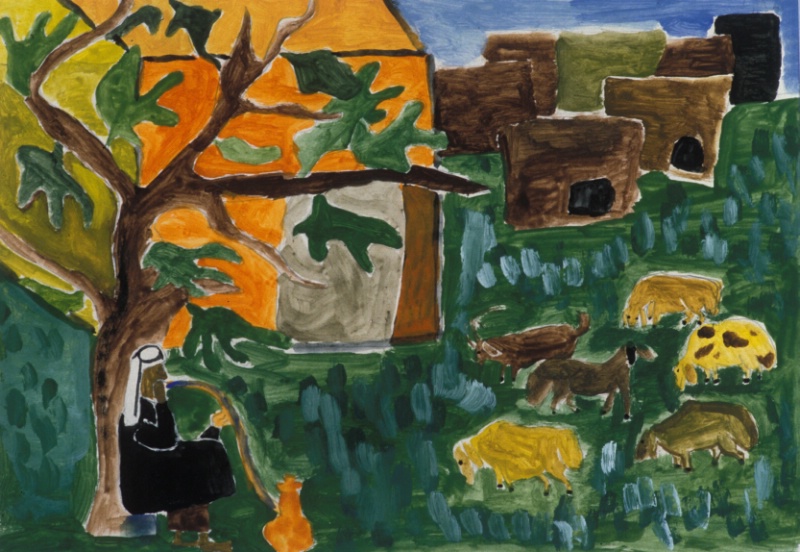
Under-Fig-Tree

Each Man Shall Live Under His Own Vine And Fig Tree (1967), by Ronen Koresh


Invitation

[Words in bold indicate the congregation’s part.]

Once upon a time, God made a garden,

and every creature lived in it happily with God.

We took long walks with God in the cool of the evening,

humans and snails, kangaroos and spiders, kitties and larks.

And when we all sat down with God to eat,

the curling vines gave up their fruit,

the tall gold wheat gave up its grain,

and we ate delicious bread

and drank from a cup of blessing,

singing songs under stars ‘till morning.

And the grateful creation was at peace.


Ever since, whenever we honor the earth

by eating and drinking with heartfelt thanks,

God walks with us again.

God sits with us and eats.

Our tables become the garden,

the whole creation sighs with peace,

and we see again how life was meant to be.


Come, now, everyone, to this table,

to the garden God planted in the East, in Eden.

Come, taste and remember,

taste and see how good God is.


Communion Prayer

Let us pray.

Thank you, Creator God,

for sharing your life with us

in every good thing of this world.

Thank you most of all for Jesus,

who sat us down to eat and drink

good bread and good wine,

so that in tasting how good they are

we could remember how good you are.

He is our East, our Eden,

our Garden of peace.

In him we find the fullness of life

you desired for us from the start—

walking together, sharing food, living in peace.

Send the Spirit to his table now

where he still sits us down,

where we still remember you.

Bless the bread and the cup,

fruit of the earth and work of our hands.

May they become by your grace

the taste of Eden in our hearts.

As we eat and drink together,

let us see more clearly

a vision of life as you meant it to be.

Consecrate us to the ministry of making it so,

by sharing earth’s goodness with all,

in reverence and hope, with justice, and joy.


Sharing Bread and Cup

Dear friends in Christ,

this is the bread Jesus blessed and broke

and gave us to share in remembrance of him.


This is the cup Jesus blessed and poured

and gave us to drink in remembrance if him.


Eating and drinking together,

we remember his death,

we rejoice in his rising,

and we wait for him to come again,

to judge in mercy,

to welcome in love,

and restore all creation,

to the praise and glory of God.

Amen!


Thanking God, Blessing the Earth

[As we sing the closing Song, inflatable globes (or small earth beach balls) will passed through the pews. When one comes to you, please hold it for a moment, thank God for the world, and give the earth your blessing. Then pass the globe along to others.]

Song “Blue Boat Home” (Peter Mayer) Tune: HYFRYDOL


The Assumption of Mary, August 15

dormition-of-the-theotokos1


–Russian Icon, The Dormition of the Theotokos

On August 15, Roman Catholics celebrate the Feast of the Assumption of Mary.* This is the belief that the mother of Jesus was ‘assumed’, or taken into heaven, ‘body and soul,’ immediately upon her death, without having to undergo the grave’s decay. By this feast, the Catholic Church teaches that the final restoration of all creation to which scripture attests, including the resurrection of the body, is anticipated in Mary.

Catholics are taught that because of her unique role in the drama of salvation, God chose to bestow on her, in an anticipated way, the glory we will all enjoy one day. The glory Mary enjoys it isn’t for her alone: she is given first what all the redeemed receive later. In the Assumption, we get to see in her what will become of us all because of the saving grace of Christ. The Assumption is the Church’s way of affirming the ancient conviction that ‘humanity’s future has a body’ (Luke Powery).

This festival has deep roots in Christian liturgy and devotion. The first extant mention of it is in the 4th century in the East. It was universally celebrated by the 6th . Clearly there was ‘something about Mary’ that the ancient church appreciated more than we do today—especially we who are Protestants and tend to view Marian doctrines as unnecessary at best and idolatrous at worst.

Here’s what I’m appreciating about the Assumption today—

The Assumption of Mary asks us to imagine that a human being in her body, not just her soul or spirit, now lives in the eternity of God we have traditionally called ‘heaven.’ Forget for a moment the triumphalist trappings, physical, and metaphysical problems of this doctrine. Go to the nub of it and allow yourself to see Mary in her body welcomed into heaven, enjoying God forever in a fully bodily way, breathing, sensing, moving… in all her body’s uniqueness. If you grant this vision, even for a moment, and if you grant that her present is our future, what does this feast day say?

It says the human body belongs in the presence of God. It says that the body is holy. It says that God and bodies are not opposites. It says that bodies are not ‘mere’ bodies, not inferior housing for a superior soul; not to be escaped from, dispensed with, or despised. It says there’s no such thing as ‘spirituality’ without ‘bodiality.’ It says you have to love the body because God does. Even when it’s hard to love the body, your particular body, and especially when it’s hard to love somebody else’s, it says you have to honor them all. It says you can’t kill Michael Brown or (insert another name here while you weep) because their bodies are male and black. It says you have to love those black bodies. It says you can’t make any body no body. It says God cares, infinitely cares, what we do with our bodies. It says when any body’s hands go up, the guns go down.

If you observe this feast day, that’s what you commit to. If you don’t, maybe you should.

——-

*The Orthodox also observe this mid-August commemoration, but they call it the Dormition (falling asleep)of the Theotokos. They prefer to think she was taken to God without experiencing even the slightest twinge of death’s customary pangs. Anglicans call this observance the Feast of Mary the Virgin, or more familiarly, the Feast of Mary in Summer. It’s a more generic celebration of Mary, but the collect of the day mentions God taking Mary to Godself, a clear nod to the ancient doctrine of the Assumption.


5 Doxologies


Praise God whose love will never cease,

whose justice raises up the least

and sits all creatures at the feast—

God’s mercy is our hope and peace!


Praise God, the source of breath and birth,

who formed us from the dust of earth,

and made us kin in unity

to love and set each other free.


Praise God, whose image we all bear;

Praise Christ, whose mercy we all share;

Praise Spirit, making justice grow—

One God from whom all blessings flow!


Praise God, who made all people one,

whose healing work is never done,

who calls us steadfast to abide

in mercy at each other’s side.


Praise God, whose life and grace belong

to good and bad, to weak and strong;

whose ways are not our human ways,

whose mercy gladdens all our days!


Blessing of Ashes (2)

IMG_5685

Most merciful God,

bless by your Holy Spirit these ashes,

dusky creature of earth and fire.

May all who receive them

and all who look upon them this day

be moved to conversion and newness of life.

May they be no empty sign, no prideful display;

but by your grace, may all who wear them

witness in bold speech and loving act

to what they signify—

your steadfast love for mortal flesh,

your will to heal,

the rich green life you bring from death.

Praise to you, Holy One!

In life and death we belong to you.

Amen.

Blessing of Ashes

IMG_5579

Most merciful God,

bless these ashes,

all that’s left of glory

after fire consumes

the lust of waving palms.

Bless these ashes,

residue of hosannas,

the swelling songs we lift

in praise of might.

Bless these ashes,

ambition’s leftovers,

dusty remains of the days

we believed in ourselves.

Bless these ashes,

fine and flyaway,

insubstantial as the heart

without its truth,

without its truth.