Category Archives: Liturgy

A Liturgy for Easter Day (with Holy Communion)

easter–James B. Janknegt, Easter Morning

Voluntary

*Hymn Christ the Lord is Risen Today

*Greeting

Dear Friends in Christ:

The night is over! The morning is here!

Christ is risen, risen as he said!

Sadness has vanished! Tears are no more!

Death has fled! Life is victorious!

This is the day the Lord has made:

We rejoice! We are glad in it!

Come, assemble for the Feast of Life,

the Feast of the Kingdom of God!

Alleluia! Alleluia! Alleluia!

*Easter Peace

Beloved in Christ,

God’s love pours out from the grave of despair.

The Risen One comes with hands full of love.

He greets us with peace the world does not know,

he give us peace the world cannot give.

Alleluia! Christ’s peace is ours forever! 

Now greet each other with Easter peace!

The Easter Peace is shared…

*Hymn This Is the Day

Prayer for Understanding

At your word, God of Life,

the earth grows green

and every creature springs to life!

Re-create us too, we pray, by your holy Word.

As we receive the ancient Good News,

give us the new joy and justice of Easter—

all death destroyed, all captives freed!

In Jesus’ name we pray. Amen.

Reading  Jeremiah 31:1-6; 10-12

Responsive Chant Psalm 118: 1-6, 15-18, 24

Reading  John 20:1-18

*Hymn Come and Taste of Resurrection

Sermon

Anthem, or Creed, Prayers or other Response of Faith here…

[For example:]

*Response of Faith

Let us declare our faith together (you may rise):

We believe in the God of Life,

whose breath is in us,

and whose mercy encircles the creation.

We believe in Jesus Christ,

who loved us indestructibly

and who shared our pain.

He is with us now as he promised,

even to the end of the age.

We believe in the Holy Spirit,

who welcomes us into the household of faith,

gives us gifts in abundance,

enlivens our hearts with joy,

and urges us into the world

to testify without fear

to God’s justice and grace.

Hoping against hope

for the promised realm of peace,

we love one another while we live,

we honor every creature God has made,

we stand against the powers of sin and death,

and we bless the earth and all that fills it.

Glory, thanks, and praise be yours,

O Living God, now and forever! Amen.

Alleluia! Alleluia! Alleluia!

Invitation to Offering

Good friends,

since by his resurrection

we have new life in Christ,

let us live as new people,

bound to each other

by cords of compassion,

attentive to the needs

of neighbors far and near,

committed to the earth

and every living thing,

eager to serve and share.

For the sake of this ministry,

we gratefully receive the Easter offering.

Offertory

*Doxology

*Prayer of Dedication

EASTER COMMUNION

*Invitation

[The people remain standing.]

Easter people, come now to the table with Christ!

For he is risen! He lives, and presides at this Feast!

Come, eat together the Bread of Life!

For he is risen, and nothing separates us from God’s love!

Come, drink together from the Cup of Gladness!

For Christ is risen! Risen as he said! Alleluia! Alleluia! Alleluia!

*Praise

Praise to you, God of glory!

You created the universe and all living things.

You breathed life into our dust

and gave us a paradise.

You sought us when we hid ourselves,

ashamed of our sin.

You made a people for yourself,

and saved them from oppression.

In the fullness of time,

your love came also to us in your servant Jesus.

He ministered to us,

healing, overcoming divisions, welcoming all.

He died on the cross of shame.

But you vindicated him,

giving him a life that is forever new!

This is the life he shares with us:

a life of justice, mercy,

and citizenship in your realm of peace.

All your creatures testify to your mighty deeds!

They declare your everlasting love!

We too proclaim it,

as with the angels of heaven we sing:

*Sanctus   Holy, Holy, Holy…

Remembering and Giving Thanks

[The people are seated.]

Now, O God, with grateful hearts we remember Jesus.

Silence

We remember that he was laid in a borrowed grave.

A heavy stone sealed up the tomb.

We remember that the women came, early in the morning, on the third day.

They did not find him among the dead.

We remember that his disciples met him on the road.

He opened the scriptures, explaining everything;

and their hearts burned within them.

They said to him,

‘Stay with us, for it is evening.’

So he went in with them.

And while they were at table,

he took bread, gave thanks,

and broke it for them to share.

Then their eyes were opened,

and they knew him in the breaking of the bread.

Prayer to the Holy Spirit

Come, Holy Spirit,

bless this bread that earth has given

and human hands have made.

Bless also this fruit of the vine,

created for our gladness.

Make them the food and drink of everlasting life,

body surrendered, blood poured out.

As we rejoice in the resurrection,

give us love for each other,

and make  us servants of peace,

until your New Realm is revealed,

and every creature beholds it.

We pray in the name of Jesus, who lives

and presides at this table,

our host and our feast.

Thanks be to him who taught us to say…

The Lord’s Prayer

Agnus Dei Lamb of God….

[After the Lord’s Prayer, the ministers and other worship leaders break the bread and place the pieces in baskets or on plates for distribution. During the breaking of bread, the ‘Lamb of God’ or other appropriate song or chant is sung.]

Sharing Bread and Cup

[The Communion elements are distributed. When all the people have received, they rise to give thanks.]

*Post-communion Thanksgiving

Let us give thanks!

Thank you, God, for life in the Spirit of Jesus,

for gladness in this bread and cup,

for love that cannot die,

for peace the world cannot give,

for joy in the company of friends,

for the splendors of creation,

and for the mission of justice you have made our own.

Give us the gifts of this holy communion –

oneness of heart, love for neighbors,

forgiveness of enemies,

the will to serve you every day,

and risen life that never ends.

In Christ’s name we pray. Amen.

Alleluia! Alleluia! Alleluia!

*Hymn  Alleluia! The Strife Is O’er

*Benediction

[This triple “blessing and sending/commissioning” may be delivered by three different voices.]

May the living God

who raised Jesus from the dead

bless you and keep you

and make you shine with joy.

May God raise up new life in you,

and give you peace,

for the sake of Jesus, Lord of Life!

1. Christ is risen! Tell the world!

Risen indeed! Alleluia! Alleluia! Alleluia!

2. Christ is risen! Tell the world!

Risen indeed! Alleluia! Alleluia! Alleluia!

3. Christ is risen! Tell the world!

Risen indeed! Alleluia! Alleluia! Alleluia!

*Choral Response

Voluntary

Our Tears Have Become Our Bread: A Good Friday Evening Service of Lamentation

crux

A Note about Lamentation

Good Friday faces us with the death of Jesus on the cross of shame. We come to be near him in his suffering. We come also to lament the world’s sin and the fragmentation of our lives. Lamentation is an ancient form of prayer, crying out to God in the midst of senselessness, violence and confusion. It is a way to “hold God accountable,” even as we admit our complicity and helplessness. Lamentation does not contradict faith in God: it arises from the conviction that God wills life, not death; that God’s love is steadfast; and that God’s mercy is over all. We believe that God grieves with us, but we also admit that we do not understand God or ourselves, and so we express doubt, anger and desire for vindication, in God’s hearing. The Bible is full of lamentations. Jesus’ own lament, “Why have you abandoned me?”, echoes especially in our hearts tonight.

Gathering

Chant  Stay with me [Taize]

*Greeting

Beloved friends,

the peace of Christ be with you.

And on the whole world, peace.

In suffering love, our God draws near

to be with us in all our pain,

absorbing our unending tears,

the bitter food of every day.

Then let us pray tonight,

the best we can,

the hard prayers of lament,

the questions of bewildered faith,

the questions without answer.

*Prayer

O grieving God,

the suffering of the world

is gathered up tonight

in the broken body of Jesus,

our tender brother, who did no harm.

Give us the grace to cling to him,

and to share his meal of tears

at the table of the cross,

so that one day,

in the new world you are preparing,

we may share with him the feast of love

at your table of justice and joy.

We ask this in his name. Amen.

Readings and Responses

Reading   Luke 19: 41-42  Jesus weeps over Jerusalem.

Silence

*Hymn When Jesus wept

Reading  Our Warring Madness

[Note: Here different voices read brief obituaries of US soldiers killed on the Good Fridays of 5 successive years of the Iraq War. In other years at this service, excerpts from soldiers’ letters home were set to recitative chant and sung by a cantor, with a people’s sung response: Lord, have mercy. Lord, have mercy. Lord, have mercy. Both these pieces may be provided upon request.]

Silence

*Prayer

Let us pray.

O silent God,

the web of human violence and death

is a terrible mystery.

We wonder if there is hope for us—

any hope at all, even in you.

Answer us, O God,

and by the tears of Jesus

keep our hearts safe and our hope alive,

as we lament our losses,

speak our anger and disappointment,

grieve our human folly,

and release our pain.

We pray in his name. Amen.

Reading  Mark 15: 25-37  Jesus is crucified.

Silence

*Hymn 201  They crucified my Lord

Ritual of Lamentation

Responsive Reading Psalm 42  My tears have become my bread.

As a deer longs for flowing streams,

so my soul longs for you, O God.

My soul thirsts for God, for the living God.

When shall I behold the face of God?

My tears have been my bread, day and night,

while people say to me continually,

“Where is your God?”

Why are you cast down, O my soul,

and why are you disquieted within me?

Hope in God; for I shall again praise God, my helper.

By day the Lord commands God’s steadfast love,

and at night God’s song is with me,

a prayer to the Lord of my life.

I say to God, my rock, “Why have you forgotten me?

Why must I walk about mournfully

because the enemy oppresses me?”

As with a deadly wound in my body,

my adversaries taunt me,

while they say to me continually,

“Where is your God?”

Why are you cast down, O my soul,

and why are you disquieted within me?

Hope in God;

for I shall again praise the Lord,

my help and my God.

Eating the Bread of Sorrow

 [A Note on the Ritual, for service planners:

The service takes place in a room with a round table at the center, chairs arranged in circular rows around it, aisles left open for access to the table and allow a good flow of movement. Bulletins for the service contain a slip of paper for the purpose of writing a personal lamentation. Pencils are at the seats.

On the center round table is a large clear glass bowl about full of water, two or three baskets with whole loaves of bread (challah was used for this service—it tears easily, picks up the salt well, and its sweetness provides a good contrast to saltiness), and two or three containers with mounds of ordinary table salt (a larger grained salt, such as sea salt, may also be used, although it is expensive). It is important that bread, water bowl, and salt be ample, large, visible—if possible use beautiful glass or ceramic containers, or expressive woven baskets. On a night of meager hope, abundant signs make all the difference.

Instructions for the ritual should be printed in the bulletin. A clear and concise verbal invitation and explanation—not of the ritual’s meaning so much as of the procedure to be followed—should also be given. It should be clear to all that one may decide not to participate: freedom should reign. [See sample written instructions below.]

When the ritual begins, people are invited to reflect on and write down a lament or other prayer for the world, the church, themselves—an expression of need or hope or of perplexity and question—then fold  the slip, come forward and deposit in the bowl of water—adding our tears to Jesus’ tears, as it were. They then approach ministers or other leaders who have been stationed in pairs—one with with bread, the other with salt—at two or three points in the room. They take a piece of bread and dip it in salt and return to their seats to await a common eating.

During this movement, music may be playing softly in the background. If there is a choir, a simple choral piece may be sung, but the music here should not overwhelm the ritual by calling too much attention to itself.

A note on wheat allergies: As with the celebration of holy communion, there should be a bread substitute available, if possible a gluten free bread (not a cracker). It should be on a dedicated plate or basket held by a third server in one of the serving groups. Make clear to people which station they should approach if they require a bread substitute.

At each station, the bread server says to each participant something like: “May the tears of Jesus feed us, and heal our suffering world.” The response is “Amen. When all have returned to their seats, the bread is blessed, and everyone eats the bread together. Then a hymn is sung.]

Participating in the Ritual

You are invited to write a brief expression of lament in solidarity with the suffering world. A slip of paper is provided. When you have finished, you may go to the table and place your lament in the large bowl of water, representing human grief and tears, including the tears of Jesus. A piece of bread will then be given to you, with the words, “May the tears of Jesus feed us, and heal our suffering world.” Please dip the bread in the salt that is also offered, then take it to your seat and wait. When all who wish to participate have returned to their seats, we will bless our laments and eat the salted bread of sorrow together.

Blessing

Holy spirit, come to us.

Bless this food of sorrow,

these morsels of pain.

Help us who taste in salted bread

the suffering of the world

become its healing and relief

by every deed of love and care

we offer in Christ’s name.

[The bread is eaten. Then all sing.]

Hymn  Bread of the world, in mercy broken

You may remain seated for the hymn.

The Good News of Consolation

Romans 8:18-39  Nothing separates us from God’s love in Christ Jesus.

Silence

*Prayer

Let us pray.

Spirit of Life, thank you

for the healing power of the cross.

Thank you for not abandoning us in our sins.

Thank you for praying in us when,

in grief and anger,

we do not know how to pray.

Thank you for giving us the tears of Christ

who bears in his body our pain and the world’s.

Thank you for the life that is to come,

the new day on a new earth

when sorrow will be no more.

Hasten that day when lament will cease

and your love will be all in all.

Now, send us into the world in hope.

Make us your tender mercy

upon the world’s suffering,

wiping away every tear.

And do not leave us when the light wanes

and the road disappears,

but bring us through all our nights

to the clear shining of Easter.

We ask this, trusting you,

in Jesus’ name. Amen.

*Blessing and Peace

Go now in peace.

Bear the weight of the cross

and the certain hope of resurrection

to all who yearn for life.

Amen.

Night and day,

may the blessing of God be upon us!

Amen.

* Hymn 335  Dona Nobis Pacem

*Greeting of Peace

The people are invited to share a sign of Christ’s peace, and leave quietly.

*[Note to worship leaders: * The asterisk indicates all the places where the people may stand. In this service all that is needed to get them to stand is example—the leaders should know when to stand and sit and do it decisively—and clear hand gestures. Try not to interrupt the flow of the service with constant invitations and instructions.]

Image:  Jame B. Janknegt, Crucifiction [sic] at Barton Creek Mall

When Jesus Wept: A Good Friday Evening Service of Lamentation

A Word about Lamentation

Ludvig_Karsten_Nedtagelsen_1925

Good Friday faces us with the death of Jesus on the cross of shame. We come to be near him in his suffering. We come also to lament the world’s sin and the fragmentation of our lives. Lamentation is an ancient form of prayer, crying out to God in the midst of senselessness, violence and confusion. It is a way to “hold God accountable,” even as we admit our complicity and helplessness. Lamentation does not contradict faith in God: it arises from the conviction that God wills life, not death; that God’s love is steadfast; and that God’s mercy is over all. We believe that God grieves with us, but we also admit that we do not understand God or ourselves, and so we express doubt, anger and desire for vindication, in God’s hearing. The Bible is full of lamentations. Jesus’ own lament, “Why have you abandoned me?”, echoes especially in our hearts tonight.

Preparation

Chant Jesus, Remember Me  [Taize]

Gathering at the Cross

*Greeting

The peace of Christ be with you.

His cross is our peace forever.

Beloved in Christ,

this is a night of grieving.

In our sorrow, we ask the Spirit to give us hope.

Let us pray:

Holy Spirit,

gather our hurts and losses

and all the world’s grief

into the arms of Christ,

extended to embrace us.

Help us to believe

that living or dying

we belong to God. Amen.

*Hymn 201  They Crucified My Lord

Handing on the Story

Reading   Isaiah 52: 13-53: 12

Silence

*Prayer

Gracious God,

at the cross, the lament of all human history

rises from the soul of Jesus.

We believe that in him

you yourself grieve,

until promised morning comes.

Praise to you in shadow and light,

in gladness and grief,

in every breath,

and at the last breath.

Amen.

Reading   Mark 15: 25-37

Silence

Hymn  Were You There?

You may remain seated for the hymn.

Reading Mark 15: 42-47

Silence

*Prayer

Silent God,

the suffering of the innocent

is a terrible mystery.

We wonder if there is hope

for our world – any hope at all,

even in you.

Answer us, O God,

and by the tears of Jesus

keep our hearts safe and our hope alive

as we lament our losses,

speak our anger,

grieve our disappointments

and release our pain. Amen.

 Pieta 1950 by Roy De Maistre 1894-1968

A Time for Lamentation

Expressing Our Grief, Questions, and Laments

[A Note to worship planners: In this service, a center table is set with bare branches and baskets filled with iron nails. In another place in the room, to which there should be easy access,  a large cross is either standing or lying on the floor. Other symbols of the passion may be at the cross—hammers, nails, thorns, rope… whatever the artistic imagination suggests. A bucket or other resonant container is also placed there, to receive people’s lamentations.

At the time of the ritual, people are invited to reflect on the world, its need, pain and sorrow, and to allow the deep questions about the “why’s” of human suffering to surface. Ample time should be given for people to reflect in silence, or with music playing softly “beneath” their reflections.

They may come to the table at any time during this period, take a nail or several from the baskets on the table, then move to the cross and pray silently. When they are finished, they may deposit their nails in the container and return to their seats. [Some participants should be prepared ahead of time to go first and model what is to be done.]

Instructions for this time of lament should be printed in the bulletin and delivered aloud, briefly and concisely by the leader of the service. Sample written instructions are given below. When all who wish to participate have done so, a hymn is sung, and the service continues.

It should go without saying that other rituals suited to a congregation’s culture and imagination  may be substituted for this one.]

 Participating in the Ritual

During this time, if you are moved to do so, you may take nails from the table, approach the cross and express your questions and lamentations in silent prayer, then place your nails in the container at the foot f the cross. You may also choose not to take nails, but simply to go to the cross and pray silently. If you wish to remain after the service and pray near the cross, please stay as long as you like.

*Hymn 190   When Jesus Wept

The Good News of Consolation

Reading   Romans 8:18-39

*Prayer

Let us pray.

Spirit of Life, thank you

for the healing power of the cross.

Thank you for not abandoning us in our sins.

Thank you for praying in us when,

in grief and anger,

we do not know what to say.

Thank you for joining us forever to Christ,

who bears our pain and the world’s great sorrow.

Thank you for the life that is to come.

Hasten the day when lament will be no more.

Now make us your tender mercy

upon the world’s suffering.

Do not leave us when the light wanes

and the road disappears,

but bring us through all our nights

to the clear shining of Easter.

We ask this, trusting you,

in Jesus’ name. Amen.


*Blessing and Peace

Go now in peace.

Bear the weight of the cross

and the hope of resurrection

to all who yearn for life.

Amen.

Night and day,

may the blessing of God be upon us.

Amen.

*Hymn Dona Nobis Pacem

*A SIGN OF PEACE

When you have offered one another a sign of Christ’s peace,  you may leave quietly.

*[Note to worship leaders: * The asterisk indicates all the places where the people may stand. In this service all that is needed to get them to stand is example—the leaders should know when to stand and sit and do it decisively—and clear hand gestures. Try not to interrupt the flow of the service with constant invitations and instructions.]

Images: Pieta, Roy de Maistrel Deposition, Ludwig Karsten


Acting Out in Holy Week

800px-Zirl_Parrish_Church-Jesus_entering_Jerusalem_1–Triumphal Entry, Fresco in the Parish Church of Zirl, Austria

It’s not often we get theatrical in church. But during Holy Week, Christian congregations all over the world do. On Palm Sunday, for example, many hold a palm parade, or they read a gospel story together with sound effects. The kids generally take to these little dramas easily. Adults are a different story—especially Protestants, who are often more than a little reluctant to leave the safe confines of their sanctuaries and march around outside, waving palms and singing “All Glory, Laud and Honor.”

What is the meaning of all this tramping about and shouting? Why, from the mid-4th century onward, have Christians practiced their faith in Holy Week by staging palm processions and dramatic readings of the passion story and carrying large crosses through city streets?

Dramas like these are one solution we create to the problem of distance. They are meant to erase the millennia between Jesus’ life and our own time. If we enter them wholeheartedly, they help impress past events upon our senses in such a way that that story and this one—Jesus’ story and ours—become one continuous story of faith.

When we dramatize events in Holy Week, are not “pretending” in the ordinary sense; we are remembering in an immediate way, such that when on Good Friday the beloved spiritual asks us, “Were you there when they crucified my Lord?”, we can reply not only that we were truly there with him then, but also that he is truly here with us now.

Our liturgical dramas signify that there is no such thing as a safe distance from the old, old story of Jesus and his love. None of us is a mere spectator to the unfolding of his fate. None of us can hang back and dispassionately observe the goings-on as if we were uninvolved, as if we were not implicated in the events we are commemorating. At one time in the church’s history, this immediacy was experienced with such conviction that the ritual “passing of the peace” was forbidden during Holy Week for fear that one of the stylized kisses believers exchanged might turn out to be the kiss of Judas – for fear, in other words, that someone in the congregation might betray the Lord again.

Now, Holy Week is a tricky time. The scriptural texts we read during this week pose many serious difficulties. In our eagerness to experience the Passion we could slide over them to our peril. For example, I find myself increasingly pained by the New Testament’s caricature of first-century Judaism, a damning portrait we may unthinkingly take as “the way it really was,” thus perpetuating anti-Judaism, even among enlightened liberal Christians.

There are also difficulties in the traditional theologies of the meaning of Jesus’ last days. For example, I am no longer able to accept the notion of a God who sent Jesus into the world only to die, who indeed demands his death as past-due payment for human sin. This God regards innocent suffering as somehow glorious and desirable, and is pleased when the world’s victims meekly accept their crosses as Jesus accepted his. For centuries, it has been all too easy for the world’s blood-thirsty powers to co-opt this God for their own oppressive purposes.

And of course there are dangers in even the most innocent and fervent of the rituals we stage to help lodge the meaning of Holy Week under our skin. Those of us who love these spectacles must always be careful not to become overly-enamored of mere aesthetics, losing our way in the trappings and choreography, confusing the rituals that are meant to embody our relationship to God, the gospel, and each other with those relationships themselves.

All these pitfalls make “acting out” in Holy Week a slightly dicey prospect for thoughtful, faithful people, and for conscientious preachers. But even in the face of these difficulties, I remain persuaded that we are not meant to appreciate the events we commemorate this week primarily with our critical faculties, at a cool, removed, intellectual distance. Our lives will not be changed by rational appraisals of the passion of Jesus. I believe we are meant to wade in over our heads, to lose our ordinary bearings, and to let these events soak into our bodies and souls by way of all our available human emotions.

If we open up all our emotional valves this week, however, there is one additional pitfall we should guard against, and that is the error of thinking that what Jesus goes through is special. We must not remember and cherish these events only because they happened uniquely to the Son of God, but also because what happened to the Son of God happens to so many children of God. His suffering is horrifying, compelling and sacred beyond telling precisely because it is prosaic, commonplace, and despairingly ordinary.

When Mary Magdalene anointed Jesus with expensive perfume and wiped his feet with her hair, it wasn’t the first nor would it be the last time a woman offers a radically-humanizing gesture in a radically-dehumanized world. When Jesus was misunderstood by his friends and misjudged and threatened by his enemies, it wasn’t the first nor would it be the last time that honesty, personal authority, vision, difference and spiritual depth are mistaken for insanity, social deviance, fraudulence and malice.

As we joyfully enter Jerusalem with him, it cannot be lost on us that we are entering an occupied city. And we know that occupation was not invented by the Romans and that it did not die with their Empire.  We know also that it seems an inevitable turn of the dreary demonic cycle of human fear that the oppressed become the oppressor, the once-occupied become the occupier. We know from intimate experience that the flip side of adulation is contempt and disdain, that the line between failure and success is paper thin, and that there is no stable truth in crowds.

Employees of Enron, investors with Bernie Madoff, and folks who placed their trust in big banks and mortgage brokers know that it is hardly out of the ordinary to be betrayed for 30 silver coins. It is not as if before Jesus was led to the slaughter no innocent was ever crucified by the collusion of national pride, expedient politics, narrow morality, and assorted vested interests; and it is not as if no innocent ever suffered like that again, after he was taken down. Ask the disappeared of Chile, Argentina, Guatemala, Honduras. Ask the refugees of any war-torn nation you can name. Ask our own children shuffled about in the vast gulag of the foster care system, the enslaved and brutalized people of North Korea, the victims of a bizarre government AIDS policy in South Africa, death row inmates in US jails, and every person who will die too soon because of disparities in our health care system.

If we let ourselves go emotionally in Holy Week in order to experience the collapse of distance between then and now; if we enter the drama with our hearts vulnerable to the impact of the Passion, fully-open and receptive, we may find ourselves blown back and pinned to the wall by the pitiless everydayness of those ancient horrors. We have to brace ourselves not for the incomparable nature of Jesus’ suffering, but for its shocking banality.

Easter will put a new spin on all human suffering, of course, but if we hope to believe in Easter at all—if we hope, rather, to experience it—we need to dwell here first. We have go through sacred motions that bring us close not only to Christ, but also to each other. We have to go through them until, like that Human Being on the cross, our capacity for solidarity grows large and deep, until the world’s sorrow and suffering become much more fully our own, until our own pain is more vulnerably shared with others. Then on the third day, like him, we too might truly rise.

palm-sunday-message-donkey_1363605492–International Family Mission Photo

With this hope in mind, let us act out with all our hearts. Let us really be overwrought disciples, certain that this is the day Jesus will finally play the trump card and claim the throne of his ancestor, David. Let us really be donkeys, clip-clopping our modest way into the Holy City, bearing the peace-loving messiah. Let us really be a dizzy, cheering, chanting crowd hailing with sweet hosannas a king upon whom we want to pin all our misguided revolutionary, nationalistic and selfish hopes. Let us really be angry authorities, sick with anxiety about what the Romans will do if this thing gets out of hand, and coming to the reasonable conclusion that we need to get this fellow gone, the faster the better, before all hell breaks loose.

And yes, let us even try to be King Jesus, who, as it turns out, enters the Holy City not to conquer anyone, not to establish anything, but to do what he has been doing all along – to teach, rebuke, restore, welcome, reconcile, heal— and eventually, in the face of our unflagging insistence on being deadly, to reveal in his own helpless flesh the compassionate and stubborn presence of the suffering God who does not will our pain, but teaches us in Christ to bear each other’s, until the day when there is no more dying, and every tear is wiped away.

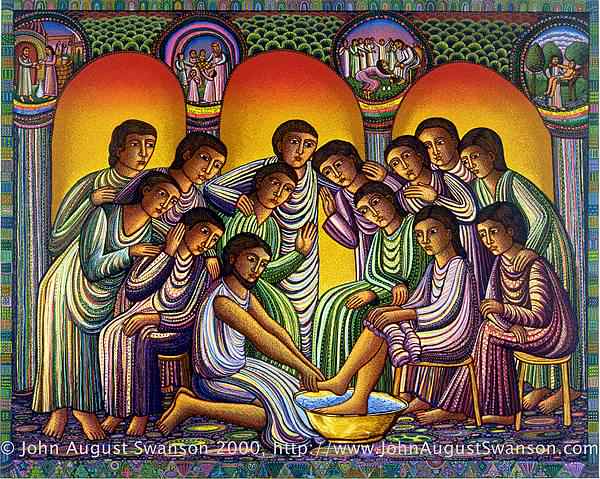
Liturgy for Maundy Thursday

Washing_600

PRELUDE

*HYMN Come gather in this peaceful place  (aka Come gather in this special place)

GREETING AND INVITATION

Dear Friends in Christ,

peace be with you on this holy night.

Why do we gather? What is this night?

It is a night of love

for on this night Jesus gave his disciples a new commandment:

to love each other as he loved them.

It is a night of communion

for on this night Jesus gave not only a commandment,

but also a sign: bread and wine broken and poured,

to remember him.

It is a night of loving service

for on this night Jesus gave us not only a commandment,

not only a sign,

but also an example: on his knees with basin and towel,

washing feet.

It is also a night of betrayal

for on this night a man Jesus loved

sold him for money,

and brought soldiers to seize and bind him

as he prayed.

This night is joyous, fierce, tender, terrible.

We begin in light, with memories and stories, friends and feasting.

We end in shadows, with a queasy fright.

We begin as the friends of Jesus did long ago: together, as one.

We end as they did: scattered in the dark.

We begin as they did: singing of love and deliverance.

We end as they did: without a single sound.

Friends, be at peace on this holy night.

Enter it with open hearts.

Now let us pray.

PRAYER

[This Collect may be offered by the leader or prayed in unison.]

God of deliverance and love,

look with pleasure on your people who gather here.

Send your Spirit to embrace us,

so that with hearts for a time made free of care,

we may receive in abundance the blessings of this night.

With Jesus we pray that whatever may come in life or in death,

your will, not ours, may be done.

Glory to you, yesterday, today, and forever.

Amen.

A READING FROM THE HEBREW SCRIPTURES Exodus 12:14-17; 24-27a

Remembering God’s deliverance: Observing the feast of Passover.

 SILENCE (allow 40-60 seconds)

*RESPONSE

[The people stand for prayer.]

Let us pray.

Holy Deliverer, Breaker of Chains,

long ago you acted with power to save your people,

enslaved in the land of  Egypt,

and in every generation

the people of your heart remember.

At table they tell the story and they sing your praise.

On this holy night, with Jesus, our brother,

we too remember: We tell the old, old story

and we praise your faithful love.

As we eat the food and drink of liberation,

free us forever from the violence

that is our way of life,

and set us on a pilgrimage of peace.

In Jesus’ name we pray. Amen.

 A  READING FROM THE EPISTLES I Corinthians 11: 23-26

What we have heard, we hand on to you: When they were eating, he took bread…

*RESPONSE  HYMN  Draw us in the Spirit’s tether

A READING FOM THE HOLY GOSPEL John 13: 1-17, 31b-35

The mark of the new community is love and service.

 SILENCE (Allow a full 40-60 seconds, or longer.)

RESPONSE ANTHEM Jesu, Jesu

[The choir sings this hymn in unison, unaccompanied, slowly and meditatively. A footwashing ritual takes place during the song. [See note on footwashing at end.] When footwashing is over, the confession follows. If footwashing is not done in the service, the following Collect might be used as a response in place of the anthem, with the people standing.:]

*COLLECT

Gracious God, on this holy night,

impress upon our hearts the example of Jesus,

whose love embraced all people

and whose service extended even to the washing of feet.

May we know him from this day forward

not only in the broken bread and brimming cup,

but also in the bent knee, in the water poured,

in the touch of selfless hands —

in service given and received,

and shared with all the world.

In remembrance of him we pray. Amen.

INVITATION TO CONFESSION

Jesus said: If anyone has something against you,

before you come to the table with gifts, make peace.

Then bring your gifts, then bring your lives.

Dear friends, let us make peace in our hearts.

Then, let us lay down the burdens

that keep us from loving each other and our God.

SILENCE (Allow at least one minute or longer for people to reflect.)

SONG OF CONFESSION  These I lay down [Chalice Hymnal]

You may remain seated for the song.

ASSURANCE OF PARDON

Beloved, by the mercy of God

we have put down our burdens

at the feet of the one who in suffering love

laid down his life for us.

Rejoice and be glad:

Pardon, healing and peace are ours

through Jesus Christ, good brother and friend.

[Continue immediately with the invitation to share a sign of peace, below…]

*PEACE

On this night he gave us a charge:

Love one another as I have loved you.

Faithful to his commandment,

we forgive each other’s faults, as we confess our own,

and we offer each other a sign of his peace.

[The people share a sign of peace, after which they sit for the anthem.]

 ANTHEM   Now the silence [Jaroslav Vajda]

[Note to choir: Where the text has “the Father’s…” substitute “our dear God’s…”]

 GATHERING AT THE TABLE

[When the anthem concludes, there is a brief silence, followed by this invitation to gather. After the invitation, the people come forward to stand in a circle around the table in the chancel. They remain standing for the entire communion liturgy, until the Service of Light and Shadows begins. Provisions should be made for those who have mobility challenges, or who prefer to remain in their seats.]

Come now and take your places at this table,

citizens of the kingdom,  heirs to the riches of God’s love,

friends of Jesus, who is our peace.

[Once all are assembled, the leader begins the Eucharistic prayer.]

 INVITATION

Beloved, let us celebrate with Jesus at the table of peace.

For he loved his own, even to the end.

Let us eat the Feast with him.

For now nothing can separate us from his love.

And let us love one another well,

For he laid down his life for us all.

PREFACE

Praise to you, God of glory!

Your love created the universe and sustains it.

You breathed life into our dust and placed us in paradise.

You found us when we hid ourselves, ashamed of our sin.

Your love shaped a people,  and you are their God to this day,

in an alliance that lasts forever.

In the fullness of time, you called us also to be your own,

through the tender ministry of Jesus.

You spoke to us with his human voice

and healed us with his human hands.

He gave us his life in bread and wine,

and suffered for his faithfulness on the cross of shame.

But you loved him faithfully, raising him from the dead.

You sent his Spirit into our hearts

and adopted us, making us heirs of his glory;

forever we belong in your household of joy.

Holy and wonderful God, all your creatures testify to your love.

With them, we too declare it, as with the angels of heaven we sing:

SANCTUS Holy, holy, holy…

REMEMBERING AND GIVING THANKS

Now, O God, we remember Jesus.

SILENCE (15-20 seconds)

We remember that he longed to celebrate the Passover with his friends.

He arranged for a meal, his last in this life.

We remember that he gave them a new commandment:

“Love one another as I have loved you.”

We remember that he gave them an example:

He knelt before them and washed their feet.

We remember that his betrayer was with him.

Jesus loved and served him too.

WORDS OF INSTITUTION

And we remember that on that night,

with danger and death in the air,

Jesus remembered with joy

the deliverance of his ancestors

from the oppression of Pharaoh.

He told the victory story, ate bitter herbs,

shared the unleavened loaf,

and drank the cup of blessing.

In love for us, he took the bread,

gave thanks to you, and broke it.

[Note: The bread is not to be broken here, but at the fraction, below.]

He gave it to them, saying:

“Take and eat this, all of you:

this is my body, broken for you.

Do this and remember me”

And when the supper was over,

he took a cup filled with wine,

blessed it in your name,

and passed it to them, saying:

“This is the cup of a new covenant in my blood.

Do this and remember me.”

PRAYER TO THE HOLY SPIRIT

Holy Spirit, come make all things new.

Bless this bread and cup, and us who share them.

May they be for us life-giving food and drink.

Give us love for each other,

and make us your servants in the world

until your new age of justice comes,

and every creature  beholds it.

We pray in the name of Jesus,

who welcomes us all and taught us to say:

THE LORD’S PRAYER

THE FRACTION

[An appropriate chant or song is sung by all as the one loaf (or loaves) is broken into many pieces and placed on plates and baskets for distribution. The deacons assist in the fraction. Song suggestions: One Bread, One Body…. Ubi Caritas…]

 INVITATION

Friends, if you are hungry for a taste of what is to come,

when all creatures great and small will feast together

without fear in the household of God;

if you yearn to feast on a love

without condition and without end;

if you are thirsting for forgiveness,

given and received in humility and in joy,

then open your hearts to this meal,

a sign of grace, a gift of peace, the bread of life, the cup of joy:

[lifting bread and cup, if desired]

The gifts of God for all God’s people!

SHARING BREAD AND CUP

[Communion bread is distributed to all, followed by cups for intinction. After all have received, the people give thanks together.]

*THANKSGIVING

Let us rise and give thanks.

Thank you Holy God,  

for life in the Spirit of Jesus,

for gladness in this bread and cup,

for love that cannot die,

for peace the world cannot give,

for joy in the company of friends,

for the splendors of creation,

and for the mission of justice you have made our own.

Give us the fruits of this holy communion:

oneness of heart, love for neighbors, forgiveness of enemies,

the will to serve you every day, and life that never ends.

In Christ’s name we pray. Amen.

 [Dismissing the people to return to their pews, the leader says:]

“And after they had sung the hymn,

they went out to the Mount of Olives.”

[The people return to their seats. The communion table and chancel are cleared of all signs of celebration. Appropriate instrumental music may accompany the people’s return to their seats and the clearing of the chancel.]

SERVICE OF LIGHT AND SHADOWS

[Here follows a brief and very simple service of short readings about the garden prayer, arrest, and “trial” of Jesus, interspersed with responsive chants, verses of a hymn, short choral pieces, or brief prayers or collects. After each reading and response, lights are dimmed or candles are extinguished until the sanctuary is in darkness. There is a time of silence, then lights are brought up just enough so that people may depart in safety. The people should leave in silence.]

 ******

Footwashing

Footwashing may be done in a symbolic way, e. g., one member of the congregation or the pastor washes another person’s feet in a stylized, mime-like ritual, center chancel. If this option is used, opportunity for others to wash and be washed might be provided before or after the liturgy, perhaps during an pre-service agape meal or love feast, or after the service in a chapel or fellowship hall set aside for this purpose. Footwashing of more than one person or a small group of representative disciples may also be done in the service itself: there may be a general invitation to wash one another’s feet at stations set up around the sanctuary, or the deacons of the church may be sent to stations to wash the feet of those who wish to participate. The congregation needs to be prepared for a slightly longer overall service. If footwashing of all who wish to take part is the choice, quiet music or appropriate hymn-singing should accompany the ritual.

Order of Service for Ash Wednesday, including Holy Communion

ash-wednesday-usa

NOTE: This order of service is in a straightforward traditional form, nothing fancy or hip; so it will not appeal to everyone, nor be useful in congregations that prefer more laid back styles of worship–although I think its formality is not stuffy, only serious. Note also that this order of service includes communion, which is a fitting beginning to the season of Lent–food for the journey, companionship along the way, the centrality of Jesus, etc.There is, however, no sermon in this service. What ‘sermon’ there is is in the form of brief introductory reflections and commentary throughout the liturgy. I have preferred to let the rituals of Ashes and the Table take center stage instead of the sermon. The service may seem long and wordy at first glance, but without a sermon, it actually runs about 45-50 minutes, depending on how many people receive ashes and communion, how many ministers may be assisting, and how much time is given to the silences that give rhythm to the section, ‘readings and responses.’ Nearly all the ‘words’–intros, readings, communion liturgy, are also fairly brief, and will move smoothly if uninterrupted by unnecessary directions, such as “Now please stand and join me in singing hymn #235,” No verbal directions at all need to be given if everything is clearly marked, and if the worship leaders lead by confident example, gesturing with gentle movement for people to stand or sit if need be.

ashwednesday-4

Assembling for Worship

Prelude

*Greeting and Introduction

The peace of the Lord be with you always.

And on the whole world, peace!

Friends in Christ:

The holy season of Lent has begun, by God’s grace and mercy. And what a mercy it is to begin this season in this way, together. For now, more than ever, we need each other—each others’ faith, each others’ presence, each others’ compassion. Because Lent is a time of conversion; a time when, with the Spirit’s help, we open ourselves to change. We ask the Spirit to turn our lives around so that they are oriented towards God and towards the good of our neighbor. We contemplate the temptations and suffering of Jesus, and humble ourselves with him, as he travels the way of the cross, bearing in his own body the weight of human grief and need. On Ash Wednesday, the first day of Lent, we are asked to face without flinching the unyielding realities of human experience—

that we are creatures made from the stuff of earth, beautiful and good in God’s sight;

but that we are not God—we are mortals, and we shall one day die;

that none of us comes to the end of our lives without having contributed something regrettable, of our own making, to the great abyss of suffering;

and that no one comes to the end of life without having been wounded by the sin of another.

Sobered by these things, but not alone, we will make our way through this season with truth and gratitude, until the light of resurrection breaks. Let us begin the journey, then, with Jesus, with each other, and with the whole church everywhere.

*Hymn I want Jesus to walk with me

Readings and Responses

1. Ashes, a sign of creation

Now we acknowledge that we are creatures, wonderfully-made. In receiving ashes, we gratefully honor our earthy origins and our likeness to all other creatures; and we welcome God’s sovereignty over all that exits.

Reading Genesis 2:4b-9

Silence

*Response  From Psalm 8

O Lord, our God, how majestic is your name in all the earth!

When I look to the heavens, the work of your fingers,

the moon and the stars you established—

what are human beings that you are mindful of us?

mortals that you care for us?

Yet you have made us only a little less than divine

and crowned us with glory and honor.

O Lord, our God, how majestic is your name in all the earth!

2. Ashes, a sign of mortality 

Now we acknowledge that we are discontented creatures; we fall into to estrangement and alienation. We confess too that we are finite creatures, and we will one day die. In receiving ashes, we express our trust that in life and in death, by divine mercy, we shall always be safe in God.

Reading Genesis 3:8-13, 17-19

Silence

*Response Hymn By gracious powers

3. Ashes, a sign of repentance 

Now we acknowledge that we sin, and that we are much-sinned-against; we need forgiveness, healing, and reconciliation. In receiving ashes, we ask God to change our hearts, to make us and others whole, and to help us offer reconciliation in this world.

Reading Isaiah 58:1-12

Silence

*Response From Psalm 130

Out of the depths I cry to you, O Lord

Lord hear my voice!

Be attentive to my supplication!

If you should count our sins against us, Lord, who could stand?

But with you is forgiveness, so that you may be revered.

I wait for the Lord, my soul waits for God,

more than those who watch for the morning,

more than those who watch for the dawn.

Hope in the Lord forever,

for with God is steadfast love and power to save.

4. Ashes in the sign of the Cross

Now we acknowledge that Jesus freely chose a life of service that led him to lay down his life in love. In receiving ashes, we humbly follow his Way, and commit ourselves to love kindness, mercy and justice as he did, even if it means laying down our own lives.

Reading Matthew 16:21-26a

Silence

*Response Hymn What wondrous love is this?

The Ritual of Ashes

Blessing of the Ashes

Bless by your Holy Spirit, O God, these ashes, this dust of the earth. May all who receive them, and all who look upon them, be moved to repentance and renewal, for their own sakes and for the sake of the suffering world. May these ashes be no empty sign; but by your mercy, may all who bear them live what they signify—your steadfast love for our mortal flesh,  your power to save, and your boundless mercy. Praise to you, Holy One! In life and death we belong to you.

The Sign of Ashes

If you wish to receive ashes, please come forward. As ashes are placed on your forehead, a minister will address you with one of the following admonitions:

Remember, [name], that you were made from the earth in the image of God.

Remember, [name], that you are dust, and to dust you shall return.

[Name], repent and believe the Good News!

During the distribution of ashes, there may be a choir anthem (e. g., Senzeni Na?) or suitable Ash Wednesday/Lenten hymns of Taize chants may be sung.

Holy Communion

Hymn These I lay down, insert  [Chalice Hymnal]

Please remain seated for the hymn.

Invitation

L: Friends, we have acknowledged before God and in each others’ presence that we depend on God for our lives, that we are sorry for our sins, that we long to be reconciled in the peace of Christ, and that we are ready to turn around and walk in  a new way of love. Come now to the table of Jesus, where he presides, our gracious host. Come to the table of Jesus, where he calls us and where he waits for us, eager to heal us, to persuade us of his love, to welcome us with an unconditional welcome. Come to the table of Jesus, where he feeds his friends with wonderful gifts. Come to this table, from which we always arise with a blessing, no longer strangers, not even guests, but children all alike of our merciful God—children safe at home.

Thanksgiving and Praise

Holy God, we thank you for the gift of life, for time to turn around, and for your steadfast love. Most of all we thank you for Jesus, our teacher, savior and friend, who made his way through this life, delighting you and serving us. We rewarded his tenderness and truth with derision and a cruel death; and he loved us still: “Forgive them,” he said to you, “They do not know what they are doing.”

Words of Institution

And we remember that on the bleak night of betrayal, he gathered his friends. Even with his betrayer beside him, he was grateful to you for life and all the gifts of this earth. He blessed and broke the bread, and gave it to them, saying, ‘This is my body, broken for you. Eat it and remember me.’

And when supper was over,

he took a cup filled with wine, and blessed it.

He gave it to them saying,

‘Take this and drink it,

it is my life-blood poured out for you

so that sins may be forgiven.

And then he said, “When you do these things together, remember me.”

Prayer to the Holy Spirit

Come Holy Spirit, bless these gifts that earth has given and human hands have made.

By our eating and drinking,

fill us with the joy of Christ

and keep us persevering in his way,

honoring our bodies,

serving our neighbor, 

and praising your name.

The Lord’s Prayer

Sharing the Meal

Communion should be by intinction if possible. During the distribution of the elements, there may be a choir song, suitable congregational hymns or chants, or instrumental music only.

*Thanksgiving

Let us give thanks.

Thank you, God,

for life in the Spirit of Jesus,

for gladness in this bread and cup, 

for love that cannot die,

for peace the world cannot give, 

for joy in the company of friends,

for the splendors of creation,

and for the mission of justice you have made our own.

Give us the fruits of this holy communion:

oneness of heart, love for neighbors,

forgiveness of enemies,

the will to serve you every day,

and life that never ends.

In Christ’s name we pray. Amen.

*Hymn How firm a foundation

Blessing, Sending, and Peace

*Blessing (Cf. Isaiah 61:1-4)

The Spirit of the Lord is upon you,

because the Lord has anointed you;

God is sending you to bring good news to the oppressed,

to bind up the broken-hearted, to proclaim a season of God’s favor,

to comfort all who mourn—

to give them a garland instead of ashes,

gladness instead of sorrow,

a mantle of praise instead of a faint spirit.

And you will be called oaks of righteousness,

the plantings of the Lord to display God’s glory.

You shall build up the ancient devastation,

repair the ruined cities,

and heal the despair of many generations.

*Response

And I shall greatly rejoice in the Lord;

for God has clothed me in garments of salvation,

and covered me with a robe of righteousness!

As the earth brings forth its shoots,

so God will cause justice and praise

to spring up before all nations!

*Peace

Go in peace to love and serve the Lord!

Thanks be to God!

Now share with each other a sign of Christ’s peace!

The people share the peace and depart.

———

* All who are able may stand.

The people’s parts are in bold.