Category Archives: Marginal Notes

Angelology 101

Isaiah 6:1-8; Psalm 103:1-5; 20-22; Hebrews 1:1-9

Jim Janknegt

According to recent surveys of religious beliefs in America, 73% of us believe in angels. Many people also think that when we die, we go to heaven and become angels ourselves. TV shows and movies galore are based on this premise, and so was one of the ghastliest rock-‘n-roll songs ever written, “Teen Angel”—“That fateful night, the car was stalled upon the railroad tracks…” Google it if you are too young to remember.

But according to the Bible, it just isn’t so. Human beings and angels are and always will be two distinct species. As one theologian quipped a while back, you and I will never be angels. The good news is that we won’t ever be cockroaches either.

It’s very sweet that every Christmas since 1946 Jimmy Stewart has discovered anew that it’s a wonderful life as he is saved from despair by Clarence, an angel trainee trying to earn his wings. But it turns out that Clarence is wasting his efforts. Angels do not earn wings. With the famous exception of the six-winged seraphs we sing about in our hymns, angels in the Bible don’t have wings. (No one seems to have told this to artists down through the ages, however. There’s hardly a depiction of an angel anywhere that doesn’t include wings.)

Angels in scripture also have more important things to do than fish despondent Savings and Loans managers out of the drink. According to the Bible, it is not a major angelic function to snatch human beings’ personal chestnuts out of the fire. Neither do angels lurk about disguised as nice people who punctuate our anxious days with kindly coincidences. You are more likely to be slammed to the ground by an angel than sweetly touched by one. Just ask the biblical patriarch who once wrestled with one—you know, the guy with the limp.

Paul Guaguin

Angels in the Bible tend to be on the rather impressive side. The angel who left Jacob in need of a hip replacement could eat the cute cast of “Angels in the Outfield” for lunch. It’s not for nothing that in many instances the first thing angels say to people is, “Fear not!”

In the first lesson, Isaiah sees God surrounded by those six-winged seraphs. Their booming voices shake up the temple. Plaster is falling, smoke is rising, and the prophet is terrified. He immediately accepts two basic facts: God is holy, and he is not. He’s preparing to drop dead when one of the seraphim zooms toward him wielding tongs. The angel drops a red-hot coal on his mouth. Thus it is God distracts Isaiah from fruitlessly contemplating his own unworthiness and frees him up to hear and accept God’s call.

Angels are intelligent, spiritual entities who exist to do God’s bidding. Because that bidding often entails delivering messages to mortals, occasionally angels take human form, as three of them did when Abraham “welcomed angels without knowing it” under the oaks of Mamre.

Marc Chagal

But angels are normally invisible, part of the world beyond the thin veil that we refer to when we say, “I believe in God…maker of heaven and earth, and of all things seen and unseen.”

Although people pray to angels in some parts of the Christian family (all Roman Catholics have “guardian angels” assigned to them), the biblical record does not show us any angels interceding for us with God, or otherwise facilitating our salvation. They are creatures, not demi-gods, mini-gods, or intermediaries between us and God.

This is the point that the author of the Letter to the Hebrews is trying to make in the second lesson. He is addressing first-century Christians who seem to have been infected with angelmania, much like people in America at the end of the 20th century when Raphael’s two pudgy-armed cherubs were merchandised to death. The author of Hebrews is trying to persuade his community that angels cannot hold a candle to Christ, in whose name alone that they can confidently expect grace and favor from God. “To which angel,” he asks dismissively, “did God ever say, ‘You are my son?’”

Like human beings, angels have free will, and that means that they can choose, and that means that at some point they could have chosen wrong. There is, for example, Christian midrash about a big angelic revolt against God after they had all gotten wind of the divine plan for a future Incarnation. Some of the purest ones flew into high dudgeon about the insult to God’s dignity such a plan entailed—they were hell-bent on saving God from God’s own folly. They were literally hell-bent when Michael, a loyal archangel, conquered their leader (another archangel named Lucifer), put down the revolt, and bounced him and all his minions out of paradise and down into hell, created especially for the occasion. From that time on, they have been called “devils.” So, the next time you bend over a baby carriage and coo, “What an angel!”, remember to specify what kind of angel you mean. You wouldn’t want to imply that the munchkin in the carriage is the spawn of Satan.

God’s angels are a lot like us—busy, busy, busy. They commute long distances to work. They multi-task. They ascend and descend Jacob’s ladder (which is one reason we know they don’t all have wings. Why climb if you can fly?).  They travel at the head of the Israelite column across the wilderness. They announce a couple of unplanned pregnancies to a couple of startled women. They guard the ark of the covenant and they stand with flaming swords at the locked gates of Paradise. They rejoice over the repentance of a single sinner. They minister to Jesus in the desert and in the Garden, and they announce his resurrection to the women at the tomb. And that’s just the short list of what angels get up to in the Bible.

There are also countless ranks of stay-at-home angels who surround God’s throne night and day, behold God’s face, and incessantly cry out, “Holy!” and “Glory!” Apparently they do not get tired of doing this sort of thing. It turns out that angels are primarily worshippers. They are praise for God’s glory. Contrary to our assumptions about this angelic worship, however, the Bible never actually says that they sing. It does say that they play musical instruments—the psalms speak effusively of a veritable heavenly orchestra.
Too numerous to count, angels are a sabaoth, a host, and when push comes to shove—and the Bible says it surely will—they are an army. In the lurid Book of Revelation we are presented again with the angels’ general, Michael, the great Warrior Prince of Heaven. It is he, we are told, who will lead the angelic troops in the final apocalyptic struggle between God’s forces and Lucifer, the great star-sweeping Dragon. It will not surprise you to learn, therefore, that Michael is the patron saint of paratroopers. (He is also, inexplicably, the patron saint of green grocers.)

So, do you believe in angels?

Jews seem to have a happy tolerance for differences of opinion about just about everything, and so naturally they also disagree about whether belief in angels is a necessary element of Judaism. Observant Muslims, on the other hand, hold to a strict belief in angels as a basic tenet of faith. They especially honor Gabriel, who taught the 114 surahs of the Holy Qur’an to Muhammed (pbuh)—and yes, that’s the same Gabriel who told Mary to expect the baby Jesus and gave Daniel the gift of pre-Jungian dream interpretation.

Concerning belief in angels, Christians divide into the same camps we divide into about belief in a lot of other things. Christians to the ‘right’ tend to think that because angels are part of the biblical worldview, they absolutely must be part of ours too. Christians to the ‘left’ are more likely to think of belief in angels on a par with Elvis sightings and UFOs. Christians in the ‘middle’ usually can take ‘em or leave ‘em. They don’t think much about angels, except maybe at Christmas, or if they have some sort of odd experience that defies rational explanation, and the metaphor of ‘angel encounter’ seems as good a metaphor for what happened as any.

As for me, I know that belief in angels will not put me right with God or save my soul. But just because something isn’t necessary for salvation, or even for faithful discipleship, doesn’t mean it can’t do me some good. And one good thing that the Christian tradition about angels does for me is enliven my imagination.

Imagine with me, then.

Picture psychedelic seraphim, eyes plastered all over their strange forms, wings flapping madly. Imagine disruptive intrusions into a person’s life or a nation’s destiny.  Imagine bizarre and even painful angelic ministrations. All these things the angels do as God’s servants. And in their activity we glimpse something of God’s character. God is more than we want and nothing we expect. God is for us, but not like us. Much of what we think we know for sure about the divine turns out to be as elusive as Isaiah’s smoky vision in the wee hours. This is not comfortable news, but it is good news. It saves us from pride and certainty, and from the violence that is often the fruit of pride and certainty.

The angels conform to God’s purposes. They are created and exist solely to do God’s will. Their brilliance, strength, and ferocity are all ordered toward that one end. They are what it might feel and look like to love and serve the Lord with all our heart, mind, soul, and strength, as scripture commands. Their service is free and complete and confident; it is service with authority. Jesus taught us to pray, ‘Thy will be done on earth as it is in heaven.”  Who does God’s will in heaven? The angels do. Their responsiveness might be a model for our own.

Angels are God’s messengers. The Greek word angelos means ‘messenger.’ It’s the same Greek word from which the word for ‘gospel’, or good news, derives—evangelion. Angels are announcers, word-bringers, heralds of glad tidings, and therefore life-changers by proxy. Imagine! What it is that we have been baptized into if not a herald’s role? We are not and never will be angels, but perhaps in the course of responding to our own callings, we can still make people jump, surprise them in their sleep or on the road with the announcement of God’s merciful purposes, God’s pleasure and God’s peace.

John Collier, Annunciation

The vocation of the angel army to defend God’s realm against evil confronts us with a question of great seriousness. Imagining that apocalyptic struggle, I imagine as well the earthly, human project of moral and spiritual growth. Do I expect it to unfold serenely? Will I not encounter enemies—the shallow world, the narrow mind, the fear-filled heart? Will they let me pass on towards my hopes for maturity and wisdom in peace, or will there be a fight? And what about the moral and spiritual well-being of others? Could the angels’ example of fighting hard for God’s interests prompt us to help someone in big personal trouble actually change the sad or self-destructive direction of his or her moral life? In addition to battling for societal and institutional justice, shouldn’t we be actively engaged in bringing sanity and strength to each other’s inner lives as well?

It is the nature of angels to worship night and day, crying out, “Glory!” and “Holy!” Every time we gather for worship, might we imagine that we are not doing it alone? Imagine that every sanctuary, when we gather as God’s people, is a thin place where earth and heaven meet, filling with the smoke of the angelic presence and the energy of their adoration? Imagine ourselves joined to their praise, engaged in the captivating duty of adoration? If you can imagine it, you may also feel a certain fright. Your heart may sink at the realization that you are so small, and a sinner. The One we worship is holy. But perhaps you can also imagine a fierce and determined seraph coming right at you with tongs, ready to burn off your protestations of unworthiness, and jolt you into a new freedom by which you will have courage to answer ‘yes’ when you are called.

Angels may or may not exist. But we do, and because we are people of story who live by beauty and imagination, we have done ourselves no harm—and we may have done ourselves some good—by thinking about them for a while. If you’re in a mood to do so, honor them too.

Their liturgical commemoration is October 2, the Feast of the Holy Angels.

Sequela Christi: Francis and the Leper

Francis is easy to diminish: he’s a bird-preaching saint, a wolf-taming saint, a saint in your backyard propped up in a bathtub shrine, Francis on the half-shell. He is the peace saint, the ecology saint, the troubadour, the juggler, the Brother Sun, Sister moon, Donavan-Zeffirelli romantic, twirling ‘round and ‘round in a golden plain turning blood red with wild poppies as the sun heats up in May. He’s a lovely man.

Yes, he was.

And he was fierce and terrible in his loveliness, a medieval madman who wanted to be poor, poor as the wretched refuse that crowded every European town in the 13th century and filled the nostrils with the stench of that poverty. He wanted to share their lives. For him there was no middle way. It was who Christ was, it was where he would find him.

It is said that Francis, at the end of his life, got his desire to be literally like Christ. After he had been engaged in an intense period of prayer, people reported seeing wounds in his hands and his feet. It is also said that every day after that until he begged to be laid naked on the cold stone floor of his cell to finish dying, he suffered the pain Jesus knew on the cross.

I don’t know about that, and neither does anyone but Francis and God. Here’s what I do know. The fullness of Francis’ transformation into the Jesus he loved so much did not happen on Mount Alvernia when the mark of nails was seared into his flesh. If it happened at any one moment, it was  two decades earlier. He had gone to Rome to find faith and forgiveness at all its shrines. He had found none. In fact the only place where anything like insight had come to him was when on impulse he paid a poor man to change clothes with him, and spent the day in the streets of the city begging with the beggars.

It was not a serious moment. Play, really. But it shifted something.

On his way home, on the outskirts of town, Jesus was waiting for him in the road. And Francis, who somehow knew he was coming, got off his horse and went to him. Here is the story:

Excerpted from Salvation: Scenes from the Life of St. Francis, by Valerie Martin,

The leper stands in the middle of the road, perfectly still. One hand rests on the bell cord around his neck, the other hangs limply at his side. He is dressed in a filthy garment, patched together from bits of sacking and undyed wool, which hangs loosely upon his emaciated body. He regards Francesco and the horse steadily, his head slightly turned and his chin lifted, the better to see them, for his disease has eaten away half his of face and he has only one eye.

Francesco does not speak, he cannot move. They face each other on the road, and the sun pours down over them, so that there are no shadows anywhere, nothing to soften or dim the reality of this encounter and nowhere to hide from the necessity of playing it out. The leper’s eye drills into Francesco; he can feel it penetrating into his brain. From childhood he has had a horror of lepers, and he has always avoided the  lazaretto at the foot of Mount Subasio, where they sometimes congregate in the road, ringing their bells and calling out for alms. The stench rising from their rotting flesh, their phlegmy, guttural voices, pursue him in dreams, from which he wakes sweating and shouting for help.

But this is no dream, and there is no point in shouting now, for no one will hear. He glances back down the road and into the neat ranks of olive trees. The world is uncommonly still.

He could ride on. There is no reason to stop. As he passes, he can throw down his last coin to the leper. His horse lifts one hoof and paws the dirt. It is time to go on, to go home. As Francesco drops his hand to the reins, his eyes fall upon his own expensive, well-fitting glove, and it dawns on him that this leper is not wearing gloves, which is odd; he and his kind are required to wear them when they leave their hospitals, just as they are required to wear and ring their bells to warn the unwary traveler of their approach. Again Francesco looks down upon the solitary figure of the leper, who has not moved a muscle. His hand is still wrapped around the cord of the bell, his head arrested at an angle. He is like a weatherbeaten statue, and Francesco has the sense the he has been standing there, in his path, forever.

Something has been coming toward him, or he has been coming to something; he has known this for some time, and he has bent his energy in the direction of finding out what it might be. This was the reason for his pilgrimage to Roma. At the shrines he recited the requisite prayers, gazed upon relics, bones, bits of hair and cloth, vials of blood and tears, proffered the proper offerings, but he did not feel the burden of his sins lifted, and this spiritual restlessness drove him on. Only when he was with the beggars beneath the portico at the basilica did he feel some respite from this condition of urgent expectancy.

He is in the grip of it again as he swings one leg over the saddle and drops to the ground beside his horse. The stillness of the world makes every sound acute: the clicking of the bridle chain as he leads the animal to a green patch nearby, the sound of grass tearing, and then the big jaws grinding as the horse chews the first clump. Francesco runs his hands through his hair, bats the dust from the front of his surcoat, and turns to face the man, who is there, waiting for him.

The leper watches him with interest. His blasted face is bathed in sunlight; the black hole that was his eye has a steely sheen, and a few moist drops on his lips glitter like precious stones. He moves at last, releasing his bell cord and extending his hand slowly, palm up, before him.

This supplicating gesture releases Francesco, for it dictates the countergesture, which he realizes he longs to make. Without hesitation, he strides across the distance separating him from his obligation, smiling all the while as if stepping out to greet an old and dear friend. He opens his purse, extracts the thin piece of silver inside it, and closes it up again. He is closer now than he has ever been to one of those unfortunate beings, and the old familiar reaction of disgust and nausea rises up, nearly choking him, but he battles it down. He can hear the rasp of the leper’s diseased, difficult breath, rattling and wet.

The war between Francesco’s will and his reluctance overmasters him; he misses a step, recovers, then drops to one knee before the outstretched hand, which is hardly recognizable as a hand but is rather a lumpish, misshapen thing, the fingers so swollen and calloused that they are hardly differentiated, the flesh as hard as an animal’s rough paw. Carefully, Francesco places his coin in the open palm, where it glitters, hot and white.

For a moment he tries to form some simple speech, some pleasantry that will restore him to the ordinary world, but even as he struggles, he understands that this world is gone from him now, that there is no turning back; it was only so much smoke, blinding and confusing him, but he has come through it somehow, he has found the source of it, and now, at last, he is standing in the fire. Tenderly he takes the leper’s hand, tenderly he brings it to his lips. At once his mouth is flooded with an unearthly sweetness, which pours over his tongue, sweet and hot, burning his throat and bringing sudden tears to his eyes. These tears moisten the corrupted hand he presses to his mouth. His ears are filled with the sound of wind, and he can feel the wind chilling his face, a cold, harsh wind blowing toward him from the future, blowing away everything that has come before this moment, which he has longed for and dreaded, as if he thought he might not live through it. He reaches up, clinging to the leper’s tunic, for the wind is so strong, so cold, he fears he cannot stand against it. Behind him, the horse lifts his head from his grazing and lets out a long, impatient whinny, but Francesco does not hear him. He is there in the road, rising to his feet, and the leper assists him, holding him by the shoulders. Then the two men clutch each other, their faces pressed close together, their arms entwined. The sun beats down, the air is hot and still, yet they appear to be caught in a whirlwind. Their clothes whip about, their hair stands on end; they hold on to each other for dear life.

Making Joy: Francis Preaches to the Birds

In a collection of 14th c. legends about Francis, I Fioretti, each vignette is a clear echo of Francis’ spirit and personality, but these “little flowers” are hardly the stuff of cold hard fact. And that’s just right. For there’s nothing like a story to tell us the truth.

Several of the fioretti involve animals. And miracles. Although not miracles so much as signs, like Jesus’ miracles were. Signs of the intentions of God to work life in the midst of death, draw joy from the wells of pain, make rich the poor, and refresh all creatures with freedom. Signs of a new heaven and a new earth, the Garden that was, and is, and is coming.

In these stories when Francis speaks and acts, it is as if we are deposited in that Garden: humans and beasts are at ease with one another, the cosmos is attentive to God, and all created things are responsive to their charge to be creatures, and simply by being creatures to glorify God.

When Francis and natural things are engaged in creature-to-creature delight, we who hear of it through stories like these are ushered into the time beyond time, as a newer hymn says, in which “praise is the healing, praise the glory, praise the final mystery.”

And in this praising lies the simplicity and freedom of what some have called original blessing. The simplicity and freedom, the lightness that lifts the wings of birds and the hearts even of the poor.

When Francis strides into a field—ragged, penniless, a man transported with joy that he is in infinite debt—and preaches that blessing to the birds, morning breaks like the first morning, blackbird speaks like the first bird.

Here’s the story:

Francis Preaches to the Birds

A short time after his conversion, Francis was uncertain about what he should do—whether to go apart from the world and devote himself only to prayer, or go into the world and preach the Gospel. And so he called Brother Masseo and said to him: “Go to Sister Clare, and ask her to pray that I may see clearly whether it is God’s will that I should preach. Then go to Brother Silvester, and ask him the same favor.” Brother Masseo did as St Francis said.

After a while, Brother Masseo returned to Francis. Francis received him with love, washed his feet, and served him at dinner. Then he called Brother Masseo into the forest. He knelt down before him, and said: “What answer do you bring me? What does my Lord want me to do?”

Brother Masseo answered: “The Lord has revealed to Brother Silvester and Sister Clare that you should preach; for you have not been called to help yourself alone, but also to help others.”

Then, filled with joy, Francis got up, and said, “Let us go in the name of God!” He took Brother Masseo and Brother Agnolo and set out, but he did not choose the road: he let himself be guided by God’s Spirit.

Along their way, Francis saw a great multitude of birds on some trees, and he was very taken with them. He said to his companions, “Wait for me here. I am going to preach to my little sisters the birds.”  He set off into the field. There he began to preach to the birds on the ground, and all those on the trees also flocked to him. They listened attentively to Francis, and did not fly away until he had given them his blessing.

Here is what Francis said to the birds:

“My little sisters the birds, you owe everything to your Creator. Therefore you should sing God’s praise always and everywhere, because God has given you freedom to fly; and although you neither spin nor sew, you have been given beautiful clothing. God sent two of your species into the Ark with Noah so that you might not be lost to the world; and God feeds you, though you neither sow nor reap. God has given you fountains and rivers to quench your thirst, mountains and valleys in which to take refuge, and trees in which to build your nests. Your Creator loves you very much. So, my little sisters, do not ever be ungrateful, but praise. Praise God.”

[“God’s Fool,” by Frank C Gaylord, of Barrem VT. Found in SS Peter and Paul Cemetery in Naperville, Illinois.] 

Then the birds began to open their beaks, stretch their necks, spread their wings, and bow their heads, showing their joy by their movements and their songs. Francis rejoiced with them, giving thanks to the Creator. Then he made the sign of the cross, and let them fly away.

All the birds rose into the air, singing. They divided themselves into four companies. One flew towards the east, another towards the west, one towards the south, and one towards the north; each company singing most wonderfully as it flew, encumbered by nothing; signifying that Francis and his brothers, and Clare and her sisters, like little birds, should possess nothing in this world, but should cast all the care of their lives on the goodness and providence of God.


Making Peace: Francis and the Wolf of Gubbio


Francis’ world was all about war.

The war between his father, a wealthy middle class cloth merchant climbing the social ladder, and Francis, with his natural impulse to generosity, giving away his father’s things to beggars on the street.

Constant war among the hilltown communes.

Struggles between the pope and the emperor.  Conquest, invasion, pogroms.

And a church split into heretical movements, the most persistent  of which denied the true humanity, the real human flesh, of the Savior.

Francis had gone to war before his conversion. He was not a good soldier. He was afraid, he was horrified, he got sick. After his conversion, he was determined to make peace. To reconcile enemies. To befriend everyone.

This was not, however, a mere psychological reaction against violence. Because by now he had read the gospels. And he had heard a voice tell him to mend the church. He thought it meant a chapel that had fallen into disrepair, and so he became a builder. But the charge went deeper: to mend the riven church, and to extend the mercy of mending  to the whole world.

That’s why he gathered a company around him. That’s why he sent them to preach compassion. That’s why he is the patron saint of stowaways, having hidden on a boat going East where he hoped to convert the sultan and end the bloody horror of the Crusades. He did not succeed, but it is said that the sultan thought he was a lovely man, and made sure he got home safely.

He was not naïve. He knew what he was up against.  But he believed in Jesus. And so he kept at it, even when in the last years of his short and painful life, his own brother Franciscans went to war with him about the most important thing of all—the vow to be poor, to own nothing, and thus to be free of the vested interests that come with possessions so that one could be an unencumbered maker of peace among all who called each other enemies.

It’s a battle Francis lost to semantics—the new rule was that the brothers would not own things, but they could make use of things. Before Francis was cold in his grave they began to build the great stone basilica where today his body lies.

“Make me an instrument of your peace,” Franciscans pray in his spirit.

“O send us an instrument of your peace,” prayed the good folk of Gubbio. And they really needed one.They had a wolf. Or better said, the wolf had them.

Along came Francis, filled with compassion for the terror of the people, and, please note, filled with compassion for the hunger of the wolf.

Here’s the story:

Francis and the Wolf of Gubbio

From I Fioretti [The Little Flowers of Saint Francis]

While Francis was living in Gubbio, a large wolf appeared in the neighborhood, terrible and fierce. He preyed on livestock, and he ate people too.  And because he often lurked near town, everyone went about armed, as if going to battle. But all defense was useless. Anyone whom the wolf surprised alone was devoured. Because they were so afraid, the people did not dare venture outside the city walls.

Seeing this, Francis was moved with compassion. He decided to go and meet the wolf, although everyone begged him not to. Putting his confidence in God, he started out of the city, taking some of the brothers with him. But they held back at the gate, and so Francis went alone towards the place where the wolf was known to lurk, while people watched from a distance.

The wolf saw him coming, and he charged Francis with his jaws wide open. Francis cried out: “Come to me, brother wolf. But I command you, in the name of Christ, not to harm me nor anybody else.”

Immediately, the terrible wolf stopped in his tracks and closed his jaws. He approached Francis quietly, and curled up at his feet, meek as a lamb.

Then Francis said to him: “Brother wolf, you have done much harm in this land, destroying and killing the creatures of God. You have destroyed livestock and people. You deserve to be hanged like a murderer. Everyone cries out against you, the dogs pursue you, all the inhabitants of this city are your enemies. But there can be peace, O brother wolf, if you stop harming them, and if they forgive you all you sins.”

The wolf listened to Francis. Then he bowed his head, and by that sign agreed.

Then Francis said: “Because you are willing to make peace, I promise you that you shall be fed every day by the inhabitants of this land as long as you live among them; you shall no longer suffer hunger, because I know it is hunger that makes you do so much evil. But if I can get the people to agree, you must promise for your part never again to attack any animal or human being. Do you promise?”

Then the wolf, bowing his head, consented.

“Brother wolf” Francis said, “Can I trust your promise?” And he extended his hand. The wolf lifted his right paw and placed it in Francis’ hand, giving him his pledge.  Then Francis said: “Brother wolf, follow me now, without hesitation or doubting, that we may go together to ratify this peace which we have made in the name of God.”

And the wolf walked along by his side as meekly as a lamb.

All the inhabitants of Gubbio, men and women, small and great, young and old, flocked to the market-place to see Francis and the wolf. Francis said: “Listen, my sisters and brothers: this wolf has promised to make peace with you. Now you must promise to give him each day his necessary food; and if you consent, I promise in his name that he will most faithfully observe the agreement.”

Then they all promised to feed the wolf to the end of his days.

Then Francis, addressing the wolf, said again: “And you, brother Wolf, do you promise to keep the compact, and never again to offend man or beast, or any other creature?”

The wolf knelt down, bowed his head, lifted his paw, he placed it in Francis’ hand .

Then all the people lifted their voices to heaven, praising and blessing God.

The wolf lived two more years in Gubbio. Every day he went from door to door without harming anyone, and all the people received him courteously, feeding him with pleasure, and no dog barked at him.

When the wolf died of old age, the people mourned his loss; for when they saw him going about so gently amongst them all, he reminded them of Francis.

Gardens and God: A Reflection on Practices

Genesis 1:9-13; Matthew 13: 1-9; 18-23

I am a city person, terminally urban. When we bought our last house, a handsome historic Greek Revival, it was in Somerville, the most densely-settled 4 square miles in Massachusetts. Unlike our former dwelling, however, this house had a small yard, and the previous owner had made the most of it. She’d created a beautiful blossoming border all around the big old house.

After we signed the papers and moved in, it took me a couple of months to understand that along with the house we’d also bought the garden. It took me another month to realize that somebody would have to take care of it! That turned out to be me.

Now, I’d never gardened before, but I came eventually to love weeding and watering, fertilizing, planting and planning. I appreciated even the yucky tasks — setting beer out for the slugs and picking off the crimson bugs that threatened the lilies.

Acquiring a love for something changes your outlook. You pay attention differently. Before I had the garden, I listened to weather reports to decide what to wear or to find out if the Sox would play. After I got started in the garden, what I wanted to know most was whether there’d be a long, soaking rain overnight, or whether I’d have to get up and lug the hose around. How long would the muggies last? Would there be a thunderstorm with damaging hail that could break the blue spikes at the back of the border?

Another thing the garden taught me was that you cannot accomplish everything all at once. I learned that it was bad for my back and bad for the garden to do too much, to spend hours on end fussing at it. But by tending only one part, doing only one chore carefully each day, the border of blossom around my house thrived, and I did too.

At first light and at last, I would sometimes go outside just to look at it, and people used to stop and look at it with me. And when they complimented me, I felt almost humiliated, struck in my soul by the disproportion between my efforts and the garden’s beauty. I’d think to myself, “Nothing I did made this happen.”

Thus I discovered anew the paradox everyone who deals in creativity and beauty knows well: if I hadn’t worked hard at my garden, it would have been a tangled mess. You know the old joke about the minister who stopped on his morning walk to admire a neighbor’s garden. The neighbor was weeding and watering, and the minister couldn’t resist a theological reflection: “Isn’t it wonderful,” he gushed, “what human beings and God can do together!” The sweaty man looked up and said, “Sure is, Reverend. You shoulda seen this garden when God was doing it alone!” Without me — no garden. But I had nothing at all to do with the beauty and pleasure it became for me and for others who saw it. The garden was in fact an extravagant gift.

Jesus says: A man went out to plant, scattering seed everywhere. Some never sprouted — the birds got to it first, or it landed on soil too rocky for roots. Some seed that did germinate got choked off by weeds, and some couldn’t get enough sun. But some fell on good earth: it got the right light and enough rain, and yielded thirty, sixty and a hundred-fold. Jesus explains: the seed is the word of God. Not everyone who hears it will take it in. But if we do, what can happen to us is beyond dreaming.

I used to hear this story as a summons to examine yourself, feel guilty and get busy. Am I the rocky soil? Do I choke off the voice of God in my life like thorns? Maybe I’d better pile on more compost, weed more diligently, shoo away cats, squish bugs and drown slugs with greater and grimmer determination. But too much of this sort of thing turns the parable into a spiritual work ethic — not Jesus’ point, I think.

As practically everyone knows by now, if you’ve ever sat through a sermon on this story, in the Palestine of Jesus farming could be a real hit or miss operation. You went out, tossed the seed indiscriminately, and hoped for the best. The best was about ten-fold. So when Jesus says that his fictional farmer might get a hundred percent yield, real farmers probably laughed in his face — it was beyond anyone’s experience.

Jesus was making an agricultural promise he couldn’t keep. But he was making a spiritual promise he had absolute confidence in: God wants to produce that kind of yield in our lives, in our human garden. This is a parable about a God who can and will make much more out of our efforts to be beautiful and fruitful than is proportionate. I know this now that I know a little about gardening.

God asks us only to come to terms with the fact that we bought the garden along with the house, and to cultivate what has already been planted in us. Just to tend a little to it, routinely — ruminating on the scriptures, worshiping with a community of faith, asking for what we need in daily prayer, giving thanks to God for all we have and for who we are, trying to bring the wisdom of Christ to our lives in small things and large, never getting out of daily touching distance of real human suffering, resolutely resisting the little evils that populate our day, putting ourselves in the way of beauty, meeting the lovely neighbor, welcoming the stranger and loving the enemy, letting ourselves fully enjoy the pleasure of the simplest things, and disciplining ourselves to believe that God is passionate about us and desires our good (for of all the tasks of the garden, this one is perversely the hardest of all).

After a while we’ll begin to feel a certain devotion to our tasks. We’ll begin to feel a need to be doing small things daily. And that in turn will become a blessed routine without which we will feel odd, at sea, a little off kilter.  And gradually, this simple daily discipline will become a deep passion. What was a chore will become a gift.

We will begin paying attention differently too, hearing differently and caring differently. Our interests and priorities will begin to shift. We may judge with more compassion and less narrow-mindedness. We may be less self-interested, more concerned for the good of people who are lacking and vulnerable. We may become less obsessed with our image or abilities, more settled and self-accepting, more open to others and less self-protective; more able to forgive and be forgiven, more able to relinquish our securities and our firmly-held but rarely thought-through opinions; more painfully aware of the pain of the world; more creative in making a difference even in the smallest of ways; more able to enjoy and more gratefully able to give and receive pleasure.

And after a few seasons of such patient daily tending, we will begin to experience that same paradox that people who deal in creativity and beauty know: the harvest we will have become is not of our own making. Rather, it will strike us as a great and extraordinary gift, full of mercy and mystery.

And when others start noticing our more centered lives; when people are attracted to God because of us; when someone inquires about our gardening secrets and growing tips, we will respond not in false modesty, but in all truth: we did not make ourselves loving and just; we did not by our own wisdom and skill help someone in our family change and live; it was not our effort that produced a reconciliation or a compromise in our circle of friends; it was not just our organizing skill that prompted the company to act more fairly or the politicians to work more diligently for the good of all. We will live gratefully in the great wonderment of the hundred-fold yield. All along it was God, we will say, all along it was the Spirit in us, just as Jesus promised.

And when we use the word “grace,” we will know whereof we speak: we will have become intimately persuaded that life is not about achievement, acquisition and productivity; not about earning God’s, our own, other people’s or some free-form cosmic approval; not a protracted struggle to get the love we never got and wish we had (and that would never be enough for us anyway), but about love already given and available in infinite supply, about gifts bestowed and received, mercy showered down and soaked up, and blessing all around. We may plant and weed and water, but God alone makes things mature, including us, including justice, including happiness, including desire.

God wants to give us this ridiculous, unbelievable yield. Maybe it’s hard to accept that we could be the object of this kind of generosity, hard to credit that God could be so besotted with us. But it’s the message of Christ, and we can at the very least try to live as if we know it to be true, in a daily discipline of refusing the internal voices that tell us it can’t be. If we get even that far — even if all we have is desire — God’s creative commitment to us will make us joyful, grateful cultivators of the gardens God gave us to tend: our souls and bodies, the family we live in, the town we are citizens of, the nation and world for which we bear responsibility, and the church wherein we learn about and celebrate the beauty of God’s work. And we will bear fruit, thirty, sixty, one hundred-fold.

You can trust God to produce this beauty, to produce it with or without you, whether you’re lugging a hose or taking a nap in the shade. You can trust that God will bless with extravagant yields your desire as well as your deeds, your deeds that flow from desire, and your sighs too deep for words.

Christ the gardener greeting Mary: Lavinia Fontana, “Noli Me Tangere,” 1581

What If…? Jesus and the Syro-Phoenician Woman

Mark 7:24-37

In my Bible, this passage has a bold-print heading that says it’s about ‘the Syrophoenecian woman’s faith.’ But I’m not exactly sure what the editors think ‘faith’ is in this story. Are they referring to the way the woman threw herself at Jesus’ feet? Maybe to them that’s ‘faith’—to want something so much it drives you to your knees.

Faith or not, it was high drama, but Jesus still said no.

He was hiding out in Gentile territory like an overexposed celebrity avoiding his fans, and she intruded. But that’s not why he told her no. He refused her because she was the wrong kind, the wrong religion, the wrong nationality. He said, in effect, “Don’t come crying to me, you dog.”

She didn’t budge. Maybe that’s what the editors call ‘faith’—pigheadedness, willfulness that won’t take no for an answer. Maybe. But if so, they should have entitled it, “The Syrophoenician woman’s chutzpah.”

Or maybe ‘faith’ means she just got fed up. If all this happened the way Mark says it did, she must have been furious when Jesus called her a dog. ‘OK. Two can play this game,’ she might have said. When she came back at him with that crack about crumbs from the table, Jesus threw in the towel: ‘For saying that, you win,’ he said. ‘Your daughter’s demon is gone.’

I’ll bet she didn’t thank him. I’ll bet she just turned around and went home. The Syrophoenecian woman’s faith. Well, maybe, but maybe it was mostly that she got annoyed. The way Jesus treated her, it’s a wonder they didn’t call this section, “Jesus acts out,” or  “Chapter 7, in which Jesus gets up on the wrong side of the bed.”

Or maybe even “Jesus the bigot.” After all, his first impulse was to withhold from a foreigner the health he’d given to his own people, and that sounds like bigotry to me. But maybe not. Maybe he intended to help her all along and was just testing her first, upping the emotional ante to make her strut her stuff, to show what she was made of.

I had an Italian Catholic grandmother whose daughters, my aunties, were talking about birth control over coffee in her kitchen one day. They were confessing that they felt guilty about using the pill. ‘Oh, don’t worry about it,’ she told them.

‘But,’ they said, ‘the pope says it’s a sin!’

‘I know he said it,’ she replied, ‘but he doesn’t really mean it.’

Maybe Jesus didn’t really mean it either. Maybe when he said no, he was just toeing the public party line. Or maybe I’m missing something because I’m just speculating. Maybe more exegesis would help. Maybe a word study. You probably already know this, for example: Jesus didn’t say ‘dog’ exactly; he said ‘puppy.’ The slur he used for that woman and her kind had endearing overtones.

Feel better? I don’t. Jesus’ answer was still no. There’s no way around it. Unlike the pope, he meant it. His ministry was not for the likes of her.

At the time this story was written down, Mark’s church may have been fighting about whether to admit all comers without restrictions, or to enforce limits and conditions of membership. Reading between the lines, it seems Mark favored a big tent approach. Maybe this story is PR for that opinion. ‘Brothers and sisters,’ he could be saying, ‘Jesus started out thinking it best to restrict his ministry to his own kind; but a Gentile woman (you heard me, a Gentile woman) made him see a bigger picture. Now, if Jesus could see it, why can’t we?’

Maybe Jesus is Mark’s trump card, the converted champion of an open door. If Mark had written the heading for his story, maybe it would’ve been, ‘WWJD?’ or ‘Touched by a Gentile.’

But the editors of my Bible called this story, ‘The Syrophoenecian woman’s faith.’ She’s the one who interests them. So let’s get back to her.

For her daughter’s sake she’s willing to accept Jesus’ disdain, but only up to a point, and she doesn’t have to like it. She gets annoyed, gives as good as she gets, does whatever it takes, and gets what she came for.

She’s fabulous. And she reminds me of God.

Now, when we hear gospel stories we tend to look for clues to the character of God in what Jesus says and does. We tend to identify with the uncomprehending disciples, the sick in need of healing, the lamb who goes astray, the prodigal child ashamed of his life. But what if in this story Jesus represents us—myopic, a little smug and in need of a breakthrough, people with all the answers?

What if in this story Jesus stands for us—constrained, seeing the world in far too circumscribed a way, and thus inhospitable, ungracious, unable to entertain new persons and new ideas?

What if Jesus stands for the way we act when we’re scared, the way we cling to what we’ve always known, the way we dig in instinctively to defend what worked before when the first serious challenge to the usual arrangement threatens to blow old assumptions out of the water?

Maybe in this story Jesus is us—human beings in need of breakthrough. And maybe the woman is God.

But if she is God, a patient, tender and compassionate God she’s not. Not the nice God we prefer—understanding, open-handed—who gives us space to fail and grow. This God’s willing to take insult and suffer our neglect, but only up to a point, and she doesn’t have to like it. She gets annoyed, fed up, gives as good as she gets.

She’s the God who intrudes and won’t budge until we throw in the towel and give her what she wants—namely, that we change our minds, enlarge our vision, expand our mission, and share a life of utmost generosity with all comers.

She will do whatever it takes to get what she wants from us—a commitment to heal her suffering daughters and her ailing sons, to extend the healing beyond our own kind, beyond our well-known and well-defended boundaries.

Our God is gentle and kind and patient, the Bible says. And that’s a God you and I need and depend on. But I think the Bible says that God is also a Syrophoenecian woman who won’t take no for an answer.

She’s a dog too, but that, it turns out, is no slur—it’s a saving grace, if, that is, you agree with me that this section of Mark’s gospel should be entitled, ‘The divine bird-dog,’ or, ‘The hound of heaven.’

Whatever she is, she is no shrinking violet. She makes a formidable claim on us. And she continues to do whatever it takes to create in us an ever larger heart, to motivate us to an even larger embrace of the world. Her indefatigable purpose is healing, the integrity of life, justice in the nations; and she will keep at it until, in Isaiah’s words, the wilderness is in bloom, eyes shed no more tears, and no one and nothing wicked accosts us on the highways of life.

She brooks no vacillation on our part, no doubts about whether we can or should grow and change and commit to her cause. She has no personal space issues either; she is so near she came in the flesh and now indwells us.

She will not cease to breathe down our necks and beg at our feet until we have to go and tell her story, until we are not the only ones who give her what she came for, not the only ones who throw in the towel to the saving grace she offers, not the only ones who see her coming and rejoice.

Abundantly Far More

I don’t need to be persuaded that mercy is at the heart of the Christian gospel. And I don’t mean a feeling or attitude of mercy, but its daily practice. “Go and do likewise” is an instruction that haunts me, waking and sleeping. When Christian friends and colleagues declare, as they often do, that Christianity “all boils down to this”—feeding the hungry, visiting the sick, and all the other things Jesus mentions in Matthew 25—I don’t say they are wrong. And when they approvingly quote the dictum attributed to Francis of Assissi, “Preach the gospel at all times, if necessary with words,” I know what they mean and don’t disagree.

If you’re living in a homeless shelter, enduring another scary day in a South Central Los Angeles, or barely keeping your head above water as a divorced parent in a middle class subdivision with three kids, no savings and bald tires, you are probably not going to feel very helped by your Christian neighbors if all they do for you is sit you down in church (as The Mikado sings) “to hear sermons/ from mystical Germans.”

Jesus didn’t ask people who came to him for lunch to be living proof of God’s all-sufficiency by giving them stones instead of fish, or by sending them off hungry to fend for themselves out in the middle of nowhere. And people who never sought the kingdom first (or at all), people who didn’t have hearts undivided and free of worldly preoccupations, were helped by Jesus anyway, even when they came to him hoping strictly for material things—new eyes, usable limbs, food for their bellies.

And yet there’s something not quite right about this reduction of discipleship to what Catholics call the corporal works of mercy. Is this really all there is, when you “boil it all down?”

Peter Gomes once put that question to a congregation in Memorial Church. He was meditating on that great scene in Matthew’s gospel in which the Baptist sends emissaries to Jesus to find out if he is “the one.” Jesus replies, “Tell John the lame walk, the blind see, the dead rise”—and, we might add, people who come out to see him but forget their lunches are lavishly fed.

There they were, all those tangible realizations, the practical stuff, the good, just and compassionate deeds for which we rightly revere Jesus, and which we rightly try to emulate as the very heart and cornerstone of our faith. But then Jesus tacks on one more enigmatic little phrase: “…and the poor have the good news preached to them.” Preach to the poor? Aren’t we supposed to be doing something – something more productive?

Some people think so, Gomes observes; but it turns out that preaching good news to the poor is the linchpin of Jesus’ ministry. Without that announcement of hope, the people he feeds, heals, or raises from the dead “have not really made much progress as human beings from the time they first met Jesus, nor do they have much of an advantage over other creatures.” If all Jesus gave to the miraculously fed and healed was “an extended, renewed license to return and take part again in the misery and sufferings of the world,” what favor has he really done them? To enjoy a full stomach, to hear, even to live again, but “to do so without promise, without horizons” is simply more of the same.

You can feed a crowd all day, Gomes says, but at the end of the day, “what you’ll have done is fill a few bellies and encourage a desperate willingness in the crowd to crown somebody—anybody—king, if only that king will keep those fishes coming.” But “if after the tangibles are taken care of, we get down to the business of gospel living for which Christ came,” the new life he offers to all who open their hearts to it, that would be something to write home about, something unimaginably powerful: nothing less than a way of being in the world “enabled and fortified by hope; by the good news of God’s acceptance that both transforms and transcends.”

The novelist, Gabriel García Márquez, touched upon this decisive “gospel life” in a curious incident he recounted to a journalist years ago. The incident took place during a gubernatorial election in a northern Mexican state where the entrenched ruling party was again on the verge of total victory. Party operatives had bought the attendance of a big crowd of villagers who, eager to earn their pesos, were patiently listening to the customary litany of PRI accomplishments – clean water, new sewers, schools, community centers, more street lights.

Rampant graft meant that everything was badly built, of course, and things broke and closed down with depressing regularity. Nonetheless, the crowd applauded on cue as each achievement was touted. But way at the back of the crowd, a small man raised a big placard on which he’d scrawled this massively subversive message: “¡Basta ya de realizaciones. Queremos promesas!” – Enough already with accomplishments! We want promises!”

Yes, I think we do. We want, and need, in fact, everything we can get—both the practice of justice and the hope of justice; both the capacity to receive the kingdom that will someday appear as a gift from the storehouse of our God who is and gives “abundantly far more” than we can imagine and the capacity to do the works of tangible love of which the kingdom is built; both the generous joys of this world and the all-sufficient joys of heaven.

Here’s the kind of ministry I believe in. It doesn’t boil anything down. It’s got a bias towards breadth and depth and height, a liking for fullness, a preference for having it all. If someone were to say, “People need bread,” I would reply, “Yes—and promises.” Or if someone were to say, “People need promises,” I would answer, “Yes—and bread.”

I believe we are most like Christ when we contend with things whole, so that if someone should say, “Our church is most faithful when it is feeding the hungry,” I would say, “Yes, it is—and when it is caught up in the ecstasy of divine love.” And if someone should say, “Our church is most truly faithful when it is at worship,” I would say, “Yes, it is—and when its life is on the line for the flesh of Christ’s flesh, the last and the least.”

The challenge for disciples lies in not dividing the gospel, in not making of it a wedge that splits action from contemplation, body from spirit, theology from practice, or ministry from buildings and grounds. The challenge is to take our life together whole—not forcing artificial choices between tradition and innovation, doctrine and pastoralia, endowment and annual giving, outreach ministries and internal fellowship, them and us (no matter how subtly such distinctions are drawn).

We’d be fools to choose one and not the other. If God’s abundance means anything, it means that God intends for us to have it all.

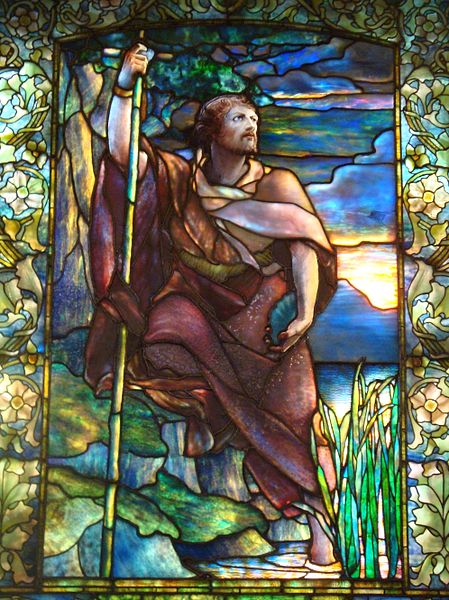
John Baptizing

When John was done sloughing off the sins

of hard soldiers and taxmen, your turn came.

You waded in knee-deep, brown water

eddying behind. He watched you come,

still plump from home, your mother’s child.

You met his eyes. Startled and unsure

he washed you anyway. You waded out,

lifting your tunic out of the pile,

sliding it over wet hair.

He noticed you shake out

the cloak, coarse weave,

whittled peg to close the neck.

It turned cloudy. A gust came up.

The next one spun you toward wasteland

silent as bone. Was it thunder he heard,

announcing a storm?

On General Priciples

A childhood friend of mine had a mother who yelled at her a lot. My mother yelled at me a lot too, but her yelling was usually connected to identifiable offenses, and I was invariably guilty of them. It was different with Tina’s mom. It was never clear what Tina had done to deserve the yelling she got. When she’d ask what she’d done this time, her mother wasn’t always able to specify.

Sometimes Tina could prove her innocence, but it didn’t matter. Her mother said that Tina had probably done lots of other things that had gone undetected, so she should just apply the yell to something she’d gotten away with; thus justice would be done.

They fell into a little routine: Tina would say, “Why are you yelling at me?” Her mother would reply, “On general principles.”

Tina was a miserable teenager. At the time, she blamed her mother for her misery, but she doesn’t anymore. She knows a lot more now about the stress and worry her mother was carrying trying to keep the family afloat. The yelling doesn’t seem as bad today as it did when she was on the receiving end. It’s like when you were small, and the house you grew up in seemed really big, but when you go back and look at it now, you wonder how your family ever fit in such a tiny place. The passing years shrink many things down to size.

Besides, we were kids in the ‘1960’s, bouncing off the walls, flouting authority and custom for good reason and for no reason—just on general principles. We gave our parents fits. It’s a wonder all they did was yell.

There’s not much point in the blame game anyway. Like me, Tina’s in her mid-sixties now, and at our age an injured attitude is not becoming. When she contemplates the rough texture of her own life in the intervening years, her mother doesn’t look all that bad. Stacked up against the injuries Tina has caused by her own flailing around, it’s not hard to let her mother off the hook. Forgiving her for “back then” is a way to forgive herself for now.

A few years ago at Tina’s suburban congregation, a disgruntled group of members presented themselves to the pastor to complain that the Confession of Sin in the weekly worship service was depressing. They had enough depressing stuff to deal with outside the sanctuary walls. They wanted it gone.

Dutifully the pastor convened a church-wide discussion about the Confession.  It opened Pandora’s box. It turns out a lot of people didn’t like the Confession. What did they do that was so awful that they had to beg for mercy every single week? They came to church to be uplifted, not to feel guilty.

And I suppose they had a point if you consider what the prayers printed in some Sunday bulletins direct us to confess. At my home church I once had to say I was sorry for causing famine in Ethiopia. One Columbus Day weekend, we lumped ourselves in with the Conquistadors, praying: “Oh God, we are all oppressors. We have enslaved your people and raped your land.” Another time we were made to say that we hated our bodies. Now, I don’t think I’m God’s gift to the universe in the conventionally-beautiful-body department, but I can’t honestly say I hate my body. I’m guilty of a lot of things, but I couldn’t ask forgiveness for that. The words stuck in my throat.

You’d think Tina, having been the proverbial poster child of bad-and-wrongness, would have led the charge to get rid of the Confession; but she didn’t. She vociferously defended it at every special meeting, and there were several. Maybe because she grew up knowing that she was damned if she did and damned if she didn’t, she has never chafed under the sinner label. She has never even minded being lumped in occasionally with the Conquistadors.

Not that she thinks she’s depraved or evil. She knows perfectly well that her ordinary sins are not the moral equivalent of enslavement and mass murder. But she also knows that, as one preacher put it, over the years she has collected a lot of sewage in [her] heart.

She’s wasted other people’s time, and they’ve wasted hers. She’s gossiped about them, and they’ve paid her back. She’s lied, lusted, coveted and taken the Lord’s name in vain. She keeps a little stash of idols on a shelf in her heart to prop her up in the day of trouble. She has hurt people, especially the ones she loves the most, and not just lightly, and not just once. She is far more self-preoccupied and far less grateful than is right for people like her who, although often, deeply and unfairly hurt, have also been unaccountably blessed, have more than they need, and have escaped untold catastrophes.

She likes to think that if at some point in her life she is faced with life-or-death moral choices, say, whether to hide Jews from the SS, she would choose the side of the angels. But she wouldn’t be surprised if she protected herself and turned every last one of them in. She understands what Mother Teresa meant when, after being lionized as a living saint by a pious devotee, the old nun tartly replied that, be that as it may, there was still a Nazi sleeping in her soul. In the same way, Tina is not confident of her own virtue.

Because she is a Boomer, she can’t help feeling vaguely responsible for everything. All the same, calling herself a sinner does not arise from guilt. Like another preacher once wrote describing himself, Tina thinks of her sinfulness more like a chronic condition – it’s not a great thing to be afflicted with, it causes trouble when it flares up, but with treatment it is survivable. Being a sinner isn’t anything singular or special about a person. It’s just true. She’s not sure why people find this hard to accept, and she wonders if ignoring or forgetting one’s human condition could be a set-up for something worse than everyday run-of-the-mill sinning.

So she argued repeatedly to her congregation that because we tend to forget who we are (willfully or otherwise), we need to be regularly and officially reminded and, occasionally, even made to admit big things we didn’t personally do, but that someone else surely did—human beings just like us when all the fancy wraps and steel-plated defenses are removed. If they did, then we could.  She did not want anyone to be deprived of a weekly opportunity to make a confession “on general principles.”

Out of love for him and a sense of fittingness, down through the centuries the Christian tradition has always claimed that Jesus was morally perfect, a human like us in everything but sin. He may have been sinless; I’m not disputing it. But in the gospels we see him line up with people who were not and accept from John a baptism of repentance. And God, we read, loves him for it—“In you I am well pleased.“ This was one of the arguments Tina used to defend the weekly Confession: If Jesus showed up for a Confession of Sin, even if it was for him a confession on general principles, why shouldn’t we?

She lost the argument. They did away with The Confession. Except in Lent. Apparently it’s okay to feel bad about yourself within certain seasonal parameters.

Tina still makes a weekly Confession all year ‘round, however. She confesses silently during the sermon. She’s tempted to feel guilty about not listening to it, but the truth is that it’s often a better use of her time.

Some of her best friends were heatedly on the other side of the argument. It hurt her a lot that some of the most adamant folks among the “we-are-not-sinful-people” crowd bad-mouthed and shunned her at coffee hour for months after the vote was taken. She really didn’t like being punished for no real crime, but she was philosophical about it. She just applied it to something she got away with.

Therefore Be Patient [James 5:1-10]

The first time I saw poverty, I was 19 years old. I’d been sent by my religious order to Mexico City to teach English to the daughters of the wealthy at a private school run by my community. We had several cleaners, local women, who attended to the school building and the teachers’ residence. They appeared at the gate at six every morning, Monday through Friday, and departed through the same gate every afternoon at four, right before the skies opened up and rained down the brief daily torrents that are typical in sub-tropical climates. The women were sweet and quiet and worked very hard, and they always left the place gleaming. I remember thinking that this was the cleanest place I’d ever lived in, a lot cleaner than my room back in Boston.

The school was located in the most glamorous part of the city, and so I assumed that the cleaning women did not live near us. I assumed that every day when they said good-bye with the soft politeness of Mexico, they got on a bus and returned to simpler homes in working class neighborhoods like the one my mother grew up in South Boston, with corner stores and local bars and a priest who knew your family. I did not know that there were no such neighborhoods there, and I did not know what the long high wall adjacent to our school was hiding.

Eventually I found out that behind the wall was what is called a barranca, a half-acre-or-so of littered open field dotted with cardboard shacks in front of which people cooked over open fires into which children routinely fell and were scarred for life, and where every Friday night most of what the women earned got spent by their despairing men on cheap, fast intoxicants. I also learned that in every rich neighborhood there were similar walls hiding similar barrancas. I learned that in Mexico City the typical distance between subhuman misery and superhuman luxury was the 8-inch width of a cement block.

The women who made our floors shine did not come by bus from across town. They ducked through a small opening in the wall of Hell, right next door. And I found that out because three Saturday mornings after I arrived, I was told to take some of our girls and go teach Christian Doctrine to the girls of the barranca. This we did weekly, ducking through that hole, sitting near those fires, teaching scarred children about God, the Virgin Mary, and the holy sacraments. And every Saturday afternoon when I got back to the residence, I would stand for 15 minutes under a hot shower, which was never hot enough or long enough to get the stench off my skin and the crawling feeling off my neck.

I hated that I could stand under hot water in a gleaming bathroom cleaned by women who had no running water, hot or cold, but you could not have gotten me out of that shower for love or money. And I used to cry myself to sleep at night over what I had seen, and I wondered what I was doing there, and where God was. And it was stunning to realize that this horror was what a great part of the world was like, and that it had been like this forever, and would probably not be changing any time soon. And I wanted desperately to go home, to New England, where it was possible not to know these things, and a lot easier to believe in God.

The sisters saw my distress and gave me the option of going home earlier than planned. Instead, I kept going to the barranca week after week with my satchel of catechisms. I don’t know why. Nothing changed because of it. I can’t even say that I made any friends in that awful place. The next time I’m in Mexico City, no nice-looking, well-dressed man is going to come running up to me to say, “You’re Mary Luti, aren’t you? I remember you! Oh, thank you, thank you, for when I was a boy you gave me hope and changed my life, and now I run a multinational!” I just kept going through the hole in the wall. I also kept hating every minute of it. I kept showering afterwards too, and I kept crying every night over what I had seen, wondering what I was doing there and where God was. Every week, the same, for months.

There’s no question in my mind that Christians are called to bold action in the world. But after a long life, I have to come think that we are also called to a peculiar form of patience that may appear at times like futility and helplessness, but may in fact be a kind of hope, even the foundation of action without which religious activism could eventually devolve into one more ideology projecting its rage into the world. The patience I mean takes shape in a persevering practice: the practice of being as simply and basically human as it is humanly possibly to be in the midst of an inhuman world.

While oppressors prosper and the poor die; while people are routinely sent to kill each other in war; while relationships break down and jobs disappoint; while our children elude parental shaping and go their own way into the world; while politics defraud, and leaders falter on clay feet; while all our choices limit us, and our futures will not bend to our wills; while our health slips out of our control, and God seems so indifferent to it all, the calling of every Christian believer is at least to take up the discipline of un-protecting ourselves from our own fear; to take the hearts we normally try so hard to keep away from the fire of so much pain and disappointment, the hearts we armor against feeling, and march them straight through any small opening we can find in the high walls that sin builds to hide its triumphs, and make some kind of human contact with the ones we find behind it, any kind of human contact at all.

The day of the Lord’s coming for which we pray every time we recite the Lord’s Prayer—“thy kingdom come”—is not only some great cataclysmic future event; it is also every moment in which we become, by grace, a little more able actually to see and feel and hear other human beings who live behind high walls. It is every moment we do not flee in horror from the terrible spectacle. The Lord’s return is also in our return, in the continuous turning we call conversion, which is nothing more nor less than a willingness to keep going back to the sights and sounds of real human life, in all its relentless pain, even if the only thing our returning produces is the tears of a shocked heart that flow down uncontrollably under a wasteful steaming shower; for all tears shed in the presence of human pain are a form of hope. For if we enter, we can see. If we see, we can feel. If we feel, we can weep. If we weep, we are connected. If we are connected, we might be saved.

And isn’t this what we claim when we say we belong to the Incarnate One? That there is a God who came to the neighborhood, ducking in through a hole in creation, and stepped inside? A God whom we know in Jesus, who was born of Mary in a kind of barranca, out of sight behind one of the world’s high walls. Isn’t this what the church proclaims about him—that his nearness to us in true human flesh is able to make us also fully human human beings, capable of the most copious tears, capable of lament, capable of a peculiar kind of patience, capable finally of commitment, and of the joy that comes from indomitable hope?