Category Archives: Marginal Notes

On Not Going Back to School

All my life I was a teacher; and whenever the end of Summer rolled around, and back-to-school ads from Staples began appearing with promises of three-ring notebooks and narrow-ruled pads, I always felt a great gearing-up in my heart. Time to begin, time to do what you love. I’d find myself believing all things, enduring all things, hoping all things.

It wasn’t all excitement, however. A great queasiness would come over me too, a dread of the headlong pace and relentless demands lurking around the Labor Day corner. From long experience I knew how bad it could get, and I’d resolve fervently to hold the line, to keep my inner life intact, to save my soul.

Not everyone looks to Staples ads for ‘a sign of the times.’ Not everyone is headed back to school this time of year.

But everyone has a life that hangs like a brittle bridge between hope and dread, anxiety and desire; and every day of every life is potentially a time of transition to something different, something new.

To step into Fall in faith—into a new school, a new semester, a new job; into life with a new baby, a church with a new minister; into a diagnosis we never thought we’d hear, a decision we never thought we’d have to make; into the phase of life we call ‘retirement,’ or into an unmapped region of the soul—I look to Christ to be my scout. He is (as a Brian Wren hymn says) “alive and goes before us, to show and share what Love can do.”

I am not returning to school this Fall, but the bridge between fear and hope still hangs there for me. Today, as he has every day of my life, no matter the season, Christ calls me to step out onto it—the bridge he crossed over to me once upon a time, the bridge he keeps crossing for us all, back and forth, until he has subdued all our fears and made our joy complete.

Whatever else may be on the other side, he will be there. So I will grab my Number 2 pencils and go.
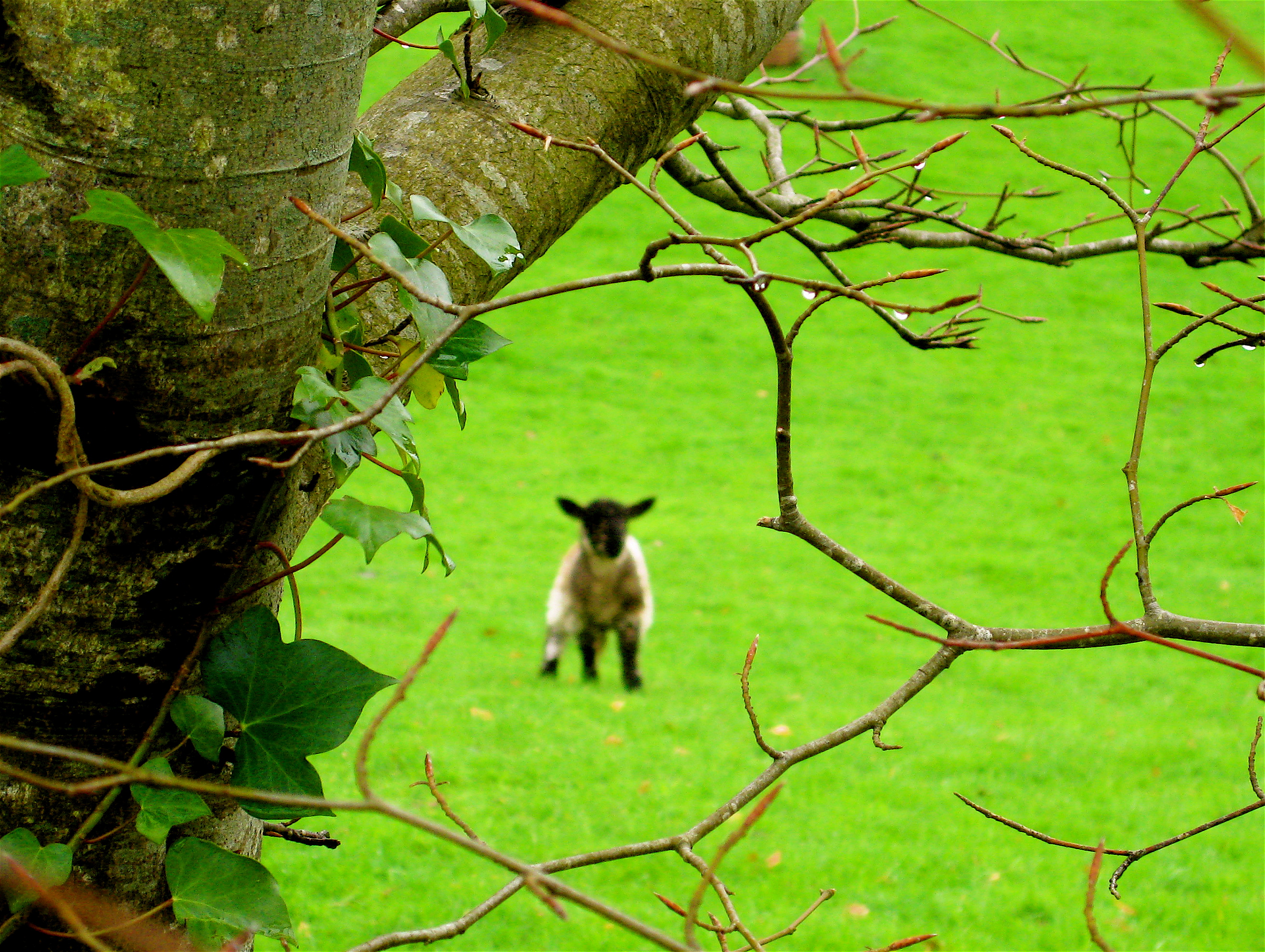
Agnus Dei

Medieval mockers sang the Mass

in Latin tongue in cheek,

upending what they’d learned by heart

from week to weary week,

inventing silly solemn chants,

ill-mannered and uncouth;

but one of them at least declared

a universal truth:

“O Christ,” they sang with sly delight,

as plain folk often do,

“You are the Lamb of God, and we

are on the lam from you!”


Oh What A Beautiful City

In July of 1993, I struck up a conversation with a young man from a former Soviet bloc country who was walking the ancient pilgrimage route from Paris to Santiago de Compostela in northwest Spain. We found ourselves drinking hard cider in a small village on the Camino, sitting peaceably in the slanting light from a setting sun outside one of the huts where you have your pilgrim’s passport stamped as you complete each leg of the journey.

He told me that this was the first time he had been out of his country since the Communists were deposed three years earlier. In fact it was the first time he had ever been allowed to leave. He had been a devout Christian in hard circumstances all his young life, and so he had decided to go and give thanks for his new freedoms by making an arduous trek to one of the holiest sites of medieval Christendom. He had been walking for weeks, and was at that moment only a day or two away from his longed-for destination.

I knew the shrine city of Santiago fairly well, but he knew it only from a couple of tourist postcards and a black and white photo in an old encyclopedia. I asked him what he expected to see when he arrived, and he proceeded to give me a detailed, emotional description of the heights above the city where one gets a first glimpse of it; the pilgrim’s gate through which exhausted pilgrims rarely walk, but nearly always run; the vast cathedral plaza where, upon entering, they throw down their walking staffs and backpacks and, despite their exhaustion, form spontaneous circles and dance to drums and bagpipes, drenched with the fine drizzle that dependably falls in Galicia.

My new friend got nearly every physical detail wrong; but the shaping impact of the vision that had formed in his heart when he was younger, the panorama of hope that had spread itself out in his soul when his destination was still impossibly far away, the hope that had sustained him all his life – all of that was precisely accurate down to the last tear that fell from his eye.

I don’t know if he made it all the way to Santiago de Compostela. I would bet good money that he did, but somehow it would have been all right if he had not, because in a profound way he had long since arrived. Before the walls fell and the tyrants too, he had already been en route; he had been running through that gate and dancing; he had already feasted his eyes of faith on the twin spires emerging from the Galician mist.

He made me think of Moses on the heights, looking over the river to the promised land. He too did not really need to see the Promised Land God showed him from the mountaintop: had he died before that vision, it would have been all right. Moses already knew it by heart. And that vision of what life might be—and in some sense, already was—was the source of the peace, joy and courage he needed to live fully every day and to die contentedly, trusting God.

That young man made me think of my own life too, and to ask myself, as I trust we all do sooner or later: What great hope is alive in me, as I sojourn in wilderness? What freeing vision sends me out on quests and pilgrimages? What gleaming city do I visit in my heart that is beautiful enough to lend shape to a life worth living, even if, walking towards it every day, I never arrive at its lofty golden gates?

Looking Up

Shower, you heavens, from above, and let the skies rain down righteousness; let the earth open, that salvation may spring up, and righteousness also. [Isaiah 45:8]

Before the 11th day of September, 2001, if something fell from the sky, it was snow, rain, or hail. If in the night we caught a flare at the corner of our eye, it was a shooting star, and we felt lucky to see it. If we noticed a silver glint above us, it was only a jet, and we might have wished we were on it, escaping for a rest.

In the days before 9/11, we did not think that planes could slice into offices, nor that looking up we would see souls hurtling a hundred stories to the dust of collapsed futures. We didn’t know that the sky could rain a million memos, a pair of shoes, a menu with the specials of the day, a man we met on Monday for a drink.

It’s not Advent yet, but it might help us today to remember that on the last Sunday of that season, our ancient forbears raised their eyes and sang to their own sorrowful sky (for there is no time without sorrow) this urgent and insistent prayer: Rorate caeli de super, et nubes pluant Justum—You heavens, open from above, that clouds may rain the Just One!

So many awful things fell down on 9/11 that for a long time afterwards we might not have dared look up, as these scriptures imply we must. Yet this is faith’s posture—heads lifted, eyes on the high horizon, hands outstretched, hearts open. This is the world’s most needed gesture—to point to every cloud of sorrow and declare, despite all evidence to the contrary, that from such skies, even from these, the longed-for healing comes.

So pray today that God will give us a new sky under which all creatures may live without fear of falling objects. Pray that what falls from the sky from now on will be only the grace of our Savior, in whom are joined the hopes and fears of all the years. Pray that under God’s new, safe sky we who are witnesses to sorrow and to mercy will co-create with God a new, safe, just, and holy earth.