Category Archives: Sermons

Who’s to Blame? A Reflection on Luke 13:1-9

Image

A friend’s college age son decided to go on a trek through Tibet before starting his junior year. Tibet is a romantic place, but it can also be dangerous. My friend couldn’t help imagining all the terrible things that could happen to him there. What if he loses his passport and gets stranded at some remote border? Gets food poisoning or altitude sickness? What if an insect bite poisons him? What if he stumbles off a steep trail into a bottomless ravine? Or gets swept up in social unrest and lands in jail? Or gets drunk and, in a stupor, runs off and marries the thirty-nine year-old trek leader?

So she set out to minimize or eliminate all those dangers before he even boarded his flight. Her minute preparations made the Secret Service look slipshod. She called me from time to time to obsess, and I tried to be supportive. But one day, I’d had enough: “For Pete’s sake, woman! Just let the boy go! You can’t stop something from happening to him on the other side of the world!”

She burst out laughing. “You can tell you’re not a mother. Look, here’s how it goes: You worry and plan to give yourself a sense of control. That way, God forbid, if something does go wrong, you won’t blame yourself for not having done everything you possibly could. Wait. Scratch that. You’ll blame yourself no matter what.”

You have to blame somebody, blame something. Your boss, bad karma, the system, the stock market, your gene pool, a communist plot, El Niño—or God. And that’s what’s going on in this story from Luke. The talk is about whom to blame for the frightening things that had happened. Maybe it was the victims themselves. Maybe they’d been bad. If they’d been good, they would’ve been spared, right? Maybe God is punishing them?

Most people I know don’t believe that. Still, when disaster strikes, it’s like a reflex—they wonder who did something wrong. Barbara Brown Taylor tells this story: A toddler’s vision suddenly blurs. A tumor is growing in her brain. On the day of surgery, her mother paces the waiting room. It smells of smoke, the ashtray is full. “It’s bad,” she says to the chaplain, “and it’s all my fault. God is punishing me for smoking. I tried to stop but I didn’t. So my child got cancer, and now she’s going to die.” The chaplain tells her God wouldn’t do such a thing, but the mother prefers a God who teaches lessons to bad mothers by killing toddlers to a God who is absent or powerless. If her daughter is dying, Taylor writes, there has to be a reason. And she is willing to be that reason.

It happens all the time. A young man I know recently told his parents he’s gay. And they, who consider themselves knowledgeable, liberal, and accepting, immediately began a frantic search through their past behaviors trying to pinpoint the thing they did wrong in their parenting to cause him to be gay.

When both the dean and the president of Andover Newton Theological School died one after the other many years ago, people at the seminary were convinced that something was wrong with the school itself. They decided we should all take better care of ourselves, as if in return for a reduced class load, a daily hour at the gym, and low-fat lunches God would be obliged to let us all live to ripe old ages.

Whenever something bad happens, we examine our habits, our diets, our relationships, our world-views, our family trees, hoping to find a cause, a reason, an explanation, so that we can stop creating our own calamities. We have an urge, Taylor says, to make sense of the senseless mingled blood and collapsing towers of our lives. There has to be something, someone to blame. And, like anguished mothers in waiting rooms, many of us have a nagging feeling that it’s us.

Jesus asked the people who came to him if they thought maybe the victims were awful sinners and had thereby caused their own catastrophes. Was God punishing them? He doesn’t wait for them to reply. He answers his own questions, and his answer is firm. It is not true to say that God is punishing us when tyrants commit atrocities, towers fall, workers shoot co-workers, babies get tumors, marriages fail, children disappoint and earthquakes ravage some already desperate part of our geography.

Sometimes terrible things just happen. And sometimes someone is to blame for what happens, and sometimes, no one is—and it’s certainly not the case that God is getting even.

And yet, Jesus says, and yet… Just because God isn’t staying up nights plotting castigating catastrophes to even the score for our sinning doesn’t mean we can go on living any way we please. Even though there is no causal cosmic connection between our conduct and the disasters that befall us, he says we still need to repent and change. He says our lives depend on it.

It’s one thing to say that God punishes us for our sins with disasters, or when bad things happen to us it must be because we are bad people. It’s another to acknowledge that our actions have consequences, that our self-preoccupied conduct sends ripples, even tsunamis, into the world far beyond the borders of our private lives, and that our unwillingness to love our neighbor can in fact be fatal.

I think this is what Jesus is getting at when he says we will all surely perish if we don’t change. He urges us to repentance not because God is lying in wait for us, but because too many of us are lying in wait for each other. God is not punishing us; we are punishing each other pretty skillfully, all on our own.

It’s important to be clear about this because some of us may think that once we have rejected the idea of a payback God; once we have consoled ourselves that God is a loving and merciful God who would never do such things to us; once we have disclaimed a direct punitive connection between our failings and the cosmic and everyday catastrophes of this life, that’s all we need to say and there’s nothing more to do. We’re home free and life goes on. But we are not done; there is more.

That “more” is Jesus’ call to repent and change. That “more” is his parable, his invitation to live differently; to tend to one another, not cut each other down; to bless the soil in which our neighbor is rooted, not curse him for breathing and taking up good space; to expect that everyone can and will bear fruit some day, and not despair of anyone too quickly, or at all.

Jesus isn’t playing the blame game, and he doesn’t think we should either; but he won’t let us go without a warning. He warns us that we will all shrivel up, dry out, and perish if we keep on behaving like the owner of the fig and not like the gardener; if our deepest reflex is not mercy, but blame; if our approach to the fruitless neighbor is anger and disowning, not patient knowing love.

If the axe in our hand falls too fast on the struggling tree, soon there will be no trees left at all, no shade, no food, no air, no life–for all alike are struggling, all alike need mercy, all alike require the tender care of Christ to grow.

If you have ears to hear, listen.

What Stress I Am Under [Luke 12:49-56; Isaiah 55: 1-6]

pill_bottle_and_pills1

Does the title of this piece sound familiar? Have you said something like this in the last ten days? You can identify…yes?  Me too. None of us is a stranger to strains that put us on medication, drive us into therapy, or land us in the doghouse when our tempers fray and our coping mechanisms fail.

That we feel stressed from time to time is natural. It’s been shown that we need a certain level of stress in order to be creative, motivated, and responsive to others. So if a deadline or a creative challenge or a crying baby stresses you out, don’t worry, be happy. It’s good for you.

Ordinary stress, physiological or psychological, is not going to kill us. Stress itself is not remarkable. What’s remarkable is that so many of us are willing to tolerate higher and higher levels of it.

Of course, if your house gets blown apart by a hurricane, your kid gets arrested for shoplifting, or your doctor gives you bad news about your last mammogram, you don’t have a choice about how high your stress level goes. If you’re a Syrian refugee in a camp in Turkey, a soldier on patrol in Afghanistan, or the mother of a teenage boy in certain sections of a big city on a hot summer night, it’d be a miracle if your stress level were not off the charts.

But much of the stress that has us on the verge of stroke, acid reflux, and road rage is unconnected to such dire things. It has to do instead with our insertion in a world of dizzying choices, so many choices that we feel disempowered by them, frustrated and depressed by sheer variety. Or it’s connected to the images of success and the good life that bombard us daily. We are set up for stress by high expectations about relationships too—parenting, the kids’ SAT scores, whether our teeth are as white as God and Crest intended. Powerful economic and cultural interests are out to get us, and we seem to have fewer and fewer defenses against them, given the influence of the media, the mediocre state of our spiritual lives, and the erosion of the power of traditional communities of wisdom to anchor us.

We have become so inured to these manipulations that even the most sincere among us have a hard time getting a clear read on what our heart-of-hearts really desires. Even the most idealistic and committed among us are easy prey for corporate marketing departments who every day determine on their own what is good for our well-being. These interests have a story to tell about what it means to be a fulfilled and contented human being, a powerful and appealing story they tell artfully and well. And most of us believe it.

We Christians have a better story to tell about the source and meaning of a good and happy life, but it seems we believe it less and less, we rarely rely on it ourselves, and we are very reluctant to tell it to others. What an irony that we who have the ‘Greatest Story Ever Told’ have lost confidence in its power to ground and shape us, ceding the ground to Madison Avenue, where there is every confidence in formative myth-making!

Perhaps we have come to acquiesce in our own unhealth because we sense that to de-stress our lives by resting in faith in the arms of the old, old story of a trustworthy God will require changes too radical to contemplate. We may long to simplify our lives, to choose downward rather than upward mobility, to learn to pray and observe more faithfully the pleasures, rhythms, and rituals of a grounded life, but we are have a hard time taking the first step to make it come true.

The thought of what it will take to de-stress stresses us all the more. And so we accept the unacceptable, take the pills, pay our therapists, and settle for small oases—a day or two without Facebook, a week-end away without the phone.

It’s time to listen to Jesus.

In an unnerving story from Luke’s gospel, Jesus announces that he is anxious too—he feels stressed, under pressure to get on with a ministry that he describes as a work of provocation and controversy. His mission will strip him and his followers of the comforts of home and family, even cost them their lives. All the traditional loyalties will be on the table to be weighed against the graceful reality of the kingdom of God that Jesus announces and embodies.

He is aware of the adverse reaction he is stirring up; and so he chooses images of fire, which means judgment and cleansing, and images of discord and disruption. If the new relationships of the kingdom undermine the traditions and cause trouble, so be it. He speaks about the “baptism” he is chafing to immerse himself in. He is at a crossroads, a crisis is fast approaching, a juncture all his disciples also face, sooner or later.

For us who follow him, this crisis might be big, bold, obvious, and immediate, like a crucifixion. But it is more likely that it will be subtle and less dramatic, and that it will unfold over time—maybe a sense prompted by a passion for justice that you must change your profession and do a new thing; or an inner voice insisting that you finally break that debilitating habit that has kept your soul in thrall and prevented you from loving the way you were meant to love; or a growing inner attraction to God that finally leads you to a scary but joyful new capacity to give away who you are and what you have more generously.

It could be a single moment of insight, or a long season of life. Whatever it is, it is a crisis, a crossroads at which we will be asked to accept that we will never be happy unless we let our hearts be governed fully by something or someone for whom we are willing to make real sacrifices.

The crazy-making stress we accept every day is different from the sort of stress Jesus says he is under, but his and ours are connected by this notion of governance and sacrifice:

Jesus’ stress is what happens when you are impelled from within. It arises from his faithfulness to a grounding vocation that has shaped everything about him and governs him completely. It is the impatient energy, the eagerness of a person in love.

Our stress arises mostly from not surrendering to something that governs us in a truly grounding way, and to live a more spiritually aimless life that makes only momentary, fragmentary sense. We hedge our bets about anything that feels like a final claim on us, and squander all our energies perfecting our defenses.

Jesus’ stress stems from the urgency to know and do God’s will.

If we are under stress, it is often because we are so easily blown around by distractions and so passively governed by unexamined wants and needs that we can’t figure out our own will, let alone God’s.

It starts early, this heart-confusion of ours. John Ortberg, a well-known preacher and author in evangelical circles, tells a (now-famous and oft-reprinted) story about the search for grounded happiness in his own young family.

He has three little kids who regularly worship at the shrine of the Golden Arches. It’s the only place they’ll eat. And they always want the same thing. It’s just a couple of basic food items and a cheap little plastic prize, but in a moment of marketing genius the folks at McDonald’s gave it a great name—the Happy Meal. The Meal of Great Joy.  You aren’t buying McNuggets and a Hercules Ring, he says, you’re buying happiness.

Every now and then he tries to talk them out of it. He gives them a dollar to buy their own cheap little plastic toys, but they want a Happy Meal. They cry for a Happy Meal. A lot. He does not want to be the father who won’t buy his kids the Meal of Great Joy, so he buys them the Happy Meal, and it makes them happy—for about a minute.

You would think, Ortberg muses, that his kids would eventually catch on and say, “You know, I keep getting these Happy Meals and they don’t give me lasting happiness so I’m not going to buy them anymore. I’m not going to set myself up for the stress of disappointment.”

But it never happens. They keep buying Happy Meals and they keep not working. No young adult ever returns home to say to her parents, “Remember that Happy Meal you gave me? That’s where I found lasting contentment and lifelong joy. I knew that if I could just have that Happy Meal, I would be anchored for a lifetime. And I am. Thanks, folks.”

Contentment, meaning, purpose, fulfillment, a God-governed, centered and meaningful life—many of us still believe it’s just a Happy Meal away; only our Happy Meals, Ortberg notes, keep getting more expensive, more complicated, more dangerous, more self-defeating and more elusive. And our stress keeps rising, our frustrations become downright cosmic.

We dream of a mystery inheritance or a Powerball win that will be the escape hatch that permits us to live the simple life in Tuscany or raise llamas in Vermont, forgetting, as they say in AA, that wherever we go, we takes ourselves with us. The truth is that there is no such thing as a geographical cure for the stress that arises in us from spiritual aimlessness—unless, of course, you decide against Tuscany and go instead on the open road to Someplace New with Jesus.

The Happy Meal our hearts truly crave is the one set out in Isaiah 55, the great banquet of creation that God is always offering. It is the banquet at which the messiah breaks bread for free, pours abundant wine with joy, and gives us the whopping prize of acceptance, mercy, forgiveness, and the bonus of a world to serve, full of kin to care for.

And all these things are ours when, by grace and over time, our hearts come at last to rest, as Jesus did, under the merciful governance of the God whose only demand—and gift—is love.

A Project Bigger than Your Life

large_14

–Avraham Binder, “Jerusalem of Peace” 1994

Luke 13:31-35

Our story opens with Jesus still in the Galilee, still on his way to Jerusalem. He’s been on this somewhat desultory journey for several chapters now, and you have to wonder if he’s as determined to get to the holy city as he claims to be in other places in the gospel of Luke.

Jerusalem, of course, is not the only place a prophet might meet a bitter end. Some sympathetic Pharisees approach him with ominous rumors about the dangers right where he is: “Get away from here,” they say, “Herod’s trying to kill you.”

They aren’t talking about Herod the Great who was king when Jesus was born and, according to Luke, died right before his return from Egypt. They’re talking about Herod Antipas, one of the Great’s three sons who each rule one third of their father’s not very big territory.

As rulers of the earth go, Antipas is a bush league potentate. All the same, a threat from any Herod is a serious thing: the Great slaughtered the innocents of Bethlehem, Antipas beheaded John the Baptist. And that’s just for starters in the nasty catalogue of Herodian terror. But Jesus doesn’t scare easily. He dismisses the threat, calling Herod an old “fox.”

Later in this story, as he approaches Jerusalem, he will liken himself to a hen that gathers her chicks under her wings in the face of imminent threat. So when Jesus calls Herod a fox, we imagine he’s thinking about Herod. And why wouldn’t he? Herod fits to a T the image of a wily predator slinking through a hole in the fence, licking his chops at the thought of God’s defenseless brood scattered around the barnyard.

But there’s another meaning of ‘fox’ that fits our story just as well. To call someone a fox was to insult him as cowardly, silly, trivial. In other words, Jesus could be saying that Herod is a gutless wonder. A nasty piece of work, to be sure, but in the great scheme of things, very small potatoes.

Jesus replies, “Tell that old fox I’m going to keep healing today and tomorrow, until the third day”— which is to say, I’m going to do what I do until God determines otherwise, and no puny human king like Herod can stand in the way.

God is in charge, Jesus is on God’s schedule, God will decide. Herod is a laughable inconsequential speck in the universe compared to the mission of infinite reach and eternal consequence that Jesus is carrying out for God.

Jesus knows himself to be the agent of something large and long, wide and deep, indestructible and lasting, something completely unlike a puppet ruler’s tiny jurisdiction in a region half the size of New Jersey.

He is the agent of a realm that can’t be corrupted, overthrown or occupied; a regime that has no imperial designs, no lust to subjugate, and yet encompasses everyone and for all time. Herod’s sovereignty is a meaningless sway over nothing, but the sovereignty of God is cosmic and never ends, even if Jesus dies.

large_27

–Avraham Binder, “Jerusalem of Hope” 1998

As for that death, Jesus seems in charge of it here. He informs his listeners that despite all the threats, it’s not going happen there, in Galilee, Herod’s territory, under his authority. It will take place in Jerusalem, the city of God.

Jerusalem sits at the heart of Luke’s story of Jesus like a magnet. It is, as another preacher put it, a desired and dreaded destination, the site of fulfillment and the scene of failure, a haunting paradox of a place where the most intense spiritual emotions are concentrated and the most ferocious violence is unleashed; a stubborn paradox of a place, where God dwells gloriously in the Temple and God’s prophets meet the stiffest resistance and the ugliest end.

Today Jerusalem still stands for all our stubborn human paradoxes. Jerusalem makes us weep. It made Jesus weep too.

No matter how certain he seems that God’s will is being done on earth as in heaven; no matter how laughable it is that God’s intentions could be thwarted by pretentious human powers; no matter how confident he is that the world is on a unstoppable trajectory of healing and justice, when he pictures Jerusalem, he is overcome with grief.

It sounds so good when you preach it, this “God is winning” message; but when you look at this world…

“I have wanted to gather you,” he laments, embodying the desire of all the prophets for the peace of God’s people. “I would have, but you would not,” he cries, summing up the longing of God for the whole human race.

The sight of Jerusalem wrenches out of Jesus the question of the ages, “How long, O Lord? Will things ever change?” It is a question of bewilderment, of unrequited and squandered love, of futility. It is a form of that other appalling question that Jesus will speak to the empty heavens outside the City, hanging on a Roman cross, “My God, my God, why have you abandoned me?”

Here is a vital lesson for us. Watch Jesus and learn that you can dismiss Herod as a pipsqueak and still question God. You can laugh at human pretentiousness and still feel the anguish of no end in sight. You can weep and wail and shake your fist and demand in your grief-stricken rage that God keep God’s unkept promises and still walk to Jerusalem with your face set like flint and your spirit resting in God’s hands.

Lamentation and confidence ground each other. And if we never lament, never wonder in our heart of hearts if anything we do makes a whit of difference, never demand answers and insist on divine faithfulness, it may be that we have never seriously engaged the world.

John Thomas, former general minister of the UCC, once observed that futility is the question hanging over every thoughtful, honest disciple. How many times have we prayed for peace, and the tanks rolled anyway, the planes flew, the bombs fell, and all those people died?  How many gun deaths and mass shootings have happened after we vowed, ‘Never again!’?

Week after week in church, we talk confidently about God’s promises, about ministry as transformation, about creating communities of radical hospitality and bold global mission, but most of the time the best any of us actually does is help a few wounded souls – and our own – limp from one day to the next, coping as best we can.

In homeless shelters, food pantries and soup kitchens, despite the selfless efforts of staff and donors, no one is solving the problem of hunger and homelessness. Neither are the politicians, who could.

We have the poor with us always, abandoned to the whims of the pious powerful for whom justice is a question of personal choice and political expediency. Social workers drown in caseloads. Parents can’t protect their children from the bizarre and hurtful fantasies the culture seduces them to dream.

And you and I?  I can’t speak for you, but I know that I will carry to my grave serious sins I did not want to commit, but committed anyway; unhealed hurts I want to forgive but can’t; gifts and energy I meant to use for the things of God, but have not, and likely never will.

A sense of defeat haunts all our hopes, Thomas observes. A victory in one part of the world, or in one part of our lives, seems sooner or later always to be overshadowed by some greater tragedy, some more horrific evil. Our noble personal intentions are thwarted by our tax dollars at work.

It is no wonder that in the face of this intractable complexity, many good people lose heart and decide to withdraw, tend their own gardens, and let the rest of the world go to hell if it wants to.

This is not the path Jesus takes. With tears in his eyes, he keeps going. Without for a moment minimizing the enormity of the pain he sees in all the Jerusalems of this world, he insists that he is engaged in a project greater and more coherent than the nonsensical and agonizing frustrations of his small slice of history. He sees over the immediate horizon. He is about a project bigger than his life.

Such a project requires a disciplined faith that knows the difference between hope and optimism, struggling daily in the dark without the solace of outcomes. It requires a face set like flint towards Jerusalem and all its painful paradoxes. It requires a steadfastness born of grief and lament, a trudging sort of hope that in practice is often nothing more than putting one aching foot in front of the other.

large_35

–Avraham Binder, “Jerusalem the Golden” 1998

What makes this futile, foolish trudge down the road to Jerusalem redemptive is that, Reinhold Niebuhr wrote, its foolishness is revealed as wisdom in the end, and its futility becomes the occasion for new striving. This is the sort of faith Paul encouraged when in the face of encompassing difficulty he wrote, “Therefore, since it is by God’s mercy that we are engaged in this ministry, we do not lose heart.”

This is the quality of faith we are invited to probe and try on and share by accompanying Jesus on the Lenten journey—the sort of hope that Frances Moore Lappe, a long-time fighter against world hunger, was talking about when she wrote, “If you are working on a question that can be solved in your lifetime, you may be wasting your life.”

Wasting my life? That judgment will surely seem exaggerated, even harsh, to people like me who are fainthearted stragglers on the trudge up to the holy city, weak in vision and self-justifyingly unsure whether there’s much to write home about at the end.

But to those who walk the futile road so stubbornly; who walk it in the company of the saints who have walked it before them and in the company of those who will come after them; to all who have experienced the long defeat and fight on with a longer courage anyway, it is the gospel truth, the Word of the Lord.

So let those with ears of faith to hear, listen.

O Felix Culpa [Luke 15]

LostDrachmaCROPPED

–The Woman and the Lost Drachma, Domenico Fetti, 1618-22

“Just so, I tell you, there will be more joy in heaven over one sinner who repents than over ninety-nine righteous people who need no repentance. [v. 7]

An old proverb says, ‘If you want to make God laugh, tell God you have a plan.’ This series of parables says, ‘If you want to make God happy, tell God you have a sin to repent of.’ According to Luke’s Jesus, God is happy when we repent— happier in fact when we sin and repent than when we don’t sin and have no need to repent.

So in a perverse sort of way you could say it’s a good thing that one lamb strayed from the flock, one small coin rolled into a dusty crevice, one willful boy took the money and ran; because if they’d all stayed put and been good, if they hadn’t gotten themselves so lost, then a woman, a shepherd, all their friends and neighbors, and a patient father would never have known what it was like to be glad like that when all those lost things got found.

The ‘good’ sin is an early (and odd) Christian conceit. On the eve of Easter, Christians who gathered for the Great Vigil used to sing a hymn that, among other things, actually praised the granddaddy of all sins, the ‘original’ sin of Adam: O felix culpa!  ‘O happy fault!’

Why is this sin a happy one? Because, the hymn continues, “you gained for us so great a savior!” If human beings had not sinned, the song implies, we wouldn’t be as happy as we are now, for we would never have known the sweetness of Christ’s love. Even God would not be as happy as God is now, for God would never have known the peculiar, sublime joy of human repentance.

Now, it’s weird to say sin is a ‘happy’ thing because of the repentance and mercy that follow. It’s theologically dicey and maybe even morally indefensible in fact. Human sin causes untold misery, after all, and not even the most profound repentance can undo its harmful effects. So what kind of religion is this that appears to like people more and holds out more hope for them when they mess up than when they don’t? What kind of teaching is it that delights more in a careless boy than in a careful one? What sort of justice blithely informs an aggrieved long-loyal son to suck it up, for virtue is its own reward?

And if God loves the fallen more than the upright, why not stop trying to be good, do whatever we want and, when we get in trouble bank on the shepherd’s care, the woman’s diligence, the old man’s mercy? If even desperate repentance born of starvation in a pigsty makes God so all-fired happy, why not let loose?

Questions like these have no answer. They have no answer because they’re the wrong questions. We usually ask them in the hope of justifying ourselves. The truth is that Jesus’ isn’t telling stories to be reasonable and moral. His teachings are not common sense. He tells these stories to disarm logic, to blow apart ordinary categories of good and bad, fairness and recompense. Stories are not explanations or arguments for anything. They are a pure shock of recognition. I mean, don’t you see yourself more clearly, even a little bit, when Jesus tells you that sinning and repenting is better than preserving your innocence? (Julien Green put it this way: “’I want to get rid of sin from my life,’ says the Christian. ‘Oh, good; I will help you,’ says Pride.”)

Jesus wants us to know that striving to be upright is laudable and necessary in one sense, but ridiculous and doomed in another. He wants us to know that there are worse things we could be than bad: we could be good like the Pharisees. In Luke’s caricature of them, they are all about avoiding sin, which is a good thing, but it turns out that they do it mostly by avoiding sinners, and their program was to teach others to do the same. That’s why they are depicted as grumbling about Jesus: his program was about being with sinners, and teaching others to be with them too.

As Luke depicts them, the Pharisees make it possible for observant people to exempt themselves from the sinner category. Their program allows ‘good’ people to create groups of ‘bad’ people whom they are to spend their lives avoiding, spurning, placing beneath them. It gives good people divine permission to hold designated bad people in contempt, making contempt itself a kind of virtue.

But here’s the problem Jesus saw in that approach: if we take this road of self-exemption and contempt, we end up distanced not only from others but also from ourselves. Because we are all in fact sinners, distancing ourselves from sinners sets us not only against ‘them,’ but also against our own hearts. Putting ourselves in the category of the good, creating an imaginary place of innocence and occupying it, means we have to delude ourselves daily and live by a false conscience that sets up impossible, judgmental, perfectionist demands. If you’ve ever tried to live like this, if you’re living like this now, you know that being good can be bad.

And sinning? Being bad? Falling flat on our weak, wounded and willful faces? Being stupid or selfish or hurtful or indifferent or unforgiving or resentful or full of fear? Well, those things are not truly good exactly, but at least being bad does not separate or distinguish us from anybody else, and God knows that any kind of human solidarity is better than distance, exclusion, and cold contempt. We also know that sin is the one thing that keeps God hot on our trail, and since God never loses the scent, that’s a good thing too. Beyond that, there’s not much to say that isn’t even odder and even more mysterious.

So maybe it’s best not to say anything else. Maybe it’s enough simply to remember that Jesus himself joined a line of sinners asking for John’s baptism of repentance. That story has the same ending as the ones we read today: God was so happy with him!

Maybe it’s enough to close our eyes and let our hearts be lured by party music wafting over the fields from inside a delirious farmhouse, lured into rejoicing over our sins too. And if we are not yet capable of rejoicing over our sins, perhaps we haven’t yet understood where we’d be without them.

So if all else fails, let’s at least pray. Pray that this Lent, as we go up again with Jesus to Jerusalem and see him die, as we traditionally say, ‘for our sins,’ the Holy Spirit will help us grasp just a little what it might mean for us and the church to contemplate our poor pathetic condition, to look more clear-eyed at our sins, and then to sing with joy and confidence in Christ that perverse little phrase, ‘O felix culpa: O happy fault!’

“Apparently You Couldn’t Be Bothered…” [Luke 4:1-13]

j-b-handelsman-i-asked-you-in-the-nicest-possible-way-to-make-me-a-better-person-but-new-yorker-cartoon–J. B. Handelsman, The New Yorker, September 14, 1998

One of my favorite New Yorker cartoons depicts a middle-aged man on his knees, praying at his bedside. Looking upward, he says to God, “I asked You, in the nicest possible way, to make me a better person, but apparently you couldn’t be bothered.”

That cartoon contains several sermons. There’s one in there about asking nicely, as if God were touchy about our tone, answering only prayers preceded by “please.”

There’s another one in there about blaming God for our imperfections, as if the fact that we are stubborn, greedy, irritable and dishonest were the result of divine dereliction of duty.

But the one that intrigues me most is the man’s prayer to become “a better person.”

I think the man on his knees is right about God’s attitude. God really can’t be bothered. No matter how nicely the man asks, or how often, it is unlikely that his prayer will get God’s attention because “becoming better persons” has so little to do with the divine project laid out in the Scriptures.

To be sure, the Bible contains plenty of commandments and rules that we are to live by. It has plenty of praise for the blameless and the upright, and plenty of condemnation for the wicked and the lawless; but the Bible is also persistent in acknowledging that no one, no matter how observant of God’s commandments, no matter how “good” a person he or she may become, can claim moral rectitude in God’s sight.

Even more, everywhere you look in Scripture a paradoxical undercutting of God’s own command to obey the commandments keeps cropping up. Some of the people who sin most often and most flagrantly in the Bible are people after God’s own heart whose sins seem only to bind them closer to God, even when God does not hesitate to punish them for what they’ve done.

The brazen sins of King David come immediately to mind, of course, but David is not alone. The Scriptures as a whole simply will not let us regard our lives or our God solely through the lens of morality. It seems that God has better things to do with us than to make us better, and much, much better things to do with us than to make us better according to our ideas of what it means to be “a better person.”

Personal makeovers used to be a hot thing on reality TV. These shows featured people who were massively unhappy with their bodies. They were whisked away from their family and friends for months on end and received tens of thousands of dollars’ worth of facelifts and nose jobs and tummy tucks and dental work. They returned home to a grand “reveal” and, they supposed, to the end of their problems, and a truly new life.

If it were up to the man in the cartoon, and if it were up to many of us, we would like God to be fully-employed in the business of personal moral makeovers. Somehow we have come to believe that the answer to our problems, to the human dilemma generally, and to the world’s sad mess, is for all of us to become “better persons.”

Because Lent is a time of repentance and conversion, we have been taught that it is also an opportune time to try to become a better person. Many people treat Lent as a time to re-make failed New Year’s resolutions to quit smoking, eat less, spend more time with the family, or take on some extra benevolence, some good deed. And if the turn of the calendar page to the Lenten season serves as a jump-start for self-improvement projects, so be it; but if the Scriptures are any indication, God will not be bothered to be of very much help to us in those projects as long as our sights remain so low and our expectations so small as to confine ourselves to becoming better persons.

What else is there, then? What is the larger horizon, the deeper quest? The thing that makes for sinning saints, for giants of God who were not always also giants of moral virtue? What other prayer can we make by our bedsides if not the prayer of the man in the cartoon “to become a better person?” And how might we spare ourselves perpetual disappointment in a God who can’t be bothered?

We could ask God, to paraphrase Eugene Peterson, to be made forever unwilling to be the subjects of our own little life projects, and to let ourselves instead be participants in who God is and what God is doing in us and in the world.

We could ask to be given the grace to step away from the center of our own self-preoccupied universes, even our religious and moral ones, and to be drawn instead into the mystery of divine action in, for, with, and through us.

800px-Temptations_of_Christ_(San_Marco)

–Temptations of Jesus, San Marco

We could ask to be led into a place empty of landmarks, a wilderness filled not only with wild beasts and wilder devils; a place not only of disorientation, temptation and moral danger; but also, as Scripture attests in many foundational stories, a place illumined by what Rowan Williams calls “a ray of darkness,” full of undreamed possibility. A place of the most profound re-making of a different kind, a time and a space for God to speak through uncluttered air not to our behaviors nor to our need for things to make moral sense, but simply to our hearts.

We could pray not to become better persons, but to live in Jesus and be assimilated to him:

He comes up out of the waters of the Jordan, having been baptized by John and confirmed in his identity by the voice from a cloud. Then the Spirit drives him in the wilderness for forty days, where he is tested by Satan to see what sort of “Son of God” we have here; and whether this Son of God will accept the vocation to be fully and dangerously transparent to the life of the God who loves him fiercely, whom he loves fiercely, and by whose moving Spirit he lives and acts for us and our salvation.

Out there, Jesus defeats the devil’s lie that he, and by extension any of us, can rightly seek a deeper, more meaningful, more successful and happier life – including a religious life – without being deeply immersed in the only true life there is, the life of God, a life that is mostly mystery.

Jesus’ victory over Satan in the wilderness was not a victory of moral virtue. To be sure, our traditions teach that Jesus was a sinless man, but it is not because he was sinless that he triumphed. He didn’t beat evil because he was good and getting better. Even though he is the protagonist, the story is not even about him—not Jesus as a tower or strength and the answer to every question, anyway.

It is rather about Jesus-in-God and God-in-Jesus. It is about the way Jesus has for forty days had his heart enraptured and refined so that it is fixed on God and God’s concerns in such a way that when the devil tempts, all Jesus can say in reply to every blandishment is “God” – we live by God’s word, we worship God alone, God is not to be tested.

The story is about God who is not responsible either for our sins or for our earnest acquisition of virtue, who is not in the business of moral makeovers or of things finally falling into place, but who is in the business of love and its cascades and cataclysms.

It is about God who does not want us so much to be better as to be lost – lost without a compass in the wilderness of God; lost, as the great hymn says, “in wonder, love, and praise,” disoriented to ourselves and reoriented to the One who is all in all.

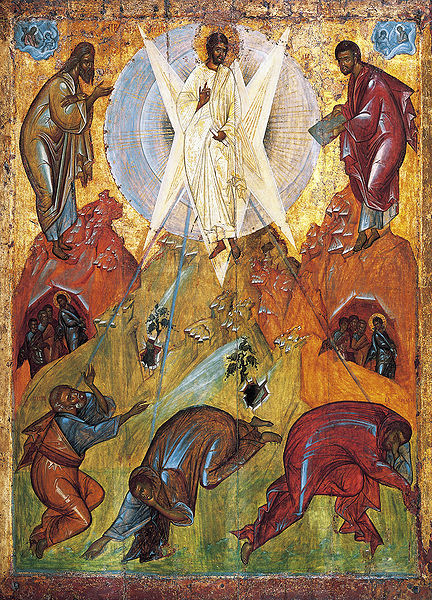
Feast of the Transfiguration: It Is Good for Us to Be Here [Luke 9:28-36]

420px-Icon_of_transfiguration_(Spaso-Preobrazhensky_Monastery,_Yaroslavl)

–Icons of the Transfiguration from the Spaso-Preobrazhensky Monastery

A sermon for pastors and preachers

We’ve heard and preached on this story many times, we know how it goes. Jesus hauls Peter, James, and John up a mountain to pray. As we watch the trio ascend, we think about an earlier climb when Moses went up Mount Sinai to talk to God. There was glory shining all around in that story, too – lightning, thunder, and clouds. When Moses came down, his face was aflame with God’s brilliance, and he was lugging those big stone tablets that eventually ended up in Judge Roy Moore’s courthouse down in Alabama. In this episode, Jesus lights up with that same brilliance. Just like back then, God speaks from the cloud. God issue a commandment in this story too—“Listen to him.”

It’s an amazing scene. The disciples are overcome with what the Bible calls “the fear of the Lord.” Then Peter blurts out his desire to set up three tents there to capture the experience. He wants to stay. But the glory dissipates as fast as it gathered, and Jesus doesn’t linger. He gets the disciples off their face and onto their feet, and they all trudge back down the mountain, back to “real life.”

And we feel sorry for poor, impulsive, clueless Peter. His desire to stay up there, indulging in radiant stupefaction, is an escapist, self-seeking temptation. Jesus knows better. Mountaintop epiphanies, it seems, are not meant to last. They are at best rest stops, gas for empty tanks, carrots to keep us going through challenging lives. When the disciples have to suffer, as they one day surely will, maybe the memory of this glorious moment will warm them and make their agony less awful. But you misunderstand Jesus if you think the point of following him is to bask in his light.

The disciples have a hard enough time grasping the odd, counter-intuitive sort of Lord and King Jesus is; if they stay up there they might never learn that he came to serve.  Down on the ground, suffering is everywhere. Jesus could not escape his own, but he tried hard to alleviate everybody else’s. And that’s what disciples must also learn to do. We should consider ourselves blessed if we get an occasional peek at glory, but we can’t rest in it any more than the disciples could. We have to go down the mountain and shoulder our ministry. Glory is fine, but only after you pay your dues. Peas first, then cake.

Now, that is a good way to interpret this text, and it can be a necessary corrective to “bliss ninnies” who think the best way to be religious is to gaze at your navel. The great 16th century mystical saint Teresa of Avila was always on the lookout for this kind of evasion in her convents. Whenever a goose-bumpy novice, languid with love and hoping to levitate, tried making permanent camp in the chapel, a no-nonsense Teresa laid down the law—nix the theatrics, eat something solid, and go help out in the laundry. Visions and voices are all well and good, but only if they don’t render you indifferent to the needs of your neighbor.

The only problem with this way of reading the story is that in our zeal to warn people away from evasion, we tend to moralize the Christian life almost to death. We make it a series of shoulds and oughts, and suggest in more than sideways fashion that worship or prayer or simple divine enjoyment is all well and good, but none of that has any value in and of itself unless we are also getting our prayerfully clasped hands dirty in the trenches of active mission.

Our repeated messages about coming down the mountain–getting back to work, doing our duty, loving God not directly but by loving our neighbors, measuring the size and strength of that love by our holy productivity–seem to assume that if we didn’t constantly exhort our people to do things, they would slide into a fog of contemplative rapture, never to be seen or heard from again. The truth is that things are exactly the opposite in most justice-aware, liberal-leaning, activist congregations. It’s a lot easier to get people on the picket line than down on their knees. Most people don’t even know what we’re talking about when we moralize about the dangers of being awestruck with divine beauty.

What a shame if we fall into the trap of telling people they must live the one sacred life they have been given according to a faith that regards ecstasy as some sort of temptation. What a shame if we fall into the trap of asking people to live by a gospel that turns out to be, in the end, just another taskmaster, just another voice among the many voices that remind us all constantly that we have not done right enough or well enough or just plain enough enough to measure up to expectation and merit approval and reward. What a shame if we take texts like this one and turn them into so much finger-wagging.

432px-Preobrazhenie

Yes, it is plain from the text that Jesus didn’t want his friends to put up those three tents. Yes, Peter was befuddled by the strange experience and “did not know what he said” when he blurted out, “It is good for us to be here.” Yes, Jesus took them right back down and yes, they plunged into the hard work of healing and teaching. There’s no question that engagement with the world is an essential component of discipleship, and that the suffering it brings requires of disciples courage, determination, and perseverance – none of them glamorous things.  But we should also want to know why Jesus would show his friends the unutterable glory of God radiating through him and not mean for them to enjoy it. And why should we label Peter obtuse and ridiculous because he wants to make such beauty and such glory –  the very pleasure of God – last and last and last?

What the disciples received that day on the mountain was not a gallon of emergency gas or a quick breather for the work crew. It was a gift of mercy, pleasure and love. They were given a glimpse of the richest and most fundamental truth about our lives, and they were meant to react to it precisely in the way they did, with awe. Just because it wasn’t time for them to enjoy it permanently doesn’t mean that they were wrong to want it permanently, or that by wanting it so much they somehow missed the meaning of the event.

Peter saw that the glory of God’s mercy and deep pleasure rested uniquely upon Jesus. This story is an epiphany, after all—a story meant to reveal something of the character of God. Its main point is clarifying the identity of Jesus, and it does so in part through the awe-struck wonder this revelation causes in the disciples. But Peter must also haves sensed that this transfiguring light was in some measure also about him. About us all. And for us all. The merciful pleasure God takes in Jesus, the joy of God’s goodness that glows like a million suns, is Peter’s origin and destiny too. It is the origin and destiny of the whole creation. We were all made in ecstasy and intended for ecstasy. Glory, and its lovely twin, Joy, is the permanent subtext of our lives.

Why does preaching so often seem to say that the only permanent thing we were made for is duty, when the truth is that we were made for delight? Why do we imply that people were made only for purpose and production, when the truth is that we were made for pleasure? Why do we help people think that the church was called and gathered only for relentless hard labor in the vineyard of Christ, when the truth is that we were called and gathered for praise, thanksgiving, and freedom – for visions, for dreams, and for the ‘royal waste of time’ we call ‘worship’?

In moments when God’s glory breaks through our flat world of fact and rationality; in times when God’s mercy transports us to the real real world, the one Jesus called the kingdom, full of justice and reconciliation, forbearance and peace; in moments, as another preacher put it, when the dazzle of God’s love squeezes through the fissures in our denial and defenses and explodes into our lives – in those moments we are drawn inexorably to God like people who have been living sun-starved for years in caves, and we too want to pitch tents on the mountain. We too want to stay and stay and stay.

We know those moments. The flood of confusion the first time someone loves you – yes, you. The time you were forgiven when you should never have been forgiven. The day you got through the whole of it without a drink. The night your first child was born. The moment you really heard the poet’s question, “What will I do with my one precious life?” The time you turned on the news and found out that that the wall was down and the tyrants were dead and people were crossing borders, singing. Or the morning early when you went for a hike, and the cloud that had threatened rain lifted suddenly, and from the top of the mountain you saw clear to Canada, and it took your breath away; and in the strange slanting light you felt somehow held, beloved, alive, and it was like The First Morning, and you believed it was possible to be new. Even in the midst of the hardest grief, it comes to us, this glory, in some stillness, in a face, a touch, a place, a smell. We know those moments. And we have all wanted to pitch a tent on those heights and stay and stay and stay.

It turns out that we cannot stay – the traditional interpretation of our story is correct about that. But the reason we cannot stay is not because it isn’t good for us to be on the summit and desire such glory. It is in fact the supreme good. To want that glory is to desire God. It is also true that while we await the final, full breakthrough of divine pleasure upon the world, we have much work to do. But this work is not the busyness and effort, the demand and expectation, the dread and drudgery, or the purpose and plan that we have been taught is pleasing to God. The work of people of faith is more wonder than competence, more surrender than skill, more beauty and imagination than plans and programs, more gratitude and praise than effort and exhaustion, more tryst than task.

The call to discipleship is not to save the world: that’s God’s job. It is rather to witness in word, deed, and in awed silence to the fact that God is in fact saving and re-creating everything, even now. Our calling is to become increasingly alert to the places where transformation has already secretly begun, and to point them out and tell the truth about what we see (often at the risk of our lives) to those who cannot see them or do not believe what they see, and who therefore languish in cynicism, sorrow and despair.  The mission of the church is to testify by overt gesture and by secret resistance, in private and in public (“in all places, everywhere and without ceasing”) that grace is even now sparking in the stubble, glory is already lighting up the mountain, and all people, strangers, kin and enemies, are even now being plucked from death, included in the sweep of mercy, and brought home to sit at the table of peace.

Our calling is therefore also to develop a capacity to see beyond common sense and ordinary sight. To see the world’s suffering unflinchingly, exactly as it is, and to see God already working right there a someday resurrection. To spot the tracers of love in the bloodstained firmament and to announce them like watchers on the wall at daybreak, and by our fearless announcement bring hope to everyone who swears all hope is lost. And this means we must learn to pray and to pray contemplatively, to re-calibrate the eyes of the heart by gazing on God. It means we must open ourselves to fire.

628px-Transfiguration_of_Christ_Icon_Sinai_12th_century

The calling of the church, our calling, is the hardest work there is – stubbornly to trust the un-evident more than the evidence at hand. To resist the caution of the earnest, the sensible, and the balanced. To be glad that God is full of the kind of generosity that mocks our guilt-ridden, self-important social action strategies, unhinges our anxious time management techniques, and beats the heck out of our prudent long-range goals. The mission of the church is to be delighted by this odd God who pays latecomers the same wage as those who grunt all day in the sun. The gospel of Jesus Christ is all about the strange pleasure of largesse, and it is our calling not to be ashamed of this gospel.

God’s will is to love the sinner, love the sinned against, empty the haughty, fill the poor, mend the brokenhearted, abide the unacceptable, bless the weak and inadequate church. And in the face of all this divine nonsense, our calling is to lose our senses too, to be like this God. It is a very hard calling, make no mistake, because it feels so much like doing nothing, and we have a terrible time shaking the notion that if we aren’t doing something, than neither is God. And yet our ministry is in the end to be the fools who understand that the very best thing we can do for the world is simply to strike a fascinated pose before the alien beauty of grace.

In the late 4th century in the Syrian desert, a young monk named Lot went out from his cave to consult and older, wiser monk whose name was Joseph. Lot said to Joseph, “Abba, the best I can, I say my prayers, I fast, I meditate, and I serve my neighbor. What else is there to do?” The old man stood up and stretched his hands toward heaven. His fingers became like ten lamps of fire, and he said, “To do? Nothing more. But you could become all flame.”

All flame…

It would be good, it would be very good, for us to be there.

Body Image (I Corinthians 12)

Frankenstein__s_Monster_by_MarkNewman

–Frankenstein monster, Mark Newman

In chapter 12 of I Corinthians, Paul tells a bunch of loose-cannon Christians that they can’t be for themselves and against each other and still be a church.

How, he asks them, do you dare give pride of place in a congregation to only some talents and ideas?

How can you regard only a few specially-gifted members as important? Imagine what your body would be like, he says, if one organ incapacitated all the others—if, for example, your eye or your liver took over and tried to run the whole show.

A body can’t thrive convulsed with self-importance, envy and contempt.

Imagine instead, Paul proposes, a community that rejects divisive standards of human worth— gender, wealth, family, education, orthodoxy—and honors you if you exhibit the slightly insane virtues of confessing your sins, serving the least, and loving your enemies.

Imagine a body whose many parts harmoniously perform indispensable, inter-dependent functions.

Imagine a church wherein members harness the passion that flows in diverse forms from God’s one Spirit to engineer the common good.

Imagine a body so united that “the suffering of one is the suffering of all, the honor of one is the honor of all.”

Imagine a fellowship of body-builders, all dedicated to sculpting one wondrous physique, gift by gift, call by call—or to switch the metaphor, as Paul often does—living stone by living stone.

Imagine, indeed!

The truth is that it’s hard for us to imagine such a church, except maybe wistfully. Those Corinthians are still alive and kicking in many of our communities, still overly-proud of gifts that should humble them, still quarreling about whose calling is more important and whose ideas about the church are right, still trying to outdo each other, still advancing private agendas, all claiming the inspiration of the Holy Spirit.

Now, there are days when I wish we had even more Corinthians in our congregations! To be sure, their hyper-spirituality requires discipline, a dose of selflessness; but if Corinthians ever managed to temper themselves, the church would flourish on their skill and passion. Our churches are more likely to be ravaged by depression than by Corinthian rambunctiousness. In many congregations, the people’s gifts are unidentified, undeveloped, or simply withheld; only a few members express the conviction that we are a body meant to grow healthy and strong; to be a member means to be a pledging unit with a vote, not a living stone edifying Christ’s body.

There’s a billboard on I-291 in Springfield, MA, advertising an auto body shop. It features a big green monster right out of Frankenstein—head bolted to a thick neck, limbs stitched roughly to an ungainly torso. The sign says, “This is the only body we can’t find parts for.” You could slap a picture of some of our congregations up there and say the same thing! Our body needs serious work, but good serviceable parts are scarce. We don’t look anything like the community Paul describes as the gifted body of Christ.

All the same, some metaphors have so much power that even our worst failings do not weaken their grip on our hope. Some things remain real and true even when we can’t see or touch them, even when we don’t believe or live up to them.

A seminary faculty discovered this when it was passing through a long period of serious and painful difficulty, some of its own making, some not. At times it seemed as if they were being torn limb from limb. Their custom was to begin every academic year with a retreat. At the height of the troubles, they came together as usual, and to kick things off they did an ice-breaking, community-building exercise based on Paul’s image of the body.

First, they were asked to think about the gifts they possessed, the unique contributions each made to the seminary. Then, they were to decide which body part best summed up their presence and activity in the school.

They thought about it. Then they paired off to share their reflections. “I think I’m like an eye,” one told the other. “I function like a neck,” another said.

And that, they thought, was the exercise.

But then they were instructed to get up and actually construct a body, one part arranged next to another as it would be in a human form. And what a misshapen thing they made! It had two heads, three hearts, no brain and no belly, four eyes, a foot, a neck, six hands, and one part that remains unidentified to this very day.

Right away they saw that their body was conventionally quite un-beautiful. But it was oddly charming, too, in a pathetic sort of way. More importantly, they realized that this odd-looking, tired old body needed significant tending, and they felt compassion for it. Its weird appearance also made them laugh so hard that they began sensing that maybe there was still life in it, the life that had gotten them through all those years, more than enough life to get them through another year. They found wondrous grace in funny flesh and bone.

This wondrous grace was well-known to Paul. He gave us other images that speak not with exasperated judgment but with sweet pathos about the body we are —priceless treasure held in fragile clay jars, weakness as strength and glory, thorns in the side.

When Paul told the Corinthians that the body they formed was Christ’s, he wasn’t thinking about a perfect buff physique. He was speaking of a body imprinted with the nail marks of human brokenness, signs of sin and frailty carried in Jesus’ flesh even into resurrected glory. Paul was speaking of a body that has yet to attain full stature, whose sufferings, he says daringly, we get to fill up in our humble love for each other and our service to the world.

We usually read this text and dwell on the undeniable imperfections of the body we are. We hear Paul scold us for our unwillingness or inability to play the part we have been given, all the ways we want to be a part we are not, to be honored and spoiled. We feel bad that we are more like warts on Christ’s body than its beauty marks.

All this is true, and striving to be a healthier, stronger, and more coordinated church is called for, no doubt. But if the body we are is truly the body of Christ—the one who knew our frailty and took it as his own, becoming obedient even unto death on a cross—we also need to learn to perceive the glory in all our ungainliness and lack , the strange loveliness God sees in our unloveliness, in its perpetually-underdeveloped quads, its trifocals and bad hair days.

Along with exhortations to take our rightful positions and perform our necessary functions in humility and zeal, the Spirit also offers us the gift of laughter, tenderness and compassion for this odd, ungainly little monster that we are.

She offers the gift of awe as well. For how could we not be awed when we see through God’s eyes that this mystic body we call the church—imperfect, misshapen, and marked with nails—is still by grace quite full of life, and still by grace capable of life-imparting.

It’s a mystery, to be sure, but the truth remains: for God we are nothing less than body beautiful.

And for that we say, Thanks be to God.

At All Costs, Ecstasy

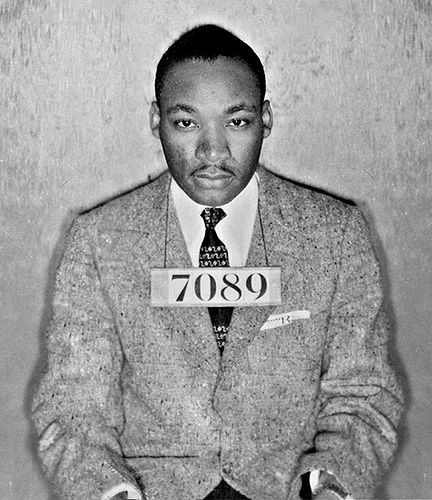
MLK_Jail–Dr Martin Luther King, Jr, booking photo, Birmingham Jail

John 2:1-11I

“They have no wine,” Mary says.

Such an odd, indirect thing to say, “They have no wine.” Yet Jesus knows what she’s after. What he hears her say is, “Do something.”

He is in no mood to do anything. He doesn’t even make sympathetic noises about how mortifying all this is for the poor just-marrieds. He turns his mother down. “This has nothing to do with us, woman.” His ‘hour’ hasn’t come, he says; that mysterious ripe time we hear so much about in John’s gospel, an ‘hour’ that includes his death.

Mary is not eager for that suffering to come any more than Jesus is. Yet a long habit of pondering has only magnified the urgency: The hungry (and the thirsty) will be filled with good things, the rich sent empty away. How much longer should this revolution wait? His hour may not have come, but maybe his minute has—and a wedding seems like just the right place to kick off the great reversal.

That’s why, over at the servers’ station, she is acting as if he’d said ‘no problem’ instead of ‘no way.’  “Do whatever he tells you,” she says, which is good advice for servants of every time and place. So Jesus goes over and starts giving instructions, and before long, six stones jars are filled to the brim with water.

The way he accomplishes the miraculous changeover is discreet, but the results are showy: he makes exquisite wine in preposterous quantities. When the steward tastes it, he just about dies. Who is this who plies with liquid heaven undeserving fools who can’t discriminate between rotgut and Rothschild?

Who indeed? This is the question of every epiphany. Who is this waster, who produces more than the world can drink? Who is this prodigal, who doesn’t seem to know the price of things? This is the question that the Spirit keeps whispering to us in the hope that we too, like the steward, might come to find the answer, taste God’s surprising vintage, and go about tantalized all our lives.

II

The head steward has no idea where the wine came from. But the servants know. Good servants always know. So do disciples, and if you go back and read the first chapter of John’s gospel, you’ll see that Jesus had just called his first set, five to be exact. John says that it was at Cana that these first few “believed in him.” Not before the wedding, note; but at the feast they believed. And not because he performs any old miracle, but because it’s this one.

They’ve all heard the words of Isaiah read in the synagogue: “As the bridegroom rejoices over the bride, so shall your God rejoice over you!” They’ve heard Wisdom, too: “She has set her table and poured her wine,” the wine of joy in the Spirit, free of charge and available to all in God’s New Day.

When Messiah comes, everybody knows, a giddy glee — not unlike inebriation (but safe ) — will grip the world. These disciples feel it now in Cana. Who is this? It must be Messiah. And they believe in him.

But they would not have been at the wedding at all, and would not have believed, if they hadn’t responded when he called days earlier, if they had not first followed him. Things happen in this order: Jesus calls, you follow, and then, in the course of following, of living with him, of going where he goes and doing what he does, you discover him as the source of joy, the fount of new wine, and you trust him, you believe.

So, in addition to being a story about the abundance of God’s New Day in which every creature’s watery old life is changed into a ruby red new one; in addition to being a story about the slap-happy joy of being in the presence of God’s Appointed One whose mission is to change mourning into gladness and keep the gladness coming in great unquaffable quantities; in addition to all that, this story is about belief and discipleship.

Between the lines we learn that it’s in the following that love, knowledge, and experience combine to make for faith. You’re a disciple if you go on the road with Jesus, go with him to weddings, and drink from the cup he proffers.

III

Today our nation commemorates the life, work, witness and sacrifice of Dr. Martin Luther King, Jr. Chances are you’ll be hearing a lot about Dr. King’s dream today, as if he’d been only a dreamer, as if the dream had been precious and peculiar only to him. You’ll hear people quote from his March on Washington “mountaintop” speech, that what matters is the content of character, not the color of skin, as if that were all he ever said.

And that line will be repeated with astonishing denial, or astonishing cynicism, or astonishing naivete, since, to take only one case, skin color can still be the difference between life and death in our criminal justice system. You’ll hear that line repeated as if he’d never also made daring critiques of the demonic nexus of racism, poverty, capitalism, war, and prison.

You’ll hear a lot about dreaming, as if all we need to do is dream on, now that he’s dead, as if dreaming on honors him. But Dr. King was not only a dreamer: he was first, last and always a disciple. He got up when he was called, and he followed. He went to the mountaintop and he went to the wedding. His eyes had seen the glory of the Lord and his lips had tasted the wine of Cana. And his faith was formed, perhaps even discovered, and certainly strengthened, in a community, following the Liberator, on the road, on the march, with Christ.

To my knowledge Dr. King never preached on John 2:1-11, but there’s no doubt he lived this story; for only from a deep awareness of abundance, only from a conviction born of the experience of everlasting reliability, only in the company of God’s Christ who keeps providing us not with enough but with forever far more than enough, only in the company of fellow followers who had also tasted the wine, could any flawed human being stride toward his inevitable “hour” so unflinchingly.

Drinking deeply of the wedding wine is still capable of intoxicating God’s people with hope, against the odds. And the hope it instills is still able to yield in us the substantial fruits of courage and perseverance, forbearance and resistance. It is still powerful enough to reveal to us nothing less than the joy of the cross.

It’s a good thing too. For if we are following, like Dr. King, we are inevitably on our inebriated way to a mountaintop. Make no mistake, the mountaintop we are going to is an imposing hill called Golgotha.

You remember, don’t you? From Cana, Jesus goes directly to the Temple in Jerusalem. Flush with the wine of messianic joy, he strides to the money-changers’ tables. You know what happens next.

Four Sermons on Baptism: 4. Have You Been Saved?

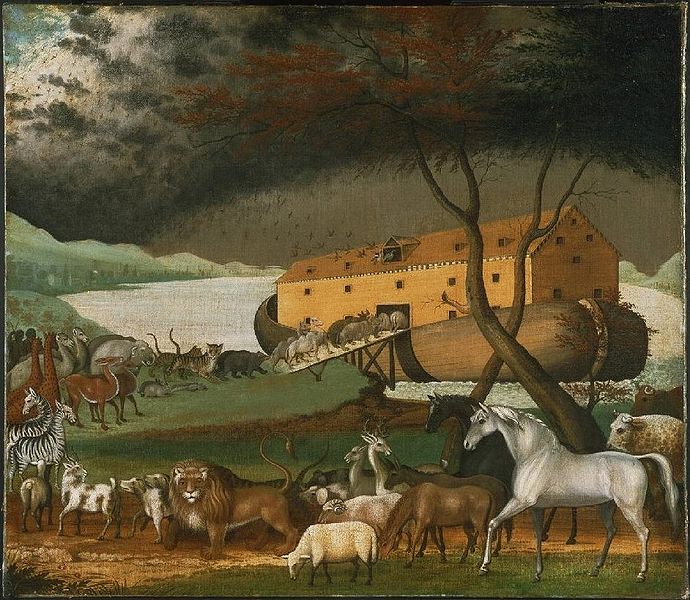
690px-Noahs_Ark

–Edward Hicks, Noah’s Ark

Luke 15:1-7

Baptism of Bryn M.

 One of the most ancient words in the Christian vocabulary is the word “salvation.” It shows up in practically all our hymns and prayers. We think we know what it means, sort of, but a lot of us would be hard-pressed to define it. It is like beige. Or wallpaper. It’s a background word. We hardly notice it.

There are other Christians, however, for whom “salvation” is not a wallpaper word. It is a foreground word, a word always on their minds. Given half a chance, these brothers and sisters will confront you with “salvation” whenever they can. And wherever they can—say, on the bridge over the Mass Pike as you’re heading to Fenway Park for a ballgame.  They accost you, wearing sandwich boards that are painted with flames (signifying hell, where they believe we all deserve to be). A picture of Jesus on the cross is superimposed over the flames (signifying the way to avoid hell. The only way). As they hand you a tract, they ask, “”If you died tonight, would you wake up in heaven or in hell?” And then, “Have you accepted Jesus as your personal Lord and Savior?”

They believe that “saving” you is the most loving thing they can do. After all, if there is a God, and if God means business, and if God’s business involves assigning eternal reward and punishment, and if there is a divinely-appointed way to avoid the punishment and get the reward—namely, affirming with your lips that Jesus is your personal Lord and Savior—then it really would be in your best interest to listen to them and do what they say.

Hardly anyone does. Especially outside Fenway Park. There’s no hope that they are going to have much success with Sox fans anyway. Most of us have already sold our souls to the devil.

Have you been saved?

The typical theologically-liberal reply to that question is not yes or no, but “it all depends.” It all depends on what you mean by ‘saved’—saved from what? Surely not from damnation. Not too many of us believe in damnation. It flies in the face of our conviction that God is all-forgiving and utterly gracious. We say things like, “Well, maybe hell exists, but that doesn’t mean anyone’s in it.” When pressed, we include even Hitler and Pol Pot in God’s mercy, and if God can redeem those monsters, God will certainly redeem us, who are much smaller potatoes.

If “getting saved” basically means “going to heaven,” then, with hell out of the picture and no purgatory to worry about (Protestants don’t hold to a doctrine of purgatory), all we mainline Christians have to do to “get saved” is to die. Which takes no special talent. Sooner or later we all die. Our somewhat wan theology about all this salvation business is neatly summed up by 19th century German poet Heinrich Heine who once wrote, “I love to sin. God loves to forgive. Really, the world is admirably arranged!”

But surely salvation is about more than where you end up when you die. Our parable today is all about salvation, but it has nothing to say about what happens after death. That’s not to say that nothing happens; it’s only to say that Jesus is not preoccupied with that in this story. He just wants to find that one lost lamb.

When we tie our notion of salvation too narrowly to the matter of our fate after death, we always end up also narrowing the grand complexity and thickness of Christian life and faith. That one might be saved simply by affirming that Jesus is Lord is a case in point. The odd case of limbo is another. Recently it was reported that the Catholic Church is going to abolish limbo. For the clueless, I’ll explain.

Traditional Catholics believe that everyone inherits the “original” sin of Adam and Eve and that we are therefore born into the world in a condition of radical separation from God. Only baptism can take that sin away and restore the human friendship with God. If you die unbaptized, you can’t go to heaven.

Where does an unbaptized soul go? If it’s not its fault that is has not been baptized—say, in the case of a newborn— it goes to a “place” or state of being in hell called “limbo.” There the soul is “punished” by being deprived forever of the vision of God, which is the greatest joy of the saved. But it is mercifully spared the eternal torment of those who are in hell through their own damned fault. In limbo, there is no active suffering, only the deprivation of God’s presence. If a soul is in limbo, it is simply, well, in limbo. Avoiding limbo is the reason that Catholics tend to baptize their babies as soon after birth as possible.

The idea of limbo was meant originally to be a consolation in the face of a very strict doctrine of original sin and a very narrow idea of salvation-as-fate-after-death. At least an unbaptized child is spared the pains of hell. But this teaching about limbo was in fact a source of terrible anxiety for parents. And when a child did die before being baptized, it caused them unspeakable agony. On top of the grief of losing a child, grieving parents had no hope of ever being reunited with her.

The current Pope Benedict is on record as saying that the doctrine of limbo is not “pastorally useful” any more. Many Catholics doubt it ever was. They can’t wait to see it go the way of fish on Fridays.

Now, I know that this internal Catholic discussion about original sin, baptism, salvation, and our fate after death has little to do with us as Protestants of the more open, y’all come, God is merciful to everyone variety. We have a very different view of original sin and a very different view of baptism. We are in no rush to baptize babies! We do not worry about their eternal fate if, God forbid, they should die without the sacrament. Washing away the stain of original sin is not the first (or the second or the last) thing on our minds when we baptize.

And yet when you look closely at our baptism service, you can find traces in it of a concern about sin and salvation. There is language that alludes to cleansing and rebirth. We make promises renouncing evil and turning towards the things that make for eternal life. We mention forgiveness.

Why do we keep that kind of talk? Isn’t baptism more about welcoming people into the Christian family? Isn’t it the moment when we hear God say to us, “You are my beloved”?

We keep traces of the language of sin and forgiveness because the family of faith into which baptism ushers us is not just any old company of people. The church of Jesus Christ has a specific character. More than anything else it is a company of the pardoned, a congregation of the redeemed, a new kind of family characterized by a life-long and life-giving dependence on forgiveness—God’s and each other’s.

In our UCC tradition, baptism does indeed speak primarily of our unconditional acceptance by God as God’s beloved children. But the amazing and precious thing about this gift of acceptance and adoption is that God bestows it on us “just as we are, without one plea.” God gives it to human beings who may come into the world free of sin, innocent, fresh and clean, but who never stay that way. And don’t you think God knows that we won’t stay that way? And yet, knowing what God knows, God embraces us anyway. Baptism’s waters plunge us into an ocean of forgiveness in which we will need to be swimming all the days of our lives.

You do not have to believe in original sin transmitted almost genetically from generation to generation in order to be persuaded that sooner or later actual sin plays a disruptive role in every human life and in every human society. No one and no society escapes its ravages—the revolting headlines of the last week’s carnage in Iraq are proof enough of that.

You do not have to believe that we come into the world already infected by sin to acknowledge that it isn’t all that long afterwards that each of us fall sin-sick in our own way, secret or public, great or small.

You do not have to believe that at our birth original sin radically separates us from God in order to take seriously the common human experience of estrangement, alienation, and loneliness that are like a persistent undertow, dragging our longing to be whole out into a vast sad sea, and against which we feel helpless to resist.

I don’t believe that the simple affirmation that Jesus is my Lord and Savior guarantees me a place in heaven if I should die in the night. In the same way, I don’t believe that left unwashed, the stain of some inherited original sin will damn me to hell at worst, or at best perpetually suspend me in a limbo of futility between my worst fears and my best hopes.

What I do believe is that I need and desire mercy. I need assurance of mercy. Assurance that my own real and deliberate sins will not cause me—now or in the end—to be forgotten or lost. Assurance that I will not—now or in the end—have nowhere to call home.  Assurance that I will not ever—now or in the end—vanish like a dream from the heart of God.

So far, Bryn, our newest little sister in the faith, has not hated anyone, started a fight or a war, or decided that she’s more righteous than the rest of us and started treating us that way. She is the very picture of God’s pleasure, holy and innocent. It’s hard to imagine her sinning when you look at her now, but even her besotted parents know that it won’t be long before she’ll be needing mercy just like the rest of us.

And so today we have done the best thing we could do for her. We did for her what loving hands once did for us. And loving hands before them did for them. We presented her to God, who is the mercy we crave. And by water and the spirit God made her part of this great, wide and embracing family of Jesus where it is always and everywhere simply a given that our need for daily saving will always be met by his endless need to save.

We have made a preemptive strike on Bryn’s life, moving it out of the lost column into the found. And by the vows we made to her today, we have become for her, with Christ, the shepherd who will track her down when later on she gets lost for real—as often as that happens, and as long as it takes to find her.

Every time we do this, we glimpse the meaning of Christian fellowship, and the nature of the Church. Every time we do this, we exercise the debt of love we owe each other because God first loved us. Every time we do this, we create and re-create the blessed tie that binds. Every time we do this, a window opens on the character of God, and what we see in that window overcomes us with a joy no circumstance can alter. Every time we do this, the ancient hope for a new world and a new way of living in it together materializes among us.

If salvation is anything, this is it.

If it is to be found anywhere, it is here.

Four Sermons on Baptism: 3. Joseph’s Tears

Bourgeois_Joseph_recognized_by_his_brothers

–Joseph Recognized by His Brothers, Leon Pierre Urbain Bourgeoise, 1863

Baptism of Oliver Magnus L.

Genesis 45:1-15; Luke 6: 27-38

If you don’t know the story of Joseph, you owe it to yourself to read it from start to finish. It has everything: jealousy, violence, sex, power, money, suspense, God — and a happy ending.  It begins in chapter 37 of Genesis when Joseph is 17 and a shepherd in the land of Canaan. It ends in chapter 50 (the end of the whole book) when Joseph dies in the land of Goshen at 110. In between, Joseph is transformed from a spoiled little Hebrew kid into a shrewd Egyptian potentate, and his pack of jealous brothers into men of honor.

The plot of this convoluted story has a large historical purpose: it is meant to explain the manner in which the Israelites whom Moses led out of Egypt got down to Egypt in the first place. But it has a theological purpose too: it is meant to demonstrate the character of Joseph’s God. This God has a plan, and everything that happens to Joseph happens for a reason.

God’s reasons become clear only in hindsight, of course; but to Joseph, the divine method in the madness makes even attempted fratricide meaningful. Joseph says to his brothers, after finally revealing his identity, “Don’t be distressed or angry with yourselves about what you did to me: it was not you who sent me here, but God, in order to preserve life” [45:5].

Now, the providential worldview that makes such a crime meaningful does not remove the need to resolve the nasty old family secret. The business of forgiveness is still pending, and it won’t be simple. Joseph will subject his brothers to a series of tests, some bizarre, before he finally reveals himself and absolves them.

But absolve them he does — through his tears. In the short passage we read this morning, Joseph weeps only once, but if you read the story from its beginning 3 chapters earlier, you’ll see that this encounter-reunion narrative is drenched in Joseph’s tears.

The first time Joseph weeps is after he has terrified his brothers by accusing them of espionage. When the brothers realize that they are in deep trouble with this powerful and enigmatic man, they can only think that their crime has returned to haunt them: “We’re about to pay the price for what we did to our brother,” they all agree. “Joseph pleaded with us, but we turned our backs. Now we will surely answer for his blood…” [42:21-22]. And Joseph, who has pretended he can’t understand their language, is overcome — he hurries from the room to weep.

Why these tears? Well, why not? Here he discovers that his brothers have come to comprehend the gravity of what they did. So it all comes back to him — the horror of being snatched and stripped and thrown into a well in the middle of nowhere, left for dead by your kin. When he hears them recall the crime, he also discovers that for all these years in a foreign land, he has not been altogether lost; he has been remembered by these brothers of his — their guilt has kept him near, and so has their grief, a grief not unlike his own.

Does he see a glimmer of possibility for a new relationship, one woven of regret and empathy for their mutual emptiness, their mutual sorrow? Does he weep, then, also in joy, because he knows now what he will do with his power over them — that he will use it to be kind to them, and that soon he will effect a reunion with his father and his mother’s only other son, the youngest of the brood, Benjamin?

Joseph’s tears fall again when, much later, the brothers return for another sojourn in Egypt, still unaware of who “the man” who so dominates their lives now really is. This time, they bring Benjamin. And again, tears force Joseph out of the room: “Then he looked up and saw his brother Benjamin, his mother’s son… He hurried out, for he was overcome with affection, and was about to weep. So he went into a private room and cried. When he composed himself and washed his face, he came out…” [43:29-31].

Joseph then plants evidence of theft on Benjamin, and when Benjamin is caught, Joseph decrees that he must remain behind as a slave while the rest of the brothers return to Canaan. This is the greatest test — whether they will abandon Benjamin just as they abandoned Joseph once upon a time. They do not. One of the brothers offers himself in Benjamin’s stead. His father’s grief would undo him, he says, if he were to go home to report yet another lost son.

Joseph is overwhelmed by the pain of his own absence and the genuineness of his brothers’ loyalty. He bursts out weeping, and this time there is no hiding his tears. His passionate weeping, the scripture says, echoes through the palace — an eruption of pain and possibility so intense that it compels him at last to drop the game and reveal himself: “I am Joseph, your brother, whom you sold into Egypt…” [45:1-2].

Now you might conclude that Joseph was a sentimental fool prone to exaggerated displays of emotion. And maybe he was — no one else but Joseph weeps in this story, and he’s not done weeping yet. When his father Jacob finally comes down from Canaan, Joseph “weep[s] on his neck” a good long while too.

But I think Joseph’s tears are more than sentiment. I think he knows that the sin of human enmity is something that can only be grieved, and never quite fully repaired. He knows that human estrangement is something to be borne, and never quite completely fixed. I think he knows, in the words of another preacher, that with those who hate us and with those whom we despise, with those who have harmed us and those whom we have harmed, we share a single damaged heart, and for this common wound he also weeps. I think he knows that the great tragedy of the refusal to forgive is that at a certain point in that stubborn sustenance of estrangement, all you succeed in doing is erasing yourself from your own on-going history; and because the absence of anyone from a rich human life is unutterably sad — a waste — it is worth weeping over.

I think he knows that you can’t retrieve, relive or reconstruct the past, and you certainly can’t forgive on command. You can only hope, by the grace of God, to test and probe and dare the present to see if you can get a little closer each day to the empathy and regret that make reconciliation and new relationships thinkable — a bit closer to the experience, the knowledge that we are in truth each other’s Josephs, that all our enemies (and those who scare us) are kin in disguise.

So in that hope he also weeps — the hope for joy in solidarity, in eventual reunion, in a holy communion. He knows it is possible: after all: his brothers tried to kill him once upon a time, but now they refuse to sacrifice Benjamin. He knows it is possible, after all: for now somehow he who was their victim is now holding them in his arms.

Today we baptized Oliver Magnus. What did we do for him? We passed him through water into a Company of Forgiveness. We wet him down with tears — God’s ancient tears, the same ones Joseph shed over his brothers, the same tears Jesus wept over us — and ushered him into a Way of Reconciliation.

Now, we know he didn’t need those tears of mercy today, didn’t need to be wept over. So far he hasn’t hated anyone, started a fight or a war, or decided he’s more righteous than the rest of us and treated us that way. He doesn’t have any siblings he can throw into a dry cistern (although there is a pesky cat in the apartment…).

But even if it’s hard to imagine him sinning today, he will need these tears some day, for sure. We all sin, there’s no reason to think he won’t end up sinning too.

So what we did for him today was to give him the best defense and the best offense we have found. Led by the Spirit, the church has for centuries collected the copious tears of God’s grieving over our alienation and aimlessness; God’s tears of regret for our foolishness and anger, our need to kill (in one form or another) to protect our own lives and the life of our tribe; God’s tears of hope for our turnaround, and God’s tears of joy at our homecoming — the tears that bathe our wounds and water our growth and enliven our pleasure and refresh our loves; the tears we too learn to shed for others, whether they belong to our tribe or sojourn in foreign places. We collected tears in this cistern (which can never dry up) and plunged this baby boy down in it, bathed him deep.

He is drenched now, and sealed: no matter what he ends up doing, where he wanders or is carried off to, God’s tears can find him, reach him, wet him down again and again. God will never lose him or let him lose himself. He is entrusted to us, too, who are likewise bathed and sealed and are wept over daily. We are each other’s kin now, now and always, God hanging on our necks and weeping tears of love, pure love, always love, nothing but love for us all.

God bless you, Oliver Magnus. We are Joseph, your siblings. Don’t be afraid. All will always be forgiven: Welcome home.