The Enneagram, the Myers-Briggs, and Other Idolatries

Enneagram-1-characteristics

When Myers-Briggs devotees ask me ‘what I am’ on the scale, I say I don’t know. Eyebrows go up. Haven’t you ‘taken the test’? Yes, four times, because two employers, one working group, and an ordination committee required me to. But I’ve always had a hard time recalling what ‘I am.’ In part that’s because every time I take it, the results change. Apparently I’m a moving target.

When the Enneagram people ask me ‘what my number is,’ I also shrug. I’ve never done it. When I admit this, they look a little sorry for me—Richard Rohr teaches it, for goodness’ sake!—and proceed to tell me what they think my number is. I guess they’ve had my number all along, which I find amusing when I don’t find it annoying.

What I have taken are those Facebook tests that tell you what country you should live in and what character you are in Hamlet. I get Fortinbras a lot. Who knew? They’re silly, of course, harmless, and pretty much always wrong, but I take them anyway, for fun. But more ponderous inventories and assessments like the Myers-Briggs and the Enneagram? Those, I confess, I resist.

It’s not that I’m incurious about who I am, or afraid to find out: I once had my palm read in a cave in southern Spain. And it’s not that I’m disapproving of the way such tools become all-explaining constructs for some people, in the same way that the labyrinth colonizes some folks’ entire approach to spirituality. It’s true that I pedantically fret about reductionist distortions of the spiritual life and can be querulous in conversations about it too (see, I know at least that much about myself); but I also know it’s not up to me to decide what people should find ‘powerful’ for their lives, and I can let my wariness go.

Nor am I put off because  there’s no scientific basis for the assumptions these tools rest on and the explanatory conclusions they deliver, although quasi-scientific claims are routinely made for them. The Enneagram also purports to be an ‘ancient’ tool, which for mystery-starved Protestant progressives lends it a great deal more authority than science ever could. I find this deference to the ancient supremely ironic in people who aggressively eschew dead white men and most expressions of tradition, but hey. In any case,  I’ve given my heart to lots of scientifically unreliable things, like Christian faith and the Red Sox, so the Enneagram gets a pass from me on this count, too.

And it’s not that I don’t understand that, as some fans of the Myers-Briggs and the Enneagram insist when I launch another tiresome critique, they’re only tools meant to help us in circumscribed ways, not the be-all and end-all, etc. You should do it, get inside it, learn from experience, let us explain it to you correctly, then you’d see. The truth would dawn. That’s sort of a gnostic argument when it comes down to it, and I don’t care much for gnostic arguments. Besides it’s just not true. I do get it that they’re only tools. But I also get that many facilitators and experts who fuel the monster self-knowledge industry are not so modest. Their ardor makes ‘only tools’ seem like existential necessities with unassailable validity, and skeptics like me would recognize that if only we would trust them when they say so.

No, what makes me a resister is more philosophical, I guess you could say, or maybe more theological. When push comes to shove, I’m just not very interested in the particular kind of self-understanding these tools offer. I don’t think self-knowledge has all that much to do with being able to unearth and describe particular personality traits or styles of being in the world. What I want is to know myself, not dissect and explain myself. For me, self-knowledge is a comprehensive thing, the sort of knowledge about my human nature that gives my soul stability, a capacity to be neither excessively enamored of its gifts nor abjectly shamed by its lacks, neither preening about its virtues nor shocked by its sins.

When I seek this kind of self-knowledge, I find I’m hardly ever preoccupied with the activity of knowing myself in particular detail. I don’t spend a lot of time negotiating the slalom course of interior self-investigation and segmentation because (as somebody once wrote, I can’t recall who) “knowing yourself is not the same as being interested in yourself.” I’m hoping instead to acquire, over a lifetime, a tacit consciousness of my human finitude and contingency, a deep background awareness of incompleteness and belovedness, a gounding knowledge to accompany me and shape my being and acting in the world.

In this sense, self-knowledge is a discipline and a gift. And what this sort of self-knowledge knows is not ‘things about me,’ but something richer and more encompassing: namely, that my human status vis-à-vis God, my neighbor, and the world is a sheer mercy.

Then there’s this truth: Even the most useful instruments for discovering the self, the shape of our personalities, and the contours of our human style obscure as often as they illumine, because human beings are necessarily elusive and hidden. We are always more than we know. More than anyone knows. And in the same way that ‘God’ cannot be nailed down, neither can we. It’s not for nothing that we were made in the divine image, so dark in its glory, so bright in its enigma. We can’t explain ourselves to ourselves, and no one else and no instrument, scientific or magical, can do it for us, either.

Trouble often comes when someone thinks they have us figured out, or when we think we know what makes another person or class of persons tick. Sometimes the trouble is trifling; sometimes it’s as big, nasty, and dehumanizing as patriarchy, racism, and, well, you name it. There’s nothing silly or wrong (despite my skepticism and occasional mockery) in knowing all kinds of things about ourselves. And I don’t doubt that there are tools  that can help in that enterprise. What I doubt is that there’s genuine wisdom to be had in it. I think there’s genuine wisdom in knowing what self-knowledge knows: the whole self cannot be known.

This truth often causes us pain. We all long to go in, to cross the threshold, to know and be known fully. It’s hard to be turned away at the door by the mystery of unknowability. And yet there’s also invincible freedom and dignity in living inside the truth that we can be captured by nothing and no one—not even ourselves.

None of these tools can deliver in any lasting way what they seem to promise (or what some people infer, correctly or not, that they promise): namely, that with numbers and letters in hand, we can understand each other more fully, get along better, make compassionate, or at least practical, accommodations for our differences, and not judge someone because they are a 2 or an INTJ. In my experience, discovering, sharing, discussing, even laughing about our ‘scores’ has rarely forestalled or resolved tension and discord in staff meetings, impatience and dismissive judgment among family members, or the facile excusing of ourselves from the obligation to grow up and behave better.

This failure isn’t the fault of the tool so much as it is a flaw in us. Same old story: we want what we can’t have. For at the core of our lives is a mystery whose entire scrutiny belongs only to God. Self-knowledge is given to us as we’re led to glimpse and embrace the nature of our creaturehood as God fashioned it and knows it, that simple human being most of us spend a lifetime evading even as we’re busily taking personality inventories to tell us who we are.

To seek self-knowledge is to enter a lifelong path of attention, faith, and surrender. It’s also to accept that no effort of ours will ever lead, or is meant to lead, to the kind of detailed understanding we crave when we sit down to take those tests. It will not hand us the keys we think will unlock us and explain us and make things better. That sort of knowing is fine as far as it goes, but to pursue and prize it is to settle for a lot less than we deserve. It may even be a kind of idolatry, depending for grace on gods that can’t bestow it. But to thirst for that larger self-knowledge is to concede divine sovereignty over our enigmatic lives. It is to worship the living God.


A Service of Holy Communion for Earth Day/Creation Sunday

Under-Fig-Tree

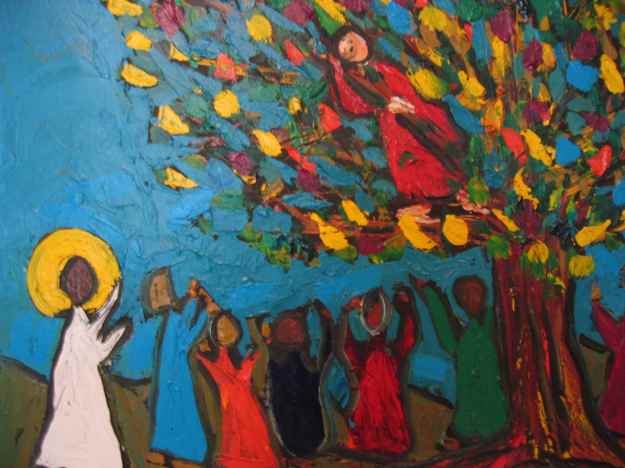
Each Man Shall Live Under His Own Vine And Fig Tree (1967), by Ronen Koresh


Invitation

[Words in bold indicate the congregation’s part.]

Once upon a time, God made a garden,

and every creature lived in it happily with God.

We took long walks with God in the cool of the evening,

humans and snails, kangaroos and spiders, kitties and larks.

And when we all sat down with God to eat,

the curling vines gave up their fruit,

the tall gold wheat gave up its grain,

and we ate delicious bread

and drank from a cup of blessing,

singing songs under stars ‘till morning.

And the grateful creation was at peace.


Ever since, whenever we honor the earth

by eating and drinking with heartfelt thanks,

God walks with us again.

God sits with us and eats.

Our tables become the garden,

the whole creation sighs with peace,

and we see again how life was meant to be.


Come, now, everyone, to this table,

to the garden God planted in the East, in Eden.

Come, taste and remember,

taste and see how good God is.


Communion Prayer

Let us pray.

Thank you, Creator God,

for sharing your life with us

in every good thing of this world.

Thank you most of all for Jesus,

who sat us down to eat and drink

good bread and good wine,

so that in tasting how good they are

we could remember how good you are.

He is our East, our Eden,

our Garden of peace.

In him we find the fullness of life

you desired for us from the start—

walking together, sharing food, living in peace.

Send the Spirit to his table now

where he still sits us down,

where we still remember you.

Bless the bread and the cup,

fruit of the earth and work of our hands.

May they become by your grace

the taste of Eden in our hearts.

As we eat and drink together,

let us see more clearly

a vision of life as you meant it to be.

Consecrate us to the ministry of making it so,

by sharing earth’s goodness with all,

in reverence and hope, with justice, and joy.


Sharing Bread and Cup

Dear friends in Christ,

this is the bread Jesus blessed and broke

and gave us to share in remembrance of him.


This is the cup Jesus blessed and poured

and gave us to drink in remembrance if him.


Eating and drinking together,

we remember his death,

we rejoice in his rising,

and we wait for him to come again,

to judge in mercy,

to welcome in love,

and restore all creation,

to the praise and glory of God.

Amen!


Thanking God, Blessing the Earth

[As we sing the closing Song, inflatable globes (or small earth beach balls) will passed through the pews. When one comes to you, please hold it for a moment, thank God for the world, and give the earth your blessing. Then pass the globe along to others.]

Song “Blue Boat Home” (Peter Mayer) Tune: HYFRYDOL


Once in a Garden: Meditation for Earth Day/Creation Sunday

30-01-10/34

The tree of Life, allegory with birds perched on branches. Mosaic pavement; 4th century CE

The first gift God gave humans was to make us from clay, to give us kinship with dirt. God named the first earthling adam, meaning ‘human,’ from the root word, adama, meaning ‘soil.’ To be human is to be grounded, in the earth. And when we remember that we’re dust, when we know our place, we become wise. And that’s a great gift.

The second gift God gave humans was breath, kinship with God, a sharing in God’s own life. The adam is related to God by breath, and every breath the human draws is full of God’s own desires. The earthling resembles God in this way: he’s drawn to beauty and full of appetites.

Which is one reason God gives adam another gift, The Garden, “beautiful to look at and good for food.” In the Garden, he could satisfy his desires, especially his desire for God. For God lived in the Garden too, strolling in the cool of the evening among rocks and plants and streams, with kitties, kangaroos, earthlings, earthworms, bunnies and bears.

And that was the way it was, once in a Garden—shared life, companions and kin, creatures all, made-in-the-shade of the Tree of Life that grew in a Garden near Eden, in the East of God’s new and wonderful world.

Now, it wasn’t all play and no work for the human. The world outside the Garden was perfect, but unfinished. Help was wanted: an on-site tiller of soil, someone who would care for the earth. God made the world with room in it for involvement and participation, for evolution and improvement. That’s why God made the earthling, the first gardener.

You’ve probably heard that God commanded Adam and Eve to ‘fill the earth and subdue it.’ To multiply and have dominion. And God does say that, in one story. The Bible has two creation stories, and in the second, God doesn’t say ‘fill and subdue,’ but till and care. The first story leads to possession and mastery. But the second story leads to belonging and participation. In this story, the humans have work to do, but it’s joyful work, because when they care for the earth, earth cares for them, too.

Then the story takes a sad turn. A smooth talking serpent appears and plants seeds of mistrust in the human heart. And that mistrust becomes a wedge. It splits things:

Humans had never felt shame in being naked; now they do. Their relationship with their own bodies is broken.

Once they’d walked with God; now they’re afraid of God and try to hide. Their relationship to God is broken.

Once they called each other ‘my own flesh and blood’; now they turn on each other in accusation and blame. Their relationship to other humans is broken.

God closes the Garden and sends the humans into the world outside. There they discover that their relationship to nature is damaged too. Participation in the world now brings suffering as well as joy. The story says that’s a punishment, but it’s not really. It’s just that we’re so deeply connected to the world that when things aren’t right with us, they’re wrong in nature too. And nature won’t be right again until we are.

But even with all its hardships, the world was still wondrous. Yet it never fully satisfied us like the Garden did. We planted garden after garden ourselves, hoping to sense God’s footfalls in the grass, to see flowers that don’t fade, to hear God speak to the heart. But nothing we made was like what we lost.

The story goes in many directions from here. For Christians, it goes to Jesus, God’s Child. The story says he came to find and stay with us who’d become so lost and lonely. He left his own Eden with God and took an earthy body, just like ours.

But by then, we were so practiced in ignoring our kinship with creatures and God that when he came to us in human flesh, breathing the divine breath, we did to him what we were doing to each other.

We treated him like a foreigner, even though he stirred a deep memory when he told stories of gardens and seeds, trees and birds, lilies, and harvests gathered into barns.

We said we didn’t know him, even though he ate, drank, sang, and danced with the happy abandon of one who knew what life was like in the Garden.

We regarded him as a stranger, even though we heard the accent of Eden in the way he talked and felt its cool breezes in the way he lived.

In a cruel twist, when we seized him, it was in a garden. And when killed him, we buried him in one too.

The ancient creeds say that as soon as he died, he descended to a gloomy place where for eons long-dead ancestors were waiting for the Messiah. Jesus “harrowed” them. That’s an old word for raking. Like a harvester, he raked them up and gathered them into his new life. Later, back at the garden tomb on Easter morning, Mary Magdalene saw him, but she thought he was a gardener. She wasn’t really wrong.

Genesis is the Bible’s first book. It recounts the first creation. Revelation is the Bible’s last book. It promises a new creation when time ends. The new earth, it says, will be like a jeweled city with walls and towers, but in its center God will plant a Tree of Life, just as God did once in a Garden.

The Tree will yield a different fruit each month, and its leaves will be medicinal for the nations—for all people, no matter who. A Tree of diversity and healing, a Garden undefiled. It’s hard to imagine. We hide guns in our gardens. We bulldoze thousand-year olives. We delude ourselves, thinking we can demean, ignore, unhouse, and kill each other, and exploit water, earth, air, and animals, and suffer no lasting harm.

But now, as we witness the effects of our self-delusion, the truth scripture teaches is stark. In disappearing ice caps and disappearing bees, in bad water and very sick children we see plainly that there’s no separation between human beings and nature, between this nation and that nation, between this continent and that island, between our own generation and those to follow. We’re in this together. For better, and for worse.

Some people say it’s too late for the earth, too late for us. But although earth has been entrusted to our care, it’s still God’s earth, not ours. We can either believe that or we can despair. It’s still God’s creation. We can either trust God or despair.

I think we won’t despair. I think we will read and study and pray the Garden story, over and over. I think we’ll speak to each other about Eden and the earth, about creatures and God and divine breath, about Adam the gardener, and Jesus, the new Adam, the harvester of life. I think we won’t despair because we have this great green story and in it, a mission and a calling.

I think we won’t despair. I think we’ll ponder how to invest our money and how to reduce our footprint and how to organize and how to protest and how to vote. I think we’ll do all those things and more.

And it won’t seem like much against the odds. But each small thing we do will be a kind of remembering. Each small step a re-connection of broken kinship, an act of love. Small thing by small thing, we will become ourselves a Garden, an oasis, a taste of Eden, at play and at rest as God intended for us and every creature under heaven. Small thing by small thing, by endless grace and persevering response to grace, God’s glorious will for the earth and for all creation will shine and shine again.

You Shall Love the Lord Your God…


DZ1ND00Z

You can’t claim to love God if you hate your neighbor, says the first letter of John; love of God is proved in love of neighbor. Nothing in all scripture is truer. But nowhere does the Bible say that neighbor-love is all there is to keeping the Great Commandment. We’re also commanded (first and above all else, mind you) to love God, and love God explicitly. Love for God is inseparable from neighbor-love, but it’s also distinct from it.

The progressive Christian habit, however, has been to collapse God-love into neighbor-love. If you love your neighbor, you’re already loving God—that’s what it means to love God. There’s no urgency (or need?) to love God any other way. Inseparability becomes substitution, and the result is what Jesuit ethicist Ed Vacek calls the “eclipse of love for God.”

Thinking about this scary phrase some years ago, I tried counting the sermons about loving God I’d heard in progressive churches. I couldn’t recall any. I realized that I myself had preached only one. I think you still have to strain to hear the sound of sustained progressive reflection on loving God explicitly and with everything you’ve got. In our wing of the church, Vacek’s eclipse is a near-silent one.

A pew-mate of mine once noticed this hush. After sitting attentively through yet another hortatory sermon about Christian obligation to the neighbor and social justice action in the world, this faithful old layman leaned in my direction and sighed, “You know, Mary, I think I know by now what God wants me to do. What I’d really like is to know is who is the God who wants me to do it?”

“Who is the God who wants me to do it?” This wasn’t a question about book-learning or theological concepts. It was a question about intimacy, a question about mystery, a question about prayer, a question ultimately about surrender; it arose straight out of a heart that longed somehow to love as well as to obey.

The habitual evasion of this question makes for an earnest, vague, and potentially joyless Christianity that aims only to make the world a better place, or else. Surely Jesus hoped more for the church than to be the delivery system of an incessant moralism that has us believing our world is so bad and our causes so urgent that the exhaustion, outrage, and bitterness we feel are justified—even a badge of honor. Surely Jesus showed us a God we could love, not the one we often project, who is as wired, anxious, workaholic, self-righteous, and unhappy as we are.


Always Contrite

prostrate

“You will not turn away, O God, from a broken and contrite heart.”—Psalm 51:17

The psalmist says that God will not spurn a contrite heart, but he might just as truthfully say that God cannot turn from such a heart. There’s something about a heart that’s been shattered, opened, rendered contrite and pliable by failure, that God cannot resist.

If that’s true, it makes me think it’d be a good thing to adopt contrition as a way of life, not just an occasional shamed response to a particular sin committed. The best heart to have would be an always contrite heart.

Not a heart always wallowing in guilt, mind you. Not a perpetually self-abasing or gloomily self-loathing heart. No wailing, breast-beating, or sackcloth and ashes. Just a heart that isn’t shocked by its own mistakes, but assumes them as a baseline human fact. A heart that, in a mysterious way of speaking, welcomes frailty as a God-magnet. A heart that knows failure is one of the best friends the soul could have.

Sr. Joan Chittister says we would do well to embrace the “sanctifying character of our mistakes.” To resist is to miss a mystery, and a biblical truth—our sins may make us holier than our virtues ever will.

An aware heart always on its knees, always truthful about its lack, always surrendered to what Mark Heim calls ‘the vast accomplished grace around us,’ and therefore always intimately accompanied by the Mercy within mercy inside mercy who is God—that’s the joyous life the penitent psalmist prays for. It’s the life I pray for too.

And you?

Prayer

Break my heart with your great mercy, O God, and be always near my always broken heart.


Passing Guests

01_20130828_Atlanta_Airport-072

“Teach me, O God, how fleeting my life is.

Hear my prayer, listen to my cry;

for I am your passing guest…,

like all who have gone before me.”— Psalm 39:12

Whenever I’m herded onto a jetliner with a couple hundred other uncomfortable, prickly travelers, or crammed into a subway full of bleary commuters, or crushed in any crowd where a crash or a derailment or a shooting or a stampede could suddenly kill us all, I find myself thinking, “These are the people I may die with today.”

I look intently at them, eavesdrop on their conversations, imagine their backstories. “You and I may die together today,” I say to them in my inmost heart.

Does that sound morbid? Maybe it is, but it helps me be human. The more I see others as people I might die with, the harder it is to be rude and judgmental and impatient, my usual behavior in hordes. There’s something pathos-inducing about this thought. It elicits a softening.

We’re not rivals for life’s overhead bins. We’re not jockeying for earth’s limited seating. We’re not first class people and steerage people. We’re dying companions. How can I not be reverent? How can I not be kind?

The psalmist knows he’s here today, gone tomorrow, a passing guest of God. We all are. On earth for a fleeting breath, we live by sheer hospitality, God’s to us, ours to each other, our common death our closest bond.

For everyone in the great crowd of mortals, age to age, it’s the same. Soon I will die with you, and you with me.

In the meanwhile, let’s be kind.

Prayer

Life is short, most holy God. Make me tender towards my dying companions, all of us your passing guests.

Render Unto Caesar: On Not Knowing What It Means, or What to Do

800px-Tizian_014

–Titian, The Tribute Coin

Exodus 33: 12-23; Mark 12:13-17

Our gospel story opens with the arrival of representatives from two factions who have put their heads together and come up with a trick question for Jesus. The first group is the Pharisees, a religious party of committed laypeople with whom Jesus had a lot in common, even though they are portrayed in the New Testament as his most intractable enemies.

For reasons scholars disagree about, but which may have something to do with the emperor setting himself up as a divine son of god, the devout Pharisees were resistant to paying the head tax to their Roman overlords.

The other faction, the Herodians, advocated pragmatic collaboration with the Romans. They get only one other mention in the gospels, and we don’t know much about them; but their name implies sympathy with a line of violent and irreligious puppet kings who ruled in Judea at Rome’s behest, and who were generally despised by pious, nationalistic Jews. That these two opposing factions are in cahoots gives a whole new meaning to the term ‘strange bedfellows’.

They begin their interview with Jesus by lathering on the flattery: ‘You are so sincere, Jesus; you truly teach God’s way…’   Jesus is thinking, ‘Blah, blah, blah!’ Then they pop the trick question. “Is it lawful to pay the tax to the emperor?’

It doesn’t take a mind reader to figure out what they are up to. Jesus knows that if he says, ‘Yes, we should pay the tax,” the popular base that resonates with his anti-imperial preaching will complain that he flip-flopped and gave into the special interests; in the next election they’ll vote for Ralph Nader. If he says, ‘No, we must not pay the tax,’ Bill O’Reilly will label him a dupe of the radical peace movement, and the NSA will step up the monitoring of his library books.

Give one answer, and your followers abandon you. Give the other, and the authorities have proof that you are a garden variety insurrectionist and will deal with you by the usual means. This Gruesome Twosome appears to have Jesus over a barrel.

Jesus asks to see the denarius used to pay the tax. He inquires about the image stamped on the little silver coin. They tell him that it is the emperor’s. Jesus says, “Well, then give him what’s his, and give God what’s God’s.”

Apparently this is a great answer. We are told that the Pharisees and Herodians heard it and went away amazed. But why? What were they amazed about? What did they make of Jesus’ reply? What did it mean exactly? What did they report to the party bosses back at headquarters?   Had they won? Had they lost? Is it clear to you what actually happened? It isn’t clear to me!

Once at an ordination I was participating in, a famous preacher gave a mesmerizing sermon that left everyone in the sanctuary breathless. Afterwards, in the reception line, a couple of colleagues sidled up to me and said, “Wasn’t she amazing?” I allowed that yes, indeed, she was. Then one of them whispered, “But what did she say, exactly?” I had absolutely no idea, and no one else did either, as it turned out. A great turn of phrase is worth a lot in my book, but it doesn’t always say anything.

Give to Caesar the things that are Caesar’s, and to God the things that are God’s’ It’s got a nice Zen-ish ring to it. But what does it mean? And what precisely are we to do with it?

Some theologians think that Jesus was talking about two distinct realms of human life—the secular and religious, or maybe what we call church and state—and telling us that we are citizens of both, one foot planted in each. God sanctions earthly government and requires our loyalty to it as long as it is godly; but when it is ungodly, or when it demands from us the absolute allegiance that pertains only to God, we must always give precedence to God’s claim on us, or risk idolatry.

Now, if that is what Jesus meant, it seems simple enough. If you think, for example, that the war in Iraq was an unjust imperial project; and if, after it took more than 2,000 American lives, untold Iraqi lives, and cost billions a day, you are more persuaded than ever in your Christian conscience and in your judgment as a citizen that preemptive war is just plain wrong, then you should not fork over the taxes that pay for it if you should be asked to support such an immoral misadventure again. Right?

On the other hand, some of you might think, taxes also pay for public education and other things that are needed and good, and one would not want to harm those interests by refusing to pay. Others might wonder, what will happen to me if I withhold my taxes? And wouldn’t it be a futile gesture? Would it really stop a war? And still others of us might say, I can’t think about this right now, I have a meeting.

Give to Caesar what belongs to him, and to God what belongs to God. What does that mean? What are we supposed to do, exactly?

Another line of interpretation says that when Jesus told the ambassadors to give to Caesar what belongs to him, he was being facetious: the overarching truth is that nothing belongs to Caesar. Everything is God’s, and claims by the Empire to possess and control its subjects with ultimacy—claims implicit in the coin’s inscription identifying Caesar as divine—are simply blasphemous.

This interpretation has given rise to various and sometimes contradictory approaches to Christian civic life. One place to which it has led is to withdrawal from the world. This is the separatist, or sectarian, impulse exemplified by the internal exile that evangelical Christians in this country once imposed on themselves—before they came to love power, that is—as the most faithful way to be a disciple in a lost and corrupt world. It is still what many religious home-schoolers believe. Minimize your involvement lest you be tainted by the idolatry of the State.

But even sectarians make compromises. Maybe you don’t run for the local town council or school board, maybe you don’t even vote, but if the government should ever move to take away your church’s tax exemption, I’m guessing you will get on the horn and call your Congressperson, or hire an attorney and use the courts for redress.

Give to Caesar what belongs to him, and to God what belongs to God. What does that mean? What are we supposed to do, exactly?

In most cases, using this passage to describe a reasoned approach to the question of the Christian citizen’s relationship to government ends up generating all sorts of complications. It’s no wonder that another typical line of interpretation gives up trying to relate this story to politics, citizenship and government altogether. Instead the story becomes a stewardship message: Give Uncle Sam what belongs to Uncle Sam, it says, but don’t forget also to give St. Polycarp by the Pool what belongs to St Polycarp by the Pool—pay your dues to your country and to your church! Render unto Caesar…

So, what did Jesus really mean?

I have no idea. And I doubt that all the Pharisees and Herodians back at headquarters did either. Whatever they understood by it, it did not convert them on the spot; it did not deter them from further confrontation with Jesus; it did not ensure him the lasting loyalty of his followers either, and it did not win him the mercy of Pontius Pilate. Whatever Jesus meant, he did not mean to save his life.

Now, we all know that this is not the only place in the scriptures where Jesus is deliberately cryptic. It isn’t the only story in which we hear that people walk away amazed, even though we are not quite sure what that amazement was about. It’s not the only instance in which the theory we spin from what Jesus says seems at first so straightforward, and then turns out not to be. Not the first time that we are left to work out the implications for ourselves, and to discover the unsettling truth that faithful disciples can and do work them out in different and even conflicting ways. It isn’t the only example of Jesus’ resistance to cooptation and manipulation.

And I think that it is in elusive moments like this one that Jesus, whom Christians believe is ‘God with us’, most reminds me of the God who is not with us in any ordinary sense, but is the Hidden One whose ways are not our ways, and who is under no compulsion to explain or justify anything at all to mortals.

This is the part of God’s biblical character that seems most forbidding to us, this absence, this stubborn silence. Many of us are impatient with Zen-like utterances. We don’t want a God that slips eternally through our fingers. But in some ways it is only this hidden, cryptic, elusive and unknown God that you can really trust to have your best interests at heart.

When by divine reticence God lets us know that God is not who we think God is; when God won’t give us a straight answer to a simple question; when God amazes us without letting on what it’s really all about, God is doing human beings a huge favor.

Because like Moses, we keep asking for clarity. We keep demanding the truth about God. We want the picture sketched out. Put the instruction manual in our hand, we pray—tell us plainly who you are, what you want, and how, precisely, we should regulate our social, political and ecclesial lives according to the gospel. But the saving grace that we are granted instead of all this clarity is simply that we are finite, partial and contingent. We want it all, but the gift and blessing we are given is to see only a little light, as we peer out from the cleft in the rock where God has thoughtfully stashed us.

Never in this life to know everything is not a cause for sadness and frustration. Not to know everything is a cause for gratitude and praise, because, by glimpsing only God’s back, we are shielded not only from a blast of full frontal glory we could not possibly endure, but we are shielded also from pride—and from the violence and contempt that always go with it. If we can be content to see only snatches of truth, if we can resist claiming more about God’s being and God’s intentions than any finite human can truly claim, we may, by God’s grace, be les likely to set ourselves up in God’s place, with all the dreadful, familiar consequences that such self-delusion always entails.

I once had student who had a great crisis of faith and left the seminary, abandoning all thought of a pastoral calling. He had many reasons why this was a good thing to do. Mostly it was a move prompted by a need for intellectual, theological and moral purity. He did not think he could be a pastor with complete integrity; he had mixed motives, his ego was untamed, he wasn’t sure that he had enough faith, or faith of the right quality. His departure seemed a sad waste to me, since no one accepts this calling with complete integrity, without a mixed motive or a doubtful cloud on the horizon of the heart. If complete personal coherence were a qualification for ministry, there would be no one serving. But one thing he said has stayed with me, and it challenges me all the time. He said, ‘I don’t know how I can get up and preach to people every Sunday as if I knew what God wants. I am afraid to speak as if I actually knew what God is saying.’

Today in our nation a large number of Christian voices are not, apparently, the least bit perplexed or stymied by Jesus or by the God of Jesus. They seem to know precisely what God means and exactly how to practice what Jesus preaches. They are often invited to tell our pluralistic nation all about it on TV. They are happy to do so. You have seen and heard them. They seem unafraid that they may be presuming too much, overreaching. No shadow of doubt or complexity haunts them.

I do not wish to judge anyone’s faith. I am in fact eager for the good news about what God is doing for the world in Christ to be heard in the street and on the airwaves. I myself hope always to speak with joyful confidence about the good news, never being ashamed of the gospel. But I also pray every day, for me and for all of us, that I might be protected from myself, from my prideful need to know it all, my anxious need to control even God, my presumption and overreaching in speaking in God’s stead—and from the violence and contempt that lurk in the shadow of such self-delusion.

I want to be protected from myself by the very God who refuses so wisely to be fully known, so that from the cleft in the rock where the hidden God has so compassionately hidden me, I may tell the amazing story of what I do not know, as well as the wondrous story of what I do know—and do so with humility of speech, with modesty of exhortation, with joy in my human limitations too many to count, and with a reverent and awe-struck heart before the One whose Holy Name cannot be pronounced, but whose seen and unseen love is everlasting.

I invite us all to the do the same.

Ghastly Prayer

images

“By your sword, deliver me from the wicked, O God. Fill their bellies with the wrath you have stored up for them. May their children have a surfeit of it too, with leftovers for their little ones.”  –Psalm 17:13-14.

What I pray for when I’m distraught, terrified, enraged, or overwhelmed is not what I pray for when I’m peaceful, content, hopeful, and safe. What comes out of my mouth when I’m beyond the end can be ghastly.

My most desperate prayers lay bare the damaged self I normally conceal under good Christian wraps—an aggrieved righteousness, contempt for those who oppose me, a primal impulse to pay back with lasting hurt those who have hurt me (and while we’re at it, their children too), and a cowardly urge to have God do the dirty work for me.

I’m grateful to this bloodthirsty psalmist for being as nasty as I am when my heart is backed into a corner. Grateful not so much for validating my emotions, or for modeling honest prayer, or for reminding me that God is big enough to absorb my fury, but for shocking me into recognition. I hate what he prays for. I recoil at his viciousness. But I’ve prayed that way myself.

We could shun psalms like these, excise them from our devotions, denounce them for their violence. Or we could pray them. We could let their hateful words come out of our mouths. We could discover in repeating them that they are not as foreign and distasteful to us as we think they are, or as we want them to be.

Self-knowledge. It’s the beginning of wisdom.

Prayer: Have mercy on me, O God, just as I (really) am.


Out of the Depths

deep-ocean


“Deep calls to deep in the roar of your cataracts…” —Psalm 42: 7


God loves the deep.

God loves abysses, caverns, valleys that lie between heights, bedrock at the bottom of the sea, profundity, and graves. If it’s deep, if it has fathoms and fathoms, if you have to go down, in, or beneath to get there, that’s where God goes. Where God is. God loves the deep.

Now, we often speak about God differently: God, we sing in our hymns, is enthroned on high, above the skies. God thunders from the mountaintop. God goes up to shouts of joy. We raise our eyes to the heavens. We lift our hearts to God. God is over and above and higher, higher than our thoughts. God is up—a ‘higher power.’

But if you go by some of the great stories of the Bible, it’s not up God loves so much as down. God is a ‘deeper power.’ God’s preferred trajectory is downward, into the depths of creation, into the depths of our lives, into the depths of love, loss, ecstasy, sin and perversity and pain; into the depths of our prayer where our sighs replace our words. Downward God goes, into the deepest thing of all, our human deaths. If something is deep, if it has depth, God will go there.

Moses discovered this when he came to the Red Sea with the Hebrew children in tow and Pharaoh’s army at his back. There God’s love plunged deep into the sea and parted it. Water high on the left and right, and in the middle, in the deep, bedrock. And the Hebrew children got down to the bottom of things. They went deep and were free. God loves the depths. If it’s deep, if you go deep, to the bottom of things, you find God there. And freedom.

Jonah discovered this when he boarded a ship to anywhere but where God wanted him to go. In a raging storm, the sailors threw him overboard, and he began to sink to the bottom. A big fish swam up out of those depths and swallowed him. In the belly of the fish Jonah swore to God he’d be a good boy and a docile prophet if God would get him out of there. It was a prayer so oily and self-serving that it made the fish throw up, spewing Jonah onto the shore, saving his life and giving him another chance to do what God wanted. God loves the deep. God works in the deep. God changes things down there.

Ezekiel learned this when God took him on a guided tour of a grisly sunken place of bones. Bone by bone, God rubbed his nose in the charnel, as if God wanted Ezekiel to certify that they were in fact ‘very dry,’ as the story says, which is another way of saying ‘very dead.’ They were. Like the corpses bulldozed into open pits at Treblinka, or the skulls of neighbors lined up on the pews of village churches in Rwanda, those bleached carcasses stood for a people, “the whole House of Israel.” The valley held a fate worse than death—genocide, the prospect of a future erased, no one left to remember and tell. And  in those depths of horror and despair, God told Ezekiel to prophesy life. You know what happens next: ‘the knee-bone connected to the thigh bone, the thigh bone connected to the hip bone…” The people live. Out of the depths.

Jesus knew it by heart, this word about God and the depths. He went deep himself when he put aside the glory that was his and lowered himself into a fully human life in his mother’s womb. It was in a lowly trough where she first laid him to sleep one silent night. And it was in an airless cave cut deep into rock that he was laid to sleep again when he died, wounded with the wounds we gave him. Out of the deep God raised him to indestructible life. Easter, never forget, took place in a grave. God loves the deep.

And remember the way he wept and groaned out of his deep love for  Lazarus? It’s a mysterious story, Lazarus’ rising. Like all stories about love and pain, loss and confusion, faith and hope, it’s deep, and we can’t fully fathom it. All we read is this—Lazarus was dead, decaying for days, but at Jesus’ command, he came out. Out of the depths he came back to life.

If you didn’t know this deep God already, wouldn’t you love this God? A God who is not a highness, but a lowness? If you loved this deep God deeply, you wouldn’t be content to live well, with panache and brio, high spirits, high ambitions, high expectations and high hopes; you’d find yourself instead longing to live in a lowly way, profoundly, with depth, humility, and outstretched hands. If you loved this deep God deeply, your trajectory would start to mirror the divine course: you’d tend to the subterranean, track downwards, into, and beneath. All the way down into the fissures love has not yet bridged you’d go, into the lesions love has not yet healed, into your own and others’ pain, into the guilt and haplessness, the fear and falsity, the secret shame, the bottom-feeding greed and self-protection. Down there, on bedrock, you’d know again on whose unfathomable mercy you utterly depend, as life and freedom beckons, and deep calls longingly to deep.


Memento Mori

St-Francis-Contemplating-a-Skull-by-Zubaran1“Teach us to number our days that we may get a heart of wisdom.” — Psalm 90:12

In the Middle Ages, many Christians practiced a spirituality summed up by the Latin phrase, memento mori: remember that you die. Our forebears figured that cultivating an awareness of death was the best way to keep themselves bracingly honest about life and deeply engaged with the world.

The proximity of death taught them that nothing is secure or permanent. The democracy of death taught them that power and privilege mean nothing in the grave. The finality of death taught them that on this side of the grave they might as well risk everything.

Such realism, they believed, was essential for grounding an authentic love for God and neighbor. But it doesn’t come naturally to us, we have to work at it. It’s an everyday discipline.

So, for example, if a medieval nun kept a companionable human skull in the alcove where she prayed, she was not being morbid, and she was not depressed by her daily contemplation of its unmistakable message. It ushered her instead into a realm of radicality, clearing her mind of the world’s nonsense and her heart of egoistic clutter.

In its shadow it seemed foolish to aspire to the unnecessary; it became easier to refuse ephemeral delights and savor lasting ones, easier to gain the freedom of soul to respond to the urgent claims of her neighbor. By a practice of discernment and detachment in the light of our common end–a practice of distinguishing impulses from needs, needs from wants, and wants from entitlements–she prepared her heart to offer the least possible resistance to the Holy Spirit.

She believed that Jesus asked her to live in such a way that when death came it had very little left to take from her.

She would be surprised that we find that notion grim. What she would find grim, as another writer has noted, is a culture like ours that considers the accumulation and protection of wealth to be so serious as to merit the efforts of a lifetime.

What she would find depressing is the way that the material things we collect and store away like cadavers in a morgue captivate our hearts.

The big question is why we don’t.

*****

Image: St Francis Contemplating A Skull, Francisco de Zuruburán, c. 1635