Author Archives: sicutlocutusest

A Festival of Rain

A rainy Memorial Day weekend. Very rainy. Torrential at times. It’s Springtime in Boston, always an iffy proposition. Of course, we need the rain. That was my mantra yesterday when I got caught in a downpour, stuck in snarled traffic, with zero visibility. We need the rain. It’s a way to make virtue out of vexation.

Of course we do need rain. All of us need rain: there’s always drought someplace in the world. It’s easy to forget that. We only occasionally get a bad one here in the Northeast. Our faucets routinely deliver great gushing quantities of water. It’s not the same elsewhere.

Sometimes, when I stand at my sink with the tap open, I try to imagine a life without easy access to water. I think about the exhausting grind of lugging water from a shared village well or a muddy stream. I think of places where control of water determines the balance of power; where water is used to subjugate, punish, and pacify, as it often is in Palestinian refugee camps. I think too of all the cities and towns of Israel where people have water, but where Israelis yearn also, as Maureen Kemeza says, to “drink the cup of security instead of the bitter dregs of terror.”

I watch the rain wash out my week-end plans and say, “Oh well, we need the rain.” I say it in the resigned, noble, yet slightly resentful way only someone divorced from the daily struggle for subsistence could say such an obvious thing. Meanwhile, somewhere else, a human being who had no week-end plans, no prospects at all in fact, looks down at dry cracked earth and prays for the rain I have resigned myself to; prays also perhaps for that other refreshment – for justice, as necessary for life as water itself.

In the gospel of John, Jesus is in Jerusalem for the Festival of Tabernacles, a week-long autumnal harvest celebration. By his day, it had taken on the character of a festival of rain. Each day of the observance, priests and people processed to the great fountain on the northeast side of the Temple. There a priest filled a golden pitcher with its water, as the choir sang a verse from the prophet Isaiah, “With joy you  draw water from salvation’s wells!” Then back up they processed, through the portal called the Water Gate. When they arrived at the altar of sacrifice, they marched around it, singing psalms. Finally, the priest ascended the ramp to the altar and poured the precious water from the pitcher through a silver funnel onto the ground.

Unlike us, who are disappointed when it rains on our parade, the celebrating Jews prayed fervently that it might rain during the Feast of Tabernacles, for rainfall during Tabernacles was taken as a sign that God would send the abundant Spring rains necessary for a good crop the following year. I have read that even in recent, more bitter years, Jordanian Arabs, who are not enamored of the Israelis, continue to keep their eye on the weather during the Jewish feast of Tabernacles, hoping for the rainfall that portends a good harvest for their own people too – common needs betraying a common humanity, in spite of everything.

In the midst of this festival of rain, surrounded by his people’s prayers for life-giving water, Jesus stands up, as if in answer to them all. He cries out that he is water, rain, the life we need. He stands up and promises that if we drink from his well, if we return repeatedly to the springs of wisdom, mercy, reconciling grace and generosity that flow within him, that he embodies, then living water will also flow from us who accept his invitation – we will ourselves become like fountains.

John tells us parenthetically that by “living water” Jesus was referring to “the Spirit” that would be bestowed upon his disciples after his death and glorification. The gift of this Spirit is the momentous religious experience we commemorated on Pentecost Sunday.

We associate Pentecost more with wind and fire than with water, because those heartier images are the star performers in the account of Pentecost in the Acts of the Apostles that we customarily read on that day. Thus we trend to think of the Holy Spirit as power and enthusiasm, impetus and ardor  –  a force to be reckoned with, transforming fear to boldness, inhibition to freedom, doubt to conviction. And so it is.

But Pentecost is also a festival of rain. And the Spirit is like holy precipitation. The rain we need. In Acts, we hear a Spirit-filled Peter try to explain to the stunned crowd what is happening. This, he says, is the drenching that was promised by the prophet Joel: “In those days, says the Lord, I will pour out my Spirit on everyone…” Pour it out, like water from a golden pitcher, like torrents from the sky.

Pentecost is a downpour, a soaking, a flood – a flood of life and possibility; and, miraculously, a flood of mutual understanding that washes away, if only for one blessed day, the desiccating divisions of clan, nation and tongue. It is like water turned mysteriously to wine, making the world giddy with hope and joy. It is a baptismal immersion from which the church rises, dripping wet, waterlogged with grace. The call given to us in those fathoms is to go and drip on everything; to rain on the drought-stricken world the rain of kingdom life.

Many congregations prayed for wind and fire last week. I wonder how many prayed for rain. As I was watching it fall very hard yesterday and late into the night, I hoped some did, because we really need the rain. We really need The Rain.

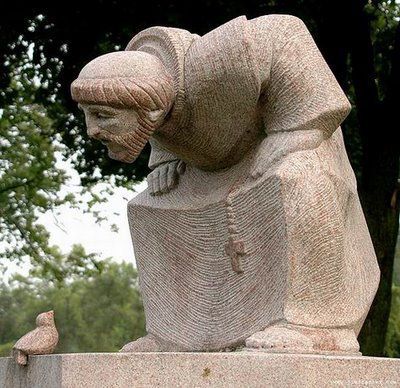


It’s Necessary to Use Words

Image

“Preach the gospel at all times; if necessary, use words.” –St. Francis of Assisi

 Along with many colleagues and companions in my progressive Christian denomination, I’ve made frequent use of this saying attributed to Francis of Assisi to make a point about the perils of lip service and the Christian imperative to serve the neighbor. It’s not surprising that we find it appealing. Activism for social justice is a vital part of our denomination’s ethos in ways that verbally commending the gospel to others—evangelism—is not. This much-quoted admonition pithily sums up our liberal credo: Talking about faith is less important than demonstrating it. Besides, Francis said it. It doesn’t matter that we don’t normally venerate saints in my denomination. Francis is hip and counter-cultural; we’re pleased to take his word for things, a word that just happens to lend authority and charm to our bias.

Lately, however, I’ve been reconsidering the usefulness of this saying. For one thing, it’s doubtful Francis ever said it. No early biographer records it among the hundreds of other sayings and stories, historical and apocryphal, attributed to il poverello. Neither is it found in any of his extant writings, which are few in any case.

Of course, the fact that Francis never said it is not in itself sufficient reason to stop using the phrase. Many things that someone never said are still useful. If they reside somewhere in the zip code of the supposed author’s spirit, no harm is done by a dubious attribution. Besides, one can get insufferably pedantic about such things, and more than a bit obsessive. The internet is rife with phony or edited citations from heroes we wish were more like us than they actually were, and to set about correcting them all would be a lifetime’s work of debatable merit.

In this case, however, I believe Francis would’ve been puzzled by this saying and by the use we make of it to defend the notion that preaching with words is of secondary importance to a gospel preached with deeds. In the context of his life and ministry, it seems misleading at best, if not plain wrong. Unlike the famous peace prayer also attributed to him, this saying about preaching appears sufficiently distant from his spirit as to make a correction meaningful, and perhaps even necessary.

He never said it, and he may not have agreed with, but there’s a section of the second Rule Francis wrote for the friars (1221) that suggests a possible origin of its association with him. In Chapter XVII, “On Preachers,” Francis legislates as follows:

No brother should preach contrary to the form and regulations of the holy Church nor unless he has been permitted by his minister. And the minister should take care not to grant [this permission] to anyone indiscriminately. All the brothers, however, should preach by their deeds.

Here Francis mandates that brothers who are engaged in a preaching ministry—the primary ministry of the friars—must be licensed to do so, and that they must take care to conform their preaching to the norms and expectations of the Church. In other words, the friars are not free agents; no one is to go out and preach on his own initiative. Notice, however, that not every brother will be granted permission. Francis charges the minister (he eschewed the term “superior”) to determine the qualified. Brothers denied permission need not feel left out, however, for “all the brothers… must “preach by their deeds.”

For Francis, this is stating the obvious; preaching with deeds is a given. Making it explicit in the Rule is his way of reminding those brothers who are not permitted to preach with words that they participate in the preaching ministry all the same by means of their example and service. For Francis, preaching with deeds is a crucial and holy default position, but he does not elevate it over preaching with words. There’s no “if” in Francis’ conviction that preaching with words is “necessary.”

His stance is unsurprising given the role of preaching in his day when the fear of doctrinal heresy mobilized the repressive machinery of church and state to the point where scholars like R. I Moore can speak of a “persecuting society.” Francis’ contemporaries believed, rightly or mistakenly, that heresy was rampant and infectious, and that one of the primary causes for its appearance was weak preaching by Catholic preachers, made even weaker by their scandalous lives. The way to prevent the spread of this contagion and recover the wayward for the true Church was for Catholic preachers to preach better and more zealously, and to conform their lives to their preaching.

Preaching with words was at the heart of many of the new evangelical movements of the period. The hierarchy kept careful watch over these movements, ruling some out of bounds because of perceived doctrinal deviance, or because of disciplinary failures, especially the failure to secure proper permission to preach from a lawful ecclesiastical authority. Francis was adamant that he and his brothers should stay in bounds; he insisted on solid doctrine and proper process.

Francis was not merely being canny or self-protective. He was a true son of the Church (which did not preclude acts of what one writer has called not civil, but “ecclesiastical disobedience”), and he was fundamentally concerned with the sequela Christi. To follow the Jesus of the gospels as closely as possible meant not only forgoing possessions as an outward sign of an inward renunciation of power; and not only keeping affectionate company with the last and the least, even the officially segregated leper; it also meant preaching the good news, announcing an urgent message, and doing so with words. Preaching was the Franciscan charism every bit as much as the devotion to the poor and pastoral care for the sick for which he and his first followers gained such fame and admiration.

Francis’ own practice is revealing. His first biographer, Thomas de Celano, describes him as a peripatetic preaching machine, in the mode of a George Whitefield or the early Wesley, sometimes preaching in up to five villages a day, mostly in the open air. In the countryside he perched atop bales of hay in granary doorways; in the cities he shouted from the top step of public buildings. He preached to anyone who would listen, as well as to those who weren’t sure they wanted to—it was reported of him that he would crash rich people’s parties and preach to them. According to legend, he even preached to the birds in the trees, from whom he got a much better reception, and to the Sultan of Egypt, who was not persuaded, but warmed to him and gave him safe passage home.

It turns out that he was a fiery sort of preacher, often dancing around or bouncing up and down as he told his listeners “about vices and virtues, punishment and glory…” (Third Rule, 1223, IX). If we were to hear him today, we might find him a bit too blunt for out taste, more like Jonathan Edwards than the sweet proto-hippie Francis of Franco Zeffirelli’s Brother Sun, Sister Moon—or if not like Edwards exactly (for Francis disliked long, elaborate sermons and exhorted the brothers to use words that are “studied and chaste, useful and edifying to the people), then at least like Jesus, who did  not hesitate to name names and call people to conversion in order to receive the good news of mercy with an open heart.

Francis’ words, de Celano wrote, “were neither hollow nor ridiculous, but filled with the power of the Holy Spirit, penetrating the marrow of the heart, so that listeners were turned to great amazement.” This most joyous of all Christian saints was serious about the power of speech—he respected words; and respect for words is another reason I’ve decided to stop saying that we should use them only “if necessary.” Such a sentiment blithely reinforces, I think, the common sense notion that words are in the end “just words,” ephemeral and useless when measured against the efficacy of deeds.

ImageWhen Barack Obama was campaigning for the presidency in 2008, his detractors mocked him for being eloquent. (Some of his supporters were wary of his speechifying too, to be fair.) The implication was clear—eloquence is a dodge for substance. Words about vision and promises sound good, but they are too easy. In the end, they defraud; realizations matter more. Or so one would think. The late Colombian novelist Gabriel Garcia Marquez recounted a curious incident to a journalist several years ago. It took place during a gubernatorial election in a northern Mexican state where the entrenched ruling party, the PRI, was again on the verge of total victory. Party operatives had bought the attendance of a big crowd of villagers who, eager to earn their pesos, were patiently listening to the customary litany of PRI accomplishments–clean water, new sewers, schools, community centers, more street lights.

Rampant graft meant that most of it was badly built, of course, and things broke or closed down with depressing regularity. Nonetheless, the crowd applauded on cue as each achievement was touted; but way at the back of the crowd, a small man raised a big placard on which he’d scrawled what I think is clearly a sarcastic, but also a massively subversive message: “¡Basta ya de realizaciones. Queremos promesas!”  Enough already with accomplishments! We want promises!

It seems that some accomplishments can’t hold a candle to words; but even more, it seems that people need hope and vision as much if not more than stuff.  Even if all that PRI stuff had been well-built, I imagine that the villagers might still want words as well as deeds, especially words that are transparent enough to raise the curtain on a new heaven and a new earth, lifting our eyes to a horizon beyond the everyday so that we can see what is not yet and thereby cultivate endurance and refine our hope.

No one disputes the assertion that words can be empty, duplicitous, or just plain vapid, but our experience also teaches that words of truth and substance, words of sincere testimony—even words that “only” promise a future or describe a vision and are not always immediately coupled with deeds—have unimaginable and “necessary” power.

It’s instructive that when it comes to the great liberation movements of our time, no one has trouble recognizing the need for and the power of words.  Speaking up and speaking out is dangerous business in such moments—and it is necessary. “We begin to die when we do not speak out about the things that matter,” said Dr. King. “Silence = Death,” proclaimed gay liberation protest signs. When it come to verbal expressions of religious faith and testimony of religious experience, however—even though we say we believe that we too have an urgent message of life and liberation—we seem far less sure.

The supposed Franciscan saying about preaching with deeds is almost irresistible, but if it encourages a subtle denigration of the power of speech to testify effectively to truth; if it downplays not only preaching in the narrow sense, but also evangelism, we probably ought to think twice about its usefulness. For a tradition of faith that stems from a Word—indeed, from the Word—and whose ministry to the world is “bold speech” about God (Acts 4:13), it seems at best ill advised to encourage a lack of confidence in or respect for the necessity of verbal testimony.

We must indeed, as George Fox always insisted, let our “carriage and life preach,” but because the distinctive meaning of the acts we perform is not always self-evident—because they do not automatically explain themselves nor make immediately apparent the peculiar character of the God who inspires them—we must speak. We’ve been called to a way of life that’s grounded in and defined by the person and work of Jesus Christ whose mission we claim as our own. That mission is in part to offer a clear word to the world, a word that, were we to keep still, would not be heard otherwise. Humbly to commend the message of mercy to others in a spirit of hospitable hope that all might know more fully who we are and what we intend, and that some might come to know the grace we ourselves have known in Christ, is not optional for Christians. As Paul asks, “How will they believe if they have not heard? And how will they hear if there are no preachers?” (Romans 10:14).

ImageIn progressive Christian circles, I know this is easier said than done. In my own denomination, the Great Commission sits uneasily on many people, clergy and laity alike. When we speak of evangelism, at best it usually means inviting people to church, which is hard enough for us, especially when we’re talking about inviting the so-called “un-churched” and not just stealing other churches’ sheep. When challenged to do more—to share the Christian story with people who don’t know it, or to share our own stories in the light of the gospel—we falter.

A colleague tested this assertion at a workshop not long ago. The participants were church people active in their local communities and committed enough to spend a long Saturday at a denominational learning event. They agreed that they were very reluctant evangelists. When asked to say what stood in their way, they noted the cultural baggage attached to the word “evangelism,” fear of offending against pluralism, and worry about being judged or rejected as holy rollers or fundamentalists. They worried that others would find them irksome or boring or judgmental. They did not want to impose their beliefs on others. They worried that they didn’t know enough to be able to “defend” what they might say, and this left them feeling intimidated. They wished they felt stronger in their faith and knowledge of the Bible. They worried that they didn’t have the language to tell the story appropriately, correctly, or compellingly. And several said they felt unsupported in their efforts to share their stories with others.

This is not the place to unpack these responses, to offer correctives to some of the assumptions about evangelism, faith, and the Christian story embedded in them, or to offer suggestions of ways to help willing disciples find their testimonial tongues in a fruitful and respectful way. The only point I want to make here is that although it’s a sure bet that every one of those workshop participants was preaching every day with good deeds, the great silence about God that descends when we don’t know how, are afraid, or believe it is somehow wrong and oppressive to speak about the reasons for our deeds, our experience of grace, and our ongoing lives of discipleship, is a silence that necessarily reproaches the Church.

We’ve been given a gift to share for the sake of the world. There’s a huge difference between believing that in that gift we have the answer to absolutely everything and that we are the only true way, and the humble practice of letting our gift be known by commending it to others, speaking with freedom, affection, and gratitude of our experience of God in Christ. This sort of respectful, invitational practice is a lot harder than old fashioned proselytism ever was. There’s no doubt that our current pluralistic context makes it hugely challenging (although people engaged in serious interfaith conversation attest that our current context also makes it hugely rewarding), but that doesn’t justify reticence. Withholding the gift is to break faith with the Giver.

Some people might chalk this silence up to having nothing to talk about. I’ve heard it said that many ordinary “liberal” Christians in the pews of our churches have never really had a vital experience of the gospel that they can share; they are without knowledge, encounter, or desire, content to show up and do unto others. I often wonder whether this perception is true, or as true generally as we think. Could it be that some people don’t recognize their experience for what it is, believing that religious experience should look and feel a certain way, holy somehow, maybe happening in church and not in the laundry or the factory? Is it because people don’t know how to frame their experience, don’t know whether it’s okay to use ordinary words or think they have to learn the right words before they speak? I wonder too whether the church directly or indirectly silences such speech; whether, for example, the liberal ethos of my denomination, with its loud crowing about being non-creedal and believing whatever you want, effectively quashes significant talk about faith, having inculcated in us all a great fear of offending and skepticism about, even disdain for significant religious experience, affirmation, and conviction?

ImageThere is much reflection abroad today about a new reformation and the unknown shape of the church to come. In that conversation, helping every disciple learn to preach the gospel with words should be a major item on the visionary agenda. I know much is being done already; some pastors are actively engaging their people in the practice of testimony, with transformative results. More of us need to follow that example.

It will not be an overnight project, but a long labor of patient encouragement, conversion, and formation, beginning with those of us who have too happily latched onto the permission this supposed saying of Francis has given us to keep our mouths shut. We should aim for communities of faith whose members are as articulate about the gospel’s vision and promise as they are active in the service of others.

Make no mistake, I do not underestimate the power of deeds. It seems silly to have to say so—they are necessary, and on the last day they will be our judge; but deeds always get first billing in my denomination. I want to put in a good word for words.

How Can We Keep From Singing?

–Nonviolent Student Protesters singing “We Shall Overcome,” circa 1963. Photo by Adger Cowans


A Sermon in Four Movements

Ephesians 5: 15-20; Mark 14: 22-26

I

On a January morning in 1990, George Peck got out of bed, walked to the kitchen, fell to the floor, and died. It was to have been his first day back to work after a year’s sabbatical. He was the president of Andover Newton Theological School. He was 58 years old.

Just two years earlier, Orlando Costas had died after a short struggle with cancer. He was the Dean of the School. A few months after his sad death, the Chair of the Board died too. And not long after George Peck’s death, a beloved professor of ethics, Jane Cary, was diagnosed with breast cancer. She died almost before any of us could say, “Oh, no!”

The older faculty of Andover Newton refer to those three years of death as “the siege,” because it felt like one. It felt like we were surrounded by a fierce enemy that was picking off our friends, one by one.

George Peck’s funeral was held at First Baptist in Newton Centre, a cavernous church. That day it was packed to the rafters. And when the service was over, that whole prodigious throng stood up to sing George’s favorite hymn.

George was an Aussie. Every Christmas he’d call us together to sing all nine hundred sixty-seven thousand verses of “Waltzing Matilda.” He loved that song, but the song he loved most was Martin Luther’s “A Mighty Fortress Is Our God.” That was the hymn that closed his service.

I had always hated that hymn. I am a sophisticated person, and I found it embarrassing. Remember how it goes? The world is full of temptation. Nasty little devils are running around everywhere, trying to trick us into sinning. We can’t do anything to defend ourselves. We are totally doomed. But thanks be to God, Christ the Holy Swashbuckler swoops down to rescue us. He swoops down and swashbuckles away—and he wins!

Ugh. It’s all so… 16th century.

But then came the siege—the funerals, the exhaustion, the sorrow—and the scary realization that we were powerless against the onslaught of Death. By the time we gathered at First Baptist, I was so sad and defeated, I needed some swooping and trampling. I ached for some swashbuckling. I required some demon-squashing triumph. So, at the end of George’s service, I took a deep breath and belted out that embarrassing old hymn. I sang it like I loved it. Like I’d always loved it. Like I really believed it. I sang it like a Lutheran—with all my heart.

And then it happened. When we got to the part about demons snatching us, we felt those claws grab at us, and we started trembling. When we sang about God sending Christ to help us, and we felt a mighty Presence swoosh into the room. We burst into applause. When we sang that God is a mighty fortress, protective steel descended. You could actually hear it clang down. The more we sang, the more the demons ran. To this day, I remember the way we climbed on the pews, thrust our fists in the air, and ordered the forces of death to back off.

… Okay, I lied. We didn’t applaud. Nobody stood on the pews. We didn’t thrust our fists in the air. But we did sing. We sang and sang. And, somehow, because we sang, we won.

Congregational hymn: “A mighty fortress…”

II

Whenever I hear the story of Jesus’ last supper with his friends, one small detail always chokes me up. Did you catch it when it was being read? It says, “They sang a hymn…”

Jesus was full of dread that night, as if he knew what was coming. Even so, he didn’t hurry the ritual meal. He didn’t shorten the prayers. And he didn’t say, “We don’t have time for all five verses of the closing hymn.” Only hours before being hauled away to be tortured and killed, he stood up with his little congregation and sang all the verses. And the song they sang at that Passover meal was probably a psalm of praise—praise to God for delivering the people from slavery and death in Egypt.

How could Jesus sing like that, knowing what was coming? How could he praise God for deliverance when there’d be none for him? In the face of disaster, how could he keep on singing?

Why do we keep on singing?

Because singing is what we do when we are really living. Even if we are also dying. It’s an act of faith. We always sing against the odds. The children of God have always been powerless against tyrants, helpless against hate, defenseless against greed, pride and ambition, up to our necks in trouble, susceptible to weaknesses of every kind, hemmed in by death on every side. We don’t have a prayer—except for our songs. Anywhere you look in the human family, when trouble comes, the next thing you hear is singing.

Congregational hymn: “When in our music God is glorified” [include verse omitted from NCH: And did not Jesus sing a psalm that night….?]

III

Now, some people sing to entertain themselves. Or to forget their troubles. Or to look on the bright side. But the singing I’m talking about isn’t a distraction, a pep pill, or a night-light. It won’t help us cheer up, forget our troubles, or pretend that there are no monsters under our beds, no gremlins in our psyches, and no savagery in the world.

The song we’re talking about today is the song God sings into the world every day, especially on days of reckoning. It’s a song we know by many names—we call it amazing grace, firm foundation, everlasting arms, trust and obey, wondrous love, grace and glory, blessed assurance—but whatever name we know it by, God has sung it into us. It’s a gift of the Holy Spirit bestowed in our baptisms, and like all the Spirit’s gifts, it’s no good unless we share it. Unless we give it away. Unless we sing it to others.

And because it is God’s own song we’re singing, once we’re singing it, once it’s out there in the air, things change.

If you aren’t sure what I mean, consider Sojourner Truth, the great abolitionist. Once when someone asked her how to destroy the evil of slavery, she said, “You lay a song on it.”

Or ask the people of Birmingham, Selma and Montgomery. Remember, if you are my age or older, what it was like to hear freedom songs above the roar of fire hoses and snarling dogs?

Ask the people of Chile who the priority victims of Pinochet’s death squads were, and they will tell you that they always arrested the songs first. They poets and the singers were “disappeared” early. The government knew that they were the most dangerous people of all.

The song God sings in us and through us against all odds is hope, courage, and life. And as long as God’s people are singing it together, truth will get told, walls will tumble, chains will break, stuck things will shift, tyrants will fall—and the new thing God is determined to do will win out, even in the most hardened hearts, even in the cruelest systems.

But this victory takes time. A song is not a bomb. It is not a quick fix, like a firing squad or a politician’s promise. And that’s why we teach God’s song to our children, so that they will teach it some day to theirs. To get the whole universe singing God’s song is a project bigger than one lifetime.

But faith assures us that sooner or later, the songs we pass from age to age, the capacity for singing we enlarge and encourage, the power of the song we sing together will so bewilder the enemies of Love that they will sheathe their claws, hang up their pitchforks, and stop dealing in death, once and for all. Sooner or later, the song from God that we sing together will be on the lips of all creation, and God’s hope for the world will come true.

Jesus “sang a psalm that night, when utmost evil strove against the light.” That psalm was first sung by the Spirit to his ancestor, David. David then sang it to the people. They taught it to their children. And centuries later, Jesus learned it from his mother, who’d learned it from hers, who’d learned it from hers. He sang it countless times in his short life, that song chanted in exile and in freedom, in trouble and in peace for countless years. It was on his lips when he died, a failed prophet. It was on his lips when he rose triumphant from the grave.

Jesus knew what every faithful soul and every faithful community knows—as long as we are singing, the struggle goes on. As long as we are singing, we are invincible. As long as we are singing, we will rise.

Choral anthem: “We shall not give up the fight…”

IV

Jesus once said to his followers, “Go into the whole world and announce the good news.” In other words, “Evangelize!”

A lot of us are reluctant to evangelize. We can’t picture ourselves hitting the streets with a floppy bible and a converting message, buttonholing our neighbors, preaching to strangers, handing out tracts.

Okay. Fair enough. That’s hard. But maybe we would be willing to sing?

Maybe we could sing the church’s faith, its ancient story, its treasury of tune and rhyme, its vast repertoire of grace. Against the odds that are stacked up against the world God loves, maybe we would be willing to sing for its life and our own.

Maybe we could sing as if we really believed that God can make life different. Maybe we could sing as if we really believed that locked chains can snap and locked doors can open. Maybe we could sing as if we believed that at the sound of God’s song on our lips, one more hatred will shrivel and die, one more war will end, one more generous heart will embrace a stranger, one more wall will tumble, and another will never get built. Maybe we could sing as if we believed that one day the only sound in all creation will be a melody of delight—God’s delight in us, and ours in God.

If we believe, if we know, that God’s new song can do all this, can do it through us, then why would we, how could we keep from singing?

Congregational hymn: “My life flows on’ [How can I keep from singing…?”]


And God Alone

I am reading many uplifting comments in the wake of the carnage at the Boston Marathon, most of which are about God. They are all in some way true and they are all heartfelt, but I find that I am more or less indifferent to them.

This reaction isn’t new. It happens to me a lot. And it has often made me wonder if I am fundamentally an impious person.

Although I do speak of God and offer my earnest prayers at times of senseless violence, tragedy and horror, I don’t experience connection to God in these moments or in their aftermath, unless you count the experience of silence and a kind of motionlessness at the center of the soul. I find it hard to engage in confident God-talk the way my friends and colleagues do so sincerely and well.

My inability to speak of God with felt confidence at such times—and at many others that are not so tragic or compelling—can leave me feeling faithless, and not a little envious. What grace do others have that I don’t? Why is God so real to them, and so unreal to me? Why is it that others find clear spiritual affirmations useful at these times, and I find them useless? When they speak so affirmatively of God, why does it sound like gibberish to me?

Comparisons are odious; eventually I stop complaining, dig deeper, and re-accept the condition that has been mine for as long as I can remember: not impiousness so much as darkness.

I have always known that I am not spiritually wired for devotion in the ordinary sense. I tend towards the apophatic, the way of negation. If I have a spirituality that merits the name, unknowing is its default position.

It’s different if we’re talking about doctrine. I am reasonably sure of my beliefs. I am also relatively unhesitant when it comes to making judgments about liturgy (which can make me a little, well, insufferable at times). I am fairly clear-eyed about the ethical life and my moral bottom lines. I am crazy about the gospels and relish the Jesus I find in them. I welcome with a joyous heart the vision of life and the character of God they portray and proclaim.

But when it comes to theology proper—that is, when we are speaking of the mystery of the true God and not of idols or projections or fantasies—I falter. I cannot say I “believe.” I certainly do not “feel.”

I do, however, surrender. Which is to say only that I live every day on the brink of full-blown atheism. My faith is the dark sort—it would not be at all surprised on the last day to learn that there is Nothing. At best I hold on. At best I demand to be held onto.

And that is all I can do, unless I decide to be dishonest. In the end, it may be all anyone can do, after words fall away, and in the boundless void God is still God and God alone.

An Eastertide Reflection: Judas, Peter, and the Apostate Church

800px-The_Denial_of_Saint_Peter-Caravaggio_(1610)–Peter’s Denial, Caravaggio

I think Christian tradition has been too hard on Judas and too easy on Peter. Judas sold Jesus to the authorities, but he never lied about knowing him. His betrayal was terrible, but it was up close, to Jesus’ face, sealed with a kiss, among friends. Peter kept his distance. He wouldn’t even say Jesus’ name. Among strangers he denied all ties to “that man.” He sought warmth by a fire while his Teacher was tortured. His renunciation was as cold as that night was cold.

Tradition turned Judas into the evil archetype of betrayers. In two places in scripture we are told that he met a gruesome end, and the implication is that it was well-deserved. In Christian imagination, he ranks just a fraction of a notch above Lucifer. Unforgivable.

Tradition turned Peter into the impetuous disciple who could never quite get or stay with the program, but whose heart was always in the right place. Peter was clueless, lovable, a little pathetic. And forgivable.

We are told that Peter wept bitterly when the cock crowed and he remembered Jesus’ prediction about his triple betrayal. We are told that Judas wept too. His remorse was profound. When he could not undo it, returning the silver, he despaired of forgiveness. He could not live with what he had done, We don’t know why Judas despaired, or why Peter did not, but because Peter held on, he became the symbolic heart of the nascent church. Because Judas could not hold on, he became an eternal embarrassment and a terrible shame.

I have reflected elsewhere on the regret I feel that the Story has Judas dead and gone before Jesus rises.* Every year at Easter, my imagination feels compelled to re-write the scriptural account to save him. If Peter lived to experience Christ’s mercy pour out for him from the empty tomb, why not Judas too, even though he died? Do you have any doubt that Jesus forgave him? Do you have any doubt that one of the fish on the fire that morning by the lake was for him?

We let Peter off the hook, but Peter did not. Even after the encounter at breakfast with the risen Jesus on the beach, even after making his triple affirmation of love, Peter never forgot what he did. When the time of trial came for him again, his legend goes, he refused to be crucified in the same manner as the Friend he did not deserve. He demanded instead that his tormentors nail him to the cross head down. I think the church would do better to remember Peter not as we have re-made him, a lovable bumbler, but as Peter knew himself, an unworthy betrayer of the first magnitude, on a par with Judas.

They are not that different, Judas and Peter. They belong close together in the church’s memory, not far apart, as if Peter were a success story and Judas a failure. As if the goal of discipleship were to get it right instead of to live in perpetual need of mercy, to know oneself permanently in need of healing, pardon, and peace.

We idealize the apostles of the first church as moral heroes and brave martyrs, and when we do, we miss the most compelling thing about those earliest followers and their mission: it was all about the mystery of weakness; it was all about the mystery of grace. Here’s what I said about this mystery in the reflection I alluded to above:

These days, many congregations want to renew themselves. They ask questions about identity and purpose—who are we as a church, what is our mission, how can we be more faithful? Well, here is a model we might all consider to our benefit—the earliest church, which was nothing more than a few sinful, weak, mortified disciples huddled around a fire tended by Jesus, eating with him. A church composed of apostates, guilty of denials and betrayals and fearful flight. A church born not in rising to the occasion, but in running from it. A congregation of weakness and shame. A fellowship of the unforgivable.

Just the kind of church Jesus wanted. The kind of church he’ll always love. The kind of church to which he will always come, in which he will always dwell, to which he will always tend with the sweetest condescension. The kind of church in which any Peter or any Judas would feel at home.

The best thing any church could hope for is to be filled with Judases and Peters. People whose lives are marked by the humiliation and the humility that come from knowing exactly what they deserved but did not get. People whose actions in the church and in the world are characterized therefore by the most reverent tenderness for the weaknesses of others. For their cruelties and betrayals. For their unpardonable sins.

The straightest route to faithfulness any church can take is through human fragility, where the depths of guilt and shame are met by the unrelenting, anticipatory, all-covering, blame-withholding mercy of the Lord.

If what we strive for instead is a church of the strong, the good, the steadfast, the productive, the able, the clever, and the powerful (even the spiritually powerful) who are perfectly capable of cooking breakfast for themselves, we may never have a church at all. And we might never have a mission either, because feeding Jesus’ lambs, inviting the whole world to come and have breakfast, sharing with others the mercy bestowed once upon a time around a charcoal fire—these are not things you can do if you’ve never been around that fire yourself, waiting for the other shoe to drop, if you’ve never felt the joy of realizing it isn’t going to drop—ever; if you’ve never understood how much you actually owe, and how clean the ledger has actually been wiped.

It is precisely the ones who should never have been forgiven, but who were, who are called to tend Jesus’ sheep. It’s not something he entrusts to just anyone. He seeks out the worst for the job. And he makes them the best by love.

By love alone.

___________

Prayer of Praise C3 Easter [John 21:1-19]

H36_0134dwf

–Miniature from Ludolf of Saxony’s Vita Christi attributed to Jacques de Besançon, 15 c.

We go fishing without you,

angling for hope

in the deep lake of dismay,

but we

who know so much about fishing

catch nothing.

Then you come,

indistinct at first light,

and hail our hearts

across the morning lake.

You name our ineffectual striving.

At your command,

we let down useless nets again.

Our hearts know what’s next.

This time they come up tensing

with riches from the sea,

while on the shore you wait,

tending mercy’s fire,

preparing to speak of love.

Praise, honor and glory to you,

O Living Christ,

now and forever!

Amen.

Preaching Thomas on “Low Sunday” — Some Possible Pathways

Doubting_Thomas_sm

John 20:19-31

In the traditional reading of this post-resurrection appearance, Jesus rebukes Thomas for doubting and commends believers who come to faith without requiring the proof of nail marks. This reading still stands up, I think, even if many preachers these days prefer to present Thomas as a model for people who struggle to believe, reassuring their listeners that doubt is a normal, even necessary, part of faith that is honest and maturing. None of the post-resurrection stories in the New Testament ignores the vexed nature of Easter faith. It is only fair and helpful, then, to point out that if we have trouble believing, we are not the first, and we are not alone.

What a “doubt is a good thing” reading of this story may miss, however, is its ecclesial dimension. When one looks at the story through that lens, Thomas may not be guilty so much of incredulity as he is of singularity. Asking for evidence (the same evidence Jesus had already granted to the others in v. 20) is not his biggest problem; refusing to trust the witness of sisters and brothers is.

He doubts the resurrection of Jesus, but more significantly he doubts that the church has faith and wisdom to give him to supply his lack. Thomas wants a private experience, a revelation of his own, prefiguring not so much our modern intellectual rejection of particular articles of the creed as our post-modern unwillingness to grant the tradition any wisdom that does not first pass the test of private reason, personal experience, and emotional comfort. Thomas was “not with them” (v. 24) in more than a geographical sense.

Jesus does not commend unseeing believers (v. 29) because they accept the “fact,” much less the “doctrine” of the resurrection, but because they trust the church’s testimony. They open-heartedly receive the tradition of his rising. They are “together” in this handed-on faith that is not the private accomplishment of any one of them.

The communal way in which we come to faith is an important preoccupation of this story, and of many others that were recorded, John says, so that we might come to believe (v. 31); but believing as such is not the final goal. The reason the evangelist is eager for us to believe in the first place is “so that [we] might have life” (v. 31), life with Jesus—a life found most richly and mysteriously through insertion in the fellowship of disciples. It is not for nothing that the other readings this Sunday focus on the fellowship (Acts 4:32-35; Ps 133; 1 Jn 1:1-2:1) and aim, in part at least, to impress upon us “how good and pleasant” (Ps 133) a company it is.

In contrast to the idea that a person comes to faith through an individually-achieved struggle for private conviction in this small moment now, the preacher might present coming to Christian faith as a shared project of trust and mutual traditioning in an ample fellowship of believers of all times and places who, by the grace and power of the Spirit, edify one another in strength, and supply one another in lack.

We might speak of the church in this season of Easter as a company of disciples learning to pool the gift of faith, eagerly inquiring into and trusting each other’s experience of God, and ever building thereby a great storehouse of small faith and great, new and seasoned, questioning and serene, from which we borrow and to which we lend, generation to generation, until he comes again.

Another avenue for preaching the text is to remove the spotlight we always shine on Thomas and put it back on Jesus, the first born from the dead. His bodily appearance is full of mystery, to be sure, and one could get sidetracked attempting to explain the physics of his penetration of that locked door or the funky nature of resurrection bodies. Better to ponder instead the tender condescension of the Living One.

He knows his disciples are afraid for their lives—he grants them encompassing shalom.

He knows they need his continued presence and power—he breathes Spirit into their flagging hearts.

He knows they have lost their sense of purpose—he commissions them to a ministry of witness and reconciliation.

He knows they can hardly believe he is their Jesus, the same one who was nailed to the cross—he shows them his wounds.

He knows Thomas is missing—he comes back the following week to make sure the Twin is not left out.

He knows the last thing they need to hear is that they failed him miserably and he is disappointed—he utters not a single word of recrimination. It is not surprising that in the presence of such immense tenderness, our text says (in what has to be one of the biggest understatements of the Bible) that the disciples “rejoiced.” The preacher could frame Easter in these terms, as the in-breaking of a new age to come in which there will be only compassion, peace, and restorative love like this, for all.

The preacher might also wish to inquire into the ethical edges of the text. A starting point might be Jesus’ refusal to blame and exact his due, thus breaking the relentlessly violent cycle of revenge by which the ordinary world turns.

One might also explore further the text’s stunning image of a Risen One who in the life of glory does not leave his wounds behind—the signs of his passion for us persist in his new flesh, such that when we see similar scars in the flesh of the neighbor, or on the body of the world, we will recognize him. And as we place our hands in mending on the wounded ones he loves, we too will exclaim on awed and bended knee before them, “My Lord and my God!” (v. 28).

A Liturgy for Easter Day (with Holy Communion)

easter–James B. Janknegt, Easter Morning

Voluntary

*Hymn Christ the Lord is Risen Today

*Greeting

Dear Friends in Christ:

The night is over! The morning is here!

Christ is risen, risen as he said!

Sadness has vanished! Tears are no more!

Death has fled! Life is victorious!

This is the day the Lord has made:

We rejoice! We are glad in it!

Come, assemble for the Feast of Life,

the Feast of the Kingdom of God!

Alleluia! Alleluia! Alleluia!

*Easter Peace

Beloved in Christ,

God’s love pours out from the grave of despair.

The Risen One comes with hands full of love.

He greets us with peace the world does not know,

he give us peace the world cannot give.

Alleluia! Christ’s peace is ours forever! 

Now greet each other with Easter peace!

The Easter Peace is shared…

*Hymn This Is the Day

Prayer for Understanding

At your word, God of Life,

the earth grows green

and every creature springs to life!

Re-create us too, we pray, by your holy Word.

As we receive the ancient Good News,

give us the new joy and justice of Easter—

all death destroyed, all captives freed!

In Jesus’ name we pray. Amen.

Reading  Jeremiah 31:1-6; 10-12

Responsive Chant Psalm 118: 1-6, 15-18, 24

Reading  John 20:1-18

*Hymn Come and Taste of Resurrection

Sermon

Anthem, or Creed, Prayers or other Response of Faith here…

[For example:]

*Response of Faith

Let us declare our faith together (you may rise):

We believe in the God of Life,

whose breath is in us,

and whose mercy encircles the creation.

We believe in Jesus Christ,

who loved us indestructibly

and who shared our pain.

He is with us now as he promised,

even to the end of the age.

We believe in the Holy Spirit,

who welcomes us into the household of faith,

gives us gifts in abundance,

enlivens our hearts with joy,

and urges us into the world

to testify without fear

to God’s justice and grace.

Hoping against hope

for the promised realm of peace,

we love one another while we live,

we honor every creature God has made,

we stand against the powers of sin and death,

and we bless the earth and all that fills it.

Glory, thanks, and praise be yours,

O Living God, now and forever! Amen.

Alleluia! Alleluia! Alleluia!

Invitation to Offering

Good friends,

since by his resurrection

we have new life in Christ,

let us live as new people,

bound to each other

by cords of compassion,

attentive to the needs

of neighbors far and near,

committed to the earth

and every living thing,

eager to serve and share.

For the sake of this ministry,

we gratefully receive the Easter offering.

Offertory

*Doxology

*Prayer of Dedication

EASTER COMMUNION

*Invitation

[The people remain standing.]

Easter people, come now to the table with Christ!

For he is risen! He lives, and presides at this Feast!

Come, eat together the Bread of Life!

For he is risen, and nothing separates us from God’s love!

Come, drink together from the Cup of Gladness!

For Christ is risen! Risen as he said! Alleluia! Alleluia! Alleluia!

*Praise

Praise to you, God of glory!

You created the universe and all living things.

You breathed life into our dust

and gave us a paradise.

You sought us when we hid ourselves,

ashamed of our sin.

You made a people for yourself,

and saved them from oppression.

In the fullness of time,

your love came also to us in your servant Jesus.

He ministered to us,

healing, overcoming divisions, welcoming all.

He died on the cross of shame.

But you vindicated him,

giving him a life that is forever new!

This is the life he shares with us:

a life of justice, mercy,

and citizenship in your realm of peace.

All your creatures testify to your mighty deeds!

They declare your everlasting love!

We too proclaim it,

as with the angels of heaven we sing:

*Sanctus   Holy, Holy, Holy…

Remembering and Giving Thanks

[The people are seated.]

Now, O God, with grateful hearts we remember Jesus.

Silence

We remember that he was laid in a borrowed grave.

A heavy stone sealed up the tomb.

We remember that the women came, early in the morning, on the third day.

They did not find him among the dead.

We remember that his disciples met him on the road.

He opened the scriptures, explaining everything;

and their hearts burned within them.

They said to him,

‘Stay with us, for it is evening.’

So he went in with them.

And while they were at table,

he took bread, gave thanks,

and broke it for them to share.

Then their eyes were opened,

and they knew him in the breaking of the bread.

Prayer to the Holy Spirit

Come, Holy Spirit,

bless this bread that earth has given

and human hands have made.

Bless also this fruit of the vine,

created for our gladness.

Make them the food and drink of everlasting life,

body surrendered, blood poured out.

As we rejoice in the resurrection,

give us love for each other,

and make  us servants of peace,

until your New Realm is revealed,

and every creature beholds it.

We pray in the name of Jesus, who lives

and presides at this table,

our host and our feast.

Thanks be to him who taught us to say…

The Lord’s Prayer

Agnus Dei Lamb of God….

[After the Lord’s Prayer, the ministers and other worship leaders break the bread and place the pieces in baskets or on plates for distribution. During the breaking of bread, the ‘Lamb of God’ or other appropriate song or chant is sung.]

Sharing Bread and Cup

[The Communion elements are distributed. When all the people have received, they rise to give thanks.]

*Post-communion Thanksgiving

Let us give thanks!

Thank you, God, for life in the Spirit of Jesus,

for gladness in this bread and cup,

for love that cannot die,

for peace the world cannot give,

for joy in the company of friends,

for the splendors of creation,

and for the mission of justice you have made our own.

Give us the gifts of this holy communion –

oneness of heart, love for neighbors,

forgiveness of enemies,

the will to serve you every day,

and risen life that never ends.

In Christ’s name we pray. Amen.

Alleluia! Alleluia! Alleluia!

*Hymn  Alleluia! The Strife Is O’er

*Benediction

[This triple “blessing and sending/commissioning” may be delivered by three different voices.]

May the living God

who raised Jesus from the dead

bless you and keep you

and make you shine with joy.

May God raise up new life in you,

and give you peace,

for the sake of Jesus, Lord of Life!

1. Christ is risen! Tell the world!

Risen indeed! Alleluia! Alleluia! Alleluia!

2. Christ is risen! Tell the world!

Risen indeed! Alleluia! Alleluia! Alleluia!

3. Christ is risen! Tell the world!

Risen indeed! Alleluia! Alleluia! Alleluia!

*Choral Response

Voluntary

And Very Early in the Morning, While It Was Still Dark

Dawn

“And very early in the morning the first day of the week,                                                         while it was still dark, Mary came to the tomb…”  [Jn 20:1]


How good the dark is!

God dwells in it, unseen, beyond all naming, a mystery of love.

How good the dark is!

God’s Spirit brooded over the world’s creation with the midnight beauty of a raven.

How good the dark is!

Under cover of night God hurried Israel’s children out of Egypt, shadowing their steps with the great cloud of presence.

How good the dark is!

Jesus was carried in the deep hideaway of the womb. He was born at midnight when everything was still. He sighed his last sigh in a darkness that covered the earth at noon. And when he was taken down from the cross, they laid him in a grave cut from rock. They rolled a stone across to seal it, so that the dark, Brian Wren wrote, could be the cradle of the dawn.

And very early in the morning, the first day of the week, while it was still dark, Mary came to the tomb.

Unless you bury a grain of wheat in the good black dirt, Jesus used to say, it will remain a grain of wheat. But if it is covered up for a while, it will rise and yield, and yield some more.

How good the dark is!

To speak of darkness on Easter—a morning shot through with gleaming alleluias, the day our ancestors called ‘the eighth day of creation’ illumined by the Sun that never sets—is not to diminish Easter’s glory, but only to confess this truth: that bright Easter is also a day of darkness.

A day of darkness because the Love that gave us Easter is as incomprehensible to us on Easter as on any other day. The Compassion that saved us by a resurrection is as unfathomable this morning as on any other morning. The Mercy that meets us this day is so hidden to our hearts, so unthinkable, that all we can say is that we are in the dark.

We walk by faith and not by sight. We see only in a glass darkly the strange things Mary sees in the garden, as night gives way and first light comes.

To speak of darkness on this shimmering day is to say that Easter faith, like the seed of which Jesus spoke, needs its time in the dark. It can’t be believed all at once. It grows up slowly, maturing in the dark good earth of an open heart.

The risen Jesus does not reveal himself all at once. It took forty days for him to materialize fully—he gave his friends a little glimpse here, another there. It took time before they stopped mistaking him for a gardener, an angel, a ghost, a Bible-teaching stranger on the road. The fullness of Easter waited, curtained, while they prodded his strange body, now solid, with nail holes in his hands; now indeterminate, unhindered by walls and dead-bolted doors.

It took centuries for the deepest questions about him to rise to the surface in the pondering church; centuries for daily encounters in liturgy and service to give up their meaning; centuries for words to be found with which to declare in these and in so many other words, “My Lord and my God!”

It takes more than one trip to the tomb to see him. Before Easter fully dawns on us, we will all bend down more than once to peer in and count the folded garments. Make more than one search of the place. Hold more than one conversation with the angel. And more than once we will turn our heads at the sound of a Voice that knows our name.

We will only slowly learn what all astonished disciples have to learn—that he is especially hard to see if we expect him to be the way he was with us once upon a time. If we want him to put things back in their old places, and restore life like it used to be, he will slip our grasp. What he offers us now is not lucid or familiar; what he tells us now is dark: “Go and meet me elsewhere, ahead of where you are today.”

To speak of darkness at Easter is to say that Easter is the thing we find most disconcerting—newness. Resurrection is original. Despite our need and our longing to unburden our pasts, to heal our memories, to change, Easter is the thing we most fear—that nothing will ever be the same. St Paul says, ‘We know what we are now, but what we will be we have no idea. The whole creation is on tiptoe, groaning in anticipation of it.’

Easter gleams with it. Easter is a ray.

It is ray, yes–a ray of darkness.

And O, how good this dark is!

Alleluia!

Bring Me A Donkey

1846 Christs_Entry_into_Jerusalem_Hippolyte_Flandrin

‘Bring me a donkey,’ he said to us. A donkey? I stared at him—‘Jesus, you can’t afford to buy a donkey. You can’t afford to rent a donkey. You don’t have any money. You don’t have a house. You don’t have even a change of clothes.  And you want us to get you a donkey?’

‘It’ll be tied up in the village,’ he said. ‘Go, bring it to me. If anybody tries to stop you, just tell them I need it.’

It was like that with him. He did the strangest things. Sometimes it was too much. It was like he was forcing you to choose. You could walk away, or you could take a deep breath, believe him, and go one more mile along the road. We often wondered who was taking the bigger risk, the ones who left, or the ones who stayed.

Anyway, Jesus was waiting for an answer. So I shrugged. Made my choice. Again.

‘Okay,’ I said.

On the way to the village we practiced our lines—‘Nice donkey you have there, Mister. We’ll take it now. No, no, really, it’s okay, we know it’s your donkey, but Jesus needs it.’

On the way back with the animal in tow, I kept asking myself, ‘Why does he need a donkey? He walks everywhere. I’ve never seen him ride.”

Later, after everything was over, his mother reminded me that he had ridden once before, when he was a baby, the night the angel told Joseph to take Jesus to Egypt to protect him from Herod.

People say that Jesus rode a donkey into Jerusalem to signal peaceful intentions. It’s true—he wasn’t a conquering hero. He believed meekness was more powerful than violence. He was a servant, not a king. But after Mary told me about that time they fled into Egypt, I wondered if he chose the donkey as a kind of course correction.

Maybe on the back of the donkey, in the midst of all the street theater that day, he was thinking, ‘I escaped back then. This time I won’t get away.’

This time no angel-dream would save him in the nick of time. No mother keep him warm at her breast. No father protect him from the tyrants and the sword.

This time he wouldn’t ride away from trouble. He would ride straight into it. On the donkey. On the carpet of coats and shawls. Through all the shouting and the palms.

———

Image: Entry into Jerusalem, A. Flandrin