Author Archives: sicutlocutusest

Up From The Grave: A Meditation for Holy Saturday

p584556463-3

–The Harrowing of Hell, School of Simon Van Taisten, Austria, 1460-ca 1503

At that moment…the tombs were opened, and many who had fallen asleep were raised.” —Matthew 27:45-6

During his earthly ministry, Jesus was shockingly intent on offering the world freedom and life. When it came to rescuing the lost, forgiving sinners, consoling the hurt, welcoming strangers, mending divisions, refreshing the exhausted, and releasing captives, nothing took precedence over freedom and life—not reason, law, moral codes, politeness, political expediency, fiscal prudence, or maintaining family harmony.

Jesus never preached, prayed, commanded or did anything in the name of God that constricted a human heart, afflicted a human body, narrowed or embittered a human mind, or chained the human conscience. He was, he is, nothing but freedom and life.

And so it brings us up short  every year in Holy Week to see him taken, bound, tortured, defeated, paraded around, nailed up, pierced, dead. It disturbs us to hear him groan wildly, like all vulnerable and tortured people do, desperate to know whether the Minder of Life, so mindful of others, has any memory of him.

But it should not surprise us that the moment he dies, the dead live. According to a tradition enshrined in the earliest Christian creeds, and still pointedly celebrated by the Orthodox, the first thing the dead Jesus does is “descend to the dead.’’ On Holy Saturday, he heads down into the haunts of the long-gone.

There he comes face to face with the given-up-on—all his hopeless, ungraced ancestors languishing under the earth—and he preaches the gospel to them. He springs from death his fellow-dead, he “harrows” Hell, he wrests them from the grip of all that would hold them back from life, he carries them away with him, and souls too long consigned to oblivion enter the joy of the living.

6506502553_006c1eb79b_b

–The Harrowing of Hell, English, c. 1240

The gospel of Matthew notes a bizarre scene: it says that at the moment Jesus gives up his spirit, tombs in the city crack open. Jesus is not yet even deposited in his own grave, and the dead and buried are leaving theirs. They “enter the city and show themselves.”

Even before Jesus is raised, there is so much life still left in his love for us that it cannot help itself: it keeps intruding into forsaken places. It keeps finding lost things, it keeps bringing them home.

What, then, about us who, in our peculiar ways, are shades inhabiting our own indistinct valleys, nether regions of self-concern and self-importance? What about us who languish in the hell of that sophisticated hopelessness we call cynicism, or who are just plain done in by the enormity of justice’s demands? What about us who hide our pain under our privilege, and who cannot for the life of us break the chain of hurts received and hurts inflicted? resurrection

–Resurrection of Christ, unidentified

On this Holy Saturday, and on all our lonely forsaken Holy Saturdays , shall we let the dead Jesus come down to us, to whatever Sheol we have been consigned by life and pride and fear, defeat our demons, and take us with him from shade to light? Dazzled by our rescue, still carrying our shrouds as evidence, will we go about our own cities, giddy and pink with his new breath in our lungs, opened eyes lit by the power of death-defying love? Will we show up in these streets, announcing to all the good news he preached to us—that God loves life fiercely and will not abide anything that constricts a heart, afflicts a body, narrows or embitters a mind, traps a conscience, or seals a human being in a grave? If we knew that neither grave nor Hades could ever hold us again, would civility, law, caution, politeness, harmony, morality, political expediency, fiscal prudence, or anything else ever shame us away from the gospel?

Our Tears Have Become Our Bread: A Good Friday Evening Service of Lamentation

crux

A Note about Lamentation

Good Friday faces us with the death of Jesus on the cross of shame. We come to be near him in his suffering. We come also to lament the world’s sin and the fragmentation of our lives. Lamentation is an ancient form of prayer, crying out to God in the midst of senselessness, violence and confusion. It is a way to “hold God accountable,” even as we admit our complicity and helplessness. Lamentation does not contradict faith in God: it arises from the conviction that God wills life, not death; that God’s love is steadfast; and that God’s mercy is over all. We believe that God grieves with us, but we also admit that we do not understand God or ourselves, and so we express doubt, anger and desire for vindication, in God’s hearing. The Bible is full of lamentations. Jesus’ own lament, “Why have you abandoned me?”, echoes especially in our hearts tonight.

Gathering

Chant  Stay with me [Taize]

*Greeting

Beloved friends,

the peace of Christ be with you.

And on the whole world, peace.

In suffering love, our God draws near

to be with us in all our pain,

absorbing our unending tears,

the bitter food of every day.

Then let us pray tonight,

the best we can,

the hard prayers of lament,

the questions of bewildered faith,

the questions without answer.

*Prayer

O grieving God,

the suffering of the world

is gathered up tonight

in the broken body of Jesus,

our tender brother, who did no harm.

Give us the grace to cling to him,

and to share his meal of tears

at the table of the cross,

so that one day,

in the new world you are preparing,

we may share with him the feast of love

at your table of justice and joy.

We ask this in his name. Amen.

Readings and Responses

Reading   Luke 19: 41-42  Jesus weeps over Jerusalem.

Silence

*Hymn When Jesus wept

Reading  Our Warring Madness

[Note: Here different voices read brief obituaries of US soldiers killed on the Good Fridays of 5 successive years of the Iraq War. In other years at this service, excerpts from soldiers’ letters home were set to recitative chant and sung by a cantor, with a people’s sung response: Lord, have mercy. Lord, have mercy. Lord, have mercy. Both these pieces may be provided upon request.]

Silence

*Prayer

Let us pray.

O silent God,

the web of human violence and death

is a terrible mystery.

We wonder if there is hope for us—

any hope at all, even in you.

Answer us, O God,

and by the tears of Jesus

keep our hearts safe and our hope alive,

as we lament our losses,

speak our anger and disappointment,

grieve our human folly,

and release our pain.

We pray in his name. Amen.

Reading  Mark 15: 25-37  Jesus is crucified.

Silence

*Hymn 201  They crucified my Lord

Ritual of Lamentation

Responsive Reading Psalm 42  My tears have become my bread.

As a deer longs for flowing streams,

so my soul longs for you, O God.

My soul thirsts for God, for the living God.

When shall I behold the face of God?

My tears have been my bread, day and night,

while people say to me continually,

“Where is your God?”

Why are you cast down, O my soul,

and why are you disquieted within me?

Hope in God; for I shall again praise God, my helper.

By day the Lord commands God’s steadfast love,

and at night God’s song is with me,

a prayer to the Lord of my life.

I say to God, my rock, “Why have you forgotten me?

Why must I walk about mournfully

because the enemy oppresses me?”

As with a deadly wound in my body,

my adversaries taunt me,

while they say to me continually,

“Where is your God?”

Why are you cast down, O my soul,

and why are you disquieted within me?

Hope in God;

for I shall again praise the Lord,

my help and my God.

Eating the Bread of Sorrow

 [A Note on the Ritual, for service planners:

The service takes place in a room with a round table at the center, chairs arranged in circular rows around it, aisles left open for access to the table and allow a good flow of movement. Bulletins for the service contain a slip of paper for the purpose of writing a personal lamentation. Pencils are at the seats.

On the center round table is a large clear glass bowl about full of water, two or three baskets with whole loaves of bread (challah was used for this service—it tears easily, picks up the salt well, and its sweetness provides a good contrast to saltiness), and two or three containers with mounds of ordinary table salt (a larger grained salt, such as sea salt, may also be used, although it is expensive). It is important that bread, water bowl, and salt be ample, large, visible—if possible use beautiful glass or ceramic containers, or expressive woven baskets. On a night of meager hope, abundant signs make all the difference.

Instructions for the ritual should be printed in the bulletin. A clear and concise verbal invitation and explanation—not of the ritual’s meaning so much as of the procedure to be followed—should also be given. It should be clear to all that one may decide not to participate: freedom should reign. [See sample written instructions below.]

When the ritual begins, people are invited to reflect on and write down a lament or other prayer for the world, the church, themselves—an expression of need or hope or of perplexity and question—then fold  the slip, come forward and deposit in the bowl of water—adding our tears to Jesus’ tears, as it were. They then approach ministers or other leaders who have been stationed in pairs—one with with bread, the other with salt—at two or three points in the room. They take a piece of bread and dip it in salt and return to their seats to await a common eating.

During this movement, music may be playing softly in the background. If there is a choir, a simple choral piece may be sung, but the music here should not overwhelm the ritual by calling too much attention to itself.

A note on wheat allergies: As with the celebration of holy communion, there should be a bread substitute available, if possible a gluten free bread (not a cracker). It should be on a dedicated plate or basket held by a third server in one of the serving groups. Make clear to people which station they should approach if they require a bread substitute.

At each station, the bread server says to each participant something like: “May the tears of Jesus feed us, and heal our suffering world.” The response is “Amen. When all have returned to their seats, the bread is blessed, and everyone eats the bread together. Then a hymn is sung.]

Participating in the Ritual

You are invited to write a brief expression of lament in solidarity with the suffering world. A slip of paper is provided. When you have finished, you may go to the table and place your lament in the large bowl of water, representing human grief and tears, including the tears of Jesus. A piece of bread will then be given to you, with the words, “May the tears of Jesus feed us, and heal our suffering world.” Please dip the bread in the salt that is also offered, then take it to your seat and wait. When all who wish to participate have returned to their seats, we will bless our laments and eat the salted bread of sorrow together.

Blessing

Holy spirit, come to us.

Bless this food of sorrow,

these morsels of pain.

Help us who taste in salted bread

the suffering of the world

become its healing and relief

by every deed of love and care

we offer in Christ’s name.

[The bread is eaten. Then all sing.]

Hymn  Bread of the world, in mercy broken

You may remain seated for the hymn.

The Good News of Consolation

Romans 8:18-39  Nothing separates us from God’s love in Christ Jesus.

Silence

*Prayer

Let us pray.

Spirit of Life, thank you

for the healing power of the cross.

Thank you for not abandoning us in our sins.

Thank you for praying in us when,

in grief and anger,

we do not know how to pray.

Thank you for giving us the tears of Christ

who bears in his body our pain and the world’s.

Thank you for the life that is to come,

the new day on a new earth

when sorrow will be no more.

Hasten that day when lament will cease

and your love will be all in all.

Now, send us into the world in hope.

Make us your tender mercy

upon the world’s suffering,

wiping away every tear.

And do not leave us when the light wanes

and the road disappears,

but bring us through all our nights

to the clear shining of Easter.

We ask this, trusting you,

in Jesus’ name. Amen.

*Blessing and Peace

Go now in peace.

Bear the weight of the cross

and the certain hope of resurrection

to all who yearn for life.

Amen.

Night and day,

may the blessing of God be upon us!

Amen.

* Hymn 335  Dona Nobis Pacem

*Greeting of Peace

The people are invited to share a sign of Christ’s peace, and leave quietly.

*[Note to worship leaders: * The asterisk indicates all the places where the people may stand. In this service all that is needed to get them to stand is example—the leaders should know when to stand and sit and do it decisively—and clear hand gestures. Try not to interrupt the flow of the service with constant invitations and instructions.]

Image:  Jame B. Janknegt, Crucifiction [sic] at Barton Creek Mall

When Jesus Wept: A Good Friday Evening Service of Lamentation

A Word about Lamentation

Ludvig_Karsten_Nedtagelsen_1925

Good Friday faces us with the death of Jesus on the cross of shame. We come to be near him in his suffering. We come also to lament the world’s sin and the fragmentation of our lives. Lamentation is an ancient form of prayer, crying out to God in the midst of senselessness, violence and confusion. It is a way to “hold God accountable,” even as we admit our complicity and helplessness. Lamentation does not contradict faith in God: it arises from the conviction that God wills life, not death; that God’s love is steadfast; and that God’s mercy is over all. We believe that God grieves with us, but we also admit that we do not understand God or ourselves, and so we express doubt, anger and desire for vindication, in God’s hearing. The Bible is full of lamentations. Jesus’ own lament, “Why have you abandoned me?”, echoes especially in our hearts tonight.

Preparation

Chant Jesus, Remember Me  [Taize]

Gathering at the Cross

*Greeting

The peace of Christ be with you.

His cross is our peace forever.

Beloved in Christ,

this is a night of grieving.

In our sorrow, we ask the Spirit to give us hope.

Let us pray:

Holy Spirit,

gather our hurts and losses

and all the world’s grief

into the arms of Christ,

extended to embrace us.

Help us to believe

that living or dying

we belong to God. Amen.

*Hymn 201  They Crucified My Lord

Handing on the Story

Reading   Isaiah 52: 13-53: 12

Silence

*Prayer

Gracious God,

at the cross, the lament of all human history

rises from the soul of Jesus.

We believe that in him

you yourself grieve,

until promised morning comes.

Praise to you in shadow and light,

in gladness and grief,

in every breath,

and at the last breath.

Amen.

Reading   Mark 15: 25-37

Silence

Hymn  Were You There?

You may remain seated for the hymn.

Reading Mark 15: 42-47

Silence

*Prayer

Silent God,

the suffering of the innocent

is a terrible mystery.

We wonder if there is hope

for our world – any hope at all,

even in you.

Answer us, O God,

and by the tears of Jesus

keep our hearts safe and our hope alive

as we lament our losses,

speak our anger,

grieve our disappointments

and release our pain. Amen.

 Pieta 1950 by Roy De Maistre 1894-1968

A Time for Lamentation

Expressing Our Grief, Questions, and Laments

[A Note to worship planners: In this service, a center table is set with bare branches and baskets filled with iron nails. In another place in the room, to which there should be easy access,  a large cross is either standing or lying on the floor. Other symbols of the passion may be at the cross—hammers, nails, thorns, rope… whatever the artistic imagination suggests. A bucket or other resonant container is also placed there, to receive people’s lamentations.

At the time of the ritual, people are invited to reflect on the world, its need, pain and sorrow, and to allow the deep questions about the “why’s” of human suffering to surface. Ample time should be given for people to reflect in silence, or with music playing softly “beneath” their reflections.

They may come to the table at any time during this period, take a nail or several from the baskets on the table, then move to the cross and pray silently. When they are finished, they may deposit their nails in the container and return to their seats. [Some participants should be prepared ahead of time to go first and model what is to be done.]

Instructions for this time of lament should be printed in the bulletin and delivered aloud, briefly and concisely by the leader of the service. Sample written instructions are given below. When all who wish to participate have done so, a hymn is sung, and the service continues.

It should go without saying that other rituals suited to a congregation’s culture and imagination  may be substituted for this one.]

 Participating in the Ritual

During this time, if you are moved to do so, you may take nails from the table, approach the cross and express your questions and lamentations in silent prayer, then place your nails in the container at the foot f the cross. You may also choose not to take nails, but simply to go to the cross and pray silently. If you wish to remain after the service and pray near the cross, please stay as long as you like.

*Hymn 190   When Jesus Wept

The Good News of Consolation

Reading   Romans 8:18-39

*Prayer

Let us pray.

Spirit of Life, thank you

for the healing power of the cross.

Thank you for not abandoning us in our sins.

Thank you for praying in us when,

in grief and anger,

we do not know what to say.

Thank you for joining us forever to Christ,

who bears our pain and the world’s great sorrow.

Thank you for the life that is to come.

Hasten the day when lament will be no more.

Now make us your tender mercy

upon the world’s suffering.

Do not leave us when the light wanes

and the road disappears,

but bring us through all our nights

to the clear shining of Easter.

We ask this, trusting you,

in Jesus’ name. Amen.


*Blessing and Peace

Go now in peace.

Bear the weight of the cross

and the hope of resurrection

to all who yearn for life.

Amen.

Night and day,

may the blessing of God be upon us.

Amen.

*Hymn Dona Nobis Pacem

*A SIGN OF PEACE

When you have offered one another a sign of Christ’s peace,  you may leave quietly.

*[Note to worship leaders: * The asterisk indicates all the places where the people may stand. In this service all that is needed to get them to stand is example—the leaders should know when to stand and sit and do it decisively—and clear hand gestures. Try not to interrupt the flow of the service with constant invitations and instructions.]

Images: Pieta, Roy de Maistrel Deposition, Ludwig Karsten


Acting Out in Holy Week

800px-Zirl_Parrish_Church-Jesus_entering_Jerusalem_1–Triumphal Entry, Fresco in the Parish Church of Zirl, Austria

It’s not often we get theatrical in church. But during Holy Week, Christian congregations all over the world do. On Palm Sunday, for example, many hold a palm parade, or they read a gospel story together with sound effects. The kids generally take to these little dramas easily. Adults are a different story—especially Protestants, who are often more than a little reluctant to leave the safe confines of their sanctuaries and march around outside, waving palms and singing “All Glory, Laud and Honor.”

What is the meaning of all this tramping about and shouting? Why, from the mid-4th century onward, have Christians practiced their faith in Holy Week by staging palm processions and dramatic readings of the passion story and carrying large crosses through city streets?

Dramas like these are one solution we create to the problem of distance. They are meant to erase the millennia between Jesus’ life and our own time. If we enter them wholeheartedly, they help impress past events upon our senses in such a way that that story and this one—Jesus’ story and ours—become one continuous story of faith.

When we dramatize events in Holy Week, are not “pretending” in the ordinary sense; we are remembering in an immediate way, such that when on Good Friday the beloved spiritual asks us, “Were you there when they crucified my Lord?”, we can reply not only that we were truly there with him then, but also that he is truly here with us now.

Our liturgical dramas signify that there is no such thing as a safe distance from the old, old story of Jesus and his love. None of us is a mere spectator to the unfolding of his fate. None of us can hang back and dispassionately observe the goings-on as if we were uninvolved, as if we were not implicated in the events we are commemorating. At one time in the church’s history, this immediacy was experienced with such conviction that the ritual “passing of the peace” was forbidden during Holy Week for fear that one of the stylized kisses believers exchanged might turn out to be the kiss of Judas – for fear, in other words, that someone in the congregation might betray the Lord again.

Now, Holy Week is a tricky time. The scriptural texts we read during this week pose many serious difficulties. In our eagerness to experience the Passion we could slide over them to our peril. For example, I find myself increasingly pained by the New Testament’s caricature of first-century Judaism, a damning portrait we may unthinkingly take as “the way it really was,” thus perpetuating anti-Judaism, even among enlightened liberal Christians.

There are also difficulties in the traditional theologies of the meaning of Jesus’ last days. For example, I am no longer able to accept the notion of a God who sent Jesus into the world only to die, who indeed demands his death as past-due payment for human sin. This God regards innocent suffering as somehow glorious and desirable, and is pleased when the world’s victims meekly accept their crosses as Jesus accepted his. For centuries, it has been all too easy for the world’s blood-thirsty powers to co-opt this God for their own oppressive purposes.

And of course there are dangers in even the most innocent and fervent of the rituals we stage to help lodge the meaning of Holy Week under our skin. Those of us who love these spectacles must always be careful not to become overly-enamored of mere aesthetics, losing our way in the trappings and choreography, confusing the rituals that are meant to embody our relationship to God, the gospel, and each other with those relationships themselves.

All these pitfalls make “acting out” in Holy Week a slightly dicey prospect for thoughtful, faithful people, and for conscientious preachers. But even in the face of these difficulties, I remain persuaded that we are not meant to appreciate the events we commemorate this week primarily with our critical faculties, at a cool, removed, intellectual distance. Our lives will not be changed by rational appraisals of the passion of Jesus. I believe we are meant to wade in over our heads, to lose our ordinary bearings, and to let these events soak into our bodies and souls by way of all our available human emotions.

If we open up all our emotional valves this week, however, there is one additional pitfall we should guard against, and that is the error of thinking that what Jesus goes through is special. We must not remember and cherish these events only because they happened uniquely to the Son of God, but also because what happened to the Son of God happens to so many children of God. His suffering is horrifying, compelling and sacred beyond telling precisely because it is prosaic, commonplace, and despairingly ordinary.

When Mary Magdalene anointed Jesus with expensive perfume and wiped his feet with her hair, it wasn’t the first nor would it be the last time a woman offers a radically-humanizing gesture in a radically-dehumanized world. When Jesus was misunderstood by his friends and misjudged and threatened by his enemies, it wasn’t the first nor would it be the last time that honesty, personal authority, vision, difference and spiritual depth are mistaken for insanity, social deviance, fraudulence and malice.

As we joyfully enter Jerusalem with him, it cannot be lost on us that we are entering an occupied city. And we know that occupation was not invented by the Romans and that it did not die with their Empire.  We know also that it seems an inevitable turn of the dreary demonic cycle of human fear that the oppressed become the oppressor, the once-occupied become the occupier. We know from intimate experience that the flip side of adulation is contempt and disdain, that the line between failure and success is paper thin, and that there is no stable truth in crowds.

Employees of Enron, investors with Bernie Madoff, and folks who placed their trust in big banks and mortgage brokers know that it is hardly out of the ordinary to be betrayed for 30 silver coins. It is not as if before Jesus was led to the slaughter no innocent was ever crucified by the collusion of national pride, expedient politics, narrow morality, and assorted vested interests; and it is not as if no innocent ever suffered like that again, after he was taken down. Ask the disappeared of Chile, Argentina, Guatemala, Honduras. Ask the refugees of any war-torn nation you can name. Ask our own children shuffled about in the vast gulag of the foster care system, the enslaved and brutalized people of North Korea, the victims of a bizarre government AIDS policy in South Africa, death row inmates in US jails, and every person who will die too soon because of disparities in our health care system.

If we let ourselves go emotionally in Holy Week in order to experience the collapse of distance between then and now; if we enter the drama with our hearts vulnerable to the impact of the Passion, fully-open and receptive, we may find ourselves blown back and pinned to the wall by the pitiless everydayness of those ancient horrors. We have to brace ourselves not for the incomparable nature of Jesus’ suffering, but for its shocking banality.

Easter will put a new spin on all human suffering, of course, but if we hope to believe in Easter at all—if we hope, rather, to experience it—we need to dwell here first. We have go through sacred motions that bring us close not only to Christ, but also to each other. We have to go through them until, like that Human Being on the cross, our capacity for solidarity grows large and deep, until the world’s sorrow and suffering become much more fully our own, until our own pain is more vulnerably shared with others. Then on the third day, like him, we too might truly rise.

palm-sunday-message-donkey_1363605492–International Family Mission Photo

With this hope in mind, let us act out with all our hearts. Let us really be overwrought disciples, certain that this is the day Jesus will finally play the trump card and claim the throne of his ancestor, David. Let us really be donkeys, clip-clopping our modest way into the Holy City, bearing the peace-loving messiah. Let us really be a dizzy, cheering, chanting crowd hailing with sweet hosannas a king upon whom we want to pin all our misguided revolutionary, nationalistic and selfish hopes. Let us really be angry authorities, sick with anxiety about what the Romans will do if this thing gets out of hand, and coming to the reasonable conclusion that we need to get this fellow gone, the faster the better, before all hell breaks loose.

And yes, let us even try to be King Jesus, who, as it turns out, enters the Holy City not to conquer anyone, not to establish anything, but to do what he has been doing all along – to teach, rebuke, restore, welcome, reconcile, heal— and eventually, in the face of our unflagging insistence on being deadly, to reveal in his own helpless flesh the compassionate and stubborn presence of the suffering God who does not will our pain, but teaches us in Christ to bear each other’s, until the day when there is no more dying, and every tear is wiped away.

What Happened? A Sermon for Palm Sunday in a Time of War (2003)

statue-saddam-hussein-falls

–Associated Press

Ah, Palm Sunday! There’s nothing like a good all-church breakfast, a funky parade on the street to signal to the sophisticates in Harvard Square out for a morning latte that it’s cool to love Jesus; nothing like a lusty rendition of “All Glory, Laud and Honor,” and a dramatic gospel reading that gets all the kids into the act and makes the choir play the role of the donkey. Palm Sunday — the joyous bridge into the saddest week of the Christian calendar,  the day Jesus gets his glorious due in public, at least for a few hours, before things turn ugly.

I hate to spoil the triumphant mood, but I wonder if any of you is having even the smallest trouble celebrating Palm Sunday today? I ask because misery loves company — it has not been an easy morning for me. I am too painfully aware that the scene our gospel offers us is a triumphal entry of a conquering hero into a capital city in need of liberation from a long and brutal oppression.

Every time I have tried to meditate on this episode of triumph, my mind has wandered to a news clip I saw on CNN last week, the day Baghdad fell, the day that an excited crowd toppled the first big statue of Saddam Hussein. The camera showed what appeared to be a huge crowd of men dancing in the streets, jumping up and down and waving, of all things, palm fronds above their heads while reaching to shake the hands of the U.S. soldiers who were in the Square. I would not have been surprised to hear those palm-waving citizens of the great ancient city cry out, “Blessed are the ones who come in the name of the Lord! Hosanna in the highest!”

Now, I know the difference between the Story of Jesus and CNN. I know that Jesus isn’t that kind of conquering hero. His entry into Jerusalem was a pilgrimage, not an assault — he went there to celebrate the high holy days with throngs of the faithful from all over the world. He had no troops, although the way some of the gospel authors write about that day, you’d think he was a great general with an army of millions. “The whole world is running after him!”, one of the city’s leaders is reported to have complained, alarmed at the uproar.

But Jesus had no army. He entered the city on a donkey, not a Bradley fighting vehicle. His disciples did not squelch the great claims about him running like sparks through the crowds (Messiah? Liberator? King?), nor did he himself try to quiet their praise, which was a mysterious departure from his usual modesty. But if you don’t count the palms and the shouting, the rest of the symbolism in the story points to humility, relinquishment and service. If this is a triumphant king, as our hymns declare, he is a king with a difference.

Jesus spent his entire ministry arduously redefining kingship, power, authority. He refused to win people’s hearts and minds by using the forces of warrior angels that the gospels imagine were secretly at his disposal. He turned aside attempts to lure him into taking up the kind of coercive authority associated with domination and empire; he took on instead the burden of our suffering and our sins. I know all this, and yet I can’t help it — today’s triumphant scene makes me uneasy. It is ripe for misunderstanding, and over the centuries there’s been no shortage of it.

The Christian community has struggled with the non-imperialist bent of its Savior from the moment Judas sold him out, disillusioned perhaps with Jesus’ meekness and lack of commitment to nationalistic purposes, right down to our own debate over the morality of this war. The history of the church is full of terrors perpetrated in the name of the Messiah-King. The fact that he redefined kingship as servanthood and authority as humble self-gift has never seemed to deter us from acting as if he had instead perfected the customs of conquest and the arts of dominance and duress. Full of the arrogance of the truth, the church has thrown its flag over the face of many a statue of fallen idols, only to demand from liberated peoples a new kind of submission.

U. S. soldiers have been propelled into the war by something closely-akin to this old Christian crusading spirit, and they have done the duty set before them with the loftiest of intentions, the best of courage, and, of course, with the deadliest of results. Whatever one’s views on the justice of the war, it cannot be denied that the rhetoric and symbolism of its prosecution has borrowed heavily from this shameful heritage.

Christians are not the only ones who make war, of course.; but we are the only ones making war who follow the Prince of Peace. We seem incapable of cleaning up our violent act — or even our liturgical language. How tricky it is in this wartime context, for example, to sing wholeheartedly about power and lordship; how complicated it is, at least for me, to hail the great victory even of this gracious, humble God. How many Christian congregations will sing lustily on Easter about battles won and conquest done, without reflecting seriously on these metaphors? My dear, wise colleague, Peter Sykes, took note the other day of one of my proposed hymn selections for Easter and asked me whether I was sure I wanted to have us all sing its militaristic words right now, in these wartime circumstances. The further question, of course, is whether we want to sing them under any circumstances.

mission_accomplishedOur tradition asserts that the Palm Sunday throng around Jesus was fickle: its mood quickly and ferociously changes; the cry for his execution replaces all the grateful songs of praise. The liturgy has long savored this bitter irony and offered it to generations of believers as a meditation on the psychology of sin and the behavior of crowds. Sadly, it is also a view of what happened to Jesus that is forever tinged with anti-semitism. The conviction that the same Jews who hailed him on Sunday lusted after his blood on Friday has fueled the Jew-Christ-killer myth and obscured the deeper point of the tale of the crowd’s behavior — namely, that “they is us.” The adoring faces of Sunday are ours, and so are the angry ones of Friday. If anyone is fickle it is you and it is me.

After seeing what I saw on CNN, however, I wonder if the crowd around Jesus on Palm Sunday might have been more conflicted and ambivalent than capricious or fickle. The episode we meditate on today is a scene of high jubilation, to be sure; but a powerful undertow of danger courses beneath it. At any moment the joyous jostling parade could get badly out of hand; at any moment, things could get (as Secretary Rumsfeld remarked with blood-chilling off-handedness) untidy. Might this not be, then, a crowd filled also with fear?  For when the camera pulled back from the other palm-waving crowd in a Baghdad city square, it revealed many other people standing on a sidewalk watching them. The faces of those bystanders were so sober and reserved that it did not surprise me to learn later that, when interviewed, they spoke of anxiety, fear, resentment, and profound humiliation as they watched that toppling of that statue.

Glad and grateful to be liberated from a tyrant, they asked nonetheless what they should make of liberators upon whom they must now depend, with or without their consent; what they should make of a principled war for their freedom that in the end is no less a war than wars of unabashed greed and conquest are — it is causing the same death and destruction, paving the way for the same pillaging and lawlessness, opening the same opportunities for the bloody settling of old scores. In their guarded, weary voices I tallied up the price of human violence — unfathomable and unending. In their somber faces I read the bitter truth that those who crush your crushers can, whenever they want to, crush you as well.

In the crowd that hailed Jesus; in the crowd that thrilled to his disciples’ heady claims that here was the promised liberator king; in the crowd that may well have taken up arms had Jesus roused himself and consented to it, had he galvanized them all in his cause and armed them for the glory of God; in that dizzy, chanting, cheering crowd, there must also have been a few who wondered whether stone would be left upon stone when that day was done, and who looked at him and his excited, fist-pumping, thumbs-up disciples with dread and resentment.

There was, we know, never anything to fear from Jesus, he was not into regime change or nation building; but within a week of all the hubbub, the powers crushed him anyway, just in case. His disciples betrayed him too, and ran away.

There is no explaining our love for violence. No explaining our choice of it again and again. And we do choose it, time after time. I am at a loss to know the reasons, the same as you. But now we have Holy Week ahead of us, and Holy Week asks us at least to stop and ponder the fact of this our most perverse human choice. Holy Week asks us at least not to hide our violence from ourselves any longer, but to stare it in the face. Holy Week asks us at least to look at it squarely, played out on the very body of God.

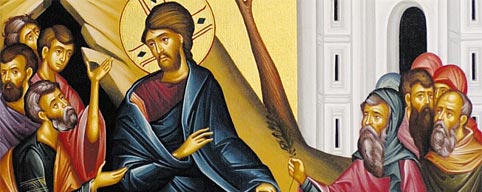
PalmSunday-01–Icon of the Entrance Into Jerusalem, Athanasios Clark

The husband of a seminary student* tells this story:

Last summer my three-year-old son and I stopped off at the seminary library to return a book for a friend. This was his first time inside the old stone building… As we stepped through the bright red doors into the darkened vestibule, he stopped in his tracks. There, on the wall to his right, hung a crucifix, about five feet tall.

I watched his young eyes study Jesus’ agonized face, the dying body hanging on a tree, the nails piercing his hands and feet. I knew the image was a new one to him. Although he’s been raised in the church, the crosses in our Baptist congregation are all clean and sanitized; their Jesuses all resurrected and ascended.

For a moment, I considered hustling him back out the door, trying to shield him from this holy horror in the same way that I “rewrite” the violent plots of his Batman comics when I read them aloud. But it was too late; he had already taken it all in.

I thought he might cry. Instead, without taking his eyes off the dying Jesus, he spoke words filled with sadness, mystery, and wonder: “Daddy, what happened?”

In this time or war, it’s the question for all of us.

What indeed?

_____________

*Doug Davidson, The Other Side, March 2002.

For Saint Joseph’s Day, March 19

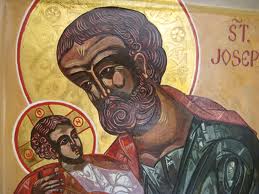
imagesToday is the liturgical commemoration of Saint Joseph, Mary’s husband and Jesus’ father or adoptive father, depending on your tradition. He was, the gospel genealogies report, loosely descended from David, but we think of him more as someone tossed and turned by angels in dreams, a man who could load up a donkey at a moment’s notice.

It’s a villager in Nazareth who tells us he was a carpenter, a woodworking artisan, a stonemason, or perhaps a contractor. But beyond that, we know nothing about him. He disappears from the gospels after he and Mary lose the adolescent Jesus and find him again in the Temple.

Tradition says that Joseph did not live to see his son’s career take off, nor its bitter end. He never knew him as a risen Lord. What carried him away? Did he die of infection or flu? Was he throttled by a client in a dispute over a bill? Did he fall from a scaffold or bleed out after an accident in the shop? If you believe the medieval tradition that he was already ancient of days when he married the Maiden, he might simply have died of old age.

No one knows his end. And no one knows his backstory either—what kind of a boy he was, whether he dutifully ate his peas or tucked them in his cheek to feed them later to the cat, whether he liked bold colors or preferred more muted tones. Had his sleep always been fitful, punctuated by dreams, or would his mother swear, if you could ask her, that he hit the pillow and was out like a light, sleeping like a log till noon?

How did he and Mary get together? Did Joseph meet her for the first time in her father’s living room? Picture it: his parents bring him all dressed up to Anna and Joachim to arrange the union, two good families making a deal for their kids. The older folks drink tea, talk it over, Mary and Joseph quiet, in the corners, eyeing each other, sizing up their chances.

Or this: they’d known each other since they were small. They ran with a pack of neighbor kids chasing balls into the street and building forts together, until the girls started being women, and the boys, men; and so it seemed natural, it was always just assumed, that they’d be wed. And so it came to pass.

Or not. Maybe he really was already old and widowed when they were betrothed, and he was a caretaker only, a protector God appointed as guardian of a divine child, a safe sexless man with a white beard and a lily blossoming from his staff, providing respectable cover for a perpetual virgin Mary.

Did he love her, then, like a father, venerable, affectionate and kind? Or did he love her like a lover, young and vigorous and eager and full of joy? Or like a man bound in duty to love her who keeps his word? Did they have chemistry? Or did they respect each other, grow on each other over the years, momentous secrets between them, stories no one would believe it they told them, so much fear, so much awe?

474px-'Joseph's_Dream',_painting_by_Gaetano_Gandolfi,_c._1790Some say that Joseph was by character and upbringing devout, and therefore unsurprised by angels, always expecting intervention, unquestioning in every ordeal. He sang psalms and praised the Lord in his candid heart as he trudged to Bethlehem, shivered in the stable, fled into Egypt, journeyed back and settled in Nazareth instead of going home. He was sweet and calm and uncomplaining through it all.

[–Gaetano Gandolfi, Joseph’s Dream]

Maybe his mother taught him about life and pain in such a way that it shaped his heart to absorb hard blows. Maybe his father was a man of dignity, and it got bequeathed to him in such a way that he could pull up short at the brink of anger and decide not to expose the pregnant Mary, but put her quietly away. Maybe it was upbringing, example, teaching. He was raised to be loyal.

But for all we know, he could have been a rough man, impervious to spiritual things, someone who tried, but to whom it didn’t come easily, and he felt resentful, deprived of a normal life by the commanding voices in his dreams. Maybe he wrestled like Jacob, resisted like Jonah, railed like Isaiah before giving in at last, like his son would give in later, drenched in sweat in the garden. Was he an unlikely saint, a man God pressed into service, and was it grace, and grace alone, that compelled him to rise to the occasion, the sort of grace that throws a switch in your soul when God decides you are the right man for the job?

He never speaks. Not once does he utter a word. No “And then Joseph said to the angel…” or “Joseph spoke to Mary, saying…” His silence is deep. Did he never say anything clever or wise or portentious enough for anyone to remark, remember, write it down? Did he say some things that were not edifying, embarrassing, not fit to hand on? Or was he as reserved as he appears, with no need to comment, no need to be heard, no compulsion to intrude on the drama and steal a scene?

Did they make him seem distant and aloof to his son, his long silences, his lack of chatter in the workspace, all those quiet meals? Or was it this the child warmed to and absorbed more than any other lesson or skill—the capacity to be and let things be? Was Joseph’s silence the wellspring of the Teacher’s need to steal away at night to hilltops to listen to God, to catch above the din below the cry of suffering and hope? Was this his father’s gift to him when, bloody and accused, he would not be provoked, but stood before Pilate and the cosmos, silent, without a self-defensive word?

In Italy they say that once upon a time when things were very bad, the good Saint Joseph heard their prayers and delivered them from famine, and that’s why they celebrate at Guiseppe’s Table every year, feasting with family and friends, strangers and guests, rich and poor. They eat a special dessert that day too, a round cream puff filled with ricotta and topped with red cherries and glazed orange slices. St Joseph’s sfinge would be enough to make me Italian, if I weren’t already.

In the United States, people have taken to burying little statues of Joseph in the yards of houses they want to buy, asking him to close the deal for them. He is, after all, the patron saint of real estate agents and house hunters, having found or built the house where Mary and Jesus lived and made a happy home for them under the roof of his care.

The 16th century St Teresa of Avila loved him above all other saints, and the first thing she did in her new convents, after making sure the bread that is Jesus was residing in the tabernacle, was to place an image of Joseph in a prominent niche and ask his blessing on the house and the ‘holy family” of nuns who would come to live and pray there.

Because labor movements in Europe had a very pinkish tinge, the Pope, feeling a need to commend work but eschew Marxism, turned to Joseph, who had toiled nobly with his hands, and appointed him to the task. The feast of Saint Joseph the Worker was proclaimed in 1955, and the day set aside to honor all godly labor was May 1, to counteract May Day, a socialist holiday. The Church hoped glad hymns to Joseph would drown out the Internationale.

In the Roman Catholic tradition, Joseph is officially the patron saint of cabinetmakers, carpenters, craftspeople, engineers, builders, the nations of Canada, Korea, China, Peru, Viet Nam, Mexico, dying people, families, fathers, house hunters, people in doubt, pioneers, travelers, the Universal Church, all working people, and pastors. All in all, I’d say that for a man who gets just a few lines in scripture, Joseph has done pretty well for himself over the centuries. Then let us, then, bSt Joseph de la toure glad in him, and pray on this the most ancient of his several feast days (since the 10th century):

Saint Joseph, father of Jesus, husband to Mary, holy insomniac, packer of bags, maker of useful things, and silent as the mystery you cared for, pray for us.

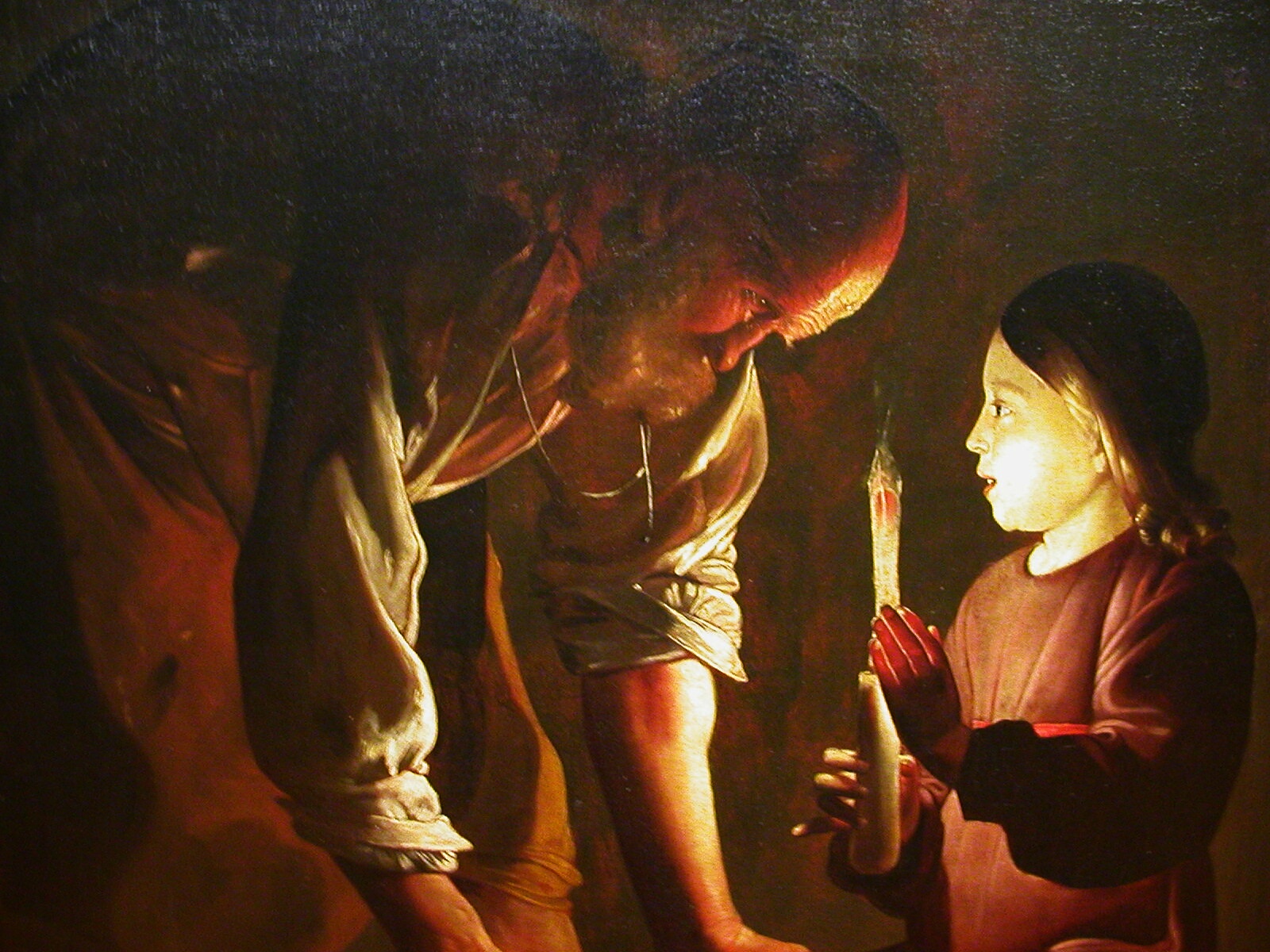
[–Georges de La Tour, Joseph the Carpenter]

Preaching Isaiah 50: 4-9a The Suffering Servant

6a00d8341d9f5853ef014e87249d11970d-800wi

–Image by Marcella Paliekara

This well-known Holy Week text presents a number of challenges for the conscientious preacher. One challenge lies in its pairing with the hymn of obedient kenosis in Philippians and with Mark’s passion story, making the identification of Isaiah’s Servant with Jesus irresistible. There is nothing new in this. The first Christians reached into Hebrew Scriptures for passages that spoke to them of Jesus’ life, illumined his significance, and confirmed him as God’s anointed one. The New Testament authors bequeathed these Christological interpretations to us. One of them is that in Jesus, the Servant has reappeared.

It is not wrong for subsequent Christians to read this text through such a lens. The challenge in a post-Holocaust, multi-faith world, however, is to do it in a way that sheds light on our Christian story without reading Jews out of theirs. We ought not employ this text as a direct prediction of the passion of Jesus, drawing neat correspondences between the Servant and Jesus (the Servant was obedient, Jesus was obedient; the Servant was silent, Jesus was silent, and so on); or imply that this passage is “really about Jesus” or “proves” that it was God’s plan from the beginning that Jesus should die in this way.

A more respectful treatment would be to comment on the text as the song of a real or imagined figure (or figures) in the Jewish story of Babylonian exile and internal division who, in faithfulness to his vocation to listen for and speak refreshing truth to those who are “weary” (v. 4), meets resistance that turns hostile and violent. By extension, it is also the song of any innocent person (including Jesus) who chooses not to resist his oppressors, and by the exercise of that freedom offers witnesses powerfully to the justice of his cause. The Servant suffers in a particular context, but he does not suffer alone. Throughout the ages, countless people are shamed by like violence. Many suffer “out there,” unknown to us; but many sit in our pews every Sunday, hoping for a word of encouragement and healing. Is there such a word for them in this text?

This leads to a second challenge. What are we to make of the Servant’s affirmation that he “set his face like flint” in the face of violent hostility, “gave his back” (v. 7) to those who struck him and “did not hide his face” (v. 6) from those who spat on him? The text says that the Servant allowed himself to be shamed in this way, refusing to flee or fight back; but the homilist must avoid suggesting that humiliation and suffering are good or desirable, or that God is pleased when someone is abused for righteousness’ sake.

Because the Servant suffers unjustly, it is tempting to glorify his pain as the price one pays for being on God’s side. To do so, however, runs the terrible risk of blessing the cruelty unleashed on the innocent. It also allows us to conclude further that violence meted out in retribution to people who are in fact guilty is justifiable because it is deserved. The preacher’s job is to keep in tension the admiration we feel for the courage displayed by people who submit to their oppressors nonviolently, and the ethical call to us, inherent in these instances, to reject the glorification of martyrdom and make a new world in which the oppression of the innocent is unheard of, no one has to face a decision to submit or resist, and even the guilty find mercy and redemption.

A third pitfall awaits in the defiant affirmations of the Servant in the final verses (vv. 6-9). The Servant calls out his attackers, daring them to prove him guilty, knowing they cannot. He is sure that God will settle the score—the shamed now will be triumphant later. The preacher will naturally want to help the congregation see themselves in the Servant, their lives confidently staked on the eventual triumph God will bestow. But she will also take care not to allow this identification to sour into a sense of Christian entitlement and victimization (We were always a Christian nation, but now “they” won’t let us pray in schools: we need to get this country back to Christ where it belongs!). She will help more if, while pastorally acknowledging the place of some of us among the oppressed, she also makes us face the identity of the oppressors. The hard truth we need to hear, especially as we enter Holy Week, is that “they” is often “us.”

Jesus once observed that opposition to prophets arises mainly within the “family circle.” This appears to be the case here. The likely context of this passage is a struggle between factions of long-exiled Jews, some of whom have adapted to and prefer Babylonian ways, and others who refuse to abandon or “acculturate” the received tradition. The Servant stands on one side of this internal struggle for the meaning of faithfulness, his own kin on the other. The preacher might help us contemplate the likelihood that people of faith are not (just) victims, we are also victimizers.

We wreaked havoc in the past on people of other faiths (Christians are not alone in this, of course, but from our pulpits we are speaking to Christians); and if the current wave of Christian Islamophobia is any indication, we are still bearing false witness against our religious neighbors and condoning shameful acts of exclusion and assault. We also routinely heap contempt on fellow Christians who believe differently from us. We believe that this internecine blood-letting is justified as long as it is for righteous ends. The preacher can remind us that religious violence is not special violence exempt from the commandment to love the neighbor and forgive the enemy. Violence in any form is violence. Naming it for what it is may be one of the most important homiletical tasks of this holiest of weeks, when the Lord of Life meets his violent death.

Francis Bernadone (1182-1226)

304772_135903169884378_1092818536_n

Francis Bernadone, 1182-1226

I like my saints wild. The fierce ones, oddballs, out of kilter, the ones with edges and cracks and terrible visions, the ridiculed and the feared. The ones who sooner or later have to be tamed; who, with the passage of time and shifting angles of vision, must be edited so that you can read about them safely in prim collections of hagiographies, no longer strange, but ‘best-loved,’ birdbath ornaments for your garden.

Like Francis Bernadone. Of Assisi.

You know him—the “make me a channel of your peace” saint. The saint who preached to birds and did behavioral therapy with wolves. The environmentally aware, all-natural, organic saint of harmonious convergence. All that and more. And so much more. For Francis was free. So free, he was dangerous.

He was a young dandy, rich and frivolous. And attractive. He spoke French and sang ballads and threw parties. He harassed street people and had his way with women and was more trouble than his first biographers wanted you to know. Everybody knew him. Most everybody liked him. It wasn’t clear that he liked himself. He was restless.

He wanted something. He felt that it was coming, but he didn’t know what or where or when. Something that mattered. So he went off to war in shiny armor on a handsome horse, hoping maybe it was glory. Loyalty and courage and glory might be the thing.

He returned wounded, traumatized, a haunted peacemaker, turned around by the special grace that flows from the fact of your own futility, that permanent sting in your misled heart and your useless flesh. After that, he could never flee his own flesh or anyone else’s. He was drawn to the useless.

He started paying attention in church. He heard the gospel: “Sell what you have and follow me.” So he gave away what he had. Then he started stealing from his father, giving away what he stole to make beggars warm. There were too many beggars to count.

When his father found out, he dragged him off to the bishop for a public reprimand. Always one for street theatre, he stripped off his clothes in front of his father, the bishop, and half the stunned and clucking town, stripped off his legacy (his father dealt in cloth), stripped off his father’s name. He walked out of the city a newborn, naked as a jay. He had been baptized as an infant. That was the day it took.

He lived in the woods, hiked the mountains, prayed in their caves, and wandered around the olive groves beneath the town. He begged for his food, leaving a blessing in exchange. If there was nothing, he went hungry. If there was something, he shared. Dressed in a penitent’s tunic and belt, barefoot in rain and heat and snow, he was Lady Poverty’s mad courtier, pledging himself to her for life, and to her family of ragged and hungry, too many to count. To everyone’s revulsion, including at first his own, he embraced lepers, kissing their sores. Soon they knew him well in the leprosarium down in the valley outside the walls. He tended wounds. Townspeople pelted him with stones.

One day he was praying in the ruins of an old chapel and saw that a crucifix was still hanging inside. He gazed at it until it spoke to him: ‘Francis, repair my Church.’ And so he did, stone by stone. It is said that what Jesus meant was for him to reform his ‘capital C’ church, but Francis was a literal man. He was not one to do grand things when a tangible needed thing was in front of his nose. Before he was done, he’d repaired several abandoned chapels in and around Assisi, working with his rich boy hands until no one recognized him any more. He became a stranger.

But some young men of the town were moved by him. A few old friends, a relative or two. They joined him, then others came, too, unknown to Francis. All classes and conditions. Before he knew it he was in charge of a growing fellowship. He had no idea it would happen. He was ill-suited to leadership. And he was indiscriminate. He welcomed them all. Sometimes that was a mistake, and he ended up having to kick some bad men out. His companions urged him to put admissions policies in place. He didn’t.

He wanted the pope’s blessing for his growing band, so he walked down to Rome. Medieval Rome. Holy city, unholy cesspool. After some bureaucratic delays, Francis in rags got the blessing he wanted. Legend has it that at the end of his audience with the pope (whose name was Innocent, but who wasn’t very), the great man in ermine and gold came down from his throne, kissed Francis’ feet, and received his blessing.

He loved Sister Clare, who ran away from her noble house in the high part of town to learn to be like Francis. He loved Brother Leo and Brother Juniper and all the men who flocked to him, many of them exchanging, like Clare, finery and privilege for rags and humiliation. Francis wanted them all to be equals and so, among other things, he was wary of books and learning because of the pride and distinctions he believed they engendered. And he didn’t want the brothers to be priests. He loved priests because he loved the Eucharist—it was Jesus himself—and priests were the way you got it. But he wanted the brothers to remain small, menores. That’s what he called them—not the Franciscan Order, but Friars Minor.

His fiercest desire was for peace. More than anything pax et bonum, his habitual greeting. Which is why he is the patron saint of stowaways, having hidden on a boat headed east where he hoped to convert the Sultan to Christ and end the bloody fifth crusade. He was appalled by the Christian armies, their violence and immorality, every bit as much as he was afraid the Saracens would go to hell if they didn’t believe the gospel. He was struck by their piety, praying five times a day. They were also clean. The Christian commanders tried to stop him, but he snuck away under cover of night and crossed enemy lines. He got the audience he wanted, staying several days. Francis explained the good news to the surprised and curious Sultan. He did not succeed in baptizing him, but it is said that the Sultan thought Francis was a lovely man, the best Christian he’d ever met, and made sure he got back safely.

He tried for reconciliation everywhere, adjudicating local disputes, making treaties. Even, it is said, taming a ravenous wolf who was killing livestock and terrorizing people in Gubbio. The deal Francis struck with people and beast stipulated that the wolf would behave if the people fed him. Afterwards, whenever the wolf came trotting into town, newly meek and peaceable, he found food at the doors and left satisfied. The people said, as the wolf loped away, that he reminded them of Francis.

Francis was not naïve. He knew what he was up against. The onslaught of demons, the persistence of violence, the imperviousness of the haughty, the sluggishness of the Church, the sly corruption of error, and the betrayals of his own heart and body. But Francis loved Jesus, and with unhinged joy he sought to be like him down to the last detail of freedom and agony.

And so on days blistering and freezing, he and his brothers prayed and preached on street corners, demanding repentance, announcing mercy. Through nights dark and shimmering, he prayed alone, too; persistently, on a mountain, a half-demented mystic crying loud for Christ. The visions that came to him there were garish and beautiful and full of pain. It is said that on one such night, seraphim he saw in the sky cut the Lord’s own wounds on his scrawny body, his hands, his feet, his side.

And then the poor scarecrow lived just a little too long. Long enough to see his then thousands of brothers dispute his meaning, split into factions, grow to despise each other. Long enough to see new leaders reinterpret him. Saints’ deaths are sometimes bitter like this. Blind and gaunt, on his final night he asked the brothers to lay him on the ground, dust to dust. With his last rasping sigh in the morning he told them, “I have done my part. May Christ teach you to do yours.” He also said, “We have only begun to live the gospel.”

It wasn’t long afterwards that the new leaders began building a gigantic basilica to house his remains. Wildly beloved by the people in the final years of his life, the dead Francis was soon to be a wildly beloved and profitable saint. The way of the world. Our way.

Francis lives now with Jesus in the heaven of his longing. It is said that in the morning mist of Paradise, angels cannot tell the two apart. There are talking birds there, and reformed wolves, and singing water, and Leo and Clare. The Pope too, crooning duets with the Sultan. And there are lepers, thousands of lepers, rosebuds blossoming on their skin where Francis kissed them.

Prayer                                                                                                                                                           Most merciful God, on this day when we remember your servant, Francis, grant your people grace to renounce gladly the vanities of this world, so that by following his example, we may become fierce for justice and delight in every creature with perfect joy.


Liturgy for Maundy Thursday

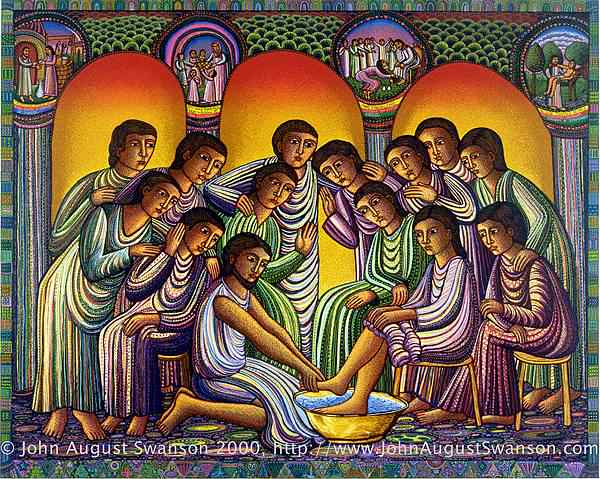
Washing_600

PRELUDE

*HYMN Come gather in this peaceful place  (aka Come gather in this special place)

GREETING AND INVITATION

Dear Friends in Christ,

peace be with you on this holy night.

Why do we gather? What is this night?

It is a night of love

for on this night Jesus gave his disciples a new commandment:

to love each other as he loved them.

It is a night of communion

for on this night Jesus gave not only a commandment,

but also a sign: bread and wine broken and poured,

to remember him.

It is a night of loving service

for on this night Jesus gave us not only a commandment,

not only a sign,

but also an example: on his knees with basin and towel,

washing feet.

It is also a night of betrayal

for on this night a man Jesus loved

sold him for money,

and brought soldiers to seize and bind him

as he prayed.

This night is joyous, fierce, tender, terrible.

We begin in light, with memories and stories, friends and feasting.

We end in shadows, with a queasy fright.

We begin as the friends of Jesus did long ago: together, as one.

We end as they did: scattered in the dark.

We begin as they did: singing of love and deliverance.

We end as they did: without a single sound.

Friends, be at peace on this holy night.

Enter it with open hearts.

Now let us pray.

PRAYER

[This Collect may be offered by the leader or prayed in unison.]

God of deliverance and love,

look with pleasure on your people who gather here.

Send your Spirit to embrace us,

so that with hearts for a time made free of care,

we may receive in abundance the blessings of this night.

With Jesus we pray that whatever may come in life or in death,

your will, not ours, may be done.

Glory to you, yesterday, today, and forever.

Amen.

A READING FROM THE HEBREW SCRIPTURES Exodus 12:14-17; 24-27a

Remembering God’s deliverance: Observing the feast of Passover.

 SILENCE (allow 40-60 seconds)

*RESPONSE

[The people stand for prayer.]

Let us pray.

Holy Deliverer, Breaker of Chains,

long ago you acted with power to save your people,

enslaved in the land of  Egypt,

and in every generation

the people of your heart remember.

At table they tell the story and they sing your praise.

On this holy night, with Jesus, our brother,

we too remember: We tell the old, old story

and we praise your faithful love.

As we eat the food and drink of liberation,

free us forever from the violence

that is our way of life,

and set us on a pilgrimage of peace.

In Jesus’ name we pray. Amen.

 A  READING FROM THE EPISTLES I Corinthians 11: 23-26

What we have heard, we hand on to you: When they were eating, he took bread…

*RESPONSE  HYMN  Draw us in the Spirit’s tether

A READING FOM THE HOLY GOSPEL John 13: 1-17, 31b-35

The mark of the new community is love and service.

 SILENCE (Allow a full 40-60 seconds, or longer.)

RESPONSE ANTHEM Jesu, Jesu

[The choir sings this hymn in unison, unaccompanied, slowly and meditatively. A footwashing ritual takes place during the song. [See note on footwashing at end.] When footwashing is over, the confession follows. If footwashing is not done in the service, the following Collect might be used as a response in place of the anthem, with the people standing.:]

*COLLECT

Gracious God, on this holy night,

impress upon our hearts the example of Jesus,

whose love embraced all people

and whose service extended even to the washing of feet.

May we know him from this day forward

not only in the broken bread and brimming cup,

but also in the bent knee, in the water poured,

in the touch of selfless hands —

in service given and received,

and shared with all the world.

In remembrance of him we pray. Amen.

INVITATION TO CONFESSION

Jesus said: If anyone has something against you,

before you come to the table with gifts, make peace.

Then bring your gifts, then bring your lives.

Dear friends, let us make peace in our hearts.

Then, let us lay down the burdens

that keep us from loving each other and our God.

SILENCE (Allow at least one minute or longer for people to reflect.)

SONG OF CONFESSION  These I lay down [Chalice Hymnal]

You may remain seated for the song.

ASSURANCE OF PARDON

Beloved, by the mercy of God

we have put down our burdens

at the feet of the one who in suffering love

laid down his life for us.

Rejoice and be glad:

Pardon, healing and peace are ours

through Jesus Christ, good brother and friend.

[Continue immediately with the invitation to share a sign of peace, below…]

*PEACE

On this night he gave us a charge:

Love one another as I have loved you.

Faithful to his commandment,

we forgive each other’s faults, as we confess our own,

and we offer each other a sign of his peace.

[The people share a sign of peace, after which they sit for the anthem.]

 ANTHEM   Now the silence [Jaroslav Vajda]

[Note to choir: Where the text has “the Father’s…” substitute “our dear God’s…”]

 GATHERING AT THE TABLE

[When the anthem concludes, there is a brief silence, followed by this invitation to gather. After the invitation, the people come forward to stand in a circle around the table in the chancel. They remain standing for the entire communion liturgy, until the Service of Light and Shadows begins. Provisions should be made for those who have mobility challenges, or who prefer to remain in their seats.]

Come now and take your places at this table,

citizens of the kingdom,  heirs to the riches of God’s love,

friends of Jesus, who is our peace.

[Once all are assembled, the leader begins the Eucharistic prayer.]

 INVITATION

Beloved, let us celebrate with Jesus at the table of peace.

For he loved his own, even to the end.

Let us eat the Feast with him.

For now nothing can separate us from his love.

And let us love one another well,

For he laid down his life for us all.

PREFACE

Praise to you, God of glory!

Your love created the universe and sustains it.

You breathed life into our dust and placed us in paradise.

You found us when we hid ourselves, ashamed of our sin.

Your love shaped a people,  and you are their God to this day,

in an alliance that lasts forever.

In the fullness of time, you called us also to be your own,

through the tender ministry of Jesus.

You spoke to us with his human voice

and healed us with his human hands.

He gave us his life in bread and wine,

and suffered for his faithfulness on the cross of shame.

But you loved him faithfully, raising him from the dead.

You sent his Spirit into our hearts

and adopted us, making us heirs of his glory;

forever we belong in your household of joy.

Holy and wonderful God, all your creatures testify to your love.

With them, we too declare it, as with the angels of heaven we sing:

SANCTUS Holy, holy, holy…

REMEMBERING AND GIVING THANKS

Now, O God, we remember Jesus.

SILENCE (15-20 seconds)

We remember that he longed to celebrate the Passover with his friends.

He arranged for a meal, his last in this life.

We remember that he gave them a new commandment:

“Love one another as I have loved you.”

We remember that he gave them an example:

He knelt before them and washed their feet.

We remember that his betrayer was with him.

Jesus loved and served him too.

WORDS OF INSTITUTION

And we remember that on that night,

with danger and death in the air,

Jesus remembered with joy

the deliverance of his ancestors

from the oppression of Pharaoh.

He told the victory story, ate bitter herbs,

shared the unleavened loaf,

and drank the cup of blessing.

In love for us, he took the bread,

gave thanks to you, and broke it.

[Note: The bread is not to be broken here, but at the fraction, below.]

He gave it to them, saying:

“Take and eat this, all of you:

this is my body, broken for you.

Do this and remember me”

And when the supper was over,

he took a cup filled with wine,

blessed it in your name,

and passed it to them, saying:

“This is the cup of a new covenant in my blood.

Do this and remember me.”

PRAYER TO THE HOLY SPIRIT

Holy Spirit, come make all things new.

Bless this bread and cup, and us who share them.

May they be for us life-giving food and drink.

Give us love for each other,

and make us your servants in the world

until your new age of justice comes,

and every creature  beholds it.

We pray in the name of Jesus,

who welcomes us all and taught us to say:

THE LORD’S PRAYER

THE FRACTION

[An appropriate chant or song is sung by all as the one loaf (or loaves) is broken into many pieces and placed on plates and baskets for distribution. The deacons assist in the fraction. Song suggestions: One Bread, One Body…. Ubi Caritas…]

 INVITATION

Friends, if you are hungry for a taste of what is to come,

when all creatures great and small will feast together

without fear in the household of God;

if you yearn to feast on a love

without condition and without end;

if you are thirsting for forgiveness,

given and received in humility and in joy,

then open your hearts to this meal,

a sign of grace, a gift of peace, the bread of life, the cup of joy:

[lifting bread and cup, if desired]

The gifts of God for all God’s people!

SHARING BREAD AND CUP

[Communion bread is distributed to all, followed by cups for intinction. After all have received, the people give thanks together.]

*THANKSGIVING

Let us rise and give thanks.

Thank you Holy God,  

for life in the Spirit of Jesus,

for gladness in this bread and cup,

for love that cannot die,

for peace the world cannot give,

for joy in the company of friends,

for the splendors of creation,

and for the mission of justice you have made our own.

Give us the fruits of this holy communion:

oneness of heart, love for neighbors, forgiveness of enemies,

the will to serve you every day, and life that never ends.

In Christ’s name we pray. Amen.

 [Dismissing the people to return to their pews, the leader says:]

“And after they had sung the hymn,

they went out to the Mount of Olives.”

[The people return to their seats. The communion table and chancel are cleared of all signs of celebration. Appropriate instrumental music may accompany the people’s return to their seats and the clearing of the chancel.]

SERVICE OF LIGHT AND SHADOWS

[Here follows a brief and very simple service of short readings about the garden prayer, arrest, and “trial” of Jesus, interspersed with responsive chants, verses of a hymn, short choral pieces, or brief prayers or collects. After each reading and response, lights are dimmed or candles are extinguished until the sanctuary is in darkness. There is a time of silence, then lights are brought up just enough so that people may depart in safety. The people should leave in silence.]

 ******

Footwashing

Footwashing may be done in a symbolic way, e. g., one member of the congregation or the pastor washes another person’s feet in a stylized, mime-like ritual, center chancel. If this option is used, opportunity for others to wash and be washed might be provided before or after the liturgy, perhaps during an pre-service agape meal or love feast, or after the service in a chapel or fellowship hall set aside for this purpose. Footwashing of more than one person or a small group of representative disciples may also be done in the service itself: there may be a general invitation to wash one another’s feet at stations set up around the sanctuary, or the deacons of the church may be sent to stations to wash the feet of those who wish to participate. The congregation needs to be prepared for a slightly longer overall service. If footwashing of all who wish to take part is the choice, quiet music or appropriate hymn-singing should accompany the ritual.

Just Around the Corner

CrocusInSnowIt was Marathon Day in Boston ten years ago. A sharp wind was blowing off the harbor. The sun was pale, and the buds of the storm-bent dogwood in the yard were unconvincing. The calendar said Spring, but you needed a winter jacket. It was no weather for T-shirts and shorts, unless you planned to run 26 miles in them.

Two young men carrying a six-pack apiece came down the street and ambled by my front window. They were wearing  T-shirts and shorts, but they didn’t look much like marathoners.

It made me shiver just to look at them. All the same,  I was glad they’d apparently decided that the calendar was right, that this was in fact a Spring day, maybe even a beach day, all evidence to the contrary notwithstanding.

They were onto something, I thought, going by the season, not the conditions, dressing according to things unfelt and unseen. It was a profession of faith.

Jesus’ first disciples claimed, after his death, to have seen the Lord. We who have come after them have believed without seeing. We have acted as if it were Spring, no matter the season. Generation after generation, we have worn light Alleluias in all kinds of weather. We have dressed according to the Word, not the conditions.

Ever since faith graced us, it has been the church’s mission to go about in T-shirts and shorts in a world hunkered down for a frost that shows no sign of thawing; to put our faces into cold winds off the water as if they were zephyrs; to love the unconvincing buds as if each struggling sprout were a paradise.

The world longs for an early, a later, and an everlasting Spring. God wants to give it such a season through the witness of our faith-filled lives. In a few short weeks it will be Easter. May the Spirit find us dressed for the occasion.