Author Archives: sicutlocutusest

Feast of the Transfiguration: It Is Good for Us to Be Here [Luke 9:28-36]

420px-Icon_of_transfiguration_(Spaso-Preobrazhensky_Monastery,_Yaroslavl)

–Icons of the Transfiguration from the Spaso-Preobrazhensky Monastery

A sermon for pastors and preachers

We’ve heard and preached on this story many times, we know how it goes. Jesus hauls Peter, James, and John up a mountain to pray. As we watch the trio ascend, we think about an earlier climb when Moses went up Mount Sinai to talk to God. There was glory shining all around in that story, too – lightning, thunder, and clouds. When Moses came down, his face was aflame with God’s brilliance, and he was lugging those big stone tablets that eventually ended up in Judge Roy Moore’s courthouse down in Alabama. In this episode, Jesus lights up with that same brilliance. Just like back then, God speaks from the cloud. God issue a commandment in this story too—“Listen to him.”

It’s an amazing scene. The disciples are overcome with what the Bible calls “the fear of the Lord.” Then Peter blurts out his desire to set up three tents there to capture the experience. He wants to stay. But the glory dissipates as fast as it gathered, and Jesus doesn’t linger. He gets the disciples off their face and onto their feet, and they all trudge back down the mountain, back to “real life.”

And we feel sorry for poor, impulsive, clueless Peter. His desire to stay up there, indulging in radiant stupefaction, is an escapist, self-seeking temptation. Jesus knows better. Mountaintop epiphanies, it seems, are not meant to last. They are at best rest stops, gas for empty tanks, carrots to keep us going through challenging lives. When the disciples have to suffer, as they one day surely will, maybe the memory of this glorious moment will warm them and make their agony less awful. But you misunderstand Jesus if you think the point of following him is to bask in his light.

The disciples have a hard enough time grasping the odd, counter-intuitive sort of Lord and King Jesus is; if they stay up there they might never learn that he came to serve.  Down on the ground, suffering is everywhere. Jesus could not escape his own, but he tried hard to alleviate everybody else’s. And that’s what disciples must also learn to do. We should consider ourselves blessed if we get an occasional peek at glory, but we can’t rest in it any more than the disciples could. We have to go down the mountain and shoulder our ministry. Glory is fine, but only after you pay your dues. Peas first, then cake.

Now, that is a good way to interpret this text, and it can be a necessary corrective to “bliss ninnies” who think the best way to be religious is to gaze at your navel. The great 16th century mystical saint Teresa of Avila was always on the lookout for this kind of evasion in her convents. Whenever a goose-bumpy novice, languid with love and hoping to levitate, tried making permanent camp in the chapel, a no-nonsense Teresa laid down the law—nix the theatrics, eat something solid, and go help out in the laundry. Visions and voices are all well and good, but only if they don’t render you indifferent to the needs of your neighbor.

The only problem with this way of reading the story is that in our zeal to warn people away from evasion, we tend to moralize the Christian life almost to death. We make it a series of shoulds and oughts, and suggest in more than sideways fashion that worship or prayer or simple divine enjoyment is all well and good, but none of that has any value in and of itself unless we are also getting our prayerfully clasped hands dirty in the trenches of active mission.

Our repeated messages about coming down the mountain–getting back to work, doing our duty, loving God not directly but by loving our neighbors, measuring the size and strength of that love by our holy productivity–seem to assume that if we didn’t constantly exhort our people to do things, they would slide into a fog of contemplative rapture, never to be seen or heard from again. The truth is that things are exactly the opposite in most justice-aware, liberal-leaning, activist congregations. It’s a lot easier to get people on the picket line than down on their knees. Most people don’t even know what we’re talking about when we moralize about the dangers of being awestruck with divine beauty.

What a shame if we fall into the trap of telling people they must live the one sacred life they have been given according to a faith that regards ecstasy as some sort of temptation. What a shame if we fall into the trap of asking people to live by a gospel that turns out to be, in the end, just another taskmaster, just another voice among the many voices that remind us all constantly that we have not done right enough or well enough or just plain enough enough to measure up to expectation and merit approval and reward. What a shame if we take texts like this one and turn them into so much finger-wagging.
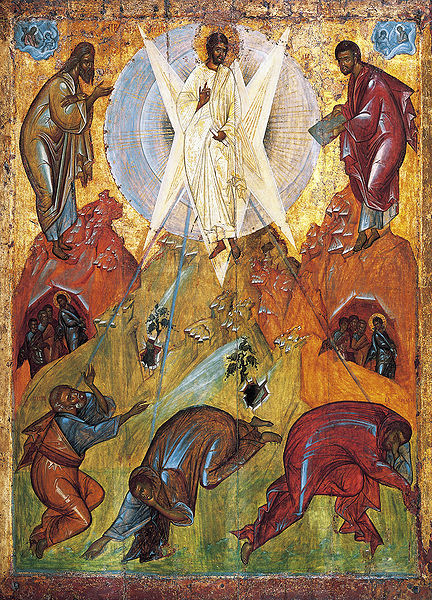
432px-Preobrazhenie

Yes, it is plain from the text that Jesus didn’t want his friends to put up those three tents. Yes, Peter was befuddled by the strange experience and “did not know what he said” when he blurted out, “It is good for us to be here.” Yes, Jesus took them right back down and yes, they plunged into the hard work of healing and teaching. There’s no question that engagement with the world is an essential component of discipleship, and that the suffering it brings requires of disciples courage, determination, and perseverance – none of them glamorous things.  But we should also want to know why Jesus would show his friends the unutterable glory of God radiating through him and not mean for them to enjoy it. And why should we label Peter obtuse and ridiculous because he wants to make such beauty and such glory –  the very pleasure of God – last and last and last?

What the disciples received that day on the mountain was not a gallon of emergency gas or a quick breather for the work crew. It was a gift of mercy, pleasure and love. They were given a glimpse of the richest and most fundamental truth about our lives, and they were meant to react to it precisely in the way they did, with awe. Just because it wasn’t time for them to enjoy it permanently doesn’t mean that they were wrong to want it permanently, or that by wanting it so much they somehow missed the meaning of the event.

Peter saw that the glory of God’s mercy and deep pleasure rested uniquely upon Jesus. This story is an epiphany, after all—a story meant to reveal something of the character of God. Its main point is clarifying the identity of Jesus, and it does so in part through the awe-struck wonder this revelation causes in the disciples. But Peter must also haves sensed that this transfiguring light was in some measure also about him. About us all. And for us all. The merciful pleasure God takes in Jesus, the joy of God’s goodness that glows like a million suns, is Peter’s origin and destiny too. It is the origin and destiny of the whole creation. We were all made in ecstasy and intended for ecstasy. Glory, and its lovely twin, Joy, is the permanent subtext of our lives.

Why does preaching so often seem to say that the only permanent thing we were made for is duty, when the truth is that we were made for delight? Why do we imply that people were made only for purpose and production, when the truth is that we were made for pleasure? Why do we help people think that the church was called and gathered only for relentless hard labor in the vineyard of Christ, when the truth is that we were called and gathered for praise, thanksgiving, and freedom – for visions, for dreams, and for the ‘royal waste of time’ we call ‘worship’?

In moments when God’s glory breaks through our flat world of fact and rationality; in times when God’s mercy transports us to the real real world, the one Jesus called the kingdom, full of justice and reconciliation, forbearance and peace; in moments, as another preacher put it, when the dazzle of God’s love squeezes through the fissures in our denial and defenses and explodes into our lives – in those moments we are drawn inexorably to God like people who have been living sun-starved for years in caves, and we too want to pitch tents on the mountain. We too want to stay and stay and stay.

We know those moments. The flood of confusion the first time someone loves you – yes, you. The time you were forgiven when you should never have been forgiven. The day you got through the whole of it without a drink. The night your first child was born. The moment you really heard the poet’s question, “What will I do with my one precious life?” The time you turned on the news and found out that that the wall was down and the tyrants were dead and people were crossing borders, singing. Or the morning early when you went for a hike, and the cloud that had threatened rain lifted suddenly, and from the top of the mountain you saw clear to Canada, and it took your breath away; and in the strange slanting light you felt somehow held, beloved, alive, and it was like The First Morning, and you believed it was possible to be new. Even in the midst of the hardest grief, it comes to us, this glory, in some stillness, in a face, a touch, a place, a smell. We know those moments. And we have all wanted to pitch a tent on those heights and stay and stay and stay.

It turns out that we cannot stay – the traditional interpretation of our story is correct about that. But the reason we cannot stay is not because it isn’t good for us to be on the summit and desire such glory. It is in fact the supreme good. To want that glory is to desire God. It is also true that while we await the final, full breakthrough of divine pleasure upon the world, we have much work to do. But this work is not the busyness and effort, the demand and expectation, the dread and drudgery, or the purpose and plan that we have been taught is pleasing to God. The work of people of faith is more wonder than competence, more surrender than skill, more beauty and imagination than plans and programs, more gratitude and praise than effort and exhaustion, more tryst than task.

The call to discipleship is not to save the world: that’s God’s job. It is rather to witness in word, deed, and in awed silence to the fact that God is in fact saving and re-creating everything, even now. Our calling is to become increasingly alert to the places where transformation has already secretly begun, and to point them out and tell the truth about what we see (often at the risk of our lives) to those who cannot see them or do not believe what they see, and who therefore languish in cynicism, sorrow and despair.  The mission of the church is to testify by overt gesture and by secret resistance, in private and in public (“in all places, everywhere and without ceasing”) that grace is even now sparking in the stubble, glory is already lighting up the mountain, and all people, strangers, kin and enemies, are even now being plucked from death, included in the sweep of mercy, and brought home to sit at the table of peace.

Our calling is therefore also to develop a capacity to see beyond common sense and ordinary sight. To see the world’s suffering unflinchingly, exactly as it is, and to see God already working right there a someday resurrection. To spot the tracers of love in the bloodstained firmament and to announce them like watchers on the wall at daybreak, and by our fearless announcement bring hope to everyone who swears all hope is lost. And this means we must learn to pray and to pray contemplatively, to re-calibrate the eyes of the heart by gazing on God. It means we must open ourselves to fire.

628px-Transfiguration_of_Christ_Icon_Sinai_12th_century

The calling of the church, our calling, is the hardest work there is – stubbornly to trust the un-evident more than the evidence at hand. To resist the caution of the earnest, the sensible, and the balanced. To be glad that God is full of the kind of generosity that mocks our guilt-ridden, self-important social action strategies, unhinges our anxious time management techniques, and beats the heck out of our prudent long-range goals. The mission of the church is to be delighted by this odd God who pays latecomers the same wage as those who grunt all day in the sun. The gospel of Jesus Christ is all about the strange pleasure of largesse, and it is our calling not to be ashamed of this gospel.

God’s will is to love the sinner, love the sinned against, empty the haughty, fill the poor, mend the brokenhearted, abide the unacceptable, bless the weak and inadequate church. And in the face of all this divine nonsense, our calling is to lose our senses too, to be like this God. It is a very hard calling, make no mistake, because it feels so much like doing nothing, and we have a terrible time shaking the notion that if we aren’t doing something, than neither is God. And yet our ministry is in the end to be the fools who understand that the very best thing we can do for the world is simply to strike a fascinated pose before the alien beauty of grace.

In the late 4th century in the Syrian desert, a young monk named Lot went out from his cave to consult and older, wiser monk whose name was Joseph. Lot said to Joseph, “Abba, the best I can, I say my prayers, I fast, I meditate, and I serve my neighbor. What else is there to do?” The old man stood up and stretched his hands toward heaven. His fingers became like ten lamps of fire, and he said, “To do? Nothing more. But you could become all flame.”

All flame…

It would be good, it would be very good, for us to be there.

Seventy Times Seven (Matthew 18:22)

forgive_sunday_icon1

A professor of world religions tells a story about one of her students, a young Muslim from Morocco, who worked part time as a waiter in a Boston hotel. Abdul, who went by ‘Mike’ to keep things simple, was an avid and attentive student, always bringing in news clippings and other tidbits related to the religions the class was studying. One day he came to class and reported on a nasty fight that had erupted among some of his coworkers at the hotel. Among other things, insults were uttered in which the integrity of mothers and sisters had been impugned. Afraid the tension would turn physical, Mike intervened. He sat his fuming coworkers down and informed them that they had a duty to forgive one another because they were Christians, and forgiveness was what Christianity was all about. “I know,” he said, “because I am taking a course.”

I don’t know whether Mike’s instruction had any impact on his Christian friends, but he was right about one thing: forgiveness is what Christianity is all about. It’s about lots of other things too, of course. I expect that if pressed most people would name love as its distinctive practice, or perhaps justice; but love is not love in the full Christian sense, nor is justice, until it has confronted the hard and terrible imperative of forgiveness and met the challenge.

Although the other two Abrahamic traditions also enjoin forgiveness on their adherents, I think it’s fair to say that neither has posed the requirement to forgive in quite the same way as Christianity. The Christian practice extends from everyday making nice among intimates to the forbearance of enemies, the pardon of persecutors, and reconciliation among nations. It hopes for, expects, and demands repentance and reparation, but does not always condition itself on either, and is to be offered even in their absence. Thus it stands at the center of Christian faith as its glory and its stumbling block, a gracious miracle and an awful scandal. If Paul is right that when all is ended, love will be the last and greatest virtue standing, it will likely have the look of an astonished enemy forgiven.

The commandment to forgive is baffling and even upsetting to many people who are not Christians. Some of my Jewish and Muslim friends are not fond of the parable of the prodigal son, for example. The pardon of the reckless son and the apparent neglect of his dutiful brother seem arbitrary and unjust. They find it hard to grasp why Christians think such a patently unfair story is so heartening. The truth is that many Christians find this story hard to fathom as well. At the same time that we secretly hope God will receive and pardon us just as the father embraces the prodigal, our hackles are raised by how easy it all seems. The kid has gotten away with murder—no questions asked, no groveling required, no penance imposed. And the elder boy gets our immediate sympathy: he deserves better.

There is no doubt that the Christian understanding of forgiveness is a touchy and complicated matter. On the interpersonal level, it is complicated especially by the assumptions of the age in which we live, a time when the human psyche is center-stage and the knowledge derived from its exploration informs much of the church’s pastoral practice. This is, of course, a good thing. I could list a thousand ways in which it is so, but suffice it to say that anything that affords insight into, instills compassion for, and contributes to the healing of a human being, mind and body, is unmistakably of God. I do not want to be misunderstood, then, when I say that in the case of the Christian practice of forgiveness, our therapeutic reflex may be helping disciples miss the peculiarly Christian mystery, and the point.

It has become commonplace in the therapist’s office and from the pulpits of Christian churches to note that forgiveness has the power to heal the one who forgives. We often hear it said that to withhold forgiveness is to harm ourselves, that forgiveness relieves us of the burden of anger and hate, and that it is therefore as much, if not more, a gift for us as it is for the person forgiven. A well-circulated Facebook meme sums it up: “Forgive others not because they deserve forgiveness, but because you deserve peace.” Forgiveness from this standpoint is about the well-being of the forgiver, not the one forgiven.

This sounds right to our psychologically-attuned ears. And in an important way it is. Psychological studies and personal experience teach that forgiveness can and does make us feel better, and that the long, fraught process of forgiving someone yields immense benefits for the one who engages it with purpose. Holding onto hate and hurt, allowing blame and anger to fester, corrodes the psyche and has an adverse impact on both body and soul. Again, this is indisputable, and anything we can do to lessen this pain and relieve this burden is too little. However, to posit personal peace as the reason we need to learn to forgive, or even as the implied goal of forgiveness, is to miss the transforming power of the particularly Christian practice of pardon.

We do not forgive because we deserve peace; we forgive because Jesus told us to forgive. We do not forgive because forgiving will heal us; we forgive because it is what Christians do. Our practice of forgiveness is before all else a practice of obedience. In other words, it is a mark of discipleship, a characteristic of the sequela Christi. If they know we are Christians by our love, they will know it unmistakably by the patient, responsive, and obedient practice of the kind of love that ideally pardons even the unpardonable, that seeks the good of the enemy, the healing and well-being of the all who sin against us. And because pardoning, especially pardoning enemies and persecutors, does not come naturally to us, we need to learn it by being obedient to a commandment that compels us to do what we would never do left to our own devices.

When people forgive their offenders soon after the offense, as in the memorable case of the Amish parents of murdered schoolchildren, we often recoil. It feels too soon. But such folk are not forgiving once and for all. They are instead starting someplace. They are obediently saying the words of forgiveness, knowing that by saying them they are beginning a practice that, they trust, will eventually help them feel and live what they say. We forgive our way into forgiving–this is the nature of practice, and it is the nature of obedience.

Return-of-the-Prodigal-Son

–Rubens, Return of the Prodigal

Now, if forgiving were a commandment  that enjoins us only to obey, we might rightly chafe under it; but it is more than a commandment—it is a person, “it is the Lord”—the same Lord who taught (ah, the parables of Luke!) that God’s joy increases when the lost are found and sinners are restored; the same Lord who embodied his teaching in his person and practice, a practice of mercy that included us. And because we love him gratefully for the mercy we have known, it is to this Lord and no other that we respond in obedience when we set out on the path of pardon to benefit our enemies, as he did his, and to seek their good.

We forgive because Jesus, whom we love, commanded it. We forgive as he did also because we know from our own experience of being forgiven that it is good to be forgiven. We want offenders and enemies and persecutors to know what we have known. To love someone who does not love us or who has caused us harm and grief is something we do for that other, not for ourselves. It’s her peace we are after, not our own.

I am not saying that this is easy, pleasant, straightforward, or quick. I am saying that it is the kenotic pattern we have been given, the pattern faith tells us will save. We love and are children of a God who does not shrink from humiliation. We follow a self-emptying Christ. Our practice is meant to conform to this divine impulse: it was to heal and restore that God’s life was poured out in other-directed and sacrificial compassion. It is hard to imagine that Jesus ever considered what was in it for him to pardon the tormentors who nailed him to the cross.

This is not to say that his practice on the cross did not affect him in any way. For all we know, it made him even more human, even more complete, even more lovely and whole than he was before he extended that amazing grace. The point is not that forgiveness doesn’t benefit us who forgive; it’s not even that we should not hope it will benefit us, or be grateful when it does, or help others see that pardoning is a process that does good to the one who pardons. The point is that a disciple of Jesus is content to forgive because Jesus did, because we were the objects of that largess, and because he told us to go and do likewise. That is enough. That there are side effects and consequences for us—things that are rich and good and human and welcome—is grace upon grace.

The idea that we forgive as much or more for ourselves than for the one forgiven is not a Christian idea. It has merit and therapeutic value, and that value cannot be discounted in the large discussion of forgiveness as a human process, difficult and prolonged, rewarding and needed. I am not aiming to drive an artificial wedge between Christian faith and human experience. I mean only to affirm that for disciples, because we are in the image of the self-emptying Christ, the goal of pardoning cannot be expressly or primarily self-seeking, even as it is true that our practice of pardoning delivers blessings of wholeness and peace to us that are in themselves desirable and good.

In the end, of course, the Christian wisdom is that the offender deserves forgiveness every bit as much as the offended against deserves healing, unburdening, and peace—which is to say, not at all. No one deserves anything in Christ’s economy of grace. We simply and unaccountably receive; we get to share in every good that Christ has to offer because God is like that—generous, compassionate, merciful, and good. We forgive and we accept forgiveness (a practice every bit as difficult and demanding and, without grace, impossible as forgiving is) because as partakers of the kingdom’s largess we move in a gracious universe–in theologian Mark Heim’s felicitous words, “the vast accomplished grace around us.”

In this resurrection cosmos, deserving drops away as a frame of reference. What takes its place is the kind of solidarity that makes it increasingly difficult to distinguish hurt from hurt. Our enemy, we discover to our own pain, is also a sufferer: someone has harmed, hated, and feared him too. And we who forgive also need forgiving for our countless offenses against the other.

There is no innocence in the kingdom, only mercy; and a revolutionary vision, available to anyone who desires it, by which—after a lifetime of hard and painful practice, our hearts fixed on Christ’s compassion–we may come to see at last the profound common suffering of our common human condition, the breathtaking truth that the sinner and the sinned against share one flesh, one damaged human heart.

Ain’t Love Grand?

il_fullxfull.125740636


I Corinthians 13

Ah, Paul on love. Not love with candy hearts and lace doilies, mind you, because for Paul love is not the way we’re supposed to feel about each other. Rather, love is a kind of conduct that builds a reliable community of faith. The love Paul describes is the divine gift that makes all God’s other gifts work correctly – that is, for the common good.

Exercised without love, even the best gifts won’t help a congregation over the long haul, and may even harm it, as the Corinthians are learning the hard way. So this lyrical passage on love is also just plain old Paul, hammering home his vision of what God really has in mind for people who call themselves ‘church.’

Because love is a gift, you can’t force it. But Paul says you can create conditions of possibility for receiving it by acting as if you already have it. You can develop habits and practices of love that train your heart to be responsive to grace.

These practices and habits will also serve as counterweights to the strong emotions and showy stars to which churches are prone to hitch their communal wagons, only to discover later that such things are ephemeral. They vanish as fast as they appear and leave us, as someone once characterized it, spinning our wheels like the Road-Runner in mid-air with no traction.

But Christ’s love was not a flash in the pan. It was a deed he did and kept on doing even after he was nailed to a cross. In order to build up Christ’s Body, then, Paul knows something more is required than occasional brilliance on the part of a few, or the thrill of excitement that momentarily animates a congregation. You need everybody to practice – to do love, to act patiently, to behave kindly, to conduct themselves humbly, in fact to rejoice over the good, and to stop being so damned rude. Not everyone can raise the dead like Jesus, preach like Paul, prophesy like John, be a martyr like Stephen, or fix heating systems like J. J. Sullivan & Sons; but everyone can take a walk on a “more excellent way,” as Paul puts it; everyone can learn to behave.

Of course, although marriage was not the original context of this strong corrective message, what Paul says about community-building love applies as well to married love, be it between Adam and Eve or Adam and Steve. So it’s no surprise that we hear it so often at weddings, even at weddings that are in church only because it’s traditional to have them there, or because it’ll make Grandma happy, or because it’s convenient to the reception hall.

It was chosen by a relative of mine for his wedding some years ago, and when he and his now former wife asked me to “say a few words” about it at the ceremony, I did. I said that if their marriage was going to last (since half of all marriages don’t), they’d need to cultivate habits that would make them receptive to the gift of love. I said that they could not kid themselves that all they’d ever need for their marriage to keep working right would be the feelings they had for each other on their wedding day.

That poor dreamy couple didn’t give a flying bull-pucky what I said. They were lost somewhere in Lace Doily Land. The congregation didn’t care either. They were fidgety because their children were fidgety, and probably also because I was saying a few words more than the few words I’d been asked to say. Afterwards, the groom’s father approached me. He had been listening, and he was offended. “Jeez!” he said. “Why did you have to say all that? You’ll scare ‘em to death!”

I felt bad, of course. I had unknowingly transgressed an unwritten understanding about weddings – namely, that when you’re asked to say a few words all they want you to do is say, “Ain’t love grand?” and sit down. Anyway, those two aren’t married any more, and it’s a darned shame, all the pain they caused each other. I wish that text had scared them more than it did. I wish it would scare our congregations too.


Trying on the Shroud

800px-Meister_der_Kahriye-Cami-Kirche_in_Istanbul_001

–Ancient mosaic of Nazareth

Jeremiah 1:4-10; Luke 4: 21-30

I’m sometimes puzzled by the italicized headings in my Bible. Take this episode in the 4th chapter of Luke. It’s labeled ‘the rejection of Jesus by his townsfolk.’  I agree that trying to hurl someone over a cliff is  a pretty emphatic form of rejection. All the same, I think it’d be fairer to call this passage ‘the not all that unsurprising reaction of his kinsmen to a very petulant Jesus,’ or more succinctly, “Jesus provokes his neighbors to violence.’

What’s wrong with neighbors fawning over you? Isn’t it a perfectly human and ordinary thing to be proud of a newly famous hometown kid, and even to congratulate yourselves that maybe you had something to do with his success? Why is Jesus determined to preempt their 15 minutes of fame?  They barely get through their burst of amazement when he starts flinging accusations at them.

“You will doubtless say, ‘Doctor, cure yourself…’” Well, no, there’s no indication at all that they were going to say that. But he taunts them anyway with Bible stories about God extending to outsiders the mercy usually reserved for insiders. It doesn’t take long for them to get his drift: “That’s what I’m doing. You say you love me, but when I start acting like the God of these stories, you’ll try to kill me. So why should I do any miracles for you?”

Oh my. Of course, he’s right about the future, and he’s right about them. But they’re not hostile now, they’re not angry yet. Why pick a fight? The text doesn’t say, but this testy Jesus reminds me of people I know who suffer what hasn’t happened yet. Psychologists call it anticipatory grief. You know something bad is on the horizon and you feel its pain long before it arrives. Far be it from me to play shrink to my Savior, but Jesus’ baiting of his kinfolk at the outset of his prophetic career smacks of anticipatory grief.

It’s why Jeremiah manufactures all those reasons to say no to God’s call “to build up and to tear down, to plant and to destroy.” It’s that tearing down and destroying part he’s worried about, the part of prophesying that, as another preacher noted, makes it unlikely that prophets will die peacefully in their beds. There’s no such thing as a successful career based on trashing people’s sensibilities. Everybody knows that. So when the young Jeremiah finally says yes, he knows he’s just agreed, if not to a death sentence, at least to a really hard and thankless life.

At the synagogue in Nazareth, Jesus is fast-forwarding to the worst case scenario, rehearsing a violent end at the beginning of his mission, trying on the shroud he will be buried in three years later, forcing the hometown folks to play their part and put it on him so that he can get a feel for its texture and dimensions, a feel for the role, the pattern of a prophet’s short and dangerous life.

Maybe it’s practice. And if it is, it poses a question for us.

Have we tried on any shrouds lately? Do we know the size we’re going to need? In what ways have we been rehearsing, even provoking the wrath to come—the wrath of the insiders who sense that they’re implicated in the great sin of mercilessness but can’t face it, and think that killing the messenger safeguards their illusion of righteousness? Have we been scrimmaging and skirmishing enough, flirting with the edges of cliffs, so that when the big battle comes down the road, we will be ready to see it through unflinchingly to the bitter end?

If Jesus is practicing, it poses a question for us. For us who say we believe in the merciful inclusive God and believe we’re totally with the program. For us who think of ourselves as the wideners of circles and the welcomers of all. For us who are so persuaded that God loves everybody without exception that we get provoked by the narrowness of those who don’t and commit mental violence against them, figuratively throwing them off cliffs of our own. For us who talk a good game. For us who must humbly confess that we have a long way to go in the business of following Jesus to the bottom of things, over the edge and into life.


In the Heart*

changing-face-of-jesus-01-0312-lgn

Sometime in1206, a young dandy named Francesco Bernadone went out riding. He heard a dreaded sound, the bell that lepers rang to warn of their proximity. And there he was, a ragged spectre in the middle of the road. Francis’ gorge rose. But after a moment, he controlled his disgust. Impelled by something he couldn’t name, he dismounted, ran to the leper, and kissed him. He gave him all his money. Two years later, in the public square of Assisi, his father accused him of theft. Francis had been giving his own money to beggars and, now low on funds, had started dipping into his father’s. The bishop told Francis to cut it out and obey his father. Francis took off his clothes, folded them at his father’s feet, and walked away, naked. He took nothing for the journey. Then he went through all their cities and towns preaching good news to the poor.

In midsummer 1941, three prisoners escaped from Auschwitz. In retaliation, ten others were selected for summary execution. As he was being fingered for death, one man fell to his knees and cried out, “I’ll never see my children again!” A prisoner who hadn’t been selected, a Franciscan priest, beckoned to the officer in charge. No one heard what he said to him, but when the ten were marched off to be shot, the man with the children was not among them. Friar Maximilian Kolbe was.

Jonathan Daniels was a seminarian at Episcopal Divinity School in Cambridge, MA, when he answered Dr. King’s summons to Montgomery in March of 1965. He stayed on, working to register voters in Lowne’s County, Georgia, one of the most dangerous counties in the deep South. In mid-August, he was with a group of picketers who were arrested and jailed. The day they were released was a scorcher. They were deposited on a country road with no transportation and not much idea what to do next. Three of them, including Daniels, walked over to Varner’s Grocery to buy a cold drink. They were met at the door by Tom Coleman and his shotgun. He leveled it at Ruby Sales. Daniels pushed her down and caught the full blast.

Every day, everywhere, and in all times, Christians of every kind wake up, say their prayers, feed their children, go to work, come home and make dinner. They do not cheat the poor. They persevere in kindness. They delight in this world. They praise God for love and breath. They ask for pardon and healing. They help their neighbors. They forgive their enemies. They confront evil and try to make peace. And every now and then, some of them forfeit their lives for others. They could do otherwise, but they choose to do these things, often at unspeakable cost.

What has gotten into these people?

I want to say Jesus. The Jesus of the gospels who is proclaimed and preached in the church. The Jesus you may encounter when you ponder those stories. The one who is risen and lives in the communion of the table and the communion of the saints. What has gotten into them is Jesus.

From the start, Christians followed his teaching. But it was never enough to follow a teaching. To follow at a bit of a distance. They sensed that there was something else, something deeper than ethical likeness they desired. They spoke of it as being “in Christ,” “I in him and him in me,” even  “Jesus in the heart.”

They talked about having  Jesus in the heart like Jews spoke of having Torah in the heart. Torah, they said, is not some stern, exacting Law we are bound to follow: it is a honeycomb, its thousand cavities brimming with gold. To study Torah is to thrust your fingers into the comb and bring out the honey. The more you savor Torah—lick your fingers, roll it on your tongue—the more it turns the heart sweet.

For many Christians, Jesus seemed like that too. He gets into your heart. For some of us, it happened as naturally as growing up. From earliest childhood, we heard stories about him. We learned them by heart. We learned songs about him too. We sang them by heart. And over time we came to believe that Jesus knew us and cared about us. He was a growing sweetness in our hearts.

For others, he got in more by surprise. We were in college, or working  jobs in another town. We’d blown off church. We’d get back to it some day, we said, maybe when we had kids. Meanwhile we spent Sunday mornings celebrating the liturgy of the roller blade, the NY Times, the Everything Bagel. Then one day we heard an old hymn, and it made us cry, or something else sparked deep emotions. We never realized that Jesus could be in the heart, but suddenly there he was. In ours.

Now, some Christians say that to have Jesus in the heart we must get on our knees, admit we’re lost, confess him as our Lord and Savior, and beg him to come into our hearts and save us. If we don’t do that, they say, we’ll have only bitterness to look forward to, and we’ll deserve its every sting. They even say that if you have  Jesus in the heart you’re worth more to God than those who don’t. But if you have him in there, he will show you  how favored you are. He will bless you with everything you could ever want or need.

It will feel warm and good to have him in there, they say. He will always be our friend. He will get us out of jams. Find us parking spaces and a spouse. Give us smooth sailing straight to heaven. Set us up on thrones to lord it over the ones who refused him as they go off to their well-deserved destruction.

But when you read the gospels, you discover that’s not exactly how it goes. What you find out is that Jesus in the heart will do you no good in the smooth sailing department. He won’t let you do any lording, either. He doesn’t do thrones, unless they’re shaped like a cross.

He won’t get you out of anything. He’ll get you into something. And it won’t always feel good. At times it will make you feel more lost than found. At times it will feel more like an injury than a cure.  It will break your heart. It will also heal your heart. It will make you brave.

And every time you think it’s enough to care only about your own kind, Jesus in the heart will tell you who your neighbor is. “A man was going down from Jericho to Jerusalem and fell among robbers…”

Every time you think it’s enough to do good only to vetted and deserving people, Jesus in the heart will ask you the question he put to the sheep and goats, “Did you see me? I was the one in jail. I was the beggar. It was me who was homeless and high. I was the refugee.”

Every time you think it’s okay to go with the crowd, isolate the misfit and pick off a stray like the woman caught in adultery, Jesus will bend down and trace your hypocrisy and betrayal on the dusty dirt floor of your innermost heart.

When you are tempted to aim for power, status, and prestige, sacrificing the people you love to your ambition, in your heart Jesus will say, “In the wilderness I was offered dominion of the world. It was tempting. You are tempted too. But you don’t have to lose your soul.”

When you face a decision you know is right but you’d do anything not to have to make it, Jesus will say, “I set my face towards Jerusalem and the cross. Follow me.”

And when you come up against the most severe, the most frightening, the most painful trial, you will look in your heart for him. And you will find him there as he is in his Passion, full of anguish. A man who knows what’s coming, who’d love to escape it and lead a life without challenge and suffering, and who is sweating blood over it, terrified and alone. His shaking hand will reach for your shaking hand. It will never let you go.


——–

*The latter part of this reflection is based on (and some portions paraphrased from) a short unattributed piece I found on the internet and kept in my files for many years. I have subsequently lost that hard copy. I would eagerly acknowledge the author and put quotation marks wherever they belong if I had a new copy and/or could discover who the author is.

Body Image (I Corinthians 12)

Frankenstein__s_Monster_by_MarkNewman

–Frankenstein monster, Mark Newman

In chapter 12 of I Corinthians, Paul tells a bunch of loose-cannon Christians that they can’t be for themselves and against each other and still be a church.

How, he asks them, do you dare give pride of place in a congregation to only some talents and ideas?

How can you regard only a few specially-gifted members as important? Imagine what your body would be like, he says, if one organ incapacitated all the others—if, for example, your eye or your liver took over and tried to run the whole show.

A body can’t thrive convulsed with self-importance, envy and contempt.

Imagine instead, Paul proposes, a community that rejects divisive standards of human worth— gender, wealth, family, education, orthodoxy—and honors you if you exhibit the slightly insane virtues of confessing your sins, serving the least, and loving your enemies.

Imagine a body whose many parts harmoniously perform indispensable, inter-dependent functions.

Imagine a church wherein members harness the passion that flows in diverse forms from God’s one Spirit to engineer the common good.

Imagine a body so united that “the suffering of one is the suffering of all, the honor of one is the honor of all.”

Imagine a fellowship of body-builders, all dedicated to sculpting one wondrous physique, gift by gift, call by call—or to switch the metaphor, as Paul often does—living stone by living stone.

Imagine, indeed!

The truth is that it’s hard for us to imagine such a church, except maybe wistfully. Those Corinthians are still alive and kicking in many of our communities, still overly-proud of gifts that should humble them, still quarreling about whose calling is more important and whose ideas about the church are right, still trying to outdo each other, still advancing private agendas, all claiming the inspiration of the Holy Spirit.

Now, there are days when I wish we had even more Corinthians in our congregations! To be sure, their hyper-spirituality requires discipline, a dose of selflessness; but if Corinthians ever managed to temper themselves, the church would flourish on their skill and passion. Our churches are more likely to be ravaged by depression than by Corinthian rambunctiousness. In many congregations, the people’s gifts are unidentified, undeveloped, or simply withheld; only a few members express the conviction that we are a body meant to grow healthy and strong; to be a member means to be a pledging unit with a vote, not a living stone edifying Christ’s body.

There’s a billboard on I-291 in Springfield, MA, advertising an auto body shop. It features a big green monster right out of Frankenstein—head bolted to a thick neck, limbs stitched roughly to an ungainly torso. The sign says, “This is the only body we can’t find parts for.” You could slap a picture of some of our congregations up there and say the same thing! Our body needs serious work, but good serviceable parts are scarce. We don’t look anything like the community Paul describes as the gifted body of Christ.

All the same, some metaphors have so much power that even our worst failings do not weaken their grip on our hope. Some things remain real and true even when we can’t see or touch them, even when we don’t believe or live up to them.

A seminary faculty discovered this when it was passing through a long period of serious and painful difficulty, some of its own making, some not. At times it seemed as if they were being torn limb from limb. Their custom was to begin every academic year with a retreat. At the height of the troubles, they came together as usual, and to kick things off they did an ice-breaking, community-building exercise based on Paul’s image of the body.

First, they were asked to think about the gifts they possessed, the unique contributions each made to the seminary. Then, they were to decide which body part best summed up their presence and activity in the school.

They thought about it. Then they paired off to share their reflections. “I think I’m like an eye,” one told the other. “I function like a neck,” another said.

And that, they thought, was the exercise.

But then they were instructed to get up and actually construct a body, one part arranged next to another as it would be in a human form. And what a misshapen thing they made! It had two heads, three hearts, no brain and no belly, four eyes, a foot, a neck, six hands, and one part that remains unidentified to this very day.

Right away they saw that their body was conventionally quite un-beautiful. But it was oddly charming, too, in a pathetic sort of way. More importantly, they realized that this odd-looking, tired old body needed significant tending, and they felt compassion for it. Its weird appearance also made them laugh so hard that they began sensing that maybe there was still life in it, the life that had gotten them through all those years, more than enough life to get them through another year. They found wondrous grace in funny flesh and bone.

This wondrous grace was well-known to Paul. He gave us other images that speak not with exasperated judgment but with sweet pathos about the body we are —priceless treasure held in fragile clay jars, weakness as strength and glory, thorns in the side.

When Paul told the Corinthians that the body they formed was Christ’s, he wasn’t thinking about a perfect buff physique. He was speaking of a body imprinted with the nail marks of human brokenness, signs of sin and frailty carried in Jesus’ flesh even into resurrected glory. Paul was speaking of a body that has yet to attain full stature, whose sufferings, he says daringly, we get to fill up in our humble love for each other and our service to the world.

We usually read this text and dwell on the undeniable imperfections of the body we are. We hear Paul scold us for our unwillingness or inability to play the part we have been given, all the ways we want to be a part we are not, to be honored and spoiled. We feel bad that we are more like warts on Christ’s body than its beauty marks.

All this is true, and striving to be a healthier, stronger, and more coordinated church is called for, no doubt. But if the body we are is truly the body of Christ—the one who knew our frailty and took it as his own, becoming obedient even unto death on a cross—we also need to learn to perceive the glory in all our ungainliness and lack , the strange loveliness God sees in our unloveliness, in its perpetually-underdeveloped quads, its trifocals and bad hair days.

Along with exhortations to take our rightful positions and perform our necessary functions in humility and zeal, the Spirit also offers us the gift of laughter, tenderness and compassion for this odd, ungainly little monster that we are.

She offers the gift of awe as well. For how could we not be awed when we see through God’s eyes that this mystic body we call the church—imperfect, misshapen, and marked with nails—is still by grace quite full of life, and still by grace capable of life-imparting.

It’s a mystery, to be sure, but the truth remains: for God we are nothing less than body beautiful.

And for that we say, Thanks be to God.

At All Costs, Ecstasy

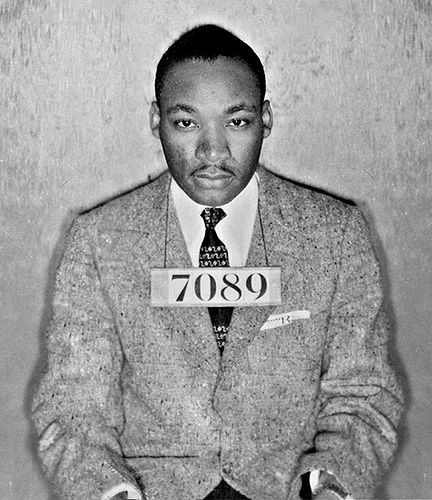
MLK_Jail–Dr Martin Luther King, Jr, booking photo, Birmingham Jail

John 2:1-11I

“They have no wine,” Mary says.

Such an odd, indirect thing to say, “They have no wine.” Yet Jesus knows what she’s after. What he hears her say is, “Do something.”

He is in no mood to do anything. He doesn’t even make sympathetic noises about how mortifying all this is for the poor just-marrieds. He turns his mother down. “This has nothing to do with us, woman.” His ‘hour’ hasn’t come, he says; that mysterious ripe time we hear so much about in John’s gospel, an ‘hour’ that includes his death.

Mary is not eager for that suffering to come any more than Jesus is. Yet a long habit of pondering has only magnified the urgency: The hungry (and the thirsty) will be filled with good things, the rich sent empty away. How much longer should this revolution wait? His hour may not have come, but maybe his minute has—and a wedding seems like just the right place to kick off the great reversal.

That’s why, over at the servers’ station, she is acting as if he’d said ‘no problem’ instead of ‘no way.’  “Do whatever he tells you,” she says, which is good advice for servants of every time and place. So Jesus goes over and starts giving instructions, and before long, six stones jars are filled to the brim with water.

The way he accomplishes the miraculous changeover is discreet, but the results are showy: he makes exquisite wine in preposterous quantities. When the steward tastes it, he just about dies. Who is this who plies with liquid heaven undeserving fools who can’t discriminate between rotgut and Rothschild?

Who indeed? This is the question of every epiphany. Who is this waster, who produces more than the world can drink? Who is this prodigal, who doesn’t seem to know the price of things? This is the question that the Spirit keeps whispering to us in the hope that we too, like the steward, might come to find the answer, taste God’s surprising vintage, and go about tantalized all our lives.

II

The head steward has no idea where the wine came from. But the servants know. Good servants always know. So do disciples, and if you go back and read the first chapter of John’s gospel, you’ll see that Jesus had just called his first set, five to be exact. John says that it was at Cana that these first few “believed in him.” Not before the wedding, note; but at the feast they believed. And not because he performs any old miracle, but because it’s this one.

They’ve all heard the words of Isaiah read in the synagogue: “As the bridegroom rejoices over the bride, so shall your God rejoice over you!” They’ve heard Wisdom, too: “She has set her table and poured her wine,” the wine of joy in the Spirit, free of charge and available to all in God’s New Day.

When Messiah comes, everybody knows, a giddy glee — not unlike inebriation (but safe ) — will grip the world. These disciples feel it now in Cana. Who is this? It must be Messiah. And they believe in him.

But they would not have been at the wedding at all, and would not have believed, if they hadn’t responded when he called days earlier, if they had not first followed him. Things happen in this order: Jesus calls, you follow, and then, in the course of following, of living with him, of going where he goes and doing what he does, you discover him as the source of joy, the fount of new wine, and you trust him, you believe.

So, in addition to being a story about the abundance of God’s New Day in which every creature’s watery old life is changed into a ruby red new one; in addition to being a story about the slap-happy joy of being in the presence of God’s Appointed One whose mission is to change mourning into gladness and keep the gladness coming in great unquaffable quantities; in addition to all that, this story is about belief and discipleship.

Between the lines we learn that it’s in the following that love, knowledge, and experience combine to make for faith. You’re a disciple if you go on the road with Jesus, go with him to weddings, and drink from the cup he proffers.

III

Today our nation commemorates the life, work, witness and sacrifice of Dr. Martin Luther King, Jr. Chances are you’ll be hearing a lot about Dr. King’s dream today, as if he’d been only a dreamer, as if the dream had been precious and peculiar only to him. You’ll hear people quote from his March on Washington “mountaintop” speech, that what matters is the content of character, not the color of skin, as if that were all he ever said.

And that line will be repeated with astonishing denial, or astonishing cynicism, or astonishing naivete, since, to take only one case, skin color can still be the difference between life and death in our criminal justice system. You’ll hear that line repeated as if he’d never also made daring critiques of the demonic nexus of racism, poverty, capitalism, war, and prison.

You’ll hear a lot about dreaming, as if all we need to do is dream on, now that he’s dead, as if dreaming on honors him. But Dr. King was not only a dreamer: he was first, last and always a disciple. He got up when he was called, and he followed. He went to the mountaintop and he went to the wedding. His eyes had seen the glory of the Lord and his lips had tasted the wine of Cana. And his faith was formed, perhaps even discovered, and certainly strengthened, in a community, following the Liberator, on the road, on the march, with Christ.

To my knowledge Dr. King never preached on John 2:1-11, but there’s no doubt he lived this story; for only from a deep awareness of abundance, only from a conviction born of the experience of everlasting reliability, only in the company of God’s Christ who keeps providing us not with enough but with forever far more than enough, only in the company of fellow followers who had also tasted the wine, could any flawed human being stride toward his inevitable “hour” so unflinchingly.

Drinking deeply of the wedding wine is still capable of intoxicating God’s people with hope, against the odds. And the hope it instills is still able to yield in us the substantial fruits of courage and perseverance, forbearance and resistance. It is still powerful enough to reveal to us nothing less than the joy of the cross.

It’s a good thing too. For if we are following, like Dr. King, we are inevitably on our inebriated way to a mountaintop. Make no mistake, the mountaintop we are going to is an imposing hill called Golgotha.

You remember, don’t you? From Cana, Jesus goes directly to the Temple in Jerusalem. Flush with the wine of messianic joy, he strides to the money-changers’ tables. You know what happens next.

Wedding Wine (John 2:1-11)

With thanks to Kathy Coffee..

cana

–Les Noces de Cana, Louis Kahn, 1949

They have no wine, Mary says. If she says it any louder, the guests will hear and head for the door.

It’s a little indirect, but her drift is clear. She wants Jesus to do something about it.

He’s been hanging around the house for thirty years, knocking together benches and chairs. His father likes him home. The sign on the door says Joseph & Son.

The gold is long since spent on groceries, the frankincense a whiff in the walls, the mystic myrrh tossed on a shelf in the shop.

Building chairs is a good job for a son, but this son was knelt to by Persian wizards. She can be forgiven if she thinks he’s destined for greater things.

She wants him out of the house.

She says, They have no wine. And they have been thirsty since Adam.

Not yet, he says. What you ask will be free for them, but will cost me plenty. One more order of chairs…?

Soused and surly, the guests are frantic to take the edge off.  Any wine will do. The old purveyors line up to supply them rotgut, smiling their oily smiles, rubbing their hands.

She thinks, not for this did the angels sing that starry night. Not for this, my darling dear, that you have a mother.

Since the day John leapt in the womb, she has been tasting it. She can taste it now: wedding wine. Bouquet of the cosmos, undertones of Eden, the finish of revolution.

She turns to the servants.

Do what he tells you.

Pour paradise on drunks.

Some Quick Notes on Some of Baptism’s Ethical Edges

3p63-3581-kids.jpg

–Birmingham Civil Rights Institute Photo

We do not vaguely follow Christ, or imitate him generally. Our discipleship has a distinctive shape, individually and collectively—a “baptismal” shape. Baptism packs an ethical punch that stamps the spirituality of the church with distinctive markers. Among them:

  • Baptism is a radical equalizer (Galatians 3:27-28, 4:6)—There is now no Jew or Greek, male or female… All who are baptized are one in Christ, all have the same “father,” all are equal heirs, all are a royal priesthood, a people set apart; all have complementary precious gifts (charisms, graces) that are all necessary for the building up of the Body of Christ. The baptismal answer to all questions of distinction, discrimination, and subordination is ‘no.’ The Church that practices a baptismal spirituality is truly alive in diversity of every kind and in profound mutual regard. And the Christian who is living out his or her baptism every day is a person who rejects the normativity of one group over another.
  • If baptism is “an immersion in Christ’s death,” which death was an act of barrier-breaking, as Paul says, baptism is also therefore an act of radical reconciliation, bringing together those who were once far off and those who were already “in.” The gospel tells us that Jesus died “outside the walls.” That is where baptismal life must unfold, beyond all the walls and barriers erected to keep some of us safe, tidy, clean, and apart from others. The Church that practices a baptismal spirituality will be a church always working to break down whatever walls continue to separate us from the most dreaded “them.”
  • The equality of the baptized (or priesthood of all believers) is subversive of all clericalism and hierarchy. There may still be offices and roles for the sake of the Church’s unity and order, but the Church that practices a baptismal spirituality will show forth in every way the essential equality of all the baptized, and each one will take on his or her priestly role with grateful gladness.
  • Baptismal renunciations of Satan: we abjure ‘him’ and his kingdom (all his minions and all his powers)—we reject  not only individual sin but also all the systemic structures of evil and injustice (Christians in the civil rights movement called baptism the “sacrament of integration”). The Church that practices a baptismal spirituality will be an engaged and resistant community, risking everything for the sake of justice.
  • Immersion or dunking (as well as anointing of the senses and extremities in some traditions) and even sprinkling, if done generously, consecrates the whole body for God and underlines God’s commitment to flesh and materiality (‘body’ is as central to the baptismal rite in some traditions as it is in the communion rite). Solidarity with real bodies is at the heart of the Christian life…implications? The Church that practices a baptismal spirituality will engage the “corporal works of mercy” assiduously, honoring all bodies (implications for ministries—health, healing, visitation, prisons, addiction, shelter, food, accompaniment, etc.)
  • Water (and oil and salt and flame…)—The natural elements “mediate” God’s promises in some way/doctrine of creation/the creation truly matters… Ecological concerns are infused in us at baptism just as much as the “charisms.” The Church that recovers a baptismal spirituality will be “green”!
  • What would you add to this list?

Thinning Memory, Ethical Wallop and Other Questions about Baptism

350px-River_baptism_in_New_Bern

I. Excerpted from, “Long-Term Memory: Anamnesis and Christian Worship,” An Anniversary Lecture, First Church in Cambridge, Congregational: 375 Years on the Way, February 15, 2011

…I see the loss of the church’s deep experiential memory play out, among other examples I could cite, in the thinning of the baptismal ritual in many of the churches I’ve worshiped in during the last couple of years. Baptism in those communities is understood mostly as the symbolic act whereby we welcome a child (or occasionally an adult) into “the Christian family.” Even though most of the baptismal liturgies in use in those churches include bracing promises to renounce evil and engage in a life of demanding discipleship; and even though most retain all the scriptural references to mystical dying and rising with Christ, and some ever refer to the radical egalitarianism in which the rite implicates believers, the emphasis in many of these services remains laser-focused on family and welcome.

Now, I would be more content with this single focus if I thought, for example, that “welcome to the family” was widely understood in congregations as a “welcome to The Family that challenges families as the world understands them”; or if it carried within it the deep imperatives to be new creatures that relate to one another as original siblings, kin in the Sprit, that our ancient forbears found so immensely convincing about the Christian message. I wouldn’t mind it so much if what was being proclaimed in that welcome were the good news that there is a family for everyone, even for you; the grateful knowledge that without this new forgiving, healing, incorporating family born of water and the Spirit, we would all be profoundly homeless; and the urgent mission (therefore), the “thirst for souls”, that impels the baptized Christian to the side of the neighbor to extend to everyone God’s generous adoption. That kind of welcome I could be glad about. But most of the time the child is welcomed only to the Little White Church on the Green—which is not bad, of course; but it is niggardly. It withholds. It conveys only an infinitesimal fraction of the grace of the great Christian memory that baptism is, and not even its most saving one.  And if baptism is not about saving in some sense—choose your theology—it has nothing to tell us that the world can’t also say.

Were we remembering more deeply as the ritual unfolds, we would find ourselves thrust into the experience of Moses at the Red Sea fleeing for his life with his people, heading down in terror between walls of water, down to the seabed, to the very bottom of things; and there and only there, in trust and self-surrender, in a kind of death, finding liberation just as God promised; and then coming up alive and whole on the other side. And that shore then would be a shore here and now. It would be us standing on it with Miriam, ready to dance and praise in the face of every tyranny. It would be us who, with our own eyes now, see oppression’s inevitable future played out. It was, it is now, and it always will be washed up, broken, and destroyed.

Were we remembering more deeply, we would find ourselves in the presence of Jonah, so unwilling and so despairing over God’s love for Jonah’s enemies, swallowed by the big fish and taken deep, but not left to languish in that watery death. Hauled up, spit out, made new, he goes to preach mercy, almost against his will. And that same fish would swim right in here and gobble us up too. It would be us in that belly, us spit up on the shore newly gasping for air, us bringing mercy to an improbably repentant people, us weeping under a bush as we come to terms with the unpalatable good news that God will do anything to save.

And we would see Naaman, too, the proud general washed clean in Israel’s unprepossessing river; and the man born blind (the newly-baptized in the ancient church were called “illuminati”, and the story of the restoration of his sight was often read at baptisms); and our dear brother Jesus at the Jordan, unembarrassed, as he always is, to be found smack in the middle of a line of sinners on the bank, ready to undergo a baptism he didn’t need but passionately desired. All this would all be happening in and for us too, right now, as with water we baptize.

Mighty stories, dangerous rituals, deep memory… these are the things that makes for communal transformation and human joy. If they have grown pale and weak in our churches, how shall we go about recovering them? …

faqbaptism2

II. Excerpted from “Just Praise, The Ethical Wallop of Worship,” Keynote Address for Christians for Justice Action, UCC General Synod 28, July 4, 2011

…. What would happen if the sacrament of baptism were celebrated with greater and more creative attention to the sign value of its characteristic elements, gestures, and words? Take away the teacup and candy dish fonts that are in use in many congregations where child baptism is celebrated, for example, and replace them with generous pools that can accommodate great volumes of water—so much that you might finally believe it when you’re told that baptism is a watery grave, a healing bath, a cataract of grace. And stop sprinkling little dainty drops over foreheads, but instead plunge the child or the adult into the water and get everyone good and wet in the process. Then watch what happens bit by bit over time as a congregation begins to see and hear and feel the risk and danger of it, the extraordinary joy of it, the healing peace of it. Watch what happens when you marry the mighty water stories of scripture—the flood of Noah, the swallowing of Jonah, the parting of the Red Sea, the Woman at the Well—to the dangerous ritual of water; what happens when the Christian imagination does its work. It may not be long before someone asks whether to baptize like this, drenching people with abundant clean water, is not only a sign of God’s abundance and of God’s will to heal and save us in the water’s depths (thanks be to God!), but might also be a counter-sign of privilege and wealth, as it is in all those places around the globe where people die for want of water. Then let someone wonder why it is that water, which should be free to all, has become a capitalist commodity. Then let your immersed people wonder what, as baptized Christians, they should be doing about that. Then you’ll know that worship is slowly working justice into the marrow of the bones of that church.

You have to be careful with this stuff, though. In one congregation, the Deacon who habitually assisted with baptisms got tired of reading the same few lines about little children being allowed to come to Jesus every time the sacrament was administered. He figured there was more to the story. So he began reading from Galatians 3 instead—‘for those baptized into Christ, there is no longer Jew nor Greek, male nor female, but all are equal in Christ.’ One year months and six baptisms later, he went to his pastor with a question about why the font was located so far away from the people, why only ordained deacons and ministers got to say anything, and why only the clergy could pour the water. He’d noticed that the Word and the ritual seemed to be contradicting each other, and thus he also noticed for the first time the subtle reality of hierarchy and clericalism in his supposedly non-hierarchical, non-clericalist church, as well as the potential of baptism to be subversive of it just by being baptism. That question caused trouble in his church. Either they had to stop baptizing, or they had to change the way they did things so that the sign value squared with their practice.

And take those baptismal promises we ask people to say. What if we were to stop trying to find inoffensive, progressive ways to say what the baptismal liturgy has traditionally named unflinchingly: that Satan and all his minions really are roaming the world seeking the ruin of souls and employing every wile to seduce us into evil’s kingdom, and that without the shield and strength of our baptism, we are easy prey, and that our subtle and overt compacts with this death-dealing cohort must be broken and renounced once and for all? What if we stopped laughing at that quaint language and re-appropriated those bold and bizarre images as straight talk that pulls no punches about what we are actually up against in this world. Over time, baptism and after baptism, what if our communities were to experience the power of the ancient act of abjuration, the determined swearing off of evil, the costly renunciation of the deeply satisfying rewards of sin, growing thereby a sharp consciousness of our vulnerability and a holy confidence that we can do all things in Christ, who claims us through these waters?  Over time, ritual act by repeated ritual act, might it happen that the baptized community becomes a disciplined and resistant community, increasingly detached from everything that could distract, allure, and encumber us when the time comes to choose up sides, increasingly daring in its death-defying confrontation with evil in themselves, in the church, and in the world? …