Category Archives: Marginal Notes

Preaching Isaiah 50: 4-9a The Suffering Servant

6a00d8341d9f5853ef014e87249d11970d-800wi

–Image by Marcella Paliekara

This well-known Holy Week text presents a number of challenges for the conscientious preacher. One challenge lies in its pairing with the hymn of obedient kenosis in Philippians and with Mark’s passion story, making the identification of Isaiah’s Servant with Jesus irresistible. There is nothing new in this. The first Christians reached into Hebrew Scriptures for passages that spoke to them of Jesus’ life, illumined his significance, and confirmed him as God’s anointed one. The New Testament authors bequeathed these Christological interpretations to us. One of them is that in Jesus, the Servant has reappeared.

It is not wrong for subsequent Christians to read this text through such a lens. The challenge in a post-Holocaust, multi-faith world, however, is to do it in a way that sheds light on our Christian story without reading Jews out of theirs. We ought not employ this text as a direct prediction of the passion of Jesus, drawing neat correspondences between the Servant and Jesus (the Servant was obedient, Jesus was obedient; the Servant was silent, Jesus was silent, and so on); or imply that this passage is “really about Jesus” or “proves” that it was God’s plan from the beginning that Jesus should die in this way.

A more respectful treatment would be to comment on the text as the song of a real or imagined figure (or figures) in the Jewish story of Babylonian exile and internal division who, in faithfulness to his vocation to listen for and speak refreshing truth to those who are “weary” (v. 4), meets resistance that turns hostile and violent. By extension, it is also the song of any innocent person (including Jesus) who chooses not to resist his oppressors, and by the exercise of that freedom offers witnesses powerfully to the justice of his cause. The Servant suffers in a particular context, but he does not suffer alone. Throughout the ages, countless people are shamed by like violence. Many suffer “out there,” unknown to us; but many sit in our pews every Sunday, hoping for a word of encouragement and healing. Is there such a word for them in this text?

This leads to a second challenge. What are we to make of the Servant’s affirmation that he “set his face like flint” in the face of violent hostility, “gave his back” (v. 7) to those who struck him and “did not hide his face” (v. 6) from those who spat on him? The text says that the Servant allowed himself to be shamed in this way, refusing to flee or fight back; but the homilist must avoid suggesting that humiliation and suffering are good or desirable, or that God is pleased when someone is abused for righteousness’ sake.

Because the Servant suffers unjustly, it is tempting to glorify his pain as the price one pays for being on God’s side. To do so, however, runs the terrible risk of blessing the cruelty unleashed on the innocent. It also allows us to conclude further that violence meted out in retribution to people who are in fact guilty is justifiable because it is deserved. The preacher’s job is to keep in tension the admiration we feel for the courage displayed by people who submit to their oppressors nonviolently, and the ethical call to us, inherent in these instances, to reject the glorification of martyrdom and make a new world in which the oppression of the innocent is unheard of, no one has to face a decision to submit or resist, and even the guilty find mercy and redemption.

A third pitfall awaits in the defiant affirmations of the Servant in the final verses (vv. 6-9). The Servant calls out his attackers, daring them to prove him guilty, knowing they cannot. He is sure that God will settle the score—the shamed now will be triumphant later. The preacher will naturally want to help the congregation see themselves in the Servant, their lives confidently staked on the eventual triumph God will bestow. But she will also take care not to allow this identification to sour into a sense of Christian entitlement and victimization (We were always a Christian nation, but now “they” won’t let us pray in schools: we need to get this country back to Christ where it belongs!). She will help more if, while pastorally acknowledging the place of some of us among the oppressed, she also makes us face the identity of the oppressors. The hard truth we need to hear, especially as we enter Holy Week, is that “they” is often “us.”

Jesus once observed that opposition to prophets arises mainly within the “family circle.” This appears to be the case here. The likely context of this passage is a struggle between factions of long-exiled Jews, some of whom have adapted to and prefer Babylonian ways, and others who refuse to abandon or “acculturate” the received tradition. The Servant stands on one side of this internal struggle for the meaning of faithfulness, his own kin on the other. The preacher might help us contemplate the likelihood that people of faith are not (just) victims, we are also victimizers.

We wreaked havoc in the past on people of other faiths (Christians are not alone in this, of course, but from our pulpits we are speaking to Christians); and if the current wave of Christian Islamophobia is any indication, we are still bearing false witness against our religious neighbors and condoning shameful acts of exclusion and assault. We also routinely heap contempt on fellow Christians who believe differently from us. We believe that this internecine blood-letting is justified as long as it is for righteous ends. The preacher can remind us that religious violence is not special violence exempt from the commandment to love the neighbor and forgive the enemy. Violence in any form is violence. Naming it for what it is may be one of the most important homiletical tasks of this holiest of weeks, when the Lord of Life meets his violent death.

Francis Bernadone (1182-1226)

304772_135903169884378_1092818536_n

Francis Bernadone, 1182-1226

I like my saints wild. The fierce ones, oddballs, out of kilter, the ones with edges and cracks and terrible visions, the ridiculed and the feared. The ones who sooner or later have to be tamed; who, with the passage of time and shifting angles of vision, must be edited so that you can read about them safely in prim collections of hagiographies, no longer strange, but ‘best-loved,’ birdbath ornaments for your garden.

Like Francis Bernadone. Of Assisi.

You know him—the “make me a channel of your peace” saint. The saint who preached to birds and did behavioral therapy with wolves. The environmentally aware, all-natural, organic saint of harmonious convergence. All that and more. And so much more. For Francis was free. So free, he was dangerous.

He was a young dandy, rich and frivolous. And attractive. He spoke French and sang ballads and threw parties. He harassed street people and had his way with women and was more trouble than his first biographers wanted you to know. Everybody knew him. Most everybody liked him. It wasn’t clear that he liked himself. He was restless.

He wanted something. He felt that it was coming, but he didn’t know what or where or when. Something that mattered. So he went off to war in shiny armor on a handsome horse, hoping maybe it was glory. Loyalty and courage and glory might be the thing.

He returned wounded, traumatized, a haunted peacemaker, turned around by the special grace that flows from the fact of your own futility, that permanent sting in your misled heart and your useless flesh. After that, he could never flee his own flesh or anyone else’s. He was drawn to the useless.

He started paying attention in church. He heard the gospel: “Sell what you have and follow me.” So he gave away what he had. Then he started stealing from his father, giving away what he stole to make beggars warm. There were too many beggars to count.

When his father found out, he dragged him off to the bishop for a public reprimand. Always one for street theatre, he stripped off his clothes in front of his father, the bishop, and half the stunned and clucking town, stripped off his legacy (his father dealt in cloth), stripped off his father’s name. He walked out of the city a newborn, naked as a jay. He had been baptized as an infant. That was the day it took.

He lived in the woods, hiked the mountains, prayed in their caves, and wandered around the olive groves beneath the town. He begged for his food, leaving a blessing in exchange. If there was nothing, he went hungry. If there was something, he shared. Dressed in a penitent’s tunic and belt, barefoot in rain and heat and snow, he was Lady Poverty’s mad courtier, pledging himself to her for life, and to her family of ragged and hungry, too many to count. To everyone’s revulsion, including at first his own, he embraced lepers, kissing their sores. Soon they knew him well in the leprosarium down in the valley outside the walls. He tended wounds. Townspeople pelted him with stones.

One day he was praying in the ruins of an old chapel and saw that a crucifix was still hanging inside. He gazed at it until it spoke to him: ‘Francis, repair my Church.’ And so he did, stone by stone. It is said that what Jesus meant was for him to reform his ‘capital C’ church, but Francis was a literal man. He was not one to do grand things when a tangible needed thing was in front of his nose. Before he was done, he’d repaired several abandoned chapels in and around Assisi, working with his rich boy hands until no one recognized him any more. He became a stranger.

But some young men of the town were moved by him. A few old friends, a relative or two. They joined him, then others came, too, unknown to Francis. All classes and conditions. Before he knew it he was in charge of a growing fellowship. He had no idea it would happen. He was ill-suited to leadership. And he was indiscriminate. He welcomed them all. Sometimes that was a mistake, and he ended up having to kick some bad men out. His companions urged him to put admissions policies in place. He didn’t.

He wanted the pope’s blessing for his growing band, so he walked down to Rome. Medieval Rome. Holy city, unholy cesspool. After some bureaucratic delays, Francis in rags got the blessing he wanted. Legend has it that at the end of his audience with the pope (whose name was Innocent, but who wasn’t very), the great man in ermine and gold came down from his throne, kissed Francis’ feet, and received his blessing.

He loved Sister Clare, who ran away from her noble house in the high part of town to learn to be like Francis. He loved Brother Leo and Brother Juniper and all the men who flocked to him, many of them exchanging, like Clare, finery and privilege for rags and humiliation. Francis wanted them all to be equals and so, among other things, he was wary of books and learning because of the pride and distinctions he believed they engendered. And he didn’t want the brothers to be priests. He loved priests because he loved the Eucharist—it was Jesus himself—and priests were the way you got it. But he wanted the brothers to remain small, menores. That’s what he called them—not the Franciscan Order, but Friars Minor.

His fiercest desire was for peace. More than anything pax et bonum, his habitual greeting. Which is why he is the patron saint of stowaways, having hidden on a boat headed east where he hoped to convert the Sultan to Christ and end the bloody fifth crusade. He was appalled by the Christian armies, their violence and immorality, every bit as much as he was afraid the Saracens would go to hell if they didn’t believe the gospel. He was struck by their piety, praying five times a day. They were also clean. The Christian commanders tried to stop him, but he snuck away under cover of night and crossed enemy lines. He got the audience he wanted, staying several days. Francis explained the good news to the surprised and curious Sultan. He did not succeed in baptizing him, but it is said that the Sultan thought Francis was a lovely man, the best Christian he’d ever met, and made sure he got back safely.

He tried for reconciliation everywhere, adjudicating local disputes, making treaties. Even, it is said, taming a ravenous wolf who was killing livestock and terrorizing people in Gubbio. The deal Francis struck with people and beast stipulated that the wolf would behave if the people fed him. Afterwards, whenever the wolf came trotting into town, newly meek and peaceable, he found food at the doors and left satisfied. The people said, as the wolf loped away, that he reminded them of Francis.

Francis was not naïve. He knew what he was up against. The onslaught of demons, the persistence of violence, the imperviousness of the haughty, the sluggishness of the Church, the sly corruption of error, and the betrayals of his own heart and body. But Francis loved Jesus, and with unhinged joy he sought to be like him down to the last detail of freedom and agony.

And so on days blistering and freezing, he and his brothers prayed and preached on street corners, demanding repentance, announcing mercy. Through nights dark and shimmering, he prayed alone, too; persistently, on a mountain, a half-demented mystic crying loud for Christ. The visions that came to him there were garish and beautiful and full of pain. It is said that on one such night, seraphim he saw in the sky cut the Lord’s own wounds on his scrawny body, his hands, his feet, his side.

And then the poor scarecrow lived just a little too long. Long enough to see his then thousands of brothers dispute his meaning, split into factions, grow to despise each other. Long enough to see new leaders reinterpret him. Saints’ deaths are sometimes bitter like this. Blind and gaunt, on his final night he asked the brothers to lay him on the ground, dust to dust. With his last rasping sigh in the morning he told them, “I have done my part. May Christ teach you to do yours.” He also said, “We have only begun to live the gospel.”

It wasn’t long afterwards that the new leaders began building a gigantic basilica to house his remains. Wildly beloved by the people in the final years of his life, the dead Francis was soon to be a wildly beloved and profitable saint. The way of the world. Our way.

Francis lives now with Jesus in the heaven of his longing. It is said that in the morning mist of Paradise, angels cannot tell the two apart. There are talking birds there, and reformed wolves, and singing water, and Leo and Clare. The Pope too, crooning duets with the Sultan. And there are lepers, thousands of lepers, rosebuds blossoming on their skin where Francis kissed them.

Prayer                                                                                                                                                           Most merciful God, on this day when we remember your servant, Francis, grant your people grace to renounce gladly the vanities of this world, so that by following his example, we may become fierce for justice and delight in every creature with perfect joy.


Just Around the Corner

CrocusInSnowIt was Marathon Day in Boston ten years ago. A sharp wind was blowing off the harbor. The sun was pale, and the buds of the storm-bent dogwood in the yard were unconvincing. The calendar said Spring, but you needed a winter jacket. It was no weather for T-shirts and shorts, unless you planned to run 26 miles in them.

Two young men carrying a six-pack apiece came down the street and ambled by my front window. They were wearing  T-shirts and shorts, but they didn’t look much like marathoners.

It made me shiver just to look at them. All the same,  I was glad they’d apparently decided that the calendar was right, that this was in fact a Spring day, maybe even a beach day, all evidence to the contrary notwithstanding.

They were onto something, I thought, going by the season, not the conditions, dressing according to things unfelt and unseen. It was a profession of faith.

Jesus’ first disciples claimed, after his death, to have seen the Lord. We who have come after them have believed without seeing. We have acted as if it were Spring, no matter the season. Generation after generation, we have worn light Alleluias in all kinds of weather. We have dressed according to the Word, not the conditions.

Ever since faith graced us, it has been the church’s mission to go about in T-shirts and shorts in a world hunkered down for a frost that shows no sign of thawing; to put our faces into cold winds off the water as if they were zephyrs; to love the unconvincing buds as if each struggling sprout were a paradise.

The world longs for an early, a later, and an everlasting Spring. God wants to give it such a season through the witness of our faith-filled lives. In a few short weeks it will be Easter. May the Spirit find us dressed for the occasion.

Bus Stop

lI’ve carried her in my head all these years. She got in there one day in the fall of 1998 when I was idling at a very long light at a suburban intersection and just happened to glance to my left. She was waiting for a bus at the corner across the street, half-leaning, half-standing with her back to the pole with the long metal T sign that tells you where you will go if you take the Number 12 or the Number 57.

An unremarkable person, she was middle-aged, medium height, brown hair. A large black bag with gold buckles weighed down one shoulder. Her collar was turned up against the unseasonable cold. She was by herself in the corner, no one else around.

I wasn’t really focusing on her, just taking in the pole and the sign and the corner, and registering her standing there too, nothing more. That’s why what happened next was so startling. Her face darkened and fell. I mean it buckled. It had been perfectly placid and then it just buckled, as if it were tin foil, as if someone had reached in and crumpled it up to throw it away. I had never seen something like that before and I was shocked.

Then she whirled around. Really, whirled is the right word, and she began hitting the T sign with her fists. Over and over she whaled at the sign. Her big bag slid off her shoulder and down her arm and bounced around wildly, the straps caught in the crook of her elbow. She was howling as she pounded the sign, or at least I remember it that way, but my windows were rolled up and the heater was on, so I might have imagined the howling.

Before I could react—what did I think I would do?—the light changed. I had to move. There was a long, impatient line of cars behind me. I looked for her in the rear view mirror, but a box truck rounding the corner made it impossible to see. For a second I thought about pulling over, running back, asking if there was anything I could do, but by then I was too far downstream in the current of traffic.

What had happened on that corner? What was it about? Was she angry, or anguished, or mentally ill, or despairing, or just sick of waiting for the bus? What grief or memory or decision or violence or finality or pain impelled that frenzied pirouette and powered her bare fists against that metal sign over and over and over?

Did she stop and compose herself, get on the bus when it came, looking as placid and unremarkable as she had before whatever had been unleashed was unleashed? That night, did she cook supper for the kids, or play cards with friends, or alone in her apartment take a long sudsy bath with a book? The next day and the next, did she recover? Did she settle the question, find a great therapist, talk to her pastor, enter a rehab, work it out with her spouse, or just suck it and keep going, up because grief is a long process and she knows there will be good days and bad?

Or is she in a locked ward somewhere, or alone now because her spouse and kids had been through enough and just couldn’t take the volatility any more, or is she fidgeting anxiously at her desk until quitting time when she can have a drink or get a fix or binge and purge because that eruption at the bus stop, for all its violence, not yet her bottom? Or is she meeting over coffee with someone from her church this morning, telling him about the time when, in a gale of tears and howling and flailing fists, time Jesus came to her in the tombs on the corner near a T stop and exorcised her, finally, returning her to her right mind? Is she praying with him, asking Jesus to save him too?

I told you that she’s been in my head all these years. At first in a disturbing way, then in a familiar way. I’m grateful to her. Not that what happened that day is about me. I know it isn’t, yet I feel blessed and privileged because of it. Not knowing who she is or what her frenzy was about or what happened to her afterwards has been an odd sort of gift. I feel connected to her, and I pray for her, but I also feel I owe something to her, in the way you feel indebted to an anonymous donor who gave you a heart or a stranger who pulled you from a hole in the ice on a late winter lake.

Maybe that comparison isn’t very apt. She didn’t mean to add a drop of grace to my salvation, didn’t even know I was there, probably wouldn’t have cared that I was there if she had noticed me noticing her. She didn’t purposely give me anything like a heart or effect my freezing rescue. Nonetheless, I feel indebted and I feel linked.

I have something of hers, or I got something from her–it’s hard to explain. I got to see a mystery, I got to see her, and now I can never not know that faces may crumple in an instant, that fists may shoot out to pummel route signs, that soundless howls may rise on any corner anywhere, and that when you have seen and heard and cannot explain, what you must do, at least, is not forget.

I Will Give You Rest

oxen-yokeIn a famous text from Matthew’s gospel, Jesus invites us to lay our burdens down. I have quite a few that need offloading. Come to me, he says, and when I hear him, I know he knows. He knows how exhausted I get. I need his rest.

So, how do I get it? He says, Put on my yoke, learn from me, for I am gentle and humble of heart.

Jesus’ rest is connected to putting on his way of being, a way of gentleness, a way of humility. I’ll have rest, he says, when I learn to live that way too.

But how do I learn humility? Should I grovel and cry, Oh what a worm am I? When people say that they love the way I sing, or that I make great brownies, should I reply, Oh no, my sister sings much better than I do; or, It wasn’t me; it was God working through me who made those delicious brownies?

That seems false to me. Doing that doesn’t make me light. It makes me phony. There’s no rest for my soul in pretending I am not who I am. Maybe the humility Jesus is talking about is more like that—just being who you are—no more, no less.

Who I am—a creature of infinite worth and estimable achievement, and a creature who occupies only an infinitesimal place in the cosmos. A creature who is God’s crowning glory, and a creature who is also always deeply conscious of my origins in the clay of the earth. A creature unique and irreplaceable, and a creature who shares an ordinary common lot with other human beings and with everything else God made.

In other words, I am lovely and great, but in an ordinary sort of way. And that lovely sort of ordinariness just might be the secret of the rest and contentment Jesus makes available when you go to him.

It doesn’t come naturally. Which is odd, because it’s the one thing that should come naturally—just being who we are. But it’s something Jesus says we need to learn. And he says we can learn it from him. And when we learn from him to be ordinary, to be who and what we are, then we will rest.

oxen-yokeOf course, we don’t usually think of Jesus as someone who was ordinary. I was taught to believe he is anything but. But he seems to have thought of himself that way. Remember that story about John the Baptist watching Jesus approach the Jordan and refusing at first to baptize him? Poor John: Here comes the Messiah, God’s Son, and John is supposed to treat him like an ordinary sinner and give him a bath of repentance for the forgiveness of sin.

When John sees Jesus lined up with everybody else, he wants more than anything for Jesus to step out of the line of these basic regular people. To exempt himself. To make it clear he is not like them. But Jesus doesn’t do it. He won’t. It’s where he wants to be. In that line. It’s where he knows he belongs. With us. Like us, who are ordinary, and in need of God’s mercy.

Then the Talking Dove comes down to announce that God is delighted with Jesus. What makes God so thrilled? I think God is happy with Jesus not so much because he’s God’s unique divine Son, but because he’s a human son who claims no advantage over any other child. His contentment with being ordinary is what makes him so lovable. If God is sweet on Jesus, it’s not because he’s different, divine and perfect. It’s because he’s so happy to be one with all the basic regular people God has loved with a passion ever since the world began.

Then the story tells us that Jesus goes into the wilderness to be tempted. What do those temptations add up to? They’re all about being special and spectacular and more than human. And Jesus resists them. His resistance sounds almost easy when you read it in the book, but it was a huge ordeal. He needed forty days of fasting and prayer and struggle to prepare to meet the intense demonic challenge of choosing to remain simply human, to let God be God, and not usurp the privilege. It was so hard that after it was all over, one gospel writer says that ministering angels came to kind of put him back together.

You wouldn’t think that just being human would be so hard. But it is, at least for me. The temptation to set myself apart, to make myself exceptional is relentless. My striving to be more than human is the source of much of the soul exhaustion Jesus says he longs to soothe. His way is a way of ordinariness; living in the truth, embracing dependence on God and solidarity with every other thing. The payoff is lightness, Jesus says. Lightness, relief, and rest for the soul.

oxen-yokeIt’s not simple being simple. It requires attention, intention, discipline. It requires simplification of life, taking your standard of living down a notch or two (if, of course, you have a choice in the matter), developing a resistance to acquisition–because all these things are deeply related to the striving of the ego to cast aside the trappings of ordinary humanity. And it requires the help of trusted others to help you keep vigil over your unruly heart and re-train your desires. It takes time and tenderness and patience and prayer to learn to enjoy life for what it is, not for what you need it to be — a stage for your own protagonism. It takes time and tenderness and patience and prayer to begin to take pleasure in the world without having to be at the center of it.

You can’t just decide to be ordinary and voila! It’s a practice. We need it because we’ve lost the art.

Jesus calls it ‘taking his yoke.’ It’s a yoke that binds us to others and to himself so that together we can all walk in step to the everyday rhythms of human ordinariness. His yoke keeps us from getting unhinged again from our own humanity. It keeps us from getting loose and chasing after something better than being human, and from exhausting ourselves in the effort, because that ‘something better’ just isn’t there. There is, in God’s eyes, nothing better than being who we are.

I retired last June. I laid down my professorial burdens. Not all of them, but most of them. I really needed to. I was exhausted physically and spiritually. I loved the work—I still do—but I wasn’t in love any more with working. There’s a difference.  Anyone who’s ever spent time in academia knows what I mean. Students and colleagues you can really engage and learn from are great. Institutional maintenance and politics, not so great. And the grind of daily commuting, less great still.

Before I retired, here’s what I most looked forward to—an empty email inbox. I detested my inbox. That box had a life of its own. It was always full. Every two minutes another message would land in it, and instantly I’d feel vaguely oppressed with obligation. Almost angry about it. The thought that I had to put one more thing on my to-do list depleted me. I especially loathed messages that came flagged with one of those aggressive little icons that tell you how to feel—this message will make your day, this one is a PROBLEM, this one is more important than reducing the federal budget deficit.

I was yoked to my inbox. It represented all the dehumanizing things about working that I had let creep into the definition of me and had now grown so tired of. That kind of yoke chafed and wore me down. I longed to wake up the day after my retirement and find my inbox empty.

Then I woke up the day after my retirement and found my inbox empty. I was overcome by an unexpected, surprisingly powerful sense of abandonment. Nobody wanted my advice. My expertise. My charm. My leadership. Nobody needed me to fix something, to do something, to arrange something, to teach something, to be someone special for them. Who was I? The waters had already begun closing over my head. Soon I would completely disappear from view.

Or so I imagined. Or so my Tempters, ego and neediness, whispered in my ear. I had what I said I wanted, and it was not what I wanted, and yet it was, but, no, it wasn’t. It was a perverse moment. It hit me then that for me the spiritual challenge of retirement is going to be the redisoxen-yokecovery of ordinariness. I will be spending time peeling away the layers of accumulated not-so-ordinariness, especially that stubborn layer that says my gifts are the definition of me, and that nobody but I can satisfy the need others have for gifts like mine.

Don’t get me wrong. It’s not that I am seeking to deny my gifts or downplay the contributions I’ve made over my career—I actually think I’ve done pretty well. To say otherwise would be phony. It would make liars out of many people who have told me that I did well. But now that I’ve stopped working full time, I see more clearly the ways I let those things obscure the simple, ordinary creaturehood that is my true glory and my best gift to others. I’ve cultivated those other things well, but simple humanness, not so much.

I have a lot to learn in the days ahead about how to be who I am, and how to walk in step with the ordinariness of life and the wonder of everything else that, like me, just is. I also realize that this is not a retirement challenge only. It presents itself more acutely now that my affiliations and daily activities are no longer what they once were, but it’s been the challenge all along, the challenge of my Christian life, which means the challenge of my human life; the challenge of humility and truth and spiritual realism in everything I am and do. And I think I may not be the only one who has it.

If it’s yours too, I hope you will believe Jesus when he says to us, If you learn humility from me; if you love your common human lot in all its ordinariness; if in all your ambitions and activities you aspire first, last and always to be simply human, nothing more and nothing less (for it is a very great thing); then you will know my rest. Your life will lighten up. This truth will set you free. You will put down self-imposed burdens and take up the only one worth carrying—my yoke, the bond of human solidarity. You will see how wonderfully common you are, how much you need each other, and how much you belong to each other; and you just might just learn to reverence one another. To learn these things is to live in my world, the kingdom of God, where love makes all things easy, and simply being who we are together makes every labor light.

What Grace Is Doing for Us All (Matthew 11:28)

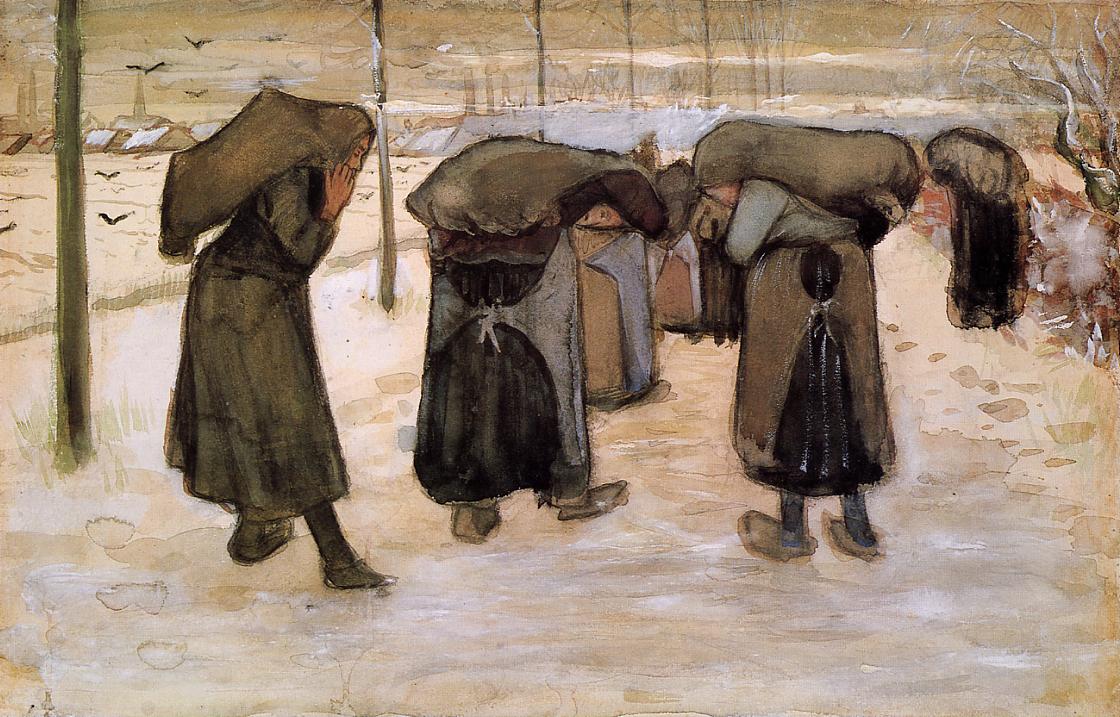
VincentVanGogh-Women-Miners-Carrying-Coal-1881-82

–Women Miners Carrying Coal, Vincent Van Gogh, 1881-82

Lent, we know, is a season of repentance. It is also therefore a season of mercy, for whenever we confess with the hope of conversion, whenever a desire to be free from a wounded or wounding life moves us to reach for help, pardon and healing are already ours.

As professor Greg Mobley writes, at the heart of Christian experience lies “the urgency of love in the present that overwhelms even the terrors of the past.” This urgency, he says, is what the slaver John Newton called “amazing grace,” and the torturer Saul of Tarsus called “the free gift of righteousness.”

In my lifetime, the urgency of love has lifted from my back more than one burden of shame and sorrow. If you have experienced the same relief even once in yours, you know what I mean when I say that I would wish this grace on my worst enemy (as well as, of course, upon my dearest friends).

I would like to suggest a simple Lenten exercise. On the Sundays of Lent when you come to worship, look around at the people with you there and try to grasp this reality – that sitting next to you, across from you, in front of you, are people carrying burdens which, if you knew all the facts and feelings of them, would rob you of breath. Then consider yourself, and your own.

During the silence at the time of confession, imagine Jesus removing one of your burdens. Tell God that you believe that you can be free.  Be grateful. Then imagine that you are helping people around you unload too, loosening knots, guiding bundles to the floor, moving them away with your foot.

Then, after the assurance of pardon, when the worship leader invites you to share a sign of Christ’s peace, step over all that useless cargo and greet your neighbors – light, relieved, and gratefully amazed at what they did for you, what you did for them, and what grace is doing for us all.

One Thing Necessary

i-BgWb6QN-L

–Photo from Keystone Pipeline Protest, REUTERS/Richard Clement

Remember the terrorism color code? It was invented in the previous administration to inform the public about the level of threat we faced at any given moment. When it got racheted up one ominous notch from yellow to orange, we’d be told, for example, that attacks on “soft targets” — malls, apartment buildings, hotels — were being planned somewhere by someone.

It was pretty scary stuff, but the officials who spoke at color code news conferences always said the same thing: “Don’t worry. Carry on your daily lives. We will protect you.” Okay, except that by definition soft targets are impossible to protect; and who wouldn’t worry at least a teeny bit about what a dirty bomb might do to Park Street Station at rush hour? I know I did then—and I still do.

But terrorism isn’t the only thing that worries me. The impending sequester worries me. Rising gas prices worry me. Gun violence worries me. Economic inequality worries me. Wall Street worries me. The breakdown of congressional compromise worries me. Racism and homophobia worry me. Drone strikes worry me. Increased settlements in the West Bank worry me. Global warming worries me. And that’s just for starters.

Most of all, I worry that things are implacably on track, and we are powerless to change them. Marches, protests, righteous legislative lobbying, letters to the White House all seem to go nowhere. I feel guilty that I’m not doing enough, which is true—I’m not. At the same time I think nothing I or others do, no matter how great or noisy, will ever really change things. I get angry and tired and cynical; and when this happens, it’s a sign that I am coming at the world, and at the work, all wrong.

I came across this paragraph in a piece by Kari Jo Verholst in Sojourner’s several years ago. It made me think deeply about what’s needed if Christians who care, who care deeply, are to avoid burnout, cop-out, or despair. I return to it every now and then when my mood turns especially sour. It helps me refocus on the only thing that should worry me—that my worrying will turn to idolatry, that I might sow a seed in the world unwatered by faith, that my care might yield nothing more than the same bitter fruit I decry.

Those of us who think of ourselves as social justice people often use activism as a shield against fear and loneliness. Leery of those who peddle spirituality as self-help and who ignore the ‘root causes’ of injustice and suffering, we can be fearful of admitting our own fatigue and dismay. [Herein] lies an idolatry… More often than not, we understand the gifts we have been given—the prophetic word, the cry of challenge to unjust systems—as something deposited in us, rather than something that flows through us. Thus we interpret our lives according to our faithfulness to this gift, rather than according to our relationship with the God who is the source of gifts and callings. This severance … either causes us to interpret ourselves as being of singular importance, which renders us easily threatened, or it increases our already deep sense that we are always failing, no matter how hard we try. In either case, cut off from our life-source, the seed we sow in the world will be born of this fatigued arrogance, and we become just one more force out there imposing its vision on the world.

The season of Lent begins with a testing. Jesus in the wilderness is confronted by illusions that try to master him. The biggest illusion of all is that he will not need God, but that by his own power he can meet the challenge of engagement with the world. He shakes off that illusion and emerges from the wilderness fully alive, ready to testify, eager for mission, but with no guarantees about the success of his efforts to change the world.

All he knows is that he has chosen—over every other power, every other posture, every other solution—to entrust himself to the love of God and to bank on God’s faithfulness to the world into which he is being sent. It was enough for him. May it be so also for us.

At Least He Knows (Luke 4:1-13)

jesus_tempted–Jesus Tempted, Chris Cook

There were soldiers and tax collectors and beggars and even a few outstanding citizens standing around on Jordan’s bank that day when Jesus went into the river, when the voice from heaven came, when it dawned on Jesus who he was, when he felt just how loved he was, when he learned how infinitely delightful God found him, when God told him, You are my Son.

There was someone else there too, watching the moment unfold, listening to that voice, musing about whether this would be an opportune time, or whether to wait, to wait and see. When the Spirit led Jesus from the Jordan directly to the wilderness, the devil on the bank went right along with him into desolation.

He abided with him through the forty-day fast. Then, when Jesus was famished, he struck up a conversation with that Son.

At the Jordan, a voice from heaven spoke; in the desert, it is a voice from hell. But not the hell you imagine. Not flames and pitchforks, but the expanding torment of a pinprick of doubt.

You, God’s son? Well, if you are… if you are… if you are.

The temptations in this story are three: to be spectacularly useful (turn the stones to bread), powerful (serve me and I will give you everything) and immortal (throw yourself down). But there is only one temptation really, one embedded in these three: to wonder who you are. To entertain the question, Am I who God says I am?

What we need to take very seriously is that Jesus was really tempted to try the stone-into-bread trick. He thought for a moment and maybe more than a moment about taking that suicidal leap from the pinnacle. He wondered what it would be like to acquire all that delicious power and wealth, all that glory, through the agency of evil.

And that means that he also entertained the idea that the voice from heaven had been a chimera or a lie. It means that he wondered about what he had heard at the river and worried that even if it was true, maybe God’s delight in him wouldn’t be enough, maybe it wouldn’t last, maybe  it could be taken away, maybe it had to be earned and re-earned over a lifetime.

This was the temptation in the wilderness: to disbelieve that he was the apple of God’s eye. To fashion a life on some other grounds.

Too many of us know intimately what doubts like these can do to you. They torment you. Too many of us know what a life on other grounds feels like. It feels like hell.

Isn’t this the hardest thing? To embrace ourselves as chosen and cherished? To believe God when God says we are loved and disbelieve the devil’s lies when the devil says we are not—at least not loved like that? That God has duped us and will get us in the end? That our worthiness is no foregone conclusion? That we had better get busy and find some other identity, some other shape for our hearts, some other satisfaction for our hungers, some other way to make our mark?

Isn’t this the hell out of which the tempter rises to address us, the horrible striving place in our souls and psyches, even in our bodies, where no love is ever enough love for us because we are so unable to credit the First and Final Love?

And if I harbor doubts about me, there is little chance I will think of others as beloved of God. I will more likely see myself in competition with them for the scraps of the devil’s promises. I will not be alone in this, either. We will all kill each other over who will get to be most spectacular and useful and daring and powerful and, we think, therefore loved; and we will all try hard never to die. Hell, indeed.

Our inability or unwillingness to know ourselves beloved may be a psychological problem, a socially-conditioned problem, a family history problem; but it is also a temptation, maybe more than anything else, a temptation; a reasonable voice that says ‘If…” and offers to help us out of the wilderness of our longings by providing attractive substitutes for the ‘one thing necessary.’

Honest to God, there are times when, contemplating my own struggles to believe the river voice and not the desert voice, contemplating the painful lives of so many people I know who struggle with the very same thing, I seriously  wonder whether what we need in order to save our Christian lives may be fewer psychologists and more exorcists.

Jesus didn’t give in to the temptation of the devil, we know. The scripture tells us that he bested Satan at the game of dueling bible quotes, he trusted God, he emerged from his ordeal victorious over the devil and took up a powerful ministry of mercy that led to his death and to his vindicating resurrection.But it was never a given. It could have been otherwise.

Don’t be a docetist and think that Jesus serenely sailed over the temptations in a divinely easy way. Such a Jesus would be a bloodless, aloof God-in-a-man-suit performing an act for our benefit, giving us an heroic ethical example of righteous resistance, but nothing more. And if that’s the case, there’s no reason to follow him anywhere, let alone to stake our lives on him.

It wasn’t the case. Remember that in one of the gospel accounts, God even has to send angels to tend to him, he is so exhausted and beat up by what he’s been through. It was an ordeal, not an example.

And then there’s that sobering last line. The devil left him, it says, defeated for a while; he left him ‘until another time.’ Until an ‘opportune’ time—that is, any time he spotted a promising opening. Which means there may well have been some. Which means that the Tempter revisited Jesus when he was at a low ebb, and Jesus had to undergo the torment all over again.

I sometimes read the gospels and try to imagine just what those opportune times may have been. What was Jesus doing up on those mountains when he went off to pray alone? Was the triumphal entry into Jerusalem more tempting than we think?

Whatever they were, it’s never quite settled. Not for him, not for us.

I’m not sure what to make of this, other than to let it calm me down into a more humane acceptance of the chronic nature of this question of belovedness and the pain it causes. Other than to let it normalize a little the experience I and many others have of a two steps forward, one step back rhythm in the life-long journey of letting God speak to our hearts a word of tenderness we can finally believe. Other than to say—and I find this immensely helpful—‘At least he knows.’

At least he knows.

Valentine’s Day Confession

vertical_column_of_pink_hearts_0071-0801-3017-0838_SMU

I don’t celebrate Valentine’s Day. Mostly it’s because I’m not a sentimental person. It’s a character flaw: I’m not particularly proud of it, but there it is.

I like spending money as much as the next profligate; no one who knows me could say I’m cheap, but I also resist spending money on ephemera as a way of showing people I love them. I know, it’s silly, but there it is. Again.

I’m also wary of the exaltation and exploitation of romantic love that characterizes our culture. I think it contributes to the deforming and diminishing of our capacity for fruitful, lasting relationships.

And I don’t like ‘holidays’ manufactured primarily to be sold to women and driven by a pernicious female stereotype—our emotional desperation to be loved and cherished uniquely by a Very Special Someone.

All this, my friends tell me, is to read way too much into a simple day of sappy, silly, affectionate frivolity: I ought to lighten up. They are undoubtedly correct. But… well, I said it already, there it is.

So I don’t celebrate Valentine’s Day, but I decided this year that instead of sniffing disapprovingly about it (see all of the above), I’d re-make it for my own purposes as a day—or at least an hour—for examining my conscience about whether I even love other people at all, or whether, when push comes to shove, I really love only myself.

vertical_column_of_pink_hearts_0071-0801-3017-0838_SMUOf course, the answer was a foregone conclusion. Frantic self-preoccupation is a permanent squatter in the house of my heart. It’s unlikely I’ll ever evict it on this side of the grave. There’s a way in which it’s just a fact that I love only myself, and it was almost a waste of time to examine myself about it.

I needed to set the bar a lot lower and ask a different question. Have I loved others in this way: by inflicting on them as little harm as possible?

Don’t laugh. The truth is that I usually find even this low level love to be immensely challenging. Maybe not so much in the doing harm department—as a witty writer recently observed about himself, I’ve never been much more than a run-of-the-mill harm-doer (mostly from lack of opportunity). But I’m a pretty competitive harm-sayer, and I’m a first-rate harm-thinker, especially when I hear someone spouting stuff I think is wicked nonsense. So you see, even with the bar set at such a modest height, I rarely reach it.

Every now and then, however, I do have an inkling of something else, fleeting instances of something ‘more.’ Not true Christian charity by any stretch, seeing Christ in my neighbor or loving the other as I love myself, but as that same writer put it, more like a sense that ‘here is a human being burdened enough without my piling on.’

vertical_column_of_pink_hearts_0071-0801-3017-0838_SMUThere’s an opening in this sensibility. An opening, not an achievement, and by no means a conversion. But something. And if this opening is all there ever is in me, I’m hoping it might be enough to spare me on the last day when, St John of the Cross says, we will be examined on love, on love and nothing more.


Happy Valentine’s Day.

Going Somewhere Special

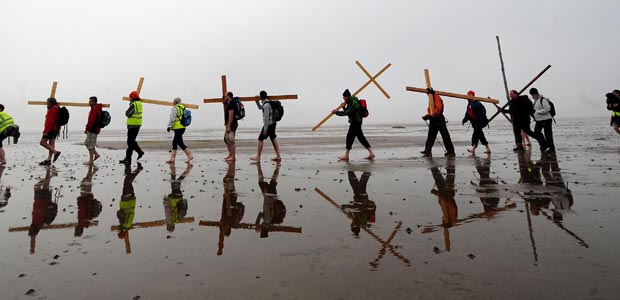
holy-island-easter-pilgrimage-image-2-435537650
After college, some of my high school friends settled down in their hometown of Concord, New Hampshire. They married and raised kids there, never venturing much beyond the Merrimack Valley. They rarely go anyplace special now either, except maybe to Manchester or Boston for a concert or a show once or twice a year.

The teenage kids I once taught in the Lower Mills section of Dorchester, a neighborhood of Boston, were even more circumscribed. Their known world dropped away as the MBTA’s Red Line reached Ashmont Station, Boston’ downtown as distant and daunting as the Indies. They had to be bribed to take a field trip with me to the Fine Arts Museum in the Fens. That trip, no more than 15 miles total, was about as far as any of them will ever travel in their lifetimes.

This sort of localized living was the norm in past generations. People died in the houses they were born in, stayed put in the same congregation, and accomplished the purpose of their existence in a few square miles.

I used to think that local lives were lesser lives for never having seen the world. Not so. Writer Richard Lischer puts it this way:

In my first parish, I ministered in a small rural community 50 miles from St. Louis. Most of my members rarely traveled as far as St, Louis, and their lives did not reflect the frenetic shifts so characteristic of American culture. In my three years in that parish, I never met anyone who was going someplace as the world measures mobility or advancement, but the whole congregation was rife with a sense of journey, and most accounted their life a great adventure. A woman named Annie was dying in the bedroom in which she was born, almost within view of the church cemetery where she would be buried. She had farmed her land, raised her kids and served her church. She had fought the good fight. What a ride! she seemed to say to me. All the way from baptism in Emmaus Lutheran Church to burial in Emmaus Lutheran Cemetery. What a journey my life has been!

This, he concludes, is the journey that counts.

Despite my own wanderings and multiple careers, I’ve rarely gone anyplace special myself, nor has any of us who moves from city to city, profession to profession, relationship to relationship, church to church, if we don’t know where we’re really headed and what it means to be going there. We all go no place special if what counts as travel is only the well-worn route up the ladder of success or down the road of self-preoccupation.

The season of Lent invites us to accompany Jesus (who spent 33 years in a place the size of New Jersey) on his journey to resurrection. Here is a different kind of mobility, a progress from starving hearts to milk and honey, from false selves to real ones, from estrangement to embrace.

It’s a group tour too, which is its special grace. Together, the whole church will make its way towards someplace really special. Through the mystery of self-gift, suffering, and death, we’ll rendezvous at an empty grave.

It’s the trip of a lifetime. Everyone can take it, without leaving home.