Our planet has come full circle, and things should feel new; yet for many people, the calendar is cleared only for business as usual, and the soul’s season, like the weather outside here in the northern hemisphere, is winter. But the church has entered a different season. We call it Epiphany, from a Greek word meaning to point out in a striking way, to reveal.
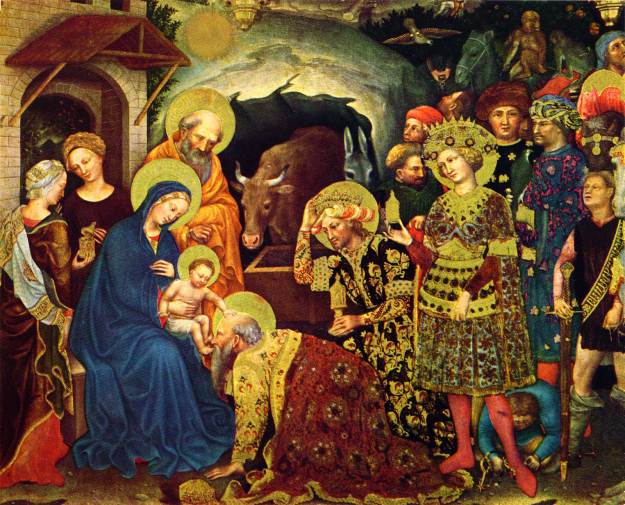
Epiphany is a season of signs. It starts with a Star in the East and ends with fire on a mountain. A season of voices, it starts with directions in a dream and ends with acknowledgment from a cloud. A season of unveiling, it starts with a glimpse of a baby’s skin and ends with a display of gleaming garments. A season of worship, it starts with the homage of kings and ends with the prostration of disciples.
How generous and wise the liturgy is to gives us this string of bright, hot God-sightings in a cold, dark time. It is the church’s way of showing us that our world only appears solid, still, dark, and cold, but is in fact ardent, vivid, and porous. As Barbara Brown Taylor says so eloquently, Epiphany reminds us that we live in a world that is leaking light, and that this long stretch of predictability we call our daily life is really a wondrous game of hide-and-seek with the divine.
Starfire, dream-clouds, baby’s flesh, garments of light, kings on their knees and disciples on their faces—in Epiphany we learn, again, to see, to listen, to worship, and to be called; for discipleship (we know, but too soon forget in our drive to be useful and productive) is as much about being spoken to as it is about speaking, as much about adoring as serving, as much about perceiving as doing, as much about being found as searching. Discipleship is born in awe, it arises from encounter, it is a consequence of worship.
Our planet has come full circle; but for us this does not mean just another round in an endless, futile turning of things. In this new year, we are not so much going around again as we are spiraling down and in, deeper and deeper. Spiraling down and in on a mystery. A mystery that calls to us to duck under the surface, to come and see, to taste and hear, to feel and know, to adore, and thus to follow.
In the fourth gospel, no story recounts the baptism of Jesus by the great Advent figure we call John the Baptist. The Evangelist refers to the day when the famous dove descended and a voice from heaven named Jesus “the beloved,” but nowhere does he tells us that John did anything that day except to be present and see it. The fourth gospel is not as interested in John the Baptist as it is in John the Witness. “I have come to testify,” John says.
That is why in Christian iconography the Forerunner is often depicted in a pointing pose. In some images, he is also given an unnaturally long index finger. Your eyes are compelled to follow along his outstretched or uplifted arm to the very end of that finger, which is precisely what John wants you to do, for beyond that finger is the most important thing of all.
There is no motion in these images: John is not preaching or immersing. He is not even scolding. He is pointing, implacably, to Someone there, here, “already among you,” he says. Someone we cannot see, Someone we need help seeing, in part because that Someone is so unremarkable (unsurprisingly so: after all, for thirty long years, he chose the same invisibility of ordinariness in which most human lives are cloaked); but also because we have trouble seeing truth in front of our eyes, truth hiding in plain sight, truth that is just too unvarnished and blunt for us to be willing to credit, truth so bracing it requires courage we do not possess of ourselves to embrace it.
And so the Witness points. He compels us to look. His help feels more like coercion; it is insistently intrusive and unpleasant, but without it we might not dare. He will not move an inch from the spot until we follow his oddly elongated finger to the object of his testimony.
That’s not the hard part, however. The hard part comes next, when we see what we see; because as compelling as the truth is, as candidly as it stands there looking back at us along the line of sight John’s finger describes, we can still decide not to see it, to look away, to avert our eyes in any one of a thousand practiced aversions—denial, fear, cowardice, exhaustion, nuanced abstraction…
To be willing to gaze at it as steadfastly as John points to it is a great grace, something to beg for every day on our knees; because the more we are willing to look, and the longer we are able to look, the more unblinking we will become, and the more we will grasp that John’s vocation is the most critical calling of all—the call to be a witness who will not move from the spot, will not lower the arm, will not retract the finger, will not permit any human heart its cherished evasions and its practiced aversions—intricate obfuscations, intellectual games, political posturing, power plays—but for a thousand thousand years if need be, will point and point and point.
Yesterday, a young man murdered his mother, 20 children, and several adults who were caring for them, and then he murdered himself. He murdered families and a school and a town and a nation. He took the life out of the world beyond the nation too. This “tragedy,” as we are so fond of calling all the world’s mass murders, did not “unfold,” as news anchors kept repeating all day: like all other mass murders (violence in our cities, war, starvation, poverty, drugs, financial manipulation, vast stolen wealth, the earth’s pollution) it was no passive accident, no random occurrence. There is something to see here, something to point to, something to be implacable about, a truth about what happened, a truth about ourselves.
Whose raised arm and long finger will show us what it is? Who will come up from this wilderness and spy the ordinary truth right in front of our eyes, the ordinary human and humanizing truth hiding in plain sight? Who will not cease pointing once the funerals end and the hue and cry has died away and the lobbies have cowed us once again? Who will not be moved?
In addition to four Sunday Advent services, many Christian congregations offer an extra service in the weeks leading up to Christmas. “Blue Christmas” services (as they are commonly called) came onto the Protestant liturgical scene in the mid-1990’s in pastoral consideration of the sadness, depression, loss, and estrangement many people report experiencing during a season of relentless cheer and family-centered celebrations. Normally held in the evening in mid-to-late Advent, these services are designed to acknowledge this pain and offer consolation in the form of worship that does not take for granted that all is well.
By many accounts, Blue Christmas services succeed beautifully in this aim. Many friends and acquaintances—and pastoral colleagues— express sincere gratitude that there is, as one put it, “a safe and sacred space” for people to name their sense of alienation or sadness, and to do so in the company of others whose experience of the season is similar. Blue Christmas services, they testify, more or less save their lives every year. I believe them. I’ve been to a few myself and can testify to their impact. All the same, I always feel an odd twinge of disappointment when the announcements of Blue Christmas services start popping up in church bulletins and on Facebook. There’s something about them, or perhaps better said, the fact that we do them, that gives me pause.
It’s hard to put my finger on the reasons for this niggling discomfort. Maybe it has to do with the way we have so quickly come to accept these services as the best or (dare I say?) the right way to address the pastoral situation that prompts them. There’s not been very much theological or liturgical reflection about Blue Christmas, other than the assertion that it serves a need. I don’t mean to imply that additional reflection will lead to a different conclusion; I mean to say only that whenever an innovation arises in the church—whether in doctrine, practice, or liturgy—it is worthy of reflection.
Change and innovation always offer gifts (which is why a lot of innovation-minded pastors keep telling their reluctant people that they should happily embrace them); but they often also offer some loss. It seems to me that the church should want to understand as clearly as it can what it stands to gain from an innovation, and what it might stand to lose.
I want to reflect on the “lose” part of this equation, not (I repeat) because I feel negatively towards Blue Christmas services, but because I think the “gain” part has already been articulated, perhaps not so much in theological essays or pastoral sermons, but in the sheer proliferation of these events. The faithful (and many seekers) have voted with their solace-seeking feet, and the verdict is in. It’s a gift to the church to be prompted to name and embrace a more nuanced and compassionate understanding of the human predicament in the seasons of Advent and Christmas. It’s of benefit to the church to ritualize a divine-human encounter that does not flinch from our weaknesses, thereby creating conditions of possibility for God’s grace to reach, comfort, encourage, and heal our broken hearts.
There are, however, critical questions that arise from the Blue Christmas phenomenon. Here’s one that comes up for me: I wonder if the proliferation of such services in Advent casts doubt on the liturgical adequacy of Advent itself, at least as the season is currently observed in many mainline Protestant churches. What is lacking in the Advent liturgy or the way we perform it that allows people to conclude that it isn’t designed to handle sorrow and loss? What does this say about our own assumptions about what the tone and content of our regular liturgy should be? What we are doing that makes it necessary to create new liturgy for the sole purpose of helping people in need of consolation and support navigate their loss and grief? Why are we steering people away, in a sense, from ordinary communal prayer and segregating their pain in separate services designed solely (or at least primarily) for the hurting?
In other words, are Blue Christmas services a sign of the failure of Advent and Christmas worship to address the full scope of human experience? Why doesn’t regular worship do for people what a special service appears to do?
If it turns out that our performance of the ordinary liturgy really is failing a significant segment of people, this is an important datum, and not a good one, because the Advent/Christmas cycle is aimed precisely at accommodating, embracing, comforting, reassuring, and reorienting a human race that has grown alienated from the source of its deepest joys. Through its classic texts, hymns, and prayers, it intends to move us all to face squarely the painful paradoxes of our human condition, the dashed hopes and deep fears of all the years, the grief of our losses and the tangle of our sins; and to clear an attentive compassionate and hopeful space for us to perceive a cry in the wilderness, lift our hearts to the footfall of a messenger on the mountain, and be charmed into new life by a lullaby of love and praise cooed over a newborn by a mother who has already had her fair share of losses, and will soon suffer even more.
The whole Advent/Christmas story is something of a downer, with its consciousness of lack and estrangement, its longing across seemingly unbridgeable distances, its village scandals, its particular hardships—occupation, cruelty, rejection, homelessness, poverty, infanticide and the kind of ageless grieving “that will not be comforted.” From this standpoint, every Advent and Christmas service is blue—and liturgically designed to make us face and negotiate the dislocations and fragmentations of life in frail and wounded flesh, as well as to find ourselves approached, embraced and remade by One who is coming, a fellow-sufferer who knows from the inside what we are made of, and whose compassion, therefore, is infinite, and infinitely healing.[i
If this is not the sort of liturgical encounter people are being invited into on Advent Sundays; if we have been playing down or obscuring the heartrending aspects of Advent and Christmas, cutting away its reference points of sin, pain, grief, and loss as if they were the unwelcome face of an ex-spouse in an old family photo; if we are reluctant to engage the very particular forms of human suffering the liturgy names in this season, in favor of focusing on the generic “wonder of children” (whose childish excitement then serves to circumscribe the range of acceptable emotional responses to the season), or on the warmth of family and friends, or on the cute pageant and the big anthem; if we eschew the telling human detail in favor of four weeks of universal (and often vague) concepts—hope, peace, joy, love—it’s no wonder that the woman whose husband just walked out on her, the young adult estranged from his family over his sexuality, or the 80-something fellow whose siblings and friends are dying off faster than he ever thought possible don’t dare weep in the back pew on Sundays, but decide to show up at a special Blue Christmas service instead, so that they can be who they are, feel what they feel, and sit with others who feel odd and out of joint not only in the mall, but also in the pews of their home congregations during the Advent and Christmas observance.
I am not suggesting that we turn Advent and Christmas Sunday morning worship services into a sallow, somber slog through every problem and pain known to humankind. There’s already enough pressure on pastors annually to produce a “perfect” Advent and Christmas that appeals, impossibly of course, to a thousand different tastes, preferences, age groups, and memories; and satisfies every conflicting and mutually exclusive felt (and loudly expressed) need. Besides, there is no quick fix for the church’s weakened liturgical sensibility (if a weakened sensibility is indeed part of the disquiet I feel and am trying to describe). Improvement will be slow and long-term, the product of ongoing reflection among pastors and people. The last thing I want to do is provoke anyone to re-think the plans for this year! I am suggesting, however, that the project of reinvesting regular worship with the tensions that make it “work” (at least potentially) for the serene and the troubled alike is a project worth shouldering—little by little, over time.
Worship that “works” for all, in season and out, requires a skillful interweaving, a sensitive rhythm if you will, of elements that affirm the best human values of culture and faith and open a space for the interrogation of those values by the gospel prayed, proclaimed, sung and confessed. This is probably way too simplistic, but for the sake of argument we might say that the ordinary liturgy of the season seems to do the happy, all is well, mythic stuff pretty well, and Blue Christmas services seem to have the sad, it isn’t all glorious, there’s another side to the story, wait a minute stuff down pat. We’d all be better off, however, if we could manage to do both in the same service, or over time in a series of services, not aiming for some phony “balance,” but in a way that mirrors the real life oscillations of soul anguish and body anguish we human beings experience in the midst of cheer, and the gladness and gratitude we are all in fact capable of knowing, even if it’s hard, in the midst of our pain. If we have lost this deft touch when it comes to creating worship that takes us on such an honest journey (liturgical scholars refers to it as the interplay of the “mythic” and the “parabolic”), we need to figure out how to recover it.
I like Blue Christmas services, but beyond their immediate usefulness to those who attend them, I wonder if they might have a more bracing purpose. Maybe they could serve as smelling salts for the liturgical practice of the churches. Maybe they could get us to wake up to the season’s inherent possibilities and draw out from our worship the full range of its concerns so that we will eventually have no need for extra services that make it too painfully apparent that right now, anyway, there is no room in the ordinary liturgical inn for the real hard griefs of real hurting people. The recovery of the ordinary liturgy’s intentions to be that welcoming house might someday reveal that the genius of Blue Christmas services, the key to their effectiveness, was not so much that they were new, but that they were old—they recovered a truth that ordinary Advent and Christmas Sunday worship had discarded, and bequeathed it back.
They recover a truth, but not every truth. Here’s another question I have about Blue Christmas services, returning to an assertion I made much earlier about separating the hurting out. Is there a sense in which providing Blue Christmas services steers people in distress away from the church’s ordinary communal prayer and segregates their pain in separate services designed for the hurting? If so, I find it ironic and worrisome, not because people do not need and deserve to have that pain honored and their grief supported during a time when everyone is busy throwing glitter over everything that smacks of trouble; but because the way Christians have always done this honoring and supporting of each other most effectively is indeed incommunity—but not in communities only of the hurting. The community in which support, consolation, and healing come to each of us most surely and most graciously is the whole community, the gathering of the joyous and the afflicted, the peaceful and the troubled, the faith-filled and the faith-emptied.
One vocation of the ordinary congregation it is to model a kind of wholeness not constituted by perfection, but by sharing, by the carrying of each other’s burdens, the carrying of each other’s ability or inability to believe and to respond, and even to feel; all of us learning to regard with awe, reverence, mercy, and compassion those among us who pray with empty hands. If those empty hands feel in any way ‘disappeared” or banished by congregations that can’t bear their presence in a supposedly happy season, Blue Christmas services may only help us evade a problem much bigger and more serious than seasonal disaffection.
It’s not for nothing that “Comfort, comfort ye my people, says the Lord,” is one of the most ringing liturgical refrains of the season. Iniquity is pardoned, warfare ended, alienation cured, grief and loss consoled, a promise of healing delivered to every broken heart. This is personal, but it’s more than personal: it’s first, last, and always communal. It is about you and me in our particular circumstances, but it isn’t just about you or me and our particular circumstances. If we treat people with seasonal distress solely as individuals with a peculiar individual problem, and not also as, in some deep sense, “common” folk with a common condition, one in which to some degree we all participate by virtue of our humanity, we may miss an opportunity for solidarity of the best kind. One of the greatest gifts and truths of Christian proclamation is that if we are made whole it is because we are inserted in a whole community, because we are together, all of us: we all require healing, and the healing of one is the healing of all.
Do we assume that the grieving can be consoled only by others who are similarly grieving, in their exact same condition? Is there relief only in the company of the like-minded or the similarly afflicted? The therapeutic tradition seems to say so, but the Christian tradition has never believed this to be true; indeed, if you credit Paul, it was precisely so that all barriers between us might fall and so that tribalism might give way to communion (even emotional and psychological tribalism) that Jesus was willing to accept death, even death on a cross. Segregating hurting people may be (certainly is) helpful, good, and necessary for a time; but it is not sufficient, it does not mature our congregational life, and it should not be our only response to the problem. In the long run, it may even add an extra burden of unnecessary isolation to the burden people are already carrying.
What a grace it would be for our Christian journey if in addition to dedicating time, creativity and pastoral sensitivity to the creation of these ancillary services, we also began the equally demanding pastoral work of shoring up the deep communal character of the season and helping all our people, the joyous and the afflicted, see themselves as engaging it in each other’s company, lending one another joy and hope, solidarity and consolation, depth and sobriety, moving through this complex time arm in arm with one another’s sorrows and joys.
I have many other questions about Blue Christmas services— e. g., Why are they invariably described as “powerful”? Is it because it’s at night and you get make things dark enough to light candles, and everybody loves candles and is moved by candlelight? Is it all “atmosphere”? If it is all or mostly atmosphere, is it also mostly emotion, and if so, will the benefits of this service stick, or will they go the way of most emotions? If we know how to do Blue Christmas services effectively, beautifully, deeply, with liturgical creativity and care—and apparently we do—why don’t we know how to do regular Advent and Christmas this way too? (Maybe we do, and I’m just being grouchy.) Are Blue Christmas services contributing, like self-fulfilling prophecies, to the need for Blue Christmas services? Are we in any way marketing sadness at Christmas? Is there a way compassionately and sensitively to help people develop disciplines of joy and gratitude through the observance of Advent and Christmas that will not mask, diminish or dishonor their loss and grief but anchor them in a truth more enduring and encompassing so that they can open themselves more fully to the One who comes “with healing in his wings”?—but I leave these questions and all the rest I’ve mused about here to your continued consideration—after the New Year and Epiphany!
Just trying to start a conversation. There’s plenty of time. And that’s all I got on my end of it, for now!
[i] Even on the third Sunday when the candle is pink and the admonition is to rejoice, there’s plenty of blue. Yes, we are told to rejoice, andto rejoice always, but that can mean only one thing—in good times and bad. The regular Advent liturgy is not oblivious to the fact that many people find cheerfulness nearly impossible in the Advent and Christmas seasons, or in any season for that matter, but wisdom is at work here. Precisely because we may lack the ability to feel cheer, the liturgy enjoins something different upon us—joy. Joy does not require that we feel or emote; it’s a gift and a virtue, available by grace and through practice to souls centered and un-centered alike. It arises not from external circumstances, but from the exercise of faith in the nearness of the Lord, whose approach makes the mountains clap their hands. (There are, of course, exceptions—a person who is deeply depressed or suicidal or suffering the first throes of a terrible grief will not likely be able to access the deepest reaches of the soul where joy resides, unaltered by circumstance. The regular Sunday liturgy nay not do much to accommodate their pain; it’s also unlikely that such grievously suffering folks will be comforted by a Blue Christmas service. Their predicament requires directed professional attention and support.)
Some congregations observe a sharp distinction between the seasons of Advent and Christmas. In Advent, they sing Advent songs. And pretty much only Advent songs. Which means that they don’t even start singing Christmas carols until everyone else is sick of them.
I’m glad some churches save Christmas songs for Christmas. Not only is it more liturgically correct (so say the purists)—it’s also safer. I’ve found that if you sing carols often enough, you actually start paying attention to the lyrics, and when you do that, you have questions. Take carols that sing about “Mary, Mother mild.” How many mothers do you know with crying infants at the breast who are ‘mild’? More like on the verge of a sleep-deprived nervous breakdown.
There are other dangers too, such as the invention of goofy lyrics. Sing carols long enough and sooner or later someone will wreck them for you. That old chestnut, “Good King Windshield Glass,” comes to mind, but I am particularly fond of “While shepherds washed their socks…”
While Shepherds washed their socks by night,
All seated ‘round the tub,
The Angel of the Lord came down
And gave them all a scrub.
And If you were ever in elementary school, you know this one:
We three Kings of Orient are
puffing on a rubber cigar.
It was loaded.
It exploded.
We two Kings…
That, by the way, is the American version. The Liverpool version is all about underwear sold in Hamilton Square for two pence a pair—So fantastic! No elastic! Not very safe to wear. And not very safe to sing, either.
But I digress.
There’s a downside to saving carols for Christmas. You don’t have much time to sing them, because the Christmas season is a mere blip on the annual liturgical screen, barely 2 weeks long (if you don’t combine it with the 4-8 weeks of Epiphany). And there are so many to sing! Thousands just in English alone!
All liturgical niceties and regulations notwithstanding, the sheer volume of carols and hymns is probably a good reason for sneaking a few in ahead of time. Here are three to start with.
I. The Huron Carol (“’Twas in the moon of wintertime”)
“The Huron Carol” was set to a 16th century French tune, but its words were composed in the Huron language by a Jesuit missionary to New France, or Eastern Canada, St. Jean de Brebeuf. De Brebeuf is among the most sympathetic of all the characters in the harrowing story of the 17th C. Jesuit mission to North America. He deeply loved the people he had been sent to evangelize, and like a good Jesuit, he made a serious effort to learn, document and preserve their language and the world of their imagination.
The carol he wrote quickly became part of Huron tradition. It was sung by Christian Hurons in Ontario until 1649, when the implacable Iroquois wiped out the Jesuit mission and drove most all the Hurons to Quebec. There the carol re-emerged and was eventually translated into English and French.
Originally called “Iesous Ahatonnia” (ee-sus a-ha-ton-nyah, Jesus, he is born), the English interpretation we have here is the work of the early 20th century Canadian music critic and choir master, Jesse Edgar Middleton. Middleton added images he thought would sound Indian, like the lodge of broken bark and the beaver pelts. Today these inauthentic “aboriginal” terms come across as Walt Disney-ish, even condescending. But the carol has nonetheless become something of a Canadian national treasure.
The Huron dialect in which it was written is now extinct, but we have a reliable reconstruction of the original hymn. It’s a text that shows the respect de Brebeuf had for the Huron converts as human beings and Christians. It also hints at the seriousness with which he must have wrestled with the perennial questions that arises in every encounter of civilizations—the possibilities and problems of learning to speak the language of the Stranger, in a way more profound than the mere mouthing of syntax and vocabulary.
It also makes me reflect on the ways in which God’s embrace of our human life, the Incarnation, is for us the emblem of all such border crossings. The living God in Jesus is the prototype of every encounter with the Other that inevitably changes us, them, and everything.
Here’s part of that literal translation:
Have courage, you who are humans;
Jesus, he is born.
Behold, the spirit who held us prisoners has fled.
Do not listen to it, it corrupts the spirits of our minds.
Jesus, he is born.
Sky people are coming with a message for us.
They are coming to say, “Be on top of life!”
Marie, she has just given birth.”
Jesus, he is born
Three elders have left to go there
Tichion, a star that has just appeared on the horizon,
leads them there
Jesus, he is born.
They found him, the one who is for them,
and he says, “Come here!”
Jesus, he is born.
They made a name many times, saying,
“Hurray, he is a good man.”
They greased his scalp, saying “Hurray.”
Jesus, he is born.
Let us show reverence for him
as he comes to be compassionate to us.
How providential it is that you love us
and that you say, ‘I should adopt them.’”
Jesus, he is born.
Listen to the Huron Carol….as performed by Chanticleer.
II. The Friendly Beasts (“Jesus our brother, kind and good”)
In the Christmas pageants of my youth, this longish carol was the traveling music for Mary and Joseph. It was also always a bone of contention. Its seven or eight verses got doled out to eleven and twelve-year old soloists. Invariably, the kid who got assigned the cow verse refused to sing it. Who wants to sing, “I,” said the cow…”? And if it wasn’t the cow, it was the ass. So in the interest of spreading the humiliation around equitably, when you sing it in your church be sure to have the whole congregation sing all the verses of this great galumphing little tune.
There are many opinions about its origins, but it was probably part of the medieval Festival of the Ass celebrating the flight of the Holy Family into Egypt, and was a regular Christmas observance in parts of France in the 13th century. During the mass of this festival, it was common for a live donkey to be led or ridden into the church.
The original song gives thanks for the donkey on which Mary rode into safety in Egypt, and begins: Orientis partibus Adventavit asinus (‘From the East the ass has come’). Each verse ended with the chorus ‘Hail, Sir Ass, hail’ and was punctuated with a rousing oh-heh, which is Latin for hee-haw.
I probably should not have said that, because now you’ll want to do that hee-haw part in church….
Oh, all right, do it.
From the East the donkey came,
Stout and strong as twenty men;
Ears like wings and eyes like flame,
Striding into Bethlehem.
Heh! Sir Ass, oh heh!
Faster than the deer he leapt,
With his burden on his back;
Though all other creatures slept,
Still the ass kept on his track.
Heh! Sir Ass, oh heh!
Still he draws his heavy load,
Fed on barley and rough hay;
Pulling on along the road.
Donkey, pull our sins away!
Heh! Sir Ass, oh heh!
Wrap him now in cloth of gold;
All rejoice who see him pass;
Mirth inhabit young and old
On this feast day of the ass.
Heh! Sir Ass, oh heh!
The carol as we have in our various hymbooks is an expanded and somewhat sentimentalized version of that original, and today it is regarded as a children’s song. But no matter how much fun was made around the figure of the donkey in the Middle Ages, the song was always meant as a serious tribute to a creature of God, without whom the work of our redemption would not have been possible. It speaks of the way God uses all the things God made to work God’s will and show God’s love.
What we might take from this carol, apart from the jolly spirits of the high Middle Ages, is a new sense that the salvation promised from of old encompasses not just the human creation, but all creation; that Christ was born into a real world that God really loves, and that everything in it, even some silly looking animals (like us!), is shot through with divine grandeur. In an age in which the ancient ice shelf is melting into the Arctic sea and the polar bear is on the endangered species list, that’s a good and necessary thing to sing about.
Listen to it here…
III. Go Tell It on the Mountain
This familiar spiritual was born in the oral culture of enslaved Africans in the American south. As is the case with most spirituals, its music and lyrics cannot be attributed to any one person, but “Go Tell It on the Mountain” has a peculiar association with The Fisk School, now Fisk University in Nashville.
The Fisk School was established in 1866 to educate everyone, including freedmen, but quickly became known as a school for African Americans. To raise money for Fisk, a group called the Jubilee Singers was formed and began touring the nation.
At first ridiculed for their unimpressive looks, the group eventually won the public over, and in seven years they were able to erase the school’s $150,000 debt. The songs they popularized were known as Jubilee Songs.
“Go Tell It on The Mountain” was one of two from their repertoire that have become household words (the other being “Swing Low, Sweet Chariot”).
African America composer John Wesley Work, who taught classics and history at Fisk, included it in a songbook he published in 1907, and it has been a staple of the Christmas repertory ever since. Work himself used to lead singers around the campus before sunrise on Christmas morning singing “Go Tell It on the Mountain,” as a way of announcing the good tidings of the day.
In thinking about this spiritual, I recalled that James Baldwin borrowed it for the title of his first novel, published in 1953. That book is a searing portrayal of black life in America, of lives horribly damaged by racism, and of a society confronting inevitable change in the civil rights movement.
It struck me that “Go Tell It on the Mountain” is no tinsel-thin holiday song, but the strong and resilient song of a people for whom good news has always been in short supply. The song of a people who endured unspeakable inhumanity as enslaved women and men, but still found the courage to endure even more as they stood up to act, and to demand that others act to recognize and respect their humanity—the same humanity that God was irrevocably committed to in the newborn flesh of Jesus. The song of a people who understood, in Baldwin’s words, that “To act is to be committed, and to be committed is to be in danger.” It’s not for nothing that in the 1960’s civil rights movement, “Go Tell IT..” was sung with the words, “Let my people go” substituting for “…that Jesus Christ is born.”
Whenever you sing this wonderful spiritual, pray that it will be a thick, strong song for you and your congregation too. And pray that when we go and tell the good news of Christmas on the mountain, over the hills and everywhere, we will by that act commit ourselves courageously to the redeeming danger of the gospel as well as to its resounding joy.
One of my favorite renditions, by Mahalia Jackson:
We are accustomed to think of Advent as a meditative season. Hushed by a vision of Mary pondering mysteries in her heart as the Child takes form in her womb, the Church grows still. Advent walks on tiptoe, a finger to its lips, trying not to distract her.
This is a season of deep night warmed by soft candles; an elegaic time of longing, for healing, for the reunion of human and divine, for justice, for enduring joy. Advent gives a voice to this perennial longing, but in a peaceful tone. It barely breathes. It does not speak above a whisper. It waits.
We crave the silence and the calm of these four weeks, and a quiet Advent is good for us, to be sure; but a quiet Advent is surprisingly out of kilter with the typical scriptures of the season. Their decibel level is high. They suggest a ruckus, not a retreat.
Right away, the very first week, stars fall from the sky, blood-streaked moons collide, nations groan in distress, thrown into a panic by the roaring of the ocean’s roiling waves. The heavens pass away in a reverse big bang, the elements dissolving in fire.
Once we get the apocalypse out of the way, we think the season will settle down. Not so. The Lectionary texts of the three liturgical cycles rev up the ruckus. They beg God to rip open the heavens and send down torrents of justice that hit the parched earth with ear-splitting force. The Lord comes, and mountains quake; fire erupts, crackling in brushwood; water heats up until it steams and boils
Advent is shrill with raised voices. There’s the Baptist crying in the wilderness and reaming out the brood of vipers. There’s the herald running across the high mountains announcing good news at the top of her lungs, “Here is your God!” And there’s singing, there’s lots of singing, enough exultation to keep the Daughter of Zion’s neighbors tossing and turning well into the wee hours.
No one gets any sleep in Advent texts; it’s a season for insomniacs—wake up, stay awake, watch, and keep watching, heads up, on your feet, the texts demand. Even the Virgin doesn’t sit still. The minute the angel leaves the room, Mary rushes off, up and over the Galilean hills, like that noisy herald, headed for her cousin’s house. And when she arrives, she breaks into (what else?) a great big stage number—a song so loud and disruptive it is echoing still. Meanwhile, in Elizabeth’s womb, John kicks hard with a fierce and leaping joy.
It’s a loud, vigorous, and purposeful season, if you go by the texts. God’s sleeves are rolled up, the Lord is harvesting, winnowing, clearing the threshing floor, gathering in the wheat. Sweaty blacksmiths are swinging heavy hammers on clanging anvils, beating swords into plowshares in stifling forges. Heavy equipment is all lined up for the Big Dig of God, ready to bulldoze, level, straighten, build.
What are we to make of this noisy Advent? Aren’t we already sleep-deprived? Aren’t we already over-busy and running on empty? Already too talkative, making too much noise in this world? We hardly need scriptural encouragement to talk more than we already talk, look busier than we already look. Is that what this is about? Do we need new texts for Advent that don’t make such a racket, texts that conform more nearly to our inclination to center in and hunker down?
No, not unless we want to mistake a mood for a truth. And the scriptural truth is this: Our healing is a long, hard labor; our salvation a heavy breathing affair. Its accomplishment is earth-shattering. The approach of God in the Child sets off a festival whose riotous glee shakes the stars from their fixtures in the ceiling of creation; and the justice that bores into the world through his appearance makes every creature sing. Long and loud.
We ought to be attentive and still in Advent. We should wait in patience and keep a finger to our lips. We do well to tiptoe softly and use our indoor voices; but if we hush up and cease from frenzy these four weeks, let it be only so that we can better hear the noise that saves us. Let it be so that we can better feel the vibrations of the work that heals us. It would be sad and ungrateful of us to try to shush the hubbub of this most noisy season. It would be sad and ungrateful of us not to love it for what it is—the crashing and banging the promises of God make as they all come true.
Advent is here. And I’m not sure I can make it through the season. That’s because I am growing impatient with a certain Advent sin often committed in the name of God in our churches. I have repented of this sin, but the fact I badly needed to repent of it tells me I will probably have to repent of it again, and so I am not exempting myself from my own warning about it. Just so that you know…
I would call it a pet peeve, but it’s more than an irritation arising from a personal preference or conviction. It’s more like a theological disquiet, even a bewilderment, an uneasy sense that we forget ourselves and the gospel when we routinely rant about the consumerist society in which we live, and by implication, deride and condemn everyone who participates in pre-Christmas ceremonies of buying and selling. I’m simply getting tired of listening to sermons in Advent that draw a sharp line between the bad world of getting and spending which barely acknowledges or even notices the reason for the season, and another good world in which none of that goes on and into which Jesus can be born properly, cleanly, to the sound of angels singing, not cash registers ringing.
Too often I’m left feeling shamed and abandoned by the church in this season, because I’m a human being like the ones I hear derided from the pulpit. I may not line up at 12 midnight on Black Friday, but I do get all caught up in commercialism and I am needy and I do want things and I do feel pressure to spend and I am certainly no Virgin Mary in Advent, rapt in pregnant contemplation in the quiet candlelight of my room during these four weeks. And if I, being a committed religious professional and all, feel shamed and condemned by anti-consumerist, world-deriding sermons, I can only imagine how it feels to a secular person who wanders into the pews to be told with divine authority that their secularity has rendered them unfit for Christmas.
Pray tell, dear preachers, where is that ‘other world’ in which people are pure and focused on the heart of the matter? (Certainly it’s not the church, which is as busy and as unfocused in this season as any heedless secularist or frantic shopper bent on the latest gadget at a door-busting price. Let the one who is without sin cast the first Christmas tree ornament.) Which world is it in which people do not need or want or try to get and try to please and try to make themselves feel better and try to escape the inevitability of their deaths? Is any of us who preaches against that bad world a citizen of some other country? No, because there is no such other world. There is only this one. And we are this world too. And we had better be. Because it is the world in which God finds us. God won’t find us anywhere else, so we ought not try to go someplace else, or lead others astray either, by telling them that the so-called secular, consumerist, commercially driven world is bad and wrong, or soon to be forsaken by God if we don’t shape up and stop buying things and having wild holiday parties.
It’s the world we have, the world we are given; and it’s a world of human creatures full of longings deep and powerful, longings for God, I would say, but so overlaid with weakness, frailty and the nagging effects of sin that we fix ourselves on needs and things that are not God. Things that are not against God, mind you; just not God. And because they are not God, our desires cannot be wholly satisfied by them. And so we keep going after other things and acquiring more things (you know how this goes—it’s your story too). But to say it is un-Christian to live like this is simply wrong. To say we have fallen into the hands of some consumerist Satan and are screwing everything up is wrong; even more, it is to miss the deeper drama. The drama God sees, the drama in which the Incarnation is the daring protagonist, the drama in which God and humans and all creatures are unaccountably finding each other, groping weirdly in the human dark by the light of desires great and small, guided and misguided, but desire for each other all the same.
It’s also wrong to imply further, as many do, that the things we lust after are bad. The things we want and need, even the things we lust after and don’t need, are not bad. Things are not bad. Materiality is not bad. Being material people is not bad and wrong. This is the way we were made, of stuff. God loves stuff. How many times do we have to be told? How much gospel do we need announced to us? And just how do we Christians who rant against stuff in Advent propose to bring people out of this bad consumerist world of stuff into that other world of purity and goodness when the very God we preach in Advent is working against us by incarnating in the world we seem to despise? Our God wants into the world we want out of—the messy, nasty, consumerist, commercial, over-sexed, greedy world is the world God loves. Remember that? Not condemns, but loves. It’s this world Jesus enters, because God loves it; and it’s in this world he lives and spends his last coin of compassion on us—this world, not some other. And it’s this world he will come again in glory to judge with a compassion so great we cannot imagine it, and because we can’t, we substitute our own judgments for his. (Ours are invariably harsh. His, invariably merciful.)
And why, at precisely the season when people are paying attention to the Story of a savior, of God’s love, of peace and justice and love—when secular people are paying attention, in their own Muzak, Hallmark, Santa Claus kind of way; not the way we might want them to, not necessarily in a churchy sort of way; but paying attention to the Story nonetheless, and with hearts softened towards it too—are we deriding them just for being people with great (if misdirected) desires, and driving them away with our anti-world rants? Isn’t it ironic that in the season of Incarnation we tell people from our pulpits that it is not okay to be fleshy? That it is wrong to want and need?
Instead of teaching people gently to order their every want and need to God so that they can live a life of want and need with gusto; instead of carefully and patiently unwrapping for them the truth of Augustine’s daring command: “Love, then do what you want,” we take these hearts that come to us longing to love in a headlong, heedless way (although right now they only know how to do it with things, which is a start, but only a start), and tell them they need to shrivel up and narrow down and set aside those lusts so that they can be truly “spiritual.” There is no such thing as “spirituality” for Christians, at least not without a robust body-ality to go with it. The hardest thing for us is not to become spiritual, after all—escapists have been doing that forever—but to become fully embodied and fully human.
And even if everything I say here is theologically full of shit, it doesn’t even make good church growth sense to get everybody in (church attendance almost always increases during Advent and Christmastide) just to ream everybody out. It’s one thing to take seriously the preacher’s duty to prick the conscience and provoke a change of heart; it’s quite another to take a world full of human desire, a church full of longing hearts—frenzied and misguided to be sure, but good, very good—and tell it to go to hell.
Advent is here. Please don’t tell me not to be human. And don’t tell God that some great cosmic mistake was made when God chose flesh, this world, and us, and pitched a tent among us.
It means, “God willing,” and all the Muslims I know punctuate ordinary conversation with it repeatedly. In its most pious use, it’s an expression of humility acknowledging the paltry power we mortals have to make things happen they way we want them to. “Man proposes, God disposes,” as the Christian saying goes—inshallah, if God wills. The future is not in our hands. Tomorrow for lunch? Inshallah. See you at the game tonight? Inshallah. I’m working till six and then, inshallah, I’ll head home. In other words, here’s my plan, but you never know: God may have a different idea.
Our guide in Morocco was an inshallah kind of guy. Every morning on the bus he turned on the sound system, rapped the microphone a couple of times to be sure it was working, and ran down the schedule for the day. Every other word was inshallah. A religious man, the expression came naturally to him; but it was, I think, more than a pious reflex. It was also his way of dashing our American expectations of efficiency—Morocco does not exactly run on clock time; schedules are always approximate; the way things will actually work out is anybody’s guess.
The tour company’s materials urged us to relax into the “full Moroccan cultural experience.” Whatever else that meant, it soon became obvious that it covered a couple of promised activities that never materialized and more than a couple that became so prolonged they ate up all the time set aside for rest and exploration “on your own.”
When I was at my best, I tried to use the inshallah-ness of everything as a chastening exercise: You are in the hands of others now. Leave your inner control freak behind. Don’t feed your disappointment with complaint. Enjoy not being in charge for a change. Let yourself be surprised. Who knows what you will discover? You can sleep when you get home. But my efforts waned fast. I was too exhausted to summon myself to carefree heights.
I began to wonder if all the emphasis on entering the full Moroccan experience was just a dodge for really bad planning. I wasn’t the only one. Nearly all of us were getting sick, and the worst sufferers begged repeatedly to stick closer to the schedule or maybe even to curtail a few of the less important things (one fewer visit, perhaps, to a cosmetic shop, a carpet shop, the jeweler’s….) so that we could get some rest.
That’s when we learned that inshallah can also mean “maybe,” but more often just means “no.” It’s a weasel word, the sleight of hand employed in cultures that are almost perversely committed to making you happy, even against your will. The assumption seems to be that no human being ever wants to be told no, and therefore one must always leave open the chance of success in the other person’s mind, even when you know perfectly well you’ll do nothing to make it happen. It’s also flagrantly paternalistic, of course, assuming as it does that the client has no idea what he really wants, or what she really needs. How could you not want to visit another cooperative? It is a highlight of the trip (as were almost all the other venues listed on our itinerary)! Why would you want to rest when there are so many fascinating experiences to be had?
When our guide pulled that last one on me over supper one night, I was at my wits’ end. Testily, I replied that, indeed, I was certain there are millions of fascinating experience to be had in Morocco, and millions more to be had in the big wide world; but that being a mortal with only one life, I was also certain I would be missing most of them; and having long ago resigned myself to this limitation, I was not about to get avaricious now— so could I please skip the henna shop experience and go to my much-neglected bed?
After a couple of days in a desert encampment, we packed up the 4x4s and headed for the town of Tinghir. The dusty, bone-jarring track out of the Sahara took us past a couple of nondescript villages, each with no more than half a dozen dwellings, a date palm or two, and an overloaded mule. When we came to a third such village, we barely gave it a glance; but as we were passing by, waving to some children who’d run out to gawk at us, the drivers pulled over. Our guide indicated that this was a stop, and so we tumbled out to look around.
What we saw was about a half acre of hard sand dotted with thousands of stones that appeared randomly strewn. We’d come upon a cemetery; the stones that seemed haphazard were markers on burial sites. Perpendicular stones signified males, horizontal stones, females. You could tell adults from children by the length of the mounds of hard sand heaped over the grave.
There were little bowls of pebbles on many of the graves. We speculated grandly about their meaning until our guide came up, shrugged, and explained that the pebbles were just to keep the bowls—receptacles for flowers and other memorial gifts—from blowing away in sandstorms.
Only three among all the graves bore the name of the person whose remains lay under the mounds. The rest were unmarked, similar in every respect. Identification of the dead, our guide reminded us, is forbidden among traditional believers for whom the democracy of death is a truth that needs teaching as often and by as many methods as possible—especially in places like this, where life’s cruel inequalities are crushingly apparent, and death is the only thing you can’t buy off with money.
The insistent anonymity of these graves rattled several people in our group. The prospect of being stripped of singularity after spending a lifetime trying so hard to achieve it was befuddling. Besides, most of us were bearing up fairly well in the face of life’s inequalities and felt no need to pull back the curtain on the fiction of our distinctiveness. It was all too candid and bleak. Several people were not sorry when the guide moved us along.
He pointed to a low adobe structure at the edge of the cemetery. Another shrine to another local saint. “Let’s go see it,” he said. We’d seen many shrines by this time, which explained the soft groans and slumped shoulders that greeted his suggestion. Like all tour groups everywhere, however, we trudged dutifully behind him.
The saint was buried inside the unadorned hut. Worse than unadorned, it seemed neglected, dark and close and (of course) full of cats. There was no light inside except for the brightness at the open door, which we had tugged halfway off its hinges when we came in. This seemed an unlikely place for veneration. One of us wondered aloud, “Does anyone even come here anymore?” As if on cue, three teenage boys materialized in the doorway.
They had seen us meandering around the cemetery, and watched as we entered the shrine. Now like gushy representatives of the Chamber of Commerce, they wanted to tell us all about it. “The saint answers many kinds of prayers,” they explained, “but specializes in women who cannot conceive. They come in all the time. They sit here all day. They eat and pray. They ask for children, and the saint hears them.”
“Do you mean they get pregnant and have babies after they pray here?” This from the one declared atheist in our group. “Do you believe that? That the saint works miracles?” The boys did not seem to understand the question. Neither did our guide. They said again, “They come, they pray, the saint hears them.”
By this time, our eyes had grown accustomed to the dark. We could now see the walls. They were patched and sooty and covered with graffiti. The guide said these were requests for help, reports of success, thanks for favors, but among the more devout scrawls we were sure there were also a few that told the world “Mustafa was here” and “Ali loves Faiza.” The more the guide denied it, the more convinced we became.
And then we saw the hands, dozens and dozens of small palm prints in bright henna stamped on the walls like Paleolithic cave drawings. These were women’s hands, supplicating, declaring presence and need, tattoos of trouble, imprints of hope.
The boys didn’t know how long they had been there, whether they were fresh or ancient, but said they did not remember a time without them.
Yes, I thought, that’s because there never has been a time without them. Here in this shrine or anywhere else.
And just like the graves outside, and like the human need they conveyed, the small red hands were anonymous, almost interchangeable, absolutely democratic in desire.
We were barely off the airplane in Casablanca when we noticed the cats. You couldn’t not notice the cats. They were everywhere, all the time, street cats with the hungry look of street cats, brazen and intrusive in tourist venues, city shops, and roadside cafes. But cute, always cute, especially the little ones; so cute that even the inevitable germophobe in the group risked the assault of unspeakable miseries to pet them.
In European cities like Rome, feral cats don’t often win local hearts, but the cats we saw in Morocco seemed not unwelcome. Tourists weren’t the only ones making mewing noises to signal the imminent drop of scraps from restaurant tables. Shallow bowls of water were set out everywhere too, even in the middle of what seemed like nowhere.
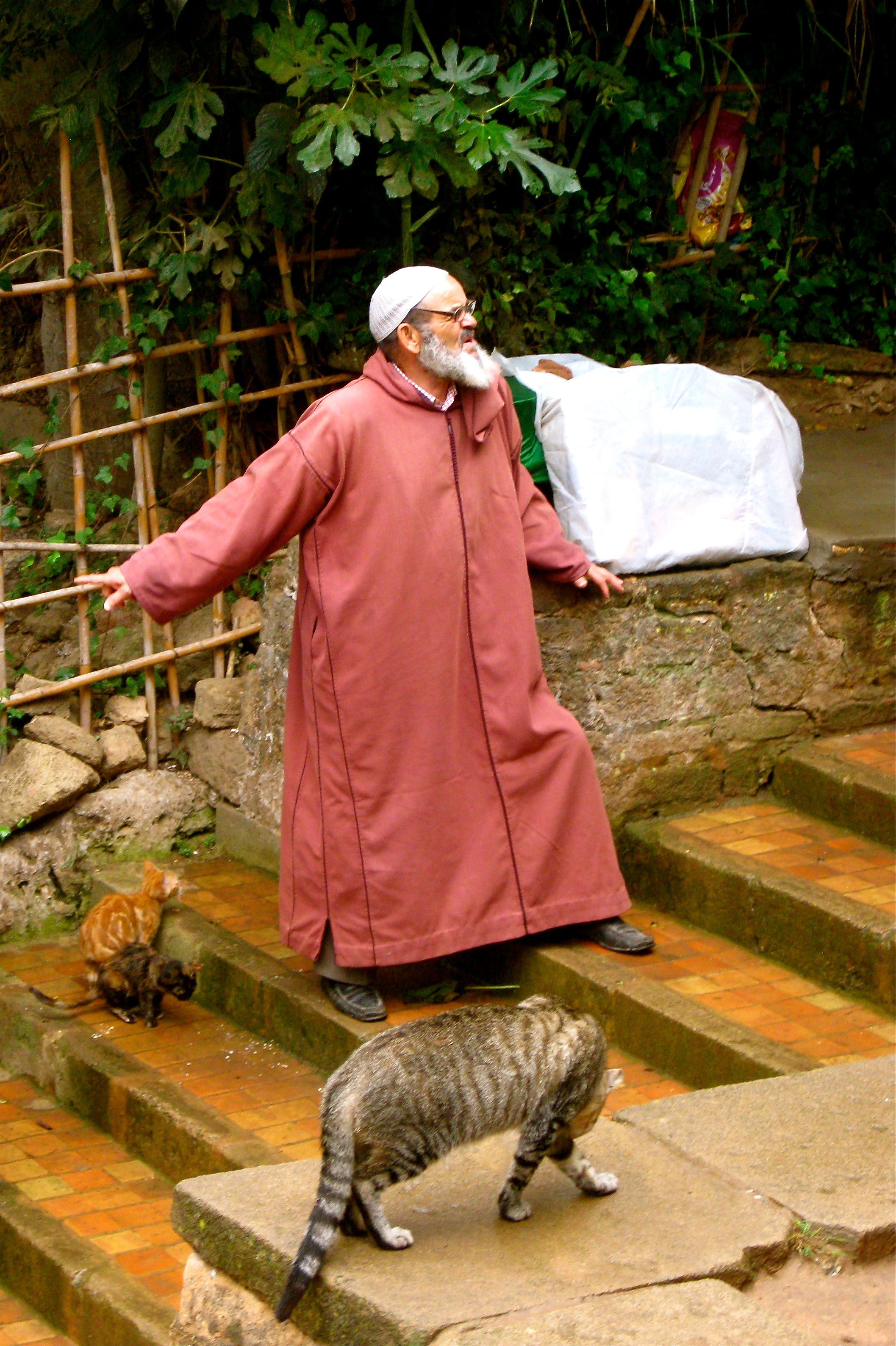
On a showery day in Rabat, we came across an old man inside the 14th century Chellah Necropolis. He was the unofficial guardian of a shrine inside the grounds. Devout Sunni Moroccans routinely deposit their raw needs at the feet of long-dead holy ones at such shrines, in hope of answered prayer, much like the Berber “pagans” and Christians in North Africa did before Islam arrived. Don’t ask me now which saint was venerated in that small dark room, there were so many shrines along the way, some imposing and ornate, but most as forlorn as the people who trudge to them. And they are filled with cats. The shrine in the Necropolis had its ample share, and the guardian fed and watered them every day, asking alms from visitors to offset the cost of his mercy.
He’d been there too many years to count, he told us, and so had most of the cats. They were his preoccupation. When a man in our group asked the obvious “Why?”, the guardian told us one of those short, slight stories that explain everything to those whose hearts want to know.
“Once upon a time, the Prophet awoke at the sound of the call to prayer and went to put on his best robe in order to pray. But he discovered that a cat, whose name was Muezza, was sound asleep on the sleeve. Rather than wake her, he got a pair of scissors and cut off the sleeve, leaving her there undisturbed.”
I liked that story very much, but it was another legend we heard in another town that captured my heart. Forgive me, Muhammed, but I think I fell for it so hard because it sounded a lot like a story Jesus would tell; and as much as I respect you, I am a hopeless sucker for him. Anyway, my Christian chauvinism aside, here it is:
“A woman with a bad reputation was returning from a night of debauchery when she saw a cat in the road. The wretched thing was starving, very close to death. The wicked woman ran into her house and filled one of her jeweled slippers with water, returned to the street, and set the slipper down before him. The cat drank and lived. Many years later, a holy man of that same town died and entered Paradise. There he saw the woman and was astonished. He asked the Prophet how it was she had found mercy. The prophet said, ‘Because she showed mercy, even to a cat.’”
Under my breath, I said (for my own instruction), “Go and do likewise.”
The first morning of our stay in Essaouira, our breakfast waiter met us at the dining room door to steer us to the table reserved for our small group of travelers. To our surprise, he did not seat us in the dining room. He led us instead to a table he had set for us, and for us alone, on an outdoor terrace overlooking the ocean.
You could tell he was pleased with himself: the smile that spread over his face when he saw our delight was positively beatific. “This will be your table every day,” he announced. “My name is Aziz.”
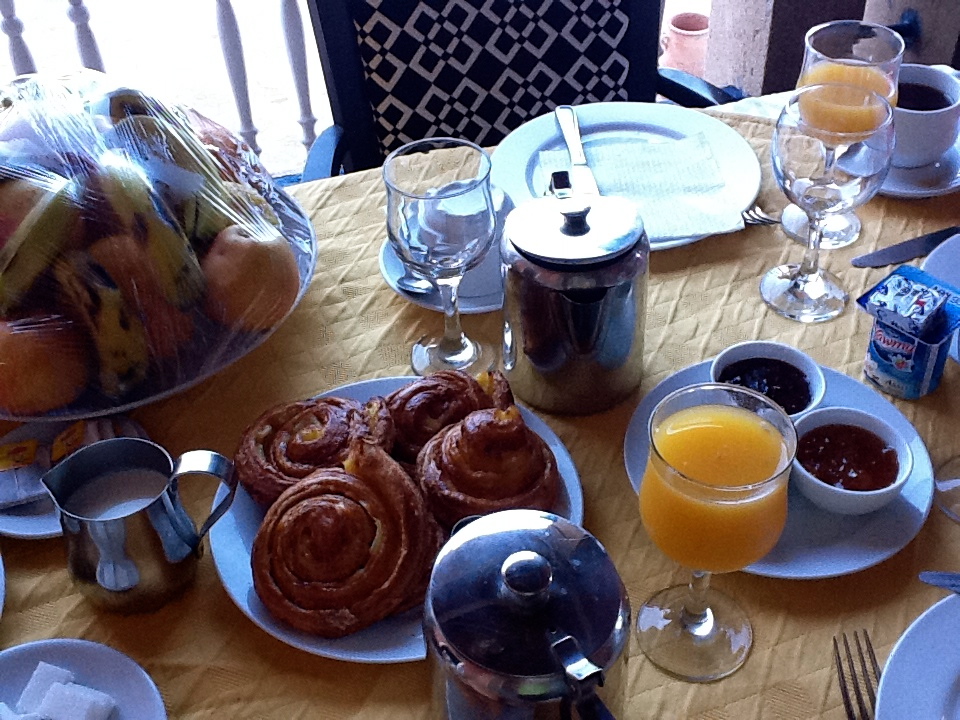
Aziz spoke Arabic, Berber and French, Morocco’s three official languages; he also spoke some German, pretty good Spanish, and passable English. In all these languages he was unfailingly exotic, old fashioned, over the top. He executed the most amazing flourishes and deep bows as he set down plate after plate of breakfast breads and pastries, huge bowls of fruit, hot coffee and milk, and fresh squeezed juice. Voilà. Voilà. Voilà.
He also made sure he learned our names so that he could greet us personally as we came to breakfast and inquire solicitously about our sleep and our health. Aziz was a quick study, and before we knew it, he had associated songs with some of our names, literary snatches with others, movie references to the rest. Even the bleary-eyed “I am not a morning person” member of our group was completely charmed by him when he broke into song or recited some corny verse tailored to her alone.
The cynic in me was tempted to think of Aziz as an astute showman who had figured out that Americans are suckers for this sort of local color and tip accordingly. And there was probably some of that in his behaviors. But I didn’t care. It’s not every day someone treats you like exalted royalty, let alone like a simple human being. It did wonders for me, who felt depleted and just this side of depressed at this point in the journey. I needed everything Aziz had to offer.
This was the morning dialogue he used with me:
“How are you today, Mary?”
“I’m fine, thank you, Aziz. How are you?”
“I am well if you are well, Mary. I am well if you are well.“
Of course I believed him.
When he flashed that smile, I had no doubt that his wellbeing hung on the thread of my own, his pleasure weighed in the balance with my delight. Of course he could not and would nor be happy if I were not, and so I resolved to be well for his sake. And for my own.
And of course on the last morning I slipped a very large bill into the pages of the memory book he begged us to sign with all his customary theatre and his brilliant, brilliant smile.






















 Sicut Locutus Est