
Category Archives: Miscellaneous Commentary

The Poor You Will Always Have With You [Matthew 26:11]


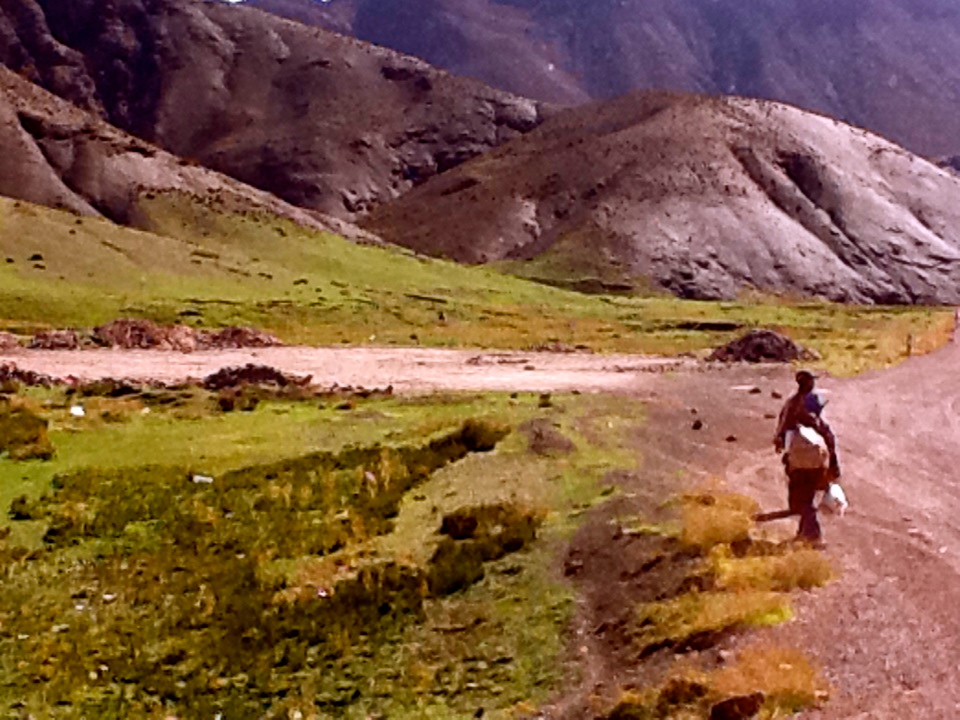
It wasn’t a very good lunch. The sweet, hard-working cook at our Sahara encampment had boxed it up for us to eat when we stopped for a break on the road through the High Atlas Mountains, but it didn’t represent his finest work. Inside each plastic bag was a slab of generic yellow cheese, 4 or 5 spicy green olives, an overcooked hardboiled egg (yes, you can overcook a hardboiled egg), two slices of pink mystery meat—the oddest and most forbidding cold-cuts I have ever seen— and one really beat up apple.

I ate mostly bread that afternoon. So did everyone else in the group. There was a lot of food left over.

By this point in our trip we’d been well schooled to throw nothing away. It was the custom to give leftovers to the poor, and we’d been doing that routinely in every city and town. We’d leave a restaurant or café with our remaining bread or meat or fruit wrapped up in napkins and hand it to the first person on the street who approached us begging. There were many such people, and no one ever refused our grease-stained packages.

But now we were deep in the High Atlas. We had gone for miles, hours, without seeing a soul. Most of us were so concentrated on the hairpin turns of the switchbacks we would probably not have noticed such a soul anyway, even if she had materialized atop the sheer cliffs or risen from the dry canyon floor below.

Our leftover lunches would be pretty disgusting by the time we reached a town. Not fit even for the poor, one person said. I recalled some of the beggars we’d seen, and doubted they would find even rancid food unfit. Nonetheless, the point was well taken—this stuff would probably go to waste on this part of the trip.

Someone else quipped that when Jesus said, “The poor you will always have with you,” he had not been on a bus in the middle of nowhere. General merriment ensued. I bit my tongue. The group had proven itself fairly impervious to nuance and complexity thus far, and there was not much hope things would change now.

A half hour later, when we had turned our minds to other things, our driver suddenly slowed the bus and pulled over. We didn’t know why. We looked out the windows, but saw only the same brown cliffs and hardscrabble valleys we’d been viewing for hours. But the driver waited. After about two minutes he said, “The lunches, the lunches.”

Our guide started collecting all the leftovers into one large bag. The driver opened the door and let him off. He ran down the road back in the direction we’d just come, jumped the low guardrail (which guarded nothing, really, just marked the edge of the narrow road) and started up a path into the hills; when out of nowhere—really, out of nowhere—a shepherd appeared. He strode nimbly down the hill and raised his arm in greeting, the only human being we’d seen for what seemed like a hundred miles.

There was an embrace and a kiss on both cheeks. When the food was proffered, the shepherd placed his right hand over his heart and patted it twice. The he took the bag, turned on his heel, and melted back into the rock, like a genie sucked back into his lantern. Our guide ran back to the bus and climbed on. The driver pulled back onto the road and smartly negotiated the next hairpin.

And I didn’t start breathing again until we came to the next pit stop, thirty kilometers down that winding road.


Which One of You, Having a Cow…? [Luke 14:5]

She got here the way

we all do, tripped up by fate,

or lured by the promise of more;

the same way we all do,

through a hole in a fence

she needed to squeeze through

because the grass was greener

on the other side;

or because so many grackles

suddenly rose in a loud

shudder of wings and caws

from that irresistible ditch.

She got here the way we all do,

tripped up, led on, curious,

ignorant of the laws of gravity,

or defiant of them and of all

the things our mothers told us.

At the brink, at the height

of freedom and enjoyment,

just this far from smelling

the clover, her knees buckled

and she fell in.

Now, like the pitiable rest of us

wedged between steep sides

looking up at sky, she is

terrified and breathing hard.

It’s not a day appointed for rescues,

but she got here the way we all do;

so you over there, retrieve the ladder,

and you, the harness and ropes.

And will someone please make

coffee?  We’re bound to be here all night.

St. Peter’s Fish [Matthew 17:24-27]

I think he misses fishing. In a boat, he knew what he was doing. After the keel grated across sand and they were off, he was at home. Out on the water in the wee hours, there wasn’t much he needed to say to others who worked alongside. Casting nets under stars required stamina, not conversation.

Now he has to talk a lot more than he’s used to. He gets himself in trouble every time he opens his mouth. On land, forgive me, he is a fish out of water. This time it’s the tax. They asked him, and he answered hotly, without skipping a beat  —  the teacher pays his due. But he didn’t know if what he said was true.

Jesus is indulgent. As if he knows Peter will soon be telling a bigger lie by the light of courtyard fires. If he can forgive him that whopper (and he will), he can forgive this little fish story. Jesus will make good. He will pay the tax. For Peter. And to avoid offense. That’s why, having put his foot in his mouth, Peter is coming down here to discover what’s in mine.

Soon he’ll be dropping in a line, fishing again. And all I ask in return for this favor, Lord—for this neat trick we concocted to save his face—is that, after removing the coin, he might take the hook out too, and throw me back.

What If…? Jesus and the Syro-Phoenician Woman

Mark 7:24-37

In my Bible, this passage has a bold-print heading that says it’s about ‘the Syrophoenecian woman’s faith.’ But I’m not exactly sure what the editors think ‘faith’ is in this story. Are they referring to the way the woman threw herself at Jesus’ feet? Maybe to them that’s ‘faith’—to want something so much it drives you to your knees.

Faith or not, it was high drama, but Jesus still said no.

He was hiding out in Gentile territory like an overexposed celebrity avoiding his fans, and she intruded. But that’s not why he told her no. He refused her because she was the wrong kind, the wrong religion, the wrong nationality. He said, in effect, “Don’t come crying to me, you dog.”

She didn’t budge. Maybe that’s what the editors call ‘faith’—pigheadedness, willfulness that won’t take no for an answer. Maybe. But if so, they should have entitled it, “The Syrophoenician woman’s chutzpah.”

Or maybe ‘faith’ means she just got fed up. If all this happened the way Mark says it did, she must have been furious when Jesus called her a dog. ‘OK. Two can play this game,’ she might have said. When she came back at him with that crack about crumbs from the table, Jesus threw in the towel: ‘For saying that, you win,’ he said. ‘Your daughter’s demon is gone.’

I’ll bet she didn’t thank him. I’ll bet she just turned around and went home. The Syrophoenecian woman’s faith. Well, maybe, but maybe it was mostly that she got annoyed. The way Jesus treated her, it’s a wonder they didn’t call this section, “Jesus acts out,” or  “Chapter 7, in which Jesus gets up on the wrong side of the bed.”

Or maybe even “Jesus the bigot.” After all, his first impulse was to withhold from a foreigner the health he’d given to his own people, and that sounds like bigotry to me. But maybe not. Maybe he intended to help her all along and was just testing her first, upping the emotional ante to make her strut her stuff, to show what she was made of.
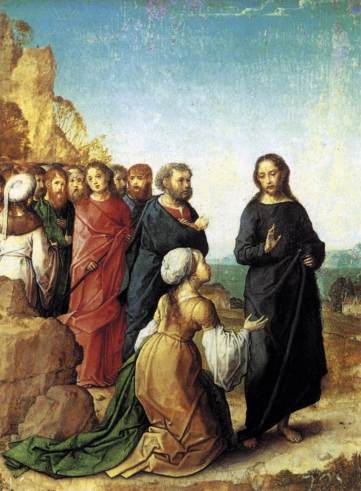
I had an Italian Catholic grandmother whose daughters, my aunties, were talking about birth control over coffee in her kitchen one day. They were confessing that they felt guilty about using the pill. ‘Oh, don’t worry about it,’ she told them.

‘But,’ they said, ‘the pope says it’s a sin!’

‘I know he said it,’ she replied, ‘but he doesn’t really mean it.’

Maybe Jesus didn’t really mean it either. Maybe when he said no, he was just toeing the public party line. Or maybe I’m missing something because I’m just speculating. Maybe more exegesis would help. Maybe a word study. You probably already know this, for example: Jesus didn’t say ‘dog’ exactly; he said ‘puppy.’ The slur he used for that woman and her kind had endearing overtones.

Feel better? I don’t. Jesus’ answer was still no. There’s no way around it. Unlike the pope, he meant it. His ministry was not for the likes of her.

At the time this story was written down, Mark’s church may have been fighting about whether to admit all comers without restrictions, or to enforce limits and conditions of membership. Reading between the lines, it seems Mark favored a big tent approach. Maybe this story is PR for that opinion. ‘Brothers and sisters,’ he could be saying, ‘Jesus started out thinking it best to restrict his ministry to his own kind; but a Gentile woman (you heard me, a Gentile woman) made him see a bigger picture. Now, if Jesus could see it, why can’t we?’

Maybe Jesus is Mark’s trump card, the converted champion of an open door. If Mark had written the heading for his story, maybe it would’ve been, ‘WWJD?’ or ‘Touched by a Gentile.’

But the editors of my Bible called this story, ‘The Syrophoenecian woman’s faith.’ She’s the one who interests them. So let’s get back to her.

For her daughter’s sake she’s willing to accept Jesus’ disdain, but only up to a point, and she doesn’t have to like it. She gets annoyed, gives as good as she gets, does whatever it takes, and gets what she came for.

She’s fabulous. And she reminds me of God.

Now, when we hear gospel stories we tend to look for clues to the character of God in what Jesus says and does. We tend to identify with the uncomprehending disciples, the sick in need of healing, the lamb who goes astray, the prodigal child ashamed of his life. But what if in this story Jesus represents us—myopic, a little smug and in need of a breakthrough, people with all the answers?

What if in this story Jesus stands for us—constrained, seeing the world in far too circumscribed a way, and thus inhospitable, ungracious, unable to entertain new persons and new ideas?

What if Jesus stands for the way we act when we’re scared, the way we cling to what we’ve always known, the way we dig in instinctively to defend what worked before when the first serious challenge to the usual arrangement threatens to blow old assumptions out of the water?

Maybe in this story Jesus is us—human beings in need of breakthrough. And maybe the woman is God.

But if she is God, a patient, tender and compassionate God she’s not. Not the nice God we prefer—understanding, open-handed—who gives us space to fail and grow. This God’s willing to take insult and suffer our neglect, but only up to a point, and she doesn’t have to like it. She gets annoyed, fed up, gives as good as she gets.

She’s the God who intrudes and won’t budge until we throw in the towel and give her what she wants—namely, that we change our minds, enlarge our vision, expand our mission, and share a life of utmost generosity with all comers.

She will do whatever it takes to get what she wants from us—a commitment to heal her suffering daughters and her ailing sons, to extend the healing beyond our own kind, beyond our well-known and well-defended boundaries.

Our God is gentle and kind and patient, the Bible says. And that’s a God you and I need and depend on. But I think the Bible says that God is also a Syrophoenecian woman who won’t take no for an answer.

She’s a dog too, but that, it turns out, is no slur—it’s a saving grace, if, that is, you agree with me that this section of Mark’s gospel should be entitled, ‘The divine bird-dog,’ or, ‘The hound of heaven.’

Whatever she is, she is no shrinking violet. She makes a formidable claim on us. And she continues to do whatever it takes to create in us an ever larger heart, to motivate us to an even larger embrace of the world. Her indefatigable purpose is healing, the integrity of life, justice in the nations; and she will keep at it until, in Isaiah’s words, the wilderness is in bloom, eyes shed no more tears, and no one and nothing wicked accosts us on the highways of life.

She brooks no vacillation on our part, no doubts about whether we can or should grow and change and commit to her cause. She has no personal space issues either; she is so near she came in the flesh and now indwells us.

She will not cease to breathe down our necks and beg at our feet until we have to go and tell her story, until we are not the only ones who give her what she came for, not the only ones who throw in the towel to the saving grace she offers, not the only ones who see her coming and rejoice.

The Strained Gnat [Matthew 23:24]


The moral, of course, is not to cultivate a habit of

scrupulosity about detail when it comes to sinning

while allowing yourself some serious whoppers.

To condemn the drinking of bugs with camel hairs

sticking out between your teeth is at best ridiculous.

The Law is holy, sweet and good: it will keep you.

The point is not to miss the point.

But you must not therefore conclude that Jesus teaches

not to strain the gnat. You still have to haul out

magnifier and mesh. You still have to angle the lamp just so

to give yourself sufficient light, she is so small.

You have to do this, for one thing, because

she is a creature that swarms upon the earth, and

Leviticus says for your own good you may not eat her

whole or drink her residue in the water she brewed in

after dropping terrified onto the roiling surface of the pot;

and, for another, because there’s always a chance

she might still be alive. For what good shepherd

does not leave the ninety-nine when one lost lamb

might still be bleating far away? And what sad boy,

finding himself in hot water, does not dream

he has a father who will pluck him from the deep?

Goats on the Left [Matthew 25]

The goats do not go off to hell because they are goats

or because they are inferior to  sheep

or because Jesus liked sheep better than goats.

The goats do not go off to hell at all: nations do, it says,

peoples who are stingy with water and food

and keep themselves warm and let others freeze

and visit no one in prison because people in prison

are horrible and do not deserve any visits.

The goats do not go off to hell: peoples who get

huffy and hurt and defiant and finally menacing

when someone says, what about poor people?—

they are the ones the implacable angels drive into

fire on the awesome Day when the Judge calls

everyone together for the sifting of wheat and tares.

It could just as well be the fat sheep

who do not make Christ’s cut of kindness

and the wiry goats who get the happy welcome home.

As adorable as most lambs are and as bad-tempered

as some goats can be, being sheep or goats

has nothing to do with why Jesus is telling the story

and what he means.  They are stand–ins:

 the goats do not go off to hell because they are goats,

but because they are nations that have not been

as human as humans should be.

The Lord Needs Them [Matthew 21:1-6]

It’s strange, to be sure, prompting many a doubt,

and even the scholars can’t figure it out

why Matthew, who no one would say is a dolt,

made Christ ride a donkey as well as her colt.

 Perhaps it was whimsy, just Matt being droll,

to mount the Messiah on filly and foal;

or maybe he found himself tied in a knot

when trying to make every tittle and jot

of prophecies old a meticulous fit

and didn’t know quite how to edit or quit

when verses came up that said “riding on two.”

We just can’t be certain, we don’t have a clue

why Christ so specifically (joking aside)

wants mother and offspring alike for his ride.

The question is open for you to opine

and your guess is good as the guess that is mine:

So I think that Jesus (this theory’s my own),

who knew what it’s like to be left all alone,

imagined the jenny apart from her foal

and felt donkey anguish knife into his soul,

and being a Mother himself, and so kind,

could simply not bear to leave baby behind.

The Swine Stick in My Mind [Mark 5:13]

It’s unbiblical to be sentimental

about swine. We are talking about

a herd of unromantic

Gentile meat and money, not

a herd of barnyard Wilburs,

pink and plump,

with plucky spiders for friends.

That said, the pigs stick in my mind.

I read commentaries.

I know the ways of different cultures,

ancient worldviews.

I understand the politics,

the story’s ethical edges.

Its justice dimensions have

preaching potential.

I should warm to it but

I hate what happened to the pigs.

I know that a bedeviled man

who was deader than

the corpses in the graveyard

where he spent his nights and days

in lacerating pain now sits adoring

at your feet, serene and safe.

It moves me that you thought

his sad hidden life

worth saving,

worth it too the ire of hard rustic men

who watched big money drown

in churning seas that day,

but this is still

one of those stories

I wish

no one had recorded.

The pigs stay with me all the way over the cliff,

and I am so astonished by you,

Jesus.

You could do everything,

even asking blind men,

What do you want me to do for you?

and then when they told you

you did it no trouble,

but for some reason, for some reason

we will never know,

you could not,

would not write “Some Wilburs”

in a web of creature

love.

The Camel Speaks for Himself [Matthew 19:24]


I am the schooner of the dunes,

a looming bow of treasure.

Beneath suns’ spice and silky moons,

I sail in pearls and pleasure.

The incensed princes of the East

recline upon my leather;

for eyes, an oriental feast

of tassels, bells and feather.

And when time comes to sleep and dream

I kneel on carpets, nesting.

The comet’s tail and planet’s gleam

concelebrate my resting.

So go ahead, make fun of me

in moral illustrations,

my hairy flanks and knobby knees,

my humpback undulations.

With metaphoric kick and push,

with metaphoric wheedle,

go on and try to shove my tush

through tiny eye of needle.

For I am blessed with regal sense.

My self-esteem is healthy.

Your jokes are not at my expense—

the joke is on the wealthy.