Category Archives: Sermons

Advent Is Here, Now Put Away Your Swords [Isaiah 2:1-5; Matthew 24:36-44]

Our Christian ancestors who invented Advent believed that following Jesus is an arduous vocation, easily abandoned when life gets tough, and even more easily abandoned when life gets really good. In both cases, they knew that we’d be tempted to deposit our human hope in things that are more immediately alluring than the Lord who left us long ago for a seat at God’s right hand. They knew that we would settle for living “ordinarily”—we would eat, drink, make merry, get and spend, marry and give in marriage oblivious to the deeper currents of God’s activity in creation, eventually losing ourselves in self-concern.

We would, they knew, get tired and bored and doubtful about the whole Christian enterprise. We would sleepwalk through our lives, waking up only briefly at times of wrenching loss or personal danger. At those motivating junctures, we might swear to live more attentively, and perhaps for a while we would let ourselves test the sharp edges of a life of faith. But it would not be long before we’d slink back to our warm beds, not long before we’d nod off again over our detective novels. We would forget who we are, where we are going, with whom we are traveling on the Way, and who it is who will come back for us when all is said and done.

And this is why those forbears of ours decided that Advent should begin with The End. Every year, the scripture appointed for the first Sunday of the season fast-forwards us to a vision of The Last Day. “Look hard at this spectacle,” the texts demand, “and see the way history ends, Jesus returns, the good are rewarded, the wicked are punished, and everything that is wrong with the world is set right. Take a lesson from this. Wake up. Live attentively. Take heart.”

These readings are traditionally drawn from texts that whack us in the face with crisis, warning, denunciation, cataclysm and judgment. It’s a genre called ‘apocalyptic’, and it plunges us into the middle of a roiling imaginative universe where angelic armies battle Satan’s minions in the ultimate cosmic smackdown. Blood drenches the moon, stars and planets explode out of their orbits, and darkness descends upon an earth laid waste by pestilence and earthquake, fire and sword. Apocalyptic is not demure about getting its message across.

Don’t waste time, it exhorts, for time is short. Shorter than you or anybody thinks. There is an end to everything, injustice is not forever, things will be straightened out once and for all. It won’t be pretty, it won’t be easy, but it will come to pass. God is in control. Therefore, do not be dismayed by the success of the wicked, much less secretly hope to enjoy that success for yourselves. Don’t be alarmed by the violent domination of the vulnerable by the strong, much less secretly covet their power. Don’t be distressed by the sleek lives of the rich, much less envy their horse farms in Virginia and easy access to Botox. They will not always come out on top. The victim will not always be victimized. A glorious reversal of fortune for the innocent, the poor and the weak is in the cards. You will see it! Hope, and keep on hoping. Wait, and keep on waiting. Be alert, and stay that way.

Easier said than done. As preacher Robin Myers writes, “life itself passes daily judgment on the idea that [God is in control], that good deeds and righteous living exempt us from mindless tragedy, or that the meek will inherit anything other than a crushing debt and a dead planet.” Nonetheless, and hoping against hope, today’s scriptures emphatically encourage us to stand firm, to refuse to throw in the towel. God really is in charge, they assert, and one day you won’t have to take that on faith.

Biblical apocalyptic paints a very big picture for the myopic Christian. It reveals the Scene behind the scene, and for faithful people it’s a good one in the end. For the faithful, the end-time’s chaos and terror are not a prelude to eternal destruction as they are for the wicked. They are birth pangs. After a long hard labor, the new age will arrive, kicking, pink, healthy, and strong. Thus the first Sunday of Advent intends to make a preemptive strike on despair as the church sets out on another year of following Christ from manger to grave, and beyond.

Quite a picture, and quite a promise! But not everybody is comforted or encouraged by it. It’s so over the top that it’s a little hard to take seriously. Its images are bizarre and off-putting, its symbolic world almost impenetrable, its action often martial and bloody. One could be pardoned for entertaining some serious theological qualms about this apocalyptic vision, questions about the way it sizes up the human condition and God’s response to it.

Whatever we may think about the Second Coming of Christ, however, most of us here today would likely agree that if he is really going to return some day, any importance this event may hold for us now does not reside in the minute details of how it might unfold then. We don’t think that in order to be a faithful disciple you have to believe in every last one of its predicted particulars.

But some Christians do think it matters. It matters infinitely, decisively, and so they dedicate themselves to a zealous study of that ‘day and hour.’ No matter how often they read in the Bible that it’s impossible for anyone, not even Jesus, to know God’s calendar; no matter how many times Jesus says not to dwell on or get anxious about what might happen at The End, but to serve the neighbor humbly in the meanwhile; no matter how repeatedly the Bible insists that judgment, reward and punishment are to be left solely to the mysterious discretion of a merciful God, they don’t think these admonitions are meant for them. And so they persist, removing this apocalyptic and prophetic end-of-the-world/Second Coming stuff from where it resides at the periphery of the Bible’s deepest concerns, and moving it right to the center.

They take it all literally, too, despite all kinds of indications in Scripture itself that we’re not supposed to. They work their spiritual slide rules overtime to determine to the millisecond when the prophesied mayhem and glorious Return will occur. Matthew’s fanciful turn of phrase about the saved wafting up to meet the Lord ‘in the air’ prompts them to plot flight paths and calculate orbits. Defenseless poetic images are routinely harmed in the making of their end-time movies.

And then there are end-time movies. And books. And t-shirts. And action figures. Even a video game. For only $39.95 and a little manual dexterity, you can join Christ’s well-armed angelic army on judgment day and mow down as many of God’s enemies as you can manage to locate through the thick smoke rising from the bodies of burning homosexuals and women who have had abortions.

They preach to millions of souls on TV as well, spinning out without irony all sorts of stomach-turning scenarios based on their findings. “We want you to be saved,” they say. “That’s why we are not sparing you the gruesome reality of the fate that awaits the unrepentant.” For our own good they lay it all out for us, down to the last bloody detail of the final cosmic war. But the glint in the eye, the suggestion of glee that’s evident when well-coiffed preachers say these things belies that high-minded intention.

When I listen to them, as I sometimes do, it seems to me that this is really not about saving souls. It’s about settling scores. It’s about what it’s like to know that you know. It’s about the rush of righteousness and the sense of satisfaction that comes over you when you know that on God’s behalf you are licensed to kill—even imaginatively—every person on earth who does not conform to your convictions. It’s about maintaining the illusion of your own innocence as you search and destroy.

But more than anything else, it’s a sick fascination with violence as an instrument of divine justice. It’s a way of reading scripture that’s got swagger and virility and moral clarity. And it is completely without apology. The Second Coming justifies a kind of bloodlust, and there are Christians in this world whose various anxieties and fears have got them fixated on it. Fear, as Anthony Froude once said, has made them cruel. And it’s hard to resist thinking that that cruelty would play itself out for real, if the chance to unleash it came along.

Preacher Fred Craddock once suggested that perhaps the reason that end-time devotees are so fixated on the Second Coming is because they are secretly so disappointed in the first one. Maybe they relish the swashbuckling triumphalism, the martial adrenalin surge, the in-your-face vindictiveness of the way they read the Second Coming because the first one was so wimpy, so peaceful, so meek. Maybe they are so comfortable with the idea that the highway to the Kingdom of God necessarily runs through pools of other people’s blood because they are deep-down ashamed that Jesus never raised a fist or a sword to convince, convert, coerce or punish anybody. He did not defend himself like a man, and he didn’t allow anyone else to defend him either. Maybe they can’t fathom how the Son of God got himself killed as a sinner and an outlaw, and they need to make up for this ancient embarrassment by turning him into a vengeful, contemptuous conquering hero-action figure at The End.

Let me now give these already-much-maligned end-time fanatics a rest, and lay all my cards on the table. I don’t think it’s only fundamentalist end-time fanatics who are mortified by the ineffectual First Coming of Christ. Very few of us really want Jesus to be the meek and humble Lamb of God and the non-violent Prince of Peace. In theory, maybe, but not for real. It’s okay to talk like that while he’s a baby, but we get impatient with his habitual mildness when he’s all grown up. Preacher Will Willimon has this to say about our impatience:

Of course we know that… Jesus’ way was love, justice, and other sweet spiritualities. But sometimes you have to be realistic, to forget all that and take matters in hand… I remember armchair campus liberation theologians who, while not thinking that violence was a good idea, particularly violence worked by the state, thought that the violence worked by Sandinista revolutionaries on behalf of the poor was OK. Violence is wrong—unless it is in the interest of justice, which makes it right. During the last Presidential election, there was debate about Senator Liebermann. “He’s a devout Jew,” some said. “He keeps Kosher. If we have a national crisis and need to go to war on a Saturday, could we count on Liebermann?” Nobody said, “George Bush is a Methodist, Al Gore is a Baptist, don’t these Christians have some funny ideas about non-violence?  Can we count on them to kick butt when we need it?” Nobody asked because, well, when it comes to such issues, you can’t tell the worshippers of Caesar from the devotees of Jesus… Relying on the power of God is fine, but just in case that doesn’t work out, keep a couple of Smith and Wessons in the glove compartment.

The lamb will indeed lie down with the lion when the Kingdom comes, but, as someone once quipped, if the dear little thing has half a brain, she’ll keep one eye open as she sleeps. Never mind that on the very night the soldiers came for him in the garden, Jesus commanded us to put away our swords. In this day and age, it is naïve and unrealistic to do anything like that.

Advent is here, and the texts of the first Sunday point us to the end of time. Perhaps the apocalyptic character of this end is hard to swallow, and if that’s the case for you, let me suggest that we just get over it and stop worrying about it, and focus our attention instead on another kind of end. How about we put an end this Advent to the idea that violence—all violence, and especially holy violence—just happens; that it’s just one more of those ‘human nature’ disabilities we are never going to get rid of, so we might as well give in and participate? Let’s end the idea that although nobody really wants it, violence just gets thrust on us, and it’s ‘naive and unrealistic’ to refuse to respond in kind. You have to set out to make a sword; it must be forged on purpose, and it is sweaty labor. Someone decides to make a bomb; it costs a lot of money. You have to want to do it. Swords do not spring naturally from the earth like gladioli. Bombs do not hang from trees like lemons and figs. We choose them. We study war. It is no accident that swords and plowshares—instruments of war and implements of food production—are mentioned in the same breath in our reading from Isaiah today. Every sword and bomb we make takes food from the poor and the hungry. We know that this is true, we know the costs and consequences, so how about ending our sleepwalking denial about it?

And while we are talking about the end in Advent, let’s put an end to the idea that only Jesus, because he was perfect, or because he is ‘God’, could do the peaceful things he preached. That his peaceful way is beyond our human capacity.  Let’s put an end to the assumption that he sets beautiful but impossible ideals for his followers, ideals we therefore are not obliged to attain, which usually means we don’t even try. An end to our subtle equivocations about the gospel. And an end to our unacknowledged shame that we are waiting for a savior who can’t save us at all—at least not in the way we’d love to be saved, with guns blazing and our enemies writhing under his feet.

Advent is here, dear church, and the first Sunday points us to the end of things. If it is true that Jesus is coming back for us some day, then along with the whole church let’s rejoice and be glad. Let’s join our hearts to the deep, plaintive longing of the ages for the universal justice that will finally be installed some great and glorious Day. Let’s be happy if then, at last, the world comes to know Christ as the One on whom God’s favor rests in a unique and awesome way. But whatever else we do, let’s not miss him here and now in the meanwhile. Here, where he lives meekly alongside the very sinners that too many Christians want to kill. Now, when he still means what he has always said to us, “Peace be with you. Now, put away your swords.”

Your Redemption Is Near [Luke 21:25-36]

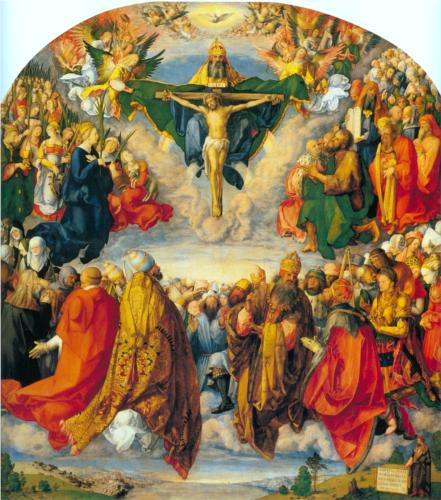
—Albrecht Durer

A couple of years ago a pastoral colleague told me the story of her debut sermon in her new congregation. It took place on the first Sunday of Advent, and her preaching text was the second coming, end of the world passage from the gospel of Luke. Apocalyptic passages like this one typically show up on the first Sunday of Advent because at the start of a new church year the Christian imagination looks far into the future, to the consummation of all things, as well into the past, to the Nativity of the Lord.

End of the world texts are notoriously tricky to preach effectively; but from what I could gather, the sermon she preached that day was theologically solid, pastorally deft, rhetorically pleasing, and socially relevant–a good sermon. What she didn’t know, however, was that in her new church it had long been the custom to let no good deed go unpunished. Sure enough, after the service she was accosted by an angry couple, parents with pre-teen kids, who proceeded to take her to task over her message.

“You’re new here,” they said, “and you need to know that in this church we don’t believe in that nonsense about stars falling out of the sky and fire on the earth and the end of the world! And if you insist on talking that way, the children will be terrified. It’s not what pastors are supposed to do, terrify children.”

I immediately thought of many things she might have said in reply, such as “Children don’t need pastors to terrify them when they already have such terrifying parents.” Sadly, she could also have reminded them that children really don’t need predictions of future catastrophes in order to feel afraid; there are plenty of awful things to frighten them right now, some of them unfolding in the privacy of their own homes.

Over-protective parents have a right to try to control what their kids are exposed to, I guess; but preachers have a duty not to trim the Good News of Jesus Christ to satisfy them, or anyone else, for that matter. And isn’t it good news that a divine regime of justice will, in the fullness of God’s good time, finally replace our world’s unjust and death-dealing systems?

And yet the doctrine of the second coming, with its multiple dimensions of judgment, vindication, consummation, and transformation, does not seem to stir us very much. We mention it once a year, on the first Sunday of Advent. And when we do mention it, we often try to explain it away; we shrug it off as if it were a silly remnant of a credulous past.

Why do we liberal Christians shy away from an active faith in the second coming? Are we not the ones who believe that through all our social justice commitments, we are preparing for the very kingdom that the second coming will finally usher in? So why not embrace it with enthusiasm?

It could be that we’re just bored. How many times have you heard the command to stay awake, to lift up your heads, to stand on tiptoe (as St. Paul says), and watch for Christ to come and install the kingdom? Every year we dutifully get up on tiptoe and watch, but nothing ever happens. After more than 2,000 years our toes get numb, and our enthusiasm begins to wane.

Recently, my colleague told me that those same parents who excoriated her for her second coming sermon took their kids to see An Inconvenient Truth, Al Gore’s film about global warming. I guess it’s okay to tell children that the world’s going to end as long as it’s Uncle Al who’s doing the telling, not Matthew, Mark, Luke or John. Which makes me wonder if perhaps another reason Christ’s second coming doesn’t grab us very much is that we’re just too secular to appreciate it.

We’re not totally secular, of course. Now and then we enjoy a quick peek under the veil that hides the word of mystery from our rational eyes. We’re allowed to be a little mystical as long as we don’t wallow in it. But the second coming? That’s the province of the Rapture weirdos who drive cars with “Beam me up, Lord” bumper stickers. It’s the comfort zone of the prophecy buffs with their maps and calculators. This sort of Christian exuberance about Christ’s return seems to us grossly deficient in what one theological wit called “eschatological chastity.” It is undignified—and it just isn’t us.

There’s another way in which it just isn’t us. Think for a moment about who it is that Jesus is talking to when he says, “When you see these signs, lift up your heads, for your redemption is near”? He’s talking to people who do not require academic explanations of redemption, much less theological justifications of the doctrine. They are people who from ancient days have been run over repeatedly by invaders and occupiers, exiled, enslaved, oppressed. People who have actually needed to be redeemed, literally bought back from captors and restored to their land and to their own history. For them redemption is not an interesting, odd, abstract, or debatable idea. It is their dream, their longing, their need, their passion. It is the story of their life.

As Neal Plantinga puts it, if you are a slave in Pharaoh’s Egypt, or in antebellum Mississippi, you want your redemption. If you are an Israelite exiled in Babylon, or a Kosovar exiled in Albania, you want your redemption. If you are a woman of any caste in modern India… and your fiancee doesn’t like the size of the dowry your family is offering and he threatens to send his friends to rape you, you want redemption from wicked sexism, and you want it now, with every fiber of your being… And if you are a Christian in sub-Saharan Africa this very day, you don’t yawn or roll your eyes when somebody mentions the return of Christ. When the AIDS epidemic has devastated whole populations you don’t care if your tippy-toes are going numb—you will stand up on them for another 2,000 years, if that what it takes. You want your redemption.

Can you taste that longing? Do you want the world’s redemption? Do you want your own?

Maybe you do, because maybe you have stopped claiming that you are “fine, thank you.” Maybe by some sweet grace you have broken through the denial that, as Kate Layzer says in one of her fine sermons, keeps most of us from ever really owning up to “the great big yawning need inside us that we can’t ever fill by ourselves, not with romance or work or food or shopping or booze or drugs or sex or self-help books or new drapes or travel or computers or psychotherapy or intellectual achievement or our own determination to be good responsible people.”

Maybe some calamity has befallen you that has unlocked your crying need for God’s freedom, healing, and restorative justice in a way that makes you long to hear the news that the kingdom is now very close at hand. Maybe your toes are not tired, maybe you are still watching, because your need is so deep and your longing immense. But if you’re anything like me and most people I know, if you’re having a pretty decent year in your own local personal kingdom, it’s hard for you to really long for the advent of God’s kingdom. When life is not all that bad, Plantinga notes, redemption doesn’t sound all that good.

I know that I go through my days with a Master Card in one hand and the Golden Rule in the other, and they appear to be enough to shape and anchor a mostly adequate life. And as long as this okay life of mine is not disrupted by illness, violence, or financial disaster, I don’t usually feel a strong need to be redeemed and transformed by the in-breaking of the New Age.

Redemption is not always the most welcome news, but God knows that it is in fact the best news we can get. And so the church is very wise to give us these four weeks of Advent every year to get over ourselves, to detect and repent from the largely oblivious way we live ordinarily, to reawaken in our dry bones the ancient human thirst for the Living One, and to learn to yearn also for the day when our thirst for the justice he brings will be satisfied.

The church is wise to give us Advent time and again, so that we can start fresh, start from the beginning, and try to walk a Christian path that is, as someone once described it, more than a moral coating applied over a functional atheism. To begin again to long for redemption—and if that’s beyond us, to try to long to long for it. To begin again to hope for shalom—and if that’s beyond us, to try to hope at least for a little more hope, for ourselves and for the world.

Year after year, Advent by Advent, the practice of this sort of patient desire and profound yearning for wholeness, justice and joy will shape and mold us into the very things we desire. And it will therefore also make of us a vivid testimony to the intentions of God toward the creation. Many people (as Plantinga says movingly) who don’t know a thing about God’s loving purposes but are searching hungrily for a clue will be able to look at us and say, “Ah, so that’s how people are going to live when righteousness takes over the world!”

Our Judge and Our Hope [Luke 21:25-36]

Advent is a journey with two destinations. One is to the past, to the manger, Jesus’ first coming. We place ourselves imaginatively alongside the ancient people of Israel. With them, we cry out in elegaic songs for the Messiah—”the desire of all the nations”—to come and heal us and to bring justice everywhere. That the Messiah did come in the frail flesh of Jesus of Nazareth is the joy Christian faith celebrates on Christmas.  The other destination of the Advent journey is the future, the second coming, when Christ will return in glory. History will end, and the new way of life Jesus called ‘the Kingdom,’ for whose coming we’ve prayed all our lives, will be ours in full at last.

The earliest Christians did not pay much attention to the first coming. They focused on the second, and they believed it was imminent. For them, who had so painfully broken with culture, custom and family to follow Jesus, nothing was more desirable than to be swept into the Kingdom by the glorious Lord of their hearts.

We, I think, are considerably less eager for it. We regard it with a certain bemused ambivalence; we say, “Jesus is coming! Look busy!” Jokes about Judgment Day are legion. Our sense of justice demands that God finally take charge of this world in which, as Robin Myers writes, “good deeds and righteous living provide no exemption from mindless tragedy, and the meek inherit nothing but a crushing debt and a dead planet.”

But even as we long for God to fix this mess, we suspect the whole thing might be a fairy tale. Our reason detects the scent of magical thinking in talk of a glorious return, and backs away. The second coming, after all, has been awfully long in coming. After 2,000 years, waiting for Jesus to come in glory feels a little like waiting for Elvis to re-enter the building. It’s embarrassing.

And, of course, as much as we know that things are just not right elsewhere, many of us are more or less satisfied with our own lives. If we’re doing okay, we feel no urgency about some future consummation. Even if our circumstances are not so great, faced with the prospect of a permanent interruption of the status quo, most of us would still opt for the life we know, not the one we don’t.

And so we let ranting fundamentalists on late-night cable teach people who are afraid of the world to read the sign of the fig tree and hammer plowshares into swords so that their fire-breathing Jesus can wreak vengeance on the ungodly. Ironically, the ungodly they love to condemn are the same folks Jesus loved to save. Oh, well. Perhaps, as Fred Craddock suggests, they are obsessed with the second coming because, deep down, they are so disappointed in the first one.

Fundamentalist nonsense aside, when you read the New Testament attentively, it’s hard to avoid the second coming. It’s also hard to avoid the judgment that accompanies it. “We believe,” all the ancient creeds professed, that “he will come again in glory, to judge the living and the dead.” And maybe this is the real reason we shy away from embracing this doctrine of the second coming. Fulfillment and wholeness, restoration and blessing, peace and justice at last—all these promises appeal to us mightily, but not the promise of judgment.

Judgment makes us nervous. In one of the exercises my congregation undertook in their visioning process many years ago, members were asked to rate a list of classical Christian beliefs from “dearly-held” to “not-so-dearly held.” When we shared the results, final judgment came in among the bottom-feeders.

And there are good reasons for our aversion. Too many of us grew up staggering under somebody’s judgment. God or a parent or some other authority was always lying in wait for us to fail. They saw everything. They forgave little. Measuring up was the name of the game, and we never did.

Faith in an incarnate God didn’t help much either. Some of us thought that the all-seeing God who became flesh and lived a perfect human life expected us to live perfect lives too, because in Jesus it was shown to be possible. As someone once noted, God could say to us, “Well, I had the same experiences you have, and they didn’t defeat me!” Who could bear to hear that on any day, let alone on the last day, when we’ve run out of chances? Let Jesus come and settle all the grand cosmic scores, but please leave our own souls and psyches out of it. We’ve had enough judgment for several lifetimes.

Or have we? Modern psychology has taught us that the worst sin we can commit is to be unsupportive and judgmental. So it’s going against a lot of grains to say that Christian tradition may be onto something important with its insistence on judgment. We may in fact need more of it, not less. More judgment, that is, of the right kind. Maybe a story can shed some light on what I mean.

A few years ago, a pastoral colleague of mine did something she regretted deeply. Feeling unsettled and guilty, she sought help from her longstanding ministry support group. She’d barely gotten through the story of what she’d done when they began telling her that it didn’t sound that bad, that she’d had good intentions, that she was way too hard on herself, and that God had already forgiven her.

They were immensely supportive, but their support made her feel worse. It seemed as if they believed she was incapable of doing anything wrong. They talked as if she were not capable of discerning a serious matter from an insignificant one. They didn’t take her seriously. All they had to offer were glib affirmations that she was really a good person.

After being left in pain by her friends, she decided she wanted to go to confession, but she wasn’t Catholic. Someone suggested she call me. I reminded her that I wasn’t Catholic either, at least not any more. But I offered to help anyway. I grabbed a UCC Book of Worship and asked her to meet me at her church. We sat down in the chancel, opened the book to the “Rite of Reconciliation of a Penitent,” and began.

First we read a prayer of confidence in God. Then I invited her to confess what she had done, and in God’s presence and mine she confessed. I affirmed her confession and asked her if she was sorry. Yes, she truly was. I inquired whether she’d formed a plan to make amends. She had, and she was resolved to do so. We prayed together for mercy and healing. Then we stood up, and I declared her sins pardoned in the name of Jesus Christ. We said a final prayer recalling the joy there is in heaven when one who was lost is found, and we exchanged a sign of peace. Then she went home, and so did I.

Now, if you knew the bad thing she did, you’d probably agree with her friends that it wasn’t that bad, that she had had very good intentions and that she was being way too hard on herself. You might even think that going through an entire reconciliation ritual for that was serious spiritual overkill. But you’d be wrong on both counts.

It is a very big deal whenever someone breaks through a sense of false innocence, faces a frailty that caused damage even without intending it, and discovers a greater authenticity of life even in a relatively small moral matter. By being judged and found wanting, she received a gift most of us crave—the certainty that God (and a representative of the church) did not love her any less even knowing what God knows about her; the joy that God (and the church) took her conscience and her sense of need seriously and believed that she was worth being judged, worth being forgiven and restored.

Often what threatens us is not judgment itself, but the experience of knowing something about ourselves, or of having someone else know it, and fearing that we will not be able to love ourselves or live with what we know, nor will they. Most of us actually want judgment, because most of us finally want to face and embrace our truth. But it is also the case that most of us cannot bear to embrace the truth about our lives without the warmth and light of love. We know from bitter experience that truth and judgment without love will crush us.

And here is where we return to Advent and its double destination. Advent asks us to believe the God enfleshed in the manger is same God who will judge us on the last day. But this is not an all-seeing Perfectionist, not a God who sees us from afar, knows what we have done, and is disappointed. This is God-with-us and God-for-us—the one of whom John’s Gospel says this most amazing thing: “He knew what was in us.” He will judge us with a judgment of kinship, the judgment of One who has been inside us, inside our human motivations, understanding us on our terms. The Jesus who will be our judge on the last day is the same one who said, paradoxically, “I judge no one.”

The more you read the gospels, the more you see that Jesus’ habitual response to sinners is full of what Rowan Williams called “sheer visceral pity.” Where are your accusers? Has no one condemned you? Neither do I. Jesus’ own terrible temptations and struggles “seem to have produced in him a sense of the precariousness of goodness so strong that no failure or error could provoke his condemnation.” The only people Jesus ever condemns are people who can’t allow for this precariousness, who refuse to see that the sinner is often a victim more than a criminal, and who imagine we are freer to choose and sin than we really are.  Jesus knows the real measure of our responsibility. He knows it better than we know it ourselves.

This divine sense of the precariousness of goodness is our hope on judgment day, and on any day when we face ourselves squarely in God’s presence.  It can save us not only from some imagined divine condemnation, but also and especially from a very real and debilitating self-condemnation. He knows what is in us.

In the cross that deals him his death, Jesus showed us the very depths of our destructive refusal of health and life, our violence and fear. And through all this he still accepts and loves us. “When we are vulnerable and fragile,” Williams concludes, “it is he who is wounded and broken, carrying all our hurt in himself.  So we may take to him our whole selves in the sure trust that nothing will be thrown back at us to wound or destroy. This is the gospel whose ministers we are.”

Yes, this is the gospel whose ministers we are. We have good news to tell of a judgment that is love and a Messiah whose only fierceness is a mercy that lays us bare for healing. May we embrace this gospel in trust and share the truth that frees. And may we use Christ’s judgment of kinship and no other with ourselves, with each other, and the world.

God Our Feast: A Thanksgiving Communion Reflection

The first big crisis in a relationship is not the day one partner finally gets tired of picking up the other’s socks. It’s not the first time partners fight over the right way to balance the checkbook, or even the right way to hang the toilet paper. The big crisis breaks the first time they cook Thanksgiving dinner at their own house.

“That isn’t stuffing!” she says, “Stuffing has apples and raisins.” Her mother made it with apples and raisins. “It is too stuffing!” he replies. “Stuffing has sausage and nuts.” His mother’s stuffing had sausage and nuts. Persuaded by the memory of a taste, each is certain of the truth about stuffing, and each is compelled to reproduce the pattern of perfection learned long ago.

The stuffing crisis is a hard one because it’s not really about stuffing. It’s about truth, ultimate harmony, right order. The memory enclosed within taste buds is the flavor of home. To have stuffing now the way it was then is to persuade our tongues and tummies that we are the same now as we were then, that things are good now like they were then.

Nostalgia has a way of distorting memories. Things are more complicated than wafting aromas suggest. It’s not for nothing that at this time of year TV sitcoms make us laugh and Hallmark specials make us cry at the anxious, ungainly spectacle of families regrouped around turkeys. At Thanksgiving, some folks don’t, won’t, or cannot go home.

For many, the nostalgia of the holidays isn’t about what was, but what ought to have been, if only. If our mouths water with nostalgia, they water also with desire—for firmer ground, for knowing and being known, for a love that circumstances can’t alter.

Dwell for a while on the thick sweet smell of nuts and sage, raisins and apples, and you will sense the source of such longings, the truth about our life: we were fashioned for a joy so fragrant we can taste it. We were made with hungering hearts. We were created for a feast laid on richly like a dream, tantalizing and aromatic, at the center of our souls.

We were made by God for God and for the amiable company of God’s people, for fellowship as pungent as precious ointment squandered by a woman on the weary feet of Jesus. We were made to sit down at a table where the feast is God.

“O, taste and see!” the ancient psalmist sings, “Taste! You’ll see how good God is.”

We are a people with a taste for God. Our history is one vast story of feeding on mercy and steadfastness, our life a drama of sustenance. Even in the harshest famines and the longest droughts, our memory floods with aromas that make our mouths water with desire for beauty and justice, that make our bellies rumble with hope for what might last—faithfulness, deliverance, vindication, breath and life, children and children’s children, righteousness, and peace.

We remember that from age to age our Shepherd’s wine runs generous and free, our cup brims full, and the board is spread with kindness. We remember that in every place our Host makes room for all kindred souls and every stranger, every widow, orphan, lost or straying sheep, each enemy, and every child.

Because we remember, we find no comfort in consuming bitter food, like the narrow do, who live only in the past. Neither are we gratified by food too rich, like the fearful do, who live just for today. We find no joy snacking on junk and skipping meals, like the headlong and ambitious do, who live only for tomorrow.

In us is a different craving, the memory of a subtle, varied flavor, tantalizingly familiar and completely new. Rolled on the tongue, lingering on the palate, filling the cavities of stomach and soul—once sampled, nothing else is good. We want no other recipe. “O God,” we cry with our ancestors, “you are our portion and our cup. For you we thirst like deserts parched, lifeless, and without water.”

“Well, then, come,” the Spirit replies, “Eat my bread and drink my wine. Come to the feast I prepared for you.”

On Thanksgiving Day we assemble around tables to say, “We are not our own. All that we have and do, all we are, comes from and belongs to our Creator and Sustainer.” We assemble to give thanks for God’s all-providing.

But when we give thanks, we aren’t settling accounts or dryly honoring a benefactor. We are God’s own; when we give thanks, our taste buds tingle, our mouths salivate, our insides rumble, our olfactory memory drives us deep.That memory makes us more than thankfully awed at what God does and all God gives; it makes us awed at who God is. Our thanks is for all our blessings, but first and most of all for having gifted palates, lives imbued with a taste for God, a predilection for the generous wares of endless love.

By the power of that love and for its sake, and for the sake of a world sated with violence and contempt, for the feeding of a world that hungers for God, we assemble so that we ourselves might become what we have tasted—bread of righteousness, seasoning of justice, water of mercy, wine of truth and sweet peace for the weary of war. We must, then, eat, and eat our fill.

Taste, see. Discover how delicious, how very, very good God is. Today, we say this grace for all this grace: “God is our feast: Thanks be to God!”

Lord, I Want to Be in that Number: A Sermon for All Saints Day

Revelation 14:1-3, 14;  Matthew 25: 30-41

“Oh when the saints go marching in…” It’s a great old song that gives voice to an even older Christian hope, that when the kingdom comes, we ourselves will be among the holy ones streaming through its pearly gates, dancing down its golden streets, cavorting in its heavenly fields, and sampling its thousand sacred sweets—speaking figuratively, of course. (Except for the sweets. The sweets had better be real!)

“Oh when the saints go marching in…” We sing it with  happy gusto, completely oblivious to the little bombshell tucked away in the third line of all the verses. Did you notice it? “Oh Lord,” the third line says, “I want to be in that number…“

Oh! There’s a number. When the roll is called up yonder, a number of saints will go marching in.

Now, when I sing, “I want to be in that number,” I really mean it. And despite recent reports of declining belief in heaven among liberal Protestants, I’m willing to bet that you want to be in that number too. But ‘number’ might mean that not all of us will be marching to Zion. ‘Number’ could imply a limit. Think ‘bouncer at the door with an official guest list,’ or ‘guy with a clicker standing under the maximum occupancy sign posted on the Pearly Gates.’

What if that’s the case? What if we’re not on that list? What if we dawdle and arrive to find heaven already at full capacity? What if we’re turned away? A cartoon shows a befuddled man standing before a desk in the clouds. St. Peter is behind the desk scowling at him, his quill pen hovering over the Ledger of Life. The man says to Peter, “Nobody told me I needed to bring my receipts.” What if we forget to bring our receipts?

“Lord, I want to be in that number…” How many are we talking about here? Just how big is ‘that number’? And will we be in it?

In the Middle Ages, the vast majority of Christians operated on the gloomy assumption that they were not going to be in that number. The church gave them lots of spiritual means for slogging their way through this earthly “vale of tears” towards the heavenly realm, but in the medieval way of believing, arriving was never a slam-dunk, no matter how often or well you made use of all those sacraments, indulgences, and intercessors.

It was widely believed that monks and nuns had a better chance at getting through heaven’s gates than the hoi-polloi did.  A monastic life removed you from all sorts of temptations—the relentless allure of the world, the flesh and the devil. In theory, anyway! But every day of their lives, ordinary Christians had to engage in tainted things like commerce, politics, and sex. And that meant they were always sinning. Thus, it was mostly those famous miracle-working, life-and-limb-losing, inimitably virtuous, perfectly perfect, officially-certified, canonized saints who got to be in that number. How many? Not many.

The idea that not everyone gets to be in that number did not pass away with the Middle Ages. Many Christians still expect the number to be limited. One newer American religious movement even teaches precisely what that number is going to be. It’s derived  from the Book of Revelation—one hundred forty-four thousand. One hundred forty-four thousand men and women “sealed for God,” which is to say, ‘marked as God’s own.’

(By the way, practically everybody in the Book of Revelation is marked in some way—whether you belong to God or Satan is something you can see.  Satan’s people are marked with the number 666. That was my telephone exchange when I lived in Somerville, MA. Some fundamentalist Christians in my neighborhood complained about it to the phone company, and so they offered everybody new numbers. I kept my old one. I loved it that people had to dial 666 to reach a minister. But I digress…)

These folks believe that when the trumpet sounds on the Last Day, one hundred forty-four thousand special believers from their community of faith will be ushered right into heaven, and there they will reign forever with God. Others in their movement will reside for all eternity on a new, paradise-like earth. So, according to a recent census of this group, if the world were to end today, the new earth’s population would be five million five hundred sixty thousand saints, minus one hundred forty-four thousand special saints in heaven. If you’re not a member of this group, you won’t be in either of those numbers. But you won’t suffer eternally in hell, either. There’s no hell in their theology. You’ll be annihilated, quickly and completely.

If you’re tempted to think those beliefs are funny or bizarre, beware. The wagging finger points right back at our own Congregationalist history. A lot of our Puritan forbears believed in double prelapsarian predestination. Now, most of us don’t know prelapsarian predestination from a potted plant, so let me sum it up this way—long before Adam and Eve even suspected that there might be such a thing as forbidden fruit, God chose who would be saved and who would not. Because God is gracious, however, God’s election is not stingy. God has chosen to save an “innumerable multitude” of saints. Yet no matter how many people God elects and saves, it’s still a number. Not everybody is going to be in it, they guessed. Some people are going to be counted in a number that’s headed south, where it’s a lot warmer.

Did you notice the “I” in our song? “Oh Lord, I want to be in that number.” Throughout Christian history, ‘I’ have always wanted to be in that number, but ‘I’ have rarely wanted you to be in that number alongside me. Fred Phelps didn’t expect to see any gay people when he got there (imagine his surprise!). Most fundamentalist and some evangelical Christians preach that unless you explicitly accept Jesus Christ as your personal Lord and Savior, you won’t be joining that number either. And it wasn’t all that long ago that nearly all Protestants believed Catholics wouldn’t go to heaven, nearly all Catholics believed Protestants wouldn’t go to heaven, and nearly all Christians believed that non-Christians wouldn’t go to heaven. (If everybody’s right, then nobody’s in heaven! And with all our violent squabbling over heavenly turf, I’m sure there are moments when God would prefer it that way.)

These days, thankfully, we’re a bit more inclusive. Well, a lot more inclusive! Catholics have done away with Limbo so that unbaptized people can now enter paradise instead of languishing forever in an in-between state, deprived eternally of the presence of God. Most Christian churches don’t consign suicides to hell anymore, in some cases owing to a deeper grasp of the complexities of depression as a form of mental illness. And in liberal Christian circles over the last generation or two, we’ve been steadily backing away from the traditional Christian conviction that there’s only one way to salvation, through the grace of Jesus Christ.

Indeed, in the UCC we break out in hives if someone even hints at excluding anybody from the procession of the heaven-bound. We expect God to elect absolutely everyone, no matter who they are, or where they are on the journey of faith. We don’t think you have to be a Christian to go marching in, let alone a particular flavor of Christian.

We also aren’t fond of the idea that Christian saints are exceptionally heroic and holy—the few, the fine, the famous, and the dead. With St. Paul, we say that to be a Christian saint, it’s enough to be baptized and to desire to live a new life in Christ—whether you’re living or dead, ordinary or extraordinary, you qualify. You’re a saint the minute the cat drags you in over the church’s threshold!  Especially if you sign up for a committee. Nothing canonizes you faster in our tradition than filling a vacancy on the Board of Christian Education.

These days, it seems that we mainline Protestants can’t think of anybody who’s not going to be in that number. Of course, it’s easy for us to say that. It’s easy for us to say anything we want about a total mystery we know nothing about. All the same, and speaking just for me, I’d rather be lax and rule everybody in, not strict and rule a bunch of people out. It seems to me that although lowering the bar as much as we do these days might have some moral downsides, it’s a far less violent way to go than its opposite.

Because ruling people in or out of heaven is not some quaint, innocuous theological game. It isn’t merely theoretical. It has consequences. If somebody thinks you’re unworthy of the next life, they probably think you’re unworthy of this one too. History is littered with the battered bodies of everybody’s excluded infidels and heathens. How we think about ‘that number’ really matters. And so it also matters what Jesus says about it. Let’s listen to him.

In the famous gospel passage about the sheep and the goats that we read today, you’ll notice that Jesus doesn’t say how many people will inherit the kingdom. What he does tell us is how to get there. And for that, the only number that counts is the number one. Listen! “Whenever you did it to one of these least, a member of my family, you did it to me.” One, fed. One, clothed. One, comforted—one is the number that counts.

I honestly don’t know if there’s a predetermined cap on how many of us will one day go marching in, but I do know that we have good warrant for setting the bar so low. Our brother Jesus was there before us, doing exactly the same thing. If you go by what he says in this passage, anybody can be in that number, because anybody can make one visit, cook one meal, throw one warm jacket over a pair of shoulders hunched-up against the cold.

I don’t know for sure if there’s a cap on that number, but I do know that Jesus isn’t trying to make it too tricky or too onerous for us to be in it. You don’t need special knowledge or heroic virtue. You don’t need to be a martyr or a monk. You don’t need to accumulate one hundred forty-four thousand good deeds or say one hundred forty-four thousand prayers to St. Jude the patron saint of lost causes. It’s one stranger welcomed, one wound healed, one thirst satisfied.

You don’t even have to do it for God! Maybe you don’t even have to know God! The sheep, after all, had no idea that they’d been lending a hand to Jesus. “Lord, when did we see you hungry, or thirsty, or naked, or homeless, or in prison, or sick?”   We know when. “When you did it to one…”

As I said, I don’t know if there’s a cap on that number, but if there is, in the course of our Christian lives, you and I have not been kept in the dark about the basis on which it will be decided. It’s no secret. It has to do with whether we hand ourselves over to each other in kindness, or whether we bring our hands down on the weak and unprotected. It has to do with whether we get our hands dirty with works of mercy, or wash them of responsibility for our neighbor. It has to do with whether we have our hands full of compassion, or remain an empty-handed people.

But even more, it has to do with the mercy of God, the one we know in Jesus, who opens the divine hand to us all and bestows largess beyond all telling, requiring so little of us in return for so much.

Praised be God by all God’s precious saints and by every creature under heaven, now and in the endless age to come.

Almost Evening: Spirituality in the Face of Death [Luke 24: 13-35 ]

“Stay with us, because it is almost evening and the day is now nearly over.”

I ran into an old friend the other day. She’s a Baptist’s Baptist who hails from deep in the Bible Belt. Soul freedom personified, and a fierce free-churcher, she is not someone you’d expect to inhabit the same zip code as a Book of Common Prayer. But there it was… she had it in her hand.

I must have raised an eyebrow, because she immediately launched into an explanatory rant about how loopy worship services at her home church had become.

‘We never know what we’re going to get,’ she said. ‘Every week it’s amateur hour!’ A few Sundays before, it seems that instead of the sermon there was a fully-costumed skit announcing the Strawberry Fair. And just last week there was special music to honor the King…of Pop.  And every Sunday, she endures the vague churchy blather (her words, not mine!) of a pastor who can never quite pull off a single, simple, clear declarative sentence—subject, verb, object. ‘And,’ she said, ‘when that man prays, bless his heart’—if you’re from the South, that’s a phrase that makes it okay to say something bad about somebody—‘when he prays, bless his heart, you’d think it was the weather report on the morning news!’

“Dear God, we thank you for the blue sky and bright sun on this perfect spring day with temperatures hovering around 70 dry, breezy degrees. And for this high pressure area that’s going to ensure pleasant weather well into the week…“

So… she’s started going to an Episcopal church. Hence that BCP. She attends Morning Prayer, Eucharist, Evening Prayer—whatever’s on offer. With the ‘Piskies she gets a fixed liturgy, time-tested language, no guesswork. She can relax. “And,” she said, “it makes me cry.”

Now, I got the part about a fixed liturgy being a relief. But I wasn’t expecting her say, “It makes me cry.” And to mean ‘that’s a good thing.’ She’s not exactly sentimental.

So I echoed her, in my best imitation of a therapist, “It makes you cry….”

“Yes. Well, no,” she said. “not everything makes me cry. It’s mostly evening prayer that makes me cry. “

Evening prayer…”  I repeated.

“Yes. Well, no, not evening prayer as such.  One of the prayers in evening prayer, the collect, this one. It makes me cry.” And she opened the prayer book to read it to me. But I already knew which one it was going to be. Maybe you do too.

“Lord Jesus, stay with us, for evening is at hand and the day is past; be our companion in the way; kindle our hearts, and awaken hope, that we may know you as you are revealed in Scripture and the breaking of bread. Grant this for the sake of your love.  Amen.”

For years this prayer has been a devotional staple of mine for when I lay me down to sleep.  It makes me cry too… In part, I think, because my heart is easily smitten by a really great metaphor: Almost evening. Nightfall. The day passing away.

You know where this is going.

If you were to place this prayer on the lips of my 91-year-old father some Monday night, he wouldn’t be thinking, ‘Monday. Monday is almost over.’ He’d be thinking about how it’s all gone so fast. He’d make a stunning calculus of years behind and years ahead and wonder how it happened. He would say to himself, deep in that place in the soul where from time to time you dare to test out the truth, ‘It won’t be long. It’s almost evening. The day is far spent. Death is near.’

And, of course, he’s not the only one.

I occasionally spend time looking at photographs of myself as a child. Not so much because I’m vain, but because it’s bracing. It’s like the old monastic practice of keeping a skull in your cave. ‘Memento mori,’ says the wiry, sun-draped child sprawled like Huck Finn on a flat rock in the swift brook that empties into Stirrup Iron Pond on her grandfather’s farm.  She is so far away. She is impossible. I’m only 65, not 91, and yet I can’t reach her. I can’t really say in truth that I remember being her. She is a day drawing to a close. She is like an evening gone. She makes me cry.

Do you know what I mean?

Once upon a time, we had our whole lives ahead of us, and we imagined them a certain way as we hatched hopes and made plans for them. We cast ourselves as protagonists of beautiful unfolding stories: We’d have a loving, lasting marriage. We’d build a good career in a meaningful profession and stash enough money away for a comfortable retirement. And we would be fine people, people who do good and not harm. We’d eradicate world hunger by the time we were forty.

And then we wake up to find that we are forty and there is still world hunger, and that good intentions notwithstanding, we were more than occasionally mean or dishonest or selfish. Whatever we did or left undone, we managed to contribute our fair share of sin and stupidity to the vast reservoir of human pain and regret.

And then we wake up one day to find that we are fifty and our tattered marriage is no better now than it was when we were forty; or maybe we find that we don’t even have a marriage any more.

And then we turn around and we’re sixty, and we are have doubts about the meaning of our life’s work, and the money we thought we’d have is not as much as the money we actually have, and what we do have may not last until we die. And we are going to die. It wakes us up in the wee hours.

And I haven’t even mentioned what could happen at 70…

The day is far spent.  It is almost evening.

In the course of my teaching and preaching, I come across a lot of people who are really “into” spirituality. They also seem to know what it is, which I find fascinating, because I’ve been studying it for a good part of my life and I’m not sure I have any solid sense of it yet. But I have come to at least one conclusion about spirituality, not so much from study as from what happens in those wee hours when one is awakened by the sadness of things slipping away. I’ve learned it from the pathos that wells up and constricts your throat when you turn the soft black page of an old album and come face to face with a child who (they swear) is you, but you can’t exactly place her. I’ve learned it from the way tears come unbidden when at vespers we finally say out loud what we know is true, ‘It is almost night.’

I think if spirituality is about anything, it has ultimately to do with the immense grief that punctures the human heart, grief that stems from the knowledge that this one life is all we have, and that it is way too short, no matter when it ends, and that even if it is full of suffering, it is still too wonderful and precious to have to abandon, just like that, to the night that is fast approaching.

This grief is the subtext of every delight, the undertow of regret we feel even in the midst of ecstasy or quiet gratitude for the beauty and pleasure of this life, the smoldering rage we reflexively stoke up when we ponder the intractability of our fate, the fact that nothing can stay.

Spirituality must be about the kind of grief and fear that, left to its own devices, is capable of recasting our souls as one life-long, fatalistic shrug of the shoulders, rendering us indifferent to all kinds of intimate and global horror; or worse, making us cruel, able to take out our despair on the innocent.

If spirituality is about anything, I think it must have to do with this stunning human disappointment, the fact that we who love to live all die, that death is the one sure thing that is coming to us all.

The job of a devotional life, if I can put it that way, is to take us as we are—caught up in immense disappointment, traveling on a rough road to more of the same–and by grace, day by day, year after year, discipline us to know and embrace our heart’s anguish as the finite echo of another, infinite and encompassing reality: the fact that, although our deaths are sure, we were not made for death, but for a persevering love that cannot lose or leave us. When all is ended, love remains

The job of a spiritual practice is not to make us perfect people, holy people, or even better people, but simply to deposit us daily, routinely, in the way of this sustaining love; to accustom us to the familiar cadences of its voice, which we may not at first be able to place exactly, but which rings so true that it blazes; and to support these frail hearts as love makes mysterious, yet shining sense for us out of the grand story of the trustworthy ways of God; and shining, yet mysterious sense for us of our own stories in God.

And then, when we look up and register that it is almost evening, that the day is indeed ending and night is falling fast, we will know that our anxious prayer has already been answered, the prayer that goes, ‘Lord Jesus, stay with us.’ Our anxious prayer not to die, not to die forever, has already been answered and is never unanswered, no matter the strange disguise in which this answer may appear. Answered and never unanswered by the companionable One whose hands still bear the mark of nails and from whose open side we have all received grace after grace.

And after we have gone in with him and he has come in with us, after we have sat to eat with him, and after we have known him again and again together, there will be only one thing to do with the life he imparts: To get up and return to that rough and hopeless road to find some other pair, some other trudging hearts despondent over death, and say to them, “Love is living still!”

Angelology 101

Isaiah 6:1-8; Psalm 103:1-5; 20-22; Hebrews 1:1-9

Jim Janknegt

According to recent surveys of religious beliefs in America, 73% of us believe in angels. Many people also think that when we die, we go to heaven and become angels ourselves. TV shows and movies galore are based on this premise, and so was one of the ghastliest rock-‘n-roll songs ever written, “Teen Angel”—“That fateful night, the car was stalled upon the railroad tracks…” Google it if you are too young to remember.

But according to the Bible, it just isn’t so. Human beings and angels are and always will be two distinct species. As one theologian quipped a while back, you and I will never be angels. The good news is that we won’t ever be cockroaches either.

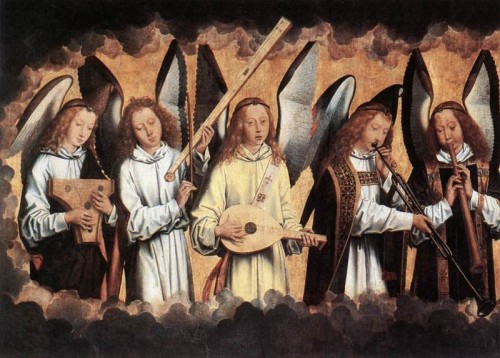
It’s very sweet that every Christmas since 1946 Jimmy Stewart has discovered anew that it’s a wonderful life as he is saved from despair by Clarence, an angel trainee trying to earn his wings. But it turns out that Clarence is wasting his efforts. Angels do not earn wings. With the famous exception of the six-winged seraphs we sing about in our hymns, angels in the Bible don’t have wings. (No one seems to have told this to artists down through the ages, however. There’s hardly a depiction of an angel anywhere that doesn’t include wings.)

Angels in scripture also have more important things to do than fish despondent Savings and Loans managers out of the drink. According to the Bible, it is not a major angelic function to snatch human beings’ personal chestnuts out of the fire. Neither do angels lurk about disguised as nice people who punctuate our anxious days with kindly coincidences. You are more likely to be slammed to the ground by an angel than sweetly touched by one. Just ask the biblical patriarch who once wrestled with one—you know, the guy with the limp.

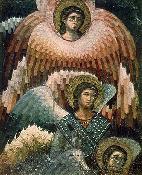
Paul Guaguin

Angels in the Bible tend to be on the rather impressive side. The angel who left Jacob in need of a hip replacement could eat the cute cast of “Angels in the Outfield” for lunch. It’s not for nothing that in many instances the first thing angels say to people is, “Fear not!”

In the first lesson, Isaiah sees God surrounded by those six-winged seraphs. Their booming voices shake up the temple. Plaster is falling, smoke is rising, and the prophet is terrified. He immediately accepts two basic facts: God is holy, and he is not. He’s preparing to drop dead when one of the seraphim zooms toward him wielding tongs. The angel drops a red-hot coal on his mouth. Thus it is God distracts Isaiah from fruitlessly contemplating his own unworthiness and frees him up to hear and accept God’s call.

Angels are intelligent, spiritual entities who exist to do God’s bidding. Because that bidding often entails delivering messages to mortals, occasionally angels take human form, as three of them did when Abraham “welcomed angels without knowing it” under the oaks of Mamre.

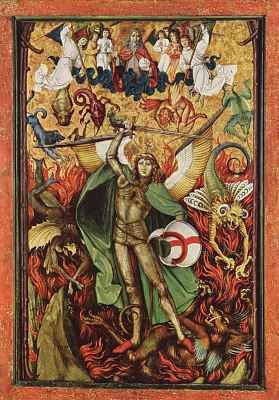
Marc Chagal

But angels are normally invisible, part of the world beyond the thin veil that we refer to when we say, “I believe in God…maker of heaven and earth, and of all things seen and unseen.”

Although people pray to angels in some parts of the Christian family (all Roman Catholics have “guardian angels” assigned to them), the biblical record does not show us any angels interceding for us with God, or otherwise facilitating our salvation. They are creatures, not demi-gods, mini-gods, or intermediaries between us and God.

This is the point that the author of the Letter to the Hebrews is trying to make in the second lesson. He is addressing first-century Christians who seem to have been infected with angelmania, much like people in America at the end of the 20th century when Raphael’s two pudgy-armed cherubs were merchandised to death. The author of Hebrews is trying to persuade his community that angels cannot hold a candle to Christ, in whose name alone that they can confidently expect grace and favor from God. “To which angel,” he asks dismissively, “did God ever say, ‘You are my son?’”

Like human beings, angels have free will, and that means that they can choose, and that means that at some point they could have chosen wrong. There is, for example, Christian midrash about a big angelic revolt against God after they had all gotten wind of the divine plan for a future Incarnation. Some of the purest ones flew into high dudgeon about the insult to God’s dignity such a plan entailed—they were hell-bent on saving God from God’s own folly. They were literally hell-bent when Michael, a loyal archangel, conquered their leader (another archangel named Lucifer), put down the revolt, and bounced him and all his minions out of paradise and down into hell, created especially for the occasion. From that time on, they have been called “devils.” So, the next time you bend over a baby carriage and coo, “What an angel!”, remember to specify what kind of angel you mean. You wouldn’t want to imply that the munchkin in the carriage is the spawn of Satan.

God’s angels are a lot like us—busy, busy, busy. They commute long distances to work. They multi-task. They ascend and descend Jacob’s ladder (which is one reason we know they don’t all have wings. Why climb if you can fly?).  They travel at the head of the Israelite column across the wilderness. They announce a couple of unplanned pregnancies to a couple of startled women. They guard the ark of the covenant and they stand with flaming swords at the locked gates of Paradise. They rejoice over the repentance of a single sinner. They minister to Jesus in the desert and in the Garden, and they announce his resurrection to the women at the tomb. And that’s just the short list of what angels get up to in the Bible.

There are also countless ranks of stay-at-home angels who surround God’s throne night and day, behold God’s face, and incessantly cry out, “Holy!” and “Glory!” Apparently they do not get tired of doing this sort of thing. It turns out that angels are primarily worshippers. They are praise for God’s glory. Contrary to our assumptions about this angelic worship, however, the Bible never actually says that they sing. It does say that they play musical instruments—the psalms speak effusively of a veritable heavenly orchestra.

Too numerous to count, angels are a sabaoth, a host, and when push comes to shove—and the Bible says it surely will—they are an army. In the lurid Book of Revelation we are presented again with the angels’ general, Michael, the great Warrior Prince of Heaven. It is he, we are told, who will lead the angelic troops in the final apocalyptic struggle between God’s forces and Lucifer, the great star-sweeping Dragon. It will not surprise you to learn, therefore, that Michael is the patron saint of paratroopers. (He is also, inexplicably, the patron saint of green grocers.)

So, do you believe in angels?

Jews seem to have a happy tolerance for differences of opinion about just about everything, and so naturally they also disagree about whether belief in angels is a necessary element of Judaism. Observant Muslims, on the other hand, hold to a strict belief in angels as a basic tenet of faith. They especially honor Gabriel, who taught the 114 surahs of the Holy Qur’an to Muhammed (pbuh)—and yes, that’s the same Gabriel who told Mary to expect the baby Jesus and gave Daniel the gift of pre-Jungian dream interpretation.

Concerning belief in angels, Christians divide into the same camps we divide into about belief in a lot of other things. Christians to the ‘right’ tend to think that because angels are part of the biblical worldview, they absolutely must be part of ours too. Christians to the ‘left’ are more likely to think of belief in angels on a par with Elvis sightings and UFOs. Christians in the ‘middle’ usually can take ‘em or leave ‘em. They don’t think much about angels, except maybe at Christmas, or if they have some sort of odd experience that defies rational explanation, and the metaphor of ‘angel encounter’ seems as good a metaphor for what happened as any.

As for me, I know that belief in angels will not put me right with God or save my soul. But just because something isn’t necessary for salvation, or even for faithful discipleship, doesn’t mean it can’t do me some good. And one good thing that the Christian tradition about angels does for me is enliven my imagination.

Imagine with me, then.

Picture psychedelic seraphim, eyes plastered all over their strange forms, wings flapping madly. Imagine disruptive intrusions into a person’s life or a nation’s destiny.  Imagine bizarre and even painful angelic ministrations. All these things the angels do as God’s servants. And in their activity we glimpse something of God’s character. God is more than we want and nothing we expect. God is for us, but not like us. Much of what we think we know for sure about the divine turns out to be as elusive as Isaiah’s smoky vision in the wee hours. This is not comfortable news, but it is good news. It saves us from pride and certainty, and from the violence that is often the fruit of pride and certainty.

The angels conform to God’s purposes. They are created and exist solely to do God’s will. Their brilliance, strength, and ferocity are all ordered toward that one end. They are what it might feel and look like to love and serve the Lord with all our heart, mind, soul, and strength, as scripture commands. Their service is free and complete and confident; it is service with authority. Jesus taught us to pray, ‘Thy will be done on earth as it is in heaven.”  Who does God’s will in heaven? The angels do. Their responsiveness might be a model for our own.

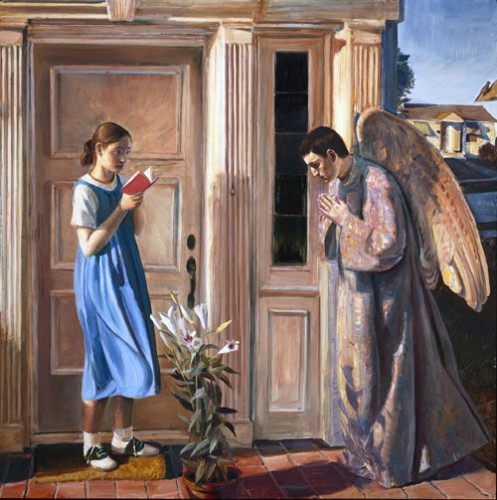
Angels are God’s messengers. The Greek word angelos means ‘messenger.’ It’s the same Greek word from which the word for ‘gospel’, or good news, derives—evangelion. Angels are announcers, word-bringers, heralds of glad tidings, and therefore life-changers by proxy. Imagine! What it is that we have been baptized into if not a herald’s role? We are not and never will be angels, but perhaps in the course of responding to our own callings, we can still make people jump, surprise them in their sleep or on the road with the announcement of God’s merciful purposes, God’s pleasure and God’s peace.

John Collier, Annunciation

The vocation of the angel army to defend God’s realm against evil confronts us with a question of great seriousness. Imagining that apocalyptic struggle, I imagine as well the earthly, human project of moral and spiritual growth. Do I expect it to unfold serenely? Will I not encounter enemies—the shallow world, the narrow mind, the fear-filled heart? Will they let me pass on towards my hopes for maturity and wisdom in peace, or will there be a fight? And what about the moral and spiritual well-being of others? Could the angels’ example of fighting hard for God’s interests prompt us to help someone in big personal trouble actually change the sad or self-destructive direction of his or her moral life? In addition to battling for societal and institutional justice, shouldn’t we be actively engaged in bringing sanity and strength to each other’s inner lives as well?

It is the nature of angels to worship night and day, crying out, “Glory!” and “Holy!” Every time we gather for worship, might we imagine that we are not doing it alone? Imagine that every sanctuary, when we gather as God’s people, is a thin place where earth and heaven meet, filling with the smoke of the angelic presence and the energy of their adoration? Imagine ourselves joined to their praise, engaged in the captivating duty of adoration? If you can imagine it, you may also feel a certain fright. Your heart may sink at the realization that you are so small, and a sinner. The One we worship is holy. But perhaps you can also imagine a fierce and determined seraph coming right at you with tongs, ready to burn off your protestations of unworthiness, and jolt you into a new freedom by which you will have courage to answer ‘yes’ when you are called.

Angels may or may not exist. But we do, and because we are people of story who live by beauty and imagination, we have done ourselves no harm—and we may have done ourselves some good—by thinking about them for a while. If you’re in a mood to do so, honor them too.

Their liturgical commemoration is October 2, the Feast of the Holy Angels.

Stay in the Boat

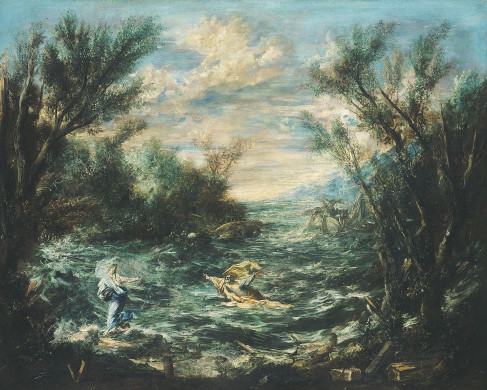
Matthew 14:22-33 After Jesus has fed thousands of hungry people with five loaves and two fish, he sends the people home. It’s late, but he wants to pray, so he tells the disciples to take the boat back across the lake. He’ll meet them later. Now, if someone says, “You go ahead in the boat, I’ll meet you later,” you think, okay, he’s going to go on foot around the lake, or maybe take another boat across. You don’t think he’ll walk to you on water. So when the disciples see someone walking on the water, when they all stand up in the boat and lean way out to get a good look, they’re not thinking, “Oh, that’s Jesus.” They’re thinking, ”Oh, Jesus, that’s a ghost.” And so you can also imagine how relieved they are when that familiar voice calls out and says something they’ve heard before: “Don’t be afraid. It’s me.” I imagine they are so relieved they sit right back down in the boat. They sit right back down and they grin at each other with those goofy grins you can’t help grinning when things that should have turned out really really bad turn out really really good. Jesus said he’d meet them. They assumed he meant on dry land. But it’s out here, in the wind and waves, in the wee hours, just when they’re most exhausted and aren’t making any headway at all. “Don’t be afraid. It’s me,” he says. And at that, everybody sits down and waits for him to get there and climb in. Everybody, that is, but Peter. We know what he does. He challenges Jesus, and Jesus challenges him back. We know that he sinks, and that he cries out, “Lord, save me!” We know that Jesus grabs him in the nick of time, and that Jesus asks him,  “Why did you doubt?” Now, when we hear that bit about doubting, we think Jesus is scolding Peter for noticing the waves and the wind. And it’s true. He notices, he wavers, he sinks. But it’s doubt that gets him onto the water in the first place. His doubt begins before he even leaves the boat. All the other disciples take Jesus as his word. It’s him. There’s nothing to fear. That’s why they sit back down. They believe it’s him. He’s coming. That’s all they need to know. But Peter says, “If it is you…” If you are who you say you are. You’ll have to prove it to me. Do a trick, a miracle, something cool and spectacular.  Like, tell me to walk to you on the water. Where have we heard this before? “If you are the Son of God, turn these stones into bread, or better yet, jump off the temple pinnacle and see if the angels will catch you.” That’s Satan tempting Jesus in the wilderness. “If you are the Son of God, let’s see you come down off that cross and save yourself.” That’s the mockers tempting Jesus as he was dying. “If it’s really you, show me the nail marks your hands.” That’s Thomas tempting Jesus after the resurrection. The minute Peter says, “If it’s you, command that I walk to you on water,” he joins the company of the tempters, and that’s not good. Jesus calls him “little faith” not so much because he gets scared and starts to sink, but because he didn’t sit down when the others did, he couldn’t wait like they waited, he wouldn’t stay in the boat. Now, I know we often hear this story differently. We make fun of Peter for sinking, but we admire his courage and impetuosity. We think it took guts and faith to get out of the boat. We like people who strike out on their own and take risks. If you’re going to do something bold for God, you can’t just sit there. You have to do something. Faith climbs over the side, faith walks out to Jesus. Yes, you’ll have doubts. Yes sometimes you’ll go under. That’s okay. Jesus will give you a hand. So get out of the boat. Just do it. That’s the way we often read this story. Like a Nike ad. But the early Christians who handed this story down to us saw it differently. For them, the best thing you can do is trust Jesus’ promise that he is either already always with us or that he is always on his way to us. Trust that it’s him when he says so. Trust him enough not to tempt him, not to try to be him, not to walk on water, but to leave that to him and stay in the boat. Why in the boat? Because he’s getting in it, and you want to be with him. And because that’s where your sisters and brothers are, and you want to be with them too. Because life is treacherous and hard and it’s easy to get picked off by its cares if you go it alone. Because evil is real and you’re easy prey if you think you can confront it alone or depend on your own virtue to avoid it. Because human sin and woundedness require compassion and healing and forgiveness, but we are unlikely to grant ourselves such gifts, such is the depth of our confusion and shame. Because we do not save ourselves and we cannot be saved alone. If there is any safety to be had in this life, it does not come through self-sufficiency, but by discovering the companionship of God, and by sailing through thick and thin with other companion disciples. If we find healing in this life, it won’t be because we went it alone, but because by God’s grace we found good company, and by that same grace we bound ourselves to Christ and to others in affection and accountability. If there is hope for us, it lies in telling each other stories and singing each other songs, and eating from each others’ hands, and showing each other our dreams and visions, and reminding each other where we’d be if there were no boat, no companions, and no fearless Christ with us, but only rising water, only howling wind. If we live to see the dawn it will be because through every adversity we have sailed together.
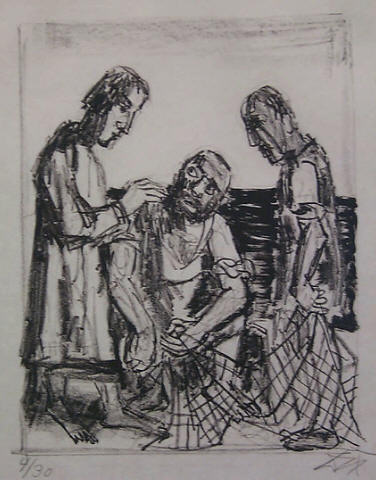
Today our story tells us to take Jesus at his word. To wait for him to arrive. To watch how he comes to us no matter how high the waves. He’s on his way, here even now, with us till the end of the age. Our story says, don’t be afraid, just sit tight, glad of the good company that gives meaning and hope to life’s sailing. Be a steadfast companion. Stay in the boat.

****

Credit: Deacon Matthew Garrett of http://www.holy-icons.com for the icon image of the Mystical Church, above.
l

Sitting under Trees, Resting under Vines: A Reflection for Peace Day

Micah 4:1-4; John 15:1-8; Revelation 21-22

Seven years ago, the Israeli Defense Ministry began investigating the theft of Palestinian olive trees. Black market trade in the trees was growing as Israeli government contractors confiscated and cleared Palestinian land in order to build an 80-mile-long barrier to stop suicide bombers from infiltrating into Israel. It appears that the government contractors were uprooting the trees and selling them to wealthy Israelis and to local town councils for their gardens and parks.

Olive trees are extremely hardy. They can weather great shocks — uprooting, transplanting, sometimes even frost, fire and, of course, flood.  When the waters of the Great Flood receded, the Book of Genesis says, it was from a hardy, surviving olive tree that the dove from the ark plucked a silver branch to carry back to Noah as a sign that the land was dry and salvation was near. Some gnarled old olive trees in the Garden of Gethsemene are said to date from the time of Jesus, although that is certainly not true. But there are olive trees there that are among the oldest in the world. And that may be why the olive branch is a symbol of peace — olive trees grow and mature very slowly, they abide, they endure, they outlast just about everything. And they are beautiful.

News of the illegal sale of Palestinian olive trees leaked out after a contractor offered two reporters 100 large trees for $250 each. The reporters also found one ancient tree on sale at a plant nursery for nearly $5,000. An official of the military command was implicated in that transaction. The Defense Ministry, which is in charge of building the security fence, stated that the Ministry pays contractors only to uproot and replant the trees; no one has permission to sell them. The contracts require that the trees be replanted in areas their owners suggest, away from the security zone; however, an Israeli human rights organization reported that these relocations were not taking place.

For the people who buy them, the trees have ornamental value. They have a different value for the people who owned them. They are the lifeblood of Palestinian agriculture, almost the only crop growing on the stony hills of the West Bank that does not need irrigation. The olives are precious. Many Palestinians are unemployed after all the years of violence; their staple diet is bread and olive oil.

According to some estimates, the wall will eventually take the land of 11,000 Palestinian farmers. One farmer complained that 44 of his 50 acres had been confiscated, and he had lost 2,700 fruit and olive trees. His village lost 7 wells, 15,000 olive trees and 50,000 citrus other fruit trees. The Palestinian Agriculture Ministry says that in the two years of fence-building to protect the settlers, over 200,000 olive trees have been destroyed.[1]

The contractors, the soldiers, the settlers, the corrupt officials — none of them, it seems, has read the Book of Deuteronomy. “Seek peace and pursue it,” the Torah teaches.  But even if you should fail, “Even if you are at war with a city . . . you shall not destroy its trees” (20: 19-20).

To sit unafraid under your own tree, to rest peacefully under your own vine — in this single striking image, the prophet Micah crystallizes God’s great vision of healing and wholeness for the creation. All the peoples of earth stream to God’s mountain where God presides. God judges them with divine insight. God instructs them with divine wisdom. Thus they stop learning war.

They dedicate themselves instead to the hot, hard and artful work of the blacksmith, pounding swords into plowshares and spears into pruning hooks. And then, when fear is gone, when nothing can harm them, when they too do no harm to anything on God’s holy mountain, they all sit beneath their own trees — their figs, their olives, their lemons — and rest under their vines. The fellowship, the well-being, the harmony, the presence of God is their shade. This, Micah implies, is God’s great shalom!

Do you sense what God’s shalom is like? It seems that many of us do, if polls are to be trusted. A poll I read a few weeks ago reported that of the huge number of Christians in this country who claim to be regular “churchgoers,” nearly 80% say we feel closest to God, most whole and most at peace with ourselves, our neighbors and the universe when we are out in nature, not in church.

And it doesn’t have to be Yosemite or Big Sur to awaken in us this intuition — memory? foretaste? — of God’s shalom.  An old Italian guy who lived a few blocks away from us in Somerville had a backyard that couldn’t have been more than 12′ x 14′, but he grew everything imaginable in there, including fruit trees. One was a weird-looking fig under which he abided amiably on Sunday morning and smoked cigarettes as the bells of St. Anne’s church summoned the rest of the neighborhood, including his wife, to mass.

Sometimes when you walked by his corner, only the wispy smoke told you he was there, sitting squarely on his old cane chair, because in the shade his face was the color of fig tree bark. He blended in. At times he seemed to be a plant himself, an old, thick, person-shaped vine with male pattern baldness. The bells would ring all morning — there were three masses — but still he abided, the garden his sanctuary, the fig tree heaven’s tent, and the lazy smoke his incense, rising to God.

You probably have your own version of shalom, maybe a special place that restores you. Your probably have glimpsed the truth and loveliness of creation’s web in some small way and have, as a result, your own story of what it’s like to stream towards God’s holy mountain. My father’s story might be about a hammock in the back yard, stretched between an aluminum pole he painted green and a maple tree that lightening struck years ago and split down the middle. Unable to bear the loss, he bolted it back together. Somehow, it survived, and he lazes about in its shade now and talks to the birds, mistaking himself for St Francis.

Mine is a cherry orchard in the Sabine Hills, north of Rome, a place I once lived and to which I’ll probably never return. On a long sloping hillside, the trees are pruned back to essentials in the early Spring, and all their skinny trunks are painted Smurf Blue. The cold mist that swirls and lifts as the sun comes up and the light changes makes them seem to move, to march in your direction — a squadron of aliens come in peace; a heavenly host.


But perhaps for you it isn’t so much a place or an experience by which God’s great shalom engulfs you. Maybe it’s simply an abiding awareness that this harmonious and satisfying presence is what is finally true about the world — as it was in the beginning in Eden, it is now and ever shall be, world without  end. Perhaps you are one of those people who carries around in your body a kind of solidarity with original solidarity, you are blessed with original blessing. Or perhaps you possess the mirror capacity to feel keenly the absence of wholeness, to feel grief well up in you over its betrayal by human self-centeredness and sin.

Last year a friend of mine was watching a news report about punishment meted out to the family of a young Palestinian who had been arrested for the shooting an off-duty Israeli policeman. She was silent as the camera showed the boy’s father turned away, his hands tearing at the hair on his head. She was silent as she watched the bulldozer smash through the walls of the family’s small house. She sat still when it rolled over the debris into the back garden and tore up an olive tree by its ancient roots. When the report ended, there was a commercial. It was about super-sizing your burger and fries. She burst into tears.

Maybe like my friend you are a witness to shalom by your sensitivity or your suffering — you have tears that testify to the reality of consolation, hunger that testifies to the reality of bread, anger that testifies to the reality of acceptance, wounds that testify to the reality of healing.

In the gospel of John, Jesus calls himself the vine and his disciples branches that will bear fruit, if they abide in the vine. The church has often read this metaphor of vine and branches as a reference to holy communion, and especially to the communion cup filled with the fruit of the vine. From ancient times, the cup has stood for the lifeblood of Jesus, blood that circulates vigorously, like the nourishing sap of a vine, through the many branches, making the lives of Teacher and disciples one deep life, lived together, fruitful and strong.

But this is not just a human in-group solidarity thing. When Jesus uses that metaphor to describe the source of a disciple’s fruitfulness — abiding like branches in a vine — we are imaginatively confronted not only with our solidarity with him and other humans, but also with the whole world of nature. To belong to God and to the one who took our flesh is to belong to the earth.

Every Christian ritual of inclusion and incorporation, of universality, affirmation and acceptance, requires us to touch the things of earth, or better said, to let the things of earth touch us. In baptism, we use water (in ancient times it would also have meant the use of oil and salt and beeswax). In our rituals of healing and forgiveness, we often use anointing oil. In the Eucharist, we bless the earth’s precious wheat and the wondrous grape. We light beeswax candles and set out bouquets – the flame and flower remind us that we are not alone, not apart from, not on some other plane, but are ourselves creatures, woven into and dependent upon nature’s wondrous web, inserted deep in the plan of God for the restoration of all things — shalom.

These natural elements remind us that we are not the only stewards on earth. The earth cares for us as much as we care for the earth.  It continually offers irreplaceable gifts to our bodies, minds and spirits, mediating God’s peace to us, in small and still imperfect measures, to be sure; but without these gifts, we might never see, taste, smell, hear and touch our God.

In the Book of Revelation, that wild series of visions that brings the Christian Bible to a close, the seer tells us that at the end of time when God’s shalom comes, it will be like a jeweled city with massive walls and gates and towers, with golden streets and many-roomed mansions. It will descend from heaven to earth and be our home. A city? Ah, read on! At the heart of the beautiful city there will be a tree — perhaps an olive? — nourished by a river gushing from the very heart of God.

That tree will produce diversity and healing. Like a kind of divine fruit-of the-month club, it will yield fruit of twelve different kinds. Not one kind for all, but many kinds for many people, something palatable for every taste. The leaves of the tree will be medicinal. They will heal the human heart, but they are meant mostly for “the healing of the nations,” for the good of the whole earth and all its peoples, believers and unbelievers alike, together. Under the canopy of that tree, all creatures may sit without being afraid. It is a tree everyone owns. Nothing and no one is fenced in or out; no one and nothing is cursed, untouchable, or unclean once touched by its shade.

It is hard to speak joyfully about such a tree today, to imagine its promised fruit, its healing leaves; for as we speak there are still guns in human gardens, we bulldoze the thousand-year olive, the wound of earth’s despoiling is opened again and again. If we sing of Easter joy, if we sing of new life, if we believe in the coming holy city with its sacred tree descending from above, if we have felt it, glimpsed it in places and moments of wholeness and peace — in the forest, in the yard out back, in sanctuary of this church, in the sleep of night, in the grief of loss and struggle, in the care we extend to one another; if we hail it at all, it is always with throats choked with tears.

We are called by the God who made us to be witness to God’s shalom without a shred of the kind of evidence the world loves to demand. But this is, of course, why faith, hope and love are required of us. It is also the very definition of our Christian calling to testify – to be so absurd, so brazen, so besotted as to announce to all (weeping, angry, suffering and lamenting all the while) that life is good, that God is even now content with us, that even now we walk in the beauty of the fig and the olive, safe on the dry land of peace; and that all will be well, all will be well, and all manner of thing will be well.


[1] From an account by journalist, Alan Philips, reporting from Jerusalem, 11-28-02.

Follow Me: An Invitation to Young Adults and Anyone Else Who Wants To Entertain It

Christ Call His Disciples, Raj Solomon

Matthew 4:12-23

Is there anything better than the feeling you get at the start of something new, when a great idea strikes you, an ambitious project finally gets off the ground, a long-anticipated journey begins, or a promising relationship comes along? That sky-high, semi-nervous, tingly feeling that everything is possible—ain’t it grand?

It is, but when this kind of euphoria overtakes you, it can also scare you. So you try to shield yourself from disappointment with a reality-check. You sit yourself down and tell yourself it won’t last, something will eventually go wrong. But it’s useless. No matter how often you remind yourself, “What goes up must come down,” you still secretly think, you secretly believe, that this adventure will be the first one in human history not go the way of all flesh. This love affair will not crash and burn. This is the fever of infatuation. It can be awfully hard on the nerves, but it’s one of the greatest feelings in the world!

So here we have four young fishermen, two sets of brothers—Andrew, James, John and Simon—who leave their nets to follow Jesus. And I’m betting that they are feeling that feeling as they get up and go. From here on out, anything goes, the sky’s the limit, the world is their oyster.

If we had a Wayback Machine, you and I could crash their 1st century party, throw a 21st century wet blanket over them, and reveal the sober ending of the script. “Boys,” we could warn them, “the ‘fishing for people’ thing that Jesus mentioned? It comes with a price. Did you know that Jesus came here to Capernaum because the baptizer got thrown in jail? No? Didn’t think so. Shades of things to come, fellas—days when you won’t feel what you’re feeling now, when you’ll grumble about him, second-guess him, and think seriously about peeling off from this now-merry little band and going home. Days when his charm wears off and his foolishness embarrasses you and his recklessness endangers you.

And there’ll be an awful day when you realize that you’re going down with him, and you’ll claim you don’t know him, that you’ve never had anything to do with him at all.”

We could tell them, but it wouldn’t matter to our four giddy fishermen right now. Not now, at the start of something big and grand and new. They would listen to us, sort of, then they would say, “Oh, sure. We know. He’s not guaranteeing a walk in the park. Got it. You want us to sign a release or something?” But they would not really register the caveat. They would brush by us with big goofy grins on their faces and hurry to catch up with Jesus.

Unconcerned about tomorrow, they’re feeling only the glory of today. We feel the exhilaration of their going, and we can’t help ourselves—we put aside what we know and cheer them on. We root for them even though the folly of their innocence is plain to us. We sense the risk, the daring, the unbridled hope in this great old story of call and response. We marvel at their beginners’ eagerness to throw themselves into the unknown, their precious idealistic willingness to follow a dream.

It’s all very energetic, isn’t it?  So energetic, upbeat, extroverted, enthusiastic, vigorous, and grand that it tires me out me just to talk about it.

Maybe it’s because I’m in my seventies that I think of this story as a young person’s story, a story for people with their whole lives ahead of them, for young adults searching for a way of life that is distinctive and worthwhile and who may still have that glorious, much-needed capacity to ignore the shadows ahead and throw caution to the wind.

Now, I know that’s wrong. This story isn’t just for young people. It’s also for people like me who are a little long in the tooth and crinkly around the edges. We are also capable of responding enthusiastically to the call of God. Not with youthful enthusiasm, perhaps, but with mature enthusiasm, with a deep and knowing eagerness.

We may not leap to our feet when Jesus calls, but we would if we could, and what our stiffer limbs balk at, our hearts can still embrace with nimbleness. We are age-appropriate disciples, offering ourselves to the adventure any way we can. We older generations have been following Jesus since we were young people. Now that we are not so young, we can—and do—persist in choosing him. This long habit of discipleship has made all the difference to us. When Jesus calls, we still find some way to go.

And he is still calling. He does not come preaching the way of our God just once. He calls us to the Christian journey all the time. Life is always changing, and the spirit is always inviting us deeper. Each new circumstance contains a new call. His invitation is never a one-off deal, never take it or leave it, once and for all. Jesus comes down to the lakeshore every day. So I know very well that the gospel’s invitation is to everyone, and in every moment. Whether we are young or old or in between, this energetic story of a new way of life is and can be anybody’s story, at any stage of life.

Nevertheless, as I was reflecting on this text anew, I felt it again—that sense that it is a young person’s story. And I felt an urge to say something about it directly to you who are a lot younger than I am. I want to tell you something that you may not hear elsewhere. I think it would be a shame not to share it with you precisely because you are unlikely to hear it elsewhere. I want to offer you the gift the church must never be reluctant to offer. I want to extend an invitation.

If you are looking for meaning in your life, or just needing to get a life, one that you can be proud of, you could do no better than to follow Jesus, to come and see where he is living and listen to what he is saying and participate in what he is doing; to take no heed for the morrow, as scripture says, and step into the adventure, no matter how many rumors you hear that things won’t always be rosy.

You will have to get past the Sunday school cardboard cutout Jesus, the unbelievable and even a little yucky holy perfect Jesus, the nasty judgmental Jesus, the “accept him into your heart as your personal savior” Jesus, or whatever Jesus it is that makes you hesitate. You will have to get past that Jesus in order to meet the Jesus who is incredibly new and very much alive, the one who will face you day in and day out (as a colleague of mine puts it) with a challenge to love like you have never loved before, and with a chance to be loved as you will never be loved by anyone else.

Thankfully it is not a Herculean task to find this real, living person. All you need to do is put yourself in his way, and he will come to meet you. Putting yourself in his way means shaping your days according to his earthy priorities. It means letting the practices that characterized his ministry give definition to your own life and your own activity in the world. It means mingling with people who know him and have shaped their lives in his pattern.

To get a life that is really worth something, you could do no better than to learn from him to be broadly and deeply hospitable as he was. To forgive, and to honor your body, the bodies of others, and the body of the broken world. To learn to say yes and mean yes, to say no and mean no, and in that way to get ready for the inevitable time when you will need to say a very costly yes to the good that conquers death, or a very costly no to the evil that deals in it. To participate in shaping new communities, beloved ones, especially the church, but also others, including households of every kind, communities in which people are accepted and valued because they are God’s creatures, not because they are rich or beautiful or productive or smart or compatible. To be a healer, pouring balm on every kind of woundedness, unrelenting compassion on unrelenting pain. To speak freely to others in your own words about what faith means to you, commending a life of faith to them with grateful joy, so that a world in shadows might brighten under the light of your testimony. To celebrate all life’s delights and to lament all its sorrows, singing your lives in the company of other singers, in the rhythms of worship and sacrament and silence, as well as in the solitary depths of your private communion with God. And some day to die well, in the love of family, friends and church, in certain hope of life that is resurrected and love that is indestructible and a God who is faithful and can never lose you.

If you are looking for a direction, for a teacher, a language, a tradition, a community, and a practice that will not merely enhance your life as you are living it now, will not merely help you cope, but will actually change you in ways that you cannot imagine now, I tell you from my heart, from 72 years of living in his company, that you could do no better than to apprentice yourself to Jesus in a community of apprentices, a community of disciples who will help you along the way, as you will surely help them.

I want to tell you now, from the experience of 72 years of living in his company, what many other faithful church-people of a certain age could also tell you—in words different from mine, and for that variety all the more compelling—that you could do no better than to become Christ’s friend, and in that friendship to discover as we have gratefully learned over many years that you can lean on him in trouble and grief, turn to him in exaltation and joy, learn from him all the time, entrust your life to him, be shaped by his words of challenge, and be loved by him with a passion so strong and enduring you will hardly know what to do with the lovely self he sees in you. You could do no better than to experience the joy of being freed in his name to love one another in the church, where I pray he will always be our center and our height, our depth and our whole, and to share that strong, healing and justice-making love with the hurting world.

I want to reassure you that knowing and following Jesus in such a company will not narrow your mind or make you judgmental or turn you into a mush-brained fool. It will not make you any stranger than your heart already longs to be, because God has given you a heart that is never going to be satisfied until it fixes on something true and selfless, and everything true and selfless will make you an alien in a world in which power, money, brute force and unvarnished self-interest are the norms of acceptance and success.

Following Jesus will not make you better than anyone else, so please don’t try to befriend him if you just want a leg-up on God’s favor and blessing, or if you just want to lord it over someone else. No, it will not make you better than anyone else, but it will make you happier than you ever thought you could be. To know and follow him will reveal your true heart to your own heart, in him you will come to know who you really are.

No matter how old or young you are, no matter whether you are newly arrived at the doorstep of faith or have been denizens of the household of God for longer than you care to say, I want to remind you, in the lovely words of another preacher, that “there was a time when we could not look at the face of God and live, but now we can look at the face of God in Jesus and live as we have never lived before.”

That is the invitation.

If you–if we– accept it, if we become (again and again) Jesus’ disciples, it won’t be a walk in the park. You know that. Nothing important ever is. So what? It’s Jesus calling. And if we all go to him, it will not be a solitary risk. We will be part of a company. We will always have each other, the church, so that in times of beauty and plenty, we will have each other’s grateful joy; and in times of challenge and pain, we will have each other’s courage; and in times of trouble, we will not hold back; and if we do fail, if we wander off, when we return we will always find acceptance, forgiveness, healing, and hope.

Can’t you feel it? Even a little? That feeling you get when something big is starting, when the world cracks open and the light comes through and the heart leaps up and a voice inside you says, “This is the real thing. Say yes. Say yes now”? The feeling you get when it dawns on you that everything can be new, that you can live an adventure, that you can be different, and that you can make a difference, and that the universe is on tiptoe just waiting to see what you will do…?

The Miraculous Catch, Eric de Saussure