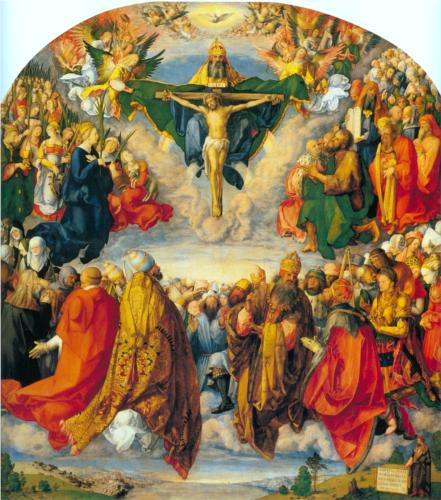
Your Redemption Is Near [Luke 21:25-36]

—Albrecht Durer

A couple of years ago a pastoral colleague told me the story of her debut sermon in her new congregation. It took place on the first Sunday of Advent, and her preaching text was the second coming, end of the world passage from the gospel of Luke. Apocalyptic passages like this one typically show up on the first Sunday of Advent because at the start of a new church year the Christian imagination looks far into the future, to the consummation of all things, as well into the past, to the Nativity of the Lord.

End of the world texts are notoriously tricky to preach effectively; but from what I could gather, the sermon she preached that day was theologically solid, pastorally deft, rhetorically pleasing, and socially relevant–a good sermon. What she didn’t know, however, was that in her new church it had long been the custom to let no good deed go unpunished. Sure enough, after the service she was accosted by an angry couple, parents with pre-teen kids, who proceeded to take her to task over her message.

“You’re new here,” they said, “and you need to know that in this church we don’t believe in that nonsense about stars falling out of the sky and fire on the earth and the end of the world! And if you insist on talking that way, the children will be terrified. It’s not what pastors are supposed to do, terrify children.”

I immediately thought of many things she might have said in reply, such as “Children don’t need pastors to terrify them when they already have such terrifying parents.” Sadly, she could also have reminded them that children really don’t need predictions of future catastrophes in order to feel afraid; there are plenty of awful things to frighten them right now, some of them unfolding in the privacy of their own homes.

Over-protective parents have a right to try to control what their kids are exposed to, I guess; but preachers have a duty not to trim the Good News of Jesus Christ to satisfy them, or anyone else, for that matter. And isn’t it good news that a divine regime of justice will, in the fullness of God’s good time, finally replace our world’s unjust and death-dealing systems?

And yet the doctrine of the second coming, with its multiple dimensions of judgment, vindication, consummation, and transformation, does not seem to stir us very much. We mention it once a year, on the first Sunday of Advent. And when we do mention it, we often try to explain it away; we shrug it off as if it were a silly remnant of a credulous past.

Why do we liberal Christians shy away from an active faith in the second coming? Are we not the ones who believe that through all our social justice commitments, we are preparing for the very kingdom that the second coming will finally usher in? So why not embrace it with enthusiasm?

It could be that we’re just bored. How many times have you heard the command to stay awake, to lift up your heads, to stand on tiptoe (as St. Paul says), and watch for Christ to come and install the kingdom? Every year we dutifully get up on tiptoe and watch, but nothing ever happens. After more than 2,000 years our toes get numb, and our enthusiasm begins to wane.

Recently, my colleague told me that those same parents who excoriated her for her second coming sermon took their kids to see An Inconvenient Truth, Al Gore’s film about global warming. I guess it’s okay to tell children that the world’s going to end as long as it’s Uncle Al who’s doing the telling, not Matthew, Mark, Luke or John. Which makes me wonder if perhaps another reason Christ’s second coming doesn’t grab us very much is that we’re just too secular to appreciate it.

We’re not totally secular, of course. Now and then we enjoy a quick peek under the veil that hides the word of mystery from our rational eyes. We’re allowed to be a little mystical as long as we don’t wallow in it. But the second coming? That’s the province of the Rapture weirdos who drive cars with “Beam me up, Lord” bumper stickers. It’s the comfort zone of the prophecy buffs with their maps and calculators. This sort of Christian exuberance about Christ’s return seems to us grossly deficient in what one theological wit called “eschatological chastity.” It is undignified—and it just isn’t us.

There’s another way in which it just isn’t us. Think for a moment about who it is that Jesus is talking to when he says, “When you see these signs, lift up your heads, for your redemption is near”? He’s talking to people who do not require academic explanations of redemption, much less theological justifications of the doctrine. They are people who from ancient days have been run over repeatedly by invaders and occupiers, exiled, enslaved, oppressed. People who have actually needed to be redeemed, literally bought back from captors and restored to their land and to their own history. For them redemption is not an interesting, odd, abstract, or debatable idea. It is their dream, their longing, their need, their passion. It is the story of their life.

As Neal Plantinga puts it, if you are a slave in Pharaoh’s Egypt, or in antebellum Mississippi, you want your redemption. If you are an Israelite exiled in Babylon, or a Kosovar exiled in Albania, you want your redemption. If you are a woman of any caste in modern India… and your fiancee doesn’t like the size of the dowry your family is offering and he threatens to send his friends to rape you, you want redemption from wicked sexism, and you want it now, with every fiber of your being… And if you are a Christian in sub-Saharan Africa this very day, you don’t yawn or roll your eyes when somebody mentions the return of Christ. When the AIDS epidemic has devastated whole populations you don’t care if your tippy-toes are going numb—you will stand up on them for another 2,000 years, if that what it takes. You want your redemption.

Can you taste that longing? Do you want the world’s redemption? Do you want your own?

Maybe you do, because maybe you have stopped claiming that you are “fine, thank you.” Maybe by some sweet grace you have broken through the denial that, as Kate Layzer says in one of her fine sermons, keeps most of us from ever really owning up to “the great big yawning need inside us that we can’t ever fill by ourselves, not with romance or work or food or shopping or booze or drugs or sex or self-help books or new drapes or travel or computers or psychotherapy or intellectual achievement or our own determination to be good responsible people.”

Maybe some calamity has befallen you that has unlocked your crying need for God’s freedom, healing, and restorative justice in a way that makes you long to hear the news that the kingdom is now very close at hand. Maybe your toes are not tired, maybe you are still watching, because your need is so deep and your longing immense. But if you’re anything like me and most people I know, if you’re having a pretty decent year in your own local personal kingdom, it’s hard for you to really long for the advent of God’s kingdom. When life is not all that bad, Plantinga notes, redemption doesn’t sound all that good.

I know that I go through my days with a Master Card in one hand and the Golden Rule in the other, and they appear to be enough to shape and anchor a mostly adequate life. And as long as this okay life of mine is not disrupted by illness, violence, or financial disaster, I don’t usually feel a strong need to be redeemed and transformed by the in-breaking of the New Age.

Redemption is not always the most welcome news, but God knows that it is in fact the best news we can get. And so the church is very wise to give us these four weeks of Advent every year to get over ourselves, to detect and repent from the largely oblivious way we live ordinarily, to reawaken in our dry bones the ancient human thirst for the Living One, and to learn to yearn also for the day when our thirst for the justice he brings will be satisfied.

The church is wise to give us Advent time and again, so that we can start fresh, start from the beginning, and try to walk a Christian path that is, as someone once described it, more than a moral coating applied over a functional atheism. To begin again to long for redemption—and if that’s beyond us, to try to long to long for it. To begin again to hope for shalom—and if that’s beyond us, to try to hope at least for a little more hope, for ourselves and for the world.

Year after year, Advent by Advent, the practice of this sort of patient desire and profound yearning for wholeness, justice and joy will shape and mold us into the very things we desire. And it will therefore also make of us a vivid testimony to the intentions of God toward the creation. Many people (as Plantinga says movingly) who don’t know a thing about God’s loving purposes but are searching hungrily for a clue will be able to look at us and say, “Ah, so that’s how people are going to live when righteousness takes over the world!”

Our Judge and Our Hope [Luke 21:25-36]

Advent is a journey with two destinations. One is to the past, to the manger, Jesus’ first coming. We place ourselves imaginatively alongside the ancient people of Israel. With them, we cry out in elegaic songs for the Messiah—”the desire of all the nations”—to come and heal us and to bring justice everywhere. That the Messiah did come in the frail flesh of Jesus of Nazareth is the joy Christian faith celebrates on Christmas.  The other destination of the Advent journey is the future, the second coming, when Christ will return in glory. History will end, and the new way of life Jesus called ‘the Kingdom,’ for whose coming we’ve prayed all our lives, will be ours in full at last.

The earliest Christians did not pay much attention to the first coming. They focused on the second, and they believed it was imminent. For them, who had so painfully broken with culture, custom and family to follow Jesus, nothing was more desirable than to be swept into the Kingdom by the glorious Lord of their hearts.

We, I think, are considerably less eager for it. We regard it with a certain bemused ambivalence; we say, “Jesus is coming! Look busy!” Jokes about Judgment Day are legion. Our sense of justice demands that God finally take charge of this world in which, as Robin Myers writes, “good deeds and righteous living provide no exemption from mindless tragedy, and the meek inherit nothing but a crushing debt and a dead planet.”

But even as we long for God to fix this mess, we suspect the whole thing might be a fairy tale. Our reason detects the scent of magical thinking in talk of a glorious return, and backs away. The second coming, after all, has been awfully long in coming. After 2,000 years, waiting for Jesus to come in glory feels a little like waiting for Elvis to re-enter the building. It’s embarrassing.

And, of course, as much as we know that things are just not right elsewhere, many of us are more or less satisfied with our own lives. If we’re doing okay, we feel no urgency about some future consummation. Even if our circumstances are not so great, faced with the prospect of a permanent interruption of the status quo, most of us would still opt for the life we know, not the one we don’t.

And so we let ranting fundamentalists on late-night cable teach people who are afraid of the world to read the sign of the fig tree and hammer plowshares into swords so that their fire-breathing Jesus can wreak vengeance on the ungodly. Ironically, the ungodly they love to condemn are the same folks Jesus loved to save. Oh, well. Perhaps, as Fred Craddock suggests, they are obsessed with the second coming because, deep down, they are so disappointed in the first one.

Fundamentalist nonsense aside, when you read the New Testament attentively, it’s hard to avoid the second coming. It’s also hard to avoid the judgment that accompanies it. “We believe,” all the ancient creeds professed, that “he will come again in glory, to judge the living and the dead.” And maybe this is the real reason we shy away from embracing this doctrine of the second coming. Fulfillment and wholeness, restoration and blessing, peace and justice at last—all these promises appeal to us mightily, but not the promise of judgment.

Judgment makes us nervous. In one of the exercises my congregation undertook in their visioning process many years ago, members were asked to rate a list of classical Christian beliefs from “dearly-held” to “not-so-dearly held.” When we shared the results, final judgment came in among the bottom-feeders.

And there are good reasons for our aversion. Too many of us grew up staggering under somebody’s judgment. God or a parent or some other authority was always lying in wait for us to fail. They saw everything. They forgave little. Measuring up was the name of the game, and we never did.

Faith in an incarnate God didn’t help much either. Some of us thought that the all-seeing God who became flesh and lived a perfect human life expected us to live perfect lives too, because in Jesus it was shown to be possible. As someone once noted, God could say to us, “Well, I had the same experiences you have, and they didn’t defeat me!” Who could bear to hear that on any day, let alone on the last day, when we’ve run out of chances? Let Jesus come and settle all the grand cosmic scores, but please leave our own souls and psyches out of it. We’ve had enough judgment for several lifetimes.

Or have we? Modern psychology has taught us that the worst sin we can commit is to be unsupportive and judgmental. So it’s going against a lot of grains to say that Christian tradition may be onto something important with its insistence on judgment. We may in fact need more of it, not less. More judgment, that is, of the right kind. Maybe a story can shed some light on what I mean.

A few years ago, a pastoral colleague of mine did something she regretted deeply. Feeling unsettled and guilty, she sought help from her longstanding ministry support group. She’d barely gotten through the story of what she’d done when they began telling her that it didn’t sound that bad, that she’d had good intentions, that she was way too hard on herself, and that God had already forgiven her.

They were immensely supportive, but their support made her feel worse. It seemed as if they believed she was incapable of doing anything wrong. They talked as if she were not capable of discerning a serious matter from an insignificant one. They didn’t take her seriously. All they had to offer were glib affirmations that she was really a good person.

After being left in pain by her friends, she decided she wanted to go to confession, but she wasn’t Catholic. Someone suggested she call me. I reminded her that I wasn’t Catholic either, at least not any more. But I offered to help anyway. I grabbed a UCC Book of Worship and asked her to meet me at her church. We sat down in the chancel, opened the book to the “Rite of Reconciliation of a Penitent,” and began.

First we read a prayer of confidence in God. Then I invited her to confess what she had done, and in God’s presence and mine she confessed. I affirmed her confession and asked her if she was sorry. Yes, she truly was. I inquired whether she’d formed a plan to make amends. She had, and she was resolved to do so. We prayed together for mercy and healing. Then we stood up, and I declared her sins pardoned in the name of Jesus Christ. We said a final prayer recalling the joy there is in heaven when one who was lost is found, and we exchanged a sign of peace. Then she went home, and so did I.

Now, if you knew the bad thing she did, you’d probably agree with her friends that it wasn’t that bad, that she had had very good intentions and that she was being way too hard on herself. You might even think that going through an entire reconciliation ritual for that was serious spiritual overkill. But you’d be wrong on both counts.

It is a very big deal whenever someone breaks through a sense of false innocence, faces a frailty that caused damage even without intending it, and discovers a greater authenticity of life even in a relatively small moral matter. By being judged and found wanting, she received a gift most of us crave—the certainty that God (and a representative of the church) did not love her any less even knowing what God knows about her; the joy that God (and the church) took her conscience and her sense of need seriously and believed that she was worth being judged, worth being forgiven and restored.

Often what threatens us is not judgment itself, but the experience of knowing something about ourselves, or of having someone else know it, and fearing that we will not be able to love ourselves or live with what we know, nor will they. Most of us actually want judgment, because most of us finally want to face and embrace our truth. But it is also the case that most of us cannot bear to embrace the truth about our lives without the warmth and light of love. We know from bitter experience that truth and judgment without love will crush us.

And here is where we return to Advent and its double destination. Advent asks us to believe the God enfleshed in the manger is same God who will judge us on the last day. But this is not an all-seeing Perfectionist, not a God who sees us from afar, knows what we have done, and is disappointed. This is God-with-us and God-for-us—the one of whom John’s Gospel says this most amazing thing: “He knew what was in us.” He will judge us with a judgment of kinship, the judgment of One who has been inside us, inside our human motivations, understanding us on our terms. The Jesus who will be our judge on the last day is the same one who said, paradoxically, “I judge no one.”

The more you read the gospels, the more you see that Jesus’ habitual response to sinners is full of what Rowan Williams called “sheer visceral pity.” Where are your accusers? Has no one condemned you? Neither do I. Jesus’ own terrible temptations and struggles “seem to have produced in him a sense of the precariousness of goodness so strong that no failure or error could provoke his condemnation.” The only people Jesus ever condemns are people who can’t allow for this precariousness, who refuse to see that the sinner is often a victim more than a criminal, and who imagine we are freer to choose and sin than we really are.  Jesus knows the real measure of our responsibility. He knows it better than we know it ourselves.

This divine sense of the precariousness of goodness is our hope on judgment day, and on any day when we face ourselves squarely in God’s presence.  It can save us not only from some imagined divine condemnation, but also and especially from a very real and debilitating self-condemnation. He knows what is in us.

In the cross that deals him his death, Jesus showed us the very depths of our destructive refusal of health and life, our violence and fear. And through all this he still accepts and loves us. “When we are vulnerable and fragile,” Williams concludes, “it is he who is wounded and broken, carrying all our hurt in himself.  So we may take to him our whole selves in the sure trust that nothing will be thrown back at us to wound or destroy. This is the gospel whose ministers we are.”

Yes, this is the gospel whose ministers we are. We have good news to tell of a judgment that is love and a Messiah whose only fierceness is a mercy that lays us bare for healing. May we embrace this gospel in trust and share the truth that frees. And may we use Christ’s judgment of kinship and no other with ourselves, with each other, and the world.

God Our Feast: A Thanksgiving Communion Reflection

The first big crisis in a relationship is not the day one partner finally gets tired of picking up the other’s socks. It’s not the first time partners fight over the right way to balance the checkbook, or even the right way to hang the toilet paper. The big crisis breaks the first time they cook Thanksgiving dinner at their own house.

“That isn’t stuffing!” she says, “Stuffing has apples and raisins.” Her mother made it with apples and raisins. “It is too stuffing!” he replies. “Stuffing has sausage and nuts.” His mother’s stuffing had sausage and nuts. Persuaded by the memory of a taste, each is certain of the truth about stuffing, and each is compelled to reproduce the pattern of perfection learned long ago.

The stuffing crisis is a hard one because it’s not really about stuffing. It’s about truth, ultimate harmony, right order. The memory enclosed within taste buds is the flavor of home. To have stuffing now the way it was then is to persuade our tongues and tummies that we are the same now as we were then, that things are good now like they were then.

Nostalgia has a way of distorting memories. Things are more complicated than wafting aromas suggest. It’s not for nothing that at this time of year TV sitcoms make us laugh and Hallmark specials make us cry at the anxious, ungainly spectacle of families regrouped around turkeys. At Thanksgiving, some folks don’t, won’t, or cannot go home.

For many, the nostalgia of the holidays isn’t about what was, but what ought to have been, if only. If our mouths water with nostalgia, they water also with desire—for firmer ground, for knowing and being known, for a love that circumstances can’t alter.

Dwell for a while on the thick sweet smell of nuts and sage, raisins and apples, and you will sense the source of such longings, the truth about our life: we were fashioned for a joy so fragrant we can taste it. We were made with hungering hearts. We were created for a feast laid on richly like a dream, tantalizing and aromatic, at the center of our souls.

We were made by God for God and for the amiable company of God’s people, for fellowship as pungent as precious ointment squandered by a woman on the weary feet of Jesus. We were made to sit down at a table where the feast is God.

“O, taste and see!” the ancient psalmist sings, “Taste! You’ll see how good God is.”

We are a people with a taste for God. Our history is one vast story of feeding on mercy and steadfastness, our life a drama of sustenance. Even in the harshest famines and the longest droughts, our memory floods with aromas that make our mouths water with desire for beauty and justice, that make our bellies rumble with hope for what might last—faithfulness, deliverance, vindication, breath and life, children and children’s children, righteousness, and peace.

We remember that from age to age our Shepherd’s wine runs generous and free, our cup brims full, and the board is spread with kindness. We remember that in every place our Host makes room for all kindred souls and every stranger, every widow, orphan, lost or straying sheep, each enemy, and every child.

Because we remember, we find no comfort in consuming bitter food, like the narrow do, who live only in the past. Neither are we gratified by food too rich, like the fearful do, who live just for today. We find no joy snacking on junk and skipping meals, like the headlong and ambitious do, who live only for tomorrow.

In us is a different craving, the memory of a subtle, varied flavor, tantalizingly familiar and completely new. Rolled on the tongue, lingering on the palate, filling the cavities of stomach and soul—once sampled, nothing else is good. We want no other recipe. “O God,” we cry with our ancestors, “you are our portion and our cup. For you we thirst like deserts parched, lifeless, and without water.”

“Well, then, come,” the Spirit replies, “Eat my bread and drink my wine. Come to the feast I prepared for you.”

On Thanksgiving Day we assemble around tables to say, “We are not our own. All that we have and do, all we are, comes from and belongs to our Creator and Sustainer.” We assemble to give thanks for God’s all-providing.

But when we give thanks, we aren’t settling accounts or dryly honoring a benefactor. We are God’s own; when we give thanks, our taste buds tingle, our mouths salivate, our insides rumble, our olfactory memory drives us deep.That memory makes us more than thankfully awed at what God does and all God gives; it makes us awed at who God is. Our thanks is for all our blessings, but first and most of all for having gifted palates, lives imbued with a taste for God, a predilection for the generous wares of endless love.

By the power of that love and for its sake, and for the sake of a world sated with violence and contempt, for the feeding of a world that hungers for God, we assemble so that we ourselves might become what we have tasted—bread of righteousness, seasoning of justice, water of mercy, wine of truth and sweet peace for the weary of war. We must, then, eat, and eat our fill.

Taste, see. Discover how delicious, how very, very good God is. Today, we say this grace for all this grace: “God is our feast: Thanks be to God!”

Lord, I Want to Be in that Number: A Sermon for All Saints Day

Revelation 14:1-3, 14;  Matthew 25: 30-41

“Oh when the saints go marching in…” It’s a great old song that gives voice to an even older Christian hope, that when the kingdom comes, we ourselves will be among the holy ones streaming through its pearly gates, dancing down its golden streets, cavorting in its heavenly fields, and sampling its thousand sacred sweets—speaking figuratively, of course. (Except for the sweets. The sweets had better be real!)

“Oh when the saints go marching in…” We sing it with  happy gusto, completely oblivious to the little bombshell tucked away in the third line of all the verses. Did you notice it? “Oh Lord,” the third line says, “I want to be in that number…“

Oh! There’s a number. When the roll is called up yonder, a number of saints will go marching in.

Now, when I sing, “I want to be in that number,” I really mean it. And despite recent reports of declining belief in heaven among liberal Protestants, I’m willing to bet that you want to be in that number too. But ‘number’ might mean that not all of us will be marching to Zion. ‘Number’ could imply a limit. Think ‘bouncer at the door with an official guest list,’ or ‘guy with a clicker standing under the maximum occupancy sign posted on the Pearly Gates.’

What if that’s the case? What if we’re not on that list? What if we dawdle and arrive to find heaven already at full capacity? What if we’re turned away? A cartoon shows a befuddled man standing before a desk in the clouds. St. Peter is behind the desk scowling at him, his quill pen hovering over the Ledger of Life. The man says to Peter, “Nobody told me I needed to bring my receipts.” What if we forget to bring our receipts?

“Lord, I want to be in that number…” How many are we talking about here? Just how big is ‘that number’? And will we be in it?

In the Middle Ages, the vast majority of Christians operated on the gloomy assumption that they were not going to be in that number. The church gave them lots of spiritual means for slogging their way through this earthly “vale of tears” towards the heavenly realm, but in the medieval way of believing, arriving was never a slam-dunk, no matter how often or well you made use of all those sacraments, indulgences, and intercessors.

It was widely believed that monks and nuns had a better chance at getting through heaven’s gates than the hoi-polloi did.  A monastic life removed you from all sorts of temptations—the relentless allure of the world, the flesh and the devil. In theory, anyway! But every day of their lives, ordinary Christians had to engage in tainted things like commerce, politics, and sex. And that meant they were always sinning. Thus, it was mostly those famous miracle-working, life-and-limb-losing, inimitably virtuous, perfectly perfect, officially-certified, canonized saints who got to be in that number. How many? Not many.

The idea that not everyone gets to be in that number did not pass away with the Middle Ages. Many Christians still expect the number to be limited. One newer American religious movement even teaches precisely what that number is going to be. It’s derived  from the Book of Revelation—one hundred forty-four thousand. One hundred forty-four thousand men and women “sealed for God,” which is to say, ‘marked as God’s own.’

(By the way, practically everybody in the Book of Revelation is marked in some way—whether you belong to God or Satan is something you can see.  Satan’s people are marked with the number 666. That was my telephone exchange when I lived in Somerville, MA. Some fundamentalist Christians in my neighborhood complained about it to the phone company, and so they offered everybody new numbers. I kept my old one. I loved it that people had to dial 666 to reach a minister. But I digress…)

These folks believe that when the trumpet sounds on the Last Day, one hundred forty-four thousand special believers from their community of faith will be ushered right into heaven, and there they will reign forever with God. Others in their movement will reside for all eternity on a new, paradise-like earth. So, according to a recent census of this group, if the world were to end today, the new earth’s population would be five million five hundred sixty thousand saints, minus one hundred forty-four thousand special saints in heaven. If you’re not a member of this group, you won’t be in either of those numbers. But you won’t suffer eternally in hell, either. There’s no hell in their theology. You’ll be annihilated, quickly and completely.

If you’re tempted to think those beliefs are funny or bizarre, beware. The wagging finger points right back at our own Congregationalist history. A lot of our Puritan forbears believed in double prelapsarian predestination. Now, most of us don’t know prelapsarian predestination from a potted plant, so let me sum it up this way—long before Adam and Eve even suspected that there might be such a thing as forbidden fruit, God chose who would be saved and who would not. Because God is gracious, however, God’s election is not stingy. God has chosen to save an “innumerable multitude” of saints. Yet no matter how many people God elects and saves, it’s still a number. Not everybody is going to be in it, they guessed. Some people are going to be counted in a number that’s headed south, where it’s a lot warmer.

Did you notice the “I” in our song? “Oh Lord, I want to be in that number.” Throughout Christian history, ‘I’ have always wanted to be in that number, but ‘I’ have rarely wanted you to be in that number alongside me. Fred Phelps didn’t expect to see any gay people when he got there (imagine his surprise!). Most fundamentalist and some evangelical Christians preach that unless you explicitly accept Jesus Christ as your personal Lord and Savior, you won’t be joining that number either. And it wasn’t all that long ago that nearly all Protestants believed Catholics wouldn’t go to heaven, nearly all Catholics believed Protestants wouldn’t go to heaven, and nearly all Christians believed that non-Christians wouldn’t go to heaven. (If everybody’s right, then nobody’s in heaven! And with all our violent squabbling over heavenly turf, I’m sure there are moments when God would prefer it that way.)

These days, thankfully, we’re a bit more inclusive. Well, a lot more inclusive! Catholics have done away with Limbo so that unbaptized people can now enter paradise instead of languishing forever in an in-between state, deprived eternally of the presence of God. Most Christian churches don’t consign suicides to hell anymore, in some cases owing to a deeper grasp of the complexities of depression as a form of mental illness. And in liberal Christian circles over the last generation or two, we’ve been steadily backing away from the traditional Christian conviction that there’s only one way to salvation, through the grace of Jesus Christ.

Indeed, in the UCC we break out in hives if someone even hints at excluding anybody from the procession of the heaven-bound. We expect God to elect absolutely everyone, no matter who they are, or where they are on the journey of faith. We don’t think you have to be a Christian to go marching in, let alone a particular flavor of Christian.

We also aren’t fond of the idea that Christian saints are exceptionally heroic and holy—the few, the fine, the famous, and the dead. With St. Paul, we say that to be a Christian saint, it’s enough to be baptized and to desire to live a new life in Christ—whether you’re living or dead, ordinary or extraordinary, you qualify. You’re a saint the minute the cat drags you in over the church’s threshold!  Especially if you sign up for a committee. Nothing canonizes you faster in our tradition than filling a vacancy on the Board of Christian Education.

These days, it seems that we mainline Protestants can’t think of anybody who’s not going to be in that number. Of course, it’s easy for us to say that. It’s easy for us to say anything we want about a total mystery we know nothing about. All the same, and speaking just for me, I’d rather be lax and rule everybody in, not strict and rule a bunch of people out. It seems to me that although lowering the bar as much as we do these days might have some moral downsides, it’s a far less violent way to go than its opposite.

Because ruling people in or out of heaven is not some quaint, innocuous theological game. It isn’t merely theoretical. It has consequences. If somebody thinks you’re unworthy of the next life, they probably think you’re unworthy of this one too. History is littered with the battered bodies of everybody’s excluded infidels and heathens. How we think about ‘that number’ really matters. And so it also matters what Jesus says about it. Let’s listen to him.

In the famous gospel passage about the sheep and the goats that we read today, you’ll notice that Jesus doesn’t say how many people will inherit the kingdom. What he does tell us is how to get there. And for that, the only number that counts is the number one. Listen! “Whenever you did it to one of these least, a member of my family, you did it to me.” One, fed. One, clothed. One, comforted—one is the number that counts.

I honestly don’t know if there’s a predetermined cap on how many of us will one day go marching in, but I do know that we have good warrant for setting the bar so low. Our brother Jesus was there before us, doing exactly the same thing. If you go by what he says in this passage, anybody can be in that number, because anybody can make one visit, cook one meal, throw one warm jacket over a pair of shoulders hunched-up against the cold.

I don’t know for sure if there’s a cap on that number, but I do know that Jesus isn’t trying to make it too tricky or too onerous for us to be in it. You don’t need special knowledge or heroic virtue. You don’t need to be a martyr or a monk. You don’t need to accumulate one hundred forty-four thousand good deeds or say one hundred forty-four thousand prayers to St. Jude the patron saint of lost causes. It’s one stranger welcomed, one wound healed, one thirst satisfied.

You don’t even have to do it for God! Maybe you don’t even have to know God! The sheep, after all, had no idea that they’d been lending a hand to Jesus. “Lord, when did we see you hungry, or thirsty, or naked, or homeless, or in prison, or sick?”   We know when. “When you did it to one…”

As I said, I don’t know if there’s a cap on that number, but if there is, in the course of our Christian lives, you and I have not been kept in the dark about the basis on which it will be decided. It’s no secret. It has to do with whether we hand ourselves over to each other in kindness, or whether we bring our hands down on the weak and unprotected. It has to do with whether we get our hands dirty with works of mercy, or wash them of responsibility for our neighbor. It has to do with whether we have our hands full of compassion, or remain an empty-handed people.

But even more, it has to do with the mercy of God, the one we know in Jesus, who opens the divine hand to us all and bestows largess beyond all telling, requiring so little of us in return for so much.

Praised be God by all God’s precious saints and by every creature under heaven, now and in the endless age to come.

Inshallah

It means, “God willing,” and all the Muslims I know punctuate ordinary conversation with it repeatedly. In its most pious use, it’s an expression of humility acknowledging the paltry power we mortals have to make things happen they way we want them to. “Man proposes, God disposes,” as the Christian saying goes—inshallah, if God wills. The future is not in our hands. Tomorrow for lunch? Inshallah. See you at the game tonight?  Inshallah. I’m working till six and then, inshallah, I’ll head home. In other words, here’s my plan, but you never know: God may have a different idea.

Our guide in Morocco was an inshallah kind of guy. Every morning on the bus he turned on the sound system, rapped the microphone a couple of times to be sure it was working, and ran down the schedule for the day. Every other word was inshallah.  A religious man, the expression came naturally to him; but it was, I think, more than a pious reflex. It was also his way of dashing our American expectations of efficiency—Morocco does not exactly run on clock time; schedules are always approximate; the way things will actually work out is anybody’s guess.

The tour company’s materials urged us to relax into the “full Moroccan cultural experience.” Whatever else that meant, it soon became obvious that it covered a couple of promised activities that never materialized and more than a couple that became so prolonged they ate up all the time set aside for rest and exploration “on your own.”

When I was at my best, I tried to use the inshallah-ness of everything as a chastening exercise: You are in the hands of others now. Leave your inner control freak behind. Don’t feed your disappointment with complaint. Enjoy not being in charge for a change. Let yourself be surprised. Who knows what you will discover? You can sleep when you get home. But my efforts waned fast. I was too exhausted to summon myself to carefree heights.

I began to wonder if all the emphasis on entering the full Moroccan experience was just a dodge for really bad planning. I wasn’t the only one. Nearly all of us were getting sick, and the worst sufferers begged repeatedly to stick closer to the schedule or maybe even to curtail a few of the less important things (one fewer visit, perhaps, to a cosmetic shop, a carpet shop, the jeweler’s….) so that we could get some rest.

That’s when we learned that inshallah can also mean “maybe,” but more often just means “no.” It’s a weasel word, the sleight of hand employed in cultures that are almost perversely committed to making you happy, even against your will. The assumption seems to be that no human being ever wants to be told no, and therefore one must always leave open the chance of success in the other person’s mind, even when you know perfectly well you’ll do nothing to make it happen. It’s also flagrantly paternalistic, of course, assuming as it does that the client has no idea what he really wants, or what she really needs. How could you not want to visit another cooperative? It is a highlight of the trip (as were almost all the other venues listed on our itinerary)! Why would you want to rest when there are so many fascinating experiences to be had?

When our guide pulled that last one on me over supper one night, I was at my wits’ end. Testily, I replied that, indeed, I was certain there are millions of fascinating experience to be had in Morocco, and millions more to be had in the big wide world; but that being a mortal with only one life, I was also certain I would be missing most of them; and having long ago resigned myself to this limitation, I was not about to get avaricious now— so could I please skip the henna shop experience and go to my much-neglected bed?

He answered,  “Inshallah.”

Supplication

After a couple of days in a desert encampment, we packed up the 4x4s and headed for the town of Tinghir. The dusty, bone-jarring track out of the Sahara took us past a couple of nondescript villages, each with no more than half a dozen dwellings, a date palm or two, and an overloaded mule. When we came to a third such village, we barely gave it a glance; but as we were passing by, waving to some children who’d run out to gawk at us, the drivers pulled over. Our guide indicated that this was a stop, and so we tumbled out to look around.

What we saw was about a half acre of hard sand dotted with thousands of stones that appeared randomly strewn. We’d come upon a cemetery; the stones that seemed haphazard were markers on burial sites. Perpendicular stones signified males, horizontal stones, females. You could tell adults from children by the length of the mounds of hard sand heaped over the grave.

There were little bowls of pebbles on many of the graves. We speculated grandly about their meaning until our guide came up, shrugged, and explained that the pebbles were just to keep the bowls—receptacles for flowers and other memorial gifts—from blowing away in sandstorms.

Only three among all the graves bore the name of the person whose remains lay under the mounds. The rest were unmarked, similar in every respect. Identification of the dead, our guide reminded us, is forbidden among traditional believers for whom the democracy of death is a truth that needs teaching as often and by as many methods as possible—especially in places like this, where life’s cruel inequalities are crushingly apparent, and death is the only thing you can’t buy off with money.

The insistent anonymity of these graves rattled several people in our group. The prospect of being stripped of singularity after spending a lifetime trying so hard to achieve it was befuddling. Besides, most of us were bearing up fairly well in the face of life’s inequalities and felt no need to pull back the curtain on the fiction of our distinctiveness. It was all too candid and bleak. Several people were not sorry when the guide moved us along.

He pointed to a low adobe structure at the edge of the cemetery. Another shrine to another local saint. “Let’s go see it,” he said. We’d seen many shrines by this time, which explained the soft groans and slumped shoulders that greeted his suggestion. Like all tour groups everywhere, however, we trudged dutifully behind him.

The saint was buried inside the unadorned hut. Worse than unadorned, it seemed neglected, dark and close and (of course) full of cats. There was no light inside except for the brightness at the open door, which we had tugged halfway off its hinges when we came in. This seemed an unlikely place for veneration. One of us wondered aloud, “Does anyone even come here anymore?” As if on cue, three teenage boys materialized in the doorway.

They had seen us meandering around the cemetery, and watched as we entered the shrine. Now like gushy representatives of the Chamber of Commerce, they wanted to tell us all about it. “The saint answers many kinds of prayers,” they explained, “but specializes in women who cannot conceive. They come in all the time. They sit here all day. They eat and pray. They ask for children, and the saint hears them.”

“Do you mean they get pregnant and have babies after they pray here?” This from the one declared atheist in our group. “Do you believe that? That the saint works miracles?” The boys did not seem to understand the question. Neither did our guide. They said again, “They come, they pray, the saint hears them.”

By this time, our eyes had grown accustomed to the dark. We could now see the walls. They were patched and sooty and covered with graffiti. The guide said these were requests for help, reports of success, thanks for favors, but among the more devout scrawls we were sure there were also a few that told the world “Mustafa was here” and “Ali loves Faiza.” The more the guide denied it, the more convinced we became.

And then we saw the hands, dozens and dozens of small palm prints in bright henna stamped on the walls like Paleolithic cave drawings. These were women’s hands, supplicating, declaring presence and need, tattoos of trouble, imprints of hope.

The boys didn’t know how long they had been there, whether they were fresh or ancient, but said they did not remember a time without them.

Yes, I thought, that’s because there never has been a time without them. Here in this shrine or anywhere else.

And just like the graves outside, and like the human need they conveyed, the small red hands were  anonymous, almost interchangeable, absolutely democratic in desire.

Muhammed’s Cats

We were barely off the airplane in Casablanca when we noticed the cats. You couldn’t not notice the cats. They were everywhere, all the time, street cats with the hungry look of street cats, brazen and intrusive in tourist venues, city shops, and roadside cafes. But cute, always cute, especially the little ones; so cute that even the inevitable germophobe in the group risked the assault of unspeakable miseries to pet them.

In European cities like Rome, feral cats don’t often win local hearts, but the cats we saw in Morocco seemed not unwelcome. Tourists weren’t the only ones making mewing noises to signal the imminent drop of scraps from restaurant tables. Shallow bowls of water were set out everywhere too, even in the middle of what seemed like nowhere.

On a showery day in Rabat, we came across an old man inside the 14th century Chellah Necropolis. He was the unofficial guardian of a shrine inside the grounds. Devout Sunni Moroccans routinely deposit their raw needs at the feet of long-dead holy ones at such shrines, in hope of answered prayer, much like the Berber “pagans” and Christians in North Africa did before Islam arrived. Don’t ask me now which saint was venerated in that small dark room, there were so many shrines along the way, some imposing and ornate, but most as forlorn as the people who trudge to them. And they are filled with cats. The shrine in the Necropolis had its ample share, and the guardian fed and watered them every day, asking alms from visitors to offset the cost of his mercy.

He’d been there too many years to count, he told us, and so had most of the cats. They were his preoccupation. When a man in our group asked the obvious “Why?”, the guardian told us one of those short, slight stories that explain everything to those whose hearts want to know.

“Once upon a time, the Prophet awoke at the sound of the call to prayer and went to put on his best robe in order to pray. But he discovered that a cat, whose name was Muezza, was sound asleep on the sleeve. Rather than wake her, he got a pair of scissors and cut off the sleeve, leaving her there undisturbed.”

I liked that story very much, but it was another legend we heard in another town that captured my heart. Forgive me, Muhammed, but I think I fell for it so hard because it sounded a lot like a story Jesus would tell; and as much as I respect you, I am a hopeless sucker for him. Anyway, my Christian chauvinism aside, here it is:

“A woman with a bad reputation was returning from a night of debauchery when she saw a cat in the road. The wretched thing was starving, very close to death. The wicked woman ran into her house and filled one of her jeweled slippers with water, returned to the street, and set the slipper down before him. The cat drank and lived. Many years later, a holy man of that same town died and entered Paradise. There he saw the woman and was astonished. He asked the Prophet how it was she had found mercy. The prophet said, ‘Because she showed mercy, even to a cat.’”

Under my breath, I said (for my own instruction), “Go and do likewise.”

Come and Have Breakfast

The first morning of our stay in Essaouira, our breakfast waiter met us at the dining room door to steer us to the table reserved for our small group of travelers. To our surprise, he did not seat us in the dining room. He led us instead to a table he had set for us, and for us alone, on an outdoor terrace overlooking the ocean.

You could tell he was pleased with himself: the smile that spread over his face when he saw our delight was positively beatific. “This will be your table every day,” he announced. “My name is Aziz.”

Aziz spoke Arabic, Berber and French, Morocco’s three official languages; he also spoke some German, pretty good Spanish, and passable English. In all these languages he was unfailingly exotic, old fashioned, over the top. He executed the most amazing flourishes and deep bows as he set down plate after plate of breakfast breads and pastries, huge bowls of fruit, hot coffee and milk, and fresh squeezed juice. Voilà. Voilà. Voilà.

He also made sure he learned our names so that he could greet us personally as we came to breakfast and inquire solicitously about our sleep and our health. Aziz was a quick study, and before we knew it, he had associated songs with some of our names, literary snatches with others, movie references to the rest. Even the bleary-eyed “I am not a morning person” member of our group was completely charmed by him when he broke into song or recited some corny verse tailored to her alone.

The cynic in me was tempted to think of Aziz as an astute showman who had figured out that Americans are suckers for this sort of local color and tip accordingly. And there was probably some of that in his behaviors. But I didn’t care. It’s not every day someone treats you like exalted royalty, let alone like a simple human being. It did wonders for me, who felt depleted and just this side of depressed at this point in the journey. I needed everything Aziz had to offer.

This was the morning dialogue he used with me:

“How are you today, Mary?”

“I’m fine, thank you, Aziz. How are you?”

“I am well if you are well, Mary. I am well if you are well.“

Of course I believed him.

When he flashed that smile, I had no doubt that his wellbeing hung on the thread of my own, his pleasure weighed in the balance with my delight. Of course he could not and would nor be happy if I were not, and so I resolved to be well for his sake. And for my own.

And of course on the last morning I slipped a very large bill into the pages of the memory book he begged us to sign with all his customary theatre and his brilliant, brilliant smile.


The Poor You Will Always Have With You [Matthew 26:11]


It wasn’t a very good lunch. The sweet, hard-working cook at our Sahara encampment had boxed it up for us to eat when we stopped for a break on the road through the High Atlas Mountains, but it didn’t represent his finest work. Inside each plastic bag was a slab of generic yellow cheese, 4 or 5 spicy green olives, an overcooked hardboiled egg (yes, you can overcook a hardboiled egg), two slices of pink mystery meat—the oddest and most forbidding cold-cuts I have ever seen— and one really beat up apple.

I ate mostly bread that afternoon. So did everyone else in the group. There was a lot of food left over.

By this point in our trip we’d been well schooled to throw nothing away. It was the custom to give leftovers to the poor, and we’d been doing that routinely in every city and town. We’d leave a restaurant or café with our remaining bread or meat or fruit wrapped up in napkins and hand it to the first person on the street who approached us begging. There were many such people, and no one ever refused our grease-stained packages.

But now we were deep in the High Atlas. We had gone for miles, hours, without seeing a soul. Most of us were so concentrated on the hairpin turns of the switchbacks we would probably not have noticed such a soul anyway, even if she had materialized atop the sheer cliffs or risen from the dry canyon floor below.

Our leftover lunches would be pretty disgusting by the time we reached a town. Not fit even for the poor, one person said. I recalled some of the beggars we’d seen, and doubted they would find even rancid food unfit. Nonetheless, the point was well taken—this stuff would probably go to waste on this part of the trip.

Someone else quipped that when Jesus said, “The poor you will always have with you,” he had not been on a bus in the middle of nowhere. General merriment ensued. I bit my tongue. The group had proven itself fairly impervious to nuance and complexity thus far, and there was not much hope things would change now.

A half hour later, when we had turned our minds to other things, our driver suddenly slowed the bus and pulled over. We didn’t know why. We looked out the windows, but saw only the same brown cliffs and hardscrabble valleys we’d been viewing for hours. But the driver waited. After about two minutes he said, “The lunches, the lunches.”

Our guide started collecting all the leftovers into one large bag. The driver opened the door and let him off. He ran down the road back in the direction we’d just come, jumped the low guardrail (which guarded nothing, really, just marked the edge of the narrow road) and started up a path into the hills; when out of nowhere—really, out of nowhere—a shepherd appeared. He strode nimbly down the hill and raised his arm in greeting, the only human being we’d seen for what seemed like a hundred miles.

There was an embrace and a kiss on both cheeks. When the food was proffered, the shepherd placed his right hand over his heart and patted it twice. The he took the bag, turned on his heel, and melted back into the rock, like a genie sucked back into his lantern. Our guide ran back to the bus and climbed on. The driver pulled back onto the road and smartly negotiated the next hairpin.

And I didn’t start breathing again until we came to the next pit stop, thirty kilometers down that winding road.


Almost Evening: Spirituality in the Face of Death [Luke 24: 13-35 ]

“Stay with us, because it is almost evening and the day is now nearly over.”

I ran into an old friend the other day. She’s a Baptist’s Baptist who hails from deep in the Bible Belt. Soul freedom personified, and a fierce free-churcher, she is not someone you’d expect to inhabit the same zip code as a Book of Common Prayer. But there it was… she had it in her hand.

I must have raised an eyebrow, because she immediately launched into an explanatory rant about how loopy worship services at her home church had become.

‘We never know what we’re going to get,’ she said. ‘Every week it’s amateur hour!’ A few Sundays before, it seems that instead of the sermon there was a fully-costumed skit announcing the Strawberry Fair. And just last week there was special music to honor the King…of Pop.  And every Sunday, she endures the vague churchy blather (her words, not mine!) of a pastor who can never quite pull off a single, simple, clear declarative sentence—subject, verb, object. ‘And,’ she said, ‘when that man prays, bless his heart’—if you’re from the South, that’s a phrase that makes it okay to say something bad about somebody—‘when he prays, bless his heart, you’d think it was the weather report on the morning news!’

“Dear God, we thank you for the blue sky and bright sun on this perfect spring day with temperatures hovering around 70 dry, breezy degrees. And for this high pressure area that’s going to ensure pleasant weather well into the week…“

So… she’s started going to an Episcopal church. Hence that BCP. She attends Morning Prayer, Eucharist, Evening Prayer—whatever’s on offer. With the ‘Piskies she gets a fixed liturgy, time-tested language, no guesswork. She can relax. “And,” she said, “it makes me cry.”

Now, I got the part about a fixed liturgy being a relief. But I wasn’t expecting her say, “It makes me cry.” And to mean ‘that’s a good thing.’ She’s not exactly sentimental.

So I echoed her, in my best imitation of a therapist, “It makes you cry….”

“Yes. Well, no,” she said. “not everything makes me cry. It’s mostly evening prayer that makes me cry. “

Evening prayer…”  I repeated.

“Yes. Well, no, not evening prayer as such.  One of the prayers in evening prayer, the collect, this one. It makes me cry.” And she opened the prayer book to read it to me. But I already knew which one it was going to be. Maybe you do too.

“Lord Jesus, stay with us, for evening is at hand and the day is past; be our companion in the way; kindle our hearts, and awaken hope, that we may know you as you are revealed in Scripture and the breaking of bread. Grant this for the sake of your love.  Amen.”

For years this prayer has been a devotional staple of mine for when I lay me down to sleep.  It makes me cry too… In part, I think, because my heart is easily smitten by a really great metaphor: Almost evening. Nightfall. The day passing away.

You know where this is going.

If you were to place this prayer on the lips of my 91-year-old father some Monday night, he wouldn’t be thinking, ‘Monday. Monday is almost over.’ He’d be thinking about how it’s all gone so fast. He’d make a stunning calculus of years behind and years ahead and wonder how it happened. He would say to himself, deep in that place in the soul where from time to time you dare to test out the truth, ‘It won’t be long. It’s almost evening. The day is far spent. Death is near.’

And, of course, he’s not the only one.

I occasionally spend time looking at photographs of myself as a child. Not so much because I’m vain, but because it’s bracing. It’s like the old monastic practice of keeping a skull in your cave. ‘Memento mori,’ says the wiry, sun-draped child sprawled like Huck Finn on a flat rock in the swift brook that empties into Stirrup Iron Pond on her grandfather’s farm.  She is so far away. She is impossible. I’m only 65, not 91, and yet I can’t reach her. I can’t really say in truth that I remember being her. She is a day drawing to a close. She is like an evening gone. She makes me cry.

Do you know what I mean?

Once upon a time, we had our whole lives ahead of us, and we imagined them a certain way as we hatched hopes and made plans for them. We cast ourselves as protagonists of beautiful unfolding stories: We’d have a loving, lasting marriage. We’d build a good career in a meaningful profession and stash enough money away for a comfortable retirement. And we would be fine people, people who do good and not harm. We’d eradicate world hunger by the time we were forty.

And then we wake up to find that we are forty and there is still world hunger, and that good intentions notwithstanding, we were more than occasionally mean or dishonest or selfish. Whatever we did or left undone, we managed to contribute our fair share of sin and stupidity to the vast reservoir of human pain and regret.

And then we wake up one day to find that we are fifty and our tattered marriage is no better now than it was when we were forty; or maybe we find that we don’t even have a marriage any more.

And then we turn around and we’re sixty, and we are have doubts about the meaning of our life’s work, and the money we thought we’d have is not as much as the money we actually have, and what we do have may not last until we die. And we are going to die. It wakes us up in the wee hours.

And I haven’t even mentioned what could happen at 70…

The day is far spent.  It is almost evening.

In the course of my teaching and preaching, I come across a lot of people who are really “into” spirituality. They also seem to know what it is, which I find fascinating, because I’ve been studying it for a good part of my life and I’m not sure I have any solid sense of it yet. But I have come to at least one conclusion about spirituality, not so much from study as from what happens in those wee hours when one is awakened by the sadness of things slipping away. I’ve learned it from the pathos that wells up and constricts your throat when you turn the soft black page of an old album and come face to face with a child who (they swear) is you, but you can’t exactly place her. I’ve learned it from the way tears come unbidden when at vespers we finally say out loud what we know is true, ‘It is almost night.’

I think if spirituality is about anything, it has ultimately to do with the immense grief that punctures the human heart, grief that stems from the knowledge that this one life is all we have, and that it is way too short, no matter when it ends, and that even if it is full of suffering, it is still too wonderful and precious to have to abandon, just like that, to the night that is fast approaching.

This grief is the subtext of every delight, the undertow of regret we feel even in the midst of ecstasy or quiet gratitude for the beauty and pleasure of this life, the smoldering rage we reflexively stoke up when we ponder the intractability of our fate, the fact that nothing can stay.

Spirituality must be about the kind of grief and fear that, left to its own devices, is capable of recasting our souls as one life-long, fatalistic shrug of the shoulders, rendering us indifferent to all kinds of intimate and global horror; or worse, making us cruel, able to take out our despair on the innocent.

If spirituality is about anything, I think it must have to do with this stunning human disappointment, the fact that we who love to live all die, that death is the one sure thing that is coming to us all.

The job of a devotional life, if I can put it that way, is to take us as we are—caught up in immense disappointment, traveling on a rough road to more of the same–and by grace, day by day, year after year, discipline us to know and embrace our heart’s anguish as the finite echo of another, infinite and encompassing reality: the fact that, although our deaths are sure, we were not made for death, but for a persevering love that cannot lose or leave us. When all is ended, love remains

The job of a spiritual practice is not to make us perfect people, holy people, or even better people, but simply to deposit us daily, routinely, in the way of this sustaining love; to accustom us to the familiar cadences of its voice, which we may not at first be able to place exactly, but which rings so true that it blazes; and to support these frail hearts as love makes mysterious, yet shining sense for us out of the grand story of the trustworthy ways of God; and shining, yet mysterious sense for us of our own stories in God.

And then, when we look up and register that it is almost evening, that the day is indeed ending and night is falling fast, we will know that our anxious prayer has already been answered, the prayer that goes, ‘Lord Jesus, stay with us.’ Our anxious prayer not to die, not to die forever, has already been answered and is never unanswered, no matter the strange disguise in which this answer may appear. Answered and never unanswered by the companionable One whose hands still bear the mark of nails and from whose open side we have all received grace after grace.

And after we have gone in with him and he has come in with us, after we have sat to eat with him, and after we have known him again and again together, there will be only one thing to do with the life he imparts: To get up and return to that rough and hopeless road to find some other pair, some other trudging hearts despondent over death, and say to them, “Love is living still!”