Author Archives: sicutlocutusest

Advent Communion Liturgy


Advent Communion


*Invitation  

L: Come, people of God, come to the table of hope!

All: Our hope is in God, who made heaven and earth!

L: Come, people of God, come to the table of peace.

All: Christ is our peace, and healing for the nations!

L: Come, people of God, come to the table of life!

All: The Spirit will feed us and make us new!


L: You are our life, O God,

our hope from the beginning of time to the end of the age.

In your presence, water springs from dry ground,

grapes hang heavy on the vine,

and grain abounds in valleys of peace.

Your word brings joy to the desolate,

and your steadfast love awakens

even those who are sleeping in death.

Therefore, we who cling to your promise

and wait for a Child to lead us,

raise our hearts to you, and with everything that lives,

we proclaim your endless glory, as we sing:


*Sanctus


Remembering and Giving Thanks 

L: And now, O God, with grateful joy, we remember Jesus.


Silence


L: We remember that he came to us humbly.

All:  He put aside the glory that was his.

L: We remember that he announced your favor.

All: He taught us to welcome your mercy.

L: We remember that he resisted evil,

loved well, and turned no one away.

All: He did your will, and trusted your love.


L: And we remember that on the night before he died,

eating supper with his friends,

he took bread, gave you thanks, and broke it.

He gave it to them and said:

Take this, all of you, and eat it.

This is my body, broken for you.

Whenever you do this, remember me.


And when they were finished eating,

he took a cup filled with wine.

He thanked you for it,

and passed it to them, saying:

This is the cup of a new covenant

poured out for you and for all,

so that sins might be forgiven.

Whenever you do this, remember me.


Prayer to the Holy Spirit  

L: Come, Holy Spirit, satisfy our hungry hearts.

Bless this grain from the field,

these grapes from the vine—

gifts you have given, and work of human hands.

As we share their goodness, 

give us love for each other

and make us servants of your peace,

until the new age of justice comes,

and every creature beholds it.

We pray in the name of Jesus, who taught us to say:  


THE LORD’S PRAYER


Agnus Dei and BREAKING OF THE BREAD


Sharing Bread and Cup 


Thanksgiving

L: Let us give thanks for all the goodness we have received!

All: Thank you, holy God,

for life in the Spirit of Jesus,

for gladness in this bread and cup,

for love that cannot die,

for peace the world cannot give,

for joy in the company of friends,

for the splendors of creation,

and for the mission of justice

you have made our own.

Give us the fruits of this holy communion:

oneness of heart, love for neighbors,

forgiveness of enemies,

the will to serve you every day,

and life that never ends.

In Christ’s name we pray. Amen.


Prayers for Advent Candle-Lighting

L: Come, People of God, let us walk in the light of God!

All: We have come to God’s house, that we may learn God’s ways.

L: Now is the favorable time: now is the time of salvation!

All: We will put off darkness and clothe ourselves in Christ.

The first candle is lit.

L: The light of Christ!

All: Thanks be to God!

L: Let us pray.

All: Holy God, you have gathered us into your presence to praise and thank you. By the light of this Advent Candle, give us purpose and hope. Keep our  hearts awake and watching for the savior you promised, so that when he comes he may find us ready, occupied with the works of peace, and learning war no more. We ask this in his name. Amen.

L: Come, People of God, bless the God who does wonders!

All: Blessed be God, whose glory fills the earth!

L: Let us gather in harmony by God’s grace,

All: And be filled with peace and joy in believing!

Two candles are lit.

L: The light of Christ!

All: Thanks be to God!

L: Let us pray.

All: Give justice to the poor and meek of the earth, O God. By the light of these Advent candles, may we leave old ways behind and witness to the new thing you are doing on the earth, so that the peaceable kingdom you promise may be the inheritance of every creature. Through Christ the savior, we pray. Amen.

L: Come, People of God, return to the Lord rejoicing!

All: We come back singing, joy everlasting upon our heads!

L: Be strong, fear not! Here is our God!

All: Happy are we whose help is the God of ages!

Three candles are lit.

L: The light of Christ!

All: Thanks be to God!

L: Let us pray.

All: Gracious God, thank you for lifting the lowly and announcing good news to the poor. Together we wait in hope for the early and late rain of your mercy, for the harvest of peace. By the light of these Advent candles, make us ready to welcome the savior, and to receive from his fullness grace upon grace. We pray in his name. Amen.

L: Come, People of God, for God is ready to restore our hearts!

All: God gives grace and peace to all who wait in hope.

L: Here is a sign for us: a woman bears a child,

All: And she names him “God-is-with-us”!

Four candles are lit.

L: The light of Christ!

All: Thanks be to God!

L: Let us pray.

All: Gracious God, you send us dreams of angels, visions of salvation, hopes of peace. Give us the courage to welcome your message and to do your will. By the light of these Advent candles, may we learn to refuse evil and choose the good, giving testimony of your love  in all times and places. We ask in Christ’s name. Amen.

L: Let us pray.

Other prayers for candle-lighting

Holy God, you call us to your house

to grow in love together.

By the light of this Advent Candle,

make our joined hearts eager and strong.

Keep us on tiptoe,

watching for the One you are sending,

so that when he comes, we will greet him

with hands made holy by the works of peace.

We pray in his name. Amen.

L:  Come, People of God, return to the Lord rejoicing!

C:  We come back singing, joy everlasting in our hearts!

L:  Be strong, fear not!  Here is our God!

C:  Happy are we whose help is the God of ages!

The candles are lit.

L:  The light of Christ!

C:  Thanks be to God!

L:  Let us pray.

C:  Gracious God, we thank you

for the early and late rains of your mercy,

and for the harvest of peace that one day will come.

By the light of these Advent candles,

grant us the joy that never ends,

and give us courage to proclaim

good news to the broken-hearted,

release to captive, and justice to the poor.

We pray in Christ’s name.  Amen.

L: Beloved, come! Hear the promises of God!

All: The promise of comfort, the promise of strength!

L: The promise of peace!

All: The promise of light!

L: Our God is still speaking!

All: We long to hear God’s voice!

The candles are lit.

L: The light of Christ!

All:  Thanks be to God!

L: Let us pray.

All: Most merciful God,

by the light of this Advent Candle,

open our hearts to your Word

and set our open hearts ablaze!

Melt away our despair!

Refine in us a new hope,

new life, and new songs,

so that in this world you love

we might be the praise of your glory

now and forever! Amen.

L: Out of Bethlehem will come a savior!

C: From something small, something great!

L: Our shepherd is coming to gather us in!

C: We will live in safety: he will be our Peace!

The candles are lit.

L: The light of Christ!

C: Thanks be to God!

L: Let us pray.

All: Holy God, prompt our hearts

to leap for joy at the coming of our Peace.

By the light of the Advent candles,

help us also to find our way to each other.

May we welcome your life into our lives

and proclaim your justice to the world.

We pray in the name of Jesus,

who is coming soon. Amen

Prayer for the Second Sunday of Advent (Year C)

Advent God,

you are always coming to us

To open our hearts,

To heal our lives,

To refresh our spirits,

And to make a glad way

Through valleys of sorrow.

You are always coming to us,

The delight and desire of your heart.

Allow us now to come to you

To savor your presence,

To know your safety,

To enjoy your love,

To receive your blessing,

And to say our prayer

That your kingdom come,

And your will be done on earth

As in heaven.

Receive us today at your refiner’s fire,

In its light, all hearts are open

And nothing is hidden from you.

Purify in its flames

our desires and our deeds.

Teach us not be afraid of your judgment,

For your judgment is mercy,

And your mercy never ends.

We give you thanks for all the signs

of the coming of your New Age

even in our own day:

every chain that is broken,

every belly that is filled,

every gun that is laid down,

every gulf that is bridged,

every beauty that is created,

every promise that is made and kept,

and every candle lit in hope

against the night.

You are always coming to us,

And so we come to you,

And ask you to bless and heal

All in our company who are sick and troubled,

All who struggle with the ordinary things of life,

And all who are searching for the joy you promise.

Give to us all a good word to say

About who you are and what you desire,

A testimony that rings true

In a world exhausted with empty words.

Make us bold to share with the neighbors we serve

The joy you are for us

And the mercy you have offered us

Through Jesus Christ, our brother and friend,

In whose name we pray:  Our Father….

ADVENT 2A Confession Prayer


Mathis_Gothart_Grünewald_024

God of the root and the trunk,

Lord of the young shoot and the green branch,

we cannot break our own hard shells.

We are buried too deep to be softened by rain.

We do not imagine the light above ground. 

We do not dream of fresh things;

we sigh and fret about the old.

You say, I am coming.

Change your hearts. Turn around.

We say, Help us, O God,

to bear the fruits of Advent.

Give us what we need to crack open with hope.

******

God of the holy mountain,

Lord of the house where righteousness dwells,

we are not like you who knows the heart,

who sees inside.

We judge by what our eyes see and our ears hear.

We do not consider the poor, nor decide for the meek.

We do not know who you are.

We do not inquire after you.

You say, I am coming.

Change your hearts. Turn around.

We say, Help us, O God,

to bear the fruits of Advent.

Give us what we need to be wise.

*****

Lord of the lion, the wolf and the lamb,

God of the leopard, the kid, and the nursing child,

we cannot lie down together in peace.

We tread carefully near the serpent’s hole.

We are afraid of everyone.

We make them afraid of us.

We watch for each other with swords in our hands.

You say, I am coming.

Change your hearts. Turn around.

We say, Help us, O God,

to bear the fruits of Advent.

Give us what we need to make peace.

 *****

God of the threshing floor, the fork and the fire,

Lord of wild honey, of locusts and wild places,

God of the axe and the crowd, 

we do not line up at the river.

We do not wade in.

We do not bend our knee.

We untie no one’s sandal.

We are a crooked road, a stony path, a haughty crowd.

We level no mountains,

 raise no valleys.

We are unprepared.

You say, I am coming.

Change your hearts. Turn around.

We say, Help us, O God,

to bear the fruits of Advent.

Give us what we need to get ready.

Give what we need to begin.

*****

God of Mary, whom you disturbed,

God of her life upturned,

God of the fruit of her womb, Jesus,

who mothered our lives with his mercy,

we are not startled by angels;

we guard against interruptions.

We do not turn and turn again the prism of our hearts,

pondering the whys.

We do not open our hands: we expect so little.

You say, I am coming.

Change your hearts. Turn around.

We say, Help us, O God,

to bear the fruits of repentance.

Give us what we need to desire.

Give us what we need to dare.

*****

God of the One who comes again,

who is always coming,

who is coming soon,

help us to watch for his coming,

help us to know when he’s near,

help us to pray in his spirit,

help us to pray as he taught us:

Our Father, who art in heaven…


Blessing and Sending


May the God of all hope

who sends justice down like rain

and summons joy from the depths of the heart;

who keeps promises

and satisfies the desire of every living thing,

be for you courage and grace,

anchor and horizon,

this day and forevermore.

Amen.


Go in peace, to wait and watch, to serve and work.

Go in peace, to dream and hope, to reach and desire.

Go in peace to sing Good News to all the weary world.

Amen.

What’s In It For Me?

npr-home

I always get impatient during my local public radio station’s on-air fund drives. I turn on to hear “Fresh Air” or “Wait, Wait, Don’t Tell Me,” and all I get is breathless program hosts oozing about how great the station is, how lucky I am to have it, and how crucial it is to support it—in any amount, nothing’s too small. I know they have to do it, but it drives me wild when they do.

Now, here comes another unedifying confession— I’m what’s known as a free-rider. It’s been a very long while since I “picked up that phone to make a pledge.” I listen all the time, but contribute nothing. I should be embarrassed. I am.

But as I drove to a meeting the other day and was listening to ‘BUR go on and on about money, I wasn’t thinking about how embarrassed I should be. I was thinking, “This is really irritating”—right up, that is, until the moment when one of the announcers said that for a donation of just a few dollars per month, they would thank me with a hefty gift certificate to a restaurant that just happens to be my favorite tapas place in the Boston area.

I pulled over, fished out my phone, and dialed 800-909-whatever that number is. Seriously. Right then and there on the shoulder of Route 128. And I doubled the amount they were suggesting, because I could, and because I wanted to, and because I’d also get a limited edition mug along with the restaurant gift certificate.

I suppose I should now also feel embarrassed that it was not some noble appeal to my better angels that finally moved me to give, but the simple prospect of a desirable reward. And yet I don’t feel embarrassed at all. In fact, upon whimsical reflection, I feel rather biblical about it!

After all, even God was not above luring people into the divine plan by holding out promises of reward. And some of the greatest figures of our tradition were not above jumping at them . They pulled right over and fished out their phones.

Abraham gave more than a few dollars a month—he gave up everything— to obtain God’s thank-you gifts: a land of his own, offspring as numerous as the stars, and the rights to divine protection.

Paul left everything behind so that he could obtain a prize, a crown, the glory of a race well run—and the surpassing gift of knowing Christ.

And after that rich young man in the gospels refused Jesus’ invitation to sell off his wealth and follow, it dawns on Peter that the disciples had done what that rich man would not. “We have left everything. So what’s in it for us?

We tend to find it an embarrassing question. Unworthy of a disciple. But Jesus doesn’t bat an eye. He lays it out for Peter and the others–you’re going to get houses and lands and family and friends and….

No, I don’t find it embarrassing that Peter asked. I find it amazing that the rich young man didn’t, and that mostly we don’t either. I guess we’ve been schooled to think only about the size of the surrender we need to make to follow Jesus, not what we might be passing up by not giving in.  Maybe we should ask more often.

Like a lot of church people I was brought up to believe that I should never ask, “What’s in it for me?” You do good because good is what you’re supposed to do, and virtue will be its own reward. I think instead that it might be a great exercise to ponder the rewards of our surrender. To try to imagine what is coming our way. To rejoice in God’s thank-you gifts and yearn to attain them. To pinch ourselves and shout the spiritual equivalent of, “A generous gift certificate to all that luscious food, and all you want, dear God, is a few dollars a month? I can do that! I can do that!”

It isn’t wrong to be moved by reward. Even people who claim they want nothing in return for their love and service to others always get something out of it, regardless (don’t we say things like—‘Oh, it was nothing—really, I got a lot more than I gave…’?). So why not just step up, be transparent, and want it? Like Paul, why not reach for it? Like Peter, why not expect it? Like Abraham, why not get up and go into the unknown, spurred on into the night of unknowing by the sights and sounds of all the wonders that are in it for you?

Direct Address

Sometimes the pastoral prayers we ministers offer in church sound more like essays about the sorry state of the world, or commercials for the great things our church is up to, or great long laundry lists of needs, or sneaky sideways sermons disguised as prayers. It’s not often that they sound as if we’re engaged in authentic direct address, that we’re actually talking to God. We just talk away, inserting God’s name into these disquisitions every five or six sentences to remind ourselves and the congregation that all the stuff we’re saying is a prayer, or maybe to justify it as one.

It’s no wonder that people in the pews have a hard time when it’s their turn to pray aloud. Most of the time, people who are invited to offer prayers during the set-aside time in Sunday services don’t even start out by addressing God, but say indirect things like, “A prayer for my friend, Jim, who’s being operated on today,” or “ A thanksgiving for my niece who made the swim team last week,” or “That there might be peace in the world.” Hardly anyone says, “Thank you, dear God, for the great joy my niece feels after making the team,” or “Gracious God, I’m worried about my friend, Jim. Please be with him,” or “God of Love, make us stop warring and learn to make peace.” It’s hard enough to talk in public, let alone really pray in front of everyone; harder still if you don’t have the proverbial role model to give you a sense of what prayer could be like, if only.

Of course, there are, or I hope there are, many exceptions to my observation—pastors and worship leaders and basic regular people in the pews who have a talent for praying deeply and openly to a God they love and trust, who enter the mystery of prayer with a kind of anticipatory awe; and who don’t really care all that much if their prayer—even the prayer they may have written out ahead of time—is syntactically all put together or even all that intelligible or lovely or meaningful or earnest, just as long as it is really prayer, really a conversation with the Holy about the deepest things the people have on their hearts; a prayer that the whole assembly will, of course, overhear, but one that they don’t necessarily have to grasp fully with their brains in order to know that prayer is happening, that God is the addressee and the interlocutor, that the conversation is real, and that it matters.

A great mystic of our day, South African Bishop Desmond Tutu, was once asked to offer prayer at the start of a big anti-apartheid event. And so he raised his hands and prayed. Then he did a little dance and prayed some more. When he was done, he grinned and sat back down. Afterwards, a woman in the receiving line said to him, a little annoyed, “I didn’t understand a word you said!” Tutu shot back, “Of course not, ma’am. I wasn’t talking to you.”

Ah.

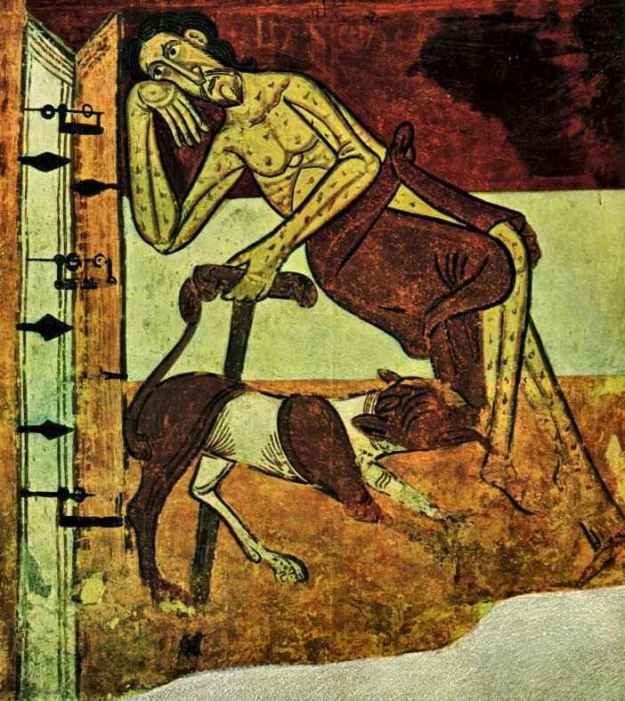
Send Lazarus [Luke 16:19-31]

LazarusTahull

Museum of Romanesque Art, Barcelona. Wall painting from San Clemente, Tahull (Lléida).

Several years ago, I was attending church in a well-to-do neighborhood of Boston. One Sunday, the deacons announced a new policy to deal with beggars who showed up at the office looking for handouts. They would no longer give out small amounts of cash. Instead, they would give out vouchers good for groceries at local supermarkets. They were very clear, however, that the vouchers would not be valid for alcohol, lottery tickets, or tobacco.

At coffee hour, people spoke approvingly of this decision. Everybody knew that for years the church’s money had been ending up in the cash register of Marty’s Liquors. Nobody wanted the church to be an “enabler,” but they didn’t want to turn people away empty-handed either. Grocery vouchers seemed like a good way to help without doing harm.

Now, I was feeling peevish that morning, not in control of my mood or my mouth. Thus it was that I asked what the deacons would do if a beggar didn’t want to buy groceries, but wanted to rent a DVD of “The Sound of Music,” or maybe take a Duck Tour of Boston, or buy a few carnations to brighten the corner where he lives?

This was not well-received, and the conversation went downhill fast. I was to blame, of course. It was an unfair thing to say, even for someone feeling peevish and looking to make a point. Everyone, including me, knows that beggars who show up at church doorsteps are not usually looking to spend an evening with Julie Andrews. Many are homeless, drifters, active alcoholics, mentally-ill. Not a few are con artists who give you a long detailed spiel about their woes. If you were to give them all money, sooner or later you’d get taken for an expensive ride, or you’d do real harm. And if word got out on the street that St. Polycarp-by-the-Pool was dispensing cold cash from the front office, it could even get dangerous.

So it’s no surprise that most churches have adopted a no-cash- approach to helping people who wander in from the street. The voucher plan was prudent. It was plain old good stewardship, for us and for them. It also gave the deacons a warm feeling. One deacon remarked that the church should be proud that our vouchers would keep street people from guzzling or gambling, and get them to eat a healthy meal for a change. I valued my life and didn’t say out loud what I was thinking about that—namely, that if the voucher plan was really aimed at getting street people to eat, say, more leafy green vegetables, then we should have put red meat on the exclusion list along with the booze, the scratch tickets, and the smokes.

Vouchers? Okay, fine. It makes a certain sense. But did we need to be so tickled about it? Why were we congratulating ourselves? Wasn’t it enough that we were the ones who had the wherewithal? The ones who got to stake out the ethical territory? The ones who could designate the proper objects of our compassion and choose the precise terms of our generosity? Wasn’t it enough that we were in a position to shape other people’s morality?

You’d think that upon announcing the voucher plan, we all would have had the good grace to feel a little embarrassed. You’d think that we would have reminded ourselves that the proper posture for giving someone a food voucher is not on your high horse, but on your knees.


Lazarus was a beggar who could have used a voucher. He was starving, lusting after Dives’ garbage. We don’t know much about him; the parable lacks the sort of data people like to have when deciding whether and how to help. We do know his name (he is the only character in Jesus’ parables to be given one), but we don’t know how he ended up starving at the rich man’s door. We don’t know if he was one of the ‘deserving’ poor, or whether he’d been a lazy, drug-addicted oaf, or simply peevish and ill-tempered like me. We don’t know whether he cornered the rich man every time he left the house to pelt him with pathetic stories of woe, or whether he just lay there, mute, day after day. All we know is that he was at the gate, open-sored, hungry, and visible.

And that, Luke seems to say, is all we need to know to predict the reversal ahead.

We don’t have much information about the rich man either. Did he invite friends over to laugh and point at Lazarus, have his goons lean on the beggar to scare him off, gag at the sight of dogs licking his sores? We don’t know if he was a cold fellow who habitually averted his eyes from unpleasantness, or a self-preoccupied man who never saw the beggar; or if he did notice him, said an honest prayer for a sorry case, but stuck to his policy of never giving cash to street people, for all the high-minded reasons those deacons had decided on vouchers. We know only that he was rich, dressed well, ate well, and enjoyed his confortable life.

And that, Luke seems to say, is all we need to know to predict the reversal ahead.

If you’ve read the gospels half-awake, you aren’t surprised by that reversal. Jesus is unnervingly repetitious about the mortal risks the wealthy run—so much so that two chapters later, the disciples get exasperated with him: “But (if what you say is true), Lord, how can anyone be saved?” It’s a familiar theme with an expected twist.

Yet there’s something in this story of reversal that has always struck me as odd. When the rich man wakes up in Hades, he is up to his neck in flames, but he doesn’t seem to realize that his new situation is for real and for good. He doesn’t seem to grasp that there is no way out, even for a Somebody like him.

Of course it’s not lost on him that he’s suffering, and that his wealth and Egyptian cotton underwear have been shot to hell. No doubt he’s sorry now that he failed to do right by Lazarus in life and would do things differently if he had another chance. But even hellfire has not burned away the capacity for self-delusion that made it easy for him to sin so greatly by omission while he was alive. In the afterlife, he has no wherewithal, but the stubborn residue of wherewithal remains. Privilege clings to him, even in hell.

“Send Lazarus,” he says.

This is not an idle line. It betrays life-long habits of command and control, habits that now make him oddly insensible to the gravity of his situation. He thinks he can still make things happen. He thinks he is still maneuvering in the earthly geography of status, power, wealth, and worth. He now recognizes that Lazarus is a man he should have helped more in life, but even now he wouldn’t trust him with cash. At best he will let Lazarus be his gofer. “Send Lazarus to bring me a drink.”

The rich man may be a damned man, but he is an important damned man who, as a courtesy, out of deference, should be exempt from the unrelenting thirst that so many others have known, exempt from the thirst of the beggar outside the gate.

It doesn’t work, but he isn’t deterred. “Well, then, if you won’t send him over here to me, send him to my kin as a warning.” The rich man believes that even in hell no problem is insoluble if you can just get your best people working on it, or if you have the right connections. God is bound to make an exception for people in the network: it’s one of those perks that money used to buy.

But there is no good news for the rich man. Abraham’s reply is truly terrible: Some outcomes cannot be altered. Some lines cannot be crossed. Things eventually harden. It is too late. There is no return. “Between you and us a great chasm is fixed,” says Father Abraham. Even the progenitor of the faith cuts no ice with a God determined to be just to the poor.

This is a bleak and unforgiving parable, one of the harshest stories in the gospels. It warns us broadly about the moral peril we incur if we ignore the needs of the poor who lie begging at our gates all the time while we go about the business of being and having and doing in a routine of indifference. But it also warns us about the delusion that persists in us even after we have seen the error of our ways and been shown the truth; even after we have acknowledged and acted on our duty of mercy towards others.

It speaks of the stubborn residue of privilege that clings to our egos and produces in our souls a mostly unconscious and unexamined confidence, a confidence that permeates and perverts even good deeds and intentions; a confidence that leads us to assume that because of who we are, we know what’s good for ourselves and for others, we can influence outcomes, we can define and ensure our own and others’ integrity.

The deep chasm in eternity that is fixed between Lazarus and the rich man is a snapshot of the scandalous distance that exists between the poor and the privileged here on earth. But it also depicts the chasm that exists inside each of us—the distance between our unthinking entitlement, condescension and judgment, and the sublime reality and true privilege of simple creaturehood; the distance between thinking of ourselves as self-made and the humility of knowing Who in fact made us, and of owing ourselves completely to that Other; the humility that establishes us in common cause and kinship with every human being and every creature, and makes plausible and possible our ideals of mutuality, love and justice.

There’s no final grace, no last minute reprieve in this parable for the privileged, entitled, self-deluded rich man; but we can hear some good news in it for us, for we are still living and thus still susceptible to a breakthrough. We can still hear Moses and the prophets. We can still listen to Jesus. We can still help each other to love being creatures and to love each other because of our common human condition, and to aspire to nothing more or nothing less.

There is no second chance for the man in the story, but there can be for us. We resemble him more than we know, but the God who makes the sun to shine on the wicked and the benighted as well as on the good and the just is ever-able to illumine our ignorance of our human condition and reveal our creaturehood to us as an unfathomable mercy. From the One who made us, there is courage, grace and healing at every turn, and Jesus promises that it will not be denied to the humble, searching, contrite and broken heart. Our task is to live fully into the calling issued by God from the beginning: to be creatures with our Creator, to be who we are before God and one another, and to love our neighbors as ourselves.

To love them as ourselves.

It is hard, but it is possible. We have the Holy Spirit. We have the church’s ancient means of grace—prayer, sacrament, song, service. We have God’s Word. We have each other. And we have today.

And thank God for that, because this sober parable tell us plainly that for us who have the wherewithal for so much good and do not do it, there might be no tomorrow.

Happy Sin [Luke 15:7]

sheep

I tell you truly, there will be more rejoicing in heaven over one sinner who repents than over ninety-nine righteous people who have no need to repent.

Jesus says that God is much happier when we sin and repent than when we don’t. So maybe it’s good that the lamb went astray. If it hadn’t, neither the shepherd nor God would have known the unique delight Jesus speaks of.

Since repenting makes heaven so all-fired happy, maybe we should sin a lot more. Then, when we’re done, we could say, “Oops, sorry!”, electrifying Paradise with that special thrill.

Well, we could do that, but it’s probably not what Jesus had in mind. And yet he seems to say that there are worse things we could do than sin, worse things we could be than bad. We could strive to be better people—the sort of better people who believe they are better than other people. We could go out of our way to avoid icky sinners, putting cold, contemptuous miles between us and them.

To sin, go astray, do harm, fall flat on our willful faces—none of that’s good exactly, but at least it’s real. At least it doesn’t separate or distinguish us from anybody else. At least it makes for human solidarity. And any kind of solidarity is better than distance, exclusion, and contempt.

Besides, if we didn’t sin, God would just stay home and read the paper all day instead of lighting out into the canyons and brambles of life to find us by the whimpers of our lost and shivering hearts. It’s wrong to say that sin repels God. Sin is a God Magnet. Wherever there’s a sinner with a sin, God is there.

So yes, by all means, we should be sad and sorry for our sins. But we should be grateful and glad for our sins, too. Think where we’d be without them.

Prayer                                                                                             Searching Shepherd, it’s weirdly paradoxical and maybe even a little wrong to thank you for my sins, but I do. Without them, I’m lost. With them, I’m found. Praise to you forever. Amen.

My Trees

IMG_4490

I live in next door to a state university in an old industrial city where green space is at a premium. A little over a week ago, a crew from the university’s buildings and grounds department planted seven young trees around a new parking lot that happens to be right outside my windows.

Even as they were going into the ground, I felt an almost irrational concern for those saplings. I worried that the B&G guys had not planted the little root balls deep enough. I fretted that they were piling the mulch too high around such slim trunks. I wondered if they’d watered them enough during the first three days when the sun was blazing hot.

Now I find myself looking out the window and checking their progress every time I get up to get a snack or retrieve the mail or find a new book or start supper, as if my looking will prevent them from shriveling up and dying from moment to moment, or help them grow twenty feet from mid-morning to noon.

I hope I’m not turning into a nosy neighbor who peers through the drapes, keeping a prurient eye on everybody’s comings and goings. I’m not sure it makes much sense, my proprietary concern for seven saplings around an asphalt lot; but these are my trees.

I wish I felt this way about everything that lives.

My Baptism(s)

There’s a family story about my birth that, like a lot of family stories told and re-told over the years, is probably only tenuously true, but it’s a good story all the same. This is how it goes:

My parents had decided that if they had a girl, they would name her Janice. This was a merciful way of naming a child for my grandmother without actually saddling the child with my grandmother’s name, which was Janetta. But my mother’s labor was long and my head and shoulders were big, and her pain was great, and at a particularly difficult moment, she—who had never been particularly devoted to the Mother of Jesus—was heard to scream, “Get me out of this and I’ll name her Mary!”

But there’s another story about my birth that I cherish more than this one. It seems that when I finally did come out, I came out yellow. I must not have looked very strong, because one of the nurses, who was Irish and Catholic and devout, took me quietly to the far side of the room, dipped two fingers in some water, traced a cross on my brow and baptized me in the name of the Father, and of the Son, and of the Holy Ghost.

Now, in the Catholic theology of 1947, this was known as a provisional baptism—an emergency baptism in case of death. Had I expired in the delivery room that morning, what that nurse did to me would have been a real live valid sacrament, and I would thereby have been spared an eternity in Limbo—a state of being in which the unbaptized soul of an infant enjoys all the natural happiness one could possibly enjoy, but where God is not present, and never will be.

But I didn’t die. I pinked up! And so I was baptized officially a month later with an honest-to-God-priest and a big baptismal font. My provisional baptism had indeed been provisional. It didn’t ‘count’ in the end, and so it became simply an amusing story about the way I came out yellow, but not a story about the day I became a Christian. That happened, according to my baptismal certificate, on January 21, the Feast of St Agnes, when my family brought me to St Mark’s on Dot Ave in the Ashmont section of Dorchester.

The church I belong to these days does not teach that baptism is necessary for salvation. In this community of faith, we don’t baptize babies because we believe they need to be baptized. Baptism for us is the cool forgiving river through which we are swept into the church. It’s a sign that we belong to the family of faith. It’s the way we pledge allegiance to the new polity we call the kingdom of God. It’s the act by which we are called to follow Jesus, and it’s the moment when we are given a ministry to carry out with him in the name of God’s compassion.

It isn’t a cleansing of original sin, but a promise that if we do sin, we will not be left in our sin; there will never be a moment in all our lives when we will be bereft of the love of God in Christ Jesus, our Lord—for God’s is a love that is incapable of holding our sins against us. No, we do not baptize in order to snatch people from the jaws of hell. We baptize in order to bury them deep in the heart of Christ’s life.

God knew me and loved me from the day I was formed in my mother’s womb, as psalm 139 so beautifully sings. Some scriptures say that God knew us even before we were formed in the womb. The point is that there was no place on the day I came yellow into the world, nor is there any place now that I’ve gone completely gray, that is devoid of God’s presence. Catholics have finally come around on this conviction too. You never hear talk about Limbo any more. That nurse need not have worried about my being cut off from God on the day I came weakly into the world. I was never in danger, mortal or immortal.

I do not, of course, remember my baptism, either one of them. But I like to imagine the day I was baptized because it is a source of comfort and courage and hope for me to know that, once upon a time (well, twice upon a time), the God who is always kind and merciful was merciful and kind to me in a very specific way, by enrolling me in the company of the faithful, making me a member of the body, a daughter of the church.

But a strange thing happens when I imagine my baptism. In my mind’s eye I never see the sanctuary of St Mark’s on Dot Ave. I always see a delivery room at the Boston Lying-In. I always hear a capped nurse murmur the trinitarian formula. I feel her fingers trace a watery cross on my head. I see me, pathetic, in her arms, a new creation in Christ. And I have to tell you that I always well up with affection for her. As far as I’m concerned, her baptism of my jaundiced little soul was anything but provisional. If I am indeed a Christian by baptism today, I believe that it was at that moment in that place and by her hand that baptism “took.” 

I don’t believe what she believed about baptism. But it doesn’t matter. What moves me so much, and the reason I prefer her baptism to the priets’s, is that on the day she baptized me she was worried sick about what would happen to me. She didn’t want me to get lost. Baptizing me was her way of making sure that the little creature she held in her hands who was created by God for God and destined for the divine vision, would in fact see God. What she intended for me was the fullness of temporal life in the church should I live, and the fullness of eternal life in God should I die.

I was in no danger. Baptism was not required. Even if I had been in danger, it still would not have been required. But that is not to say that it did nothing for me. Her baptizing of me has given me a way of thinking about the church into which the sacrament ushers us. She has become in my mind a prototype of the church at its best, the assembly of graceful people who care about what happens to you, today and tomorrow and forever. People who would move heaven and earth to help you get free of every danger, mortal and immortal. People who do everything in their power to set you safely on the Way, keep you there, and not let you get lost.

The church is about a lot of things, but if it isn’t at least about this kind of concern, we may have missed the point.