Category Archives: ADVENT Resources and Reflections

ADVENT 2A Confession Prayer


Mathis_Gothart_Grünewald_024

God of the root and the trunk,

Lord of the young shoot and the green branch,

we cannot break our own hard shells.

We are buried too deep to be softened by rain.

We do not imagine the light above ground. 

We do not dream of fresh things;

we sigh and fret about the old.

You say, I am coming.

Change your hearts. Turn around.

We say, Help us, O God,

to bear the fruits of Advent.

Give us what we need to crack open with hope.

******

God of the holy mountain,

Lord of the house where righteousness dwells,

we are not like you who knows the heart,

who sees inside.

We judge by what our eyes see and our ears hear.

We do not consider the poor, nor decide for the meek.

We do not know who you are.

We do not inquire after you.

You say, I am coming.

Change your hearts. Turn around.

We say, Help us, O God,

to bear the fruits of Advent.

Give us what we need to be wise.

*****

Lord of the lion, the wolf and the lamb,

God of the leopard, the kid, and the nursing child,

we cannot lie down together in peace.

We tread carefully near the serpent’s hole.

We are afraid of everyone.

We make them afraid of us.

We watch for each other with swords in our hands.

You say, I am coming.

Change your hearts. Turn around.

We say, Help us, O God,

to bear the fruits of Advent.

Give us what we need to make peace.

 *****

God of the threshing floor, the fork and the fire,

Lord of wild honey, of locusts and wild places,

God of the axe and the crowd, 

we do not line up at the river.

We do not wade in.

We do not bend our knee.

We untie no one’s sandal.

We are a crooked road, a stony path, a haughty crowd.

We level no mountains,

 raise no valleys.

We are unprepared.

You say, I am coming.

Change your hearts. Turn around.

We say, Help us, O God,

to bear the fruits of Advent.

Give us what we need to get ready.

Give what we need to begin.

*****

God of Mary, whom you disturbed,

God of her life upturned,

God of the fruit of her womb, Jesus,

who mothered our lives with his mercy,

we are not startled by angels;

we guard against interruptions.

We do not turn and turn again the prism of our hearts,

pondering the whys.

We do not open our hands: we expect so little.

You say, I am coming.

Change your hearts. Turn around.

We say, Help us, O God,

to bear the fruits of repentance.

Give us what we need to desire.

Give us what we need to dare.

*****

God of the One who comes again,

who is always coming,

who is coming soon,

help us to watch for his coming,

help us to know when he’s near,

help us to pray in his spirit,

help us to pray as he taught us:

Our Father, who art in heaven…


Blessing and Sending


May the God of all hope

who sends justice down like rain

and summons joy from the depths of the heart;

who keeps promises

and satisfies the desire of every living thing,

be for you courage and grace,

anchor and horizon,

this day and forevermore.

Amen.


Go in peace, to wait and watch, to serve and work.

Go in peace, to dream and hope, to reach and desire.

Go in peace to sing Good News to all the weary world.

Amen.

According to Matthew

Epiphany-Josephat-Rest-Gentile_da_Fabriano_030-e1356892384419

–Joseph Sleeping, Gentile da Fabriano

According to Matthew, angels do not sleep: in the small hours they intervene, scattering the sleep of others.

They harry exhausted fathers and tip off shrewd men who hail from far away.

According to Matthew, the world is a place where good people’s dreams bulge with warnings, and hope is barely one hard breathing step ahead of tyrants bent on harm.

According to Matthew, there is an inexhaustible supply  of tyrants.

Angels have to work overtime; even then children die.

Only one escapes this time.

He will grow to be the sort of man who accepts angelic ministrations in wilderness and garden, but no more intervention.

Even forewarned, he will not flee; not even put up a fight.

It’s O and O and O

Tune: DUNLAP’S CREEK (McFarland)

mmt215620

O, O, said God, when at one Word

the day burst forth from night:

O light, O lovely, God declared,

astounded by the sight.

 mmt215623

O, O, cried Mary in alarm

when Gabriel begged assent:

O Mystery, O yes, she said,

unknowing what it meant.

mmt215620

O, O, the kneeling Sages wept,

their tears with stars entwined:

O Love, O ken beyond the ken

of star-pursuing minds.

mmt215623

O, O, the longing Church has sighed

through all things ill and well:

O Day, O Mystery, O Lord,

O come, Emmanuel!

mmt215620

And when our Healing comes at last

we’ll hear a Word we know;

for Heaven makes but one sweet sound:

it’s O and O and O!


For Dunlap’s Creek, see: https://hymnary.org/tune/dunlaps_creek_mcfarland?sort=meter&extended=false

See also: https://www.youtube.com/watch?v=eV6InsztHKQ


O Antiphon: Clavis David

20 Dec O Clavis David

O Key of David,

and scepter of the house of Israel,

you open and no one can close,

you close and no one can open:

Come and rescue prisoners

who are seated in darkness,

and the shadow of death.

 hands

If you’ve ever spent any time in a prison in the United States, you will not read this antiphon as a universal desire for Christ to come and break down barriers and walls and liberate us all from the things that keep us bound.

If you’ve been in prison, on one side of the bars or the other, you will not gentle-down or spiritualize this plea. In a country where locking the cell door and throwing away the key is a national pastime, to reduce this antiphon’s desperation to the longings of our inner selves or for generic freedom is an evasion worthy of divine reproach.

The church that utters this cry from the most desolate regions of its soul knows about real prisoners in real prisons. It has languished in them itself, after all. One powerful strand of its history is nothing less than the history of outlaws and jailbirds.

This church knows that prisoners don’t need kindness or pity or understanding or even better conditions, although all that would be good. What they need is rescuing.

Rescuing from their own brokenness and despair and anger and violent impulses and whatever else it was that got them locked up in the first place.

Rescuing from the zealotry and self-righteousness and racism and unreasoning fear and inequality of our justice and penal systems.

Rescuing from the bloodlust of too many citizens who think prison is too good for prisoners, that they should be tormented, strung up, flayed alive, disappeared forever in some horrible way, not allowed to live, and even to live it up (they believe), in country clubs, while the law-abiding pick up the tab.

Rescuing from the willful aversion of the eye that never sees the fact that many prisoners are getting exactly what the bloodthirsty among us want them to get: torment, a living and indescribable hell.

Rescuing from the ordinary relief of citizens like you and me who, thanks to all those who are willing to throw away the keys, can go about our business, most of the time, without giving any of this nasty, vexing, implacable problem a single serious thought.

None of this is to deny that many prisoners are dangerous, implacably bent on harm, perhaps even irredeemable insofar as social rehabilitation is concerned. It is not to say that we should breezily unlock every cell, let everyone go, and inflict their harm on the law-abiding. It is not to forget victims of crime and their families, whose own sentences are indescribably unjust, life without parole.

No, this is not to romanticize prisoners. It is to dare to name them kin and children of God, as Jesus commanded, and to acknowledge that the darkness and the shadows of death in which they sit is not only of their own making but also of ours, and that we deepen the darkness and thicken the shadows by our forgetting them. By our being glad we can forget them. By our rarely, if ever, praying with tears for them. By our throwing away the key and going about our lives loving other neighbors and even other enemies, but not these. Anyone but these.

We refuse to know, or care very much, because we are implicated; implicated not because we played a role in their incarceration, although honest analysis might show that we all do; but because whether we like it or not, we share a human life and the human lot. If what prisoners need is to be rescued, then so do we. As they are rotting away in jail, so are we.

Which is the point: In the end, the antiphon is about our spiritual condition. We who live outside prisons are not free unless, paradoxically, we are making decisive moves to get ourselves locked up in prisons alongside real prisoners— locked up spiritually or physically, it doesn’t matter, as long as it is a real incarceration of mind, body, soul; as long as it ends up that we cannot even breathe while things are still as they are in this nation, and this world; as long as we learn how desperately urgent it is that someone with incontestable authority (for that is what the antiphon means by opening and shutting) should come, and come soon, to rescue us all from this madness.

Rescue won’t happen from a distance. The unlocking we beg for in the antiphon is not remote control unlocking, much less a spiritualized unlocking of good thoughts and wishful thinking. It is an unlocking by proximity, by a human hand.

And not just any human hand. The key in the lock is turned by a wounded hand, the hand of an arrested, judged, flayed, gashed, and humiliated man, a death row prisoner, a dead man walking. If anyone has the authority to wield that key, he does. And by extension, we who claim to have died with him do too.

We have the authority. We have the key. But it can’t be done from afar. At least some of us have to go. If the gospel is to have any credibility at all, key in hand, at least some of us have to go.

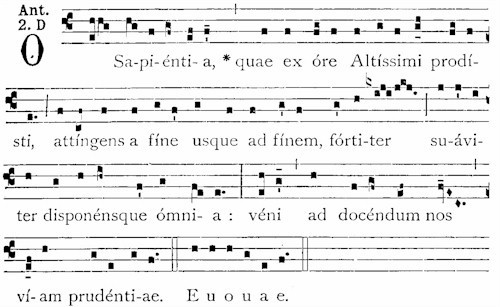
O Antiphon: Sapientia

17 December

O Wisdom, you came forth from the mouth of the Most High, and reaching from beginning to end, you ordered all things mightily and sweetly. Come and teach us the way of prudence.

17 Dec O Sapientia

Prudence?

Now there’s an unsexy virtue. Do you know anyone who sets her heart on becoming prudent? Works at it everyday in her spiritual exercises? To become loving, yes, that’s a lovely goal; faithful too, or patient, even humble. But prudent?

The very sound of the word is off-putting. It sounds … prudish. Careful, surveying the scene, looking for trouble to avoid. Who wants to be like that—calculating risks, playing it safe, and sourly disapproving of the bold?

Too bad about prudence. It’s a lonely virtue, like meekness, forbearance, and long-suffering, misunderstood and underrated. But without it, the world would be doomed. Already is, almost, since it is singularly lacking. Which is why we pray in Advent that Wisdom, who appears among us as a Child, will hurry and teach it to us.

So what is it? Prudence is one way to worship God with your whole mind, as the Great Commandment says we ought. We tend to neglect this part of that charge in favor of the more familiar and comfortable loves of heart and soul. (We don’t love God very much with our bodies, either, but that’s a story for another day.) But there it is: love God with your mind, your intellect, your reason.

Prudence is thinking things through and distinguishing among things correctly. It’s telling good from bad, excellent from mediocre, ultimate from penultimate—as well as slogging through the proverbial gray areas, the complexities of the middle ground and the forgotten ground. The prudent person willingly spends time among the perplexities, listening and thinking, and then thinking some more.

Prudence studies the evidence of love and the rumors of life, skimming dross from the surface to reveal glints of gold beneath. Like a skilled shopper at a big department store sale, she sorts through everything that’s on offer until she finds clothes that fit God’s taste and style. These she buys.

All this she does not obsessively, in an anxious effort to get control over life, but “mightily,” as the antiphon says, strongly confident that there is in fact a discernible God-hinting pattern, and that the gift of reason graced by faith will be able to perceive it.

MMstudyingByWeydenPrudence is not content to say, “We shall never know.” It is of course true that we shall never know, completely. But prudence is avid for as much knowledge as she can get by peering intently through the mirror Paul talks about in I Corinthians 13. Even if our seeing is ever only dim, prudence believes that looking will yield something true enough.

True enough for what? To choose. This is the key. Prudence chooses, she decides, she commits, she sets out. And orders things.

This is where the “sweetly” part comes in. Because in that choosing, in the ordering of decisions and actions, in the reorientation of life that deep and godly knowledge directs, prudence is prudent enough to know that despite faithful application of graced reason to the maze of worldly possibilities for making life good, we could be finally mistaken in our judgments and in the choices that flow from them.

Her action is thus as humble as her seeking, which doesn’t mean it is not loud or long or deep or keening or ecstatic or prophetic; only that in all things it is profoundly charitable and meek, in the way Jesus was meek, in the way we are all meant to be foolish in order to be wise. Prudence is, in the end, not so much an egghead, a scholar, a weighty theologian, nor even a conventionally wise person filled with common sense–perhaps she is that least of all. No, she is the one who engages doggedly in a great and necessary folly. Prudence is a great and wise old fool.

After all,

Where is the one who is wise?  Where is the scribe?  Where is the debater of this age?  Has not God made foolish the wisdom of the world?  For since, in the wisdom of God, the world did not know God through wisdom, God decided, through the foolishness of our proclamation, to save those who believe.  For Jews demand signs and Greeks desire wisdom, but we proclaim Christ crucified, a stumbling block to Jews and foolishness to Gentiles, but to those who are the called, both Jews and Greeks, Christ the power of God and the wisdom of God.  For God’s foolishness is wiser than human wisdom, and God’s weakness is stronger than human strength. [1 Corinthians 1:20-25]

The Finger of John

Mathis_Gothart_Grünewald_024

–Detail of John the Baptist, Matthew Grunewald

In the fourth gospel, no story recounts the baptism of Jesus by the great Advent figure we call John the Baptist. The Evangelist refers to the day when the famous dove descended and a voice from heaven named Jesus “the beloved,” but nowhere does he tells us that John did anything that day except to be present and see it. The fourth gospel is not as interested in John the Baptist as it is in John the Witness. “I have come to testify,” John says.

That is why in Christian iconography the Forerunner is often depicted in a pointing pose. In some images, he is also given an unnaturally long index finger. Your eyes are compelled to follow along his outstretched or uplifted arm to the very end of that finger, which is precisely what John wants you to do, for beyond that finger is the most important thing of all.

There is no motion in these images: John is not preaching or immersing. He is not even scolding. He is pointing, implacably, to Someone there, here, “already among you,” he says. Someone we cannot see, Someone we need help seeing, in part because that Someone is so unremarkable (unsurprisingly so: after all, for thirty long years, he chose the same invisibility of ordinariness in which most human lives are cloaked); but also because we have trouble seeing truth in front of our eyes, truth hiding in plain sight, truth that is just too unvarnished and blunt for us to be willing to credit, truth so bracing it requires courage we do not possess of ourselves to embrace it.

And so the Witness points. He compels us to look. His help feels more like coercion; it is insistently intrusive and unpleasant, but without it we might not dare. He will not move an inch from the spot until we follow his oddly elongated finger to the object of his testimony.

That’s not the hard part, however. The hard part comes next, when we see what we see; because as compelling as the truth is, as candidly as it stands there looking back at us along the line of sight John’s finger describes, we can still decide not to see it, to look away, to avert our eyes in any one of a thousand practiced aversions—denial, fear, cowardice, exhaustion, nuanced abstraction…

To be willing to gaze at it as steadfastly as John points to it is a great grace, something to beg for every day on our knees; because the more we are willing to look, and the longer we are able to look, the more unblinking we will become, and the more we will grasp that John’s vocation is the most critical calling of all—the call to be a witness who will not move from the spot, will not lower the arm, will not retract the finger, will not permit any human heart its cherished evasions and its practiced aversions—intricate obfuscations, intellectual games, political posturing, power plays—but for a thousand thousand years if need be, will point and point and point.

Yesterday, a young man murdered his mother, 20 children, and several adults who were caring for them, and then he murdered himself. He murdered families and a school and a town and a nation. He took the life out of the world beyond the nation too. This “tragedy,” as we are so fond of calling all the world’s mass murders, did not “unfold,” as news anchors kept repeating all day: like all other mass murders (violence in our cities, war, starvation, poverty, drugs, financial manipulation, vast stolen wealth, the earth’s pollution) it was no passive accident, no random occurrence. There is something to see here, something to point to, something to be implacable about, a truth about what happened, a truth about ourselves.

Whose raised arm and long finger will show us what it is? Who will come up from this wilderness and spy the ordinary truth right in front of our eyes, the ordinary human and humanizing truth hiding in plain sight? Who will not cease pointing once the funerals end and the hue and cry has died away and the lobbies have cowed us once again? Who will not be moved?

Can we get a witness?

Odds and Ends of Advent/Christmas Liturgy

Messina

I. Words to Introduce A Carol

Leader: Advent is waiting and preparing.

It is desire and hope.

It is also a question.

A question Mary asks.

A question you have asked.

A question everyone asks, sooner or later.

How can this be? What does it mean?

Scripture tells us that for Mary,

Advent was a long pondering.

She spent the time

between angel and manger

turning things over in her heart.

Advent is a wondering,

perhaps a contradiction,

certainly a mystery.

How can this be? What does it mean?

Advent is also a morning.

It begins to dawn on us,

which is why we light candles.

In Advent there is light, increasing light,

such beautiful light;

but that doesn’t mean anything is clear.

Carol [solo or choir] I Wonder As I Wander

 **********

4320471_f248–Tricia Mason

II. Words to Introduce A Carol

Leader: Some babies are born into bleak midwinters

when water is stone.

Others are born in spring

with soft blankets under their chins.

Some children are born to own their lives.

They are never dressed in hand-me-downs.

Others draw their first breath in a borrowed crib

and their last in a borrowed tomb.

This is way things are. What can you do?

What can you do?

Carol  In The Bleak Midwinter

**********

grotto-candles-cc-christopher-chan

–Candles in the Grotto of the Nativity, Bethlehem, photo Christopher Chen

III. A Candle-Lighting Liturgy for Advent 3 Gaudete

Reading  Isaiah 35:1-10

Reader 1: A reading from the prophet Isaiah.

The wilderness and the dry land shall be glad, the desert shall rejoice and blossom; like the crocus 2it shall blossom abundantly, and rejoice with joy and singing. The glory of Lebanon shall be given to it, the majesty of Carmel and Sharon. They shall see the glory of the Lord, the majesty of our God.

Reader 2: Strengthen the weak hands, and make firm the feeble knees. 4Say to those who are of a fearful heart, “Be strong, do not fear! Here is your God.” 5Then the eyes of the blind shall be opened, and the ears of the deaf unstopped; 6then the lame shall leap like a deer, and the tongue of the speechless sing for joy.

Reader 1: For waters shall break forth in the wilderness, and streams in the desert; 7the burning sand shall become a pool, and the thirsty ground springs of water; the haunt of jackals shall become a swamp, the grass shall become reeds and rushes.

Reader 2: A highway shall be there, and it shall be called the Holy Way; the unclean shall not travel on it, but it shall be for God’s people; no traveler, not even fools, shall go astray. 9No lion shall be there, nor shall any ravenous beast come up on it; they shall not be found there, but the redeemed shall walk there.

Reader 1: And the ransomed of the Lord shall return, and come to Zion with singing; everlasting joy shall be upon their heads; they shall obtain joy and gladness, and sorrow and sighing shall flee away.

Candle Lighting

Leader:  In silence and shadow, we wait.

In mystery, we live.

In unknowing, we look for wisdom,

for a ray of darkness.

At night, our hearts are awake:

Love is not far away.

And in the fullness of time,

when everything is still,

the One we wait for comes.

[Light Candle(s) here]

Leader:  Let us pray.

All:  Joy of every longing heart,

you draw the sound of singing

from speechless fear and unrelenting pain;

from the gulf of estrangement

come laughter and song.

By the light of this candle, show us again

the glory of your mercy full and free—

death routed and in flight,

a cradle rocking newborn Life,

all creation dancing home,

ringed  ‘round by herald angels

playing music in the air.

Hymn  My Soul Sings Out with Joyful Praise

[or another setting of the Magnificat]

Scandal and Soap

homeless-people–Boca Raton Tribune

Malachi 3:1-5; Luke 3:1-6

You don’t need me to tell you that the rebounding economy is not rebounding for everyone. You don’t need me to tell you that there are poor people in the United States of America. You may be one. You know as well as I do that without lots of money or a job with good benefits, it’s hard to be healthy in this country, and that depending on where you live or what kind of job you have, it may still be hard even after all the provisions of the Affordable Health Care Act kick in. You know too that the poorer you are, the sicker you are; and if you are not white, you’re sicker still. You also know that no matter what finally shakes out with healthcare in this country, old people and poor people will still have to pay a hidden cost of indignity and the not-so-hidden cost of red tape and mystifying paperwork.

You don’t need me to cite depressing statistics about housing, or food stamps, or available childcare and eldercare—or should I say unavailable childcare and eldercare? You know those numbers. And you know that a lot of people are scared right now, imagining that negotiations aimed at avoiding the metaphorical fiscal cliff could end up hurtling the vulnerable over a literal cliff of their own. You already know without my telling you, for example, that schoolchildren learn better on a full stomach, and your common sense tells you there should be school breakfast programs for every kid who needs a meal, so you don’t need me to tell you that any cutbacks in these programs will not only hurt kids now, but will also have a long-range effect on the economy and on the social fabric.

And I don’t need to tell you about indigent drug addicts and drunks and (here’s an awful word) “de-institutionalized” mentally-ill people; you’ve seen them, so you already know, or you can easily guess, that even if this winter is not too harsh, over the next few months a few of them will die on the streets where many of them live. And you don’t need me to tell you that social workers, state-funded childcare providers, and people who work in homelessteenx390public assistance of every kind are among the least well-paid professionals in the country. You can guess yourselves, without any help from me, at the high turn-over and burnout rates in these jobs; and you can easily imagine that it doesn’t take long in that kind of public service for some good people’s idealism and commitment to settle into a kind of functional despair, or sour to cynicism and contempt.

You’ve read about them in those human interest stories that appear in newspapers every Christmas, so I wouldn’t be telling you anything you don’t already know if I were to describe the daily struggles of families that are (what’s that grim phrase?) “less fortunate”—as if living in an apartment with no heat, frozen pipes, and an absentee landlord were a matter of sheer serendipity; as if somehow, had these families just been in the right place at the right time a year or two ago, they’d be living on Easy Street today. Poverty has an awful randomness to it, to be sure; many people, maybe even some of you, are a paycheck or an illness away from trouble; but you know as well as I do that it isn’t all just the luck of the draw.

You don’t need me to explain that the continued existence of poverty in this country is a scandal, that the lack of adequate health care in this country is a scandal, and that scandals by definition are stumbling blocks for the conscience, barriers to belief. Who could believe in a God who says that the poor are dear to the divinfamily_in_car1e heart but whose heart appears to be stone, whose ears don’t seem to hear anything, whose arm hangs down, ineffectual, as if having thrown in the towel? You don’t need me to tell you that it is not our reason that most often denies the existence of God; far more often it is our gut that rebels, our heart that recoils, our gorge that rises to deny the truth of a compassionate God in the face of so much suffering and degradation. And you don’t need me to explain that, as far as the Bible is concerned, it is not God who has the stony heart, but God’s people; not God who’s deaf, but God’s people; not God who has the lifeless arm, but God’s people who have thrown in the towel even as they raise their voice in prayer. And you already know perfectly well that the biblical God is notoriously disgusted by piety disconnected from justice.

And you know, because you’ve read the text from the book of the prophet Malachi, that as a result of this disconnect, God has found it necessary to become a refiner who sits down (because it’s going to take a very long time and a lot of patience), fires up the furnace, and burns away the dross until the gold is pure; and God has found it necessary to become a harsh soap, a fuller’s lye, to bleach and scrub and bleach and scrub again the sons of Levi (that is, the tribe of priests, and by extension, us), until they (and we) are cleawhat-fullers-soap-800x800n enough to carry out, without separation, right worship in the Temple and right action in the world. You don’t need me to tell you that if you are indifferent to or exploit your needy neighbors, you will always read Scripture, sing hymns and pray to this meticulous God at your peril.

But you don’t need me to make you feel guilty either. We feel guilty enough on our own. But if you don’t feel guilty—if, for instance, you have made your peace with social disparities; if you have made up your mind that poor people are here to stay, and there’s nothing anybody can do about it; if you have concluded that throwing money at the health care system won’t change anything, or that government programs are never the answer to social problems anyway—you are not going to feel bad and guilty just because of something I or somebody else may say.  Besides, it would be unfair for me to try to make you feel guilty, since so many of you are engaged day in and day out in work that serves the poor and the sick, work that immediately or remotely heals and counsels and lifts and teaches and comforts and inspires; work that helps change or improve the systems and conditions we deplore. So, you don’t need me to grind away at the guilt machine. And you don’t need me to tell you what you should be doing about all this. You know what to do, and many of you are doing it. You give money, you write to your lawmakers, you vote for change, you belong to organizations that work for justice. You do what you can. You do your part. You try to live more simply. You find ways of making human contact with suffering that is not your own. You teach your children about the real world. You preach. You witness. You occupy. You serve. You find a thousand ways to see, to touch, to learn. So you don’t need me to give you social justice marching orders. The truth is I could learn a thing or two from you.

Let’s see. What else is there that you already know and don’t need me to tell you? Well, you know it’s Advent, and that in Advent we pay attention to the Christ of three comings: the Christ who came long ago, who comes to us now, and who will come again. We reflected on that final coming during the first week of Advent. On Christmas we will commemorate the first coming on the straw of a stable. And you’ve already figured out, I’m sure, that here we’re focusing on Christ’s present Advent, his coming and his availability to us now in the Spirit, and especially (for he does have his preferences) his keeping company with the poor, the hungry, the sick. For if we’re speaking of Advent, then we’re also speaking of Incarnation. And to speak of Incarnation is to speak of the conviction that God is not some vague mythic idea, impersonal archetype, general concept or feeling, not love-at-large, or generic benevolence; but rathes_o01_58590925r that in a specific person, Jesus of Nazareth, God lived a fully human life. Incarnation is the expression of God’s solidarity with us, solidarity so complete and full that in some mysterious way that we can’t fathom, God is changed, and so are we. The Word’s humanity is forever part of what it means to be God. And the Word’s divinity is forever part of what it means to be human.

–WSJ

Incarnation is the Christian truth claim most people, including Christians, find hardest to swallow. It’s the scandal that keeps on scandalizing. It’s always been easier to believe that Jesus Christ was “divine” than to embrace the implications of a full humanity. Matthew 25 says something about this scandalous solidarity. It’s a oneness with all flesh, which sounds very nice and kind of harmless in general; but the scandal really hits you when you realize what “all” includes. You know what I’m going to say next, and you don’t need me to remind you of it, but I will anyway: the “all flesh” of Incarnation compels us to confess that God is a shrinking shape on a nursing home bed, an obnoxious odor in an unventilated room, an empty stomach at a first-grade desk, a family of eight on an income for two, a man on the bus with six shirts and a tin foil hat who chooses you to sit next to, a newborn wrapped in rags and laid on the floor of a stall, poor, hungry, real.

As I said, this is old news. You’ve heard it a thousand times. So why say it again? Why tell you things you already know?

For the same reason we do Christmas every year, read the same old prophecies, make the same old jokes about how weird John the Baptist is, drag out the same old Christmas decorations and sing the same old carols. Year after year after year. For the same reason we tell family stories over and over, like the one about the way Mom and Dad met, or the story of the way you carried on your first day at school. For the same reason the sayings of Jesus were collected, written down, and handed on. We tell things we already know so that we will never forget, so that we will learn the truth of things that matter more than anything, so that our children will know what we stand for, believe in, stake our lives on—what makes us who we are. And because if the church (that’s you and me) doesn’t talk about them, and keep talking about them, fewer and fewer people will be talking about them; fewer and fewer, until finally there is only silence. And just ask anybody struggling for justice about the horror of such a silence, the nasty things that happen when nobody utters a word.

Retired Episcopal bishop Packard and other protesters affiliated with the Occupy Wall Street movement are detained in New York

–National Post

We need to tell each other things we already know because there’s knowing, and then there’s knowing. There’s the kind that gives you things to think about, and then there’s kind that gets under your skin, penetrates and aims for your fault lines, breaks you up and leaves you so shattered you require divine rearrangement. We tell each other things we already know so that God will lay what we’re saying decisively upon us and shatter our hearts, for the first time in some cases, in others for the umpteenth time. If that shattering were to happen this Advent, we would be blessed indeed; for God, a psalm says, cannot pass by a broken heart. Our God will come.

Do you know that already? Let me tell you anyway, again…


Why Is It That Blue Christmas Services Make Me A Little Blue?

Blue_Christmas

In addition to four Sunday Advent services, many Christian congregations offer an extra service in the weeks leading up to Christmas. “Blue Christmas” services (as they are commonly called) came onto the Protestant liturgical scene in the mid-1990’s in pastoral consideration of the sadness, depression, loss, and estrangement many people report experiencing during a season of relentless cheer and family-centered celebrations. Normally held in the evening in mid-to-late Advent, these services are designed to acknowledge this pain and offer consolation in the form of worship that does not take for granted that all is well.

By many accounts, Blue Christmas services succeed beautifully in this aim. Many friends and acquaintances—and pastoral colleagues— express sincere gratitude that there is, as one put it, “a safe and sacred space” for people to name their sense of alienation or sadness, and to do so in the company of others whose experience of the season is similar. Blue Christmas services, they testify, more or less save their lives every year. I believe them. I’ve been to a few myself and can testify to their impact. All the same, I always feel an odd twinge of disappointment when the announcements of Blue Christmas services start popping up in church bulletins and on Facebook. There’s something about them, or perhaps better said, the fact that we do them, that gives me pause.

It’s hard to put my finger on the reasons for this niggling discomfort. Maybe it has to do with the way we have so quickly come to accept these services as the best or (dare I say?) the right way to address the pastoral situation that prompts them. There’s not been very much theological or liturgical reflection about Blue Christmas, other than the assertion that it serves a need. I don’t mean to imply that additional reflection will lead to a different conclusion; I mean to say only that whenever an innovation arises in the church—whether in doctrine, practice, or liturgy—it is worthy of reflection.

Change and innovation always offer gifts (which is why a lot of innovation-minded pastors keep telling their reluctant people that they should happily embrace them); but they often also offer some loss. It seems to me that the church should want to understand as clearly as it can what it stands to gain from an innovation, and what it might stand to lose.

I want to reflect on the “lose” part of this equation, not (I repeat) because I feel negatively towards Blue Christmas services, but because I think the “gain” part has already been articulated, perhaps not so much in theological essays or pastoral sermons, but in the sheer proliferation of these events. The faithful (and many seekers) have voted with their solace-seeking feet, and the verdict is in. It’s a gift to the church to be prompted to name and embrace a more nuanced and compassionate understanding of the human predicament in the seasons of Advent and Christmas. It’s of benefit to the church to ritualize a divine-human encounter that does not flinch from our weaknesses, thereby creating conditions of possibility for God’s grace to reach, comfort, encourage, and heal our broken hearts.

imageThere are, however, critical questions that arise from the Blue Christmas phenomenon. Here’s one that comes up for me:  I wonder if the proliferation of such services in Advent casts doubt on the liturgical adequacy of Advent itself, at least as the season is currently observed in many mainline Protestant churches. What is lacking in the Advent liturgy or the way we perform it that allows people to conclude that it isn’t designed to handle sorrow and loss? What does this say about our own assumptions about what the tone and content of our regular liturgy should be? What we are doing that makes it necessary to create new liturgy for the sole purpose of helping people in need of consolation and support navigate their loss and grief? Why are we steering people away, in a sense, from ordinary communal prayer and segregating their pain in separate services designed solely (or at least primarily) for the hurting?

In other words, are Blue Christmas services a sign of the failure of Advent and Christmas worship to address the full scope of human experience? Why doesn’t regular worship do for people what a special service appears to do?

If it turns out that our performance of the ordinary liturgy really is failing a significant segment of people, this is an important datum, and not a good one, because the Advent/Christmas cycle is aimed precisely at accommodating, embracing, comforting, reassuring, and reorienting a human race that has grown alienated from the source of its deepest joys. Through its classic texts, hymns, and prayers, it intends to move us all to face squarely the painful paradoxes of our human condition, the dashed hopes and deep fears of all the years, the grief of our losses and the tangle of our sins; and to clear an attentive compassionate and hopeful space for us to perceive a cry in the wilderness, lift our hearts to the footfall of a messenger on the mountain, and be charmed into new life by a lullaby of love and praise cooed over a newborn by a mother who has already had her fair share of losses, and will soon suffer even more.

The whole Advent/Christmas story is something of a downer, with its consciousness of lack and estrangement, its longing across seemingly unbridgeable distances, its village scandals, its particular hardships—occupation, cruelty, rejection, homelessness, poverty, infanticide and the kind of ageless grieving “that will not be comforted.” From this standpoint, every Advent and Christmas service is blue—and liturgically designed to make us face and negotiate the dislocations and fragmentations of life in frail and wounded flesh, as well as to find ourselves approached, embraced and remade by One who is coming, a fellow-sufferer who knows from the inside what we are made of, and whose compassion, therefore, is infinite, and infinitely healing.[i

CandleIf this is not the sort of liturgical encounter people are being invited into on Advent Sundays; if we have been playing down or obscuring the heartrending aspects of Advent and Christmas, cutting away its reference points of sin, pain, grief, and loss as if they were the unwelcome face of an ex-spouse in an old family photo; if we are reluctant to engage the very particular forms of human suffering the liturgy names in this season, in favor of focusing on the generic “wonder of children” (whose childish excitement then serves to circumscribe the range of acceptable emotional responses to the season), or on the warmth of family and friends, or on the cute pageant and the big anthem; if we eschew the telling human detail in favor of four weeks of universal (and often vague) concepts—hope, peace, joy, love—it’s no wonder that the woman whose husband just walked out on her, the young adult estranged from his family over his sexuality, or the 80-something fellow whose siblings and friends are dying off faster than he ever thought possible don’t dare weep in the back pew on Sundays, but decide to show up at a special Blue Christmas service instead, so that they can be who they are, feel what they feel, and sit with others who feel odd and out of joint not only in the mall, but also in the pews of their home congregations during the Advent and Christmas observance.

I am not suggesting that we turn Advent and Christmas Sunday morning worship services into a sallow, somber slog through every problem and pain known to humankind. There’s already enough pressure on pastors annually to produce a “perfect” Advent and Christmas that appeals, impossibly of course, to a thousand different tastes, preferences, age groups, and memories; and satisfies every conflicting and mutually exclusive felt (and loudly expressed) need. Besides, there is no quick fix for the church’s weakened liturgical sensibility (if a weakened sensibility is indeed part of the disquiet I feel and am trying to describe). Improvement will be slow and long-term, the product of ongoing reflection among pastors and people. The last thing I want to do is provoke anyone to re-think the plans for this year! I am suggesting, however, that the project of reinvesting regular worship with the tensions that make it “work” (at least potentially) for the serene and the troubled alike is a project worth shouldering—little by little, over time.

Worship that “works” for all, in season and out, requires a skillful interweaving, a sensitive rhythm if you will, of elements that affirm the best human values of culture and faith and open a space for the interrogation of those values by the gospel prayed, proclaimed, sung and confessed. This is probably way too simplistic, but for the sake of argument we might say that the ordinary liturgy of the season seems to do the happy, all is well, mythic stuff pretty well, and Blue Christmas services seem to have the sad, it isn’t all glorious, there’s another side to the story, wait a minute stuff down pat. We’d all be better off, however, if we could manage to do both in the same service, or over time in a series of services, not aiming for some phony “balance,” but in a way that mirrors the real life oscillations of soul anguish and body anguish we human beings experience in the midst of cheer, and the gladness and gratitude we are all in fact capable of knowing, even if it’s hard, in the midst of our pain. If we have lost this deft touch when it comes to creating worship that takes us on such an honest journey (liturgical scholars refers to it as the interplay of the “mythic” and the “parabolic”), we need to figure out how to recover it.

bluechristmastreechristchurchI like Blue Christmas services, but beyond their immediate usefulness to those who attend them, I wonder if they might have a more bracing purpose. Maybe they could serve as smelling salts for the liturgical practice of the churches. Maybe they could get us to wake up to the season’s inherent possibilities and draw out from our worship the full range of its concerns so that we will eventually have no need for extra services that make it too painfully apparent that right now, anyway, there is no room in the ordinary liturgical inn for the real hard griefs of real hurting people. The recovery of the ordinary liturgy’s intentions to be that welcoming house might someday reveal that the genius of Blue Christmas services, the key to their effectiveness, was not so much that they were new, but that they were old—they recovered a truth that ordinary Advent and Christmas Sunday worship had discarded, and bequeathed it back.

They recover a truth, but not every truth. Here’s another question I have about Blue Christmas services, returning to an assertion I made much earlier about separating the hurting out. Is there a sense in which providing Blue Christmas services steers people in distress away from the church’s ordinary communal prayer and segregates their pain in separate services designed for the hurting? If so, I find it ironic and worrisome, not because people do not need and deserve to have that pain honored and their grief supported during a time when everyone is busy throwing glitter over everything that smacks of trouble; but because the way Christians have always done this honoring and supporting of each other most effectively is indeed in community—but not in communities only of the hurting. The community in which support, consolation, and healing come to each of us most surely and most graciously is the whole community, the gathering of the joyous and the afflicted, the peaceful and the troubled, the faith-filled and the faith-emptied.

One vocation of the ordinary congregation it is to model a kind of wholeness not constituted by perfection, but by sharing, by the carrying of each other’s burdens, the carrying of each other’s ability or inability to believe and to respond, and even to feel; all of us learning to regard with awe, reverence, mercy, and compassion those among us who pray with empty hands. If those empty hands feel in any way ‘disappeared” or banished by congregations that can’t bear their presence in a supposedly happy season, Blue Christmas services may only help us evade a problem much bigger and more serious than seasonal disaffection.

It’s not for nothing that “Comfort, comfort ye my people, says the Lord,” is one of the most ringing liturgical refrains of the season. Iniquity is pardoned, warfare ended, alienation cured, grief and loss consoled, a promise of healing delivered to every broken heart. This is personal, but it’s more than personal: it’s first, last, and always communal. It is about you and me in our particular circumstances, but it isn’t just about you or me and our particular circumstances. If we treat people with seasonal distress solely as individuals with a peculiar individual problem, and not also as, in some deep sense, “common” folk with a common condition, one in which to some degree we all participate by virtue of our humanity, we may miss an opportunity for solidarity of the best kind. One of the greatest gifts and truths of Christian proclamation is that if we are made whole it is because we are inserted in a whole community, because we are together, all of us: we all require healing, and the healing of one is the healing of all.

Do we assume that the grieving can be consoled only by others who are similarly grieving, in their exact same condition? Is there relief only in the company of the like-minded or the similarly afflicted? The therapeutic tradition seems to say so, but the Christian tradition has never believed this to be true; indeed, if you credit Paul, it was precisely so that all barriers between us might fall and so that tribalism might give way to communion (even emotional and psychological tribalism) that Jesus was willing to accept death, even death on a cross. Segregating hurting people may be (certainly is) helpful, good, and necessary for a time; but it is not sufficient, it does not mature our congregational life, and it should not be our only response to the problem. In the long run, it may even add an extra burden of unnecessary isolation to the burden people are already carrying.

LongestNightFeaturedWhat a grace it would be for our Christian journey if in addition to dedicating time, creativity and pastoral sensitivity to the creation of these ancillary services, we also began the equally demanding pastoral work of shoring up the deep communal character of the season and helping all our people, the joyous and the afflicted, see themselves as engaging it in each other’s company, lending one another joy and hope, solidarity and consolation, depth and sobriety, moving through this complex time arm in arm with one another’s sorrows and joys.

I have many other questions about Blue Christmas services— e. g., Why are they invariably described as “powerful”? Is it because it’s at night and you get make things dark enough to light candles, and everybody loves candles and is moved by candlelight? Is it all “atmosphere”? If it is all or mostly atmosphere, is it also mostly emotion, and if so, will the benefits of this service stick, or will they go the way of most emotions? If we know how to do Blue Christmas services effectively, beautifully, deeply, with liturgical creativity and care—and apparently we do—why don’t we know how to do regular Advent and Christmas this way too? (Maybe we do, and I’m just being grouchy.) Are Blue Christmas services contributing, like self-fulfilling prophecies, to the need for Blue Christmas services? Are we in any way marketing sadness at Christmas? Is there a way compassionately and sensitively to help people develop disciplines of joy and gratitude through the observance of Advent and Christmas that will not mask, diminish or dishonor their loss and grief but anchor them in a truth more enduring and encompassing so that they can open themselves more fully to the One who comes “with healing in his wings”?—but I leave these questions and all the rest I’ve mused about here to your continued consideration—after the New Year and Epiphany!

Just trying to start a conversation. There’s plenty of time. And that’s all I got on my end of it, for now!


[i] Even on the third Sunday when the candle is pink and the admonition is to rejoice, there’s plenty of blue. Yes, we are told to rejoice, andto rejoice always, but that can mean only one thing—in good times and bad. The regular Advent liturgy is not oblivious to the fact that many people find cheerfulness nearly impossible in the Advent and Christmas seasons, or in any season for that matter, but wisdom is at work here. Precisely because we may lack the ability to feel cheer, the liturgy enjoins something different upon us—joy.  Joy does not require that we feel or emote; it’s a gift and a virtue, available by grace and through practice to souls centered and un-centered alike. It arises not from external circumstances, but from the exercise of faith in the nearness of the Lord, whose approach makes the mountains clap their hands. (There are, of course, exceptions—a person who is deeply depressed or suicidal or suffering the first throes of a terrible grief will not likely be able to access the deepest reaches of the soul where joy resides, unaltered by circumstance. The regular Sunday liturgy nay not do much to accommodate their pain; it’s also unlikely that such grievously suffering folks will be comforted by a Blue Christmas service. Their predicament requires directed professional attention and support.)


What Do You Want?

christmas-present6

Christmas is just around the corner. Have you made your list? What’s on it this year?

What do you really want?

iPhone7Plus?

Season tickets?

Gardening tools?

A trip to Greece?

Scotch? Cash? Clothes? Not fruitcake?

What do you want this year?

A better address?

A smarter broker?

More clout? More control? Less pain?

Good kids? Good sex? Good schools? Good health?

Want to quit drinking? Quit pretending? Quit worrying? Quit working 18-hour days?

What do you want for Christmas?

That other life you planned?

More love? Some love? Another chance? Anything but what you’ve got?

What do you really want?

World peace, more jobs, less hate, no guns?

The big bad mess cleaned up once and for all—yours, mine, ours, theirs?

What do you want this time around?

A strange and shining grace – to be the partners of a God who will be born not in the world that ought to be, but here, right here, in yours?

To say ‘yes’ like Mary to what was not your plan?

To wed like Joseph the tainted mother and accept her child?

To bow and kiss the mystery and the mess? To coo and soothe it, rock it in your arms?

What do you want this year?

The whisper of an angel in a dream, ‘Don’t be afraid’?

The whisper of an angel in a dream, ‘Don’t be afraid’?

Christmas is just around the corner.

What do you want?