Category Archives: Marginal Notes

Keeping the Great Commandment

Image 


“You shall love the Lord your God with all your heart…” our priest droned for the tenth time. His pedagogy was nothing if not dogged. He would have said it again, but I jumped in: “How can I love someone I can’t see?”

The other kids sat up. Would he ignore me or call my parents? I always tried to rattle him, but for once I wasn’t showing off. The first hymn I’d learned as a child wondered, “Jesus, my Lord, my God, my All, how can I love Thee as I ought?” It was a rhetorical question, more mystical than mechanical; but from the day I read in my Baltimore Catechism that I‘d been created to love God, I’d wanted an answer to the question, How?

The nuns in grammar school used to tell us that you could love God so much that you’d join the convent and ‘marry God.’ I didn’t know what she meant exactly, but at Catholic summer camp, I got a clearer picture. Camp was a piety blitz: daily mass in the chapel, devotions at the grotto, rosary in our cabins after lights-out. Spiritual aspirations ran high; dreams of joining the convent were as common as athlete’s foot—we were all potential Brides of Christ. One summer, both my fervent counselors made plans across bunks after dark. “I’m joining this Fall,” one whispered. “Are you?” She wasn’t sure: “Maybe if I were more in love with God…”

In love with God!—there it was again! Girls couldn’t grow up Catholic in the pre-Vatican II era un-scorched by the possibility of such a passion. For one thing, we were surrounded by God’s lovers. I knew their stories the way boys knew box scores: Agnes, martyred for choosing Christ over a pagan spouse; Francis of Assisi, stigmatized with the real wounds of Jesus; Ignatius Loyola, who drenched his diary with one mystic word over and over: tears; John of the Cross, crooning to Baby Jesus in his cradle; Simeon the hermit, for years perched atop a pole.

This was rich fare for the affections. Loving God, you found out early, was no tame thing. It made you say yes or no — but never maybe. It made you loopy. It ruined your health. Most of all, it made you feel something. How did they come by it? How could I come by it?

Sure that in the convent I’d find out, I married God during my first year at college, only to discover that in my religious community, passion for God implied coolness towards people. Of course, we didn’t ignore the second great commandment, “… and your neighbor as yourself.” Indeed we were resolved not only to die for all our generic unknown neighbors, but also (and this proved more difficult) to suffer Sister Peggy’s nasty quirks in close quarters.

No one missed the logic of 1 John 4: 20—you don’t love God if you loathe your roommate. Nevertheless, when it came to loving “creatures,” we found ourselves at a far emotional remove from the torrid love for God to which we aspired.

We were drilled in this odd theology: All love is divine, one in origin and end. In practice, however, people-love is a different breed and a greedy competitor. You can never love God inordinately, but you can love God too little by loving people too much. So you have to be vigilant: creatures can sneak up and steal the love reserved for God while, distracted, you make supper or service the car.

We tried hard to love others, including each other, for Christ’s sake alone. You had to aim x-ray affections through people’s skin and hit the One who alone made them lovable in the first place. If somehow you could by-pass the reality of embodiment, you could even licitly feel love for others: pure intentions kept your affections chaste, and chaste affections did not cheat God. But some of us never got it right, and others never tired of disapproving. Some of us sinned warmly, pursuing various attractions to unsurprising ends; others sinned coldly, loving no one at all really, thus attaining (we imagined) perfect love for God.

This painful affective muddle was foreign to the Catholic high school kids I ended up teaching. They were oblivious to the wary rationing of love going on around them. Whatever loving God was like, they knew it wasn’t like loving your boyfriend, your school, or your Harley. They also knew that if it meant sitting on a pole, they’d never love God. No one they hung around with would either. When I’d drone on about it, they’d object: “You can’t love a God you don’t see!” It crossed my mind to call their parents.

If they got romantic about God at all, it was on weekend retreats. Then, softened up by candles and guitars, they’d weep for love of parents, classmates, all living things on the planet, and especially God. On Monday, they’d revert to a normal state of emotional inconstancy. But they always showed up for service projects. Matthew 25 was the one scripture passage they knew by heart; and since the Judge in the story was happy with deeds of love, deeds were the way to go. In the daylight, the saints those kids admired did not weep or croon or pole-sit; they were all business, dispensing coats and crusts to the least and lost.

I left high school teaching and went on to graduate school, no closer than I’d been at six, twelve, or twenty-two to feeling what saints in love with God must surely feel. In the first month, an earnest classmate reading Andres Nygren intervened. From him I learned that human “love” for God is a false and blasphemous thing, hardly a Christian ideal.

Nygren had my number: I was all eros, no agape. All my life, it turned out, I’d craved not God, but the false rewards of experience. According to Nygren, I’d reduced God to one among many objects of human avarice to satisfy my selfish needs. Mortified to have made it to graduate school still desiring, I gave it up and hitched my wagon to obedient trust through naked faith alone.

It didn’t take me long to unhitch it. For one thing, I found that renouncing the rewards of experience was, well, rewarding. For another, I wondered why God, whose history with us is a trajectory into flesh and blood, would require from us a fleshless and bloodless response. But mostly, it just seemed silly to pretend that God was not in fact attractive (I was now reading Augustine).

I relapsed completely while writing a dissertation on the 16th-century Spanish mystic, Teresa of Avila. You’d be hard-pressed to find a saint more in love with God than Teresa. While Spain’s top bishop did time in the Inquisition’s jail for preaching that Christians could be friends with God, she was practicing spousal mysticism, exposing flustered nuns to the Song of Songs, and frightening confessors with reports of angels penetrating her heart (her heart?) with hot flaming darts.

Teresa would be easy to dismiss had she not also been so surprisingly averse to the idea that loving God is exhausted in such experiences. In good monastic fashion, she taught that you can’t build anything sturdy on the base of experience alone. Feelings are fickle, easily induced and easily manipulated. Experiences are overrated, a dime a dozen. Whenever one of her goose-bumpy novices, languid with love and hoping to levitate, tried making permanent camp in the chapel, a no-nonsense Teresa laid down the law—nix the theatrics, eat something solid, and go help out in the laundry.

Yet Teresa came down even harder on the idea that loving God has nothing to do with experience. She was never convinced that trust, obedience, and service cover the whole territory of love. To love by doing good was essential, but by itself it was too small an ambition for people who have been saved by God’s passion. So she taught the nuns also to love God explicitly, to unleash their hearts. To be sure, she also taught them humility, theology, and discernment; and she created a demanding communal life and required obedience to the hierarchy—all traditional safeguards against self-deception. But the most important thing she taught them was not to be afraid, not of feelings for God, not of feelings for each other (she herself tended to sin warmly).

Finishing graduate school, I began teaching in a Protestant seminary. Soon afterwards—Nygren notwithstanding—I became a Protestant myself. I still hoped to love God passionately some day, but by then I’d decided that steadfastly hoping for such a love was itself a pretty good way of loving, and that it would have to be enough. Now and then, however, I felt compelled to conduct comparative spot-checks among unsuspecting seminarians. They’d come in to consult about a paper or a course selection, and I’d ask, “Do you love God?”

Most said yes, but not without qualifications (“Well, yes, if what you mean by love is…”). Others spoke of awe at the natural world or at the birth of a child or other blessings in their lives. Only rarely did anyone speak of explicit feelings for God. Now, these were the same students who never said “think” if they could say “feel,” and who let you know their “comfort levels” with everything from classroom temperature to creedal affirmations. Why were they so diffident when it came to God?

Some, I imagine, were protecting themselves, and rightly so; how they felt about God was in fact none of my business. Others said they were afraid of sounding flaky. It was clear that they had no serviceable language for what they may have felt. One woman told me that the church she grew up in was still mortified by outbreaks of enthusiasm in previous centuries and newly anxious about the high number of Catholics, with their propensity for “smells and bells,” now joining the congregation. Speaking about or showing signs of passion for God in that church was to invite polite but effective ostracism.

I especially remember one frank young man who said he loved God the way his late father had loved his family: his wife and kids rarely saw him, yet they knew he cared because he worked hard and provided well. Shouldn’t that be enough? Aware of my own lack of sacred diligence, I dissembled and said I wasn’t sure. But I am sure: it may be enough, but it’s not all there is.

A few years ago I led a program for a church group about loving God. A middle-aged pastor at one session complained that it was much ado about nothing. “Navel-gazing” was his verdict on the heart’s quest for the divine (so much for Augustine, Jonathan Edwards and Bernard of Clairvaux). At my urging, he spent the afternoon free time reading the Song of Songs, a book he knew only by snippets. He returned for the evening session with red ears and a pained look, “What’s this doing in the Bible?” A sharp young laywoman wondered whether trying to love God after the Holocaust might be a morally vacuous enterprise. Someone else observed that a command to love is a contradiction. A thoughtful denominational leader wondered whether love for God is best conceived as a corporate activity — the whole church loves; the individual members participate in Christ’s perfect love for God.

Most of the participants agreed finally that loving God explicitly (with or without feelings) is probably required if Christian life is to be more than “anonymous monotheism,” in Jesuit ethicist Ed Vacek’s words. They also agreed that it’s easier to talk about God’s love for us and our love for self and neighbor than it is to get a fix on love for God. Even though the famous verses of John’s first letter teach that love for God is both inseparable and distinct from love for neighbor, we had to acknowledge that the modern habit is always to collapse the former into the latter. Inseparability then gives way to substitution, and the result is near-silence about the one thing necessary. Vacek calls it “the eclipse of love for God.”

When I first read that scary phrase, I tried counting the sermons on loving God I’d heard in the last 15 years. I couldn’t recall even one. A cursory check through a theological library’s holdings did turn up a scholarly book (Vacek’s), a dissertation, a published sermon. That was all. I had to strain hard for sounds of recent mainline reflection on keeping the great commandment. Independently, a pewmate noticed this hush too. After another in a series of fine sermons about Christian obligation in the world, he sighed, “OK, I think I know what I’m supposed to do. What I’d really like now is to know the God who wants me to do it.”

So how do you meet, know, even fall in love with God? Well, over the years I’ve learned this much from the classics and the saints: Loving God is not any one thing. As Roberta Bondi observes in a slim but juicy book on prayer, people love God differently, employing “incalculably numerous expressions” over a lifetime.

Astute Christians will say this too: love for God in any form is God’s initiative, a divine gift. If we love at all, the New Testament says, it’s because God loved us first—although as much as I believe that to be true, I’m not sure it’s much practical help. In that church group I led, the idea that love is a gift was kind of a conversation-stopper. After all, when something’s a gift, you might be given it, or you might not. More bewildering than a command to love or a hot angelic arrow to the heart is the prospect that God is going about whimsically wooing some people, but not others.

Fortunately, the same New Testament that says love is a gift also tells us it’s universally available, and that God does not consider it excessively forward of human beings to ask for it. If we want to love God wholeheartedly, whatever that means in practice, we begin by praying. I’ve found, however, that persistently begging for “More Love to Thee,” as the old hymn goes, is such a no-frills, basic step that even sensible people sometimes skip it as they cast about for fancier techniques by which to deepen their life with God.

I’ve also learned that great lovers of God tend to have imagination and a lot of cheek. They create conditions of possibility for love, waving their arms in God’s face, as it were, so there’ll be no mistaking a potential target for grace. Believing themselves unworthy and incapable, nonetheless they expect God to draw them into intimacy. They put themselves in the way of every kind of beauty, knowledge, person and pain, developing reflexes of awe, reverence, compassion, compunction, gratitude, zeal and delight. They meditate on the gospels, exposing themselves daily to the ambush of Jesus’ appeal. They hang around God’s likely and unlikely friends—the precious folks, as Rowan Williams once observed, in whose presence you sense that what God promises is possible and in whom you catch a glimpse of life as it was meant to be. And if it seems like they’re getting nowhere, God’s lovers don’t quit; they fake it if they have to, knowing that God deserves even an “as-if” love arising from utter incapacity.

The canonized saints of my childhood fascination did these things and more. To be sure, they were often bizarre, in many respects utterly inimitable—even if you are so inclined, rolling naked in thorn bushes like Francis did is not a good idea, and Lord knows we don’t need any more violent conquests of infidels born of zealous love for God. All the same, if you scratch this distancing surface, you’ll always find more than messy psyches and fervor run amok. You’ll also find the hard muscles of heroism on behalf of the neighbor, some of it as subtle as a kiss on a leper’s eyes, some dense as a notion that feeds the minds of millions over time.

Now, my old saints uniformly attributed their formidable love for neighbor to their prior love for God. Without that first love, they claimed, no heroism or longevity in the service of others is possible. How could Mother Teresa lift the dead from Calcutta’s streets day after day, year after year, if not for love of God? But we know that this claim, although edifying, is not altogether true. Atheists routinely do the same, humbling believers like me who do much less.

We must love our neighbor if we say we love God; but experience teaches that the reverse is not necessarily so. Vacek claims that the believer is distinguishable from the atheist in this alone: one loves God, the other doesn’t.  And if he’s right, the next question is a terrible one: So, if the end result looks the same, why bother?

Don’t ask me. After all these years, I still have no idea. And I still wish more than anything that I did.

Don’t you?

Do you love God?

The Real World

I recently read a ranting criticism of ‘religious people’ that I found infuriating, and hilarious. The topic sentence of the writer’s attack was that people like me (yes, I took it personally) who live by “old fairy tales”—i. e., the Bible—are deluded, and not a little useless as citizens of something the author called ‘the real world.’ Apparently, I live with my head in the clouds spouting unrealistic inanities about universal peace, love, and abundance for all; whereas sensible and morally serious people have their feet more firmly planted on the ground. They know that in the “real world” you have to face facts, make tough choices, and compromise your ideals.

An Episcopal bishop once commented on what he called a “very silly” op-ed piece in the local paper that argued that in the ‘real world’ the last thing we need is compassion and other mushy-headed values. What we need is unrestrained capitalism and unequivocal support for strategic U.S. allies, even the nasty ones. “My response,” wrote the bishop, “is to fantasize that there probably is a special place in hell for people who take religious types aside and deliver condescending lectures about the ‘real world’, as though standing at a thousand death beds, knowing first-hand the many forms of human misery, and nurturing hope where the system is not about to provide it were somehow ‘unreal.’ It’s those who think that the ‘real world’ is about the acquisition of wealth and power, and not about their generous dispersal, who live in unreality. It’s people who struggle for status or who are obsessed with control who are not free. It is those who would be embarrassed to be a little less affluent who are ‘unreal.’”

Now, this is not to say that there is an ‘us’ who have it right and a ’them’ who have it wrong. We are always crossing over the boundary of hope into the land of cynicism, and back again. The world that demands we face facts and deal with ‘reality’ is our world too. When we lack a habit of discernment and resistance, we frequently find ourselves echoing our detractors. Prayer and hope and mercy are fine most of the time, we end up saying, but sometimes you’ve just got to face facts. We are not immune to the silly—and deadly—notion that the ‘real world’ is more real than the kingdom of God.

The critical question is who gets to say what’s real. Remember this famous flap in the Reagan Administration? Questioned about the conservation of forests, then-Interior Secretary James Watt replied that it won’t make much difference in the end if we have this or that policy of conservation because, “After the last tree is felled … Christ will have returned.” And after that, presumably, we will have no need of trees, or of the planet for that matter. Bill Moyers summed up his astonished outrage in a NY Times op-ed piece by noting that in American politics, “the delusional is no longer marginal. It has come in from the fringe to sit in the seats of power.” And that was in the Reagan Administration. If we added our own examples, we’d be here all day.

I have long held the opinion that the best thing we can do in the face of the decline of the so-called mainline is to turn our energies to the renewal of congregational worship. I’m not talking about duking it out over styles of worship, but about recovering the ethical wallop of worship—the ways in which worship of any kind, if it is laser-focused on God and the ways of God in history, can be a stay against delusion. For every time a congregation gathers to ponder together one of those ‘old fairy tales’ and confess its hope in the vision of life it describes, it renews a struggle over who gets to name the facts. It is (or can be) a habit-forming exercise in discernment and resistance, a form of fact-finding, a bracing reality check.

What’s at stake in all our praising, singing, and silence-keeping; our confessing, assurance and offering; our praying, peace-passing and blessing is the very definition of ‘real.’ The kind of ‘real’ that allows us to see how precious are all the people and things the ‘real world’ has abandoned as useless and hopeless. The kind of ‘real’, as Will Willimon writes, that allows us to see a nondescript teacher “squatting in the dust with a gaggle of common fisherfolk and former tax collectors and know that they are the light of the world.” To hear an opinionated Paul tell a “ragtag crowd at First Church Corinth, after chewing them out for fighting in church and acting bad in their bedrooms,”  ‘You are God’s treasure.’” To recognize in our own congregations, just as we are without one plea, God’s answer to what’s wrong with the world, and see “a sneak preview of God’s cosmic redemption on-going in our midst.” And to encounter a million people like the woman in Louisiana who raised, on a maid’s income, sixteen foster children, and who, when asked how she did it, replied, “I saw a new world a-comin.’”

A new world. A real world. God’s real real world.


In Charge

cranky-child-grocery-store-636-150x150Not long ago, I was in the supermarket looking for something I couldn’t find. As I wandered around, I kept bumping into the same mother and child. The boy was probably three, and in a bad way, squirmy and demanding. His mother was admirably calm, considering, but her firm  “No, honey’s” got tighter as he made a dash for the cereal aisle. When he ripped open the Cheerios, she’d had enough. In one practiced move, she yanked the box out of his hand, plunked him down in the carriage and wheeled him to the register before he could summon a sound.

And it occurred to me at that moment that it’s a terrible thing to be three. You want what you want when you want it, but you can have only what grown-ups decide is good for you and convenient for them. You can manipulate adults to a point, but your power is limited by size and weight; because you are small, in the end they hold all the cards. If all else fails, they can snatch you up like a head of lettuce, toss you in a cart, and wheel you away.

It’s no wonder little kids like playing grown-up—they give the orders, they say yes or no. But we know, as we watch them, that it’s an illusory exercise in more ways than one. Children imagine that it would be a fabulous freedom to grow up, because grown-ups do whatever they want. Everything they desire jumps down from the shelf into their carts. Little ones don’t know about the fright of decision, the tyranny of choices. Even less do they know about shouldering the unknown consequences of any given yes or no. What we have learned, most of us the hard way, is that to be in charge of yes and no is even more terrible than being three.

It’s a great irony of adulthood that no matter what you decide with your grown-up will, you still have to negotiate what others think is good for you and convenient for them, and live with the deals you make. And the kicker is that even though you’re now supposedly in charge, you are never not at the mercy of a rogue circumstance that can without warning or consent snatch the yellow box from your hand like a fed-up parent in a grocery aisle. Even if you’re 6’5” and weigh 240, life can still toss you in its carriage and wheel you away.

When it comes to self-determination, we are no more in control or better off at fifty than we were at three. Wisdom, then, lies in considering the lilies; in the sort of striving that begins and ends in abandonment, that begins and ends by making a great embracing peace.


The Garden on Garden Street

I once had a second floor study that was a true window on the world. Only an extrovert could love such a study. Through its tall arched window, I looked down on Garden Street, a fire station at one end, Harvard Square at the other, and in between, four undergraduate houses of Harvard College. Foot traffic, car traffic, fire engine sirens, conversations angry, earnest and glad all reached me from the well-traveled street below.

From my bright perch I could also see a miniature vegetable garden. It was growing on a patch of dirt on the street side of a fence that hid the opposite house. A low loose circle of chicken-wire enclosed the patch, but as a constraint it was laughable; every day the garden inched out farther onto the busy brick sidewalk.

On days when I was up early, I conducted covert surveillance of this small Eden. I saw people in a hurry turn their heads towards the exuberant green tangle. I saw some give it a wide berth, careful not to crush the tendrils that were laying claim to the sidewalk. I saw an old man bend down to finger the leaves of the squash plant, as if testing for plastic. A day care teacher with toddlers in tow stopped to give lessons in vegetables. And one day, a few minutes after sunrise, a short fellow in baggy overalls picked and pocketed a tomato.

In a long summer of watching, only once did I see the gardener. It was just after dawn when she threw a hose over the fence from the inner yard and watered for a while. Seeing her materialize like that, I knew who she was.

And I thought, What happy carelessness, to have planted a garden in a patch outside a fence. What detachment, to be doing nothing to constrain it from encroaching on the city’s bricks, to be watering only. What elemental generosity, to post no sign, no warning, but to make an offering-at-large to which noticing, admiring, touching, instructing, and plucking are all correct responses.

In this season of gardening, then, I pray:

God, make us like you, planting gardens outside fences, tending in secret, letting things grow the way they must, offering us your Eden, hoping it will turn our heads, accepting our various approaches, content with them all, whether we glance or touch, or pluck to taste and see. Make us like you. Amen.


A Festival of Rain

A rainy Memorial Day weekend. Very rainy. Torrential at times. It’s Springtime in Boston, always an iffy proposition. Of course, we need the rain. That was my mantra yesterday when I got caught in a downpour, stuck in snarled traffic, with zero visibility. We need the rain. It’s a way to make virtue out of vexation.

Of course we do need rain. All of us need rain: there’s always drought someplace in the world. It’s easy to forget that. We only occasionally get a bad one here in the Northeast. Our faucets routinely deliver great gushing quantities of water. It’s not the same elsewhere.

Sometimes, when I stand at my sink with the tap open, I try to imagine a life without easy access to water. I think about the exhausting grind of lugging water from a shared village well or a muddy stream. I think of places where control of water determines the balance of power; where water is used to subjugate, punish, and pacify, as it often is in Palestinian refugee camps. I think too of all the cities and towns of Israel where people have water, but where Israelis yearn also, as Maureen Kemeza says, to “drink the cup of security instead of the bitter dregs of terror.”

I watch the rain wash out my week-end plans and say, “Oh well, we need the rain.” I say it in the resigned, noble, yet slightly resentful way only someone divorced from the daily struggle for subsistence could say such an obvious thing. Meanwhile, somewhere else, a human being who had no week-end plans, no prospects at all in fact, looks down at dry cracked earth and prays for the rain I have resigned myself to; prays also perhaps for that other refreshment – for justice, as necessary for life as water itself.

In the gospel of John, Jesus is in Jerusalem for the Festival of Tabernacles, a week-long autumnal harvest celebration. By his day, it had taken on the character of a festival of rain. Each day of the observance, priests and people processed to the great fountain on the northeast side of the Temple. There a priest filled a golden pitcher with its water, as the choir sang a verse from the prophet Isaiah, “With joy you  draw water from salvation’s wells!” Then back up they processed, through the portal called the Water Gate. When they arrived at the altar of sacrifice, they marched around it, singing psalms. Finally, the priest ascended the ramp to the altar and poured the precious water from the pitcher through a silver funnel onto the ground.

Unlike us, who are disappointed when it rains on our parade, the celebrating Jews prayed fervently that it might rain during the Feast of Tabernacles, for rainfall during Tabernacles was taken as a sign that God would send the abundant Spring rains necessary for a good crop the following year. I have read that even in recent, more bitter years, Jordanian Arabs, who are not enamored of the Israelis, continue to keep their eye on the weather during the Jewish feast of Tabernacles, hoping for the rainfall that portends a good harvest for their own people too – common needs betraying a common humanity, in spite of everything.

In the midst of this festival of rain, surrounded by his people’s prayers for life-giving water, Jesus stands up, as if in answer to them all. He cries out that he is water, rain, the life we need. He stands up and promises that if we drink from his well, if we return repeatedly to the springs of wisdom, mercy, reconciling grace and generosity that flow within him, that he embodies, then living water will also flow from us who accept his invitation – we will ourselves become like fountains.

John tells us parenthetically that by “living water” Jesus was referring to “the Spirit” that would be bestowed upon his disciples after his death and glorification. The gift of this Spirit is the momentous religious experience we commemorated on Pentecost Sunday.

We associate Pentecost more with wind and fire than with water, because those heartier images are the star performers in the account of Pentecost in the Acts of the Apostles that we customarily read on that day. Thus we trend to think of the Holy Spirit as power and enthusiasm, impetus and ardor  –  a force to be reckoned with, transforming fear to boldness, inhibition to freedom, doubt to conviction. And so it is.

But Pentecost is also a festival of rain. And the Spirit is like holy precipitation. The rain we need. In Acts, we hear a Spirit-filled Peter try to explain to the stunned crowd what is happening. This, he says, is the drenching that was promised by the prophet Joel: “In those days, says the Lord, I will pour out my Spirit on everyone…” Pour it out, like water from a golden pitcher, like torrents from the sky.

Pentecost is a downpour, a soaking, a flood – a flood of life and possibility; and, miraculously, a flood of mutual understanding that washes away, if only for one blessed day, the desiccating divisions of clan, nation and tongue. It is like water turned mysteriously to wine, making the world giddy with hope and joy. It is a baptismal immersion from which the church rises, dripping wet, waterlogged with grace. The call given to us in those fathoms is to go and drip on everything; to rain on the drought-stricken world the rain of kingdom life.

Many congregations prayed for wind and fire last week. I wonder how many prayed for rain. As I was watching it fall very hard yesterday and late into the night, I hoped some did, because we really need the rain. We really need The Rain.


And God Alone

I am reading many uplifting comments in the wake of the carnage at the Boston Marathon, most of which are about God. They are all in some way true and they are all heartfelt, but I find that I am more or less indifferent to them.

This reaction isn’t new. It happens to me a lot. And it has often made me wonder if I am fundamentally an impious person.

Although I do speak of God and offer my earnest prayers at times of senseless violence, tragedy and horror, I don’t experience connection to God in these moments or in their aftermath, unless you count the experience of silence and a kind of motionlessness at the center of the soul. I find it hard to engage in confident God-talk the way my friends and colleagues do so sincerely and well.

My inability to speak of God with felt confidence at such times—and at many others that are not so tragic or compelling—can leave me feeling faithless, and not a little envious. What grace do others have that I don’t? Why is God so real to them, and so unreal to me? Why is it that others find clear spiritual affirmations useful at these times, and I find them useless? When they speak so affirmatively of God, why does it sound like gibberish to me?

Comparisons are odious; eventually I stop complaining, dig deeper, and re-accept the condition that has been mine for as long as I can remember: not impiousness so much as darkness.

I have always known that I am not spiritually wired for devotion in the ordinary sense. I tend towards the apophatic, the way of negation. If I have a spirituality that merits the name, unknowing is its default position.

It’s different if we’re talking about doctrine. I am reasonably sure of my beliefs. I am also relatively unhesitant when it comes to making judgments about liturgy (which can make me a little, well, insufferable at times). I am fairly clear-eyed about the ethical life and my moral bottom lines. I am crazy about the gospels and relish the Jesus I find in them. I welcome with a joyous heart the vision of life and the character of God they portray and proclaim.

But when it comes to theology proper—that is, when we are speaking of the mystery of the true God and not of idols or projections or fantasies—I falter. I cannot say I “believe.” I certainly do not “feel.”

I do, however, surrender. Which is to say only that I live every day on the brink of full-blown atheism. My faith is the dark sort—it would not be at all surprised on the last day to learn that there is Nothing. At best I hold on. At best I demand to be held onto.

And that is all I can do, unless I decide to be dishonest. In the end, it may be all anyone can do, after words fall away, and in the boundless void God is still God and God alone.

An Eastertide Reflection: Judas, Peter, and the Apostate Church

800px-The_Denial_of_Saint_Peter-Caravaggio_(1610)–Peter’s Denial, Caravaggio

I think Christian tradition has been too hard on Judas and too easy on Peter. Judas sold Jesus to the authorities, but he never lied about knowing him. His betrayal was terrible, but it was up close, to Jesus’ face, sealed with a kiss, among friends. Peter kept his distance. He wouldn’t even say Jesus’ name. Among strangers he denied all ties to “that man.” He sought warmth by a fire while his Teacher was tortured. His renunciation was as cold as that night was cold.

Tradition turned Judas into the evil archetype of betrayers. In two places in scripture we are told that he met a gruesome end, and the implication is that it was well-deserved. In Christian imagination, he ranks just a fraction of a notch above Lucifer. Unforgivable.

Tradition turned Peter into the impetuous disciple who could never quite get or stay with the program, but whose heart was always in the right place. Peter was clueless, lovable, a little pathetic. And forgivable.

We are told that Peter wept bitterly when the cock crowed and he remembered Jesus’ prediction about his triple betrayal. We are told that Judas wept too. His remorse was profound. When he could not undo it, returning the silver, he despaired of forgiveness. He could not live with what he had done, We don’t know why Judas despaired, or why Peter did not, but because Peter held on, he became the symbolic heart of the nascent church. Because Judas could not hold on, he became an eternal embarrassment and a terrible shame.

I have reflected elsewhere on the regret I feel that the Story has Judas dead and gone before Jesus rises.* Every year at Easter, my imagination feels compelled to re-write the scriptural account to save him. If Peter lived to experience Christ’s mercy pour out for him from the empty tomb, why not Judas too, even though he died? Do you have any doubt that Jesus forgave him? Do you have any doubt that one of the fish on the fire that morning by the lake was for him?

We let Peter off the hook, but Peter did not. Even after the encounter at breakfast with the risen Jesus on the beach, even after making his triple affirmation of love, Peter never forgot what he did. When the time of trial came for him again, his legend goes, he refused to be crucified in the same manner as the Friend he did not deserve. He demanded instead that his tormentors nail him to the cross head down. I think the church would do better to remember Peter not as we have re-made him, a lovable bumbler, but as Peter knew himself, an unworthy betrayer of the first magnitude, on a par with Judas.

They are not that different, Judas and Peter. They belong close together in the church’s memory, not far apart, as if Peter were a success story and Judas a failure. As if the goal of discipleship were to get it right instead of to live in perpetual need of mercy, to know oneself permanently in need of healing, pardon, and peace.

We idealize the apostles of the first church as moral heroes and brave martyrs, and when we do, we miss the most compelling thing about those earliest followers and their mission: it was all about the mystery of weakness; it was all about the mystery of grace. Here’s what I said about this mystery in the reflection I alluded to above:

These days, many congregations want to renew themselves. They ask questions about identity and purpose—who are we as a church, what is our mission, how can we be more faithful? Well, here is a model we might all consider to our benefit—the earliest church, which was nothing more than a few sinful, weak, mortified disciples huddled around a fire tended by Jesus, eating with him. A church composed of apostates, guilty of denials and betrayals and fearful flight. A church born not in rising to the occasion, but in running from it. A congregation of weakness and shame. A fellowship of the unforgivable.

Just the kind of church Jesus wanted. The kind of church he’ll always love. The kind of church to which he will always come, in which he will always dwell, to which he will always tend with the sweetest condescension. The kind of church in which any Peter or any Judas would feel at home.

The best thing any church could hope for is to be filled with Judases and Peters. People whose lives are marked by the humiliation and the humility that come from knowing exactly what they deserved but did not get. People whose actions in the church and in the world are characterized therefore by the most reverent tenderness for the weaknesses of others. For their cruelties and betrayals. For their unpardonable sins.

The straightest route to faithfulness any church can take is through human fragility, where the depths of guilt and shame are met by the unrelenting, anticipatory, all-covering, blame-withholding mercy of the Lord.

If what we strive for instead is a church of the strong, the good, the steadfast, the productive, the able, the clever, and the powerful (even the spiritually powerful) who are perfectly capable of cooking breakfast for themselves, we may never have a church at all. And we might never have a mission either, because feeding Jesus’ lambs, inviting the whole world to come and have breakfast, sharing with others the mercy bestowed once upon a time around a charcoal fire—these are not things you can do if you’ve never been around that fire yourself, waiting for the other shoe to drop, if you’ve never felt the joy of realizing it isn’t going to drop—ever; if you’ve never understood how much you actually owe, and how clean the ledger has actually been wiped.

It is precisely the ones who should never have been forgiven, but who were, who are called to tend Jesus’ sheep. It’s not something he entrusts to just anyone. He seeks out the worst for the job. And he makes them the best by love.

By love alone.

___________

Preaching Thomas on “Low Sunday” — Some Possible Pathways

Doubting_Thomas_sm

John 20:19-31

In the traditional reading of this post-resurrection appearance, Jesus rebukes Thomas for doubting and commends believers who come to faith without requiring the proof of nail marks. This reading still stands up, I think, even if many preachers these days prefer to present Thomas as a model for people who struggle to believe, reassuring their listeners that doubt is a normal, even necessary, part of faith that is honest and maturing. None of the post-resurrection stories in the New Testament ignores the vexed nature of Easter faith. It is only fair and helpful, then, to point out that if we have trouble believing, we are not the first, and we are not alone.

What a “doubt is a good thing” reading of this story may miss, however, is its ecclesial dimension. When one looks at the story through that lens, Thomas may not be guilty so much of incredulity as he is of singularity. Asking for evidence (the same evidence Jesus had already granted to the others in v. 20) is not his biggest problem; refusing to trust the witness of sisters and brothers is.

He doubts the resurrection of Jesus, but more significantly he doubts that the church has faith and wisdom to give him to supply his lack. Thomas wants a private experience, a revelation of his own, prefiguring not so much our modern intellectual rejection of particular articles of the creed as our post-modern unwillingness to grant the tradition any wisdom that does not first pass the test of private reason, personal experience, and emotional comfort. Thomas was “not with them” (v. 24) in more than a geographical sense.

Jesus does not commend unseeing believers (v. 29) because they accept the “fact,” much less the “doctrine” of the resurrection, but because they trust the church’s testimony. They open-heartedly receive the tradition of his rising. They are “together” in this handed-on faith that is not the private accomplishment of any one of them.

The communal way in which we come to faith is an important preoccupation of this story, and of many others that were recorded, John says, so that we might come to believe (v. 31); but believing as such is not the final goal. The reason the evangelist is eager for us to believe in the first place is “so that [we] might have life” (v. 31), life with Jesus—a life found most richly and mysteriously through insertion in the fellowship of disciples. It is not for nothing that the other readings this Sunday focus on the fellowship (Acts 4:32-35; Ps 133; 1 Jn 1:1-2:1) and aim, in part at least, to impress upon us “how good and pleasant” (Ps 133) a company it is.

In contrast to the idea that a person comes to faith through an individually-achieved struggle for private conviction in this small moment now, the preacher might present coming to Christian faith as a shared project of trust and mutual traditioning in an ample fellowship of believers of all times and places who, by the grace and power of the Spirit, edify one another in strength, and supply one another in lack.

We might speak of the church in this season of Easter as a company of disciples learning to pool the gift of faith, eagerly inquiring into and trusting each other’s experience of God, and ever building thereby a great storehouse of small faith and great, new and seasoned, questioning and serene, from which we borrow and to which we lend, generation to generation, until he comes again.

Another avenue for preaching the text is to remove the spotlight we always shine on Thomas and put it back on Jesus, the first born from the dead. His bodily appearance is full of mystery, to be sure, and one could get sidetracked attempting to explain the physics of his penetration of that locked door or the funky nature of resurrection bodies. Better to ponder instead the tender condescension of the Living One.

He knows his disciples are afraid for their lives—he grants them encompassing shalom.

He knows they need his continued presence and power—he breathes Spirit into their flagging hearts.

He knows they have lost their sense of purpose—he commissions them to a ministry of witness and reconciliation.

He knows they can hardly believe he is their Jesus, the same one who was nailed to the cross—he shows them his wounds.

He knows Thomas is missing—he comes back the following week to make sure the Twin is not left out.

He knows the last thing they need to hear is that they failed him miserably and he is disappointed—he utters not a single word of recrimination. It is not surprising that in the presence of such immense tenderness, our text says (in what has to be one of the biggest understatements of the Bible) that the disciples “rejoiced.” The preacher could frame Easter in these terms, as the in-breaking of a new age to come in which there will be only compassion, peace, and restorative love like this, for all.

The preacher might also wish to inquire into the ethical edges of the text. A starting point might be Jesus’ refusal to blame and exact his due, thus breaking the relentlessly violent cycle of revenge by which the ordinary world turns.

One might also explore further the text’s stunning image of a Risen One who in the life of glory does not leave his wounds behind—the signs of his passion for us persist in his new flesh, such that when we see similar scars in the flesh of the neighbor, or on the body of the world, we will recognize him. And as we place our hands in mending on the wounded ones he loves, we too will exclaim on awed and bended knee before them, “My Lord and my God!” (v. 28).

Acting Out in Holy Week

800px-Zirl_Parrish_Church-Jesus_entering_Jerusalem_1–Triumphal Entry, Fresco in the Parish Church of Zirl, Austria

It’s not often we get theatrical in church. But during Holy Week, Christian congregations all over the world do. On Palm Sunday, for example, many hold a palm parade, or they read a gospel story together with sound effects. The kids generally take to these little dramas easily. Adults are a different story—especially Protestants, who are often more than a little reluctant to leave the safe confines of their sanctuaries and march around outside, waving palms and singing “All Glory, Laud and Honor.”

What is the meaning of all this tramping about and shouting? Why, from the mid-4th century onward, have Christians practiced their faith in Holy Week by staging palm processions and dramatic readings of the passion story and carrying large crosses through city streets?

Dramas like these are one solution we create to the problem of distance. They are meant to erase the millennia between Jesus’ life and our own time. If we enter them wholeheartedly, they help impress past events upon our senses in such a way that that story and this one—Jesus’ story and ours—become one continuous story of faith.

When we dramatize events in Holy Week, are not “pretending” in the ordinary sense; we are remembering in an immediate way, such that when on Good Friday the beloved spiritual asks us, “Were you there when they crucified my Lord?”, we can reply not only that we were truly there with him then, but also that he is truly here with us now.

Our liturgical dramas signify that there is no such thing as a safe distance from the old, old story of Jesus and his love. None of us is a mere spectator to the unfolding of his fate. None of us can hang back and dispassionately observe the goings-on as if we were uninvolved, as if we were not implicated in the events we are commemorating. At one time in the church’s history, this immediacy was experienced with such conviction that the ritual “passing of the peace” was forbidden during Holy Week for fear that one of the stylized kisses believers exchanged might turn out to be the kiss of Judas – for fear, in other words, that someone in the congregation might betray the Lord again.

Now, Holy Week is a tricky time. The scriptural texts we read during this week pose many serious difficulties. In our eagerness to experience the Passion we could slide over them to our peril. For example, I find myself increasingly pained by the New Testament’s caricature of first-century Judaism, a damning portrait we may unthinkingly take as “the way it really was,” thus perpetuating anti-Judaism, even among enlightened liberal Christians.

There are also difficulties in the traditional theologies of the meaning of Jesus’ last days. For example, I am no longer able to accept the notion of a God who sent Jesus into the world only to die, who indeed demands his death as past-due payment for human sin. This God regards innocent suffering as somehow glorious and desirable, and is pleased when the world’s victims meekly accept their crosses as Jesus accepted his. For centuries, it has been all too easy for the world’s blood-thirsty powers to co-opt this God for their own oppressive purposes.

And of course there are dangers in even the most innocent and fervent of the rituals we stage to help lodge the meaning of Holy Week under our skin. Those of us who love these spectacles must always be careful not to become overly-enamored of mere aesthetics, losing our way in the trappings and choreography, confusing the rituals that are meant to embody our relationship to God, the gospel, and each other with those relationships themselves.

All these pitfalls make “acting out” in Holy Week a slightly dicey prospect for thoughtful, faithful people, and for conscientious preachers. But even in the face of these difficulties, I remain persuaded that we are not meant to appreciate the events we commemorate this week primarily with our critical faculties, at a cool, removed, intellectual distance. Our lives will not be changed by rational appraisals of the passion of Jesus. I believe we are meant to wade in over our heads, to lose our ordinary bearings, and to let these events soak into our bodies and souls by way of all our available human emotions.

If we open up all our emotional valves this week, however, there is one additional pitfall we should guard against, and that is the error of thinking that what Jesus goes through is special. We must not remember and cherish these events only because they happened uniquely to the Son of God, but also because what happened to the Son of God happens to so many children of God. His suffering is horrifying, compelling and sacred beyond telling precisely because it is prosaic, commonplace, and despairingly ordinary.

When Mary Magdalene anointed Jesus with expensive perfume and wiped his feet with her hair, it wasn’t the first nor would it be the last time a woman offers a radically-humanizing gesture in a radically-dehumanized world. When Jesus was misunderstood by his friends and misjudged and threatened by his enemies, it wasn’t the first nor would it be the last time that honesty, personal authority, vision, difference and spiritual depth are mistaken for insanity, social deviance, fraudulence and malice.

As we joyfully enter Jerusalem with him, it cannot be lost on us that we are entering an occupied city. And we know that occupation was not invented by the Romans and that it did not die with their Empire.  We know also that it seems an inevitable turn of the dreary demonic cycle of human fear that the oppressed become the oppressor, the once-occupied become the occupier. We know from intimate experience that the flip side of adulation is contempt and disdain, that the line between failure and success is paper thin, and that there is no stable truth in crowds.

Employees of Enron, investors with Bernie Madoff, and folks who placed their trust in big banks and mortgage brokers know that it is hardly out of the ordinary to be betrayed for 30 silver coins. It is not as if before Jesus was led to the slaughter no innocent was ever crucified by the collusion of national pride, expedient politics, narrow morality, and assorted vested interests; and it is not as if no innocent ever suffered like that again, after he was taken down. Ask the disappeared of Chile, Argentina, Guatemala, Honduras. Ask the refugees of any war-torn nation you can name. Ask our own children shuffled about in the vast gulag of the foster care system, the enslaved and brutalized people of North Korea, the victims of a bizarre government AIDS policy in South Africa, death row inmates in US jails, and every person who will die too soon because of disparities in our health care system.

If we let ourselves go emotionally in Holy Week in order to experience the collapse of distance between then and now; if we enter the drama with our hearts vulnerable to the impact of the Passion, fully-open and receptive, we may find ourselves blown back and pinned to the wall by the pitiless everydayness of those ancient horrors. We have to brace ourselves not for the incomparable nature of Jesus’ suffering, but for its shocking banality.

Easter will put a new spin on all human suffering, of course, but if we hope to believe in Easter at all—if we hope, rather, to experience it—we need to dwell here first. We have go through sacred motions that bring us close not only to Christ, but also to each other. We have to go through them until, like that Human Being on the cross, our capacity for solidarity grows large and deep, until the world’s sorrow and suffering become much more fully our own, until our own pain is more vulnerably shared with others. Then on the third day, like him, we too might truly rise.

palm-sunday-message-donkey_1363605492–International Family Mission Photo

With this hope in mind, let us act out with all our hearts. Let us really be overwrought disciples, certain that this is the day Jesus will finally play the trump card and claim the throne of his ancestor, David. Let us really be donkeys, clip-clopping our modest way into the Holy City, bearing the peace-loving messiah. Let us really be a dizzy, cheering, chanting crowd hailing with sweet hosannas a king upon whom we want to pin all our misguided revolutionary, nationalistic and selfish hopes. Let us really be angry authorities, sick with anxiety about what the Romans will do if this thing gets out of hand, and coming to the reasonable conclusion that we need to get this fellow gone, the faster the better, before all hell breaks loose.

And yes, let us even try to be King Jesus, who, as it turns out, enters the Holy City not to conquer anyone, not to establish anything, but to do what he has been doing all along – to teach, rebuke, restore, welcome, reconcile, heal— and eventually, in the face of our unflagging insistence on being deadly, to reveal in his own helpless flesh the compassionate and stubborn presence of the suffering God who does not will our pain, but teaches us in Christ to bear each other’s, until the day when there is no more dying, and every tear is wiped away.

For Saint Joseph’s Day, March 19

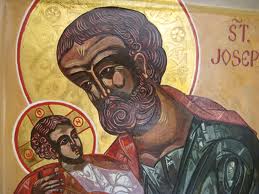
imagesToday is the liturgical commemoration of Saint Joseph, Mary’s husband and Jesus’ father or adoptive father, depending on your tradition. He was, the gospel genealogies report, loosely descended from David, but we think of him more as someone tossed and turned by angels in dreams, a man who could load up a donkey at a moment’s notice.

It’s a villager in Nazareth who tells us he was a carpenter, a woodworking artisan, a stonemason, or perhaps a contractor. But beyond that, we know nothing about him. He disappears from the gospels after he and Mary lose the adolescent Jesus and find him again in the Temple.

Tradition says that Joseph did not live to see his son’s career take off, nor its bitter end. He never knew him as a risen Lord. What carried him away? Did he die of infection or flu? Was he throttled by a client in a dispute over a bill? Did he fall from a scaffold or bleed out after an accident in the shop? If you believe the medieval tradition that he was already ancient of days when he married the Maiden, he might simply have died of old age.

No one knows his end. And no one knows his backstory either—what kind of a boy he was, whether he dutifully ate his peas or tucked them in his cheek to feed them later to the cat, whether he liked bold colors or preferred more muted tones. Had his sleep always been fitful, punctuated by dreams, or would his mother swear, if you could ask her, that he hit the pillow and was out like a light, sleeping like a log till noon?

How did he and Mary get together? Did Joseph meet her for the first time in her father’s living room? Picture it: his parents bring him all dressed up to Anna and Joachim to arrange the union, two good families making a deal for their kids. The older folks drink tea, talk it over, Mary and Joseph quiet, in the corners, eyeing each other, sizing up their chances.

Or this: they’d known each other since they were small. They ran with a pack of neighbor kids chasing balls into the street and building forts together, until the girls started being women, and the boys, men; and so it seemed natural, it was always just assumed, that they’d be wed. And so it came to pass.

Or not. Maybe he really was already old and widowed when they were betrothed, and he was a caretaker only, a protector God appointed as guardian of a divine child, a safe sexless man with a white beard and a lily blossoming from his staff, providing respectable cover for a perpetual virgin Mary.

Did he love her, then, like a father, venerable, affectionate and kind? Or did he love her like a lover, young and vigorous and eager and full of joy? Or like a man bound in duty to love her who keeps his word? Did they have chemistry? Or did they respect each other, grow on each other over the years, momentous secrets between them, stories no one would believe it they told them, so much fear, so much awe?

474px-'Joseph's_Dream',_painting_by_Gaetano_Gandolfi,_c._1790Some say that Joseph was by character and upbringing devout, and therefore unsurprised by angels, always expecting intervention, unquestioning in every ordeal. He sang psalms and praised the Lord in his candid heart as he trudged to Bethlehem, shivered in the stable, fled into Egypt, journeyed back and settled in Nazareth instead of going home. He was sweet and calm and uncomplaining through it all.

[–Gaetano Gandolfi, Joseph’s Dream]

Maybe his mother taught him about life and pain in such a way that it shaped his heart to absorb hard blows. Maybe his father was a man of dignity, and it got bequeathed to him in such a way that he could pull up short at the brink of anger and decide not to expose the pregnant Mary, but put her quietly away. Maybe it was upbringing, example, teaching. He was raised to be loyal.

But for all we know, he could have been a rough man, impervious to spiritual things, someone who tried, but to whom it didn’t come easily, and he felt resentful, deprived of a normal life by the commanding voices in his dreams. Maybe he wrestled like Jacob, resisted like Jonah, railed like Isaiah before giving in at last, like his son would give in later, drenched in sweat in the garden. Was he an unlikely saint, a man God pressed into service, and was it grace, and grace alone, that compelled him to rise to the occasion, the sort of grace that throws a switch in your soul when God decides you are the right man for the job?

He never speaks. Not once does he utter a word. No “And then Joseph said to the angel…” or “Joseph spoke to Mary, saying…” His silence is deep. Did he never say anything clever or wise or portentious enough for anyone to remark, remember, write it down? Did he say some things that were not edifying, embarrassing, not fit to hand on? Or was he as reserved as he appears, with no need to comment, no need to be heard, no compulsion to intrude on the drama and steal a scene?

Did they make him seem distant and aloof to his son, his long silences, his lack of chatter in the workspace, all those quiet meals? Or was it this the child warmed to and absorbed more than any other lesson or skill—the capacity to be and let things be? Was Joseph’s silence the wellspring of the Teacher’s need to steal away at night to hilltops to listen to God, to catch above the din below the cry of suffering and hope? Was this his father’s gift to him when, bloody and accused, he would not be provoked, but stood before Pilate and the cosmos, silent, without a self-defensive word?

In Italy they say that once upon a time when things were very bad, the good Saint Joseph heard their prayers and delivered them from famine, and that’s why they celebrate at Guiseppe’s Table every year, feasting with family and friends, strangers and guests, rich and poor. They eat a special dessert that day too, a round cream puff filled with ricotta and topped with red cherries and glazed orange slices. St Joseph’s sfinge would be enough to make me Italian, if I weren’t already.

In the United States, people have taken to burying little statues of Joseph in the yards of houses they want to buy, asking him to close the deal for them. He is, after all, the patron saint of real estate agents and house hunters, having found or built the house where Mary and Jesus lived and made a happy home for them under the roof of his care.

The 16th century St Teresa of Avila loved him above all other saints, and the first thing she did in her new convents, after making sure the bread that is Jesus was residing in the tabernacle, was to place an image of Joseph in a prominent niche and ask his blessing on the house and the ‘holy family” of nuns who would come to live and pray there.

Because labor movements in Europe had a very pinkish tinge, the Pope, feeling a need to commend work but eschew Marxism, turned to Joseph, who had toiled nobly with his hands, and appointed him to the task. The feast of Saint Joseph the Worker was proclaimed in 1955, and the day set aside to honor all godly labor was May 1, to counteract May Day, a socialist holiday. The Church hoped glad hymns to Joseph would drown out the Internationale.

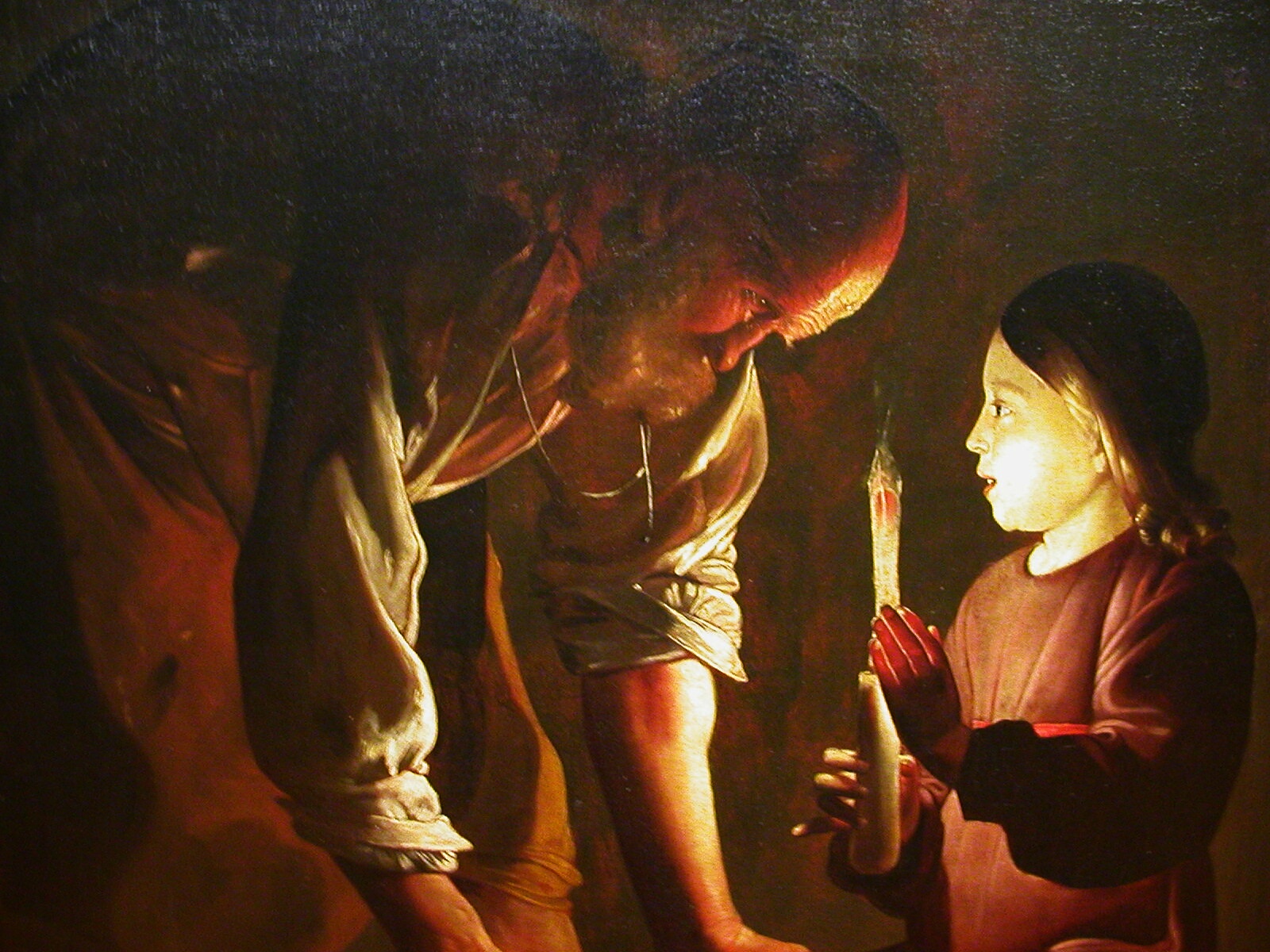
In the Roman Catholic tradition, Joseph is officially the patron saint of cabinetmakers, carpenters, craftspeople, engineers, builders, the nations of Canada, Korea, China, Peru, Viet Nam, Mexico, dying people, families, fathers, house hunters, people in doubt, pioneers, travelers, the Universal Church, all working people, and pastors. All in all, I’d say that for a man who gets just a few lines in scripture, Joseph has done pretty well for himself over the centuries. Then let us, then, bSt Joseph de la toure glad in him, and pray on this the most ancient of his several feast days (since the 10th century):

Saint Joseph, father of Jesus, husband to Mary, holy insomniac, packer of bags, maker of useful things, and silent as the mystery you cared for, pray for us.

[–Georges de La Tour, Joseph the Carpenter]