Category Archives: Sermons

Four Sermons on Baptism: 2. Keep to the Trail of Water

Image

–Photo: National Park Service

Exodus 15:22-27; John 2:1-11

Baptism of Aiden D.

Have you heard about extremophiles? I don’t mean people who hang-glide over belching volcanoes or snowboard down Mt.Everest blindfolded. Those risk-taking, rock-climbing, canyon-jumping, rapids-rushing, bull-running, totally insane folks can’t hold a candle to the critters I’m talking about.

Extremophiles, I read in yesterday’s Boston Globe, are microorganisms that thrive in the most unforgiving conditions imaginable. Some of these remarkable beings live miles below the earth’s surface. Others survive in temperatures reaching 250 degrees. Some breathe iron, some consume hydrogen, some eat rocks. The ones that live under the ocean floor have respiration rates 100,000times slower than organisms nearer the surface. As Beth Daley, the science reporter, put it, they lead “a mellow life” for millions of years – scientists call them “Zen microbes.”

How cool is that?

It turns out that life is far more pervasive, varied and enduring than we ever suspected. And so simple! While we complicated human creatures are madly trying to lengthen our lifespans and improve our looks with no carbs and comb-overs, these strange invisibilities are eating granite and living practically forever. Even as we reach for our cell phones, breathing hard and on the run, there are bugs out there sitting calmly in lotus positions, simply being bugs – they have no mortgages, no soccer practice, no sibling rivalries, no crummy co-workers to moan about, no nuthin’…

Of course they have no brains, either – no self-awareness, no emotions, no music, no aspirations, no ice cream. There’s not a Rembrandt or Ted Williams among them. And that’s one reason that, as cool as it is to contemplate the sheer tenacity of these little lives, and as humbling as it is to know that when our high-achieving species disappears from the planet, extremophiles will still be doing their no-thing thing in unseen places, I’m glad I’m me, and not one of them.

And yet…  Aren’t there times when our human environment seems every bit as extreme as theirs? Times when we discover that we are all extremophiles (well, not philes exactly, since we don’t usually love our hardships)?

Sooner or later most of us find ourselves in unforgiving conditions, at the far limits of livability, eating grief instead of bread, breathing pain instead of air; colonizing a subsurface world of depression and shame, or sojourning in the bewildering landscape of a bad diagnosis, an unfair dismissal, a financial disaster or some other almost casual calamity.

We cling to life in the hot core of anger or on the frozen crust of indifference, subsisting for what seems like an eternity on only the tiniest of kindnesses and paper-thin hopes. And somehow we hang on, scratching out a living in extremis, expanding the definition of the spiritual habitable zone.

How do we do it? Some people think it’s by force of will. Others think it’s by dumb luck, or good genes. More and more people swear by pharmaceuticals. But if you ask me, I’d say it’s water. We would never make it for a minute without water.

The Globe report agrees with me. It noted that one of the reasons scientists are so excited about the discovery of extremophiles is that in the search for life elsewhere in our universe, the amazing microorganisms we are finding here may be the clue to what to look for there. And in that search for life, scientists have one cardinal rule: Keep to the trail of water. “Studying life in extreme environments,” one said, “reinforces our focus on water. One thing all these life forms need at some time in their life cycle… is water.”

And let all the thirsty Israelites of today’s first reading say, “Amen!”

They have come out of Egypt thinking that unbearable misery is behind them, a painful memory. But now they are three days into the even more miserable wilderness of Shur with no water in sight, except for the polluted stuff they find at Marah. Worse than no water at all is lots of water you can’t drink; and so, wanting to live and not to die, the people cry out to Moses to do something. Moses cries out to God to do something. And God? God answers Moses by giving him… a piece of wood.

Wood?

Moses picks it up and tosses it into the water. Now, notice that God does not tell Moses to do that. He does it on his own. I read one preacher who wondered if, when he saw that piece of wood, Moses thought, “Great! A piece of wood. This is so not a good answer to our prayer!”, and threw that stick into the bitter water in disgust – or in utter despair.

But Moses’ God is the same God who makes it possible for some little bug somewhere under the earth in Peru to do rather well by eating rocks and breathing iron, so there’s no reason that a piece of wood can’t quench the thirst of God’s people, ailing in the wilderness of Shur.

And sure enough, it does. As soon as it hits those acrid waters, they turn sweet. The people drink and live. They live to thrive, for soon afterwards they arrive at the oasis of Elim, with its twelve springs and seventy palms. And there they camp, the Bible says, “close to water.”

If you are looking for a life that persists in extreme conditions, for a life that thrives when by logic it should shrivel up and die, keep to the trail of water.

And if you want a life that is more than life, more than merely coping with adversity, more than occasionally rearranging the furniture, more than the illusion of balance; a life rescued from the undertow of regret, fear, guilt or the dullness brought on by a lack of depth and challenge or by casual sin; if you want your life of obligation (and resentment) transformed into a life of delight and inexplicable, indestructible joy, take the same advice – keep to the trail of water.

Follow that trail to a village wedding where the wine has run out, or to some other human circumstance in which even the best intentions and the hardest work have not been enough to make us completely happy. Follow it to an ordinary disappointment or embarrassment that rubs your nose in your everyday limitations, brings you face to face with your lack of foresight and wisdom, your inability to control circumstances, your lack of imagination, your tendency to give only a small fraction of who you are and what you have to the great feast of life, and then to complain that you have been shortchanged, that there is not enough.

The trail of water – follow it to six stone ceremonial washing jars, holding twenty or thirty gallons each. Follow it to Jesus, who said that he has living water for everyone, and who out of compassion for our ineptitude is always changing the water of obligation and self-preoccupation and low expectations into a kind of extravagant and useless delight, a new and better wine. Always transforming the bitterness of the cross into the sweetness of resurrection. Always taking ordinary life and creating from it a miraculous adventure.

How do we thrive in impossible climates?  Human will?  I admire it. Dumb luck? I am always amazed (and amused) by it. Good genes? I wish I had ‘em. Drugs? They can help. But I believe, and I know, that we would never make it for a minute in the challenging conditions of this life without the daily water of God, without the Christ of transformation – without their extremophile grace.

Call it mercy, forgiveness, acceptance, welcome. Call it the power of the Holy Spirit, divine adoption, vision, vocation, hope. Or call it the central symbolic expression of Christian faith – call it baptism – that washing, drowning, refreshing, soaking, birthing, forgiving, restoring, including, welcoming water that makes extremophiles of us all, able and even willing to live and thrive in any circumstance or condition, including the forbidding habitats we are, by our sin, forever creating for ourselves.

In a few minutes, God is going to make an extremophile out of Aidan. We will pour over him the water that signifies the grace that will help him thrive in all climates and conditions – including the harsh geology of his own sins and weaknesses (which, of course, he does not have very many of right now, but will surely start acquiring as soon as he is old enough to make a mess of things other than the purely biological ones he now makes several times a day).

We don’t know what life holds for him – bringing a child into the world is one of the greatest acts of faith anyone can make – but by baptizing him we believe we will have done the best we can for him from the start. We will have given him water, the secret of an existence more astounding than iron-eating microbes and Zen bugs breathing slow. We will have welcomed him to the trail of water, where Life is always seeking other life, to know, to love, to thrive and to rejoice.

Now, how cool is that?

Four Sermons on Baptism: 1. Water World

http-inlinethumb21.webshots.com-22484-2592936640102347975S600x600Q85

Isaiah 41:17-20; John 4:1-15

Baptism of Anne Elizabeth B.

He gets really tired, our Jesus, and worn out from traveling. So he takes a load off his feet at the highest, hottest hour of the day at a well in a Samaritan town where the neighbors are unlikely to be friendly. But it can’t be helped, because he has this great thirst. And because he has no bucket, and the well is deep, he’s going to have to ask somebody for help, the first person who comes along, who is likely to be a woman, and if she happens to be hard-nosed about Jewish-Samaritan relations, she might just cut him dead if he speaks to her, and if she does, he won’t get his drink of water. And water is what he wants.

When she comes, Jesus asks her for a drink. She gives him a little lip about not having a bucket, but he isn’t put off; before long they’re talking theology. First they talk about water, although at the start she thinks he’s talking about the water from Jacob’s well. But eventually the conversation gets around to establishing that the water she needs and the water he wants to give her are different. Then they move to the subject of life—just a short step away from the topic of water, since water and life are twins. But it’s not life in the abstract he is interested in; he wants to talk about her life, including her five husbands, and “everything she’s ever done.”

She drinks his “living water.” How quickly it revives her; how unencumbered she becomes! She drops everything and plunges into town to tell everybody about Jesus, and about a soul-thirst she didn’t even know she had, about the thirst Jesus first awakens in her, and then slakes. It turns out that she is the one who had no bucket, standing at the deepest of deep wells. It turns out that Jesus is the one who hospitably dips into unseen depths to refresh her. You could even say that he baptizes her, immerses and drenches her from the inside out; and from that day on, she who lived in a hot, dry world begins living also in a world of water, amid secret pools of refreshment, intimate cascades of acceptance and favor, and subterranean streams of joy.

She enters a water world: we have come to call it the church, the great reservoir of life. Since time immemorial rejuvenating waters have been collecting in its cisterns: the waters that buoyed up Jesus in Mary’s womb, they’re in there. The water by which John the Baptist cleansed Jesus, it’s in there, too. That water that by wedding’s end became good wine, it’s all there.

The church’s well holds the angry sea that Christ rebuked to save his friends, the waters he made as firm as a road so that he could reach them in their swamped boat; the tears he cried over the city he loved, and over Lazarus, his friend; the water from the basin he dragged from foot to foot at his last supper; the water that flowed from his side when the soldiers pierced him; the waters of ecstasy and revelation at Pentecost when the Holy Spirit, poured out from above, became living water within us.

The church is a great reservoir of all the waters that heal and challenge, cleanse and refresh, delight and save and serve and compel. And when by God’s mercy we are invited into the church, we who live in such hot, dry places get drenched with them. Safely submerged, we learn to swim in a brand new world, wet and wondrous; we learn to go deep and drink to our heart’s content.

Today we baptize Anne Elizabeth, child of God. We bring her not into the world (her parents managed that just fine), nor into communion with God (God knew and loved her from her mother’s womb), but into Christ’s body, into the church, into this world of water. By water we quench a thirst she is too small even to know she has—a thirst for becoming completely who she is, a thirst for fellowship with God’s people, for belonging to a household of faith and service, a thirst for home and the eternal vision of God.

Her baptism is pure gift to her: before she is able to fend for herself, to understand anything, to name anything or even to ask for anything, Christ drenches her with welcome and acceptance, makes her an indispensable member of his body, and reserves for her a unique place at our table of memory, justice and love.

Her baptism is pure gift to her: it is a lifetime pass to our village well, a right to draw from the church’s reservoir that never dries up or runs out and at which she will always find Jesus waiting for her, ready to help her, to talk with her about her life, to help her uncover who she really is, what she most truly desires. She will always find him at the center of town, at this well; and in life-long conversation with him she will drink in the kind of unencumbering good news she can’t produce for herself or get from anybody else.

And if the rest of us water babies do our part, the part we promise in our vows to God, as she grows up among us, she’ll never dry out, because we will daily be soaking her in the gifts of God with which the church is waterlogged—worship, sacraments, prayer, singing, fellowship, encouragement, teaching, counsel, correction, stewardship, healing.

If the rest of us water babies do our part, she too will someday go squishing about to tell others what it’s like to live in a water world, about the One who lives at the source, the One who can awaken their thirst too, and then quench it, the One who will hospitably draw out for them the same unending joy she knows.

Anne Elizabeth, child of God, baptized today. You came here with no bucket of your own to draw water from this pool, and Jesus was here waiting for you. He has now given you everything you’ll ever need to be safe and sound  — he has given you to us and us to you; he has made you a water baby and introduced you into a water world.

And something else too, something that we all too soon forget; but as you grow up here, we want you to remind us of it. Here it is: today we baptized you also into a mission and ministry. “What is it?” you will ask someday.  I’ll tell you now, and if we keep the promises we made to you today, we’ll be telling each other again and again for years to come.

Remember the drink that Jesus asked for? In all the commotion, it isn’t clear if he ever got it. We need to find out. Our mission and ministry is to ask and keep asking if Jesus ever got his drink of water, to ask and keep asking whether he is still thirsty, and to be on the lookout for him in all the village squares where he is dying for refreshment, in all the places where in so many guises he sits down to rest (including pews like these). Our ministry is to see him and give him that drink, to make sure someone passes by to refresh him. It isn’t much, but it’s all he’s ever asked for, all he’s ever wanted, all he wants from us today.

If you see him in the heat of the day or in the cool of the evening and give him a drink, if together we help each other do this day by day, on the Great Day when God calls us home, you and I and everybody here who loves you, along with all the saints who, waterlogged with the works of love, squish their way before Christ’s seat at God’s right hand, will hear Christ say:

“Well done, good and faithful church; well done, good and faithful Elizabeth Anne. Now enter my Father’s joy, prepared for you from the foundation of the world, for I gave you living water, and you gave it back to me. When I was thirsty, you gave me a drink.”

Naming Jesus

Luke 2:15-21  After eight days had passed, it was time to circumcise the child; and he was called Jesus, the name given by the angel before he was conceived in the womb.

 00348701

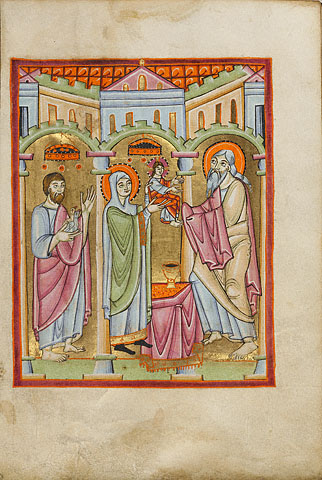
Image: Unknown , Ottonian, Regensburg, c. 1030 – 1040

It used to be that when I’d find out that a couple was expecting or preparing to adopt an infant, I’d inquire right away about whether they’d decided on a name. But experience has taught me that it’s a very bad question to ask, especially if you also feel it’s your duty to offer a few suggestions! Parents are generally pretty particular and protective about choosing names. It is often a cause of friction between them, and if the relatives are butting in too, everybody is on edge. It’s not for nothing that many of our given names have little family stories attached to them.

When I was leading small discussion groups, I’d sometimes break the ice with a question about the participants’ names. Why were you named Elizabeth or Paul or Malcolm or Linda? Were you named for a hero or saint, a grandparent, a movie star? Was ‘Tiffany’ or ‘Grant’ a hot name the year you were born? Is your name brand new, invented out of wonderful sounds, like Keeshawn or Tawanda or Juwan? Or is it traditional, biblical, like Ruth or Rachael or Adam?

I, for example, was supposed to be named Janice, after my mother’s mother, Janetta. But the labor was long and my head and shoulders were big, and the pain was great, and my mother — who up till that moment had not been particularly devoted to the Mother of Jesus — was heard to scream, loud enough for everyone in heaven to hear: “Get me out of this and I’ll name her Mary!”

Names matter to us. We try to remember names and get them right. We’re embarrassed when we forget somebody’s name. It bothers us when somebody gets ours wrong, adds an ‘e’ on Ann if there isn’t one, or forgets to add one if there is. We don’t treat our names lightly.

Names have a way of saying: Attention! Human being here. To deny people their personhood, we take their names away. When people are sent to prison, they gets a number; when Jews were sent to camps, they became numbers; when Africans were enslaved, their African names were erased and they were given different ones, left nameless, or called ‘Tom’ or ‘boy.’ To sing, then, as they did, “Hush, hush, somebody’s calling my name…” was a defiant assertion of human dignity. Jesus knew their names.

If our names don’t feel right, we change them. You know, one minute he was ‘Prince,’ and the next he was ‘The Artist Formerly Known as Prince,’ and then he was a graphic logo. We snicker, but we also understand. In some irreplaceable way, our names do more than identify us: they create us. And the simple utterance of a given name often generates the most intimate intimacies. Recall the scene in the Gospel of John when one of the women who went to anoint the entombed Jesus met a man she thought was the caretaker. She demanded to know where Jesus’ body was. He said, ‘Mary.” And she knew him.

Names elicit real presences. If you doubt the power of a name to evoke a person, go to the Viet Nam Memorial. Watch people trace with their fingers the names cut into the wall as if they were making out the features of a well-loved face in a dark room.

Names, the scriptures tell us, are also important to God. Practically any place you open the Bible, you’ll find God preoccupied with names, naming people, changing their names, explaining their names. This God won’t assign you a number. In fact, God is said to know us before we are even conceived, and that means by name. God, we are told, has inscribed all our names on the palm of the divine hand. In scripture, being called by name is a rich gift—it carries with it implications of belonging and safety and redemption and covenant love and mission and accountability.

It shouldn’t surprise us, then, that God had a name picked out for Mary and Joseph’s child. When he announced the birth, Gabriel also announced the name, and thus the couple was spared all the intra-family hazards of having to choose one. They never fought over which grandfather to honor, or whether to name him Joseph, Jr., or whether to saddle him with a hip name or an old fashioned one. And when eight days had passed, and the time came for him to be circumcised, they gave him, Luke’s gospel says, the name commanded by the angel before he was conceived in the womb– Jesus, that is, ‘God saves.

Naming their child was an act of obedience, one of a series of obedient responses that marked the odd experience of these parents. This obedience is the only reason Luke mentions the naming ceremony in his gospel (it only merits half a line, after all): he wants to show that neither this child nor the child’s parents are independent agents. They operate faithfully in response to the divine plan for reconciliation. Mary and Joseph name the child Jesus because even though it’s plain that neither of them understands fully what is happening, they believe God has spoken, and that’s enough for them. From the beginning, then, the child whose name means ‘God saves’ is a son of obedience as well as a son of God.

And that never changes. This association of salvation and obedience permeates Jesus’ life. It is a major concern of the evangelists too. You can invoke Jesus’ name again and again, one says, but unless you are also obediently carrying out God’s will, it will do you no good. You can be his mother, the first to call him by name, says another, but unless you are hearing and obeying God’s word of mercy, blood connections and old family stories won’t do you any good either. Even the demons know Jesus’ name, we read, and they easily invoke it; but they are still demons.

Each of us has a different name. But we have a name in common too. We who follow Jesus bear his name together. It is the name God likes to call us, even if it is also the one we find hardest to call ourselves, since we are usually better at knowing ourselves deficient and a cause of God’s disappointment than we are at knowing ourselves holy and a source of God’s delight. And yet by grace the name of Jesus is indeed our best and truest name, the name that delivers us into God’s intimacy. If we hush, hush, we will always hear the Spirit calling it, reminding us of the dignity we possess even when we ignore or squander it. Bearing this name of Jesus self-consciously, purposefully, responsively, will make us children of obedience like he was, so that we will not be children of God in name only.

The name of Jesus belongs first to the baptized, but it is not an exclusive name; it also fits every person who obediently seeks the mystery of God and the community of justice and wholeness that is the will of God. Anyone who has ever participated in depth in inter-faith dialogue or in cross-cultural movements for liberation knows well how much the name of Jesus is revered and ‘adopted’ by people whose religious lives unfold in other traditions, sometimes more so than within the Christian family itself.

The name of Jesus is a precious name. Many a soul has gone trustingly to an awful martyrdom or to a kinder, everyday death with this name on its lips. Many a struggling heart has found that name sweet in times of illness and strong in times of fear. Many courageous, persevering men and women have invoked its righteous beauty in the face of injustice and oppression. We pray privately and communally in that name, assured by scripture that God responds as faithfully to it as Jesus did to God. We sing stirring hymns in church about the glorious name of Jesus, and about how every knee must bend to it.

But we are generally timid about naming Jesus explicitly outside the small circle of our faith communities, and sometimes even inside them. Some of us hesitate to name him to others (and to each other) because we think we don’t believe enough, or believe correctly, or believe at all. Some think it is hypocritical to speak of him if one’s actions do not match in every particular one’s rhetoric. Some of us fear ‘imposing’ his name on others, as if merely speaking of Jesus were coercive or imperialistic. Or we worry that if we invite people to glimpse this cornerstone of our hope, to grasp the reason for our commitment to the world, they will hear in our naming of Jesus only the narrow-mindedness of the ultra-conservative right or the fanaticism of the fundamentalist.

Of course, we can’t help but be acutely aware that in the name of Jesus every imaginable human horror has been and is still being devised and perpetrated. We know all too well what happens when naming Jesus is divorced from obedience to the God whose ways are not our ways. But the solution is not to keep still about him and about the way we know and experience him. If we are silent about Jesus, withholding from the world the reasons for the way we think and live, we concede the field to the demons who happily speak his name in the world, but only in order to lie about him.

In the silence deepened by our reluctance, God only knows what those demons might say—that Jesus prefers white, well-to-do people? That he stands against the violence of the Palestinians, but not that of the Israelis, or vice-versa? That he is satisfied when the state punishes killing with more killing? That he shows his wrath at Western homosexuality by striking millions of heterosexual Africans with AIDS? That he thinks the answer to gun violence is more guns? If we fail to name him as we have come to know him, at the sound of his name named by such demonic voices, knees will bend all right, but it will surely be in loathing, or in ridicule, or in dread.

But what if we were in the world naming him differently? What if we were less timid and more aware of the difference naming him as we know him could make?  What if we encouraged each other to name him, telling stories of how we got this name, telling the world why we think it is a lovely one, why he is ‘God saves,’ and not ‘God condemns,’ why he is worthy of our allegiance. Maybe the more we name him, the more his obedience will live in us, the more his life will be reproduced in us, and the more his compassion will go out from us to the world God loved.

I Christmas: Turn Around and You’re Grown (Luke 2:41-52)

bosch12

–The Child Jesus with A Walking Frame, Hieronymous Bosch, 15 c.

I.

n the 1960’s, Kodak ran a commercial during “The Wonderful World of Disney” that became one of the most beloved in the history of advertising. It was a simple photo sequence that captured the progress of a baby from infancy through girlhood, adolescence, young adulthood and marriage, ending with the young woman coming home from the hospital with a baby of her own in her arms.

The pictures were accompanied by a song called, “Turn Around.” Parents everywhere blubbered openly when it played.

Where are you going my little one, little one?

Where are you going, my baby, my own?

Turn around and you’re two,

Turn around and you’re four,

Turn around and you’re a young girl

Going out of the door.

Where are you going my little one, little one?

Little pigtails and petticoats,

Where have you gone?

Turn around and you’re tiny,

Turn around and you’re grown,

Turn around and you’re a young wife

With babes of your own.*

The ad and its soundtrack were impossibly sentimental, but something about them struck a deep chord. Little ones grow up, we all know, and they do it, it seems, when you are distracted for a split second.

Only a week ago it was Christmas. The Babe in the manger hadn’t even opened his eyes. Last week, he wasn’t old enough for strained peas. This week he’s an adolescent. How did we get here so fast? Turn around and he’s born, turn around and he’s grown…

Grown, and something of a prodigy. He’s wowing the teachers in the Temple with precocious questions. He’s a willful kid too, and he’s giving his parents fits. I’m told that Luke uses the same word to describe Mary’s anguished confusion in this episode as he uses to describe the consternation of Dives, the rich man who ends up in hell in the story of the beggar, Lazarus. Luke knew something about the underbelly of parenting, I guess.

In the church I grew up in, we called this Sunday ‘Holy Family Sunday.’ It was a celebration of the ideal family, the one we were supposed to imitate in our own. I could never figure out what was so ideal about them, though. It didn’t seem very ideal to me to misplace your kid in a big crowded public place. And when his careless parents find him,hb_32.100.123 Mary doesn’t seem to remember or much care that Jesus is Somebody Special. She’s as frazzled as any ordinary mother would be and yells at him as if he were a run-of-the-mill pre-teen. Jesus’ reply is curt, even dismissive. This sounded more like my own family, certainly not a holy one.

But the preachers of my youth didn’t seem to notice. They especially played up the last line of the story—He went down with them and was subject to them. ‘Go and do likewise’ was the moral of the story, as far as they were concerned; and every parent in the sanctuary nodded in agreement while we kids slumped in our seats. The Holy Family is a family in which parents are good and caring, and their kids submissively obey them.

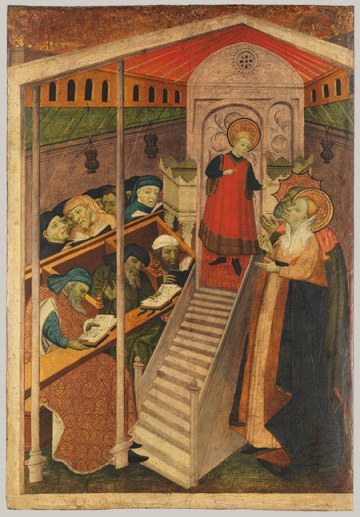
–Christ among The Doctors, Cataln, 14th c.

II.

Of course this is Kodak sentimentality passing for Christian instruction. Not only is this not a story about a Holy Family, it’s also not a story about being submissive. It’s a story about the time that comes when one must disobey. It pinpoints the moment when an authentic calling renders human absolutes relative. It’s a story in which we learn that sooner or later choices have to be made that override the obligations even of blood kinship.

Luke shows us this moment in Jesus’ life by playing on the word ‘father’ in the exchange between the boy and his mother. Mary asks, ‘Why have you done this to us? Your father and I have been searching…’ Jesus responds, ‘Why were you looking for me? Did you not know that I must be about my Father’s business?’ In this moment, Jesus shifts his allegiance from Joseph (‘your father’) to God (‘my Father’). This child is becoming an adult, and we know he’s on his way because he is sorting out competing loyalties; he is negotiating the tensions between ordinary expectations on the small stage of a nuclear family and great aspirations on the larger stage of a ministry to the world; he is making choices and accepting the obligation and pain that comes with a life-claiming, life-shaping call: ‘I must be about God’s work.’

Eventually Jesus will return home with his parents, for the time being, the story says, and ‘obediently.’ And then the gospels are silent about him for the next eighteen years. But the die is cast at twelve. According to Luke, Jesus was born for one purpose only, the common human purpose—to grow up; that is, to achieve an adulthood shaped around chosen priorities. Here Jesus is already clarifying what his will be—only those things pertaining to God’s house and God’s business. The priorities Jesus chooses will lead him to demand a wrenching reordering of everything. We know how that goes: The mighty cast down, the rich sent away empty; the meek inheriting the earth, the last moving into first place, mercy trumping everything else.

Jesus’ commitment to God’s work will also demand a new kind of kinship that persistently condemns the ordinary idolatry of clan and family. His first and final allegiance to God’s house over all other allegiances to every other house – personal, religious, political, national – will eventually mark him for a state execution; and in the meanwhile his own family will be embarrassed, confused, and disheartened by the things he says and the company he keeps.

But all this is in the future. It will come soon enough. In a split second of Marian distraction, he will be fully-grown. In another blink of an eye, he will be dying on a cross. But for this split second now, he is a boy, learning the Law and beginning to walk in the pathway that will be his life.

Christ in the House of His Parents ('The Carpenter's Shop') 1849-50 by Sir John Everett Millais, Bt 1829-1896

–Christ in the House of His Parents, John Everett Millais, 1849-50

III.

In the Christmas season, I hear many smart, faithful Christians say they don’t believe any longer in the New Testament’s infancy narratives—especially Christ’s miraculous birth from a mother who was also a virgin. As I grow older, I find these ancient stories easier and easier to believe, at least to believe in that way theologians call ‘a second naïvete.’ My problem is not with the divine child in the manger, but with the precocious, willful boy in the Temple who is figuring out that God’s business merits the unswerving dedication of a whole life. As Will Willimon once noted, it is harder to believe in a life ‘unreservedly shaped around the priority of God’ than it is to imagine that a virgin could bear a son. It’s not that hard to embrace the possibility that God came as a human baby if God stays a baby and does not grow up to be a man who is God’s alone, and does not demand that we choose to be God’s too.

Former UCC General Minister and President, John Thomas, tells this story:

“Bethlehem, Pa., was named by its Moravian founders after their first communion service was held on Christmas Eve. Today ‘the Christmas City’ offers a delightful array of Moravian Christmas traditions [to the public] every year… [Annually], a Nativity scene is erected on the plaza between the library and city hall, dominated by a huge lighted star on the mountain overlooking the Lehigh River to the south.”

One year, John continues, while he was serving a church in nearby Easton, “the newspaper reported that the figure of Jesus had been stolen. Jesus was eventually located… where the vandals had left him and, to avoid a recurrence, the city mothers and fathers bolted him to the manger after they returned him to the plaza.”

Most of us, as John comments, are “happy to keep Jesus bolted to his manger.” Who wants him grown up and walking around, “meddling in the greed that denies children health care, or a decent home, or a safe school? Who wants him challenging our easy resort to violence as the only way to personal and global security? Who wants him asking us awkward questions about why we treat the creation as little more than a convenience store filled with raw materials to satisfy our endless desire? Who wants him holding up a mirror to the deceits and betrayals of our personal lives? Better to keep him bolted [to] that manger.” (2)

Yes, indeed. We hate to see the Infant Jesus grow up so fast. He’s such a pretty little baby. We want to savor the Kodak moment forever. But it’s not just because he’s so sweet and cuddly that we hate to see him outgrow his crib. It’s also because deep sown we know that when the infant becomes a boy, and the boy becomes a man, we will be asked to grow up too.

 *******

*“Turn Around,” by Harry Belafonte, Alan Greene, and Malvina Reynolds

What You Can See Through Tears

 La_Pieta_Santa_Maria_della_Vita_Niccolo_del_Arca_1462

— Niccolo dell’Arca

John 20:1-18

Someone said to me a few days ago, “Easter is going to be a hard sell this year, isn’t it?”

By “this year,” of course, he meant 9/11; and he meant the war in Afghanistan, the crazed violence of the Middle East, the fear of Muslims, the fear of flying, the fear of the future, the free-form fear ignited by color-coded homeland security alerts.

By “this year” he also meant the anger of grown-up little boys molested by trusted Fathers, and the duplicity of the Fathers of those Fathers who for indefensible reasons did not, when the children cried out, put aside every other consideration and run raging, weeping and full of tenderness to their aid.

“Easter is going to be a hard sell this year, isn’t it?”

The question implies that in a year such as this one has been, it will be at best a perplexing exercise to sing lusty alleluias about the death of death. It implies that this year we’ll need to put up a struggle so that the undertow of grief won’t drag our high hosannas out into a sea of sadness.

It also suggests that perhaps we hepped-up Easter preachers should be careful when we claim that because of the resurrection, everything we think is so gosh-darn bad is really not all that bad after all, when all is said and done! Christ is risen from the dead: Presto change-o! All’s right with the world.

Watch out, this question warns, that Great Easter not become a shallow dismissal of the unspeakable pain, the mindless destruction and the utter helplessness we have known together “this year.”

I experienced something like that dismissal recently, as I participated in an ecumenical Good Friday service in Boston. At the end of the service, a young layman employed by the Catholic Archdiocese of Boston sang movingly, “Were You There When They Crucified My Lord?”  But he couldn’t let the question hang in the trembling air, as it was meant to do, unanswered. He proceeded instead to assure us breezily that although things have been hard in the Catholic Church lately, the resurrection of Jesus is going to make it all OK. The bad acts of a few bad priests will not destroy the Church: after all, he explained, one of the Twelve betrayed Jesus, but the rest did not. And after that betrayal, they just chose another man to take Judas’ place, and with the number full again, the good work continued. So, friends, he concluded, don’t worry! Never forget: the tomb is empty!  Not to worry. Presto change-o! Alleluia, alleluia, alleluia.

“Easter is going to be a hard sell this year, isn’t it?”

Yes, I suppose it is. But isn’t Easter always a hard sell?

wpe2With all due respect to the faith-challenges of this terrible year, Easter is no more a hard sell today than it was in 1069, when a preacher in Cologne, Germany, finished his Good Friday sermon on the text, “Father, forgive them, they know not what they do,” and dismissed the gathered faithful — whereupon they all poured out of the cathedral and began looking for Jews to kill. The killing continued for weeks. It was the first instance of that pious Christian anti-Jewish violence that we have come to know as the pogrom.

Easter is no more a hard sell this year than in 2000, when, if you believe that year’s domestic violence statistics, in the home of at least one family of someone you know (but would never suspect), a husband threw a hard fist at his wife, and both of them lied about it later in the emergency room.

Easter is no more a hard sell this year than it was or is in any year when a person gets fired because of a losing battle with the bottle, or gets laid off because of a company’s losing battle with the bottom line; or a placement is denied to fit foster parents because they are gay; or somebody steals your perfectly pleasant fourteen-year-old when you aren’t looking and replaces her with a pot-smoking monster who hates you and whom you don’t like very much either.

Easter is no more a hard sell this year than in any year in which human beings perpetrate and suffer all manner of violence and illness, when natural disasters wreak havoc, good kids lose their way, death-loving zealots win too many hearts to their bloody causes, and indifference permits evil to prosper.

A hard sell this year?

The truth is that we always celebrate Easter in the throes of one disaster or another, personal, communal, and global. Easter cannot prevent these things, and Easter must not gloss over them. Pain, sorrow, terror and outrage are, along with ordinary pleasures and extraordinary ecstasies, the stuff of our real human life; and our real human life matters so much to God that God shared it. Our real human situation – our life, our suffering, our mortality, our hope – matters so much to God that, as another preacher has pointed out, “Easter, our greatest godly celebration, takes place in a grave.”

giottonaIf the Easter message promises, and I believe it does, that all will be well beyond our wildest dreams, it does so only through the medium of scars and tears, dust and ashes. The Easter miracle is the power of God’s love and life in the human condition, not in spite of it, or against it, or above it, or beyond it. The gospels claim that Jesus’ resurrected body was so strange that the disciples were not always sure whether the man appearing before them was the same man who’d been dragged to the gallows only a few days before. Some of them were sure only when they saw nail-marks in his hands, the gash still gaping in his side. The risen Christ did not shake off the signs of his earthly service and suffering. His glorious face is eternally grooved by human tears.

Easter is not fairy dust flung over horror to “make nice.”  It is not the way our spirits lift at the annual rebirth of nature. It’s not comfort derived from our the common wisdom that brown things green up after bad winters. It is not a coping mechanism. It is not a basketful of bunnies and chickens and eggs reminding us that no matter what, life goes on and tomorrow will be another day.

Easter is instead the gift of power — power to live fully- free, fully-open, fully-vulnerable, and fully-engaged human lives in the bad winters, in the unthinkable disasters, in the terrifying destruction, on the brutal cross of shame, in each and every human grief and sorrow, in the painful groaning of the whole created cosmos for liberation and new life.

The writer, James Carroll, tells the story of a holy teacher who lost the power of words. He had spoken healing comfort to the dying all his life, but the dying still sickened and died. He had comforted the poor, but poverty still clung to them. He became discouraged, and at last, despairing, he fell completely silent, and settled at the edge of a vast wasteland, alone.

One day a desperate stranger crawled across the spiky stubble to the door of his hermitage and begged him for a word, just one.

“I am ages alone,” the stranger said, “and I am dying from being unspoken to.”

Silence.

The stranger insisted, “Your wordlessness is killing me. I see that it is killing you too.”

More silence.

At last, the stranger asked the hermit, “Do you want me to die?”

The hermit began to weep. From the deep cave of his being came a terrible moan. His old heart grasped the sound and pushed it up to his cracked lips. His lips formed it into a single shattering word: “No.”

Both men died that night. They might have died dead, but they didn’t. They died alive.

Easter is the gracious power that allows you and me, while we live, to resist a retreat into wordless despair and to overcome fear — not the fear of dying, but the fear of living humanly, feeling, perceiving, thinking, open, vulnerable, connected, committed and engaged. Easter is therefore also the power that, when we die, allows you and me to die alive. It is the power to hear, to believe and to act out in our own living, serving and suffering God’s thunderous “No!” to the most tortured question you, I, and the world address to heaven: “Do you want us to die?”

If we derive from Jesus’ resurrection only an optimistic ”faith perspective” on hard things, but are not driven by our Easter joy right down into the heart of suffering where Easter matters most; if down there we do not steadfastly offer Easter’s preposterousness, its tenacious hope-against-hope; if the lusty alleluias of our Easter liturgy are not also the thunderous “No’s” of God to the despairing deaths that stalk the world; if Easter indulges even the mildest indifference to the immense reservoir of human suffering — if it is evasive, it is not Easter, and we blaspheme when we sing.

Mary_Magdalene_sculptureBut if we do go down there, if we go down deep, and if we mourn and weep…  Well, consider Mary Magdalene. She went to the grave of Jesus while it was dark. The stone was gone, but she neither understood nor believed. She ran to the disciples who raced back with her, looked in, saw the linens, credited her story of a missing corpse, and went home. They didn’t invite her to go home with them. Or maybe she refused to go. She stayed there “in the garden alone,” as the old hymns says. Then, we are told, there in the dark she started to weep. She just stood there, glued to the spot, facing the tomb, deep in the grief and the horror. And she wept.

She wept and wept and wept. She could have wept forever.

But then she began to see.

It is amazing what you can see through tears.

What looked like an empty tomb is full of angels.

A gardener speaks, and faith knows that voice, registers those features.

In a room where the first time we looked there were only frightened women and men, peace materializes.

In broken dreams, broken bodies, and broken bread, you can see through tears that there, there, precisely there, the Great Wide Mercy dwells.

A Voice in Ramah

This is an excerpt from an older sermon on the Feast of the Holy Innocents…

persp22_22

Matthew 2:13-23

Did you hear it? That voice? Not Herod’s voice or Joseph’s, for neither of them speaks in this passage. Not the angel’s voice either, although Gabriel speaks twice, first ordering Joseph to take the family to safety in Egypt and then ordering him home again when Herod dies. No, it’s a voice Matthew reaches far back into the Hebrew scriptures to retrieve and play back for us. It belongs to a woman who at the time Matthew wrote this story had been dead for a thousand years. The voice of Rachael, the great matriarch who died while giving birth to her second son, Benjamin, whom she intended to name ‘son of sorrow.’ Rachael, the personification  of maternal grief.

Matthew brings her voice into the story of Jesus via the prophet Jeremiah, who remembered her as he wrote about the calamity that had befallen God’s people when they were overrun and driven into exile. Their Babylonian captors assembled the terrified deportees in the border town of Ramah, and it was there that Jeremiah hears her weeping down through the ages ‘for her children…and she will not be comforted, because they are no more.’

She will not be comforted. There is no way to address a grief like Rachael’s, and she stubbornly refuses everyone who tries. She refuses to diminish the unspeakable reality of innocent suffering by the attempts of the well-meaning to assuage or explain it, to make sense of it or sublimate it. Rachael is a witness to things in human life that are so awful they cannot be soothed or repaired. They can only be wept over, lamented, and comfortlessly mourned.

Rachael’s weeping is the voice of all the keening mothers of Bethlehem’s babies, and to the un-voiceable anguish of every parent, family, clan, and nation from whom children have ever been torn away by a police state, by Jim Crow or apartheid, by political greed and indifference, by war and the glorification of war, by gun violence, bigotry, or crushing poverty. Rachael will not be hushed about these things. Her anguish will not be pacified.

These days we are surrounded by hushing, pacifying voices. By knowing voices that explain and justify the unfortunate necessity of innocent suffering, as if it happens all by itself without human complicity. By cool voices that prettify what violence actually does and paint a sanctified picture of the meaning of suffering. By the pandering voices of politicians.  The smug voices of the self-made. The dismissive voices of the privileged. Even our own voices that too often echo the hollow pieties of the church and the self-involved bromides of the world.

On the cusp of a new year, one that will almost certainly see some new atrocity unleashed upon this gasping planet, the liturgy does not give us assurances that hope is rational or that better days are ahead. What we hear instead is the stubborn wail of Rachael weeping for her children. Rachael’s tears telling us to resist comfort. To refuse explaining, justifying voices and listen instead to hers over every bland dismissal of the real needs of real children, over every empty proclamation of concern uncoupled from policy and deed, over every thought or prayer offered for their brutal, preventable deaths. Rachael weeping: listen for that voice, and refuse to be comforted.

Listen for her weeping. And join her. Rip apart with lamentation the curtain behind which hides the greatest lie: that it just can’t be helped, that we have no choice but to stand by and accept the murder of innocents, whether it be lives destroyed in office buildings in New York, in hospitals with no supplies in Syria, by famine in Sudan, in school buses in Tel Aviv, in shot-up elementary schools in quiet American towns, or razed homes in the little town of modern Bethlehem.

Rachael makes only a brief appearance on the Christmas stage, but when this wailing mother of a dead child shows up beside a sleeping child watched over by a Virgin tender and mild, we are also reminded that what our feeble words cannot speak of adequately or truthfully, God’s Word, the Word we experience in Jesus, can. The Babe who escaped this time; the Child who one Herod could not find, but who will be found by another in thirty-three years’ time and will not escape him then; this  Word is God’s decisive Word to our world.

It is also, perhaps, a Word of comfort all the world’s Rachaels might finally be willing to accept, because it is a Word of justice. A Word profound enough, courageous enough, persevering enough (through trial, cross and grave) to address whatever horrific stuff our living and dying, our ignorance, sin and fear can present. Now and forever it is spoken powerfully against powers-that-be, defeating death itself — even ours, when we pick up its resonance, welcome its light, echo its truth, and live on its dangerous edge.

No, Not Now

This sermon was preached on the occasion of the great Asian tsunami at Christmastime in 2005.     It may have some relevance to the horrific shooting in Connecticut today.

the-weeping-woman

–Pablo Picasso, The Weeping Woman

Psalm 69:1-3, 13-18

If you’ve been following the news coverage of the South Asian tsunami, by now you will surely have seen something that has torn your heart out –- piles of bodies unceremoniously bulldozed into mass graves; a child with impossibly big eyes standing alone, staring into the distance; the stunning before-and-after satellite photos of a ravaged coast.

Or perhaps you saw the report in which a journalist is speaking with several Indonesian survivors, some of whom have lost entire families. They tell their stories to him, some with unnerving stoicism, others wailing and striking their heads with flat hands. Then, in the background you hear an unmistakable sound. It is Friday, and somewhere in that desolate place, a muzzein is calling the faithful to prayer – as if to remind the whole flooded world that no matter what, God lives, and that to pray is just what one does, what one must do, for everything to make sense.

Allah akbar! God is great! There is no God but God. Come to salvation! Come to prayer!

Hearing the call to prayer, the reporter asks the men if they are going to the prayers. Some nod yes. Some get up to go. But one man, who has just told us that twenty-four members of his family are dead, shakes his head. Through the translator he says simply, “No, not now. Now I do not have it in me to pray.”

When I heard the call to prayer invite everyone to come to the good God and find salvation, I felt something rebel in my stomach. In spite of my deep conviction that God had nothing to do with making this horror happen, my mind filled involuntarily with the age-old Big Questions. What is it that one could possibly pray for in the midst of such misery? And why would one ask anything of a God who seems to have stood by and done nothing while it unfolded?

In that moment, it was not enough for me to answer myself by saying that God was not responsible when tectonic plates collided, and the sea floor rose, and the displaced water needed somewhere to go. It was not enough for me to affirm, in C. S. Lewis’ words, that God is not a “cosmic sadist” or a “spiteful imbecile.” When my stomach lurched at the call to prayer, it was because my soul needed to be able to say something more affirmative than that about God; to be able to say not only where God was not, but also and more importantly where God was.

And I couldn’t. At least not honestly. Everything that came to mind seemed inadequate, even repulsive. I went down the long list of standard explanations and theological considerations, each one leaving me emptier than the last – until I heard that poor man say, “No, not now. Now I do not have it in me to pray.”

His was not an answer, not a solution, not an explanation. But it rang true – a simple acknowledgement that there are times when we are unable to bear the thought of God, unable to give ourselves to God in trust, unable to accept that there is any moment but this awful moment, unable to feel that anything exists outside our loss, unable to believe that anything can be done but endure it.

And I began to think that if we are not at least that honest, our piety will serve only to shield us from reality, our prayers will be only a game of “make nice,” and our faith will only separate us from our own humanity. Whether we contemplate the ravages of a tsunami, the carnage of war, a mindless mass shooting, the stupid waste of a death by drunk driving, or the intimate catastrophe of a loved one’s untimely passing, what matters is not so much our particular beliefs about God, but rather our capacity to be before God in our truth and to allow every question to rise, even if for some of us that means that what used to pass in us for faith is lost, and what replaces it is a permanent open-ended question.

I have no quarrel with the people who got up to go to Friday prayers. I am glad for them that they could go to God as the one who saves. But I found a great relief and blessing in that grieving man’s refusal to worship God right now. I also found a great relief and blessing in his refusal to rule it out for later. Above all, I found relief and blessing in his implicit confession that it is not up to him to know how and when and whether the conversation between him and God may be renewed. All he knows is that it isn’t now. Not yet. Now he does not have it in him to pray.

We Christians find it hard to refrain from overwhelming great empty spaces and terrifying silences with hope-filled murmuring about God’s love and abiding presence. We are people who count the resurrection as the core of our faith. For us, hope is a second nature reflex, nothing is impossible, death is not the end. But there are times when we rush too quickly to Easter, times when we take Jesus off the cross and usher him into glory with unseemly dispatch. Perhaps this haste is a reason why, as Anthony Padovano once observed, Easter is doubted by so many.

There are times when the God of the lilies of the field and of all our carefully-counted hairs must repulse us. Times when, in the face of the vulgar horrors of our world and the intimate tragedies of our lives, an all-caring God is inadequate. Times when light is premature, when it hurts our eyes and does not heal. Times when we need the cover of night.

Sooner or later, we all wonder with Job why we were ever born. Sooner or later, we all pore over the lexicon for a word with which to fashion inconsolable laments—and we find, the cross. Padovano calls it Christianity’s most believable symbol, because it offers no answers. It offers instead a common lot: sooner or later life deposits us all at the cross. It is the gathering place for the world’s sorrow, its wasted efforts, its murdered children, its unimaginable catastrophes, its utter silences. When we arrive at its foot, we also discover its hope – not the hope of Easter so much, but the hope that comes from having a place to gather when the pain is unspeakable and the sorrow beyond all bearing.

It is not yet the dawn. Not yet. We need to be healed, and we will be, but not yet, not too fast. It takes time. We have to wait. And we have to stay together, bearing with every loss and horror creation has ever borne. We have to stay together so that it is not too frightening to wait, so that our waiting does not become despair. Like that inconsolable man in Indonesia, we may even prefer to wait, just as long as we are not alone. Together we will outwait death and come startled and blinking to Easter.

But no, not yet, not now.

Scandal and Soap

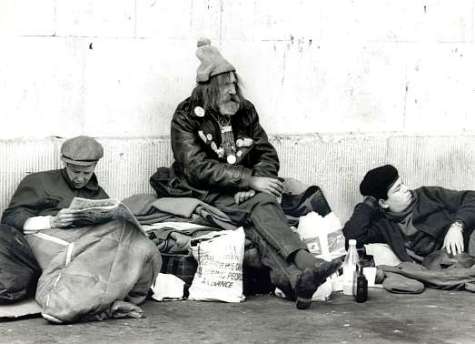
homeless-people–Boca Raton Tribune

Malachi 3:1-5; Luke 3:1-6

You don’t need me to tell you that the rebounding economy is not rebounding for everyone. You don’t need me to tell you that there are poor people in the United States of America. You may be one. You know as well as I do that without lots of money or a job with good benefits, it’s hard to be healthy in this country, and that depending on where you live or what kind of job you have, it may still be hard even after all the provisions of the Affordable Health Care Act kick in. You know too that the poorer you are, the sicker you are; and if you are not white, you’re sicker still. You also know that no matter what finally shakes out with healthcare in this country, old people and poor people will still have to pay a hidden cost of indignity and the not-so-hidden cost of red tape and mystifying paperwork.

You don’t need me to cite depressing statistics about housing, or food stamps, or available childcare and eldercare—or should I say unavailable childcare and eldercare? You know those numbers. And you know that a lot of people are scared right now, imagining that negotiations aimed at avoiding the metaphorical fiscal cliff could end up hurtling the vulnerable over a literal cliff of their own. You already know without my telling you, for example, that schoolchildren learn better on a full stomach, and your common sense tells you there should be school breakfast programs for every kid who needs a meal, so you don’t need me to tell you that any cutbacks in these programs will not only hurt kids now, but will also have a long-range effect on the economy and on the social fabric.

And I don’t need to tell you about indigent drug addicts and drunks and (here’s an awful word) “de-institutionalized” mentally-ill people; you’ve seen them, so you already know, or you can easily guess, that even if this winter is not too harsh, over the next few months a few of them will die on the streets where many of them live. And you don’t need me to tell you that social workers, state-funded childcare providers, and people who work in homelessteenx390public assistance of every kind are among the least well-paid professionals in the country. You can guess yourselves, without any help from me, at the high turn-over and burnout rates in these jobs; and you can easily imagine that it doesn’t take long in that kind of public service for some good people’s idealism and commitment to settle into a kind of functional despair, or sour to cynicism and contempt.

You’ve read about them in those human interest stories that appear in newspapers every Christmas, so I wouldn’t be telling you anything you don’t already know if I were to describe the daily struggles of families that are (what’s that grim phrase?) “less fortunate”—as if living in an apartment with no heat, frozen pipes, and an absentee landlord were a matter of sheer serendipity; as if somehow, had these families just been in the right place at the right time a year or two ago, they’d be living on Easy Street today. Poverty has an awful randomness to it, to be sure; many people, maybe even some of you, are a paycheck or an illness away from trouble; but you know as well as I do that it isn’t all just the luck of the draw.

You don’t need me to explain that the continued existence of poverty in this country is a scandal, that the lack of adequate health care in this country is a scandal, and that scandals by definition are stumbling blocks for the conscience, barriers to belief. Who could believe in a God who says that the poor are dear to the divinfamily_in_car1e heart but whose heart appears to be stone, whose ears don’t seem to hear anything, whose arm hangs down, ineffectual, as if having thrown in the towel? You don’t need me to tell you that it is not our reason that most often denies the existence of God; far more often it is our gut that rebels, our heart that recoils, our gorge that rises to deny the truth of a compassionate God in the face of so much suffering and degradation. And you don’t need me to explain that, as far as the Bible is concerned, it is not God who has the stony heart, but God’s people; not God who’s deaf, but God’s people; not God who has the lifeless arm, but God’s people who have thrown in the towel even as they raise their voice in prayer. And you already know perfectly well that the biblical God is notoriously disgusted by piety disconnected from justice.

And you know, because you’ve read the text from the book of the prophet Malachi, that as a result of this disconnect, God has found it necessary to become a refiner who sits down (because it’s going to take a very long time and a lot of patience), fires up the furnace, and burns away the dross until the gold is pure; and God has found it necessary to become a harsh soap, a fuller’s lye, to bleach and scrub and bleach and scrub again the sons of Levi (that is, the tribe of priests, and by extension, us), until they (and we) are cleawhat-fullers-soap-800x800n enough to carry out, without separation, right worship in the Temple and right action in the world. You don’t need me to tell you that if you are indifferent to or exploit your needy neighbors, you will always read Scripture, sing hymns and pray to this meticulous God at your peril.

But you don’t need me to make you feel guilty either. We feel guilty enough on our own. But if you don’t feel guilty—if, for instance, you have made your peace with social disparities; if you have made up your mind that poor people are here to stay, and there’s nothing anybody can do about it; if you have concluded that throwing money at the health care system won’t change anything, or that government programs are never the answer to social problems anyway—you are not going to feel bad and guilty just because of something I or somebody else may say.  Besides, it would be unfair for me to try to make you feel guilty, since so many of you are engaged day in and day out in work that serves the poor and the sick, work that immediately or remotely heals and counsels and lifts and teaches and comforts and inspires; work that helps change or improve the systems and conditions we deplore. So, you don’t need me to grind away at the guilt machine. And you don’t need me to tell you what you should be doing about all this. You know what to do, and many of you are doing it. You give money, you write to your lawmakers, you vote for change, you belong to organizations that work for justice. You do what you can. You do your part. You try to live more simply. You find ways of making human contact with suffering that is not your own. You teach your children about the real world. You preach. You witness. You occupy. You serve. You find a thousand ways to see, to touch, to learn. So you don’t need me to give you social justice marching orders. The truth is I could learn a thing or two from you.

Let’s see. What else is there that you already know and don’t need me to tell you? Well, you know it’s Advent, and that in Advent we pay attention to the Christ of three comings: the Christ who came long ago, who comes to us now, and who will come again. We reflected on that final coming during the first week of Advent. On Christmas we will commemorate the first coming on the straw of a stable. And you’ve already figured out, I’m sure, that here we’re focusing on Christ’s present Advent, his coming and his availability to us now in the Spirit, and especially (for he does have his preferences) his keeping company with the poor, the hungry, the sick. For if we’re speaking of Advent, then we’re also speaking of Incarnation. And to speak of Incarnation is to speak of the conviction that God is not some vague mythic idea, impersonal archetype, general concept or feeling, not love-at-large, or generic benevolence; but rathes_o01_58590925r that in a specific person, Jesus of Nazareth, God lived a fully human life. Incarnation is the expression of God’s solidarity with us, solidarity so complete and full that in some mysterious way that we can’t fathom, God is changed, and so are we. The Word’s humanity is forever part of what it means to be God. And the Word’s divinity is forever part of what it means to be human.

–WSJ

Incarnation is the Christian truth claim most people, including Christians, find hardest to swallow. It’s the scandal that keeps on scandalizing. It’s always been easier to believe that Jesus Christ was “divine” than to embrace the implications of a full humanity. Matthew 25 says something about this scandalous solidarity. It’s a oneness with all flesh, which sounds very nice and kind of harmless in general; but the scandal really hits you when you realize what “all” includes. You know what I’m going to say next, and you don’t need me to remind you of it, but I will anyway: the “all flesh” of Incarnation compels us to confess that God is a shrinking shape on a nursing home bed, an obnoxious odor in an unventilated room, an empty stomach at a first-grade desk, a family of eight on an income for two, a man on the bus with six shirts and a tin foil hat who chooses you to sit next to, a newborn wrapped in rags and laid on the floor of a stall, poor, hungry, real.

As I said, this is old news. You’ve heard it a thousand times. So why say it again? Why tell you things you already know?

For the same reason we do Christmas every year, read the same old prophecies, make the same old jokes about how weird John the Baptist is, drag out the same old Christmas decorations and sing the same old carols. Year after year after year. For the same reason we tell family stories over and over, like the one about the way Mom and Dad met, or the story of the way you carried on your first day at school. For the same reason the sayings of Jesus were collected, written down, and handed on. We tell things we already know so that we will never forget, so that we will learn the truth of things that matter more than anything, so that our children will know what we stand for, believe in, stake our lives on—what makes us who we are. And because if the church (that’s you and me) doesn’t talk about them, and keep talking about them, fewer and fewer people will be talking about them; fewer and fewer, until finally there is only silence. And just ask anybody struggling for justice about the horror of such a silence, the nasty things that happen when nobody utters a word.

Retired Episcopal bishop Packard and other protesters affiliated with the Occupy Wall Street movement are detained in New York

–National Post

We need to tell each other things we already know because there’s knowing, and then there’s knowing. There’s the kind that gives you things to think about, and then there’s kind that gets under your skin, penetrates and aims for your fault lines, breaks you up and leaves you so shattered you require divine rearrangement. We tell each other things we already know so that God will lay what we’re saying decisively upon us and shatter our hearts, for the first time in some cases, in others for the umpteenth time. If that shattering were to happen this Advent, we would be blessed indeed; for God, a psalm says, cannot pass by a broken heart. Our God will come.

Do you know that already? Let me tell you anyway, again…


Hail Mary, Full of Imagination [Luke 1: 39-56]

JM2visitationLG–Joyful Mystery #2: Visitation, by Jim Janknegt

“My soul magnifies the Lord…”

When I was growing up, the nuns who taught me religion made much of Mary’s faith. Her greatness, they said, lay in her obedient disposition to believe the angel’s message and accept unquestioningly  the mysterious assignment to be the virgin mother of the Lord. She may have wondered aloud to the angel how such a miracle was to happen, but she never doubted that it could.

Mary’s faith was what we used to call “blind faith” before we became more sensitive to the fact that blindness does not mean you cannot see. In the religious world of my childhood, blind faith was the best faith you could have. We knew none of us had it, or would ever have it, at least not in the measure of Mary; but we were brought up nonetheless to be fundamentally biased towards belief.

No matter how much I now cherish the practice of doubt and question, I am still persuaded that there is a lot to be said for a second-nature reflex of faith, an instinctive willingness to give God the benefit of the doubt. I give my ancestors in the faith the benefit of the doubt too, which is why I still love the ancient creeds and keep them as the bedrock of my faith. After all, just because people lived in the past doesn’t mean they were naïve. Or stupid. This benefit of the doubt is not blind faith, but it’s my way of saying “yes” to things that lurk in a blur at the corner of the heart’s eye, waiting to clarify in time.

That said, however, I no longer admire Mary’s blind faith. I admire her perceptive faith—her capacity to perceive clearly a promised but (for most of us) still blurry world of divine justice and righteousness. And I admire her ability to inhabit that world now—to act and speak according to promised new conditions that have yet fully to appear. I admire Mary for her religious and moral imagination.

This wondrous imagination of hers is not the fantasy of a utopian dreamer, an escapist or a Pollyanna. She is, the gospel tells us, “lowly,” and the Greek original clarifies the meaning: not “humble” so much as “poor.” Dirt poor. Mary does her imagining the way dirt poor people always do—“amid ten thousand losses,” as Patty Van Ness puts it; or, as Kate Layzer writes, “amid the hard griefs of this world, its bitterness and need.”*

Mary imagines and inhabits God’s new world while embedded in the mystery of human privation, her own and her people’s. Perhaps that’s the only place where such imagination is even possible.

Like her singing sisters before her—Hannah, Judith, Deborah, Miriam—she intones a song whose verses leave no room for doubt: this hard world is real and it is miserable–and it is not all there is to say or see. Its suffering and injustice are horrific, and they are decidedly not the will of the God of “swirling joys.”  And so her imagination sings about tyrants dethroned, poor bellies full, mercy extended to the umpteenth generation. But note how she sings of these things with thanks and praise: it is as if God had already done all the rearranging that the world so desperately requires. That’s a holy, and a true, imagination.

645px-Folio_59v_-_The_VisitationIt’s a fierce and dangerous set of verses, this Magnificat. I’m told that an Anglican bishop once prohibited missionaries from reading it in the presence of the local chiefs, knowing that its implications would not be lost on them. It would be news all too welcome among them, and the Church couldn’t stand to lose what it stands to lose.

You’d be taking your life in your hands to use Mary’s song as the opening prayer of a board meeting of most Fortune 500 companies too (or in a meeting of the president’s cabinet.) The gift of a new world and the sway of its just Ruler is not receivable everywhere. It is not even seeable in some places. It takes a lot of imagination. But Mary is undaunted. She is pregnant with imagination. And pregnant with a child. And like most pregnant women, she believes that a new world is being knit together right in her own womb, and that her own child will be the one who makes all the difference.

You don’t have to be a woman, much less a pregnant one, to imagine what Mary imagines. But you can’t imagine anything at all—anything true, that is— if you can’t see beyond your own privilege to confess that things in the world are not the way God intends.

You can’t imagine anything true at all if you can’t contain your getting and spending so that you can receive the vision of the Day of the Lord with an uncluttered heart.

You can’t imagine the new thing God has in store if you don’t regularly feed your soul with the unspeakable misery and ineffable beauty of the world and all its creatures, putting yourself regularly in the company of real suffering people and real amazing joy.

You can’t imagine a new way of life if you try to go it alone without the generations of the faithful alongside you, without a community with whom you faithfully practice imagining, a community within which are told and retold a thousand thousand times the stories of God’s dream—a dream, as Will Willimon writes, “larger than the desperation of any of our particular moments.”

And if you cannot imagine, you cannot hope. If you cannot hope, you are left to your fear.  And if there is only fear, you know where that leaves you, where it leaves all of us, and where it has always left the world.

2So this Advent, wait and watch, ponder and pray, light candles and do whatever you do; but more than anything else, dare to imagine. Imagine a poor woman named Mary, singing. Imagine a baby leaping in a cousin’s barren womb. Imagine an infant surprise wailing in a manger under shooting stars. And see that old fox, Herod, jittery and wobbling on his lofty throne.

–Visitation, African Gospel Mafa

————–

*Text of  the Cantata, “Advent,” by Patricia Van Ness, Composer-in-Residence, First Church in Cambridge, Congregational (United Church of Christ).

Amidst ten thousand losses and swirling joys

At this very instant

On this sacred Earth

I wait.

Come to us,

Beauty, Wisdom, Goodness, Peace,

Solace, Grace, Counsel, Love.

Through the open archway this cold night

Air, rich as gold, flows.

Fine snow glistens on our faces.

Each flake,

Every exquisite crystal blossom

Is a covenant of your love

Told a thousand thousand times.

Amen.

*Text of the hymn, “Called from the World to Mystery,” by Kate Layzer

Called from the world to Mystery, from mystery to love,

we hold the hope within ourselves of certainties above;

and you, O God, who plant this hope in us and scatter it like seed

amid the hard griefs of the world, its bitterness and need,

have sent us as your laborers in fields sown by your grace–

the harvest and the harvesters caught in divine embrace–

for you in Christ held nothing back; may we likewise be free,

until when we have poured out all, we merge with Mystery.

Leave John in Jail [Matthew 11: 2-11]

1723_1593234—John the Baptist in Jail, visited by two disciples. Giovanni di Paolo, c. 1399–1482.

When John, who was in prison, heard about the deeds of the Messiah, he sent his disciples 3 to ask him, “Are you the one who is to come, or should we expect someone else?” (Matthew 11:2-1)

Whenever I read this gospel passage, it’s hard for me to get past the sobering news it opens with: John the Baptist is in jail. Sometimes I imagine him there, pacing in his cell, railing against the powers that arrested him. Sometimes I see him squatting in a corner, staring at the consequences of his conscience. But sometimes I can’t see him at all. I don’t want to. It’s just too sad to think of such a vital man confined.

And he was a vital man. John was no cartoon crazy-man waving a placard, menacing the downtown crowd with threats of doom. He had substance. The size of the movement that sprang up at his preaching testifies to a spiritual genius.  Jesus always loved him. In this gospel we read the Lord’s praise of him: John, Jesus says, is the greatest man alive.

But now John is in jail. That old fox, Herod, put him there. John could never be bought off. He was no reed shaking in the wind. Herod was the shaky one. When John criticized his corruption, Herod arrested him. He wanted to kill him, but because he feared an uprising, he didn’t dare. Instead, he decided to let John rot in jail. That’s not the way it ended, of course. Eventually Herod had to kill him, for reasons so tawdry you can’t help feeling outrage two thousand years later.

But now John is in jail. And as John languishes in a cell, Jesus moves center stage. John’s absence from the scene gives a boost to Jesus’ ministry. In the swelling crowds around Jesus, some of John’s followers begin showing up, ready to switch loyalties. More will follow. John’s influence is waning.

Jesus takes no pleasure in John’s decline. His reverence for John goes deep. He may even once have been a follower. He was certainly responsive to his preaching and showed it by presenting himself for John’s baptism. All the same, Jesus does not try to save John’s movement or protect John’s leadership. Instead, he begins to speak of John’s ministry as a preparation for his own.

John is not the one who will bring in God’s new age, not even to his own followers, all those people he had baptized in the Jordan. Jesus puts it this way: “John is the greatest man who ever lived; but the least in the kingdom of heaven is greater than he.” Anyone who accepts the message Jesus preaches will receive a healing even John can’t imagine, a freedom even John can’t grasp, a joy even John can’t deliver.

So quickly does Jesus’ star rise that everyone starts to wonder whether he is the messiah. In jail, John gets wind of the speculation and wants Jesus to confirm it. He sends envoys to him. “Tell us: are you the one?”

Jesus replies: “Go tell John this: the blind see, the lame walk, the dead rise, and the poor have God on their side.” The gospel doesn’t record John’s reaction when he heard this message back in his cell, but the Baptist knew his Bible. Jesus was roughly quoting Isaiah, who said that when the blind see, the lame walk, the dead rise, and the poor get justice, it’s a sure sign that God is nearby, and will soon set about removing the wicked and breathing new life into the whole creation.

When John hears what Jesus says about himself, he must realize that a joyous future is dawning, a new day ushered in by none other than Jesus of Nazareth.

But that line from Isaiah is not all Jesus said that day. What if, as they turned away to return to John in jail, the emissaries overheard the conversation between Jesus and the crowd? That stunning line—“No one ever born is greater than John.” And the addendum—“but the least in the kingdom is greater.” What if they reported that to John, too? In that dismal cell, would he have been glad to be praised so highly? Or might that praise have sounded like a eulogy? A kind word spoken over the grave of his movement. John is great! Bur John is yesterday! Long live John! Now, let’s get on to Jesus.

The handwriting is on the wall. I imagine that John knows it. Something new is afoot, and it doesn’t include him. He has done his part. He is not needed for what God is doing now, nor for what God will do tomorrow. The world will not turn to him in that jail for its healing. It will not find in his prison a durable hope. And it will not search for a key to release him. John has to stay in jail. And Jesus has to leave him there.

Leaving John in jail is hard. It seems heartless, ungrateful, unfeeling. There will always be good reasons to stay behind with John. You want to get him out of jail so that he can keep doing the good work he was doing. You want to honor his contributions, to let him know you care about what happens to him. But it can’t be that way. You have to go on without him if you want what Jesus promises, the new life he wants to give you from God.

Still, it’s not easy to leave John in jail. If you ever tried to leave some John of your own behind, you know what I mean. If you ever tried to break from an okay way of life that was keeping you from a great one, you know what I’m talking about. If you’ve ever tried to let go of something solid, a bird in the hand, to take that risk that’s been calling to you for a long, long time, calling you to stake your life on a promise or a dream, you know what I mean. You need to leave John in jail and go forward.

Leaving John in jail is not easy. You know what I mean if you’ve ever been forced to consider that a cherished tradition may not serve a purpose anymore, or that a hard-won opinion may now be off the mark. You know what I’m getting at if you’ve ever had to change your mind about something that matters, put old certainties on the shelf.

You know what it means if you’ve ever had to fight against a fierce desire to be right; a desire so strong it compelled you to lay down rut after rut on already well-worn ground in a daily effort to preserve things the way you need them, the way you want them, the way you think they should be.

You know what I mean if you’ve ever admitted that what was first is not always best, what used to be is not always right, what you’ve always known is not all there is to know, not all God has in store.

You know what it means to leave John in jail if you’ve ever looked an old enemy or a misplaced love in the eye and offered to start over, to find a way, to go forward and not look back.

You know something about how necessary it is to leave John in jail if you’ve ever been on your knees pleading for things to be different; praying that the heaviness in you might shift, that a steadier light might shine from your spirit, a forgiving voice emerge from your throat.

You know what I mean if somehow, even once in your life, you had the strength to let the burden of your past just go, and step into a breaking day.

Christmas is just a couple of weeks away, and most of us are up to our necks in sweet angels, fluffy sheep, good will toward men, gingerbread and drummer boys. You don’t see spiky desert stubble at the mall. The hard prophets of Advent don’t put in guest appearances on TV talk shows. You can’t order a leveled Advent mountain on the internet. You can’t email a jacked-up valley or a superhighway made straight for God in the nowhere of starved and broken hearts. You can’t download the messianic hue and cry that alerts us to the appearance of the Lord’s Great Day. The only appearance causing any real excitement is the appearance of the latest greatest gadget under the tree.

We settle, most of us, for the tried and true at Christmas — a favorite carol, a nostalgic replay of a perfect childhood memory, that cup of eggnog, a pious cliché. Comforting things. Good seasonal routines. They do the trick, they make us warm, they take the edge off our deeper sadnesses. Even the terrors of the holidays — estranged siblings, abandoned parents, the pleas of the needy, consumer madness — have their own predictability, a perversely familiar feel.

No, there’s nothing really unsettling in sight; it’s a soothing time, same old same old. Assembly required. Batteries not included. Been there, done that.

But meanwhile, back in the scriptures, and somewhere deep in the human heart, God is calling for a break in the usual action. God is working with a beginner’s mind. A new thing is coming. Contrary to TV specials and most Christmas sermons, it is nothing like anything you already know, it is nothing you have ever seen, it is not what you are used to, what you bank on, it has little to do with the way things were, once upon a time.

It is a real human being with a face on fire from tomorrow’s light. It is a real divine savior who can make the difference you are dying for, the difference you are dying without. He is just and he is free, and he walks closer than is prudent to the edge of love, for you and for your healing. He is so new, so real, that he is the scariest man who ever lived. It is the great irony of faith that we will be safe only with him.

The scriptures say he is coming soon. He has bright morning in his eyes.

When he comes, leave John in jail and follow him.