Direct Address

Sometimes the pastoral prayers we ministers offer in church sound more like essays about the sorry state of the world, or commercials for the great things our church is up to, or great long laundry lists of needs, or sneaky sideways sermons disguised as prayers. It’s not often that they sound as if we’re engaged in authentic direct address, that we’re actually talking to God. We just talk away, inserting God’s name into these disquisitions every five or six sentences to remind ourselves and the congregation that all the stuff we’re saying is a prayer, or maybe to justify it as one.

It’s no wonder that people in the pews have a hard time when it’s their turn to pray aloud. Most of the time, people who are invited to offer prayers during the set-aside time in Sunday services don’t even start out by addressing God, but say indirect things like, “A prayer for my friend, Jim, who’s being operated on today,” or “ A thanksgiving for my niece who made the swim team last week,” or “That there might be peace in the world.” Hardly anyone says, “Thank you, dear God, for the great joy my niece feels after making the team,” or “Gracious God, I’m worried about my friend, Jim. Please be with him,” or “God of Love, make us stop warring and learn to make peace.” It’s hard enough to talk in public, let alone really pray in front of everyone; harder still if you don’t have the proverbial role model to give you a sense of what prayer could be like, if only.

Of course, there are, or I hope there are, many exceptions to my observation—pastors and worship leaders and basic regular people in the pews who have a talent for praying deeply and openly to a God they love and trust, who enter the mystery of prayer with a kind of anticipatory awe; and who don’t really care all that much if their prayer—even the prayer they may have written out ahead of time—is syntactically all put together or even all that intelligible or lovely or meaningful or earnest, just as long as it is really prayer, really a conversation with the Holy about the deepest things the people have on their hearts; a prayer that the whole assembly will, of course, overhear, but one that they don’t necessarily have to grasp fully with their brains in order to know that prayer is happening, that God is the addressee and the interlocutor, that the conversation is real, and that it matters.

A great mystic of our day, South African Bishop Desmond Tutu, was once asked to offer prayer at the start of a big anti-apartheid event. And so he raised his hands and prayed. Then he did a little dance and prayed some more. When he was done, he grinned and sat back down. Afterwards, a woman in the receiving line said to him, a little annoyed, “I didn’t understand a word you said!” Tutu shot back, “Of course not, ma’am. I wasn’t talking to you.”

Ah.

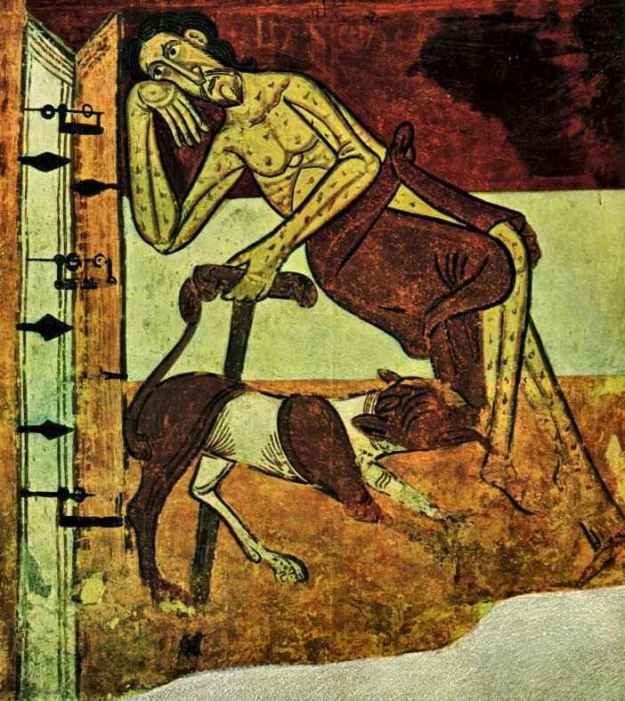
Send Lazarus [Luke 16:19-31]

LazarusTahull

Museum of Romanesque Art, Barcelona. Wall painting from San Clemente, Tahull (Lléida).

Several years ago, I was attending church in a well-to-do neighborhood of Boston. One Sunday, the deacons announced a new policy to deal with beggars who showed up at the office looking for handouts. They would no longer give out small amounts of cash. Instead, they would give out vouchers good for groceries at local supermarkets. They were very clear, however, that the vouchers would not be valid for alcohol, lottery tickets, or tobacco.

At coffee hour, people spoke approvingly of this decision. Everybody knew that for years the church’s money had been ending up in the cash register of Marty’s Liquors. Nobody wanted the church to be an “enabler,” but they didn’t want to turn people away empty-handed either. Grocery vouchers seemed like a good way to help without doing harm.

Now, I was feeling peevish that morning, not in control of my mood or my mouth. Thus it was that I asked what the deacons would do if a beggar didn’t want to buy groceries, but wanted to rent a DVD of “The Sound of Music,” or maybe take a Duck Tour of Boston, or buy a few carnations to brighten the corner where he lives?

This was not well-received, and the conversation went downhill fast. I was to blame, of course. It was an unfair thing to say, even for someone feeling peevish and looking to make a point. Everyone, including me, knows that beggars who show up at church doorsteps are not usually looking to spend an evening with Julie Andrews. Many are homeless, drifters, active alcoholics, mentally-ill. Not a few are con artists who give you a long detailed spiel about their woes. If you were to give them all money, sooner or later you’d get taken for an expensive ride, or you’d do real harm. And if word got out on the street that St. Polycarp-by-the-Pool was dispensing cold cash from the front office, it could even get dangerous.

So it’s no surprise that most churches have adopted a no-cash- approach to helping people who wander in from the street. The voucher plan was prudent. It was plain old good stewardship, for us and for them. It also gave the deacons a warm feeling. One deacon remarked that the church should be proud that our vouchers would keep street people from guzzling or gambling, and get them to eat a healthy meal for a change. I valued my life and didn’t say out loud what I was thinking about that—namely, that if the voucher plan was really aimed at getting street people to eat, say, more leafy green vegetables, then we should have put red meat on the exclusion list along with the booze, the scratch tickets, and the smokes.

Vouchers? Okay, fine. It makes a certain sense. But did we need to be so tickled about it? Why were we congratulating ourselves? Wasn’t it enough that we were the ones who had the wherewithal? The ones who got to stake out the ethical territory? The ones who could designate the proper objects of our compassion and choose the precise terms of our generosity? Wasn’t it enough that we were in a position to shape other people’s morality?

You’d think that upon announcing the voucher plan, we all would have had the good grace to feel a little embarrassed. You’d think that we would have reminded ourselves that the proper posture for giving someone a food voucher is not on your high horse, but on your knees.


Lazarus was a beggar who could have used a voucher. He was starving, lusting after Dives’ garbage. We don’t know much about him; the parable lacks the sort of data people like to have when deciding whether and how to help. We do know his name (he is the only character in Jesus’ parables to be given one), but we don’t know how he ended up starving at the rich man’s door. We don’t know if he was one of the ‘deserving’ poor, or whether he’d been a lazy, drug-addicted oaf, or simply peevish and ill-tempered like me. We don’t know whether he cornered the rich man every time he left the house to pelt him with pathetic stories of woe, or whether he just lay there, mute, day after day. All we know is that he was at the gate, open-sored, hungry, and visible.

And that, Luke seems to say, is all we need to know to predict the reversal ahead.

We don’t have much information about the rich man either. Did he invite friends over to laugh and point at Lazarus, have his goons lean on the beggar to scare him off, gag at the sight of dogs licking his sores? We don’t know if he was a cold fellow who habitually averted his eyes from unpleasantness, or a self-preoccupied man who never saw the beggar; or if he did notice him, said an honest prayer for a sorry case, but stuck to his policy of never giving cash to street people, for all the high-minded reasons those deacons had decided on vouchers. We know only that he was rich, dressed well, ate well, and enjoyed his confortable life.

And that, Luke seems to say, is all we need to know to predict the reversal ahead.

If you’ve read the gospels half-awake, you aren’t surprised by that reversal. Jesus is unnervingly repetitious about the mortal risks the wealthy run—so much so that two chapters later, the disciples get exasperated with him: “But (if what you say is true), Lord, how can anyone be saved?” It’s a familiar theme with an expected twist.

Yet there’s something in this story of reversal that has always struck me as odd. When the rich man wakes up in Hades, he is up to his neck in flames, but he doesn’t seem to realize that his new situation is for real and for good. He doesn’t seem to grasp that there is no way out, even for a Somebody like him.

Of course it’s not lost on him that he’s suffering, and that his wealth and Egyptian cotton underwear have been shot to hell. No doubt he’s sorry now that he failed to do right by Lazarus in life and would do things differently if he had another chance. But even hellfire has not burned away the capacity for self-delusion that made it easy for him to sin so greatly by omission while he was alive. In the afterlife, he has no wherewithal, but the stubborn residue of wherewithal remains. Privilege clings to him, even in hell.

“Send Lazarus,” he says.

This is not an idle line. It betrays life-long habits of command and control, habits that now make him oddly insensible to the gravity of his situation. He thinks he can still make things happen. He thinks he is still maneuvering in the earthly geography of status, power, wealth, and worth. He now recognizes that Lazarus is a man he should have helped more in life, but even now he wouldn’t trust him with cash. At best he will let Lazarus be his gofer. “Send Lazarus to bring me a drink.”

The rich man may be a damned man, but he is an important damned man who, as a courtesy, out of deference, should be exempt from the unrelenting thirst that so many others have known, exempt from the thirst of the beggar outside the gate.

It doesn’t work, but he isn’t deterred. “Well, then, if you won’t send him over here to me, send him to my kin as a warning.” The rich man believes that even in hell no problem is insoluble if you can just get your best people working on it, or if you have the right connections. God is bound to make an exception for people in the network: it’s one of those perks that money used to buy.

But there is no good news for the rich man. Abraham’s reply is truly terrible: Some outcomes cannot be altered. Some lines cannot be crossed. Things eventually harden. It is too late. There is no return. “Between you and us a great chasm is fixed,” says Father Abraham. Even the progenitor of the faith cuts no ice with a God determined to be just to the poor.

This is a bleak and unforgiving parable, one of the harshest stories in the gospels. It warns us broadly about the moral peril we incur if we ignore the needs of the poor who lie begging at our gates all the time while we go about the business of being and having and doing in a routine of indifference. But it also warns us about the delusion that persists in us even after we have seen the error of our ways and been shown the truth; even after we have acknowledged and acted on our duty of mercy towards others.

It speaks of the stubborn residue of privilege that clings to our egos and produces in our souls a mostly unconscious and unexamined confidence, a confidence that permeates and perverts even good deeds and intentions; a confidence that leads us to assume that because of who we are, we know what’s good for ourselves and for others, we can influence outcomes, we can define and ensure our own and others’ integrity.

The deep chasm in eternity that is fixed between Lazarus and the rich man is a snapshot of the scandalous distance that exists between the poor and the privileged here on earth. But it also depicts the chasm that exists inside each of us—the distance between our unthinking entitlement, condescension and judgment, and the sublime reality and true privilege of simple creaturehood; the distance between thinking of ourselves as self-made and the humility of knowing Who in fact made us, and of owing ourselves completely to that Other; the humility that establishes us in common cause and kinship with every human being and every creature, and makes plausible and possible our ideals of mutuality, love and justice.

There’s no final grace, no last minute reprieve in this parable for the privileged, entitled, self-deluded rich man; but we can hear some good news in it for us, for we are still living and thus still susceptible to a breakthrough. We can still hear Moses and the prophets. We can still listen to Jesus. We can still help each other to love being creatures and to love each other because of our common human condition, and to aspire to nothing more or nothing less.

There is no second chance for the man in the story, but there can be for us. We resemble him more than we know, but the God who makes the sun to shine on the wicked and the benighted as well as on the good and the just is ever-able to illumine our ignorance of our human condition and reveal our creaturehood to us as an unfathomable mercy. From the One who made us, there is courage, grace and healing at every turn, and Jesus promises that it will not be denied to the humble, searching, contrite and broken heart. Our task is to live fully into the calling issued by God from the beginning: to be creatures with our Creator, to be who we are before God and one another, and to love our neighbors as ourselves.

To love them as ourselves.

It is hard, but it is possible. We have the Holy Spirit. We have the church’s ancient means of grace—prayer, sacrament, song, service. We have God’s Word. We have each other. And we have today.

And thank God for that, because this sober parable tell us plainly that for us who have the wherewithal for so much good and do not do it, there might be no tomorrow.

Happy Sin [Luke 15:7]

sheep

I tell you truly, there will be more rejoicing in heaven over one sinner who repents than over ninety-nine righteous people who have no need to repent.

Jesus says that God is much happier when we sin and repent than when we don’t. So maybe it’s good that the lamb went astray. If it hadn’t, neither the shepherd nor God would have known the unique delight Jesus speaks of.

Since repenting makes heaven so all-fired happy, maybe we should sin a lot more. Then, when we’re done, we could say, “Oops, sorry!”, electrifying Paradise with that special thrill.

Well, we could do that, but it’s probably not what Jesus had in mind. And yet he seems to say that there are worse things we could do than sin, worse things we could be than bad. We could strive to be better people—the sort of better people who believe they are better than other people. We could go out of our way to avoid icky sinners, putting cold, contemptuous miles between us and them.

To sin, go astray, do harm, fall flat on our willful faces—none of that’s good exactly, but at least it’s real. At least it doesn’t separate or distinguish us from anybody else. At least it makes for human solidarity. And any kind of solidarity is better than distance, exclusion, and contempt.

Besides, if we didn’t sin, God would just stay home and read the paper all day instead of lighting out into the canyons and brambles of life to find us by the whimpers of our lost and shivering hearts. It’s wrong to say that sin repels God. Sin is a God Magnet. Wherever there’s a sinner with a sin, God is there.

So yes, by all means, we should be sad and sorry for our sins. But we should be grateful and glad for our sins, too. Think where we’d be without them.

Prayer                                                                                             Searching Shepherd, it’s weirdly paradoxical and maybe even a little wrong to thank you for my sins, but I do. Without them, I’m lost. With them, I’m found. Praise to you forever. Amen.

My Trees

IMG_4490

I live in next door to a state university in an old industrial city where green space is at a premium. A little over a week ago, a crew from the university’s buildings and grounds department planted seven young trees around a new parking lot that happens to be right outside my windows.

Even as they were going into the ground, I felt an almost irrational concern for those saplings. I worried that the B&G guys had not planted the little root balls deep enough. I fretted that they were piling the mulch too high around such slim trunks. I wondered if they’d watered them enough during the first three days when the sun was blazing hot.

Now I find myself looking out the window and checking their progress every time I get up to get a snack or retrieve the mail or find a new book or start supper, as if my looking will prevent them from shriveling up and dying from moment to moment, or help them grow twenty feet from mid-morning to noon.

I hope I’m not turning into a nosy neighbor who peers through the drapes, keeping a prurient eye on everybody’s comings and goings. I’m not sure it makes much sense, my proprietary concern for seven saplings around an asphalt lot; but these are my trees.

I wish I felt this way about everything that lives.

My Baptism(s)

There’s a family story about my birth that, like a lot of family stories told and re-told over the years, is probably only tenuously true, but it’s a good story all the same. This is how it goes:

My parents had decided that if they had a girl, they would name her Janice. This was a merciful way of naming a child for my grandmother without actually saddling the child with my grandmother’s name, which was Janetta. But my mother’s labor was long and my head and shoulders were big, and her pain was great, and at a particularly difficult moment, she—who had never been particularly devoted to the Mother of Jesus—was heard to scream, “Get me out of this and I’ll name her Mary!”

But there’s another story about my birth that I cherish more than this one. It seems that when I finally did come out, I came out yellow. I must not have looked very strong, because one of the nurses, who was Irish and Catholic and devout, took me quietly to the far side of the room, dipped two fingers in some water, traced a cross on my brow and baptized me in the name of the Father, and of the Son, and of the Holy Ghost.

Now, in the Catholic theology of 1947, this was known as a provisional baptism—an emergency baptism in case of death. Had I expired in the delivery room that morning, what that nurse did to me would have been a real live valid sacrament, and I would thereby have been spared an eternity in Limbo—a state of being in which the unbaptized soul of an infant enjoys all the natural happiness one could possibly enjoy, but where God is not present, and never will be.

But I didn’t die. I pinked up! And so I was baptized officially a month later with an honest-to-God-priest and a big baptismal font. My provisional baptism had indeed been provisional. It didn’t ‘count’ in the end, and so it became simply an amusing story about the way I came out yellow, but not a story about the day I became a Christian. That happened, according to my baptismal certificate, on January 21, the Feast of St Agnes, when my family brought me to St Mark’s on Dot Ave in the Ashmont section of Dorchester.

The church I belong to these days does not teach that baptism is necessary for salvation. In this community of faith, we don’t baptize babies because we believe they need to be baptized. Baptism for us is the cool forgiving river through which we are swept into the church. It’s a sign that we belong to the family of faith. It’s the way we pledge allegiance to the new polity we call the kingdom of God. It’s the act by which we are called to follow Jesus, and it’s the moment when we are given a ministry to carry out with him in the name of God’s compassion.

It isn’t a cleansing of original sin, but a promise that if we do sin, we will not be left in our sin; there will never be a moment in all our lives when we will be bereft of the love of God in Christ Jesus, our Lord—for God’s is a love that is incapable of holding our sins against us. No, we do not baptize in order to snatch people from the jaws of hell. We baptize in order to bury them deep in the heart of Christ’s life.

God knew me and loved me from the day I was formed in my mother’s womb, as psalm 139 so beautifully sings. Some scriptures say that God knew us even before we were formed in the womb. The point is that there was no place on the day I came yellow into the world, nor is there any place now that I’ve gone completely gray, that is devoid of God’s presence. Catholics have finally come around on this conviction too. You never hear talk about Limbo any more. That nurse need not have worried about my being cut off from God on the day I came weakly into the world. I was never in danger, mortal or immortal.

I do not, of course, remember my baptism, either one of them. But I like to imagine the day I was baptized because it is a source of comfort and courage and hope for me to know that, once upon a time (well, twice upon a time), the God who is always kind and merciful was merciful and kind to me in a very specific way, by enrolling me in the company of the faithful, making me a member of the body, a daughter of the church.

But a strange thing happens when I imagine my baptism. In my mind’s eye I never see the sanctuary of St Mark’s on Dot Ave. I always see a delivery room at the Boston Lying-In. I always hear a capped nurse murmur the trinitarian formula. I feel her fingers trace a watery cross on my head. I see me, pathetic, in her arms, a new creation in Christ. And I have to tell you that I always well up with affection for her. As far as I’m concerned, her baptism of my jaundiced little soul was anything but provisional. If I am indeed a Christian by baptism today, I believe that it was at that moment in that place and by her hand that baptism “took.” 

I don’t believe what she believed about baptism. But it doesn’t matter. What moves me so much, and the reason I prefer her baptism to the priets’s, is that on the day she baptized me she was worried sick about what would happen to me. She didn’t want me to get lost. Baptizing me was her way of making sure that the little creature she held in her hands who was created by God for God and destined for the divine vision, would in fact see God. What she intended for me was the fullness of temporal life in the church should I live, and the fullness of eternal life in God should I die.

I was in no danger. Baptism was not required. Even if I had been in danger, it still would not have been required. But that is not to say that it did nothing for me. Her baptizing of me has given me a way of thinking about the church into which the sacrament ushers us. She has become in my mind a prototype of the church at its best, the assembly of graceful people who care about what happens to you, today and tomorrow and forever. People who would move heaven and earth to help you get free of every danger, mortal and immortal. People who do everything in their power to set you safely on the Way, keep you there, and not let you get lost.

The church is about a lot of things, but if it isn’t at least about this kind of concern, we may have missed the point.

Like A Tree Beside the Water

 ba1e50efc3f14a1429aa361ce3e7696d.7938d515eb3060c0132c26f5c6187c95

—Photo by Dan Burkholder

In the beginning, God planted a garden and at its heart God set the Tree of Life. From that moment on, we have been tree people. We cannot tell the story of God’s love without speaking of trunks and roots, vines and branches, leaves and fruit. The oaks of Mamre, the root of Jesse, the burning bush, the olive, the mulberry, the willow, the cedar of Lebanon, and the fig—as we learn their names in the stories of our tradition, we come also to know the God whose mere presence, the psalmist says, causes all the trees to stand up and applaud.

And so it’s not surprising that when God drew even closer to us in Jesus, his story also unfolded tree by tree. We remember that Zacchaeus became his disciple while draped in the branches of a sycamore. Nathaniel went after him too, after Jesus summoned him out from under the shady fig. We still tell each other the story of the mustard seed that grew into a great tree whose branches hosted all the birds of the air—no matter who they were, or where they found themselves on the journey of life.

A tree that is not producing anything, Jesus said, need not be cut down, but commended to the care of the arborist for another year—a mercy (we suspect) that was probably extended the year after that as well, and the year after that one too. Other unproductive trees were not so lucky, but they made his point about the urgency of responding actively to the gospel. Jesus was hanged on a tree. They buried him in a garden full of trees. And in the end, when God re-creates all things, a tree will straddle the River of Life and produce fruit in every season, and its leaves will be for the healing of the nations.

Sometimes we imagine the church as a club you join. Or we think of it as an organization that has business to do. Or as a center of advocacy and the promoter of causes. Our attention tends to focus on membership, activity, programs, and numbers. But the Bible tells us a different story about who we are.

The church is not a club, nor an organization concerned with bottom lines and the size and success of the franchise, nor a social service agency or political action group. The church is a people set apart, a priesthood, a new kind of family, God’s adopted daughters and sons, citizens in a new commonwealth, an assembly, a holy gathering for God’s praise and purposes. And it is, the Bible says in many places, a tree—a cedar, an evergreen, an oak of God’s own planting.

Not only does God gather us under trees for shade and protection; not only do God’s trees welcome us, their fruits nourish us, and their leaves heal us; not only are trees parables of God’s patient mercy and faithfulness, as well as of God’s urgency and impatience; not only are they places of epiphany, encounter, and decision; not only does our life with God and with each other unfold tree by storied tree, we ourselves are a tree planted by God and in God, who is the living stream that feeds us.

When our roots drink deeply from that stream, we are a tree whose leaves do not wither and whose fruit never fails, a tree capable of welcoming, shading, feeding, and healing, planted at the heart of the garden of this world to offer life.

When the church welcome new members, then, it’s not like signing people up on the dotted line. It’s more like grafting new branches into the trunk of a tree. God makes new life circulate to everyone through such new branches. And by God’s grace it means that there will be even more room for many more birds of every kind to flock, to feed, and to rest.

When the church meets, it’s not primarily to cast votes, fill committees, and discuss budgets, but to marvel at and give thanks for all the ways God provides for our health and wholeness, watering, pruning, and dressing us, so that we might thrive, so that we might be a blessing, so that we might give ourselves away.

And when the church worships, it is not to talk a lot to God and to each other and to come away with insights to improve our lives, but to join the praise of trees and all creatures, who by being alive, or by just being, please the Maker.

In a world where great forests are clear-cut for profit, where ancient olives are bulldozed and torn up by the roots from a land called holy, and where young human saplings are cut down by bullets on city streets, never to reach full stature; in the face of all the life-destroying things that human beings may do on this earth, God stubbornly plants and cultivates trees. God does not give up cultivating life—like the life that is in us, life for the sake of other life, life for the sake of the world.

Would anything be different about its way of being and doing if a congregation knew it was a tree?


He Passed

This is primarily for my Christian colleagues, but anyone else who may have ideas to contribute, please do!

Do you use the term ‘passed’ as a euphemism for death? I’m hearing it often these days. (Maybe it’s been around forever and I’m just now catching up.) If you say ‘she passed’ instead of ‘she died’, I wonder why you prefer the euphemism and what it suggests to you that the straightforward term does not?

Euphemisms for death are a dime a dozen, of course. We have used them from time immemorial, often in an effort to sweeten the sour reality of death. But not always. Euphemisms can supply the fact of death with specific religious content.

For example, our ancestors in the Christian faith spoke of “falling asleep” to describe the death of those who died before Christ’s expected return. It made emotional sense to speak that way when you thought that his return—and with it, the bodily resurrection of all the dead—was imminent. The person who had died would stay dead for only a little while; it was as if she were sleeping through an ordinary night and would open her eyes and rise again in the morning.

Although few of us hold to the hope of an imminent return these days, this euphemism may still be useful and ‘true’ in that it speaks to a specific Christian hope—the resurrection of the dead. Other common expressions for death and dying may do that too, but their connections to the Tradition seem to me more tenuous.

I almost always prefer to speak plainly about death, forgoing substitute expressions that seem to me to be indirect. For some reason, I especially dislike the expression ‘he passed,’ which is the shortened form of ‘passed away.’ The longer form had the virtue of indicating that a person is gone, passed away.  The shorter ‘passed’ leaves you hanging with unanswered questions. Passed to what, through what, over what, into what?

I have wondered if this expression is trying to be Pauline, as when the Apostle says that by our baptisms, we have “passed from death to life. ” But Paul was speaking of a mystic death—the Christian’s sacramental participation in Christ’s death and resurrection—not our actual deaths, although the term works for our actual deaths by pious extension (which is why in some traditions, a white cloth symbolizing baptism is draped over a dead person’s casket or urn). Although there may be some tenuous connection here, I suspect the term ‘passed’ is more likely to have gained currency not from a biblical starting point, but simply from the human tendency to condense things.

What I resist about ‘passed’ is that it makes death sound like a simple transition from one ‘shore’ to another, or one life to another; or as the lifting of some sort of veil or curtain through which one serenely steps into another realm or dimension of existence. The hard fact of death is made to appear sort of gentle, even harmless—there’s nothing to be afraid of or resist. This may work okay for quiet deaths (up to a point, that is, for a death is a death, and all deaths are brutal in some way); but it seems especially inadequate for miserable deaths, of which there are many.

The imprecision of this expression is said to be more comforting to mourners than the hard cold edges of the words ‘dead’ and ‘died.’ I have heard pastors say that those frank expressions are too unbuffered for the family to hear, too shocking for those who are so freshly numb with grief. Maybe. And yet it seems to me that those who are suffering the sting of a loved one’s death hardly need to be shielded from a reality they know all too well is a painful and final one. I always thought that it helped more to name things candidly in a kind and thoughtful way, rather than to call them something else in the hope of avoiding more pain. But I could be very wrong about this.

The expression ‘passed’ is indeed sufficiently vague as to allow us to fill in the blank with all sorts of different ideas about what happened when the person died, and about what happens next, if anything. It also allows us to supply no ideas or affirmations at all if we want to remain comfortably agnostic about the whole business. It sounds sort of “Celtic”—the thin veil, etc.—and anything Celtic these days seems better than other things to many Christians, since we have come to believe (thanks to the ‘Celtic spirituality’ industry) that those Christians were more enlightened, earth-centered, body-centered and lyrical than other Christians were, and are.

The vagueness of ‘passed’ mirrors the fuzzy state of modern Christian theological reflection about death and about what happens after death, as well as the aversion some pastors feel to naming and proclaiming a distinctive biblical message about ‘last things.’ In the past, theologians felt more confident in speaking of particular and general judgments and resurrection of the dead at the Parousia. These days we more often say ‘No one knows’; and we are right—no one knows. No one has even known; but millions who did not know nonetheless believed certain things. Not to take those beliefs seriously into consideration is to write off our ancestors (and many of our contemporaries) as benighted and unsophisticated. This is something the arrogant modern does too often, to our detriment, I think.

We also say that what really matter is living, and living well, in loving service to others and in persevering militancy in causes of justice. Speculation about the form and function of the afterlife, if it exists at all, is fruitless. It diverts us from the more pressing issues of the here and now. Yet many people experiencing the death of loved ones, even social justice activists, continue to ask questions about last things. They want to know, Where is she? Will I see her again? What did she ‘pass’ into? And most people, at least when they are wide awake in the wee hours, have deep questions about themselves and what will happen to them when they die as well. Do we have a way of talking to them about these questions that does not fall back on banal generalities that lack specific Christian content?

I have talked with pastors who think ‘last things’ conversations only reveal how egocentric and self-preoccupied we human beings are—the only sentient beings that refuse to accept the natural order of things, the only ones who have to invent an afterlife to calm our anxieties about ceasing to exist. Of course, we may be the only ones capable of such refusal, and one wonders what might happen if cats and snakes had the capacity to be aware of death in the same way we are aware. (I, for one, am glad they do not appear to worry about such things—my cat is anxious enough as it is just wondering where his next meal is coming from.)

Some pastors offer a reassurance that loved ones are safe in God’s hands and that they will be too; or they assure the surviving mourners that the loved one lives on in heart-held memory; but they sidestep the question of personal existence after death and eventual reunion. A few pastors I know have confided that they have stopped believing in ‘heaven,’ or any other notions of an afterlife, but they avoid saying so among their people, for fear of disappointing them. Others tell me that some of their people have stopped believing in ‘heaven’ too, but don’t admit it for fear of disappointing their pastors! ‘Passed’ seems to them a good expression in this circumstance; it commits you to nothing you don’t believe in anymore, but has a nice spiritual ring to it all the same.

At the same time, I am noticing the increasing popularity of All Saints Day celebrations in progressive Protestant churches. People seem to love the idea that we are, as Hebrews says, surrounded by a great cloud of witnesses. They fairly shout all the umpteen verses of ‘For All the Saints,’ with its triumphant affirmations about the victors’ crowns of gold and a yet more glorious day. It seems odd that people who love the celebration of the Witness Cloud should be so diffident about speaking of the actual death required to be admitted to it, and about the character of the cloud itself.

I’m not quite sure what to make of all this, given that for millennia the promise of eternal life (whether in a heaven, or on a restored earth, or in a new creation, or in some other form we cannot imagine) figured as the greatest hope and consolation of the Christian life. What do you think? When you have to talk about these things, what do you say?

Just wondering.

[Unattributed image taken from http://www.goodfuneralguide.co.uk/category/funeral-cost/%5D

July 26 — Anne, Mother of Mary, Grandmother of Jesus

Today is the Commemoration of Anne, the mother of Mary and grandmother of Jesus. That Mary had a mother and Jesus had a grandmother there can be no doubt—we all have them—but the New Testament authors do not name Anne (or her husband, Joachim) or give us a single detail about her in the stories of Jesus’ conception, birth, and upbringing.

That there was an  Anne is what some call ‘a venerable tradition’ and others disdain as a pious lie, depending on the extent to which one honors and enjoys the religious imaginations of the ancestors and is not reflexively dismissive of stories. You know where I come down on this one.

Anne (along with Joachim) first appears in the Protoevangelium of James, c. 150 [?], a much-loved book in the ancient Eastern Church (in the West, not so much), and later in other non-canonical writings. Some people say that her story—an older woman conceiving later in life, bearing a famous child—was modeled after the story of Hannah (Anne), the mother of Samuel. Whatever the origins and literary models of her story, she soon became a fan favorite.

Devotion to Anne can be documented in the East from the mid-6th century; but if by that time the Byzantine emperor Justinian is busy constructing a great church in her honor, we can be sure that it had been gaining steam for a good while before that. In the West, there is no extant representation of Anne until the 8th century (a nice fresco in Rome), and not much fervent devotion until the 13th; but it took off after her story was included in a popular collection of saints lives (The Golden Legend, Jacobus de Voraigne), and Anne swiftly became one of the most beloved saints of the Latin Church.

The medieval imagination provided Mary’s parents with parents too—Stollanus and Emerentia; and with many marriage stories, including one in which Anne is married and widowed a three times, giving birth in successive unions to Anne (by Joachim); to Mary (by a fellow named Cleophas), who becomes the wife of Alphaeus and mother of the apostles James the Lesser, Simon and Judas, and of Joseph, called the Just; and Maria Salomae (by  Salomas) who became the wife of Zebedaeus and mother of the apostles John and James the Greater. The way her story was developing, she might eventually have ended up grandmothering the entire corps of apostles, and the further 72 as well. 

Muslims also venerate Anne (Hannah), the grandmother of the much-venerated prophet, Isa, whom we know as Jesus. The Qur’an does not name her (only her father and husband get names—Faqud and Imram, respectively), but subsequent teachers tell a poignant  story about her conception of Maryam (Mary): Hannah has trouble conceiving and is about to give up when she sees a mother bird feeding hatchlings. The maternal desire grows strong again and she and her husband try one more time. You know the result.

The Qur’an recounts that before conceiving, Hannah had promised Allah that, like the Biblical Hannah, she would dedicate her son to him (she was sure it would be a boy). She is surprised when a girl appears, and maybe a little afraid to present the little Maryam to God, but in mystical insight she decides that the baby girl is a true gift of God. The Qur’an is at pains to show that Allah is extremely pleased with the birth of this girl child and has great plans for her.

After she dies, Anne endured the fate of many great saints in the medieval church, traveling more in death than she ever had in life. Her relics are said to have been taken to Constantinople in 710. They remained there, in Hagia Sophia, until 1331, when the city was conquered and her relics were taken to Europe for safekeeping—and dispersal. Or if you like you can follow the tradition that Lazarus, Jesus’ moldy friend, took her body to France and buried her there. In Douai, you can venerate her foot (not sure if it is her left or right). Her head resided in Mainz in Germany for a while, before it was stolen by pious thieves from Duren in the Rhineland. I could go on, but these are unedifying details, so no more of this.

One of the lovely traditions of iconography associated with Anne is called the Metterza (Italy), Anna selbdritt (Germany) or Anna te Drieen (Low Countries). Taken together, these terms describe depictions of ‘the three generations’—Anne, Mary and Jesus; or as one author put it, these are images in which “Granny makes three.” {See such a depiction by Albrecht Düerer, below.) 

Another important iconographic tradition shows Anne teaching Mary to read. Anne was a good teacher, it seems, and Mary learned well. She was still reading as a young woman: in a great deal of iconography of the Annunciation, the angel Gabriel enters to find Mary with a book (probably scripture) open on her lap. The Word arrives as words are pondered.

Now, if you are a Protestant and not much inclined to saints, you have good reason to like this one, for it could be said that St. Anne made the Reformation possible. When, caught in the midst of a terrible lightning storm, a terrified young Martin Luther cried out to heaven to be spared, promising to become a monk if he lived, it was to St. Anne that he prayed. Apparently, she heard him. Luther credited his safety to her intercession. He kept his vow and entered the Augustinian friary at Erfut on July 17, 1505.  The rest is history.

Keeping the Great Commandment

Image 


“You shall love the Lord your God with all your heart…” our priest droned for the tenth time. His pedagogy was nothing if not dogged. He would have said it again, but I jumped in: “How can I love someone I can’t see?”

The other kids sat up. Would he ignore me or call my parents? I always tried to rattle him, but for once I wasn’t showing off. The first hymn I’d learned as a child wondered, “Jesus, my Lord, my God, my All, how can I love Thee as I ought?” It was a rhetorical question, more mystical than mechanical; but from the day I read in my Baltimore Catechism that I‘d been created to love God, I’d wanted an answer to the question, How?

The nuns in grammar school used to tell us that you could love God so much that you’d join the convent and ‘marry God.’ I didn’t know what she meant exactly, but at Catholic summer camp, I got a clearer picture. Camp was a piety blitz: daily mass in the chapel, devotions at the grotto, rosary in our cabins after lights-out. Spiritual aspirations ran high; dreams of joining the convent were as common as athlete’s foot—we were all potential Brides of Christ. One summer, both my fervent counselors made plans across bunks after dark. “I’m joining this Fall,” one whispered. “Are you?” She wasn’t sure: “Maybe if I were more in love with God…”

In love with God!—there it was again! Girls couldn’t grow up Catholic in the pre-Vatican II era un-scorched by the possibility of such a passion. For one thing, we were surrounded by God’s lovers. I knew their stories the way boys knew box scores: Agnes, martyred for choosing Christ over a pagan spouse; Francis of Assisi, stigmatized with the real wounds of Jesus; Ignatius Loyola, who drenched his diary with one mystic word over and over: tears; John of the Cross, crooning to Baby Jesus in his cradle; Simeon the hermit, for years perched atop a pole.

This was rich fare for the affections. Loving God, you found out early, was no tame thing. It made you say yes or no — but never maybe. It made you loopy. It ruined your health. Most of all, it made you feel something. How did they come by it? How could I come by it?

Sure that in the convent I’d find out, I married God during my first year at college, only to discover that in my religious community, passion for God implied coolness towards people. Of course, we didn’t ignore the second great commandment, “… and your neighbor as yourself.” Indeed we were resolved not only to die for all our generic unknown neighbors, but also (and this proved more difficult) to suffer Sister Peggy’s nasty quirks in close quarters.

No one missed the logic of 1 John 4: 20—you don’t love God if you loathe your roommate. Nevertheless, when it came to loving “creatures,” we found ourselves at a far emotional remove from the torrid love for God to which we aspired.

We were drilled in this odd theology: All love is divine, one in origin and end. In practice, however, people-love is a different breed and a greedy competitor. You can never love God inordinately, but you can love God too little by loving people too much. So you have to be vigilant: creatures can sneak up and steal the love reserved for God while, distracted, you make supper or service the car.

We tried hard to love others, including each other, for Christ’s sake alone. You had to aim x-ray affections through people’s skin and hit the One who alone made them lovable in the first place. If somehow you could by-pass the reality of embodiment, you could even licitly feel love for others: pure intentions kept your affections chaste, and chaste affections did not cheat God. But some of us never got it right, and others never tired of disapproving. Some of us sinned warmly, pursuing various attractions to unsurprising ends; others sinned coldly, loving no one at all really, thus attaining (we imagined) perfect love for God.

This painful affective muddle was foreign to the Catholic high school kids I ended up teaching. They were oblivious to the wary rationing of love going on around them. Whatever loving God was like, they knew it wasn’t like loving your boyfriend, your school, or your Harley. They also knew that if it meant sitting on a pole, they’d never love God. No one they hung around with would either. When I’d drone on about it, they’d object: “You can’t love a God you don’t see!” It crossed my mind to call their parents.

If they got romantic about God at all, it was on weekend retreats. Then, softened up by candles and guitars, they’d weep for love of parents, classmates, all living things on the planet, and especially God. On Monday, they’d revert to a normal state of emotional inconstancy. But they always showed up for service projects. Matthew 25 was the one scripture passage they knew by heart; and since the Judge in the story was happy with deeds of love, deeds were the way to go. In the daylight, the saints those kids admired did not weep or croon or pole-sit; they were all business, dispensing coats and crusts to the least and lost.

I left high school teaching and went on to graduate school, no closer than I’d been at six, twelve, or twenty-two to feeling what saints in love with God must surely feel. In the first month, an earnest classmate reading Andres Nygren intervened. From him I learned that human “love” for God is a false and blasphemous thing, hardly a Christian ideal.

Nygren had my number: I was all eros, no agape. All my life, it turned out, I’d craved not God, but the false rewards of experience. According to Nygren, I’d reduced God to one among many objects of human avarice to satisfy my selfish needs. Mortified to have made it to graduate school still desiring, I gave it up and hitched my wagon to obedient trust through naked faith alone.

It didn’t take me long to unhitch it. For one thing, I found that renouncing the rewards of experience was, well, rewarding. For another, I wondered why God, whose history with us is a trajectory into flesh and blood, would require from us a fleshless and bloodless response. But mostly, it just seemed silly to pretend that God was not in fact attractive (I was now reading Augustine).

I relapsed completely while writing a dissertation on the 16th-century Spanish mystic, Teresa of Avila. You’d be hard-pressed to find a saint more in love with God than Teresa. While Spain’s top bishop did time in the Inquisition’s jail for preaching that Christians could be friends with God, she was practicing spousal mysticism, exposing flustered nuns to the Song of Songs, and frightening confessors with reports of angels penetrating her heart (her heart?) with hot flaming darts.

Teresa would be easy to dismiss had she not also been so surprisingly averse to the idea that loving God is exhausted in such experiences. In good monastic fashion, she taught that you can’t build anything sturdy on the base of experience alone. Feelings are fickle, easily induced and easily manipulated. Experiences are overrated, a dime a dozen. Whenever one of her goose-bumpy novices, languid with love and hoping to levitate, tried making permanent camp in the chapel, a no-nonsense Teresa laid down the law—nix the theatrics, eat something solid, and go help out in the laundry.

Yet Teresa came down even harder on the idea that loving God has nothing to do with experience. She was never convinced that trust, obedience, and service cover the whole territory of love. To love by doing good was essential, but by itself it was too small an ambition for people who have been saved by God’s passion. So she taught the nuns also to love God explicitly, to unleash their hearts. To be sure, she also taught them humility, theology, and discernment; and she created a demanding communal life and required obedience to the hierarchy—all traditional safeguards against self-deception. But the most important thing she taught them was not to be afraid, not of feelings for God, not of feelings for each other (she herself tended to sin warmly).

Finishing graduate school, I began teaching in a Protestant seminary. Soon afterwards—Nygren notwithstanding—I became a Protestant myself. I still hoped to love God passionately some day, but by then I’d decided that steadfastly hoping for such a love was itself a pretty good way of loving, and that it would have to be enough. Now and then, however, I felt compelled to conduct comparative spot-checks among unsuspecting seminarians. They’d come in to consult about a paper or a course selection, and I’d ask, “Do you love God?”

Most said yes, but not without qualifications (“Well, yes, if what you mean by love is…”). Others spoke of awe at the natural world or at the birth of a child or other blessings in their lives. Only rarely did anyone speak of explicit feelings for God. Now, these were the same students who never said “think” if they could say “feel,” and who let you know their “comfort levels” with everything from classroom temperature to creedal affirmations. Why were they so diffident when it came to God?

Some, I imagine, were protecting themselves, and rightly so; how they felt about God was in fact none of my business. Others said they were afraid of sounding flaky. It was clear that they had no serviceable language for what they may have felt. One woman told me that the church she grew up in was still mortified by outbreaks of enthusiasm in previous centuries and newly anxious about the high number of Catholics, with their propensity for “smells and bells,” now joining the congregation. Speaking about or showing signs of passion for God in that church was to invite polite but effective ostracism.

I especially remember one frank young man who said he loved God the way his late father had loved his family: his wife and kids rarely saw him, yet they knew he cared because he worked hard and provided well. Shouldn’t that be enough? Aware of my own lack of sacred diligence, I dissembled and said I wasn’t sure. But I am sure: it may be enough, but it’s not all there is.

A few years ago I led a program for a church group about loving God. A middle-aged pastor at one session complained that it was much ado about nothing. “Navel-gazing” was his verdict on the heart’s quest for the divine (so much for Augustine, Jonathan Edwards and Bernard of Clairvaux). At my urging, he spent the afternoon free time reading the Song of Songs, a book he knew only by snippets. He returned for the evening session with red ears and a pained look, “What’s this doing in the Bible?” A sharp young laywoman wondered whether trying to love God after the Holocaust might be a morally vacuous enterprise. Someone else observed that a command to love is a contradiction. A thoughtful denominational leader wondered whether love for God is best conceived as a corporate activity — the whole church loves; the individual members participate in Christ’s perfect love for God.

Most of the participants agreed finally that loving God explicitly (with or without feelings) is probably required if Christian life is to be more than “anonymous monotheism,” in Jesuit ethicist Ed Vacek’s words. They also agreed that it’s easier to talk about God’s love for us and our love for self and neighbor than it is to get a fix on love for God. Even though the famous verses of John’s first letter teach that love for God is both inseparable and distinct from love for neighbor, we had to acknowledge that the modern habit is always to collapse the former into the latter. Inseparability then gives way to substitution, and the result is near-silence about the one thing necessary. Vacek calls it “the eclipse of love for God.”

When I first read that scary phrase, I tried counting the sermons on loving God I’d heard in the last 15 years. I couldn’t recall even one. A cursory check through a theological library’s holdings did turn up a scholarly book (Vacek’s), a dissertation, a published sermon. That was all. I had to strain hard for sounds of recent mainline reflection on keeping the great commandment. Independently, a pewmate noticed this hush too. After another in a series of fine sermons about Christian obligation in the world, he sighed, “OK, I think I know what I’m supposed to do. What I’d really like now is to know the God who wants me to do it.”

So how do you meet, know, even fall in love with God? Well, over the years I’ve learned this much from the classics and the saints: Loving God is not any one thing. As Roberta Bondi observes in a slim but juicy book on prayer, people love God differently, employing “incalculably numerous expressions” over a lifetime.

Astute Christians will say this too: love for God in any form is God’s initiative, a divine gift. If we love at all, the New Testament says, it’s because God loved us first—although as much as I believe that to be true, I’m not sure it’s much practical help. In that church group I led, the idea that love is a gift was kind of a conversation-stopper. After all, when something’s a gift, you might be given it, or you might not. More bewildering than a command to love or a hot angelic arrow to the heart is the prospect that God is going about whimsically wooing some people, but not others.

Fortunately, the same New Testament that says love is a gift also tells us it’s universally available, and that God does not consider it excessively forward of human beings to ask for it. If we want to love God wholeheartedly, whatever that means in practice, we begin by praying. I’ve found, however, that persistently begging for “More Love to Thee,” as the old hymn goes, is such a no-frills, basic step that even sensible people sometimes skip it as they cast about for fancier techniques by which to deepen their life with God.

I’ve also learned that great lovers of God tend to have imagination and a lot of cheek. They create conditions of possibility for love, waving their arms in God’s face, as it were, so there’ll be no mistaking a potential target for grace. Believing themselves unworthy and incapable, nonetheless they expect God to draw them into intimacy. They put themselves in the way of every kind of beauty, knowledge, person and pain, developing reflexes of awe, reverence, compassion, compunction, gratitude, zeal and delight. They meditate on the gospels, exposing themselves daily to the ambush of Jesus’ appeal. They hang around God’s likely and unlikely friends—the precious folks, as Rowan Williams once observed, in whose presence you sense that what God promises is possible and in whom you catch a glimpse of life as it was meant to be. And if it seems like they’re getting nowhere, God’s lovers don’t quit; they fake it if they have to, knowing that God deserves even an “as-if” love arising from utter incapacity.

The canonized saints of my childhood fascination did these things and more. To be sure, they were often bizarre, in many respects utterly inimitable—even if you are so inclined, rolling naked in thorn bushes like Francis did is not a good idea, and Lord knows we don’t need any more violent conquests of infidels born of zealous love for God. All the same, if you scratch this distancing surface, you’ll always find more than messy psyches and fervor run amok. You’ll also find the hard muscles of heroism on behalf of the neighbor, some of it as subtle as a kiss on a leper’s eyes, some dense as a notion that feeds the minds of millions over time.

Now, my old saints uniformly attributed their formidable love for neighbor to their prior love for God. Without that first love, they claimed, no heroism or longevity in the service of others is possible. How could Mother Teresa lift the dead from Calcutta’s streets day after day, year after year, if not for love of God? But we know that this claim, although edifying, is not altogether true. Atheists routinely do the same, humbling believers like me who do much less.

We must love our neighbor if we say we love God; but experience teaches that the reverse is not necessarily so. Vacek claims that the believer is distinguishable from the atheist in this alone: one loves God, the other doesn’t.  And if he’s right, the next question is a terrible one: So, if the end result looks the same, why bother?

Don’t ask me. After all these years, I still have no idea. And I still wish more than anything that I did.

Don’t you?

Do you love God?

Muddling Through

the-prophet-elisha-cleansing-naaman-1560.jpg!Blog

–The Prophet Elisha Cleansing Naaman, Giogio Vasari, 1560

2 Kings 5:1-19

Years ago when I became a seminary administrator, a colleague at another school gave me some advice about dealing with the faculty: “Always remember, faculty members are people; and even when they have Ph. D.’s, publishing records as long as your arm, and noble religious motives, they still tend to act out of simple self-interest. So when you want them to do something, bank on the fact that they’ll invariably ask themselves, ‘What’s in it for me?’ If you figure out the answer before you approach them, you’ll go far in this business.” In other words, my job was to outfox self-centered intellectuals bent on advancing their own agendas!

Now, this struck me as pretty cynical, and it didn’t take me long to discover that it was not right: it was only partly right. If people acted only from self-interest all the time, it would indeed be easy to deal with them. But things are more complicated than that. It turns out that not only members of seminary faculties but all of us as well are motivated by a bewildering array of convictions, internal contradictions, needs, and frisky passions, many of which we are unaware of, cannot name, or don’t care to, and some of which, perversely, actually undermine our true self-interest.

Given this maze of self-asserting and self-subverting motivations, sometimes the most you can do as a leader is create conditions in which people can muddle along towards the goal the best they can, intervening only occasionally to keep them on track. Thus will the ragged human convoy of high-minded posturing, insecurity, piqued honor, hurt feelings, good humor, intelligence, and good will eventually wend its way to insight and accomplishment. The trick is not so much to outfox as to outwait.

I could have learned all this a lot sooner just by opening my Bible to the story of Naaman.

Here we have a proud and powerful man making his way towards health, a restorative knowledge of God, and a new understanding of himself; but only by fits and starts. What is in his self-interest is abundantly clear: to find a cure for the disease that threatens his career, his place in human company, his very life. When we see the huge amount of capital he takes with him to Israel, we can only imagine the sums he has already spent on specialists in Aram trying to find a cure, with no results. When the servant girl tells his wife about Elisha, the prophet in Israel, it has the anguished tone of last resort: “If only the master would go to Israel…”

If simple self-interest ruled Naaman, his story would be a lot shorter than it is. He would have gone to Samaria and done exactly as he was told. But since there’s more to human motivation, there’s more to the story.

You heard his rage when the prophet did not come out to him with all the fanfare Naaman thought he deserved. You heard his contempt for the simplicity of the plan, his haughty dismissal of the river Jordan. Where he comes from, the people are better-behaved, rivers course through their channels with power and beauty, and the gods are charming and sophisticated. Never mind that there was no cure for him there; Naaman craves respect even more than he craves health. He is so sure he knows what is right and fitting, so certain of what should happen, that he almost refuses the gift God is preparing to give him.

Almost, but not quite. Because it seems that God really wants him. And God’s mercy will wait him out. When Naaman doesn’t get the flashy respect he thinks is his due, God does not close the door on the offer of health, but lets Naaman go off to vent and strut. No lightning bolt consumes the pagan general in mid-rant, no disapproving angel descends to warn him off his temerious display of pique. God abides the tantrum until Naaman rids himself of our common human propensity to work hard against our own good. And when the servants appeal to the general again, when he finally relents and obeys them, we begin to glimpse in him what God has seen all along, a man of faith.

For we’d be wrong if we regarded his healing and conversion as something sudden, a shocking miracle. What God outwaited in the story of Naaman was not just the tantrum he threw when he felt dissed; what God patiently awaited was the fitful progress of a transformation that had been advancing well before Namaan set foot on the soil of Samaria or waded into the puny Jordan.

When, back in his own house, the great warrior stooped to accept advice from women, God’s grace entered that slender opening, germinated in him, and began its wait.

When this loyal Aramean subdued what must have been revulsion at the idea of asking for help from an enemy, the grace of that enemy’s God widened the fissure in his soul a little more, made even more room in his heart for wholeness.

When he gave up his rage, overcame his sense of entitlement, relinquished his sophistication, surrendered to his own servants, and headed humbly for the water, his healing was already well underway.

Long before Naaman waded out into the Jordan, God had already established a pulse of faith in him—an irregular one, perhaps, and weak; but enough of a pulse not to be arrested by his prideful rage. When the mighty Naaman finally decides to give the prophet’s cure a chance, he is already far enough along in his healing that there isn’t a lot more for the disagreeable Jordan to do. All that remains is to go into the water and meet, knee-deep in mercy, the One God who had, unbeknownst to him, engineered all his victories and who had, unbeknownst to him, always presided over his life. Once awash in this revelation, Naaman, “a great man” from the start, becomes God’s man for good, a servant of the Living One.

Naaman has come a long, ragged way. The man who derided the unappealing river and the bush league prophets of Israel now goes home with mule-packs full of Israel’s soil, so that back in Aram he may spread it our, kneel down on it, and worship God on holy ground.

Now, I would be deceiving you if I told you that this is the end of his story. But while we live, healing is always a work in progress, our lives are always unfolding, new afflictions come at us from the outside and eat away at us from within; and the great tangle of passions, weaknesses, desires, hopes and needs that impel us raggedly through this life never quits threatening to derail us. Naaman’s skin will be, by God’s mercy, new as a boy’s forever; but the integrity of his heart, the depth of his faith, the wholesome trajectory of his life? Well, that’s another story.

He’s come a long way, but for him and for us there is always an iffy road ahead. We will always be traveling back and forth from Aram to Samaria, from our self-subverting passions to liberation in the humble trickle of pardon and healing. We will always be tempted to spurn simple mercy in favor of some other more sophisticated solution to our basic brokenness. Our progress from self-subversion to graced immersion will always be ragged, full of fits and starts.

But the story of Naaman instructs us not to worry too much about our one-step-forward, two-steps-back advance on wholeness. There is such a thing as “progress enough for now.” God does not expect even the miraculously-cured Naaman be mature in faith completely and all at once. I think that’s why the prophet Elisha, who is usually very jealous of Yahweh’s prerogatives, does not hold Naaman to the highest standards after his conversion.

You heard their exchange: Naaman is sensitive to the fact that in serving his king back home, he may need every now and then, for ceremony’s sake, to go with him and pay respects to the old gods in the House of Rimmon. And so he asks for the prophets’ blessing on this unavoidable compromise.

Elisha could have invoked the first commandment and insisted on a no-compromise-with-idols policy. But he doesn’t. It’s almost as if God takes whatever God can get. Given the erratic character of our human procession toward wholeness and some of the deadly pitfalls lining the road, even the God who demands that we put “no other gods before him” is not as touchy as we think about a now-and-then concession to the status quo.

Progress enough for now. Maybe that’s the good news in this story for us, especially those of us who expect so much of ourselves that we become enraged with others when they fall short. After all, Naaman is no stranger to us. If we are honest, we see in ourselves all the irritating and endearing, weak and tenacious behaviors in this story: desperate need, consuming self-importance, offense-taking and feeling dissed, tantrum-throwing, pleading and cajoling, seeing reason, eating crow, giving in — and we’ve all secretly hoped to be permitted a few of our necessary compromises. So to watch God leave Naaman alone while never leaving his side is a huge relief. It is also a strong antidote to perfectionism, a bracing reproach to our thousand-and-one daily judgmental impulses, a real cause for gratitude and praise.

God outwaits us while in everyday weakness our healing begins. While we futz around in life, God locates the fissures of possibility in the heaped debris of our fear and vented spleens. God infuses them with tender mercies, and in spite of ourselves we slowly learn to breathe the Spirit’s air. We are not all led to God by miracles, but we are all led to God by grace.

We will never approach the river of wholeness except “the best we can,” which is not that great all the time, Nonetheless, we are going to that river, whatever the reason or unreason that moves us. We may be just muddling through, making progress in fits and starts, but we are nonetheless being drawn inexorably into the healing waters of God by hidden grace. And we are going to wade right in.

Knee-deep in unaccountable love, we are going to meet the One who gives us all our ragged victories and is sovereign over all our lives. And then we are going to get up and go back to our countries healed and grateful, carrying within us the holy ground of faith, the sacred soil of hope.

We are going to be healed and grateful enough; that is, enough to know that we need healing and faith. Healed and grateful enough to know that we will never not need grace. Healed and grateful enough to stop demanding that God deal with us on our own self-defeating terms. Healed and grateful enough to give in to the simple, humble, unflashy and unclassy ways of God.

Healed and grateful enough to believe that whenever our stubborn rage subsides, God’s forgiveness waits.