The Real World

I recently read a ranting criticism of ‘religious people’ that I found infuriating, and hilarious. The topic sentence of the writer’s attack was that people like me (yes, I took it personally) who live by “old fairy tales”—i. e., the Bible—are deluded, and not a little useless as citizens of something the author called ‘the real world.’ Apparently, I live with my head in the clouds spouting unrealistic inanities about universal peace, love, and abundance for all; whereas sensible and morally serious people have their feet more firmly planted on the ground. They know that in the “real world” you have to face facts, make tough choices, and compromise your ideals.

An Episcopal bishop once commented on what he called a “very silly” op-ed piece in the local paper that argued that in the ‘real world’ the last thing we need is compassion and other mushy-headed values. What we need is unrestrained capitalism and unequivocal support for strategic U.S. allies, even the nasty ones. “My response,” wrote the bishop, “is to fantasize that there probably is a special place in hell for people who take religious types aside and deliver condescending lectures about the ‘real world’, as though standing at a thousand death beds, knowing first-hand the many forms of human misery, and nurturing hope where the system is not about to provide it were somehow ‘unreal.’ It’s those who think that the ‘real world’ is about the acquisition of wealth and power, and not about their generous dispersal, who live in unreality. It’s people who struggle for status or who are obsessed with control who are not free. It is those who would be embarrassed to be a little less affluent who are ‘unreal.’”

Now, this is not to say that there is an ‘us’ who have it right and a ’them’ who have it wrong. We are always crossing over the boundary of hope into the land of cynicism, and back again. The world that demands we face facts and deal with ‘reality’ is our world too. When we lack a habit of discernment and resistance, we frequently find ourselves echoing our detractors. Prayer and hope and mercy are fine most of the time, we end up saying, but sometimes you’ve just got to face facts. We are not immune to the silly—and deadly—notion that the ‘real world’ is more real than the kingdom of God.

The critical question is who gets to say what’s real. Remember this famous flap in the Reagan Administration? Questioned about the conservation of forests, then-Interior Secretary James Watt replied that it won’t make much difference in the end if we have this or that policy of conservation because, “After the last tree is felled … Christ will have returned.” And after that, presumably, we will have no need of trees, or of the planet for that matter. Bill Moyers summed up his astonished outrage in a NY Times op-ed piece by noting that in American politics, “the delusional is no longer marginal. It has come in from the fringe to sit in the seats of power.” And that was in the Reagan Administration. If we added our own examples, we’d be here all day.

I have long held the opinion that the best thing we can do in the face of the decline of the so-called mainline is to turn our energies to the renewal of congregational worship. I’m not talking about duking it out over styles of worship, but about recovering the ethical wallop of worship—the ways in which worship of any kind, if it is laser-focused on God and the ways of God in history, can be a stay against delusion. For every time a congregation gathers to ponder together one of those ‘old fairy tales’ and confess its hope in the vision of life it describes, it renews a struggle over who gets to name the facts. It is (or can be) a habit-forming exercise in discernment and resistance, a form of fact-finding, a bracing reality check.

What’s at stake in all our praising, singing, and silence-keeping; our confessing, assurance and offering; our praying, peace-passing and blessing is the very definition of ‘real.’ The kind of ‘real’ that allows us to see how precious are all the people and things the ‘real world’ has abandoned as useless and hopeless. The kind of ‘real’, as Will Willimon writes, that allows us to see a nondescript teacher “squatting in the dust with a gaggle of common fisherfolk and former tax collectors and know that they are the light of the world.” To hear an opinionated Paul tell a “ragtag crowd at First Church Corinth, after chewing them out for fighting in church and acting bad in their bedrooms,”  ‘You are God’s treasure.’” To recognize in our own congregations, just as we are without one plea, God’s answer to what’s wrong with the world, and see “a sneak preview of God’s cosmic redemption on-going in our midst.” And to encounter a million people like the woman in Louisiana who raised, on a maid’s income, sixteen foster children, and who, when asked how she did it, replied, “I saw a new world a-comin.’”

A new world. A real world. God’s real real world.


In Charge

cranky-child-grocery-store-636-150x150Not long ago, I was in the supermarket looking for something I couldn’t find. As I wandered around, I kept bumping into the same mother and child. The boy was probably three, and in a bad way, squirmy and demanding. His mother was admirably calm, considering, but her firm  “No, honey’s” got tighter as he made a dash for the cereal aisle. When he ripped open the Cheerios, she’d had enough. In one practiced move, she yanked the box out of his hand, plunked him down in the carriage and wheeled him to the register before he could summon a sound.

And it occurred to me at that moment that it’s a terrible thing to be three. You want what you want when you want it, but you can have only what grown-ups decide is good for you and convenient for them. You can manipulate adults to a point, but your power is limited by size and weight; because you are small, in the end they hold all the cards. If all else fails, they can snatch you up like a head of lettuce, toss you in a cart, and wheel you away.

It’s no wonder little kids like playing grown-up—they give the orders, they say yes or no. But we know, as we watch them, that it’s an illusory exercise in more ways than one. Children imagine that it would be a fabulous freedom to grow up, because grown-ups do whatever they want. Everything they desire jumps down from the shelf into their carts. Little ones don’t know about the fright of decision, the tyranny of choices. Even less do they know about shouldering the unknown consequences of any given yes or no. What we have learned, most of us the hard way, is that to be in charge of yes and no is even more terrible than being three.

It’s a great irony of adulthood that no matter what you decide with your grown-up will, you still have to negotiate what others think is good for you and convenient for them, and live with the deals you make. And the kicker is that even though you’re now supposedly in charge, you are never not at the mercy of a rogue circumstance that can without warning or consent snatch the yellow box from your hand like a fed-up parent in a grocery aisle. Even if you’re 6’5” and weigh 240, life can still toss you in its carriage and wheel you away.

When it comes to self-determination, we are no more in control or better off at fifty than we were at three. Wisdom, then, lies in considering the lilies; in the sort of striving that begins and ends in abandonment, that begins and ends by making a great embracing peace.


The Jesus We Get

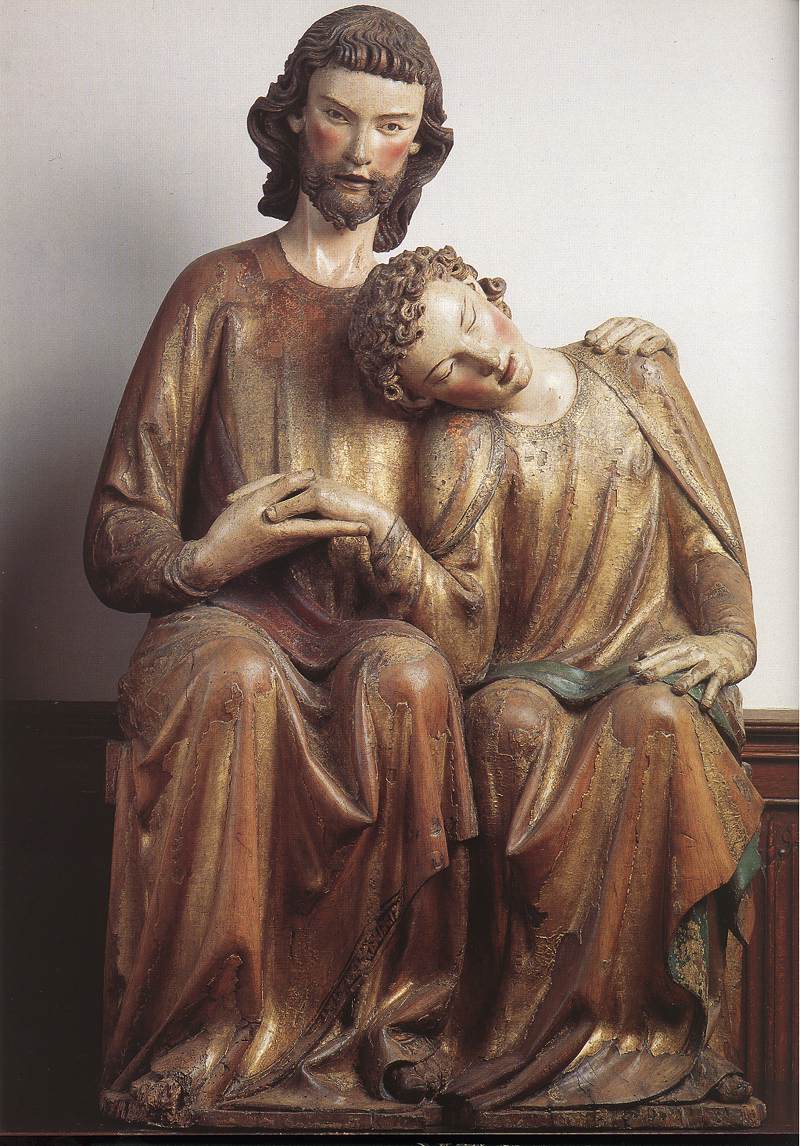
2john_re–St John Resting on Jesus’ Chest, c. 1320, Museum Mayer van den Bergh, Antwerp

John 6

In one of the lectionary cycles, there’s a long stretch when we’re asked to plow through some of Jesus’ interminable discourses in the gospel of John. Jesus talks non-stop from the middle of July straight through August. After a few weeks of this stuff your start to wonder if John’s Jesus ever does anything but talk.

I know a pastor in a lectionary tradition who gets really cranky when the she’s confronted with preaching on these long speeches. She thinks John’s Jesus is way too into himself. It reminds her of an old cartoon in which a man on a first date blathers on and on about himself to his dinner companion. Finally he remembers he’s not alone. “Well, enough about me,” he says. “Let’s talk about you. What do you think about me?” If John’s Jesus is that self-absorbed, he is not the Jesus she wants.

I like John’s Jesus just fine; but I confess that I like him best not when he’s making long cryptic speeches, but when he’s making one of those impossibly tender gestures for which John’s gospel is also known, such building a fire on the beach and making breakfast for his sad and exhausted disciples. Now, that’s the Jesus I want.

Well, that’s the Jesus I want today. I’ve wanted him otherwise.

At one time or another I’ve wanted a Che Guevara Jesus, a flower child Jesus, a Galilean sage Jesus, an apocalyptic prophet Jesus, a divine savior Jesus, a judging Jesus, a warm inclusive Jesus, a cosmic bellhop Jesus, a finder of parking spaces in Harvard Square Jesus, a homeless Jesus, a crucified Jesus, a risen Jesus, a Jesus in you, a Jesus in me, a feminist Jesus, an historical Jesus.

But if there’s one thing I’ve learned in the course of trying to follow him over the years, it’s that you can’t pick your Jesus. You can’t always have him your way. Because it turns out that he’s never just the Jesus you want. He’s not even just the Jesus you need, or the Jesus you think you need. He’s always, as an old mentor of mine once put it, “the Jesus you’re damn well going to get.”

Take that speech we call ‘The Bread of Life Discourse” in John 6. Jesus addresses it to a crowd that for months has wandered the countryside with him, drawn by his healings, transfixed by his teachings. But the crowd’s mood turns fretful when he starts making some big claims about who he is. They begin to murmur, and if you do any kind of public speaking, you know that’s not a good sign.

They murmur because Jesus suggests that he is greater than Moses; not the deliverer, but Delivery itself. He suggests that he is more than a sage, he is Wisdom itself, that mysterious being described in the Bible as playing in God’s presence, privy to God’s secrets before the foundation of the world; a mother calling her children to eat and drink a great feast without having to foot the bill or earn their keep.

This is perplexing. Troubling. Maybe even blasphemous. And it’s not this Jesus they want.

The Jesus who turned water to wine? Fine. The one who healed the sick and multiplied bread and fish? Swell. The Jesus who walked on water? Awesome. Wonder-worker, story-teller, that’s a good Jesus. A Jesus you want.

Up to this point in the story, John’s Jesus has glided from triumph to triumph, glory to glory, and it’s been visible for all to see. But now he asks for more than enthusiasm about wise preaching and merciful miracles. Now he asks for a relationship so close that to get at it, John has to use images of eating, which (along with sex) is the most intimate of all shared human experiences. Now he’s asking for a friendship so intertwined and interdependent that elsewhere John can only speak of vines and branches. Now John is saying that Jesus is no open book, that he must not be taken for granted, that he is in a sense unknowable and unreachable unless God reveals him to you. Now he is claiming that he can show us the character of God.

In John’s rendition of Jesus, this god-like, life-giving, sovereign and inscrutable man is also asking people to decide, to decide whether to accept his claims about himself and his claim upon them. Some followers won’t, or can’t. “We know who his parents are!” they say. “We know where he comes from!” Do they think Jesus is an overachieving small town boy who’s letting all the attention go to his head? He would, it seems, be closer to the savior they want if he were more modest; if only he would put forward lesser claims. Or if he would just let them remain agnostic about the whole thing.

But he won’t.  All of a sudden he is the Jesus they are damn well going to get. And so they start drifting away. The circle around Jesus continues to contract for the rest of his short career as more people find him bewildering. First these, then a few more, even some of his intimates, until at the end only three women and John stand at the foot of his cross.

Here’s what I think: No matter which Jesus you want now or have ever wanted, there is a Jesus you are always damn well going to get; and in this case it is the Jesus who, in whatever guise, will always try to be intimate with you; will always want to lay a claim upon your whole life; will always wait for you freely to decide for him.

Following Jesus’ teachings and emulating his tender gestures towards people in need and proclaiming a just and merciful kingdom against the enemies of life are what a true disciple does; but they do not exhaust John’s definition of a disciple. John, after all, is called the “beloved disciple,” and his community, “the beloved community.” His purpose is to face you with the Fierce Belovedness he identifies so intimately with this man, Jesus.

You don’t need to be a follower of John’s divine-ish Jesus to do works of mercy and justice. People of all faiths and no faith do them too, often better than those who bear the name of Jesus. You don’t need his example to feed the poor, shelter the homeless, testify at a Senate hearing on behalf of research for breast cancer. You don’t need faith in Jesus to give an at-risk kid a job, visit a prison, comfort the dying, or be kind to animals.

Although many of us do find the full motivation for our various ministries in Jesus’ example and teaching, we can’t say for sure that we would never have acted selflessly without them. We might have found some other wisdom in which to root a humane and caring life. Ethical and exemplary human beings arise from a thousand sources that are not Jesus.

Christian discipleship is not just a matter of selfless behaviors, even if the gospel of Matthew reminds us that loving service of our neighbor will be the basis of our judgment on the last day. For John, the distinctive of the disciple is not only merciful deeds; it is also intimate friendship with Jesus—the capacity and willingness to relate deeply to this person who is able to pour the wine of gladness for us and sing in us the new song of God’s delight and pull back for us the veil that covers the character of God. This friendship is what makes disciples brave and persistent; for when disciples become Christ’s friends and receive his joy, everything changes. Life and ministry become more wonder than competence, more  surrender than skill, more beauty than plans, more imagination than programs, more gratitude and praise than committees and votes, more celebration than obligation, more grace than guilt, more tryst than task.

This inestimable gift rarely comes from the Jesus we want. It is most often the gift of the Jesus we are damned well going to get. The saddest thing is that around this Jesus the crowds are thin. At the feet of this Jesus not every hand is upturned and open. In his presence only a few delight.  If you wanted to be there with him, there’d be room for you. If you wanted to be his friend,  you would not have to wait in line.


Cleanliness Is Next to Godliness

Germs

A reasonable caution about the potential for infection in church is not to be mocked, but now that the use of hand sanitizers has become a quasi-sacramental rite in many congregations, the ancient sign of peace is omitted for fear of passing more than peace, and some people refuse to take communion from the hand of another (not to mention from a common cup or even by intinction), my inner mocker can no longer be constrained. People, people, really! Germs are not the enemy, antiseptic obsession is! (See The New York Times Magazine, May 19, 2013, “Some of My Best Friends Are Germs.”) Sigh. Knowing that I will convince no one who is otherwise persuaded on this matter, I share with you a Blessing and a Communion Prayer that you may freely make use of to ensure a sanitary worship experience for your congregations (originally written for a community service at Andover Newton during flu season).

21consu.184

Blessing of the Holy Hand Sanitizers

 Holy One,

Thou art godliness indeed,

and cleanliness is next to Thee.

To Thee the ancient psalmist prayed

Wash me, Lord!

Sprinkle me with hyssop,

and I shall be cleansed of every stain.

We too come to Thee,

confident in Thy promise

to create in us pure hearts,

to keep us squeaky clean,

and to free us

from all who seek to do us harm,

bad microbes great and small.

Bless then, O Antiseptic One,

this your servant, Purell,

fruit of the Dow Chemical Company

and gift of germophobe deacons

whose concern for us

is second only to your own

and even more irrational.

As we share its sanitizing power,

grant that we may be

not only a clean people,

but also a more cautious people,

more vigilant,

more on guard against germs,

and the contamination of bodies,

more afraid of the Other

and of one another,

now and forever. Amen.


10615410-hand-sanitizer

Communion Prayer, with Words of Institution

O God, dear Lord,

Jesus is Thy gift to us,

and we thank Thee for him

with all our hearts.

He said a lot of nice things about Thee,

and he told some terrific stories

about soft lambs and small children.

We like soft lambs and small children.

We are, however, a little disappointed in him.

Well, very disappointed,

if Thou must know the truth.

 We know it was not his fault

that when he was born

his parents showed poor judgment

by allowing dirty cows to breathe on him

and dirty shepherds to kiss him.

But when he grew up and became an adult,

he made some poor choices of his own.

 He was not careful about whom he ate with.

He did not wash his hands

or make anyone else wash theirs.

And he even put bread

in the smelly hand of his own betrayer.

What was that about?

That night before he died?

When he took bread and thanked Thee

and called the bread his body?

We do not like to talk about bodies

or acknowledge in church that we have one—

for bodies are kind of icky

when you get right down to it.

(By the way, did you notice?

He handled that bread,

without tongs or gloves.)

 And what was that about,

when he took the cup and called it his blood—

which is a yucky thing to say under any circumstances—

and had them drink it,

from the same cup,

without a napkin?

(He even said,

Do this in memory of me!

And so we were stuck with it.)

Anyway, dear Lord,

we want Thee to know,

as we gather around this table,

leaving ample personal space,

that we don’t hold it against him;

but, no offense and with all due respect,

we really couldn’t let it go.

Thou wouldst not expect us to,

wouldst Thou?

No, of course not;

so we have taken care of it.

We have corrected his deficiencies.

We have tightened up.

We wash our hands.

And just to be doubly sure

that no one worries about germs,

distracting them from the pure worship of Thee,

we have decided that it isn’t really food we’re sharing

but a holy token

that vaguely reminds us of food

come down out of a gleaming stainless steel kitchen

in heaven from you.

And we barely touch it,

let alone slurp or chew.

It will do Thy heart good, we are sure,

that as meals go,

this one is teensy,

and it does not often make us glad.

And we offer it only to our own,

to those we have vetted,

who are wearing ties,

who never clear their throats,

who have showered,

and who manage to look good in the artificial light

of most of our sanctuaries.

For this satisfying solution,

and for all your blessings,

we who stand before you

with clean hands and antiseptic hearts,

offer thanks and praise to Thee,

to whose godliness our cleanliness is next,

now and forever. Amen.

6a00d8341cc08553ef011278dc3f7d28a4-800wi

The Garden on Garden Street

I once had a second floor study that was a true window on the world. Only an extrovert could love such a study. Through its tall arched window, I looked down on Garden Street, a fire station at one end, Harvard Square at the other, and in between, four undergraduate houses of Harvard College. Foot traffic, car traffic, fire engine sirens, conversations angry, earnest and glad all reached me from the well-traveled street below.

From my bright perch I could also see a miniature vegetable garden. It was growing on a patch of dirt on the street side of a fence that hid the opposite house. A low loose circle of chicken-wire enclosed the patch, but as a constraint it was laughable; every day the garden inched out farther onto the busy brick sidewalk.

On days when I was up early, I conducted covert surveillance of this small Eden. I saw people in a hurry turn their heads towards the exuberant green tangle. I saw some give it a wide berth, careful not to crush the tendrils that were laying claim to the sidewalk. I saw an old man bend down to finger the leaves of the squash plant, as if testing for plastic. A day care teacher with toddlers in tow stopped to give lessons in vegetables. And one day, a few minutes after sunrise, a short fellow in baggy overalls picked and pocketed a tomato.

In a long summer of watching, only once did I see the gardener. It was just after dawn when she threw a hose over the fence from the inner yard and watered for a while. Seeing her materialize like that, I knew who she was.

And I thought, What happy carelessness, to have planted a garden in a patch outside a fence. What detachment, to be doing nothing to constrain it from encroaching on the city’s bricks, to be watering only. What elemental generosity, to post no sign, no warning, but to make an offering-at-large to which noticing, admiring, touching, instructing, and plucking are all correct responses.

In this season of gardening, then, I pray:

God, make us like you, planting gardens outside fences, tending in secret, letting things grow the way they must, offering us your Eden, hoping it will turn our heads, accepting our various approaches, content with them all, whether we glance or touch, or pluck to taste and see. Make us like you. Amen.


A Festival of Rain

A rainy Memorial Day weekend. Very rainy. Torrential at times. It’s Springtime in Boston, always an iffy proposition. Of course, we need the rain. That was my mantra yesterday when I got caught in a downpour, stuck in snarled traffic, with zero visibility. We need the rain. It’s a way to make virtue out of vexation.

Of course we do need rain. All of us need rain: there’s always drought someplace in the world. It’s easy to forget that. We only occasionally get a bad one here in the Northeast. Our faucets routinely deliver great gushing quantities of water. It’s not the same elsewhere.

Sometimes, when I stand at my sink with the tap open, I try to imagine a life without easy access to water. I think about the exhausting grind of lugging water from a shared village well or a muddy stream. I think of places where control of water determines the balance of power; where water is used to subjugate, punish, and pacify, as it often is in Palestinian refugee camps. I think too of all the cities and towns of Israel where people have water, but where Israelis yearn also, as Maureen Kemeza says, to “drink the cup of security instead of the bitter dregs of terror.”

I watch the rain wash out my week-end plans and say, “Oh well, we need the rain.” I say it in the resigned, noble, yet slightly resentful way only someone divorced from the daily struggle for subsistence could say such an obvious thing. Meanwhile, somewhere else, a human being who had no week-end plans, no prospects at all in fact, looks down at dry cracked earth and prays for the rain I have resigned myself to; prays also perhaps for that other refreshment – for justice, as necessary for life as water itself.

In the gospel of John, Jesus is in Jerusalem for the Festival of Tabernacles, a week-long autumnal harvest celebration. By his day, it had taken on the character of a festival of rain. Each day of the observance, priests and people processed to the great fountain on the northeast side of the Temple. There a priest filled a golden pitcher with its water, as the choir sang a verse from the prophet Isaiah, “With joy you  draw water from salvation’s wells!” Then back up they processed, through the portal called the Water Gate. When they arrived at the altar of sacrifice, they marched around it, singing psalms. Finally, the priest ascended the ramp to the altar and poured the precious water from the pitcher through a silver funnel onto the ground.

Unlike us, who are disappointed when it rains on our parade, the celebrating Jews prayed fervently that it might rain during the Feast of Tabernacles, for rainfall during Tabernacles was taken as a sign that God would send the abundant Spring rains necessary for a good crop the following year. I have read that even in recent, more bitter years, Jordanian Arabs, who are not enamored of the Israelis, continue to keep their eye on the weather during the Jewish feast of Tabernacles, hoping for the rainfall that portends a good harvest for their own people too – common needs betraying a common humanity, in spite of everything.

In the midst of this festival of rain, surrounded by his people’s prayers for life-giving water, Jesus stands up, as if in answer to them all. He cries out that he is water, rain, the life we need. He stands up and promises that if we drink from his well, if we return repeatedly to the springs of wisdom, mercy, reconciling grace and generosity that flow within him, that he embodies, then living water will also flow from us who accept his invitation – we will ourselves become like fountains.

John tells us parenthetically that by “living water” Jesus was referring to “the Spirit” that would be bestowed upon his disciples after his death and glorification. The gift of this Spirit is the momentous religious experience we commemorated on Pentecost Sunday.

We associate Pentecost more with wind and fire than with water, because those heartier images are the star performers in the account of Pentecost in the Acts of the Apostles that we customarily read on that day. Thus we trend to think of the Holy Spirit as power and enthusiasm, impetus and ardor  –  a force to be reckoned with, transforming fear to boldness, inhibition to freedom, doubt to conviction. And so it is.

But Pentecost is also a festival of rain. And the Spirit is like holy precipitation. The rain we need. In Acts, we hear a Spirit-filled Peter try to explain to the stunned crowd what is happening. This, he says, is the drenching that was promised by the prophet Joel: “In those days, says the Lord, I will pour out my Spirit on everyone…” Pour it out, like water from a golden pitcher, like torrents from the sky.

Pentecost is a downpour, a soaking, a flood – a flood of life and possibility; and, miraculously, a flood of mutual understanding that washes away, if only for one blessed day, the desiccating divisions of clan, nation and tongue. It is like water turned mysteriously to wine, making the world giddy with hope and joy. It is a baptismal immersion from which the church rises, dripping wet, waterlogged with grace. The call given to us in those fathoms is to go and drip on everything; to rain on the drought-stricken world the rain of kingdom life.

Many congregations prayed for wind and fire last week. I wonder how many prayed for rain. As I was watching it fall very hard yesterday and late into the night, I hoped some did, because we really need the rain. We really need The Rain.


It’s Necessary to Use Words

Image

“Preach the gospel at all times; if necessary, use words.” –St. Francis of Assisi

 Along with many colleagues and companions in my progressive Christian denomination, I’ve made frequent use of this saying attributed to Francis of Assisi to make a point about the perils of lip service and the Christian imperative to serve the neighbor. It’s not surprising that we find it appealing. Activism for social justice is a vital part of our denomination’s ethos in ways that verbally commending the gospel to others—evangelism—is not. This much-quoted admonition pithily sums up our liberal credo: Talking about faith is less important than demonstrating it. Besides, Francis said it. It doesn’t matter that we don’t normally venerate saints in my denomination. Francis is hip and counter-cultural; we’re pleased to take his word for things, a word that just happens to lend authority and charm to our bias.

Lately, however, I’ve been reconsidering the usefulness of this saying. For one thing, it’s doubtful Francis ever said it. No early biographer records it among the hundreds of other sayings and stories, historical and apocryphal, attributed to il poverello. Neither is it found in any of his extant writings, which are few in any case.

Of course, the fact that Francis never said it is not in itself sufficient reason to stop using the phrase. Many things that someone never said are still useful. If they reside somewhere in the zip code of the supposed author’s spirit, no harm is done by a dubious attribution. Besides, one can get insufferably pedantic about such things, and more than a bit obsessive. The internet is rife with phony or edited citations from heroes we wish were more like us than they actually were, and to set about correcting them all would be a lifetime’s work of debatable merit.

In this case, however, I believe Francis would’ve been puzzled by this saying and by the use we make of it to defend the notion that preaching with words is of secondary importance to a gospel preached with deeds. In the context of his life and ministry, it seems misleading at best, if not plain wrong. Unlike the famous peace prayer also attributed to him, this saying about preaching appears sufficiently distant from his spirit as to make a correction meaningful, and perhaps even necessary.

He never said it, and he may not have agreed with, but there’s a section of the second Rule Francis wrote for the friars (1221) that suggests a possible origin of its association with him. In Chapter XVII, “On Preachers,” Francis legislates as follows:

No brother should preach contrary to the form and regulations of the holy Church nor unless he has been permitted by his minister. And the minister should take care not to grant [this permission] to anyone indiscriminately. All the brothers, however, should preach by their deeds.

Here Francis mandates that brothers who are engaged in a preaching ministry—the primary ministry of the friars—must be licensed to do so, and that they must take care to conform their preaching to the norms and expectations of the Church. In other words, the friars are not free agents; no one is to go out and preach on his own initiative. Notice, however, that not every brother will be granted permission. Francis charges the minister (he eschewed the term “superior”) to determine the qualified. Brothers denied permission need not feel left out, however, for “all the brothers… must “preach by their deeds.”

For Francis, this is stating the obvious; preaching with deeds is a given. Making it explicit in the Rule is his way of reminding those brothers who are not permitted to preach with words that they participate in the preaching ministry all the same by means of their example and service. For Francis, preaching with deeds is a crucial and holy default position, but he does not elevate it over preaching with words. There’s no “if” in Francis’ conviction that preaching with words is “necessary.”

His stance is unsurprising given the role of preaching in his day when the fear of doctrinal heresy mobilized the repressive machinery of church and state to the point where scholars like R. I Moore can speak of a “persecuting society.” Francis’ contemporaries believed, rightly or mistakenly, that heresy was rampant and infectious, and that one of the primary causes for its appearance was weak preaching by Catholic preachers, made even weaker by their scandalous lives. The way to prevent the spread of this contagion and recover the wayward for the true Church was for Catholic preachers to preach better and more zealously, and to conform their lives to their preaching.

Preaching with words was at the heart of many of the new evangelical movements of the period. The hierarchy kept careful watch over these movements, ruling some out of bounds because of perceived doctrinal deviance, or because of disciplinary failures, especially the failure to secure proper permission to preach from a lawful ecclesiastical authority. Francis was adamant that he and his brothers should stay in bounds; he insisted on solid doctrine and proper process.

Francis was not merely being canny or self-protective. He was a true son of the Church (which did not preclude acts of what one writer has called not civil, but “ecclesiastical disobedience”), and he was fundamentally concerned with the sequela Christi. To follow the Jesus of the gospels as closely as possible meant not only forgoing possessions as an outward sign of an inward renunciation of power; and not only keeping affectionate company with the last and the least, even the officially segregated leper; it also meant preaching the good news, announcing an urgent message, and doing so with words. Preaching was the Franciscan charism every bit as much as the devotion to the poor and pastoral care for the sick for which he and his first followers gained such fame and admiration.

Francis’ own practice is revealing. His first biographer, Thomas de Celano, describes him as a peripatetic preaching machine, in the mode of a George Whitefield or the early Wesley, sometimes preaching in up to five villages a day, mostly in the open air. In the countryside he perched atop bales of hay in granary doorways; in the cities he shouted from the top step of public buildings. He preached to anyone who would listen, as well as to those who weren’t sure they wanted to—it was reported of him that he would crash rich people’s parties and preach to them. According to legend, he even preached to the birds in the trees, from whom he got a much better reception, and to the Sultan of Egypt, who was not persuaded, but warmed to him and gave him safe passage home.

It turns out that he was a fiery sort of preacher, often dancing around or bouncing up and down as he told his listeners “about vices and virtues, punishment and glory…” (Third Rule, 1223, IX). If we were to hear him today, we might find him a bit too blunt for out taste, more like Jonathan Edwards than the sweet proto-hippie Francis of Franco Zeffirelli’s Brother Sun, Sister Moon—or if not like Edwards exactly (for Francis disliked long, elaborate sermons and exhorted the brothers to use words that are “studied and chaste, useful and edifying to the people), then at least like Jesus, who did  not hesitate to name names and call people to conversion in order to receive the good news of mercy with an open heart.

Francis’ words, de Celano wrote, “were neither hollow nor ridiculous, but filled with the power of the Holy Spirit, penetrating the marrow of the heart, so that listeners were turned to great amazement.” This most joyous of all Christian saints was serious about the power of speech—he respected words; and respect for words is another reason I’ve decided to stop saying that we should use them only “if necessary.” Such a sentiment blithely reinforces, I think, the common sense notion that words are in the end “just words,” ephemeral and useless when measured against the efficacy of deeds.

ImageWhen Barack Obama was campaigning for the presidency in 2008, his detractors mocked him for being eloquent. (Some of his supporters were wary of his speechifying too, to be fair.) The implication was clear—eloquence is a dodge for substance. Words about vision and promises sound good, but they are too easy. In the end, they defraud; realizations matter more. Or so one would think. The late Colombian novelist Gabriel Garcia Marquez recounted a curious incident to a journalist several years ago. It took place during a gubernatorial election in a northern Mexican state where the entrenched ruling party, the PRI, was again on the verge of total victory. Party operatives had bought the attendance of a big crowd of villagers who, eager to earn their pesos, were patiently listening to the customary litany of PRI accomplishments–clean water, new sewers, schools, community centers, more street lights.

Rampant graft meant that most of it was badly built, of course, and things broke or closed down with depressing regularity. Nonetheless, the crowd applauded on cue as each achievement was touted; but way at the back of the crowd, a small man raised a big placard on which he’d scrawled what I think is clearly a sarcastic, but also a massively subversive message: “¡Basta ya de realizaciones. Queremos promesas!”  Enough already with accomplishments! We want promises!

It seems that some accomplishments can’t hold a candle to words; but even more, it seems that people need hope and vision as much if not more than stuff.  Even if all that PRI stuff had been well-built, I imagine that the villagers might still want words as well as deeds, especially words that are transparent enough to raise the curtain on a new heaven and a new earth, lifting our eyes to a horizon beyond the everyday so that we can see what is not yet and thereby cultivate endurance and refine our hope.

No one disputes the assertion that words can be empty, duplicitous, or just plain vapid, but our experience also teaches that words of truth and substance, words of sincere testimony—even words that “only” promise a future or describe a vision and are not always immediately coupled with deeds—have unimaginable and “necessary” power.

It’s instructive that when it comes to the great liberation movements of our time, no one has trouble recognizing the need for and the power of words.  Speaking up and speaking out is dangerous business in such moments—and it is necessary. “We begin to die when we do not speak out about the things that matter,” said Dr. King. “Silence = Death,” proclaimed gay liberation protest signs. When it come to verbal expressions of religious faith and testimony of religious experience, however—even though we say we believe that we too have an urgent message of life and liberation—we seem far less sure.

The supposed Franciscan saying about preaching with deeds is almost irresistible, but if it encourages a subtle denigration of the power of speech to testify effectively to truth; if it downplays not only preaching in the narrow sense, but also evangelism, we probably ought to think twice about its usefulness. For a tradition of faith that stems from a Word—indeed, from the Word—and whose ministry to the world is “bold speech” about God (Acts 4:13), it seems at best ill advised to encourage a lack of confidence in or respect for the necessity of verbal testimony.

We must indeed, as George Fox always insisted, let our “carriage and life preach,” but because the distinctive meaning of the acts we perform is not always self-evident—because they do not automatically explain themselves nor make immediately apparent the peculiar character of the God who inspires them—we must speak. We’ve been called to a way of life that’s grounded in and defined by the person and work of Jesus Christ whose mission we claim as our own. That mission is in part to offer a clear word to the world, a word that, were we to keep still, would not be heard otherwise. Humbly to commend the message of mercy to others in a spirit of hospitable hope that all might know more fully who we are and what we intend, and that some might come to know the grace we ourselves have known in Christ, is not optional for Christians. As Paul asks, “How will they believe if they have not heard? And how will they hear if there are no preachers?” (Romans 10:14).

ImageIn progressive Christian circles, I know this is easier said than done. In my own denomination, the Great Commission sits uneasily on many people, clergy and laity alike. When we speak of evangelism, at best it usually means inviting people to church, which is hard enough for us, especially when we’re talking about inviting the so-called “un-churched” and not just stealing other churches’ sheep. When challenged to do more—to share the Christian story with people who don’t know it, or to share our own stories in the light of the gospel—we falter.

A colleague tested this assertion at a workshop not long ago. The participants were church people active in their local communities and committed enough to spend a long Saturday at a denominational learning event. They agreed that they were very reluctant evangelists. When asked to say what stood in their way, they noted the cultural baggage attached to the word “evangelism,” fear of offending against pluralism, and worry about being judged or rejected as holy rollers or fundamentalists. They worried that others would find them irksome or boring or judgmental. They did not want to impose their beliefs on others. They worried that they didn’t know enough to be able to “defend” what they might say, and this left them feeling intimidated. They wished they felt stronger in their faith and knowledge of the Bible. They worried that they didn’t have the language to tell the story appropriately, correctly, or compellingly. And several said they felt unsupported in their efforts to share their stories with others.

This is not the place to unpack these responses, to offer correctives to some of the assumptions about evangelism, faith, and the Christian story embedded in them, or to offer suggestions of ways to help willing disciples find their testimonial tongues in a fruitful and respectful way. The only point I want to make here is that although it’s a sure bet that every one of those workshop participants was preaching every day with good deeds, the great silence about God that descends when we don’t know how, are afraid, or believe it is somehow wrong and oppressive to speak about the reasons for our deeds, our experience of grace, and our ongoing lives of discipleship, is a silence that necessarily reproaches the Church.

We’ve been given a gift to share for the sake of the world. There’s a huge difference between believing that in that gift we have the answer to absolutely everything and that we are the only true way, and the humble practice of letting our gift be known by commending it to others, speaking with freedom, affection, and gratitude of our experience of God in Christ. This sort of respectful, invitational practice is a lot harder than old fashioned proselytism ever was. There’s no doubt that our current pluralistic context makes it hugely challenging (although people engaged in serious interfaith conversation attest that our current context also makes it hugely rewarding), but that doesn’t justify reticence. Withholding the gift is to break faith with the Giver.

Some people might chalk this silence up to having nothing to talk about. I’ve heard it said that many ordinary “liberal” Christians in the pews of our churches have never really had a vital experience of the gospel that they can share; they are without knowledge, encounter, or desire, content to show up and do unto others. I often wonder whether this perception is true, or as true generally as we think. Could it be that some people don’t recognize their experience for what it is, believing that religious experience should look and feel a certain way, holy somehow, maybe happening in church and not in the laundry or the factory? Is it because people don’t know how to frame their experience, don’t know whether it’s okay to use ordinary words or think they have to learn the right words before they speak? I wonder too whether the church directly or indirectly silences such speech; whether, for example, the liberal ethos of my denomination, with its loud crowing about being non-creedal and believing whatever you want, effectively quashes significant talk about faith, having inculcated in us all a great fear of offending and skepticism about, even disdain for significant religious experience, affirmation, and conviction?

ImageThere is much reflection abroad today about a new reformation and the unknown shape of the church to come. In that conversation, helping every disciple learn to preach the gospel with words should be a major item on the visionary agenda. I know much is being done already; some pastors are actively engaging their people in the practice of testimony, with transformative results. More of us need to follow that example.

It will not be an overnight project, but a long labor of patient encouragement, conversion, and formation, beginning with those of us who have too happily latched onto the permission this supposed saying of Francis has given us to keep our mouths shut. We should aim for communities of faith whose members are as articulate about the gospel’s vision and promise as they are active in the service of others.

Make no mistake, I do not underestimate the power of deeds. It seems silly to have to say so—they are necessary, and on the last day they will be our judge; but deeds always get first billing in my denomination. I want to put in a good word for words.

How Can We Keep From Singing?

–Nonviolent Student Protesters singing “We Shall Overcome,” circa 1963. Photo by Adger Cowans


A Sermon in Four Movements

Ephesians 5: 15-20; Mark 14: 22-26

I

On a January morning in 1990, George Peck got out of bed, walked to the kitchen, fell to the floor, and died. It was to have been his first day back to work after a year’s sabbatical. He was the president of Andover Newton Theological School. He was 58 years old.

Just two years earlier, Orlando Costas had died after a short struggle with cancer. He was the Dean of the School. A few months after his sad death, the Chair of the Board died too. And not long after George Peck’s death, a beloved professor of ethics, Jane Cary, was diagnosed with breast cancer. She died almost before any of us could say, “Oh, no!”

The older faculty of Andover Newton refer to those three years of death as “the siege,” because it felt like one. It felt like we were surrounded by a fierce enemy that was picking off our friends, one by one.

George Peck’s funeral was held at First Baptist in Newton Centre, a cavernous church. That day it was packed to the rafters. And when the service was over, that whole prodigious throng stood up to sing George’s favorite hymn.

George was an Aussie. Every Christmas he’d call us together to sing all nine hundred sixty-seven thousand verses of “Waltzing Matilda.” He loved that song, but the song he loved most was Martin Luther’s “A Mighty Fortress Is Our God.” That was the hymn that closed his service.

I had always hated that hymn. I am a sophisticated person, and I found it embarrassing. Remember how it goes? The world is full of temptation. Nasty little devils are running around everywhere, trying to trick us into sinning. We can’t do anything to defend ourselves. We are totally doomed. But thanks be to God, Christ the Holy Swashbuckler swoops down to rescue us. He swoops down and swashbuckles away—and he wins!

Ugh. It’s all so… 16th century.

But then came the siege—the funerals, the exhaustion, the sorrow—and the scary realization that we were powerless against the onslaught of Death. By the time we gathered at First Baptist, I was so sad and defeated, I needed some swooping and trampling. I ached for some swashbuckling. I required some demon-squashing triumph. So, at the end of George’s service, I took a deep breath and belted out that embarrassing old hymn. I sang it like I loved it. Like I’d always loved it. Like I really believed it. I sang it like a Lutheran—with all my heart.

And then it happened. When we got to the part about demons snatching us, we felt those claws grab at us, and we started trembling. When we sang about God sending Christ to help us, and we felt a mighty Presence swoosh into the room. We burst into applause. When we sang that God is a mighty fortress, protective steel descended. You could actually hear it clang down. The more we sang, the more the demons ran. To this day, I remember the way we climbed on the pews, thrust our fists in the air, and ordered the forces of death to back off.

… Okay, I lied. We didn’t applaud. Nobody stood on the pews. We didn’t thrust our fists in the air. But we did sing. We sang and sang. And, somehow, because we sang, we won.

Congregational hymn: “A mighty fortress…”

II

Whenever I hear the story of Jesus’ last supper with his friends, one small detail always chokes me up. Did you catch it when it was being read? It says, “They sang a hymn…”

Jesus was full of dread that night, as if he knew what was coming. Even so, he didn’t hurry the ritual meal. He didn’t shorten the prayers. And he didn’t say, “We don’t have time for all five verses of the closing hymn.” Only hours before being hauled away to be tortured and killed, he stood up with his little congregation and sang all the verses. And the song they sang at that Passover meal was probably a psalm of praise—praise to God for delivering the people from slavery and death in Egypt.

How could Jesus sing like that, knowing what was coming? How could he praise God for deliverance when there’d be none for him? In the face of disaster, how could he keep on singing?

Why do we keep on singing?

Because singing is what we do when we are really living. Even if we are also dying. It’s an act of faith. We always sing against the odds. The children of God have always been powerless against tyrants, helpless against hate, defenseless against greed, pride and ambition, up to our necks in trouble, susceptible to weaknesses of every kind, hemmed in by death on every side. We don’t have a prayer—except for our songs. Anywhere you look in the human family, when trouble comes, the next thing you hear is singing.

Congregational hymn: “When in our music God is glorified” [include verse omitted from NCH: And did not Jesus sing a psalm that night….?]

III

Now, some people sing to entertain themselves. Or to forget their troubles. Or to look on the bright side. But the singing I’m talking about isn’t a distraction, a pep pill, or a night-light. It won’t help us cheer up, forget our troubles, or pretend that there are no monsters under our beds, no gremlins in our psyches, and no savagery in the world.

The song we’re talking about today is the song God sings into the world every day, especially on days of reckoning. It’s a song we know by many names—we call it amazing grace, firm foundation, everlasting arms, trust and obey, wondrous love, grace and glory, blessed assurance—but whatever name we know it by, God has sung it into us. It’s a gift of the Holy Spirit bestowed in our baptisms, and like all the Spirit’s gifts, it’s no good unless we share it. Unless we give it away. Unless we sing it to others.

And because it is God’s own song we’re singing, once we’re singing it, once it’s out there in the air, things change.

If you aren’t sure what I mean, consider Sojourner Truth, the great abolitionist. Once when someone asked her how to destroy the evil of slavery, she said, “You lay a song on it.”

Or ask the people of Birmingham, Selma and Montgomery. Remember, if you are my age or older, what it was like to hear freedom songs above the roar of fire hoses and snarling dogs?

Ask the people of Chile who the priority victims of Pinochet’s death squads were, and they will tell you that they always arrested the songs first. They poets and the singers were “disappeared” early. The government knew that they were the most dangerous people of all.

The song God sings in us and through us against all odds is hope, courage, and life. And as long as God’s people are singing it together, truth will get told, walls will tumble, chains will break, stuck things will shift, tyrants will fall—and the new thing God is determined to do will win out, even in the most hardened hearts, even in the cruelest systems.

But this victory takes time. A song is not a bomb. It is not a quick fix, like a firing squad or a politician’s promise. And that’s why we teach God’s song to our children, so that they will teach it some day to theirs. To get the whole universe singing God’s song is a project bigger than one lifetime.

But faith assures us that sooner or later, the songs we pass from age to age, the capacity for singing we enlarge and encourage, the power of the song we sing together will so bewilder the enemies of Love that they will sheathe their claws, hang up their pitchforks, and stop dealing in death, once and for all. Sooner or later, the song from God that we sing together will be on the lips of all creation, and God’s hope for the world will come true.

Jesus “sang a psalm that night, when utmost evil strove against the light.” That psalm was first sung by the Spirit to his ancestor, David. David then sang it to the people. They taught it to their children. And centuries later, Jesus learned it from his mother, who’d learned it from hers, who’d learned it from hers. He sang it countless times in his short life, that song chanted in exile and in freedom, in trouble and in peace for countless years. It was on his lips when he died, a failed prophet. It was on his lips when he rose triumphant from the grave.

Jesus knew what every faithful soul and every faithful community knows—as long as we are singing, the struggle goes on. As long as we are singing, we are invincible. As long as we are singing, we will rise.

Choral anthem: “We shall not give up the fight…”

IV

Jesus once said to his followers, “Go into the whole world and announce the good news.” In other words, “Evangelize!”

A lot of us are reluctant to evangelize. We can’t picture ourselves hitting the streets with a floppy bible and a converting message, buttonholing our neighbors, preaching to strangers, handing out tracts.

Okay. Fair enough. That’s hard. But maybe we would be willing to sing?

Maybe we could sing the church’s faith, its ancient story, its treasury of tune and rhyme, its vast repertoire of grace. Against the odds that are stacked up against the world God loves, maybe we would be willing to sing for its life and our own.

Maybe we could sing as if we really believed that God can make life different. Maybe we could sing as if we really believed that locked chains can snap and locked doors can open. Maybe we could sing as if we believed that at the sound of God’s song on our lips, one more hatred will shrivel and die, one more war will end, one more generous heart will embrace a stranger, one more wall will tumble, and another will never get built. Maybe we could sing as if we believed that one day the only sound in all creation will be a melody of delight—God’s delight in us, and ours in God.

If we believe, if we know, that God’s new song can do all this, can do it through us, then why would we, how could we keep from singing?

Congregational hymn: “My life flows on’ [How can I keep from singing…?”]


And God Alone

I am reading many uplifting comments in the wake of the carnage at the Boston Marathon, most of which are about God. They are all in some way true and they are all heartfelt, but I find that I am more or less indifferent to them.

This reaction isn’t new. It happens to me a lot. And it has often made me wonder if I am fundamentally an impious person.

Although I do speak of God and offer my earnest prayers at times of senseless violence, tragedy and horror, I don’t experience connection to God in these moments or in their aftermath, unless you count the experience of silence and a kind of motionlessness at the center of the soul. I find it hard to engage in confident God-talk the way my friends and colleagues do so sincerely and well.

My inability to speak of God with felt confidence at such times—and at many others that are not so tragic or compelling—can leave me feeling faithless, and not a little envious. What grace do others have that I don’t? Why is God so real to them, and so unreal to me? Why is it that others find clear spiritual affirmations useful at these times, and I find them useless? When they speak so affirmatively of God, why does it sound like gibberish to me?

Comparisons are odious; eventually I stop complaining, dig deeper, and re-accept the condition that has been mine for as long as I can remember: not impiousness so much as darkness.

I have always known that I am not spiritually wired for devotion in the ordinary sense. I tend towards the apophatic, the way of negation. If I have a spirituality that merits the name, unknowing is its default position.

It’s different if we’re talking about doctrine. I am reasonably sure of my beliefs. I am also relatively unhesitant when it comes to making judgments about liturgy (which can make me a little, well, insufferable at times). I am fairly clear-eyed about the ethical life and my moral bottom lines. I am crazy about the gospels and relish the Jesus I find in them. I welcome with a joyous heart the vision of life and the character of God they portray and proclaim.

But when it comes to theology proper—that is, when we are speaking of the mystery of the true God and not of idols or projections or fantasies—I falter. I cannot say I “believe.” I certainly do not “feel.”

I do, however, surrender. Which is to say only that I live every day on the brink of full-blown atheism. My faith is the dark sort—it would not be at all surprised on the last day to learn that there is Nothing. At best I hold on. At best I demand to be held onto.

And that is all I can do, unless I decide to be dishonest. In the end, it may be all anyone can do, after words fall away, and in the boundless void God is still God and God alone.

An Eastertide Reflection: Judas, Peter, and the Apostate Church

800px-The_Denial_of_Saint_Peter-Caravaggio_(1610)–Peter’s Denial, Caravaggio

I think Christian tradition has been too hard on Judas and too easy on Peter. Judas sold Jesus to the authorities, but he never lied about knowing him. His betrayal was terrible, but it was up close, to Jesus’ face, sealed with a kiss, among friends. Peter kept his distance. He wouldn’t even say Jesus’ name. Among strangers he denied all ties to “that man.” He sought warmth by a fire while his Teacher was tortured. His renunciation was as cold as that night was cold.

Tradition turned Judas into the evil archetype of betrayers. In two places in scripture we are told that he met a gruesome end, and the implication is that it was well-deserved. In Christian imagination, he ranks just a fraction of a notch above Lucifer. Unforgivable.

Tradition turned Peter into the impetuous disciple who could never quite get or stay with the program, but whose heart was always in the right place. Peter was clueless, lovable, a little pathetic. And forgivable.

We are told that Peter wept bitterly when the cock crowed and he remembered Jesus’ prediction about his triple betrayal. We are told that Judas wept too. His remorse was profound. When he could not undo it, returning the silver, he despaired of forgiveness. He could not live with what he had done, We don’t know why Judas despaired, or why Peter did not, but because Peter held on, he became the symbolic heart of the nascent church. Because Judas could not hold on, he became an eternal embarrassment and a terrible shame.

I have reflected elsewhere on the regret I feel that the Story has Judas dead and gone before Jesus rises.* Every year at Easter, my imagination feels compelled to re-write the scriptural account to save him. If Peter lived to experience Christ’s mercy pour out for him from the empty tomb, why not Judas too, even though he died? Do you have any doubt that Jesus forgave him? Do you have any doubt that one of the fish on the fire that morning by the lake was for him?

We let Peter off the hook, but Peter did not. Even after the encounter at breakfast with the risen Jesus on the beach, even after making his triple affirmation of love, Peter never forgot what he did. When the time of trial came for him again, his legend goes, he refused to be crucified in the same manner as the Friend he did not deserve. He demanded instead that his tormentors nail him to the cross head down. I think the church would do better to remember Peter not as we have re-made him, a lovable bumbler, but as Peter knew himself, an unworthy betrayer of the first magnitude, on a par with Judas.

They are not that different, Judas and Peter. They belong close together in the church’s memory, not far apart, as if Peter were a success story and Judas a failure. As if the goal of discipleship were to get it right instead of to live in perpetual need of mercy, to know oneself permanently in need of healing, pardon, and peace.

We idealize the apostles of the first church as moral heroes and brave martyrs, and when we do, we miss the most compelling thing about those earliest followers and their mission: it was all about the mystery of weakness; it was all about the mystery of grace. Here’s what I said about this mystery in the reflection I alluded to above:

These days, many congregations want to renew themselves. They ask questions about identity and purpose—who are we as a church, what is our mission, how can we be more faithful? Well, here is a model we might all consider to our benefit—the earliest church, which was nothing more than a few sinful, weak, mortified disciples huddled around a fire tended by Jesus, eating with him. A church composed of apostates, guilty of denials and betrayals and fearful flight. A church born not in rising to the occasion, but in running from it. A congregation of weakness and shame. A fellowship of the unforgivable.

Just the kind of church Jesus wanted. The kind of church he’ll always love. The kind of church to which he will always come, in which he will always dwell, to which he will always tend with the sweetest condescension. The kind of church in which any Peter or any Judas would feel at home.

The best thing any church could hope for is to be filled with Judases and Peters. People whose lives are marked by the humiliation and the humility that come from knowing exactly what they deserved but did not get. People whose actions in the church and in the world are characterized therefore by the most reverent tenderness for the weaknesses of others. For their cruelties and betrayals. For their unpardonable sins.

The straightest route to faithfulness any church can take is through human fragility, where the depths of guilt and shame are met by the unrelenting, anticipatory, all-covering, blame-withholding mercy of the Lord.

If what we strive for instead is a church of the strong, the good, the steadfast, the productive, the able, the clever, and the powerful (even the spiritually powerful) who are perfectly capable of cooking breakfast for themselves, we may never have a church at all. And we might never have a mission either, because feeding Jesus’ lambs, inviting the whole world to come and have breakfast, sharing with others the mercy bestowed once upon a time around a charcoal fire—these are not things you can do if you’ve never been around that fire yourself, waiting for the other shoe to drop, if you’ve never felt the joy of realizing it isn’t going to drop—ever; if you’ve never understood how much you actually owe, and how clean the ledger has actually been wiped.

It is precisely the ones who should never have been forgiven, but who were, who are called to tend Jesus’ sheep. It’s not something he entrusts to just anyone. He seeks out the worst for the job. And he makes them the best by love.

By love alone.

___________