Epiphany: A Brief Primer


Epiphany is an ancient Christian festival that pre-dates the celebration of Christmas. For many centuries it was (and still is in some parts of the Church) the second most important celebration of the Christian year, Easter being the first. Epiphany is also one of the two major festivals in the Christian year on which it was customary to initiate people into the church through baptism, the other being the Great Vigil of Easter.

“Epiphany” means “revelation.” During the 5-8 week  season of Epiphany, Christians contemplate the figure of Jesus as a revelation of God’s hopes for the world. It is a time of growing insight into the way we believe God was working for our good through Jesus’ ministry of preaching, healing, justice, and reconciliation. Who he is for us and our salvation “dawns on us” gradually during this season of light.

The season of Epiphany begins with a double commemoration—the visit of the Magi to the child in Bethlehem, and Jesus’ baptism in the Jordan river.

The story of the Magi, or ‘wise men from the East’, is found in Matthew 2:1-12. These mythic Magi are ancient astrologers, the scientists and philosophers of their day, who follow the trajectory of a new star from their own countries to the manger in Bethlehem. After eluding the machinations of King Herod, they acknowledge the Babe as a ‘new king’ and a revelation of God, presenting him with gifts of gold, frankincense and myrrh. Then they return home ‘by a different way.’

The gospel of Matthew says nothing about the meaning of the Magi’s gifts, but later Christian imagination assigned symbolic meaning to them. Gold honors the Child’s royal lineage—Jesus is said to be descended from the house of King David. Frankincense, a costly incense, recognizes his divine origin—Jesus was said to have been born “of the Holy Spirit.” Myrrh, a bitter ointment, foretells the suffering of Jesus on the cross.

Because of the importance of Epiphany, we have countless homilies and commentaries on its meaning from early Christian preachers. Three aspects of Epiphany stand out in these sermons:

The visit of the Magi symbolizes the inclusion of the Gentiles in God’s promise of salvation. The non-Jewish world is given a great gift through the birth of this Jewish baby in Bethlehem: we come to “sees the light” with our own eyes and receive the blessings of God’s promises given first (and forever) to the Jews. We are, in Paul’s words’ “grafted on” to the ancient tree, adopted into the family and made heirs of the Promise.

The Magi’s visit also stands for the illumination of secular learning with the light of faith—human knowledge deepened, corrected, and perfected by the encounter with divine mystery. The wise men discover in an unknown, poor child a new light, a new wisdom, a new hope surpassing anything they ever discovered about God and the world on their own, by their own lights. Epiphany is thus the feast of the learned and the wise who know much, but who also humbly bow before divine wisdom, acknowledging their own limits and unknowing in light of the vastness of the mystery of God.

The journey of the Magi was also a way of speaking about vocation, or faith’s steady calling to the human heart. Epiphany is a season of callings—Jesus chooses his disciples and begins schooling them in the ways of the Kingdom of God. Christians have always seen in the Star a sign of beckoning for the Church and for each and every disciple. Following the Star perseveringly our whole life long leads us to our deepest desire, to wholeness and fulfillment through our obedient responsiveness to God.

In the story of Jesus’ baptism from Matthew 3:13-17, the author places Jesus in the company of ordinary people—“sinners”—who have lined up at the Jordan to be purified and prepared by a baptism of repentance. These are the same people with whom Jesus will most closely associate himself throughout his ministry. “I have come,” he said, “to look for the lost.”

The early Christians saw in Jesus’ submission to baptism—which they believe he did not require, not being a sinner—a revelation of his human solidarity with the poor and the despised who knew that they were in need of God’s mercy and had no one else to turn to. In the story, a heavenly voice declares that Jesus is God’s son, but we come to know precisely what sort of son we have in Jesus when we are shown that he identifies himself with sinners.

The heavenly voice also reveals that God is “well-pleased” with him (and presumably with this identification). Christians have traditionally understood this epiphany as an assurance that, by extension, God has also accepted us as beloved children and is well-pleased with us too, especially when, following the practice of Jesus, we live in solidarity with those whom the world rejects, and work for justice and peace.

Some Thoughts on Preaching John 10:1-11


I’ve heard countless sheep and shepherd sermons over the years. Some have informed me that sheep are the world’s stupidest, smelliest animals. Others insisted that they’re smart creatures, clean and good-natured. One preacher read us a long excerpt from a biblical encyclopedia article about shepherding as a disreputable profession in Jesus’ day. Other preachers referred to the same information, only a bit more artfully. In one oddly memorable sermon, an older preacher regaled us with his youthful escapades around sheep on a hippie commune. Still another shared a travelogue of her recent trip to Ireland where, she assured us solemnly, ‘you can see a lot of sheep.’

All these sermons eventually meandered home to their various points and conclusions, some of which were worth the wait. Still, every time this text comes up in the Lectionary, I find myself praying that preachers will resist the temptation to indoctrinate or entertain us with lore about sheep, lest they and we be led, like sheep, astray.

They do this, I think, because they believe that, lacking real-world knowledge of sheep and shepherding, we’ll fail to grasp what Jesus is getting at, so they contextualize, ‘splain, describe, and illustrate. The irony is that Jesus’ audience had way more sheep culture than we do, even after we’ve heard a dozen sermons on ovine IQ, yet they had trouble grasping his message, too. Notice that about halfway through, Jesus seems to register some perplexed looks, some unspoken confusion. ‘You’re a shepherd? Funny, you don’t look like a shepherd…’ It appears that they have no idea what he’s talking about. So he re-winds and changes the metaphor. ‘Okay, not a shepherd; this time I’m a gate. The sheep gate. Got that?’

Um. Maybe…

We progressives say we’re not literalists, but the truth is when things aren’t straightforward and clear, we get as nervous as the next person, as eager to nail things down as any fundamentalist. We say we prefer heart over head, yet in our need to get to the factoidal bottom of things, we cling to our commentaries and seminary notes,  forgetting to feel. But in texts like these, the thing is to feel, and to try to help other stubborn literalists to feel, too. Forget sheepy information and encyclopedia articles, one to one correspondences, the sheep equal this, the gate means that, God is represented by X, in Jesus’ day a sheep pen measured so many square feet… We’re not in that world, we’re in a different world, the realm of acute, converting feeling.

We’re also not in the world of ethics. At least not immediately. It may be true, for example, that identifying oneself with a shepherd was not an endearing comparison, that it probably had the same upending shock value as identifying with a Samaritan. If this is right, it does suggest some compelling ethical applications to the church’s  mission to stand with the outcast and oppressed. Yet as important as moral applications are for provoking conversion and commitment, they’re not the only means to that end. What happens when we routinely resort to moralizing is that our exhortations eventually go the way of all churchy language—in one ear and out the other.

The best-kept secret of preaching, alas, is that people are capable of coming to deep ethical conversion and courageous commitment by way of awe as well as (and maybe more than) moral exhortation. But we hardly ever give them awe. The most important stories don’t work by explanation or exhortation. They work by imagination, goose bumps, nerve endings. Explanation has its place, but only just enough to set the stage for wonder. Too much, and we’ll end up with heads full of animal husbandry and hearts bereft of mystery, truth, and power. No one was ever converted by knowing the exact dimensions of a sheep pen in first century Palestine.

We might be converted, however, if we suddenly felt the overwhelming fear in the text: the trembling terror in lurking bandits, thieves and strangers; all that looking-over-your-shoulder for killers. We might be saved if we go down through the fears we can articulate—money woes, our children’s futures, illness, aging, and diminishment—to finally touch the fears we cannot speak or face—that maybe no one knows our name, that maybe no one could ever want to “own” us, that we could be picked off at any moment and no one would care.

We might be converted if our nerve endings start to twinge in longing for recognition and dignity, safety and nourishment, belonging and life, in sync with the same desires of other human beings, and of all creation. We could be saved if we’re led by imaginative preaching to hear in the air the name-knowing voice that echoes in this text and in all the scriptures, beginning to end–the ancient litany of tender and insistent calling that resounds in the church’s heart deeper than any fear.

Instead of trips to Ireland and seminary notes, we might be changed by a mirror held up to the vivid Jesus in this text; by a long, loving gaze at him as he works his poet’s heart out attempting to capture our imaginations, trying out one metaphor after another in an ever-turning prism of meaning and possibility, until some glint off one of its surfaces ignites a small flame in us, and something shifts to make way for a little more light. And then a little more, until everything is fire.

Jesus’ Syllabus

IMG_3306.jpg

“If you do not hate your father and mother… you cannot be my disciple.”—Luke 14:26

I know a professor who’s delightful in the classroom. His courses routinely overfill. But he loathes those huge classes. He suspects many students come for his style, not his material; to be entertained, not educated. He can’t get a personality transplant, so he’s revised the course requirements—now it’s a killer. This semester, the crowds thinned out fast.

“You must hate your family…” That’s a killer, too. Jesus sounds tired of being the teacher everybody likes but nobody learns from. Tired of crowds that come for surprising stories and clever banter with lawyers but remain unchanged. Maybe he’s stiffening the requirements to thin them out.

Or maybe he’s having a smelling-salts moment, head snapping back as he comprehends, with mind-clearing clarity, how much it’ll cost him to love what is most worthy of love, and to love it in and above all other loves. Maybe he’s saying it aloud to make it real for himself as well as for us: “I will have to loosen every tie that binds.”

Here’s a horrible vision of life: I’ll love you and let you live if you’re like me; I’ll hate you and kill you if you’re not. It’s the ruling vision of our world. We know the ferocious consequences of its demonic irrationality. The question is whether we have any sense at all of the sacrifice it’ll take to destroy it and create the boundless fellowship of God.

Jesus says, ”You want to be my disciple? Then don’t come to me casually as if we were going to a picnic in the woods instead of a pitched battle in the anguished heart of the world. Read my syllabus. Read it again. Then come, follow me.”

Prayer

I’ve read it, Jesus. I’m not sure I can do it. Give me courage and grace.


And


Cleve_Agony_in_the_Garden (1)

“In the morning, while it was still very dark, he got up and went out to a deserted place, and there he prayed.”  [Mark 1:35]

At her denomination’s annual meeting, a social justice activist listened impatiently to a keynote address about spirituality. She was heard to mutter, “The world’s in flames, and these bliss-ninnies want to do guided meditations.”

In her view, ‘spirituality types’ are several singing bowls removed from the problems of the real world, clueless about root causes and systemic solutions. You want to pray? Do justice. Let that be your prayer. Want to linger devoutly over Scripture? Linger over Matthew 25. Then get to work. Enough with the navel-gazing!

Meanwhile, the keynoter was wondering why the ‘social justice types’ always seem so touchy, so grumpy. They have this air of fatigued arrogance about them, she thought, as if everything hinges on them—world peace, justice for he poor, an end to hunger. They can’t relax for even a nanosecond, because maybe, just maybe, the next action or petition will be the thing that finally fixes everything.

Jesus, Scripture says, puts his body on the line all day. And in the wee hours he prays. He never separates inseparables. For him, the kingdom comes by wonder and strategy, protest and ecstasy, imagination and politics, beauty and meetings, service and solitude, rallies and gratitude, rest and work, resolutions and praise.

It’s not a competition between the soul’s silence and the noise of the street. It’s not the sanctuary versus the subcommittee. It’s not even a matter of finding a balance, or making equal time. It’s about that and. About yielding our whole selves—every gift and skill, picketing and praying—to the Living One, in the sure and certain hope that, with us and without us, the kingdom comes, work of our hands and pure gift beyond our dreams.

Prayer
In prayer and action, O God, we hope in you. In you alone.

Ash Wednesday: Showered with Stars

20160210_ash_jsc_020

“…For dust you are and to dust you will return.”—Genesis 3:19

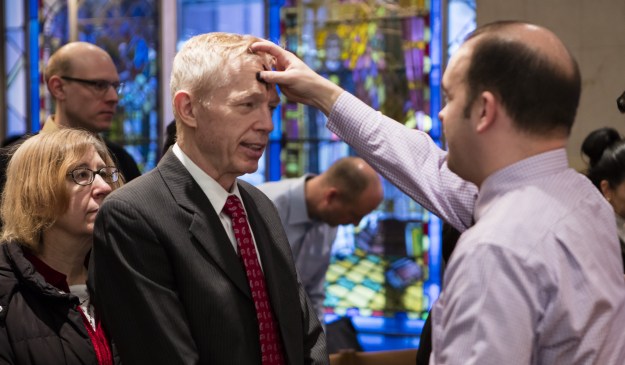
Halfway through the line I almost lost it. Until that moment I’d been in a ritual groove, looking my parishioners in the eye, dusting them with ashes, calmly delivering the ancient admonition, “Remember, you are dust and to dust you will return.” One by one they came, listened, received. But halfway through I faltered.

It wasn’t that I suddenly realized the gravity of what I was telling them, that they were breathtakingly fragile, that at any moment they could dissolve into elemental bits, that someday they would. I’d been feeling the heft of that truth all evening.

So no, it wasn’t that I was giving them fatal news. It was that they wanted to hear it. It was that they’d lined up to hear it of their own free will. They knew exactly what the message was going to be, and still they inched their way towards the messenger.

My knees went wobbly as water. I wanted to wave them off, tell them they didn’t have to come, they could go sit down. But I knew no one would. That was the most stunning thing: even if I’d said it, I knew no one would.

So I regrouped, kept tracing charred crosses, kept saying the old words. And they kept coming, one after another, offering me their foreheads with the trust of a child.

And when I told them they would die, some nodded. Some said amen. Some even smiled; they said thank you, as if instead of sentencing them to death, I’d showered them with stars.

Prayer

Holy One, may I live this Lent in bare truth, total trust, and knowing joy; for in life and in death I belong to you.


Grounded

2013030420unknown_northwestern_france_jesus_driven_from_nazareth_koninklijke_bibliotheek_the_hague_c

“They drove him to a hilltop, intending to hurl him off… But passing through the midst of them, he went on his way.”—Luke 4:28-30

At Jesus’ baptism, God discloses his identity: beloved Child. Later, in the wilderness, Jesus resists the temptation to be something else—showman, potentate, Satan’s son. Then he goes public, healing, and announcing God’s reign. The buzz grows.

In Nazareth, his neighbors ask him to preach. He starts with a portion of Isaiah: “God has anointed me to bring good news to the poor, freedom to the oppressed…” Then he says, “Today, in your hearing, this scripture is fulfilled.”

We could hear that line as a deep, solemn pronouncement, but I think it’s more giddy than grave; for nothing makes us happier than knowing who we truly are and what we’re meant to do. When he sees himself in Isaiah’s text, I think Jesus is struck with the joy of it, and the exhilarating truth just comes bursting out of him—“This is who I am!”

His neighbors aren’t as thrilled. After a tense exchange, they press him to the cliff. Then things turn mysterious: “But passing through the midst of them, he went on his way.”

I don’t know how he did that, but there’s something so spare and serene about that sentence that I think it has to do with being grounded in God, your identity, and your calling. Something to do with the lightness, the fearlessness inherent in being so grounded; the safe passage it grants you—not to avoid danger or suffering, but to go straight through it with your freedom intact, eyes on the prize, anchored in and lifted by the joy no mob can kill and no circumstance can alter.

Prayer

Ground me in the knowledge of who I am and what I’m called to do; and in that grounding may I find joy and safe passage forever.

Pastoral Prayer at the End of Advent

1350124891_12

Most gracious God,

desire of every living thing,

you have lighted our way in Advent

candle by candle,

dispelling our gloom.

and now four candles shine.

The night is almost over.

The Day is almost here.

But not yet.

Promise by promise

you have cleared our sight

with words from afar,

dreams, signs and wonders,

and now the Word made flesh

Is almost appearing.

But not yet.

Grace by grace

you have kept us awake,

brightening our eyes of faith,

and now we watch only a little more.

Now on tiptoe we see

the one we waited for

is almost here.

But not yet.

At the end of Advent,

in these days of not quite yet,

look with compassion

on the pain of the joyless,

the grief of the childless,

the sorrow of the bereaved:

for not all people enjoy the season,

not every family embraces,

not every womb conceives and carries,

not every day dawns with the presence of those we love,

not every story is full of angels,

not every song is ‘Glory!’

As we tell again the story

of your coming among us,

bind our hearts to the anguish of the poor,

the suffering of the sick,

the misery of the imprisoned,

and keep us alive to the terrors of war,

too easily forgotten, too easily accepted.

Increase the joy of earth,

and help us relish with thankful hearts

every good thing that will be ours at Christmas:

every pleasure and taste,

every sound and sight,

every touch and memory,

so that in the delight of our bodies

and the thoughts of our minds

we will know and love you,

who visits us through every sense and pore.

More than anything, O God,

we ask for Christ –

to meet his love, to know his goodness,

to experience his power, to be attracted to his way.

We ask for Christ—

to make the difference, to anchor our hearts,

to lead the way, to bring us home.

We ask for Christ – for cradle and cross,

for lullaby and lament, for life and death

and life made new in him.

In hope we pray,

the spirit of Christmas leaping within us,

heartened by his almost visitation,

the words he taught us on our lips:

Our Father….

Desire

the-night-sky

“Like a deer longs for flowing streams, so my soul longs for you, O God… When shall I see you face to face?”—Psalm 42:1-2

Waiting is the hallmark of Advent, yet the Advent psalms and prophets speak more about longing than waiting: panting, fainting, begging, crying, desperate human need.

Waiting can be active, but it’s rarely terrible and driving. Desire, however, is visceral, like the crazed thirst of a wild animal in a parched land. God is a fierce and unrelenting need. Advent craves God.

Do you?

No, you aren’t thrashing through underbrush frantically seeking water. You don’t really relate much to that panting deer. You don’t have those kinds of experiences of God. You’re no mystic.

Although there was that moment when you heard a loon on the lake and cried, couldn’t stop, didn’t know why, but so wished you did.

Although there was that moment when you felt incomplete, a restlessness, and wondered what you were missing.

Although there was that moment when you were suddenly and completely happy, consoled without cause, and you wish you could feel it again.

Although there was that moment at the peace march or serving communion or stargazing in pure black night when you grasped it whole, the way it is, the way it’s meant to be.

Although there was that moment when your heart lurched listening to a story about someone who risked it all, who loved the way you want to, yes, you do.

Although there was that moment your defenses were down and your suffering was great when you just cried out, cried out for God, and then got scared: what if God comes?

No, you’re no mystic, no thrashing deer.

But there was that time…

Prayer: I’m so thirsty for you, O God. Like the deer. When will I see you face to face?


Commemoration of Saint Nicholas, December 6

detail0

“He had to be made like his siblings in every way, so that he might become a merciful high priest… For we do not have a high priest who is unable to empathize with our weaknesses…”—Hebrews 2:17, 4:15

When his wealthy parents died, Nicholas of Myra gave away a fortune and gave himself to the church. As a bishop, he acquired a reputation for generosity to the poor. After he died on December 6, 354, his fame spread beyond Asia Minor. In Europe, Christian imagination transformed him into jolly old St. Nick. Here, cartoonist Thomas Nast made him Santa Claus.

These days, many Christians are down on Santa and the commercialization of the season he represents. Aiming for a holier Advent, they point back to St. Nicholas, Santa’s prototype. We’d be a lot closer to the right spirit, they say, if we looked to the bishop, not the elf.

If only it were that simple. It turns out that the kind bishop was also a harsh bishop. Once jailed for his orthodox faith, he gave as good as he got, persecuting pagans and repressing Arian heretics. He was an amalgam of utmost kindness and fierce certainty, passions sweet and cruel, a compromised person in a complicated world. Like ours. Like us.

And if we’re hoping to be squeaky clean in this expectant season; if we think there’s a right way to do Advent that will bring us to Christmas with bright shiny faces; if we’re striving to reach a spiritual place in our lives without defects, contradictions, and dead-ends, perhaps we haven’t yet begun to grasp the Mercy we’re waiting for, the One who reached eagerly for the compromised flesh we try to escape, entered the complicated world we try to smooth out, and loved them both to death, even death on a cross.

Prayer

On St. Nicholas Day, we surrender our compromised hearts, complicated lives, and earnest striving to you, O Mercy without end.


Image: St Nicholas, 16th c. Russian icon

Lectio Divina with Mary in Advent

 a_annunciation_collier

 First Church in Cambridge, Congregational, UCC

Lectio Divina

 Advent 2007

The Word of Scripture should never stop sounding in your ears and working in you all day long, just like the words of someone you love. And just as you do not analyze the words of someone you love, but accept them as they are said to you, accept the Word of Scripture and ponder it in your heart, as Mary did. That is all. That is meditation……Do not ask “how shall I pass this on?” but “What does it say to me?” Then ponder this Word long in your heart until it has gone right into you and taken possession of you.

– Dietrich Bonhoeffer

What Is Lectio Divina?

Lectio divina, or “sacred reading” is an ancient practice that emerged in the early centuries of the Christian church, and was widely used in monastic communities throughout the subsequent centuries. Although they did not use the term, our Puritan forebears also used a method of meditating on scripture and “inwardly digesting” its meaning that is similar to lectio.

Lectio divina invites us to approach the Bible not as an abstruse book to be studied, but as a privileged space in which to meet a living God. The practice of lectio doesn’t ask us to figure out the meaning of a text with our heads; it allows us to be met by its meaning in our hearts. Lectio invites us to know a God who wants to speak to our whole lives through the words of scripture. Through the practice of lectio, the Spirit draws us into the Word, to become absorbed in it, to ponder its intersections with our daily lives, and to be changed by our pondering.

During the season of Advent especially, lectio divina takes its inspiration from Mary, the mother of Jesus. Since the beginning, the Christian tradition has recognized her as the prayerful reader of the Word par excellence. She attended to the Word uttered in the Hebrew scriptures, the Word made flesh in her own body, the Word revealed in the ministry of Jesus, and the Word unfolding in the life of the church. Mary models what it means to be a disciple by her open, active attentiveness to her son, through whom God spoke—and is still speaking—a transforming Word. She who was “overshadowed by the Holy Spirit” at Jesus’ conception, was guided by that same Spirit to ponder the meaning of his life at every turn. This Advent. we are invited to learn from her to do the same.

Four Movements

Lectio divina can be practiced individually or in a group. Our focus in this booklet is on individual practice. It is traditionally comprised of four movements:

1) Lectio – reading God’s Word

2) Meditatio – meditating on the Word

3) Oratio – responding prayerfully to the Word

4) Contemplatio – resting in contemplation of God through the Word.

The movements of lectio divina are not fixed rules, but guidelines that also describe the way that this form of prayer normally develops. Its natural movement is towards increasing simplicity—less and less thinking and talking, and more and more deep listening. Over time, with perseverance, the words of scripture reveal the Word of God to the attentive ears of our heart.

Guidelines for Personal Lectio Divina

These four movements are traditionally practiced like this:

0) Preparation

Preparing for the encounter with the Word

Quiet yourself. Try to be fully present to God, in a spirit of expectancy. Ask the Holy Spirit to guide your reading. Don’t rush this preparation.

1) First ReadingLectio

Reading the Word slowly so that it sinks into us

Read a passage of scripture slowly and attentively. As you read, be aware of words or phrases in the text that seem to stay with you. Pay attention to a word or phrase that shimmers, disturbs, lures, or invites you. After a short pause, read the passage a second time. Then allow some silence. In that time, repeat inwardly the word or phrase that drew your attention; take it in, gently recite it to yourself, linger over it, savor and ponder it.

2) Second ReadingMeditatio

Recognizing the places where the Word intersects with our lives

Read the text again. During this reading, be mindful of instances in which the text seems to intersect with your recent experience. Ask, “Does this reading touch my life here and now, today?” “Does the word or phrase that attracted my attention connect with or illumine what is going on with me now?”

Spend 2-3 minutes in silence. Pay calm attention to any images or feelings that arise from pondering where the chosen word or phrase connects with your recent experience. (If some other word or phrase from the passage comes to mind and your heart seems drawn to it, feel free to go with it!) You may not immediately understand connections that emerge between your word (or the passage itself) and your life. They may not seem logical or direct. It doesn’t matter. Accept whatever comes to you, dwell with it, and reflect on it.

3) Third ReadingOratio

Listening for the Word’s invitation

Read the passage slowly once more. Ask yourself, “Do I sense this passage inviting me to do or be something? To take a new step in my discipleship? Am I finding myself in a new place? Or hearing something for the first time? Is there encouragement for me here? A challenge? If so, what is it?” If you don’t feel an invitation, you might wish to ponder, “Am I changed in any way by my prayerful reading of this text?”

Read the passage again. Then try to leave the thinking/reasoning part of you aside for a while, and allow your heart to speak to God. Let your feelings lead your prayer.

4) PrayerContemplatio

Resting in the Word’s presence

In the silence of prayer, calm down your own words and thoughts, and simply rest in the Word of God. Let God take the lead. Listen at the deepest level of your being for God to address you. The “voice” you hear may simply be a deep silence, or perhaps an echo of the word that spoke to you in the text, or some other “voice.” Conclude by praying the Lord’s Prayer, slowly and with attention to each petition. Thank God for this time of prayer, and go your way!

annuncia33

Texts for Advent Lectio Divina

Here are some suggested texts for your pondering during the season of Advent. In some weeks only one text is suggested; in others, more than one. In any given week, you should feel free to meditate on all the texts. just one of them, on a few lines from one of them, or even different texts altogether! The important thing is to practice prayerful reading, and let a word of scripture burrow deep within you in this sacred time.

Week One

The Word in the Book

Christian tradition often depicts Mary as a faithful reader of the Hebrew scriptures. It even goes so far as to imagine that the young Mary was reading—pondering God’s promise of a savior in the pages of scripture—at the very moment that the angel Gabriel appeared to her to announce that she would be the mother of God’s anointed one. This idea has become a familiar motif in Christian art over the centuries.

Nowhere does the New Testament depict Mary actually reading, but it is not far-fetched to think that, like many fervent Jews in 1st century Palestine, she longed for the appearance of an anointed one who would establish justice and peace on earth. It is not far-fetched to imagine that she was faithfully attentive to God’s Word of promise, always pondering what it might mean for her people and for her own life too.

In this first week of Advent, we ponder the familiar text of the angel’s annunciation to Mary. We see Mary, steeped in the Word and faithfully to the covenant of people, at the very moment that the promise is fulfilled. How might this text intersect with your own life and faith this Advent?

Luke 1: 26-38

26In the sixth month the angel Gabriel was sent by God to a town in Galilee called Nazareth, 27to a virgin engaged to a man whose name was Joseph, of the house of David. The virgin’s name was Mary. 28And he came to her and said, “Greetings, favored one! The Lord is with you.” 29But she was much perplexed by his words and pondered what sort of greeting this might be. 30The angel said to her, “Do not be afraid, Mary, for you have found favor with God. 31And now, you will conceive in your womb and bear a son, and you will name him Jesus. 32He will be great, and will be called the Son of the Most High, and the Lord God will give to him the throne of his ancestor David. 33He will reign over the house of Jacob forever, and of his kingdom there will be no end.” 34Mary said to the angel, “How can this be, since I am a virgin?” 35The angel said to her, “The Holy Spirit will come upon you, and the power of the Most High will overshadow you; therefore the child to be born will be holy; he will be called Son of God. 36And now, your relative Elizabeth in her old age has also conceived a son; and this is the sixth month for her who was said to be barren. 37For nothing will be impossible with God.” 38Then Mary said, “Here am I, the servant of the Lord; let it be with me according to your word.” Then the angel departed from her.

Week Two

The Word in the Body

One of the central affirmations of Christianity is that although God speaks to us in many different ways, God speaks to us in a unique way in the man, Jesus of Nazareth. In him, God’s Word dwells fully. This is what Christians call the Incarnation—the Word becomes flesh, taking on a fully human life. The Word lived among us, sharing our lot and revealing in a new way God’s will for our world.

Tradition teaches that Mary became pregnant with this Word. She carried the Word in her body. It is Jesus, her son. As the Word grew within her, her joy increased. Pondering the presence of the Holy in her very flesh caused her to burst into song, glorifying God for the salvation that was to come into the world through the power of the Holy Spirit and her own “yes” to God’s life-changing invitation to bear the Word.

In the second week, we are invited to reflect on a pregnant Mary’s visit to her cousin Elizabeth, also pregnant and full of hope. We also listen to Mary’s song of joyful praise, the “Magnificat.” How might these texts intersect with your own life and faith this Advent?

Luke 1:26-45

26In the sixth month the angel Gabriel was sent by God to a town in Galilee called Nazareth, 27to a virgin engaged to a man whose name was Joseph, of the house of David. The virgin’s name was Mary. 28And he came to her and said, “Greetings, favored one! The Lord is with you.” 29But she was much perplexed by his words and pondered what sort of greeting this might be. 30The angel said to her, “Do not be afraid, Mary, for you have found favor with God. 31And now, you will conceive in your womb and bear a son, and you will name him Jesus. 32He will be great, and will be called the Son of the Most High, and the Lord God will give to him the throne of his ancestor David. 33He will reign over the house of Jacob forever, and of his kingdom there will be no end.” 34Mary said to the angel, “How can this be, since I am a virgin?” 35The angel said to her, “The Holy Spirit will come upon you, and the power of the Most High will overshadow you; therefore the child to be born will be holy; he will be called Son of God. 36And now, your relative Elizabeth in her old age has also conceived a son; and this is the sixth month for her who was said to be barren. 37For nothing will be impossible with God.” 38Then Mary said, “Here am I, the servant of the Lord; let it be with me according to your word.” Then the angel departed from her.

39In those days Mary set out and went with haste to a Judean town in the hill country, 40where she entered the house of Zechariah and greeted Elizabeth. 41When Elizabeth heard Mary’s greeting, the child leaped in her womb. And Elizabeth was filled with the Holy Spirit 42and exclaimed with a loud cry, “Blessed are you among women, and blessed is the fruit of your womb. 43And why has this happened to me, that the mother of my Lord comes to me? 44For as soon as I heard the sound of your greeting, the child in my womb leaped for joy. 45And blessed is she who believed that there would be a fulfillment of what was spoken to her by the Lord.”

 Luke 1: 45-56

45And blessed is she who believed that there would be a fulfillment of what was spoken to her by the Lord.” 46And Mary said, “My soul magnifies the Lord, 47and my spirit rejoices in God my Savior, 48for he has looked with favor on the lowliness of his servant. Surely, from now on all generations will call me blessed; 49for the Mighty One has done great things for me, and holy is his name. 50His mercy is for those who fear him from generation to generation. 51He has shown strength with his arm; he has scattered the proud in the thoughts of their hearts. 52He has brought down the powerful from their thrones, and lifted up the lowly; 53he has filled the hungry with good things, and sent the rich away empty. 54He has helped his servant Israel, in remembrance of his mercy, 55according to the promise he made to our ancestors, to Abraham and to his descendants forever.” 56And Mary remained with her about three months and then returned to her home.

a-annuncia18

Week Three

The Word in Jesus of Nazareth

Luke’s gospel speaks of shepherds following a star to the stable in Bethlehem. When these poor, marginalized laborers reach the crib of Jesus—the one who “lay aside the glory that was his” to spend his life as a companion of the poor—they bend their knees, marveling at the sight of him and of his mother. They praise God for keeping the age-old promise to send the prince of peace. Mary marvels in turn, and, the gospel says, “she treasured their words in her heart.”

Later, when Jesus is a teenager and astonishes the teachers with his wisdom, Mary will have cause to ponder the mystery of his person again. And the mystery deepens as Jesus begins his teaching ministry in Gallilee. At the foot of the Cross, Mary’s contemplation of the Word in her son reaches new depths of mysterious and agonizing awe.

In the third week, we ponder with Mary the Word in action in the ministry and teachings of Jesus, a Word that speaks of radical faithfulness to the ultimate and absolute claim of God upon his life. How might these texts intersect with your own life and faith this Advent?

Luke 2:15-19

15When the angels had left them and gone into heaven, the shepherds said to one another, “Let us go now to Bethlehem and see this thing that has taken place, which the Lord has made known to us.” 16So they went with haste and found Mary and Joseph, and the child lying in the manger. 17When they saw this, they made known what had been told them about this child; 18and all who heard it were amazed at what the shepherds told them. 19But Mary treasured all these words and pondered them in her heart.

Luke 2:41-52

\41Now every year his parents went to Jerusalem for the festival of the Passover. 42And when he was twelve years old, they went up as usual for the festival. 43When the festival was ended and they started to return, the boy Jesus stayed behind in Jerusalem, but his parents did not know it. 44Assuming that he was in the group of travelers, they went a day’s journey. Then they started to look for him among their relatives and friends. 45When they did not find him, they returned to Jerusalem to search for him. 46After three days they found him in the temple, sitting among the teachers, listening to them and asking them questions. 47And all who heard him were amazed at his understanding and his answers. 48When his parents saw him they were astonished; and his mother said to him, “Child, why have you treated us like this? Look, your father and I have been searching for you in great anxiety.” 49He said to them, “Why were you searching for me? Did you not know that I must be in my Father’s house?” 50But they did not understand what he said to them. 51Then he went down with them and came to Nazareth, and was obedient to them. His mother treasured all these things in her heart. 52And Jesus increased in wisdom and in years, and in divine and human favor.

Luke 11:27-28; Luke 8:18-21

11:27While he was saying this, a woman in the crowd raised her voice and said to him, “Blessed is the womb that bore you and the breasts that nursed you!” 28But he said, “Blessed rather are those who hear the word of God and obey it!”

8:18Then pay attention to how you listen; for to those who have, more will be given; and from those who do not have, even what they seem to have will be taken away.” 19Then his mother and his brothers came to him, but they could not reach him because of the crowd. 20And he was told, “Your mother and your brothers are standing outside, wanting to see you.” 21But he said to them, “My mother and my brothers are those who hear the word of God and do it.

John 19:25b-27

25And that is what the soldiers did. Meanwhile, standing near the cross of Jesus were his mother, and his mother’s sister, Mary the wife of Clopas, and Mary Magdalene. 26When Jesus saw his mother and the disciple whom he loved standing beside her, he said to his mother, “Woman, here is your son.” 27Then he said to the disciple, “Here is your mother.” And from that hour the disciple took her into his own home.

a-annunciation_da_messina

Week Four

 The Word in the Church

The Acts of the Apostles is a chronicle of the life of the early Christian church as it takes root and grows in the Mediterranean world after the resurrection of Jesus. Although the gospels say little about Mary overall, she is expressly mentioned as being at the heart of the early church with the other disciples in the upper room, after Jesus’ farewell on the Mount of Olives. There, with Jesus’ inner circle, she waited and prayed for the coming of the Holy Spirit at Pentecost. Together they devoted themselves to pondering, to fellowship, and to breaking and sharing the bread of the Eucharist—the bread her son called “his body.”

Subsequent tradition would call her “the mother of the church,” which is (as St Paul would say) Christ’s body. But the most important thing about Mary is that she was the first disciple, a faithful follower all her days, and spent her remaining years—or so we imagine—the same way she lived her early life, turning over in her heart the meaning of God’s Word of promise. This is what the church is all about—a communion of disciples pondering God’s Word of promise and embodying it in our daily lives through love and service, in imitation of Jesus, and with boundless hope.

In the fourth week, we contemplate Mary at the center of the community, modeling hope, breaking bread, and still following her son through a faithful life in the church. How might these texts intersect with your own life and faith this Advent?

Acts 1:12-14

Then they returned to Jerusalem from the mount called Olivet, which is near Jerusalem, a sabbath day’s journey away. 13When they had entered the city, they went to the room upstairs where they were staying, Peter, and John, and James, and Andrew, Philip and Thomas, Bartholomew and Matthew, James son of Alphaeus, and Simon the Zealot, and Judas son of James. 14All these were constantly devoting themselves to prayer, together with certain women, including Mary the mother of Jesus, as well as his brothers.

Acts 2:43-47

Awe came upon everyone, because many wonders and signs were being done by the apostles. 44All who believed were together and had all things in common; 45they would sell their possessions and goods and distribute the proceeds to all, as any had need. 46Day by day, as they spent much time together in the temple, they broke bread at home and ate their food with glad and generous hearts, 47praising God and having the goodwill of all the people. And day by day the Lord added to their number those who were being saved.


Images:

Annunciation, John Collier

Annunciation, Edward Frampton

Annunciation, Jean Hey

Annunciation, Antonello da Messina